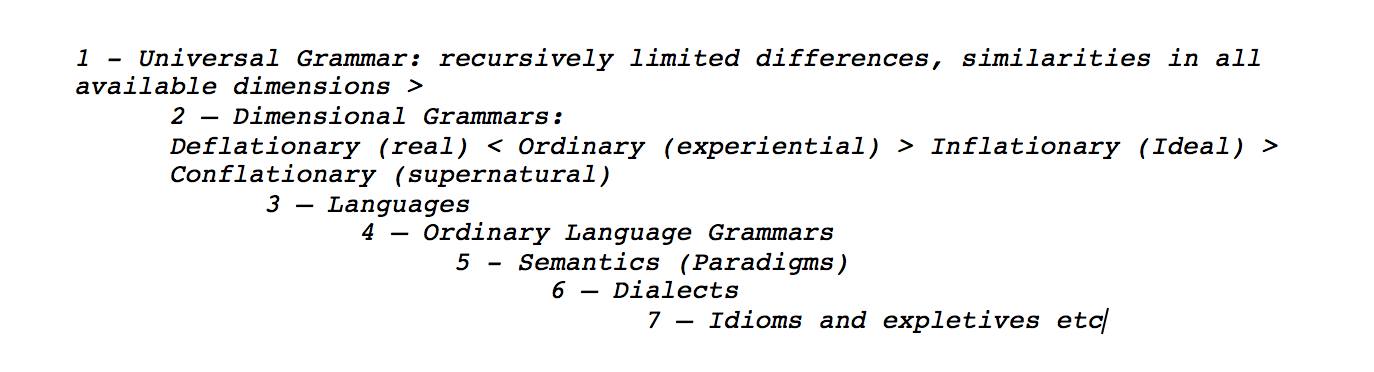
photos_and_videos/TimelinePhotos_43196237263/23333930_10155862946252264_3031696271668975324_o_10155862946252264.jpg Ok. I did it. Unfortunately, linguistics and logic use the term ‘mode’ rather than ‘dimension’ – the term that is used in all other fields. So correcting that term, and completing the hierarchy, we see this organization. And now we get to ‘wow’ people with the meaning of universal grammar and its relation to the physical, experiential, and imaginary dimensions of our reality.
I have almost completed the data structure for language but I am not sure that this is a good investment of my time – since all I want to demonstrate is that all grammatical dimensions in all disciplines use different terms but mirror reality.
From that point I can more easily demonstrate that operational grammar limits semantic and therefore dimensional content to the existential – and why.
I was originally struggling because I was not separating the semantic (set of paradigms) in any langauge, from the dimensional grammars that can be constructed regardless of language, using different deflationary and inflationary grammars of universal grammar.
Unfortunately we will have to wait for artificial intelligence to discover the metric we need for quantitative expression of these relations. Either that or some scientist will stumble on it by puzzling it enough. So just as we compare IQ to the center of the white distribution, we will compare the x-factor of universal grammar as a relationship between a 100IQ and our first general intelligence.Bill JoslinI suspected measurement and commensurability were going to be key.
I’m now convinced that the universe is relational.
Time – relation between changes in the state of affairs of the universe
Space – positional relations of mass/matter
Matter – constant relations of forces (persistent roperty of a relation) in proximity
Phenomena – relations which occured constantly within set limits
Operational language – centers language on relations, and measures of relations opposed to identity.
Identity – boundaries (limits) where constant relations occur
Math – nearly perfect relational language (models based on analogy of quantity and relationships of quantity.
Blah blah blah
A relational paradigm may provide commensurability between languages ( a meta measure of language and linguistic models) and a spectra from languages which afford the most explicit measure (accounting) of relations to the most obscure accounting for relations.Nov 07, 2017 11:12amCurt DoolittleyepNov 07, 2017 11:19amCurt Doolittle;)Nov 07, 2017 11:19amCurt Doolittlewhen I built the grammar-table it kind of freaked me out for a bit. Sort of de-humanizing in a way…..Nov 07, 2017 11:20amBill JoslinSpoken language couples to persception. Persception is a piss poor measure of relations (unless at personal human scale). Math couples to measure and is nearly perfect relational model but doesn’t couple to persception very well. Analogies and metaphors take a piss-poor measure (persception) and try to high light a relation, but in doing so further obscures measurement – it fakes commensurability.
Then relying on coherence theories of truth (does the assertion cohere to experience) proclaims authority on universal truths – when it has actually taken steps away from measure and commensurability.Nov 07, 2017 11:28amTimo RohnerJust don’t follow Leibniz and his relationalism too long lest you don’t mind ending up with idealism. That’s where Leibniz arrived at some point.Nov 07, 2017 12:28pmBryan Nova Brey@[1255416290:2048:Blake Southwood] is a programmer tennis coach friend of mine with a pretty high IQ who will be blown away by this. He was working on a “plain language” programming language years ago. Looks like you cracked the code!
Congrats dude.
Atlas level effort!Nov 08, 2017 1:36amBlake SouthwoodIt’s a fun problem. It’s masking conplexity with simplicity with managed order. Semantics is taste and upbringing and is tainted by the first programming language someone is exposed too.
Machine learning and expert systems using fuzzy logic with accumulating human knowledge, wisdom, information will prevail. It’s a Holy Grail problem that is a quest difficult to manage and represent in one dimension. For i sight read Chomsky Linguistics and Dijkstra’s Turing speech. Everything is mathematical and there is order in chaotic systems. Chaos theory is everywhere. Watson at IBM is fluent in 12 human languages now including all the hard ones. Hal is the wrong direction. An interface between man and code that is more palatable will be the bridge.
The universe is unfathomable and incomprehensibly deep and vast.
My question is where does the universe reside within and how does the gravity fabric of time and space have structure in a vaccume? As a friend of my brother told me that works at Space X the problem wuth languages is ambiguity and assumptions which is why the boolean logic level and sparce language keyword size and the syntax is cryptic due to tradition (and the mathematical evolution of coding) and to make compilers simpler to write. These were all constraints that were inherited thru the slow evolution of cs. The language I am designing is Strawberry based on Don Knuth’s Literate programming at Stanford.Nov 08, 2017 2:21amCurt DoolittleThe universe is entirely fathomable, the only problem being the discovery of constant relations across limits of prior sets of constant relations.
I’m working on commensurability of speech in order to prevent various forms of fictionalism (deceit).
Mathematics, as a system of positional names, provides scale independence (constant relations regardless of scale), but it’s dependent on commensurability.
So the question is, how do we provide commensurability across paradigms where relations are not constant, and only intermediary phenomenon are constant.
Logics have tried to do this but they are somewhat lost having nothing but internal consistency as a measure, just as mathematics has only scale independence, and constant relations in n-dimensions.
Now, if we can develop the mathematics of operational symmetries ( what should emerge out of what today we call lie groups) then I think we have the kind of mathematics that we are looking for.
But operations are algorithmic just as mathematics is operational in construction. The difference is that it mathematics can only describe the consequence of operations
In other words, we have to have something to measure, and something commensurable to compare it to.Nov 08, 2017 12:28pmOk. I did it. Unfortunately, linguistics and logic use the term ‘mode’ rather than ‘dimension’ – the term that is used in all other fields. So correcting that term, and completing the hierarchy, we see this organization. And now we get to ‘wow’ people with the meaning of universal grammar and its relation to the physical, experiential, and imaginary dimensions of our reality.
I have almost completed the data structure for language but I am not sure that this is a good investment of my time – since all I want to demonstrate is that all grammatical dimensions in all disciplines use different terms but mirror reality.
From that point I can more easily demonstrate that operational grammar limits semantic and therefore dimensional content to the existential – and why.
I was originally struggling because I was not separating the semantic (set of paradigms) in any langauge, from the dimensional grammars that can be constructed regardless of language, using different deflationary and inflationary grammars of universal grammar.
Unfortunately we will have to wait for artificial intelligence to discover the metric we need for quantitative expression of these relations. Either that or some scientist will stumble on it by puzzling it enough. So just as we compare IQ to the center of the white distribution, we will compare the x-factor of universal grammar as a relationship between a 100IQ and our first general intelligence.
Source date (UTC): 2017-11-07 10:38:00 UTC
Leave a Reply