JAE: Ergo: Mises combined Weber, Simmel, and someone (?)from the analytic movement, and failed in Economics as did Russel et all in logic, Brouwer in Math, Bridgman in Physics, and less so Popper in Philosophy of Science, by claiming a constructivist logic could produce closure.
JAE:So given we have learned that (a) there is no truth value in induction (b) no closure (c) all general rules of arbitrary precision remain arbitrary unless tautological (d) all logic is falsificationary (e)then the apriori are only hypothetical (f) and proofs falsificationary.
JAE:So given we have learned that (a) there is no truth value in induction (b) no closure (c) all general rules of arbitrary precision remain arbitrary unless tautological (d) all logic is falsificationary (e)then the apriori are only hypothetical (f) and proofs falsificationary.
Jewish Austrian Econs (JAE): (an apriori) Is money neutral? Well, not quite. It turns out there is a lot of lossiness in inflationary money that ends up in unpredictable parts of the economy.
Jewish Austrian Econs (JAE): (an apriori) Is the stickiness of prices deducible apriori, or was that discovery empirical? It was an empirical discovery.
Jewish Austrian Econs: (an apriori) Does raising the minimum wage increase unemployment? Empirical evidence says no. Instead it lowers rotation through low-wage jobs, preventing people from climbing the hierarchy of the workforce, and generates demand for redistribution (France).
9) Abrahamism: Consists of undermining truth reason probability and evidence by use of False Promise, Baiting into Hazard, Pilpul (positive), Critique (negative), straw-manning, and heaping of undue praise, and propagation into social construction, to use suggestion and overloading to force individuals, groups, and polities, to appeal to your intuition rather than reason and evidence. it’s the same technique used by faith healers, priests, and con artists. And the higher a group’s trust the more susceptible they are to it.
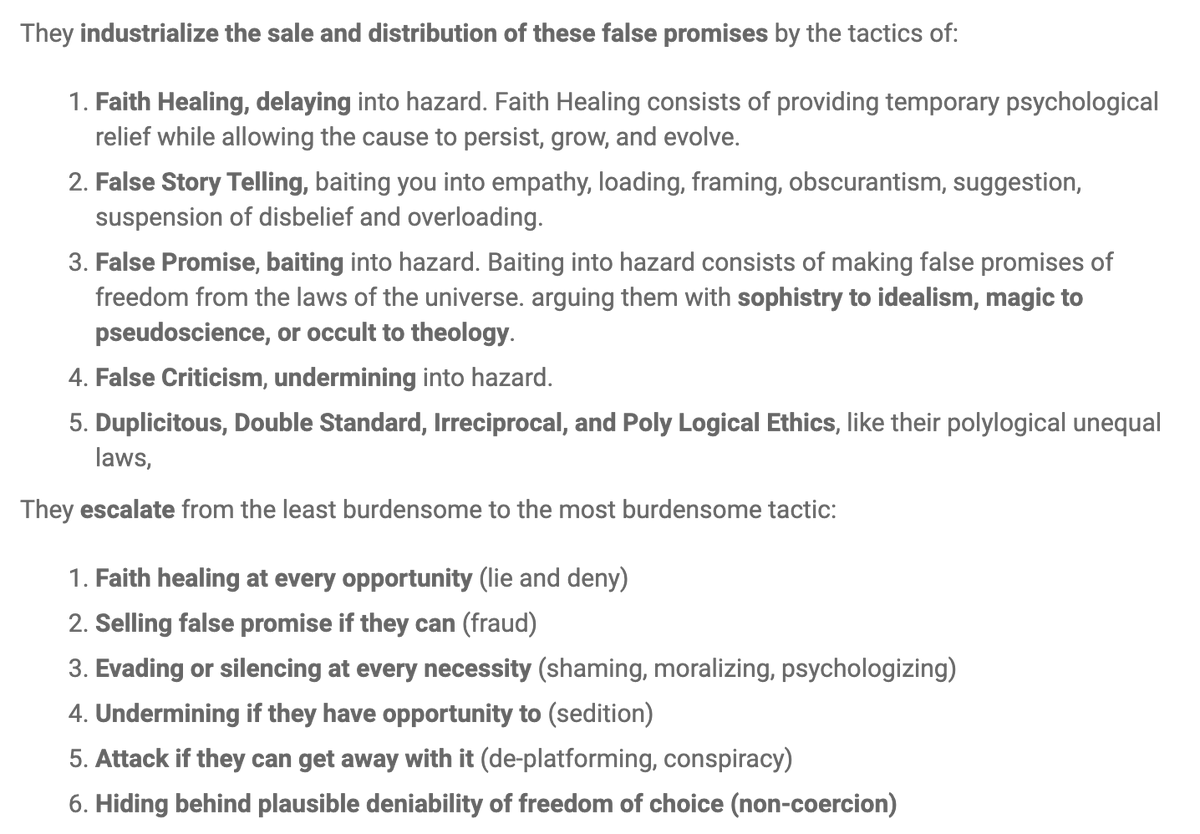
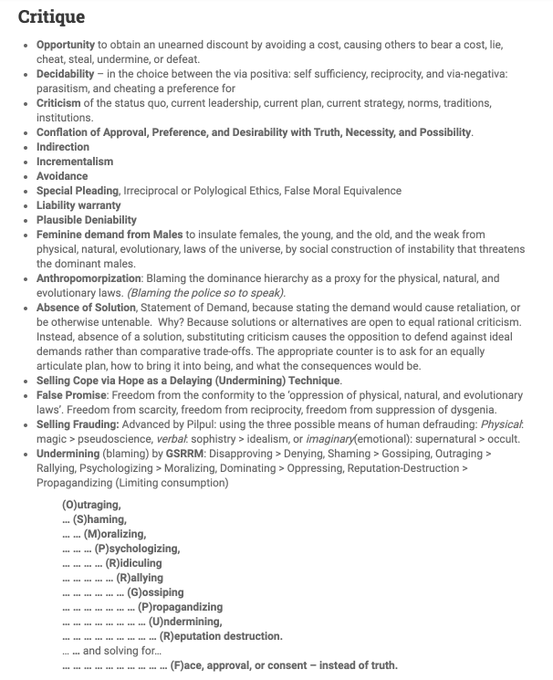
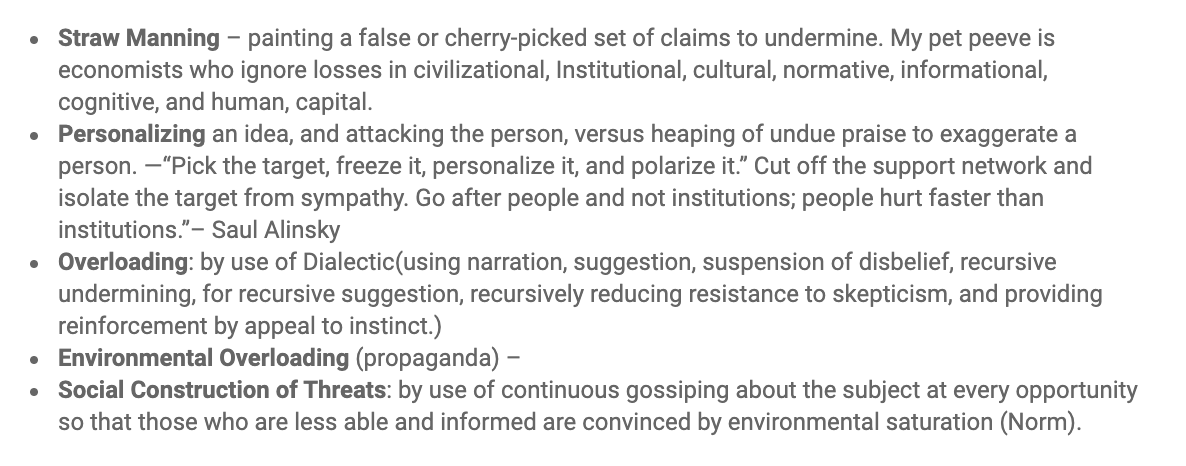
TERMS: Grammar, Logic, Justification, Sophistry, Pilpul, Critique, Abrahamism 1) Grammar: (a) rules of “continuous recursive disambiguation” creating a contract for meaning, and consisting of: A Paradigm, consisting of: First Principles, Logic, Vocabulary, Syntax. (b) Grammars can be DeflationaryInflationary, where deflationary consists of math, logic, accounting, procedures, etc, and inflationary consist of stories, fictions, fictionalisms, deceits, and denials etc. (c) Operational grammar: operational grammar consists of complete sentences in promissory form, consisting of a sequence of subjectively testable operations producing complete transactions of changes in state. ie: ‘unambiguous measurements’. 2) Logic: the test of constant relations between properties reducible to analogy to experience, internally as identity, externally between premises and statements, or externally between statements. (a) all statements must consist of continuously recursive disambiguation (b) there is no closure other than tautology, (c) all non-tautological tests are falsificationary. (d) falsification requires tests: internal, external, operational, rational, reciprocal, completeness. 3) Truth: (a)Truth consists of a claim of innocence, by testimony sufficient for the satisfaction of demand for infallibility in the context. https://propertarianinstitute.com/2020/04/24/truth-testimony-that-satisfies-demand-for-infallibility/ (b) Hierarchy of Decidability: Statements are undecidable, possibly true, or certainly false. All logic is Ternary. (c) A proof provides a test of possibility: a justification. Truth must survive falsification. 4) Justification: either (a) a moral explanation for a claim of innocence (b) a false pretense that a proof is other than a possibility (c) and an evasion of the cost of falsification. (d) a fraud constructed by the pretense of due diligency by paying the cost of falsification. 5) Sophistry: (a) General: any use of loading, framing, suggestion, obscuring, conflating, inflating, fictionalism, or denial, to claim consistency in identity, internality, externality, operationality, rationality, reciprocity, or completeness that does not exist. (b) More specifically, the use of the three means of fictionalism: Physical: Magic to Pseudoscience, Verbal: Sophistry to idealism (philosophy), Imaginary: Occult to Supernaturalism (theology), to convey a pretense of causality or knowledge that cannot be testified to. 7) Pilpul: (attached) “The Positive Sell” Sophistry that implies a false promise of freedom from formal, physical, natural, or evolutionary laws by use of the following methods: (first image) 8) Critique: (attached) “The Negative Sell” (second and third images) (9) MORE IN COMMENTS….
1) Grammar: (a) rules of “continuous recursive disambiguation” creating a contract for meaning, and consisting of: A Paradigm, consisting of: First Principles, Logic, Vocabulary, Syntax.
(b) Grammars can be DeflationaryInflationary, where deflationary consists of math, logic, accounting, procedures, etc, and inflationary consist of stories, fictions, fictionalisms, deceits, and denials etc.
(c) Operational grammar: operational grammar consists of complete sentences in promissory form, consisting of a sequence of subjectively testable operations producing complete transactions of changes in state. ie: ‘unambiguous measurements’.
2) Logic: the test of constant relations between properties reducible to analogy to experience, internally as identity, externally between premises and statements, or externally between statements.
(a) all statements must consist of continuously recursive disambiguation (b) there is no closure other than tautology, (c) all non-tautological tests are falsificationary. (d) falsification requires tests: internal, external, operational, rational, reciprocal, completeness.
(b) Hierarchy of Decidability: Statements are undecidable, possibly true, or certainly false. All logic is Ternary.
(c) A proof provides a test of possibility: a justification. Truth must survive falsification.
4) Justification: either (a) a moral explanation for a claim of innocence (b) a false pretense that a proof is other than a possibility (c) and an evasion of the cost of falsification. (d) a fraud constructed by the pretense of due diligency by paying the cost of falsification.
5) Sophistry: (a) General: any use of loading, framing, suggestion, obscuring, conflating, inflating, fictionalism, or denial, to claim consistency in identity, internality, externality, operationality, rationality, reciprocity, or completeness that does not exist.
(b) More specifically, the use of the three means of fictionalism: Physical: Magic to Pseudoscience, Verbal: Sophistry to idealism (philosophy), Imaginary: Occult to Supernaturalism (theology), to convey a pretense of causality or knowledge that cannot be testified to.
7) Pilpul: (attached) “The Positive Sell” Sophistry that implies a false promise of freedom from formal, physical, natural, or evolutionary laws by use of the following methods: (first image)
8) Critique: (attached) “The Negative Sell” (second and third images)
IOW, it sounds like English but it’s much closer to programming or mathematics. And it allows falsification of any truth claims in and across all disciplines. It’s not ideology, or philosophy. It’s a constructivist logic of falsification.Libertarians think: “praxology completed.”
@Dage90 @BobMurphyEcon @Bohm_Baller @billyj41 “The paradigm, first principles, logic, vocabulary, and grammar of P-Law produce a universally commensurable system of measurement across all disciplines at the cost of unambiguous terms, operational language, complete transactional sentences, equilibrating changes in state.”
“The paradigm, first principles, logic, vocabulary, and grammar of P-Law produce a universally commensurable system of measurement across all disciplines at the cost of unambiguous terms, operational language, complete transactional sentences, equilibrating changes in state.”
5) Sophistry (a) General: any use of loading, framing, suggestion, obscuring, conflating, inflating, fictionalism, or denial, to claim consistency in identity, internality, externality, operationality, rationality, reciprocity, or completeness that does not exist.
4) Justification:either (a) a moral explanation for a claim of innocence (b) a false prtense that a proof is other than a possiblitity (c) and an evasion of the cost of falsification. (d) a fraud constructed by pretense of due diligency by paying the cost of falsification.
4) Justification:either (a) a moral explanation for a claim of innocence (b) a false prtense that a proof is other than a possiblitity (c) and an evasion of the cost of falsification. (d) a fraud constructed by pretense of due diligency by paying the cost of falsification.
3) Truth: (a)Truth consists of a claim of innocence, by testimony sufficient for satisfaction of demand for infallibility in the context.
https://propertarianinstitute.com/2020/04/24/truth-testimony-that-satisfies-demand-for-infallibility/
(b) Hierarchy of Decidability: Statements are undecidable, possibly true, or certainly false. All logic is Ternary.