DOSTOYEVSKY > NIETZSCHE > SCIENCE
Peterson says it better. I’ve been saying this for years but nowhere near as elegantly: Dostoyevsky provided the novel, Nietzsche the Rationalism. And all of in the 20th and now 21st century are trying to produce the Science. And we are trying to do it faster than the Abrahamists can destroy our civilization again.
Theme: Science
-
DOSTOYEVSKY > NIETZSCHE > SCIENCE Peterson says it better. I’ve been saying this
DOSTOYEVSKY > NIETZSCHE > SCIENCE
Peterson says it better. I’ve been saying this for years but nowhere near as elegantly: Dostoyevsky provided the novel, Nietzsche the Rationalism. And all of in the 20th and now 21st century are trying to produce the Science. And we are trying to do it faster than the Abrahamists can destroy our civilization again.
Source date (UTC): 2018-02-05 15:24:00 UTC
-
Animals, Sentience, Consciousness, Reason, And The Illusion Thereof.
Animals don’t reason other than it is clear that the very smartest can in fact do so (Corvids) and many predators. And the demarcation between sentience and consciousness is the mirror test. And some animals can pass it – even possibly pigeons. Many animals dream so they must ‘think’ at whatever level it is that they dream. But when we say ‘think’ we can mean ‘feel your way thru something’, visualize your way thru something, plan your way through something using tools, reason (talk) your way thru something, and explain to others how to act through something. To say animals are sentient is true, to say they are conscious – well there are some that appear to be. To say they are rational, it is not clear that all people are rational, or that we are fooled that they are rational because they are capable of language, and language creates the illusion of similarity. The more we learn the more the gradual progress from nervous system to sentience, to consciousness is just as continuous as the spectrum from feminine pschosis to feminine solipsism to normal balanced personality, to male aspieness, to male autism. -
ANIMALS, SENTIENCE, CONSCIOUSNESS, REASON, AND THE ILLUSION THEREOF. Animals don
ANIMALS, SENTIENCE, CONSCIOUSNESS, REASON, AND THE ILLUSION THEREOF.
Animals don’t reason other than it is clear that the very smartest can in fact do so (Corvids) and many predators. And the demarcation between sentience and consciousness is the mirror test. And some animals can pass it – even possibly pigeons.
Many animals dream so they must ‘think’ at whatever level it is that they dream.
But when we say ‘think’ we can mean ‘feel your way thru something’, visualize your way thru something, plan your way through something using tools, reason (talk) your way thru something, and explain to others how to act through something.
To say animals are sentient is true, to say they are conscious –
well there are some that appear to be.
To say they are rational, it is not clear that all people are rational, or that we are fooled that they are rational because they are capable of language, and language creates the illusion of similarity.
The more we learn the more the gradual progress from nervous system to sentience, to consciousness is just as continuous as the spectrum from feminine pschosis to feminine solipsism to normal balanced personality, to male aspieness, to male autism.
Source date (UTC): 2018-02-04 17:50:00 UTC
-
Animals, Sentience, Consciousness, Reason, And The Illusion Thereof.
Animals don’t reason other than it is clear that the very smartest can in fact do so (Corvids) and many predators. And the demarcation between sentience and consciousness is the mirror test. And some animals can pass it – even possibly pigeons. Many animals dream so they must ‘think’ at whatever level it is that they dream. But when we say ‘think’ we can mean ‘feel your way thru something’, visualize your way thru something, plan your way through something using tools, reason (talk) your way thru something, and explain to others how to act through something. To say animals are sentient is true, to say they are conscious – well there are some that appear to be. To say they are rational, it is not clear that all people are rational, or that we are fooled that they are rational because they are capable of language, and language creates the illusion of similarity. The more we learn the more the gradual progress from nervous system to sentience, to consciousness is just as continuous as the spectrum from feminine pschosis to feminine solipsism to normal balanced personality, to male aspieness, to male autism. -
Origins Of Philosophy
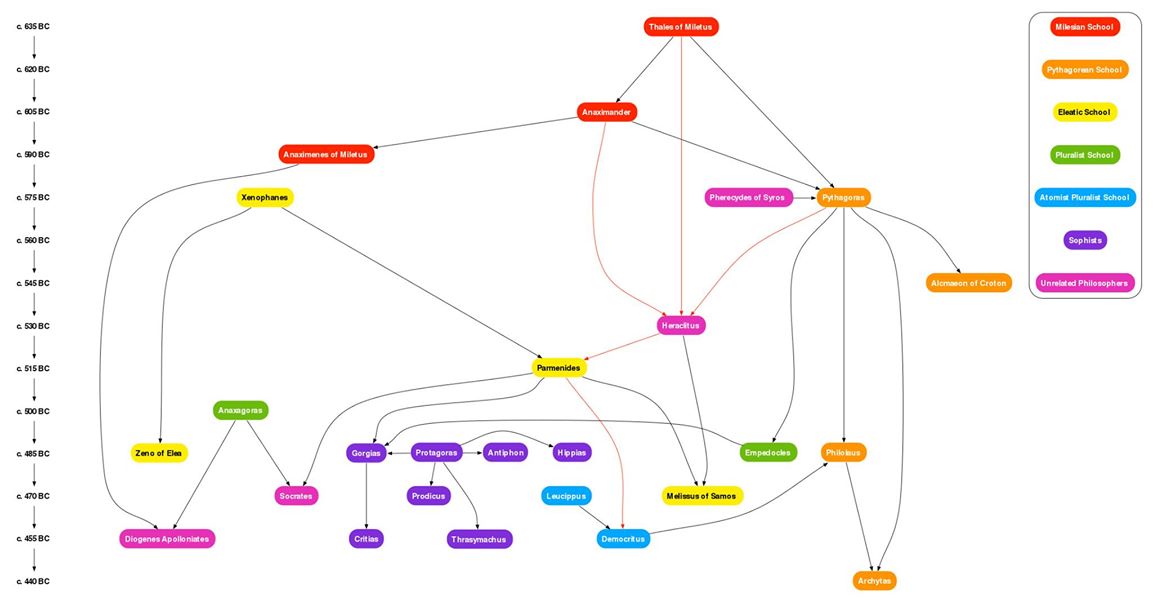
ORIGINS OF PHILOSOPHY IN COMPETITION BETWEEN NATURALISTS, THEOLOGIANS(Pseudoscience), AND MYTHICISTS(PseudoHistorians) The Presocratic philosophers were called physiologoi (Greek: φυσιολόγοι; in English, physical or natural philosophers). Aristotle was the first to make a clear distinction between these physiologoi or physikoi (“physicists”, after physis, “nature”) who sought natural explanations for phenomena, and the earlier theologoi (theologians), or mythologoi (story tellers and bards) who attributed these phenomena to various gods. Diogenes Laërtius divides the physiologoi into two groups: Ionian, led by Anaximander, and the Italiote, led by Pythagoras. IT BEGINS IN 635 BC But they begin in 635BC with Thales, who was a greek citizen, but may or may not have been a descendent of the Phoenicians, who may or may not have originated on the Red sea, which may or may not refer to the civilization that developed on the trade route between africa and yemen in that region south of what is today ethiopia, but continues across the south of the arabian peninsula, and to the trade routes with India. It is this trade route as much as the mediterranean that accounted for much of the wealth of the levant. Engineering and construction, and Commercial transactions encourage the development of contract, reason and calculation – because of risk, investment, and liability. So Thales evolved his thought Just as there is a competition today between literary and theological authors, and scientists, and commercialists. The law has no competitor except religion. And its possibly important to note that it was the borderland peoples who invented reason, not the urbanites in Athens. Why? Density encourages civic deceit. Objective analysis of civic deceit produces reason. Thales bought all the olive presses in Miletus after predicting the weather and a good harvest for a particular year. Another version of the story has Aristotle explain that Thales had reserved presses in advance, at a discount, and could rent them out at a high price when demand peaked, following his prediction of a particularly good harvest. Aristotle explains that Thales’ objective in doing this was not to enrich himself but to prove to his fellow Milesians that philosophy could be useful, contrary to what they thought, or alternatively, Thales had made his foray into enterprise because of a personal challenge put to him by an individual who had asked why, if Thales was an intelligent famous philosopher, he had yet to attain wealth. This first version of the story would constitute the first historically known creation and use of futures, whereas the second version would be the first historically known of creation and use of options. But his theoretical insights are from geometry. |CAUSALITY| Commerce(Finance) > Engineering > Geometry > Science. -
photos_and_videos/TimelinePhotos_dJ9jhts2Ng/27503394_187184071878491_23571431584
photos_and_videos/TimelinePhotos_dJ9jhts2Ng/27503394_187184071878491_2357143158474927727_o_187184071878491.jpg ORIGINS OF PHILOSOPHY IN COMPETITION BETWEEN NATURALISTS, THEOLOGIANS(Pseudoscience), AND MYTHICISTS(PseudoHistorians)
The Presocratic philosophers were called physiologoi (Greek: φυσιολόγοι; in English, physical or natural philosophers). Aristotle was the first to make a clear distinction between these physiologoi or physikoi (“physicists”, after physis, “nature”) who sought natural explanations for phenomena, and the earlier theologoi (theologians), or mythologoi (story tellers and bards) who attributed these phenomena to various gods.
Diogenes Laërtius divides the physiologoi into two groups: Ionian, led by Anaximander, and the Italiote, led by Pythagoras.
IT BEGINS IN 635 BC
But they begin in 635BC with Thales, who was a greek citizen, but may or may not have been a descendent of the Phoenicians, who may or may not have originated on the Red sea, which may or may not refer to the civilization that developed on the trade route between africa and yemen in that region south of what is today ethiopia, but continues across the south of the arabian peninsula, and to the trade routes with India. It is this trade route as much as the mediterranean that accounted for much of the wealth of the levant.
Engineering and construction, and Commercial transactions encourage the development of contract, reason and calculation – because of risk, investment, and liability.
So Thales evolved his thought Just as there is a competition today between literary and theological authors, and scientists, and commercialists. The law has no competitor except religion.
And its possibly important to note that it was the borderland peoples who invented reason, not the urbanites in Athens. Why? Density encourages civic deceit. Objective analysis of civic deceit produces reason.
Thales bought all the olive presses in Miletus after predicting the weather and a good harvest for a particular year. Another version of the story has Aristotle explain that Thales had reserved presses in advance, at a discount, and could rent them out at a high price when demand peaked, following his prediction of a particularly good harvest. Aristotle explains that Thales’ objective in doing this was not to enrich himself but to prove to his fellow Milesians that philosophy could be useful, contrary to what they thought, or alternatively, Thales had made his foray into enterprise because of a personal challenge put to him by an individual who had asked why, if Thales was an intelligent famous philosopher, he had yet to attain wealth. This first version of the story would constitute the first historically known creation and use of futures, whereas the second version would be the first historically known of creation and use of options.
But his theoretical insights are from geometry.
|CAUSALITY| Commerce(Finance) > Engineering > Geometry > Science.ORIGINS OF PHILOSOPHY IN COMPETITION BETWEEN NATURALISTS, THEOLOGIANS(Pseudoscience), AND MYTHICISTS(PseudoHistorians)
The Presocratic philosophers were called physiologoi (Greek: φυσιολόγοι; in English, physical or natural philosophers). Aristotle was the first to make a clear distinction between these physiologoi or physikoi (“physicists”, after physis, “nature”) who sought natural explanations for phenomena, and the earlier theologoi (theologians), or mythologoi (story tellers and bards) who attributed these phenomena to various gods.
Diogenes Laërtius divides the physiologoi into two groups: Ionian, led by Anaximander, and the Italiote, led by Pythagoras.
IT BEGINS IN 635 BC
But they begin in 635BC with Thales, who was a greek citizen, but may or may not have been a descendent of the Phoenicians, who may or may not have originated on the Red sea, which may or may not refer to the civilization that developed on the trade route between africa and yemen in that region south of what is today ethiopia, but continues across the south of the arabian peninsula, and to the trade routes with India. It is this trade route as much as the mediterranean that accounted for much of the wealth of the levant.
Engineering and construction, and Commercial transactions encourage the development of contract, reason and calculation – because of risk, investment, and liability.
So Thales evolved his thought Just as there is a competition today between literary and theological authors, and scientists, and commercialists. The law has no competitor except religion.
And its possibly important to note that it was the borderland peoples who invented reason, not the urbanites in Athens. Why? Density encourages civic deceit. Objective analysis of civic deceit produces reason.
Thales bought all the olive presses in Miletus after predicting the weather and a good harvest for a particular year. Another version of the story has Aristotle explain that Thales had reserved presses in advance, at a discount, and could rent them out at a high price when demand peaked, following his prediction of a particularly good harvest. Aristotle explains that Thales’ objective in doing this was not to enrich himself but to prove to his fellow Milesians that philosophy could be useful, contrary to what they thought, or alternatively, Thales had made his foray into enterprise because of a personal challenge put to him by an individual who had asked why, if Thales was an intelligent famous philosopher, he had yet to attain wealth. This first version of the story would constitute the first historically known creation and use of futures, whereas the second version would be the first historically known of creation and use of options.
But his theoretical insights are from geometry.
|CAUSALITY| Commerce(Finance) > Engineering > Geometry > Science.
Source date (UTC): 2018-02-03 13:36:00 UTC
-
Origins Of Philosophy
ORIGINS OF PHILOSOPHY IN COMPETITION BETWEEN NATURALISTS, THEOLOGIANS(Pseudoscience), AND MYTHICISTS(PseudoHistorians) The Presocratic philosophers were called physiologoi (Greek: φυσιολόγοι; in English, physical or natural philosophers). Aristotle was the first to make a clear distinction between these physiologoi or physikoi (“physicists”, after physis, “nature”) who sought natural explanations for phenomena, and the earlier theologoi (theologians), or mythologoi (story tellers and bards) who attributed these phenomena to various gods. Diogenes Laërtius divides the physiologoi into two groups: Ionian, led by Anaximander, and the Italiote, led by Pythagoras. IT BEGINS IN 635 BC But they begin in 635BC with Thales, who was a greek citizen, but may or may not have been a descendent of the Phoenicians, who may or may not have originated on the Red sea, which may or may not refer to the civilization that developed on the trade route between africa and yemen in that region south of what is today ethiopia, but continues across the south of the arabian peninsula, and to the trade routes with India. It is this trade route as much as the mediterranean that accounted for much of the wealth of the levant. Engineering and construction, and Commercial transactions encourage the development of contract, reason and calculation – because of risk, investment, and liability. So Thales evolved his thought Just as there is a competition today between literary and theological authors, and scientists, and commercialists. The law has no competitor except religion. And its possibly important to note that it was the borderland peoples who invented reason, not the urbanites in Athens. Why? Density encourages civic deceit. Objective analysis of civic deceit produces reason. Thales bought all the olive presses in Miletus after predicting the weather and a good harvest for a particular year. Another version of the story has Aristotle explain that Thales had reserved presses in advance, at a discount, and could rent them out at a high price when demand peaked, following his prediction of a particularly good harvest. Aristotle explains that Thales’ objective in doing this was not to enrich himself but to prove to his fellow Milesians that philosophy could be useful, contrary to what they thought, or alternatively, Thales had made his foray into enterprise because of a personal challenge put to him by an individual who had asked why, if Thales was an intelligent famous philosopher, he had yet to attain wealth. This first version of the story would constitute the first historically known creation and use of futures, whereas the second version would be the first historically known of creation and use of options. But his theoretical insights are from geometry. |CAUSALITY| Commerce(Finance) > Engineering > Geometry > Science. -
Aesthetics is a Science of Beauty. Moral Fictionalism Is Just Secular Religion f
Aesthetics is a Science of Beauty. Moral Fictionalism Is Just Secular Religion for the Weak.
By Bill Joslin
–“the ‘ m’uh aesthetic thus your philo sucks’ is a variation of the Nirvana Fallacy. we’ve hammered out the first main branches of philos (metaphysics, epistemology, rhetoric and three of the four subbranches (politics, ethics, law).
IMO the privileging of aesthetics is an age thing – a young man’s complaint. After a few years of running a crew, business, or family (engaging with real consequences which extend beyond the personal domain) rectifies such notions… the flavour of the wine remains secondary to its ability to sustain the body”—
Brilliant.
Source date (UTC): 2018-02-01 13:41:00 UTC
-
Aesthetics is a Science of Beauty. Moral Fictionalism Is Just Secular Religion f
Aesthetics is a Science of Beauty. Moral Fictionalism Is Just Secular Religion for the Weak. By Bill Joslin –“the ‘ m’uh aesthetic thus your philo sucks’ is a variation of the Nirvana Fallacy. we’ve hammered out the first main branches of philos (metaphysics, epistemology, rhetoric and three of the four subbranches (politics, ethics, law). IMO the privileging of aesthetics is an age thing – a young man’s complaint. After a few years of running a crew, business, or family (engaging with real consequences which extend beyond the personal domain) rectifies such notions… the flavour of the wine remains secondary to its ability to sustain the body”— Brilliant.