Theme: Science

  • “”Decolonize the curriculum is simply forced prohibition of cultural appropriati

    —“”Decolonize the curriculum is simply forced prohibition of cultural appropriation – take away the science. No phones, internet, semiconductors, universal polyphase power grid, no cars, elevators, escalators, forget the printing press.””— James Santagata


    Source date (UTC): 2019-03-04 15:17:40 UTC

    Original post: https://twitter.com/i/web/status/1102588928723427329

  • “”Decolonize the curriculum is simply forced prohibition of cultural appropriati

    —“”Decolonize the curriculum is simply forced prohibition of cultural appropriation – take away the science. No phones, internet, semiconductors, universal polyphase power grid, no cars, elevators, escalators, forget the printing press.””— James Santagata


    Source date (UTC): 2019-03-04 10:17:00 UTC

  • STOICISM, PROPERTARIANISM, ECONOMICS, HISTORY ARE THE BEST WE CAN DO. There will

    STOICISM, PROPERTARIANISM, ECONOMICS, HISTORY ARE THE BEST WE CAN DO.

    There will always be hyper conservatives, sophists, pseudoscientists, supernaturalists on the right.

    There will always be hedonists (hyper consumption), sophists, pseudoscientist and occultists on the left.

    The best we can do is provide education in mindfulness, propertarianism, history to reduce their numbers

    Stoicism => Self

    Propertarianism => Others

    Economics => Polities

    History => Mankind.

    #post


    Source date (UTC): 2019-03-03 12:26:00 UTC

  • NO MORE LIES —“@Curt Doolittle If I have an idea, a theory, yet don’t have the

    NO MORE LIES

    —“@Curt Doolittle If I have an idea, a theory, yet don’t have the evidence yet–it still might be true. The Higgs Boson comes to mind. It was an idea, a theory, there were no facts yet to prove it, it fit in with the standard model, itself a theory, and solved some problems in quantum mechanics, but it wasn’t until the particle was actually discovered by the LHC that we could call it true. So was it a lie before then? You can’t always exactly know what’s true. Some questions are unsettled. So we make assumptions to try things out. It’s not exactly faith but it’s like it. It requires that we temporarily believe in it to test it, to question it, to try and figure it out. All part of reasoning. Maybe you didn’t mean what you said to this depth, what you wrote seems to make perfect sense on the surface, but through a little questioning, seeking to drill down, to get to the essence and the fundamentals of things, it seemed to me to be a little imprecise. This is not to simply be disputatious, to be contrary, not to be mean or anything, your statement was a fine, stimulating, sentiment, but to honestly question.​”— Mark Wright

    We do not have faith or temporarily believe in anything. We seek only to discover by testing that which is testable. And we limit ourselves to that limit.

    1) such things are testable and falsifiable.

    2) such things preserve the parsimony of naturalism,

    3) such things are not counter to all of historical evidence, nor commensurate with the long history of ignorance error, fraud, and deceit

    4) such things serve as no premise for consequent inference likewise for fraud and deceit,

    5) such things are not dependent on verbal pretense or sophism,

    6) such things are not claimed true only speculative,

    7) such things have no malincentive to lie, or preserve a lie.

    8) Conversely what i argued against was the opposite of all those tests.

    It is not arrogance but intolerance for the continued use of lies against my people by those in conscious or unconscious league with the ancient enemy of not only my people but all of mankind.

    No more lies.

    #post


    Source date (UTC): 2019-03-02 19:21:00 UTC

  • “…a primate of our overall brain volume…” sigh. And doesn’t mention ratio. .

    “…a primate of our overall brain volume…” sigh. And doesn’t mention ratio. … Not only with his outside voice. Not only in writing. Not only in published writing. But in a journal. And the profession wonders why we ridicule its members regularly.


    Source date (UTC): 2019-03-01 13:19:31 UTC

    Original post: https://twitter.com/i/web/status/1101472031378456577

    Reply addressees: @DegenRolf

    Replying to: https://twitter.com/i/web/status/1101109227827982337


    IN REPLY TO:

    @DegenRolf

    Humans pride themselves too much on their purportedly extra large cortex, which really isn’t such a big thing, psychologist complains. https://t.co/r6UEP0Cob3 https://t.co/TFC2OcERxt

    Original post: https://twitter.com/i/web/status/1101109227827982337

  • YES PSYCHOLOGY IS PLAGUED BY PSEUDOSCIENCE AND YES THE REPLICATION CRISIS DESTRO

    YES PSYCHOLOGY IS PLAGUED BY PSEUDOSCIENCE AND YES THE REPLICATION CRISIS DESTROYED ITS CREDIBILITY


    —“Paper finds evidence that the reproducibility crisis may already have damaged the trust in psychological science and the perception of its value among lay people beyond repair. https://osf.io/4ukq5 “— Rolf Degen

    It has in both Psych. and Soc. Cog-Sci Won. Better model is neural networks, neural economy, the Homunculus, hemispheric competition (predatory prey), gender differences, reward systems, division of labor, and that all human behavior is expressible as acquisition using economics.

    In other words, if you can’t explain human behavior in economic language you’re projecting judgements (biases) to conformity on what is a division of perception, cognition, memory, advocacy, and labor.


    Source date (UTC): 2019-03-01 08:35:00 UTC

  • photos_and_videos/TimelinePhotos_SxeO6JU-xg/52896753_10157019016252264_254172488

    photos_and_videos/TimelinePhotos_SxeO6JU-xg/52896753_10157019016252264_254172488

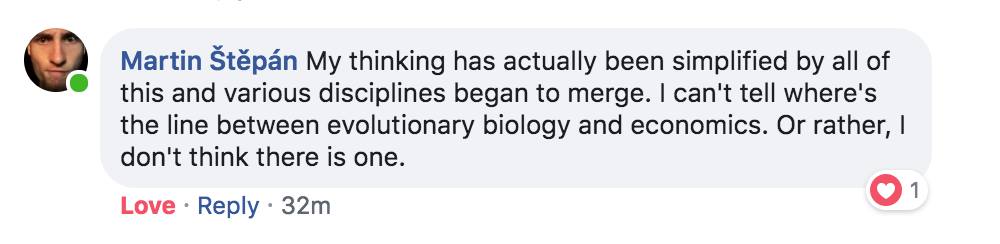
    photos_and_videos/TimelinePhotos_SxeO6JU-xg/52896753_10157019016252264_254172488085274624_o_10157019016237264.jpg See?Jarrod MarmaBut Martin said biological testing on subgroups is immoral. SAD!Feb 28, 2019, 7:03 PMPattern Principle’Eco-‘ the prefix of both ecology and economics is not by mistake. Economy is ecology, as ecology is economy. The etymological definition of eco is ‘house’ – so Propertarians are merely getting our house in order, so to speak.Feb 28, 2019, 7:04 PMOliver CrokeFrank Sandberg wrote a paper on this.Feb 28, 2019, 8:37 PMCurt Doolittleon what?Feb 28, 2019, 8:47 PMOliver CrokeHe wrote about the principle of innate self healing/organisation of human bodies and explained the nature of the principle with reference to Austrian economics if I remember it correctly (was a few years ago).Feb 28, 2019, 8:50 PMMartin ŠtěpánJarrod Marma I don’t make moral statements. I’ve said you wouldn’t get away with it because controlled breeding and keeping for scientific purposes is something that is not looked kindly upon when done to humans.Mar 1, 2019, 12:59 AMMartin ŠtěpánReplication, variation, markets (competition, selection, transaction) and evolution in everything.Mar 1, 2019, 4:24 AMDan WarrenAre we cleaning our rooms?Mar 1, 2019, 6:59 AMMoritz BierlingCleaning every room (discipline) until the entire house (system of systems) is in order.Mar 1, 2019, 9:00 AMJarrod MarmaWhat does that mean entirely? CRISPR experiments seem to be popping up regularly in the news. The entire reason we have cold weather training information is due to human experimentation. I’m sure surgical experience originated similarly from vivisections. “Not looked kindly upon” is a vague platitude.Mar 1, 2019, 9:23 AMSee?


    Source date (UTC): 2019-02-28 18:46:00 UTC

  • The Hierarchy of The Laws (core)

    THE HIERARCHY OF THE LAWS (Core) VIA NEGATIVA 1. Laws of Nature (Measurement) … Physics … Chemistry … Biology … Ecology … Economics (Cooperation) … Logics … Sentience (thought, reason)

    1. Laws of Action
      … Engineering (?Where?)
      … … ( … ) Applied
    2. Laws of Thought ( Logics )
      … ( … )
      … Neural Economy
    3. Laws of Speech (Grammars)
      … … Logic
      … … Mathematics
      … … … Positional Naming
      … … … Counting
      … … … Arithmetic
      … … … … Accounting
      … … … Geometry
      … … … Calculus
      … … … Statistics
      … … Algorithm
      … … Recipe, Protocol
      … … Testimony
      … … Description
      … … Narration
      … … Fiction
      … … Fictionalisms
      … … … Sophistry, Idealism, Surrealism.
      … … … Spiritual, Occult, Supernatural
      … … … Magical, Supernormal, Pseudo scientific
      … … Deceits
    4. Natural Law (Cooperation)
      … Juridical Law ( Conflict Resolution)
      … … Law of Property (Conflict Avoidance)
      … … Law of Tort (Conflict over Harms)
      … … Law of Contract (Conflict over Trades)
      … Normative Law (…)
      … … Manners, Ethics, Morals,
      … … Strategy (Traditions, Rituals, Myths, Histories)
      … … Institutions formal and informal.
      … Legislation (Commons Production)
      … … Regulation (Prior Restraints)
      … Command ( Deciding the Undecidable )
      … Treaty ( Between insurers of last resort )
      … War ( Beyond the Limits of Cooperation )

    WHAT ‘LAW’ MEANS That’s what Laws of Nature(unconscious, deterministic) and Natural Law (conscious, volitionary) mean: they are DESCRIPTIVE. You cannot violate the laws of nature but you can manipulate them. You can violate the natural laws, and pay the consequences. The natural world already calculates its optimum, and we ‘cheat’ it. The natural law is something else men cheat. However, the optimum method of human evolution is the elimination of cheating (parasitism). If you eliminate all parasitism you end up with natural law. If you do not then you don’t. That’s what “Law” means “Decidable” in scientific language, and which means “Absolute” in archaic moral language. We have ‘appropriated’ the term ‘law’ in science, and reframed the original meaning of law as the series Findings of Common Law (Court), Command(Ruler), Legislation(Government), Regulation(Bureaucracy). The Continental system of law is different in this hierarchy since the continent uses Roman and Napoleonic law, and the state is separate from the people, whereas in Anglo (Scandinavian) Civilization, the Rulers are just current members of the people. This subtle difference is profound in consequence between the continental and intercontinental (anglo) civilizations.


    COMMON LAW AND TORT LAW AND HOW THEY ARE RELATED. I’m talking about the common law in the old sense as ‘the traditional law’ which consists of sovereignty and tort. In both UK and USA ‘common law’ often includes legislation that violates sovereignty and tort. In my work I make a clear distinction between the one law (reciprocity) common law (findings of the court), legislative law (improving or undermining the common law and the one law) and regulation (enforcement of legislative law whether it improves or undermines the common law and the one law) I refer to tort when I want to remind people that legislation and regulation do not necessarily (and often do not) preserve our natural, customary, traditional, rule of law by findings of law. The legislature’s original purpose was to choose whether the monarchy’s demand for the population to bear costs was acceptable to the regions,the warriors, the militia, and sometimes out of pragmatism) to the people. The ‘enlightenment’ took the power of commons choice out of the hands of the monarchy and put it into the republic (elected representatives, and the peerage (local governors)). The marxist and social democratic movement reversed our civilization by expanding the commons such that they violated our underlying natural law of reciprocity, in favor of the rest of humanity’s underclass demand for proportionality, and upon receiving proportionality, the political and underclass demand for equality of outcome. So, great question.


    WHAT DOES NATURAL LAW MEAN? (with updates by Doolittle) Natural LawNatural Law – What is Law? Natural Law is a broad and often misapplied term tossed around various schools of philosophy, science, history, theology, and law. Indeed, Immanuel Kant reminded us, ‘What is law?’ may be said to be about as embarrassing to the jurist as the well-know question “What is Truth?” is to the logician. Law, in its generic sense, is a body of rules of action or conduct prescribed by controlling authority, and having binding legal force. That which must be obeyed and followed by citizens subject to sanctions or legal consequences is a law (Black’s Law Dictionary, Sixth Edition, p. 884). Jurisprudence is the philosophy of law and how the law developed. Natural Law – A Moral Theory of Jurisprudence Natural Law is a moral theory of jurisprudence, which maintains that law should be based on morality and ethics. Natural Law holds that the law is based on what’s “correct.” Natural Law is “discovered” by humans through the use of reason and choosing between good and evil. Therefore, Natural Law finds its power in discovering certain universal standards in morality and ethics.Natural Law – The HistoryThe Greeks — Socrates, Plato, and Aristotle emphasized the distinction between “nature” (physics) and “law,” “custom,” or “convention” (nomos). What the law commanded varied from place to place, but what was “by nature” should be the same everywhere. Aristotle (BC 322) is considered by many to be the father of natural law. In Rhetoric, he argues that aside from particularlaws that each people has set up for itself, there is a common lawor higher lawthat is according to nature (Rhetoric 1373b2). The Stoics — The development of natural law theory continued in the Hellenistic school of philosophy, particularly with the Stoics. The Stoics pointed to the existence of a rational and purposeful order to the universe. The means by which a rational being lived in accordance with this cosmic order was considered natural law. Unlike Aristotle’s “higher law,” Stoic natural law was indifferent to the divine or natural source of that law. Stoic philosophy was very influential with Roman jurists such as Cicero, thus playing a significant role in the development of Roman legal theory. The Christians — Augustine (AD 354—430) equates natural law with man’s Pre-Fall state. Therefore, life according to nature is no longer possible and mankind must instead seek salvation through the divine law and Christ’s grace. Gratian (12th century) reconnected the concept of natural law and divine law. “The Human Race is ruled by two things: namely, natural law and usages (mos, moris, mores). Natural law is what is contained in the law and the Gospel. By it, each person is commanded to do to others what he wants done to himself and is prohibited from inflicting on others what he does not want done to himself.” (Decretum, D.1 d.a.c.1; ca. 1140 AD) — ADDED BY DOOLITTLE—- The Enlightenment Thinkers (AD 1600 – 2016) (Bacon/English, Locke/British, Jefferson/Anglo-German, Hayek/Austrian, Rothbard/Jewish, Hoppe/German, Doolittle/American. The attempt to mature Stoic, Roman, Germanic, and British empirical law into a formal logic wherein all rights are reduced to property rights, law is strictly constructed from the prohibition on the imposition of costs that would cause retaliation and increase the costs, risk, and likelihood of cooperation, that creates prosperity in a division of perception, cognition, knowledge, labor, and advocacy. In other words, natural law, evolved from empirical common law, as the formal category(property), logic (construction), empiricism(from observation), and science (continuous improvement) of human cooperation. In this view, ethics, morality, economics, law, politics constitute the science of cooperation: social science. Everything else is justification, advocacy, literature, and propaganda. — ADDED BY DOOLITTLE—- Natural Law – The Conclusion In the end, where does law come from? The Theory of Natural Law maintains that certain moral laws transcend time, culture, and government. There are universal standards that apply to all mankind throughout all time. These universal moral standards are inherent in and discoverable by all of us, and form the basis of a just society.


    THE PROBLEM WITH THE US LAW (THE LEFT’S ATTACK)FAILINGS OF THE CONSTITUTION’S AUTHORS 1) The founders (Principally, Adams) understood natural law, and understood Locke, and understood the development of Contractualism of the Anglo Saxons (North Sea Civilization), in which all men are sovereign, and that all cooperation under any crown was limited to sovereign contract. They had fought civil wars over it. But they lacked the knowledge with which to require decidability in the law. It wasn’t until the last decade of the 19th and the first half of the twentieth century that we developed an understanding of the limits of language in philosophy and logic, and developed Operational Language in the Physical Sciences. It has taken us until the late twentieth century (for reasons I won’t go into here) to develop Operational Grammar, Functional authoring of Contracts (Legislation, Regulation, and Findings of the Law), and the requirement for strict construction of the law from the first principle of Reciprocity (Natural Law), the codifications of the tests of Reciprocity (Property in person, family, private, and common forms), and finally the measurement of changes in capital produced by advances in our ability to enact policy in Monetary, Fiscal, Trade, Institutional, Cultural – and now genetic – forms. 2) While the provision by which to modify the constitution was put in place, it has been aggressively circumvented such that the 14th amendment has eradicated the 9th and 10th. But while modification of the constitution was encoded (even if ignored) the legislatures were not bound in the Constitution to pay the consequences of the poor quality of their legislation, by a limit on the time to revise legislation that was returned to them by the Court before it was nullified as undecidable by the court, or the court reverted to natural law as a means of deciding a conflict despite nullifying the legislation. 3) Requirement for Positive Intent of the law (Scope). While the constitution states intentions (Scope) in the form of ‘whereas…(intent)’, followed by prohibition. THE ATTACK ON THE CONSTITUTION AND NATURAL LAW OF RECIPROCITY BY THE LEFT The Function of the court of Natural Law is not to interpret the law, but to apply the law to cases before it, and determine if the case is decidable or not. And if it is not decidable is it not so because the parties are not believable, the evidence is insufficient, the terms of the private contract are insufficient, or the legislation and regulation are insufficient, or the constitution is insufficient. 1) The destruction of the constitution during and after the civil war, which, as a means of preventing the extension of slavery to the western territories, and therefore the domination of the continent by the South and its agrarian allies, and the containment of the northeast – a conflcit which still separates our peoples today. Not over slavery but over dominance by the few urban immigrant centers over the suburban, rural, and agrarian peoples. It may have been correct to go to war and kill 500,000 people over slavery, and even to turn the south into a possession, but not to conquer the south and then to destroy the constitution with amendments that violate the natural law of reciprocity under which the constitution and its experiment in meritocracy was created. 2) the conflation of natural law of reciprocity, common law evolved from it, legislation that usurped it. 3) the attempt by the activist left to ascend majority tyranny to precedence over that of natural law, thereby reversing the full history of anglo saxon law. 4) the attempt by the activist left to extend necessary and possible natural rights under natural law, consisting entirely of negative rights, to ideal, and positive claims upon the actions of others, under the misnomer “positive rights” (which cannot logically exist as rights). 5) The attempt by the communist left to extend natural rights that are necessary for the decidability of conflicts under the natural law of reciprocity, to Human Rights, which both (a) demand positive claims (rights) upon others, and demand (b) these rights be granted universally rather than within the citizenry, despite lack of reciprocity by foreign states. THE RIGHT HAS FAILED UNTIL NOW TO SOLVE THE PROBLEM OF AUTHORING FUNCTIONAL LAW Until this century the right has failed to (a) articulate the western tradition in ratio scientific terms, and (b) produce a means of requiring strictly constructed law (in the logical sense not the colloquial sense), textualism, and limited to original intent (scope). But that does not mean the right has not understood the nature of the problem. The problem is however now solvable. (although I won’t go into that painful detail here). The method and reasons and excuses the left has made to restore the tyranny of the majority over that of reciprocity and meritocracy is well understood. The problem is, do we have to have a revolution to fix this issue and return to negotiating legislation truthfully by contract, or will we continue the charade that we do anything other than deceive the common man in order to obtain power for our factions? The question is, why would you not want to engage in honest reciprocal exchanges rather than lobby for predations upon others by propaganda and deceit? STRICTLY CONSTRUCTED LAW AND CONTRACT It’s not that different from programming, which any reasonably intelligent lawyer that can program a bit will readily observe.

    The Structure of a Program or Contract

    Purpose (Whereas these conditions exist) Return Value (and Whereas we wish to produce these ends) Constants and Variables (definitions constructed) Objects (constructions from base types / “first principles”) Libraries and Includes ( we refer to these libraries, objects, definitions) Functions (clauses that can be performed) Event Listeners ( criteria that invokes clauses) Operations (assignments of value, comparisons of value) Termination (termination conditions – no infinite loops) The only thing preventing law from strict construction was the definition of the first principle from which all constants, variables, objects, operations, and functions are derived: 1 – Productive 2 – Fully informed 3 – Warrantied 4 – Voluntary Exchange 5 – Constrained to externality of the same criteria. DEFINITION: LAW (‘inescapable’, ‘limits’). 1 – Law: a statement of perpetual continuity (determinism), insured by the forces (organizations) of nature or man(polity, or government). 2 – Law (physical): a statement of perpetual continuity (determinism), discovered by a process of testing(prosecuting) an hypothesis against reality, 3 – Law (Natural): a statement of perpetual continuity (reciprocity) insured by the forces of nature (natural law) 4 – Law (Common): a discovery (finding) of a violation of reciprocity, argued by a plaintiff, defendant, or prosecutor (hypothesis) of the findings of an inquiry by a judge (theory), that survives refutation from other judges (law), insured by a third party insurer of last resort (polity, government). 5 – “Law” (Command) A command issued by the insurer of last resort, insured (enforced) by that insurer of last resort. 6 – “Law” (Legislation): A contract on terms between members of ruling organization, issued by that organization, in its capacity of an insurer of last resort (self insurance). 7 – “Law” (Treaty): An agreement between insurers of last resort, under reciprocal promise of adherence and insurance. Of these seven, command and legislation are not laws, but enforced as if they were laws. Treaties are uninsurable, because compliance is voluntary, unenforcible, and such agreements are, and always have been regularly violated – unless insured by an empire: a larger insurer of last resort. TIPS ON STRICT CONSTRUCTION Strict construction, in operational language, is extremely difficult, because it requires you have procedural understanding of the subject. Strictly constructed propertarian arguments SHOULDN’T be terribly difficult because each operation is subjectively testable by you. What I’ve seen from others efforts, is an attempt to mix non-operational moral language with feigned attempts at operational language, in order to retain moral loading – in order to textually vent moral frustration. But if you make a propertarian argument, you’re merely showing whether theft has occurred or not, or whether theft is attempted or not. That’s all. It’s only AFTER that determination that you can use pejorative and moral language to morally load an accusation of theft or attempted theft, deceit, or error. So try to build a story consisting of statements of ‘operational accounting’ He did this, she did that, etc. And only at the end should any statement transform the analytic proof of involuntary transfer to the moral accusation. Mathematical proofs are not moral they just describe. Accounting balances are not moral, they just describe. Propertarian arguments are not moral, they just describe. Legal justification from first principle of non-parasitism is not moral, just describes. It is after the proofs of each: mathematical equality, accounting ‘balance’, and propertarian voluntary transfer, that we render our judgements. Trying to load and frame a propertarian argument is difficult BECAUSE THAT’S PRECISELY WHAT I CREATED IT TO PREVENT.
  • The Hierarchy of The Laws (core)

    THE HIERARCHY OF THE LAWS (Core) VIA NEGATIVA 1. Laws of Nature (Measurement) … Physics … Chemistry … Biology … Ecology … Economics (Cooperation) … Logics … Sentience (thought, reason)

    1. Laws of Action
      … Engineering (?Where?)
      … … ( … ) Applied
    2. Laws of Thought ( Logics )
      … ( … )
      … Neural Economy
    3. Laws of Speech (Grammars)
      … … Logic
      … … Mathematics
      … … … Positional Naming
      … … … Counting
      … … … Arithmetic
      … … … … Accounting
      … … … Geometry
      … … … Calculus
      … … … Statistics
      … … Algorithm
      … … Recipe, Protocol
      … … Testimony
      … … Description
      … … Narration
      … … Fiction
      … … Fictionalisms
      … … … Sophistry, Idealism, Surrealism.
      … … … Spiritual, Occult, Supernatural
      … … … Magical, Supernormal, Pseudo scientific
      … … Deceits
    4. Natural Law (Cooperation)
      … Juridical Law ( Conflict Resolution)
      … … Law of Property (Conflict Avoidance)
      … … Law of Tort (Conflict over Harms)
      … … Law of Contract (Conflict over Trades)
      … Normative Law (…)
      … … Manners, Ethics, Morals,
      … … Strategy (Traditions, Rituals, Myths, Histories)
      … … Institutions formal and informal.
      … Legislation (Commons Production)
      … … Regulation (Prior Restraints)
      … Command ( Deciding the Undecidable )
      … Treaty ( Between insurers of last resort )
      … War ( Beyond the Limits of Cooperation )

    WHAT ‘LAW’ MEANS That’s what Laws of Nature(unconscious, deterministic) and Natural Law (conscious, volitionary) mean: they are DESCRIPTIVE. You cannot violate the laws of nature but you can manipulate them. You can violate the natural laws, and pay the consequences. The natural world already calculates its optimum, and we ‘cheat’ it. The natural law is something else men cheat. However, the optimum method of human evolution is the elimination of cheating (parasitism). If you eliminate all parasitism you end up with natural law. If you do not then you don’t. That’s what “Law” means “Decidable” in scientific language, and which means “Absolute” in archaic moral language. We have ‘appropriated’ the term ‘law’ in science, and reframed the original meaning of law as the series Findings of Common Law (Court), Command(Ruler), Legislation(Government), Regulation(Bureaucracy). The Continental system of law is different in this hierarchy since the continent uses Roman and Napoleonic law, and the state is separate from the people, whereas in Anglo (Scandinavian) Civilization, the Rulers are just current members of the people. This subtle difference is profound in consequence between the continental and intercontinental (anglo) civilizations.


    COMMON LAW AND TORT LAW AND HOW THEY ARE RELATED. I’m talking about the common law in the old sense as ‘the traditional law’ which consists of sovereignty and tort. In both UK and USA ‘common law’ often includes legislation that violates sovereignty and tort. In my work I make a clear distinction between the one law (reciprocity) common law (findings of the court), legislative law (improving or undermining the common law and the one law) and regulation (enforcement of legislative law whether it improves or undermines the common law and the one law) I refer to tort when I want to remind people that legislation and regulation do not necessarily (and often do not) preserve our natural, customary, traditional, rule of law by findings of law. The legislature’s original purpose was to choose whether the monarchy’s demand for the population to bear costs was acceptable to the regions,the warriors, the militia, and sometimes out of pragmatism) to the people. The ‘enlightenment’ took the power of commons choice out of the hands of the monarchy and put it into the republic (elected representatives, and the peerage (local governors)). The marxist and social democratic movement reversed our civilization by expanding the commons such that they violated our underlying natural law of reciprocity, in favor of the rest of humanity’s underclass demand for proportionality, and upon receiving proportionality, the political and underclass demand for equality of outcome. So, great question.


    WHAT DOES NATURAL LAW MEAN? (with updates by Doolittle) Natural LawNatural Law – What is Law? Natural Law is a broad and often misapplied term tossed around various schools of philosophy, science, history, theology, and law. Indeed, Immanuel Kant reminded us, ‘What is law?’ may be said to be about as embarrassing to the jurist as the well-know question “What is Truth?” is to the logician. Law, in its generic sense, is a body of rules of action or conduct prescribed by controlling authority, and having binding legal force. That which must be obeyed and followed by citizens subject to sanctions or legal consequences is a law (Black’s Law Dictionary, Sixth Edition, p. 884). Jurisprudence is the philosophy of law and how the law developed. Natural Law – A Moral Theory of Jurisprudence Natural Law is a moral theory of jurisprudence, which maintains that law should be based on morality and ethics. Natural Law holds that the law is based on what’s “correct.” Natural Law is “discovered” by humans through the use of reason and choosing between good and evil. Therefore, Natural Law finds its power in discovering certain universal standards in morality and ethics.Natural Law – The HistoryThe Greeks — Socrates, Plato, and Aristotle emphasized the distinction between “nature” (physics) and “law,” “custom,” or “convention” (nomos). What the law commanded varied from place to place, but what was “by nature” should be the same everywhere. Aristotle (BC 322) is considered by many to be the father of natural law. In Rhetoric, he argues that aside from particularlaws that each people has set up for itself, there is a common lawor higher lawthat is according to nature (Rhetoric 1373b2). The Stoics — The development of natural law theory continued in the Hellenistic school of philosophy, particularly with the Stoics. The Stoics pointed to the existence of a rational and purposeful order to the universe. The means by which a rational being lived in accordance with this cosmic order was considered natural law. Unlike Aristotle’s “higher law,” Stoic natural law was indifferent to the divine or natural source of that law. Stoic philosophy was very influential with Roman jurists such as Cicero, thus playing a significant role in the development of Roman legal theory. The Christians — Augustine (AD 354—430) equates natural law with man’s Pre-Fall state. Therefore, life according to nature is no longer possible and mankind must instead seek salvation through the divine law and Christ’s grace. Gratian (12th century) reconnected the concept of natural law and divine law. “The Human Race is ruled by two things: namely, natural law and usages (mos, moris, mores). Natural law is what is contained in the law and the Gospel. By it, each person is commanded to do to others what he wants done to himself and is prohibited from inflicting on others what he does not want done to himself.” (Decretum, D.1 d.a.c.1; ca. 1140 AD) — ADDED BY DOOLITTLE—- The Enlightenment Thinkers (AD 1600 – 2016) (Bacon/English, Locke/British, Jefferson/Anglo-German, Hayek/Austrian, Rothbard/Jewish, Hoppe/German, Doolittle/American. The attempt to mature Stoic, Roman, Germanic, and British empirical law into a formal logic wherein all rights are reduced to property rights, law is strictly constructed from the prohibition on the imposition of costs that would cause retaliation and increase the costs, risk, and likelihood of cooperation, that creates prosperity in a division of perception, cognition, knowledge, labor, and advocacy. In other words, natural law, evolved from empirical common law, as the formal category(property), logic (construction), empiricism(from observation), and science (continuous improvement) of human cooperation. In this view, ethics, morality, economics, law, politics constitute the science of cooperation: social science. Everything else is justification, advocacy, literature, and propaganda. — ADDED BY DOOLITTLE—- Natural Law – The Conclusion In the end, where does law come from? The Theory of Natural Law maintains that certain moral laws transcend time, culture, and government. There are universal standards that apply to all mankind throughout all time. These universal moral standards are inherent in and discoverable by all of us, and form the basis of a just society.


    THE PROBLEM WITH THE US LAW (THE LEFT’S ATTACK)FAILINGS OF THE CONSTITUTION’S AUTHORS 1) The founders (Principally, Adams) understood natural law, and understood Locke, and understood the development of Contractualism of the Anglo Saxons (North Sea Civilization), in which all men are sovereign, and that all cooperation under any crown was limited to sovereign contract. They had fought civil wars over it. But they lacked the knowledge with which to require decidability in the law. It wasn’t until the last decade of the 19th and the first half of the twentieth century that we developed an understanding of the limits of language in philosophy and logic, and developed Operational Language in the Physical Sciences. It has taken us until the late twentieth century (for reasons I won’t go into here) to develop Operational Grammar, Functional authoring of Contracts (Legislation, Regulation, and Findings of the Law), and the requirement for strict construction of the law from the first principle of Reciprocity (Natural Law), the codifications of the tests of Reciprocity (Property in person, family, private, and common forms), and finally the measurement of changes in capital produced by advances in our ability to enact policy in Monetary, Fiscal, Trade, Institutional, Cultural – and now genetic – forms. 2) While the provision by which to modify the constitution was put in place, it has been aggressively circumvented such that the 14th amendment has eradicated the 9th and 10th. But while modification of the constitution was encoded (even if ignored) the legislatures were not bound in the Constitution to pay the consequences of the poor quality of their legislation, by a limit on the time to revise legislation that was returned to them by the Court before it was nullified as undecidable by the court, or the court reverted to natural law as a means of deciding a conflict despite nullifying the legislation. 3) Requirement for Positive Intent of the law (Scope). While the constitution states intentions (Scope) in the form of ‘whereas…(intent)’, followed by prohibition. THE ATTACK ON THE CONSTITUTION AND NATURAL LAW OF RECIPROCITY BY THE LEFT The Function of the court of Natural Law is not to interpret the law, but to apply the law to cases before it, and determine if the case is decidable or not. And if it is not decidable is it not so because the parties are not believable, the evidence is insufficient, the terms of the private contract are insufficient, or the legislation and regulation are insufficient, or the constitution is insufficient. 1) The destruction of the constitution during and after the civil war, which, as a means of preventing the extension of slavery to the western territories, and therefore the domination of the continent by the South and its agrarian allies, and the containment of the northeast – a conflcit which still separates our peoples today. Not over slavery but over dominance by the few urban immigrant centers over the suburban, rural, and agrarian peoples. It may have been correct to go to war and kill 500,000 people over slavery, and even to turn the south into a possession, but not to conquer the south and then to destroy the constitution with amendments that violate the natural law of reciprocity under which the constitution and its experiment in meritocracy was created. 2) the conflation of natural law of reciprocity, common law evolved from it, legislation that usurped it. 3) the attempt by the activist left to ascend majority tyranny to precedence over that of natural law, thereby reversing the full history of anglo saxon law. 4) the attempt by the activist left to extend necessary and possible natural rights under natural law, consisting entirely of negative rights, to ideal, and positive claims upon the actions of others, under the misnomer “positive rights” (which cannot logically exist as rights). 5) The attempt by the communist left to extend natural rights that are necessary for the decidability of conflicts under the natural law of reciprocity, to Human Rights, which both (a) demand positive claims (rights) upon others, and demand (b) these rights be granted universally rather than within the citizenry, despite lack of reciprocity by foreign states. THE RIGHT HAS FAILED UNTIL NOW TO SOLVE THE PROBLEM OF AUTHORING FUNCTIONAL LAW Until this century the right has failed to (a) articulate the western tradition in ratio scientific terms, and (b) produce a means of requiring strictly constructed law (in the logical sense not the colloquial sense), textualism, and limited to original intent (scope). But that does not mean the right has not understood the nature of the problem. The problem is however now solvable. (although I won’t go into that painful detail here). The method and reasons and excuses the left has made to restore the tyranny of the majority over that of reciprocity and meritocracy is well understood. The problem is, do we have to have a revolution to fix this issue and return to negotiating legislation truthfully by contract, or will we continue the charade that we do anything other than deceive the common man in order to obtain power for our factions? The question is, why would you not want to engage in honest reciprocal exchanges rather than lobby for predations upon others by propaganda and deceit? STRICTLY CONSTRUCTED LAW AND CONTRACT It’s not that different from programming, which any reasonably intelligent lawyer that can program a bit will readily observe.

    The Structure of a Program or Contract

    Purpose (Whereas these conditions exist) Return Value (and Whereas we wish to produce these ends) Constants and Variables (definitions constructed) Objects (constructions from base types / “first principles”) Libraries and Includes ( we refer to these libraries, objects, definitions) Functions (clauses that can be performed) Event Listeners ( criteria that invokes clauses) Operations (assignments of value, comparisons of value) Termination (termination conditions – no infinite loops) The only thing preventing law from strict construction was the definition of the first principle from which all constants, variables, objects, operations, and functions are derived: 1 – Productive 2 – Fully informed 3 – Warrantied 4 – Voluntary Exchange 5 – Constrained to externality of the same criteria. DEFINITION: LAW (‘inescapable’, ‘limits’). 1 – Law: a statement of perpetual continuity (determinism), insured by the forces (organizations) of nature or man(polity, or government). 2 – Law (physical): a statement of perpetual continuity (determinism), discovered by a process of testing(prosecuting) an hypothesis against reality, 3 – Law (Natural): a statement of perpetual continuity (reciprocity) insured by the forces of nature (natural law) 4 – Law (Common): a discovery (finding) of a violation of reciprocity, argued by a plaintiff, defendant, or prosecutor (hypothesis) of the findings of an inquiry by a judge (theory), that survives refutation from other judges (law), insured by a third party insurer of last resort (polity, government). 5 – “Law” (Command) A command issued by the insurer of last resort, insured (enforced) by that insurer of last resort. 6 – “Law” (Legislation): A contract on terms between members of ruling organization, issued by that organization, in its capacity of an insurer of last resort (self insurance). 7 – “Law” (Treaty): An agreement between insurers of last resort, under reciprocal promise of adherence and insurance. Of these seven, command and legislation are not laws, but enforced as if they were laws. Treaties are uninsurable, because compliance is voluntary, unenforcible, and such agreements are, and always have been regularly violated – unless insured by an empire: a larger insurer of last resort. TIPS ON STRICT CONSTRUCTION Strict construction, in operational language, is extremely difficult, because it requires you have procedural understanding of the subject. Strictly constructed propertarian arguments SHOULDN’T be terribly difficult because each operation is subjectively testable by you. What I’ve seen from others efforts, is an attempt to mix non-operational moral language with feigned attempts at operational language, in order to retain moral loading – in order to textually vent moral frustration. But if you make a propertarian argument, you’re merely showing whether theft has occurred or not, or whether theft is attempted or not. That’s all. It’s only AFTER that determination that you can use pejorative and moral language to morally load an accusation of theft or attempted theft, deceit, or error. So try to build a story consisting of statements of ‘operational accounting’ He did this, she did that, etc. And only at the end should any statement transform the analytic proof of involuntary transfer to the moral accusation. Mathematical proofs are not moral they just describe. Accounting balances are not moral, they just describe. Propertarian arguments are not moral, they just describe. Legal justification from first principle of non-parasitism is not moral, just describes. It is after the proofs of each: mathematical equality, accounting ‘balance’, and propertarian voluntary transfer, that we render our judgements. Trying to load and frame a propertarian argument is difficult BECAUSE THAT’S PRECISELY WHAT I CREATED IT TO PREVENT.

  • so explode contract as one bubble, or many bubbles exploding and contracting. Th

    so explode contract as one bubble, or many bubbles exploding and contracting. This eliminates the problem of what forces cause contraction etc.


    Source date (UTC): 2019-02-26 19:42:50 UTC

    Original post: https://twitter.com/i/web/status/1100481331941789696

    Reply addressees: @VolkischWeeb

    Replying to: https://twitter.com/i/web/status/1100479848194043904


    IN REPLY TO:

    @gothickagura

    @curtdoolittle umm what is multi-oscillating universe theory?

    Original post: https://twitter.com/i/web/status/1100479848194043904