Theme: Science

  • Stephen Wolfram’s Revolution – and Questions To Help Explain It

    Regarding

    @Stephen_Wolfram: This is the most complete and coherent explanation you’ve given so far. I would like to help explain it a little more clearly, by taking this talk, pulling out the key concepts, and stating them in operational language. Doing so would unite your work on computational physics, Joscha Bach’s work on computational intelligence, and my work on computational behavioral science( and testimonial truth in law regarding all of the above), which together would provide explanatory power for the entire suite of formal, physical, behavioral, and evolutionary sciences with a single consistent and coherent model.

    TOPICS
    Goal: Less concerned with application to physics but with the general implications of and application of “Wolfram’s Computational Revolution.”
    PROVIDE CONTEXT
    • Language as measurement, and measurement of commensurability, and commensurability at human scale Reason vs Calculation (transformation) vs Mathematics (top-down deduction) vs Computation (bottom up construction)
    • What is the difference between a mental model, a mathematical description, and an operational(calculated) construction?
    • The limits mathematics (upper and lower) vs computation (address human scale, limits of human mathematical ability)
    • What was and why did the Combinatoric Revolution Dissipate?
    • What was his original idea and what did we learn from Mandelbrot?
    SET UP WCR’S BROADER CONTEXTUAL SUCCESS
    • Interject: What if anything is wrong with mathematics?
    • Interject: What’s wrong with Statistics? (completeness)
    • Interject: Physics: the success of GR and QM, but the Problem of Cantor and Bohr. (Reversing Descartes)
    • Interject: The Failure of the Philosophical Project (analytic)
    • Interject: Why did Economics Fail? (balance sheet)
    CORE OF WOLFRAM’S INSIGHTS
    • Explain Dimension (measurement, or cause, vs existence) Does space have three plus one dimensions or do we measure space with three plus one dimension?
    • Explain Decidability and Undecidability (mathematics, limits, arbitrary precision, scale independence (choice) vs computational invariance and decidability) Explain Universal Computation (arbitrary rules of computation, computation as operations, math expressed in operations (computation) vs language (sets))
    • Explain Computational(operational) Unpredictability
    • Explain Computational Reduction, Reducibility
    • Explain Computational(operational) Irreducibility
    • Explain The Principle of Computational Equivalence (generalization, universalization, resulting in indifference, limits)
    • Explain Causal Invariance ( lots of unexpected explanatory power in this conclusion )
    • Explain how we can identify a successful branch or branches
    • Explain whether some branches are ‘false’ and if so, how we can experimentally or logically Prune Branches from Graphs.
    • What is the ‘field’ of mathematical expressions vs ‘field’ of computational expression? What is the generalization we learn from this?
    • Explain how we would state a theory in computational rules? (the rule set AND the subset of the result sets)
    • Do you have a wild guess about (a) how far you are from finding the elementary rule? (b) how long it will take for the physics and mathematics (and then subsequent fields) to adopt and adapt to this new model?
    • How does this affect the allocation of funds for scientific research in physics? (justifies funding experiments to verify, falsify)
    CONSEQUENCE
    • Would you consider it possible that you’re providing a universal mental model?  (mental model > mathematical description > computational consturction)
    • Explain emergent phenomenon (everything that can be calculated will be) What does this mean for the universe? What does this say about Goedel? Language? (talk about grammar and what grammar and logic mean)
    • What does this say about evolutionary possibility? (maybe: costs vs costless, math(instant) vs operations(time), philosophy and cost, economics and failure of full accounting)
    • What’s the General Meaning for all of Science (predictability) vs Calculability (explanatory power) isn’t that adversarialism? Adversarialism vs Falsificationism. (Tie back to failed operationalist revolution: Babbage revolution > operational (intuitionistic) revolution > combinatoric revolution failures. Why? (cost) )
    • Have you discovered or considered a frame of the adversarial competition in the universe that leads to equilibrial states.
    EXTRAS IF POSSIBLE:
    • What would bayesian accounting add, as we’ve seen in proteins – which is the hard problem. Why did biologists use permutation but physicists not? (human scale problem again). what does this say about the current research in physics?
    • Would you expect vocabulary (references), grammar (of continuous recursive disambiguation), and logic of equilibrial states (abstractions) – particles, atoms, molecules, organic molecules etc – to emerge? (of course) Is there any limit to this vocabulary?
    • Is there any implication that how far you are from discovering a set of equilibrial states below our existing particles? (admitting that particles are waves)
    • Why did you choose vectors as rules rather than geometries? How did geometries emerge? Why did Triangles emerge? (equilibria) (Why triangles in human spatial computation.)
    • Is your claim that there are an endless number of languages of computational expression? (why not parsimony of positional names. Body form and sense as standard of measure)
    • How much of the challenge of teaching mathematics is a failure of reducing it to computational realism and a ‘periodic table’ of dimensions vs techniques?
    • R is challenging. Wolfram language is enormous. what is the relationship between today’s AI (bayesian categorization), algorithmic choice, wolfram Language, and databases? Are we passing human scale in mathematics (logics)? Is that the whole problem of the 19th 20th? (I think so).
    NOTES
    • Note 1: IMO Babbage’s failure to convert from physical experimentation to theoretical expression and subsequent exposition of applications of the theory cost mankind at least a century, delayed the Einsteinian and quantum revolutions, and gave permission to ‘mathiness’ (pseudomathematics and pseudoscience) in philosophy, law, economics, social science, psychology, and very nearly brought about a dark age in present academia because of it. In other words, while you see your work solving the problem of the foundations of physics, it’s more that our generation is compensating for one of the great intellectual failures in history with one of the most dangerous consequences in history – at least as dangerous as the Christian destruction of Greek and Roman arts, knowledge, law, and administration. My experience is that we are compensating for and correcting a vast wave of pseudoscience outside of applied science in branches of technology, in a desperate race to reverse the momentum of the ‘pseudoscientific’ revolution. So my analysis is that your work is more important outside the field than is obvious.
    • Note 2: Following Hayek and Popper, and less so Brouwer and Bridgman, I saw the problem in economics and law that you saw in mathematics and physics, and that the solution was computational (better labeled perhaps, as operational). The difference is, that while you can reform mathematical platonism into mathematical and computational realism (thank you), and reform physics with it into operational realism (thank you), with mathematicians resisting your reform, physicists largely appreciative, and the general public will lionize you. And while the Joscha Bach’s of the world can reform cognitive science into operational realism, with philosophers and theologians in opposition. My attempt to reform psychology and sociology, economics and politics, ethics and law will be (has been) met with pitchforks and scythes. Truth is only as valuable as it empowers us with new discounts and opportunities. All attempts in history to suppress desirable and profitable deceits is met with vehement resistance. Socrates Aristotle, Galileo and Darwin and all those between them. 😉 -Cheers
  • Stephen Wolfram’s Revolution – and Questions To Help Explain It

    Regarding

    @Stephen_Wolfram: This is the most complete and coherent explanation you’ve given so far. I would like to help explain it a little more clearly, by taking this talk, pulling out the key concepts, and stating them in operational language. Doing so would unite your work on computational physics, Joscha Bach’s work on computational intelligence, and my work on computational behavioral science( and testimonial truth in law regarding all of the above), which together would provide explanatory power for the entire suite of formal, physical, behavioral, and evolutionary sciences with a single consistent and coherent model.

    TOPICS
    Goal: Less concerned with application to physics but with the general implications of and application of “Wolfram’s Computational Revolution.”
    PROVIDE CONTEXT
    • Language as measurement, and measurement of commensurability, and commensurability at human scale Reason vs Calculation (transformation) vs Mathematics (top-down deduction) vs Computation (bottom up construction)
    • What is the difference between a mental model, a mathematical description, and an operational(calculated) construction?
    • The limits mathematics (upper and lower) vs computation (address human scale, limits of human mathematical ability)
    • What was and why did the Combinatoric Revolution Dissipate?
    • What was his original idea and what did we learn from Mandelbrot?
    SET UP WCR’S BROADER CONTEXTUAL SUCCESS
    • Interject: What if anything is wrong with mathematics?
    • Interject: What’s wrong with Statistics? (completeness)
    • Interject: Physics: the success of GR and QM, but the Problem of Cantor and Bohr. (Reversing Descartes)
    • Interject: The Failure of the Philosophical Project (analytic)
    • Interject: Why did Economics Fail? (balance sheet)
    CORE OF WOLFRAM’S INSIGHTS
    • Explain Dimension (measurement, or cause, vs existence) Does space have three plus one dimensions or do we measure space with three plus one dimension?
    • Explain Decidability and Undecidability (mathematics, limits, arbitrary precision, scale independence (choice) vs computational invariance and decidability) Explain Universal Computation (arbitrary rules of computation, computation as operations, math expressed in operations (computation) vs language (sets))
    • Explain Computational(operational) Unpredictability
    • Explain Computational Reduction, Reducibility
    • Explain Computational(operational) Irreducibility
    • Explain The Principle of Computational Equivalence (generalization, universalization, resulting in indifference, limits)
    • Explain Causal Invariance ( lots of unexpected explanatory power in this conclusion )
    • Explain how we can identify a successful branch or branches
    • Explain whether some branches are ‘false’ and if so, how we can experimentally or logically Prune Branches from Graphs.
    • What is the ‘field’ of mathematical expressions vs ‘field’ of computational expression? What is the generalization we learn from this?
    • Explain how we would state a theory in computational rules? (the rule set AND the subset of the result sets)
    • Do you have a wild guess about (a) how far you are from finding the elementary rule? (b) how long it will take for the physics and mathematics (and then subsequent fields) to adopt and adapt to this new model?
    • How does this affect the allocation of funds for scientific research in physics? (justifies funding experiments to verify, falsify)
    CONSEQUENCE
    • Would you consider it possible that you’re providing a universal mental model?  (mental model > mathematical description > computational consturction)
    • Explain emergent phenomenon (everything that can be calculated will be) What does this mean for the universe? What does this say about Goedel? Language? (talk about grammar and what grammar and logic mean)
    • What does this say about evolutionary possibility? (maybe: costs vs costless, math(instant) vs operations(time), philosophy and cost, economics and failure of full accounting)
    • What’s the General Meaning for all of Science (predictability) vs Calculability (explanatory power) isn’t that adversarialism? Adversarialism vs Falsificationism. (Tie back to failed operationalist revolution: Babbage revolution > operational (intuitionistic) revolution > combinatoric revolution failures. Why? (cost) )
    • Have you discovered or considered a frame of the adversarial competition in the universe that leads to equilibrial states.
    EXTRAS IF POSSIBLE:
    • What would bayesian accounting add, as we’ve seen in proteins – which is the hard problem. Why did biologists use permutation but physicists not? (human scale problem again). what does this say about the current research in physics?
    • Would you expect vocabulary (references), grammar (of continuous recursive disambiguation), and logic of equilibrial states (abstractions) – particles, atoms, molecules, organic molecules etc – to emerge? (of course) Is there any limit to this vocabulary?
    • Is there any implication that how far you are from discovering a set of equilibrial states below our existing particles? (admitting that particles are waves)
    • Why did you choose vectors as rules rather than geometries? How did geometries emerge? Why did Triangles emerge? (equilibria) (Why triangles in human spatial computation.)
    • Is your claim that there are an endless number of languages of computational expression? (why not parsimony of positional names. Body form and sense as standard of measure)
    • How much of the challenge of teaching mathematics is a failure of reducing it to computational realism and a ‘periodic table’ of dimensions vs techniques?
    • R is challenging. Wolfram language is enormous. what is the relationship between today’s AI (bayesian categorization), algorithmic choice, wolfram Language, and databases? Are we passing human scale in mathematics (logics)? Is that the whole problem of the 19th 20th? (I think so).
    NOTES
    • Note 1: IMO Babbage’s failure to convert from physical experimentation to theoretical expression and subsequent exposition of applications of the theory cost mankind at least a century, delayed the Einsteinian and quantum revolutions, and gave permission to ‘mathiness’ (pseudomathematics and pseudoscience) in philosophy, law, economics, social science, psychology, and very nearly brought about a dark age in present academia because of it. In other words, while you see your work solving the problem of the foundations of physics, it’s more that our generation is compensating for one of the great intellectual failures in history with one of the most dangerous consequences in history – at least as dangerous as the Christian destruction of Greek and Roman arts, knowledge, law, and administration. My experience is that we are compensating for and correcting a vast wave of pseudoscience outside of applied science in branches of technology, in a desperate race to reverse the momentum of the ‘pseudoscientific’ revolution. So my analysis is that your work is more important outside the field than is obvious.
    • Note 2: Following Hayek and Popper, and less so Brouwer and Bridgman, I saw the problem in economics and law that you saw in mathematics and physics, and that the solution was computational (better labeled perhaps, as operational). The difference is, that while you can reform mathematical platonism into mathematical and computational realism (thank you), and reform physics with it into operational realism (thank you), with mathematicians resisting your reform, physicists largely appreciative, and the general public will lionize you. And while the Joscha Bach’s of the world can reform cognitive science into operational realism, with philosophers and theologians in opposition. My attempt to reform psychology and sociology, economics and politics, ethics and law will be (has been) met with pitchforks and scythes. Truth is only as valuable as it empowers us with new discounts and opportunities. All attempts in history to suppress desirable and profitable deceits is met with vehement resistance. Socrates Aristotle, Galileo and Darwin and all those between them. 😉 -Cheers
  • Apparently, Science is offensive

    Apparently, Science is offensive. https://t.co/xxb1U4uDyV


    Source date (UTC): 2020-12-21 18:48:07 UTC

    Original post: https://twitter.com/i/web/status/1341093104930197508

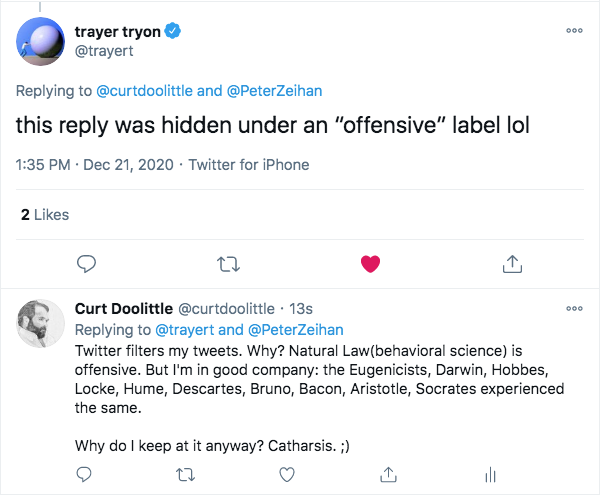
  • Twitter filters my tweets. Why? Natural Law(behavioral science) is offensive. Bu

    Twitter filters my tweets. Why? Natural Law(behavioral science) is offensive. But I’m in good company: the Eugenicists, Darwin, Hobbes, Locke, Hume, Descartes, Bruno, Bacon, Aristotle, Socrates experienced the same.

    Why do I keep at it anyway? Catharsis. 😉


    Source date (UTC): 2020-12-21 18:47:02 UTC

    Original post: https://twitter.com/i/web/status/1341092832040398849

    Reply addressees: @trayert @PeterZeihan

    Replying to: https://twitter.com/i/web/status/1341089847721615360

  • @sakovkt @RadioFreeNorthwest The Propertarian project (P-Law) is the largest in

    @sakovkt@RadioFreeNorthwest The Propertarian project (P-Law) is the largest in scope since the enlightenment. It includes not less than a) the completion of the scientific method merging the formal, physical, behavioral, and evolutionary sciences. b) a formal logic of natural law using that science, c) a constitutional reformation and policies of legal, economic, social, and political reforms using that law d) an explanation for the disproportionate success of western civilization BECAUSE of our Law DESPITE rebellions against it by our religion and philosophy.

    It will be too heavy for most, but the reforms are here, and organized in imitation of the founders: propertarianinstitute.com/the-book/revolution

    Cheers


    Source date (UTC): 2020-12-21 15:53:42 UTC

    Original post: https://gab.com/curtd/posts/105418982806804678

  • Science is a discipline for the production of testimony which is why only the we

    Science is a discipline for the production of testimony which is why only the west evolved truth-before-face, rule of law, individual sovereignty. Unfortunately, while science evolved from the law, science (and public speech in general) is no longer subject to crimes of perjury.


    Source date (UTC): 2020-12-20 23:13:04 UTC

    Original post: https://twitter.com/i/web/status/1340797396599627780

    Reply addressees: @jbarro

    Replying to: https://twitter.com/i/web/status/1340719438845403141

  • There’s a difference between one’s internal intuitions (self), political activis

    There’s a difference between one’s internal intuitions (self), political activism (team), political solutions to problems of the age (everyone), and the science of cooperation that we call the law (science). … Some of us can distinguish between them – and others can’t.


    Source date (UTC): 2020-12-20 23:04:43 UTC

    Original post: https://twitter.com/i/web/status/1340795292157927424

  • @_skycaptain Natural Selection. If you can’t understand it, then you failed natu

    @_skycaptain Natural Selection. If you can’t understand it, then you failed natural selection. 😉


    Source date (UTC): 2020-12-20 18:08:11 UTC

    Original post: https://gab.com/curtd/posts/105413849324716285

  • (a) you have ‘faith’ that we are all equal but you are wrong: empirically, scien

    (a) you have ‘faith’ that we are all equal but you are wrong: empirically, scientifically, absolutely wrong.
    (b) my ideas are trth. What we do with the truth is a choice.
    (c) It doesn’t matter what most Americans think, only that we can separate into regions and states we want.


    Source date (UTC): 2020-12-20 18:04:01 UTC

    Original post: https://twitter.com/i/web/status/1340719619368243202

    Reply addressees: @NestlerJj

    Replying to: https://twitter.com/i/web/status/1340713825926934529

  • If you put religion over science that is a choice, not a truth, and that choice

    If you put religion over science that is a choice, not a truth, and that choice is why you are conquered and destroyed., Because it is predicated on the lie that while we may treat one another as Christians interpersonally we may not do so politically where we act as groups.


    Source date (UTC): 2020-12-20 17:19:02 UTC

    Original post: https://twitter.com/i/web/status/1340708301504458761

    Reply addressees: @NestlerJj

    Replying to: https://twitter.com/i/web/status/1340707173316190209