—“The true meaning of P is that without reciprocity, you have to keep running faster and faster to stay in the same place.”—Duke Newcomb
Source date (UTC): 2019-11-13 18:39:21 UTC
Original post: https://twitter.com/i/web/status/1194686201703337986
—“The true meaning of P is that without reciprocity, you have to keep running faster and faster to stay in the same place.”—Duke Newcomb
Source date (UTC): 2019-11-13 18:39:21 UTC
Original post: https://twitter.com/i/web/status/1194686201703337986
Christianity(The Empathic Feminine) cannot survive without internal competition from martial aristocracy (The Empirical Masculine) which together produce the Competing Markets (Reciprocal) as the only means of compromise between the extremes (excellences).
I never err.
Source date (UTC): 2019-11-13 17:36:02 UTC
Original post: https://twitter.com/i/web/status/1194670267840237571
The Natural Law is compatible with Christianity – not identical. Meaning that Natural Law presumes it is superior to conquer, rule, enserf, enslave, or exterminate others unless they are capable of equal reciprocity. Christianity, the opposite: it is superior to suffer conquest.
Source date (UTC): 2019-11-13 16:42:27 UTC
Original post: https://twitter.com/i/web/status/1194656781823365120
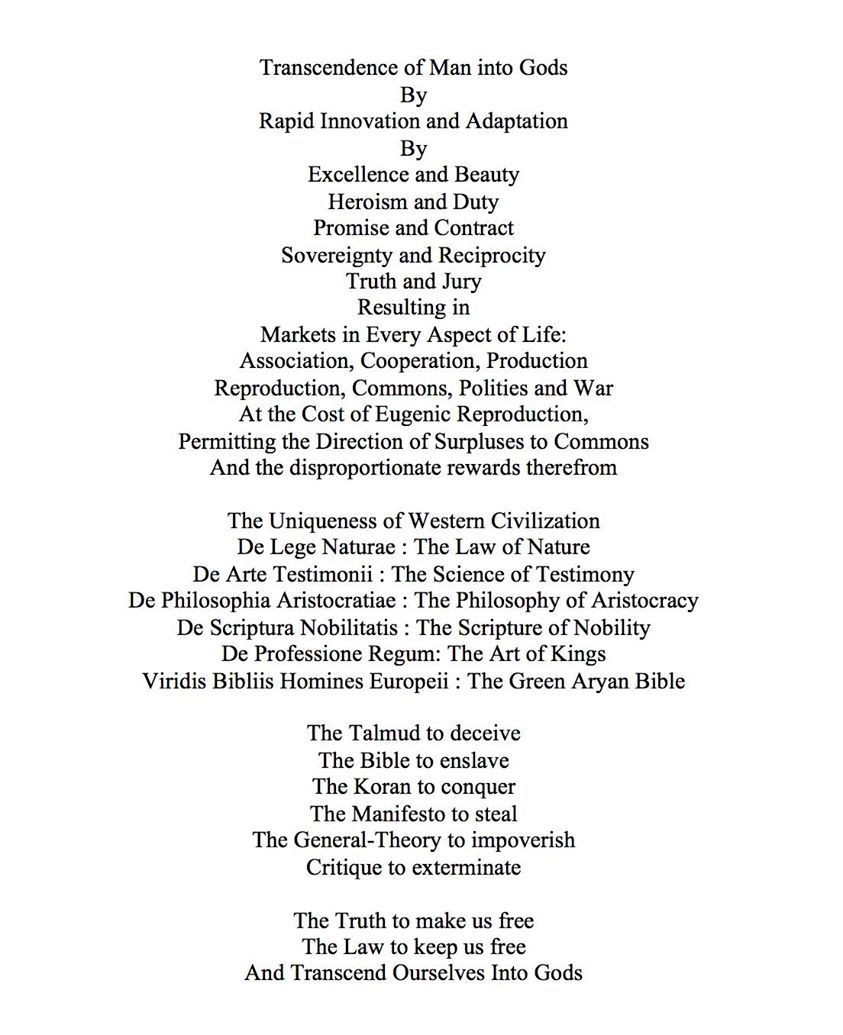
photos_and_videos/TimelinePhotos_dJ9jhts2Ng/75642464_506015806661981_9032505661610524672_o_506015803328648.jpg The Law The DIrection of Dominance Expression to the Commons, and from Commons to Transcendance of Man.The Law The DIrection of Dominance Expression to the Commons, and from Commons to Transcendance of Man.
Source date (UTC): 2019-11-13 14:40:00 UTC
—“The true meaning of P is that without reciprocity, you have to keep running faster and faster to stay in the same place.”—Duke Newcomb
Source date (UTC): 2019-11-13 13:39:00 UTC
(writing is in progress …)
The most frequent complaint from both readers and viewers is that they want to quickly understand this thing we call Propertarianism – and I’ve repeatedly failed to answer the question in a way that people who are not advanced degree holders in the philosophy of science, economics, law, or politics can understand. And everyone says ‘get to the point’. So if I get to the point I’ll say: It’s the completion of the scientific method – which almost certainly means nothing to most of you – and even if you think it does, I promise you that you don’t understand – because your understanding of the scientific method is almost certainly incomplete. I didn’t understand the scope of consequences that would result from completing it either. And that’s why Propertarianism is complicated: because the consequences of completing that method affect every discipline. And one of the other consequences is that it explains includes our present social and political conflict, and how to solve it. So the minimum reason you want to understand my work is to understand and perhaps solve the present conflict. And, hopefully, that’s enough to tempt you into following along with me. If it doesn’t then our current conflict is in even more desperate condition. So, It’s the completion of the scientific method, and its extension from the physical sciences to the human sciences – or what we call the soft sciences of language, psychology, sociology, politics, group strategy, including ethics, law, and economics. The result is a vocabulary and grammar – meaning a vocabulary and sentence structure – that serves as a system of measurement across all human disciplines. And you’ll discover pretty quickly how close that grammar is to mathematics – especially to geometry. And if you have experience with logic, in the sense of how we study the logics in philosophy, you might discover how it solves problems logics couldn’t. And if you have experience with programming you’ll understand just why that’s so. And if you also understood a bit of law and a bit of economics it will all fit together quickly. But for most of you, think about it as a programming language for describing the world, rather than for programming a computer to simulate an artificial world. Because really – that’s what it is. It’s a bridge between a programming language and ordinary language like logic is a bridge between mathematics and language. And just like mathematics, logic, formal logic, programming, P is a methodology. And just as math uses numbers, operators, and an equals sign to balance them in a well-formed grammar that lets you test them; and just as programming uses primitive types, complex types, variables, expressions ( phrases), classes, and functions(sentences), including operators (verbs), and programs (stories) that you, a compiler, or a computer can test, P (short for Propertarianism) uses a set of constant terms, variable terms, complete sentences, operational vocabulary (meaning actions), that you – or anyone – can test the same way a programmer or lawyer tests a program or contract today – except it’s far closer to the rigor of a program and far less easy to play games like you can in contract and law. So, more precisely, it’s the completion of the scientific method, producing a universally commensurable logic of all sciences and all disciplines ( metaphysics, language, psychology, sociology, politics, ethics, law, and economics). And with that logic, we can make statements about the formerly soft sciences just as concretely as we have about the formerly physical, or what we call hard sciences. Understanding Ourselves And we can use this methodto describe the west’s disproportionate success in both the ancient and modern worlds, at dragging mankind kicking and screaming out of ignorance, superstition, hard labor, poverty, starvation, disease, suffering, child mortality, early death, and his abuse by a nature all but hostile to human life. Understanding Our Enemy And with that knowledge, determine how and why the west decline in the present world. And with that knowledge, and our law, restore our civilization, and continue dragging mankind to godhood – kicking and screaming against us all the while.
( … ) Precision in truthful speech
( … ) lying, baiting into hazard… list of problems of the day
( … law)
( … ) non-religious law A Template Constitution for States in Western Civilization ( … ) A Constitution for the United States … and Canada, and Australia, and .. ( … ) And this complete’s Aristotle’s project. And solves our current crisis. So there. That’s Propertariaism (Testimony).
As an aside, I probably should call it Testimonialism, or the Science of Testimony, or The Law. Because it’s the science of truthful, reciprocal, operational speech. Because ‘Propertarianism’ confuses people. Propertarianism refers only to the use of Property as a system of measurement for testing reciprocity within Ethics and Law. And I started with ethics. So I called it Propertarianism. And now, I am sort of stuck with the name “Propertarianism” at the moment, unless I publish a book under something else. Propertarianism is the science of testimony: truthful speech.
So Then What? The Problem of Our Age. You probably understand that we are in a period of social and political conflict. It’s hard not to know that. You might also know of this thing called the replication crisis, in psychology, sociology, political science, and even the relatively recent failures of economics. And you may or may not know that while the last century has been full of technical innovations, that in general, it appears that certain parts of mathematics, physics, and economics are ‘stuck’ – and that anthropology, psychology, sociology, politics, law, and economics, are being overturned by genetics, cognitive science, and archeology, as consisting of largely of pseudoscience – meaning they’re wrong, lies, harmful, or worse. We don’t think of it this way, but Socrates Plato, Aristotle, and the other great greeks you may or may not have heard of; the British scientific enlightenment thinkers; also wrote their ideas during and after a great time of conflict or failure. And it’s during these periods of stress we are most likely to force ourselves to seek solutions to problems we may have thought we understood. Because, now, imagine not that long ago, a world without computers. Then, imagine how people thought about the world before Einstein, or before Darwin. Well, what did people think like before Aristotle – who invented what became a science. And there are a lot of people in between them. ( … )
Now, let’s take it a step farther. Let’s say you want to learn this methodology. Most people who have learned it, say there are a few basic ideas that provide most of it. At that point, you’d start understanding what we’re talking about. Now, let’s take it a step farther – Grammar (logics); What if you want to use it? You will want to know:
1. The Arguments – The spectrum of means of argument we’re familiar with 2. Grammar: Human Facilities, Grammar facility, Paradigms/Dimensions, Grammars. 3. The Grammars – and Deceits. (Which should give you an aha! moment) 4. The Deceits – How lies, deciets, frauds, and baitings into hazard are constructedNow, let’s take it a step farther – Grammar (logics); What if you want to use it? You will want to know:
5. Disambiguation: Deflation, Operationalization, Serialization – and the Glossary 6. Operational Prose …. Complete Sentences, …. Operational vocabulary(actions), and in …. ePrime – without the verb to-be. (is, are, was, were) 7. Promissory Prose … 8. Full Accounting Prose … – Using Property-in-toto, accounting, financial, economic terms. 9. Parenthetic Prose …. – Parallels between paradigms 10. Enumerative Prose … – Enumerating Series 11. Algorithmic Prose … – Programmatic construction of arguments. At that point, you’d start ‘talking funny’ like the rest of us. Next – Psychology:
15. Acquisition: Acquisition of anything and everything. 16. Man: how the brain works and produces consciousness. 17. Distributions: Genders, Classes, Nations, RacesNext – Sociology (Compatibilism)
18. Compatibilism, Cooperation and we are compatible thru marketsNext – Ethics – Via Positiva (Cooperation)
1. Demonstrated Interests 2. Property-In-Toto (as a system of measurement of reciprocity.) 1. Reciprocity (instead of ‘morality’)Next – Epistemology:
14. Metaphysics of Action: Realism, Naturalism, Operationalism, Empiricism, Logicism, Rational Choice – Action. 14. Falsification vs Justification 15. The Epistemic Cycle: 14. Testimony: TestifiabilityNext – Law – Via Negativa (Conflict)
20. Jurisprudence 21. Natural Law Strict construction of law and findings of the court 22. Constitutions in Strict ConstructionNext – Economics – Via Positiva (Production of goods, services, information, incentive)
19. Time, Division of Labor, 20. Money Accounting. 19. Micro Economics , Organizations, through The Civilizational Distribution of Labor 20. Behavioral Economics: Metaphysics, Psychology, Sociology, Politics in Economic Terms.Next – Politics – Production of Commons
19. Perfect Government, Through Ethnonationalism.Next – Group Competitive Strategy:
1. The Western Group Evolutionary Strategy: The reason for the disproportionate success of West vs the Rest.
Sovereignty Markets in everything Tripartism Trifunctionalism
2. The Semitic Group Anti-Evolutionary Strategy: The history of the Conflict between Civilizations, and in particular western eugenic, productive truthful, and Semitic dysgenic, parasitic and deceitful.
3. Other Cultures‘ Group Strategies.
4. Incompatibilism: … Differences between groupsAnd so;
A Constitution, in P-Law, staring our strategy, restores both our via-Positiva markets for productive cooperation and our via-negativa court-market for the rapid suppression of irreciprocity and fraud.
Including the suppression of (… public speech … )
Thereby preventing the second Semitic destruction of civilization.The Result.
1. A System of Thought that completes the Aristotelian, Anglo Empirical, American Legal, and European Scientific Program.
2. The Completion of the Scientific Method, and with it, the Empirical Revolution. By Completing the Empirical Revolution, We complete the Social Sciences. By Completing the Social Sciences we Produce The Logic Of Social Sciences
3. The Logic of the Social Sciences is a A Universal, Value-Neutral, Formal, Operational, Logic and Method, of Metaphysics, Psychology, Ethics, Morality, Politics, Group Evolutionary Strategy
4. The result is our ability to construct The Natural Law, in Ratio-Scientific Form, its Methodology, and its Application
5. This natural law, and perfect government is The Group Evolutionary Strategy of the European Peoples
6. And we can use this law and that government to suppress the second Semitic destruction of the advanced world.
7. …. ( recreating the market for the suppression … ) … ugh
( … )
1. Disambiguation: Deflation, Operationalization, Serialization – and the Glossary
For example, in mathematics, we take a series of words, put them in order – meaning in a position – on in a line, and call that a number line. And when we do that, we can use the number line as a system of measurement. And it’s very hard to confuse by accident or pretend so that we deceive ourselves of others, that two positions on that line are the same.
So in Testimony do the same thing. We take an idea. We collect a number of words that are synonyms and antonyms for that idea, then put them in some kind of order on a line, then define each of them as actions, then define each on differently from the others, and we have created a system of measurement that’s very precise. And so it is very hard to confuse (or conflate) by accident or to confuse (or conflate) for the purpose of deception of ourselves or of others Disambiguation by Serialization
So let’s use ‘moral‘ because that’s a word that we all use but conflate (confuse) often.
Good, Moral, Ethical, Right, Amoral, Wrong, Unethical, Immoral, Evil,
Which we usually write with arrows so that we can help the reader understand the direction of the idea, and we put bars around the starting point.
Good < Moral < Ethical < Right < |Amoral| > Wrong > Unethical > Immoral, > Evil
Disambiguation by Redefinition
( … ) moral and ethical overlap
Disambiguation and Deflation by Operationalization. ( … )
And then define them as actions:
Good: When you do something that benefits others, at neutral or some cost to you. Moral: When you do something where you could cheat others indirectly and anonymously but you don’t. Ethical: when you do something where you could cheat the other person directly but you don’t. Right: when you do something that could affect others but you ensure it doesn’t. Amoral: when you do something that doesn’t affect others because it can’t. Wrong: when you do something that affects others but don’t you ensure and it does. Unethical: when you do something where you can cheat the other person directly and you do. Immoral: when you do something where you could cheat others indirectly and anonymously and you don’t. Evil: when you do something that harms others, just to harm them even if it costs you.
Where the “constant-relation” between the terms is the spectrum of means of imposing – or avoiding imposing – the consequences of your actions upon others.
So now we have a unit of measurement of the morality of human actions. So whether we want to speak truthfully, or determine whether someone else is speaking truthfully, we have a simple means of testing their speech.
When we use these terms we won’t confuse them, and everyone else writing in Testimony can use them the same way. And, you might think that this would be a lot of work and be confusing, but it turns out that there aren’t very many of them, after a while, you’ll memorize all of them, and this is one of the most common series we use.
We call this technique “Disambiguation, Serialization, and Operationalization” because we de-conflate terms, by writing them in operational language, meaning definitions that start with ‘when you do something that causes something that you experience as.’ And then we sort them by trial and error into order, and adjust their definitions until they don’t overlap (conflate), so that they are disambiguated.
Universal Commensurability
Writing in actions – operational language – causes us to write from the same point of view, so that no matter what we are discussing, no matter what subject we discuss by reducing all of our terms to actions in operational language, they will all be measurable by the same standard: actions. This technique creates “commensurability” regardless of the subject matter.
Not so that we must speak in that system of measurement – it would be burdensome, but so like mathematics in the determinism (constant relations) of the physical science, we would have a language of measurement for all sciences, including the human sciences.
2. Operational Prose …. ePrime – without the verb to-be. (is, are, was, were) …. Operational Vocabulary (actions), and in …. Promissory Prose … …. Complete Sentences … …. Full Accounting Prose – Using Property-in-toto, accounting, financial, economic terms. …. Parenthetic Prose – Parallels between paradigms …. Enumerative Prose – Enumerating Series …. Algorithmic Prose – Programmatic construction of arguments.
Operational Prose requires we use the following techniques to limit pretense of means of existence, pretense of knowledge, pretense of unaccountability, and possibility ambiguity whether by elimination (leaving out), inflation (adding), conflation(mixing) instead of just stating a description. …. 1. ePrime – eliminate the verb to-be. (am is, are, was, were) …. 2. Operational vocabulary(actions), …. 3. Promissory Form …. 4. Complete Sentences, …. 5. Parenthetical Prose …. 6. Eumeratitve Prose …. 7. Algorithmic Prose This set of examples provides a basic understanding of the series of techniques.
We changed from it’s (it is) to I see: from proclamation to testimony. This is an operational transformation. Or in philosophical terms, from an ‘ideal’ to a ‘real’. In Our english language, we use the grammatical order of subject verb object, and out of habit we create the context using the subject. Jon threw the ball (to Jane). Some other languages, like latin, use say, Subject, Object Verb: Jon (to jane) the ball threw. And still others use The ball, Jon (to Jane) threw, or The ball, (to Jane), Jon threw. Each of these orders requires slightly different habit and changing this habit is work – like learning a foreign language. Now, langauges differ in the amount of inference required. So we call some languages high context if they requires a lot of inference, and low context if they don’t require much inference. English is a low context high precision language, with a greedy vocabulary that loves new words, that places more burden on the speaker and on the listener. In exchange for this complexity we find english is very good for legal, technical, and scientific prose – and good for poetic prose dependent on vocabulary, even if it’s not terribly good for emotional or aesthetic prose dependent upon inference and association, and mutliple meanings. We changed I see a black cat from implied or inferred, to testimony and added implied warranty.
We changed from inferred consequences to stated consequences. This produces a sentence that serves as a complete transaction with nothing else implied or assumed. We have eliminated most possible ambiguity, unaccountability, and pretense of knowlege and understanding. From here on we’re further disambiguating and preventing further errores of inference suggestion or deceit.
The purpose of parentheticals is to use multiple paradigms (networks of related concepts) to eliminate ambiguity while preserving the consistency of the paradigm, and as such the readability of the underlying sentence. So we have now further reduced
The purpose of enumerative, like parenthetical, is to prevent the reader from engaging in mis-interpreteation by making it difficult or impossible to misinterpret your meaning, as is easy when we use a single term. In P-law we use a small number of repetitious enumerations to prevent errors and deceits of inference. The most common examples are:
|True| False < Truth Candidate(True) < Undecidable < Non-Logical < Nonsensical (Where falsehood(certainty) is always prescedent over truth (Contingency) This is ternary logic of science, vs the binary logic, or truth table logic you are familiar with in the logic of inference – which is how logic is taught: set inference rather than scientific and contingent. ALmost everything in P requires at least three states Miniumum, medium, maximum in order to falsify the series. “It takes at least Three points test a line”. In most definitions we will use five and some as many as twelve or more.
|Truth| Tautological < Analytic Truth < Truthful (True) < Honest < Impulsive (unconsidered)
|Falsehoods| ignorance, error, bias, wishful thinking, suggestion (loading, framing) obscurantism, fitionalism (pseudoscience, sophism, occult), fiction (deceit), and denial.
|Epistemology|Observation > Free Association > Hypothesis > Theory > Surviving Theory > “Law”
|Testimonial Due Diligence| categorial, logical, operational, empirical, rational, reciprocal, limited, fully accounted, coherent and warrantied within the limits of restitutability.
|Demonstrated Interests| Self, Mate, Children, Kin, Kith, Capital Property, Several Property, Shared (Shareholder Property), Common(Citizen) Property, institutional property (norms, laws, institutions), intergenerational property (traditions).
|Harms| Murder, Harm, Damage, Theft, Fraud, Baiting into hazard, free riding, privatizing commons, socializing losses, corruption, conspiracy, conversion, immigration, war, conquest.
|Reciprocal| Productive, Fully informed, warrantied, voluntary transfer of demonstrated interests, free of imposition of cost supon the demonstrated interests of others by externality.
|Moral| Evil < Immoral < Unethical < Amoral > Ethical > Moral > Good
Given; … The Definitions; … … Commitment { Unsure, Confident, Sure, Promise, Warranty} … … Look { |Duration|: glance, look, observe, stare } … … Color(Reflected Color) {|Visible Spectrum|: red, orange, yellow, green, blue, indigo, violet} … … … Where; … … … … The sum of Color(Reflected Color) {White} … … … … The Absence of Color(Reflected Color)} {Black} … … Fur { |Volume|: Fuzz, Hair, Fur, Coat, Mane} … … Domesticated Cat: Those “Felids” of Subclass “Domesticated”, including African, Black Footed, Chinese Mountain, Domestic, European Wildcat, Jungle and Sand.
Whereas; … [name] promises, without warranty, that he currently [location, date and time] observes, and indicates by pointing with his hand, a domesticated cat, with black fur.
Therefore; … Any observer of this same domesticated cat that [name]points toward, at this location, date and time, shall also observe and agree to the correspondence of [name’s] description of the cat bearing fur of the color black. That’s a very simple version but that’s how it’s done. And it explains why contract law and propertarian prose sound similar. In this sense propertarianism’s methodology completes the transition of the natural law of tort and contract into the universal language (grammar, paradigm, vocabular and logic) and of social science.
4. The Arguments – The spectrum of means of argument we’re familiar with 5. Grammar: Human Facilities, Grammar facility, Paradigms/Dimensions, Grammars. 5. The Grammars – and Deceits. (Which should give you an aha! moment) 6. The Deceits – How lies, deciets, frauds, and baitings into hazard are constructed
Table: Name Number Math Discipline
THE HUMAN GRAMMATICAL CAPACITY
A GRAMMAR (reorganizing the grammatical capacity)
DIMENSIONS
Human Perception
Observer, Name,    Verb,   Phrase,   Phrases,  Complete Sentence, Story.
Observer, Point,   Line,   Plane,    Object,   Change(time),      N-dimensional Change
Observer, Numbers, Arith., Math/Alg, Geometry, Calculus,          Algebraic Geometry
THE GRAMMARS
Now you probably know the difference between: { math: arithmetic, accounting, algebra, geometry, calculus, and algebraic geometry.}
And you might also know the difference between: { logic: … }
And you might also know the difference between: { physical science: physics, chemistry, biochemistry, and biology. }
And you might also know the difference between: { human science: psychology, sociology, politics and comparative civilizations (anthropology). }
And maybe you thought about the difference between: { Storytelling: an essay, a biography, history, a story, literature, and mythology. }
And maybe you thought about the difference between: { Logic: The human logical facility(ability), reason, logic, algorithm, procedure (recipe, protocol), calculation, computation }
And maybe you thought about the difference between: { Language: The human language facility(ability), human grammar(rules of continuous disambiguation), consent-approval/rejection-disapproval, name, name-modifier, verb(state-operator), verb (state-operator) modifier, phrase, sentence, story. }
You might not know that those differences also exist in the disciplines of truthful speech, and that unspoken discipline of lying. { Lying: Loading-Framing, Suggesting-Obscuring, Inflating-Conflating, fictionalisms(Pseudoscience->Magic, Ideal->Surreal, Supernatural-Occult), fiction-lies. }
You might or might not have identified a pattern between all those sets of disciplines
{ … }
But it’s unlikely that you thought about language as a system of measurement using the only system of measurement we have: { Senses(Nerves), Associations(Memory), Predictions(Imaginations), Valuations(emotions-predictions), Experiences, Comparisons, Choices, Actions(Motor) }
1. Acquisition: Acquisition of anything and everything. 2. Man: how the brain works and produces consciousness. 3. Distributions: Genders, Classes, Nations, Races
1. Compatibilism, Cooperation and we are compatible thru markets 2. Micro Economics Time, Division of Labor, Organizations, through The Civilizational Distribution of Labor 3. Behavioral Economics: Metaphysics, Psychology, Sociology, Politics in Economic Terms.
1. Demonstrated Interests 2. Property-In-Toto (as a system of measurement of reciprocity.) 3. Reciprocity (instead of ‘morality’)
( … )
Given the Choices of …. (i) Avoidance (ii) Cooperation and (iii) Conflict; And Given the Choices of ; …. (iv) The returns on Cooperation, …. (v) The returns on future Cooperation, …. (vi) The cost of provoking retaliation; Thou shalt not; …. by display, word, or deed, …. or …. absence of display, word or deed, …. impose costs upon the demonstrated Interests of others (property-in-toto), …. …. either directly or indirectly, where; …. those Interests were obtained by …. …. Settlement (homesteading, conversion, or first use) …. …. or productive, fully informed, warrantied, voluntary exchange in the absence of; …. such imposition of costs upon the demonstrated interests of others.
14. Metaphysics of Action: Realism, Naturalism, Operationalism, Empiricism, Logicism, Rational Choice – Action. 14. Falsification vs Justification 15. The Epistemic Cycle: 14. Testimony: Testifiability
Action: Realism, Naturalism, Operationalism, Empiricism, Logicism, Rational Choice – Action.
(…)
|Universal Epistemology| : Free Association**(survived minimum relations for cognizance) -> **Hypothesis** (survived rational falsification) -> **Theory** (survived empirical falsification) -> **Law** (survived applied falsification).
A FACT consists of a promise of a theory of an observation.
A THEORY consists of (i) A method of producing decidability in a context, and (ii) A story for searching for possibilities to apply the method of decidability.
A TRUTH Proposition consists of a promise of a theory of an observable, *Including the reciprocally subjectively testable*.
( … )
|Testimonial Truth| : A promise that the correspondence between the experience invoked in the audience by the statement and something observable: open to senses(physical), emotions(Intuitionistic), or mind(intellectual) – satisfies the demand for decidability (correspondence), given the consequences and demand for restitution upon ignorance, error, bias, or deceit.
In practice, we use Fact for measurements or records of existentially observable reality, and objective Truth is a ‘fuzzier term’ that attempts to include statements about language (verbalisms) and to attribute to them the freedom from error, bias, and deceit of facts.
In other words, these terms are specific (fact) and loose (Objective) assertions of the absence of ignorance, error, bias, and deceit. We use the via positiva assertion “True”, meaning rather than the via negativa assertion “free of ignorance, error, bias, and deceit” for brevity and habit, despite the fact that the term true can and only can mean ‘free of ignorance, error, bias, and deceit given the scope of externalities of the question (harm)”. Because that is all it is possible to know. The completion of Aristotle’s Project, by the solution to the Human Sciences, the way that the people in the 1800’s found the solution to the physical sciences, the way that the British enlightenment found the solution Supply and Demand vs SetsFalsification: Is it Possible For You To Make A Truth Claim?
Testimonial prose allows us to determine whether a person who is claiming something is reciprocal (truthful and right, ethical, moral, or good) can make the claim by demonstrating sufficient knowledge to make the claim, and has made the claim.
And that is the purpose of Testimony: to create A System of Measurement: A Value Neutral Language for the discussion of Reality (what we call metaphysics), physical sciences and the human sciences of psychology, sociology, economics, ethics, law politics, and group strategy.
A Value-Neutral Language for use as a fully commensurable, System of Measurement, for the non-physical sciences.
We search for truthful statements. Because that is all we can know. A Demand for Ideal Truth, in the form of Truthful Speech, consists of a Demand for Decidability in Display, Word, and Deed, in Answer To a Given Question.
a) In the REVERSE: a question (statement) is DECIDABLE if an algorithm (set of operations) exists within the limits of the system (rules, axioms, theories) that can produce a decision (choice). In other words, if the sufficient information for the decision is present (ie: is decidable) within the âsystemâ(ie: grammar).
b) In the OBVERSE: Instead, we should determine if there is a means of choosing without the need for additional information supplied from outside the system (ie: not discretionary).
Or in simple terms, if DISCRETION is necessary the question is undecidable, and if discretion is unnecessary, a proposition is decidable. This separates reason (or calculation in the wider sense) from computation (algorithm).Given These Dimensions of Actionable Reality:
Therefore These dimensions of actionable reality yield the Series:
Yields Demand for the Infallibility of Decidability in The Series:
Where Truth Consists in The Series
Where the Criteria for Truthful Speech Is Coherence Across the Dimensions Testifiable by Man, in The Series:
… (i)as having performed due diligence in the above dimensions; … (ii)where due diligence is sufficient to satisfy the demand for infallibility; … (iii)and where one entertains no risk that one cannot perform restitution for.As a Defense Against the Series (ignorance, error, bias deceit fraud and baiting into hazard):
In Defense or Advocacy Of:
1. Any transfer that is not: … (a) productive … (b) fully informed … (c) warrantied … (d) voluntary … (e) free of externality of the same criteriaIncluding but Not Limited to The Series of Those Categories Of Irreciprocity:
1. murder, 2. harm, damage, theft, 3. fraud, fraud by omission, fraud by indirection, baiting into hazard 4. free riding, socialization of losses, privatization of commons, 5. rent-seeking, monopoly seeking, conspiracy, statism/corporatism, 6. conversion(religion/pseudoscience), 7. displacement(immigration/overbreeding), 8. conquest (war).
20. Jurisprudence 21. Natural Law Strict construction of law and findings of the court 22. Constitutions in Strict Construction
10. Time
19. Perfect Government, Through Ethnonationalism.
Sciences....Soft Sciences...Philosophy...Law......Logic....Math
Micro-Subatomic
Macro-Astronomy
Human-Physics
Chemistry
Bio-Chemistry
Biology
Cog Sci.....Psychology......Metaphysics.
............Language........Epistemology..........Grammars.Math
............................Ethics
............Sociology
........................................Law
........................................Economics
............Politics........Politics
Physics
... Micro-Subatomic
... Macro-Astronomy
... Human-Scale-Physics
... Chemistry
Biology
... Bio-Chemistry
... Genetics
... Biology
... ... Life Forms
... ... Ecology (life systems)
Sentience
... Cog Sci (Disambiguation)
... Acqusition (Psychology)
... Language (continuous recursive disambiguation)
... ... Metaphysics (Paradigms).
... ... Grammars
... Epistemology
Cooperation
... Ethics
... Law
... Economics
... Politics
... Group Strategy
It’s easier to say how to do it.
i) inventory the synonyms and antonyms. three is minimum, five better, seven or more best. ii) Order them into a series or spectrum either from more to less, less to more, or middle to less on one side and middle to more on the other. (there are more options but this is the simplest) iii) define them in operational language: as a series of actions. iv) if necessary modify the definitions so that they don’t overlap. v) Define this ‘series’ by whatever property or properties it shares, again, in operational language. Now, just as when, in arithmetic, every number has a unique name, every name is ordered on a line, and while two points make a line, three points test a line, and more points test the consistency of line even better. And while a number is the name of a position, and that’s all it is: the name of a position in an order – our names are …. In most cases, when say ‘moral’ and you hear ‘moral’, we might both associate that word with a vague notion of ‘good somehow’. Do you understand the difference between mathematics, physical science, the logics, programming, economics, legal testimony, ordinary speech, narration, fiction, the fictionalisms of pseudoscience, idealism, and theology? Do you understand the difference between Aristotelianism including Empiricism and Mathematics is vs say Platonism, Confucianism, Abrahamic Monotheism, Buddhism, Confucianism? That’s how to think about Testimony (propertarianism) The Completion of the scientific method; Producing a formal methodology, vocabulary, grammar of both truthful and moral (reciprocal) speech; restating all disciplines in that truthful and reciprocal speech. including producing a law of truthful and reciprocal speech. Producing a formal methodology, vocabulary, grammar of both truthful and moral (reciprocal) speech; restating all disciplines in that truthful and reciprocal speech. including producing a law of truthful and reciprocal speech. Testimony (Propertarianism) consists of … the use of procedural falsification; … in all dimensions of human perception; … resulting in the completion of the Scientific Method ; … its application to the totality of human knowledge; … resulting in a universally commensurable language of all thought; … its embodiment in the common law of tort; … its use in the construction of a template for constitutions; … and as a consequence creating a market for the prosecution of; … … superstition, pseudoscience, sophism, fraud, and deceit … and the eradication of: … … … superstition, pseudoscience, sophism, fraud, and deceit … from the commercial, financial, economic, political, and informational commons; … reversing the second Semitic attempt at the destruction of Western Civilization as it has destroyed every other by systematic undermining from within; … and restoring the quality of life we have expected from Western Civilization; … for those that live today, and those that will yet live in the future;” But what does that mean? It means a body of inviolable law, a constitution built from it, a law that encourages the prosecution of enemies rather than protecting them, and a system of government that restores and preserves that constitution and our way of life, and the uniqueness of Western Civilization for eternity. HISTORY European Mythology +European Evidentiary Customary Law + European Geometry > Socratic Argument > Aristotelian Reason and Naturalism > Roman Law and Administration > Anglo Empiricism and Realism > 20th Century Operationalism > Doolittle’s Testimonialism (we unfortunately call propertarianism).
(writing is in progress …)
The most frequent complaint from both readers and viewers is that they want to quickly understand this thing we call Propertarianism – and I’ve repeatedly failed to answer the question in a way that people who are not advanced degree holders in the philosophy of science, economics, law, or politics can understand. And everyone says ‘get to the point’. So if I get to the point I’ll say: It’s the completion of the scientific method – which almost certainly means nothing to most of you – and even if you think it does, I promise you that you don’t understand – because your understanding of the scientific method is almost certainly incomplete. I didn’t understand the scope of consequences that would result from completing it either. And that’s why Propertarianism is complicated: because the consequences of completing that method affect every discipline. And one of the other consequences is that it explains includes our present social and political conflict, and how to solve it. So the minimum reason you want to understand my work is to understand and perhaps solve the present conflict. And, hopefully, that’s enough to tempt you into following along with me. If it doesn’t then our current conflict is in even more desperate condition. So, It’s the completion of the scientific method, and its extension from the physical sciences to the human sciences – or what we call the soft sciences of language, psychology, sociology, politics, group strategy, including ethics, law, and economics. The result is a vocabulary and grammar – meaning a vocabulary and sentence structure – that serves as a system of measurement across all human disciplines. And you’ll discover pretty quickly how close that grammar is to mathematics – especially to geometry. And if you have experience with logic, in the sense of how we study the logics in philosophy, you might discover how it solves problems logics couldn’t. And if you have experience with programming you’ll understand just why that’s so. And if you also understood a bit of law and a bit of economics it will all fit together quickly. But for most of you, think about it as a programming language for describing the world, rather than for programming a computer to simulate an artificial world. Because really – that’s what it is. It’s a bridge between a programming language and ordinary language like logic is a bridge between mathematics and language. And just like mathematics, logic, formal logic, programming, P is a methodology. And just as math uses numbers, operators, and an equals sign to balance them in a well-formed grammar that lets you test them; and just as programming uses primitive types, complex types, variables, expressions ( phrases), classes, and functions(sentences), including operators (verbs), and programs (stories) that you, a compiler, or a computer can test, P (short for Propertarianism) uses a set of constant terms, variable terms, complete sentences, operational vocabulary (meaning actions), that you – or anyone – can test the same way a programmer or lawyer tests a program or contract today – except it’s far closer to the rigor of a program and far less easy to play games like you can in contract and law. So, more precisely, it’s the completion of the scientific method, producing a universally commensurable logic of all sciences and all disciplines ( metaphysics, language, psychology, sociology, politics, ethics, law, and economics). And with that logic, we can make statements about the formerly soft sciences just as concretely as we have about the formerly physical, or what we call hard sciences. Understanding Ourselves And we can use this methodto describe the west’s disproportionate success in both the ancient and modern worlds, at dragging mankind kicking and screaming out of ignorance, superstition, hard labor, poverty, starvation, disease, suffering, child mortality, early death, and his abuse by a nature all but hostile to human life. Understanding Our Enemy And with that knowledge, determine how and why the west decline in the present world. And with that knowledge, and our law, restore our civilization, and continue dragging mankind to godhood – kicking and screaming against us all the while.
( … ) Precision in truthful speech
( … ) lying, baiting into hazard… list of problems of the day
( … law)
( … ) non-religious law A Template Constitution for States in Western Civilization ( … ) A Constitution for the United States … and Canada, and Australia, and .. ( … ) And this complete’s Aristotle’s project. And solves our current crisis. So there. That’s Propertariaism (Testimony).
As an aside, I probably should call it Testimonialism, or the Science of Testimony, or The Law. Because it’s the science of truthful, reciprocal, operational speech. Because ‘Propertarianism’ confuses people. Propertarianism refers only to the use of Property as a system of measurement for testing reciprocity within Ethics and Law. And I started with ethics. So I called it Propertarianism. And now, I am sort of stuck with the name “Propertarianism” at the moment, unless I publish a book under something else. Propertarianism is the science of testimony: truthful speech.
So Then What? The Problem of Our Age. You probably understand that we are in a period of social and political conflict. It’s hard not to know that. You might also know of this thing called the replication crisis, in psychology, sociology, political science, and even the relatively recent failures of economics. And you may or may not know that while the last century has been full of technical innovations, that in general, it appears that certain parts of mathematics, physics, and economics are ‘stuck’ – and that anthropology, psychology, sociology, politics, law, and economics, are being overturned by genetics, cognitive science, and archeology, as consisting of largely of pseudoscience – meaning they’re wrong, lies, harmful, or worse. We don’t think of it this way, but Socrates Plato, Aristotle, and the other great greeks you may or may not have heard of; the British scientific enlightenment thinkers; also wrote their ideas during and after a great time of conflict or failure. And it’s during these periods of stress we are most likely to force ourselves to seek solutions to problems we may have thought we understood. Because, now, imagine not that long ago, a world without computers. Then, imagine how people thought about the world before Einstein, or before Darwin. Well, what did people think like before Aristotle – who invented what became a science. And there are a lot of people in between them. ( … )
Now, let’s take it a step farther. Let’s say you want to learn this methodology. Most people who have learned it, say there are a few basic ideas that provide most of it. At that point, you’d start understanding what we’re talking about. Now, let’s take it a step farther – Grammar (logics); What if you want to use it? You will want to know:
1. The Arguments – The spectrum of means of argument we’re familiar with 2. Grammar: Human Facilities, Grammar facility, Paradigms/Dimensions, Grammars. 3. The Grammars – and Deceits. (Which should give you an aha! moment) 4. The Deceits – How lies, deciets, frauds, and baitings into hazard are constructedNow, let’s take it a step farther – Grammar (logics); What if you want to use it? You will want to know:
5. Disambiguation: Deflation, Operationalization, Serialization – and the Glossary 6. Operational Prose …. Complete Sentences, …. Operational vocabulary(actions), and in …. ePrime – without the verb to-be. (is, are, was, were) 7. Promissory Prose … 8. Full Accounting Prose … – Using Property-in-toto, accounting, financial, economic terms. 9. Parenthetic Prose …. – Parallels between paradigms 10. Enumerative Prose … – Enumerating Series 11. Algorithmic Prose … – Programmatic construction of arguments. At that point, you’d start ‘talking funny’ like the rest of us. Next – Psychology:
15. Acquisition: Acquisition of anything and everything. 16. Man: how the brain works and produces consciousness. 17. Distributions: Genders, Classes, Nations, RacesNext – Sociology (Compatibilism)
18. Compatibilism, Cooperation and we are compatible thru marketsNext – Ethics – Via Positiva (Cooperation)
1. Demonstrated Interests 2. Property-In-Toto (as a system of measurement of reciprocity.) 1. Reciprocity (instead of ‘morality’)Next – Epistemology:
14. Metaphysics of Action: Realism, Naturalism, Operationalism, Empiricism, Logicism, Rational Choice – Action. 14. Falsification vs Justification 15. The Epistemic Cycle: 14. Testimony: TestifiabilityNext – Law – Via Negativa (Conflict)
20. Jurisprudence 21. Natural Law Strict construction of law and findings of the court 22. Constitutions in Strict ConstructionNext – Economics – Via Positiva (Production of goods, services, information, incentive)
19. Time, Division of Labor, 20. Money Accounting. 19. Micro Economics , Organizations, through The Civilizational Distribution of Labor 20. Behavioral Economics: Metaphysics, Psychology, Sociology, Politics in Economic Terms.Next – Politics – Production of Commons
19. Perfect Government, Through Ethnonationalism.Next – Group Competitive Strategy:
1. The Western Group Evolutionary Strategy: The reason for the disproportionate success of West vs the Rest.
Sovereignty Markets in everything Tripartism Trifunctionalism
2. The Semitic Group Anti-Evolutionary Strategy: The history of the Conflict between Civilizations, and in particular western eugenic, productive truthful, and Semitic dysgenic, parasitic and deceitful.
3. Other Cultures‘ Group Strategies.
4. Incompatibilism: … Differences between groupsAnd so;
A Constitution, in P-Law, staring our strategy, restores both our via-Positiva markets for productive cooperation and our via-negativa court-market for the rapid suppression of irreciprocity and fraud.
Including the suppression of (… public speech … )
Thereby preventing the second Semitic destruction of civilization.The Result.
1. A System of Thought that completes the Aristotelian, Anglo Empirical, American Legal, and European Scientific Program.
2. The Completion of the Scientific Method, and with it, the Empirical Revolution. By Completing the Empirical Revolution, We complete the Social Sciences. By Completing the Social Sciences we Produce The Logic Of Social Sciences
3. The Logic of the Social Sciences is a A Universal, Value-Neutral, Formal, Operational, Logic and Method, of Metaphysics, Psychology, Ethics, Morality, Politics, Group Evolutionary Strategy
4. The result is our ability to construct The Natural Law, in Ratio-Scientific Form, its Methodology, and its Application
5. This natural law, and perfect government is The Group Evolutionary Strategy of the European Peoples
6. And we can use this law and that government to suppress the second Semitic destruction of the advanced world.
7. …. ( recreating the market for the suppression … ) … ugh
( … )
1. Disambiguation: Deflation, Operationalization, Serialization – and the Glossary
For example, in mathematics, we take a series of words, put them in order – meaning in a position – on in a line, and call that a number line. And when we do that, we can use the number line as a system of measurement. And it’s very hard to confuse by accident or pretend so that we deceive ourselves of others, that two positions on that line are the same.
So in Testimony do the same thing. We take an idea. We collect a number of words that are synonyms and antonyms for that idea, then put them in some kind of order on a line, then define each of them as actions, then define each on differently from the others, and we have created a system of measurement that’s very precise. And so it is very hard to confuse (or conflate) by accident or to confuse (or conflate) for the purpose of deception of ourselves or of others Disambiguation by Serialization
So let’s use ‘moral‘ because that’s a word that we all use but conflate (confuse) often.
Good, Moral, Ethical, Right, Amoral, Wrong, Unethical, Immoral, Evil,
Which we usually write with arrows so that we can help the reader understand the direction of the idea, and we put bars around the starting point.
Good < Moral < Ethical < Right < |Amoral| > Wrong > Unethical > Immoral, > Evil
Disambiguation by Redefinition
( … ) moral and ethical overlap
Disambiguation and Deflation by Operationalization. ( … )
And then define them as actions:
Good: When you do something that benefits others, at neutral or some cost to you. Moral: When you do something where you could cheat others indirectly and anonymously but you don’t. Ethical: when you do something where you could cheat the other person directly but you don’t. Right: when you do something that could affect others but you ensure it doesn’t. Amoral: when you do something that doesn’t affect others because it can’t. Wrong: when you do something that affects others but don’t you ensure and it does. Unethical: when you do something where you can cheat the other person directly and you do. Immoral: when you do something where you could cheat others indirectly and anonymously and you don’t. Evil: when you do something that harms others, just to harm them even if it costs you.
Where the “constant-relation” between the terms is the spectrum of means of imposing – or avoiding imposing – the consequences of your actions upon others.
So now we have a unit of measurement of the morality of human actions. So whether we want to speak truthfully, or determine whether someone else is speaking truthfully, we have a simple means of testing their speech.
When we use these terms we won’t confuse them, and everyone else writing in Testimony can use them the same way. And, you might think that this would be a lot of work and be confusing, but it turns out that there aren’t very many of them, after a while, you’ll memorize all of them, and this is one of the most common series we use.
We call this technique “Disambiguation, Serialization, and Operationalization” because we de-conflate terms, by writing them in operational language, meaning definitions that start with ‘when you do something that causes something that you experience as.’ And then we sort them by trial and error into order, and adjust their definitions until they don’t overlap (conflate), so that they are disambiguated.
Universal Commensurability
Writing in actions – operational language – causes us to write from the same point of view, so that no matter what we are discussing, no matter what subject we discuss by reducing all of our terms to actions in operational language, they will all be measurable by the same standard: actions. This technique creates “commensurability” regardless of the subject matter.
Not so that we must speak in that system of measurement – it would be burdensome, but so like mathematics in the determinism (constant relations) of the physical science, we would have a language of measurement for all sciences, including the human sciences.
2. Operational Prose …. ePrime – without the verb to-be. (is, are, was, were) …. Operational Vocabulary (actions), and in …. Promissory Prose … …. Complete Sentences … …. Full Accounting Prose – Using Property-in-toto, accounting, financial, economic terms. …. Parenthetic Prose – Parallels between paradigms …. Enumerative Prose – Enumerating Series …. Algorithmic Prose – Programmatic construction of arguments.
Operational Prose requires we use the following techniques to limit pretense of means of existence, pretense of knowledge, pretense of unaccountability, and possibility ambiguity whether by elimination (leaving out), inflation (adding), conflation(mixing) instead of just stating a description. …. 1. ePrime – eliminate the verb to-be. (am is, are, was, were) …. 2. Operational vocabulary(actions), …. 3. Promissory Form …. 4. Complete Sentences, …. 5. Parenthetical Prose …. 6. Eumeratitve Prose …. 7. Algorithmic Prose This set of examples provides a basic understanding of the series of techniques.
We changed from it’s (it is) to I see: from proclamation to testimony. This is an operational transformation. Or in philosophical terms, from an ‘ideal’ to a ‘real’. In Our english language, we use the grammatical order of subject verb object, and out of habit we create the context using the subject. Jon threw the ball (to Jane). Some other languages, like latin, use say, Subject, Object Verb: Jon (to jane) the ball threw. And still others use The ball, Jon (to Jane) threw, or The ball, (to Jane), Jon threw. Each of these orders requires slightly different habit and changing this habit is work – like learning a foreign language. Now, langauges differ in the amount of inference required. So we call some languages high context if they requires a lot of inference, and low context if they don’t require much inference. English is a low context high precision language, with a greedy vocabulary that loves new words, that places more burden on the speaker and on the listener. In exchange for this complexity we find english is very good for legal, technical, and scientific prose – and good for poetic prose dependent on vocabulary, even if it’s not terribly good for emotional or aesthetic prose dependent upon inference and association, and mutliple meanings. We changed I see a black cat from implied or inferred, to testimony and added implied warranty.
We changed from inferred consequences to stated consequences. This produces a sentence that serves as a complete transaction with nothing else implied or assumed. We have eliminated most possible ambiguity, unaccountability, and pretense of knowlege and understanding. From here on we’re further disambiguating and preventing further errores of inference suggestion or deceit.
The purpose of parentheticals is to use multiple paradigms (networks of related concepts) to eliminate ambiguity while preserving the consistency of the paradigm, and as such the readability of the underlying sentence. So we have now further reduced
The purpose of enumerative, like parenthetical, is to prevent the reader from engaging in mis-interpreteation by making it difficult or impossible to misinterpret your meaning, as is easy when we use a single term. In P-law we use a small number of repetitious enumerations to prevent errors and deceits of inference. The most common examples are:
|True| False < Truth Candidate(True) < Undecidable < Non-Logical < Nonsensical (Where falsehood(certainty) is always prescedent over truth (Contingency) This is ternary logic of science, vs the binary logic, or truth table logic you are familiar with in the logic of inference – which is how logic is taught: set inference rather than scientific and contingent. ALmost everything in P requires at least three states Miniumum, medium, maximum in order to falsify the series. “It takes at least Three points test a line”. In most definitions we will use five and some as many as twelve or more.
|Truth| Tautological < Analytic Truth < Truthful (True) < Honest < Impulsive (unconsidered)
|Falsehoods| ignorance, error, bias, wishful thinking, suggestion (loading, framing) obscurantism, fitionalism (pseudoscience, sophism, occult), fiction (deceit), and denial.
|Epistemology|Observation > Free Association > Hypothesis > Theory > Surviving Theory > “Law”
|Testimonial Due Diligence| categorial, logical, operational, empirical, rational, reciprocal, limited, fully accounted, coherent and warrantied within the limits of restitutability.
|Demonstrated Interests| Self, Mate, Children, Kin, Kith, Capital Property, Several Property, Shared (Shareholder Property), Common(Citizen) Property, institutional property (norms, laws, institutions), intergenerational property (traditions).
|Harms| Murder, Harm, Damage, Theft, Fraud, Baiting into hazard, free riding, privatizing commons, socializing losses, corruption, conspiracy, conversion, immigration, war, conquest.
|Reciprocal| Productive, Fully informed, warrantied, voluntary transfer of demonstrated interests, free of imposition of cost supon the demonstrated interests of others by externality.
|Moral| Evil < Immoral < Unethical < Amoral > Ethical > Moral > Good
Given; … The Definitions; … … Commitment { Unsure, Confident, Sure, Promise, Warranty} … … Look { |Duration|: glance, look, observe, stare } … … Color(Reflected Color) {|Visible Spectrum|: red, orange, yellow, green, blue, indigo, violet} … … … Where; … … … … The sum of Color(Reflected Color) {White} … … … … The Absence of Color(Reflected Color)} {Black} … … Fur { |Volume|: Fuzz, Hair, Fur, Coat, Mane} … … Domesticated Cat: Those “Felids” of Subclass “Domesticated”, including African, Black Footed, Chinese Mountain, Domestic, European Wildcat, Jungle and Sand.
Whereas; … [name] promises, without warranty, that he currently [location, date and time] observes, and indicates by pointing with his hand, a domesticated cat, with black fur.
Therefore; … Any observer of this same domesticated cat that [name]points toward, at this location, date and time, shall also observe and agree to the correspondence of [name’s] description of the cat bearing fur of the color black. That’s a very simple version but that’s how it’s done. And it explains why contract law and propertarian prose sound similar. In this sense propertarianism’s methodology completes the transition of the natural law of tort and contract into the universal language (grammar, paradigm, vocabular and logic) and of social science.
4. The Arguments – The spectrum of means of argument we’re familiar with 5. Grammar: Human Facilities, Grammar facility, Paradigms/Dimensions, Grammars. 5. The Grammars – and Deceits. (Which should give you an aha! moment) 6. The Deceits – How lies, deciets, frauds, and baitings into hazard are constructed
Table: Name Number Math Discipline
THE HUMAN GRAMMATICAL CAPACITY
A GRAMMAR (reorganizing the grammatical capacity)
DIMENSIONS
Human Perception
Observer, Name,    Verb,   Phrase,   Phrases,  Complete Sentence, Story.
Observer, Point,   Line,   Plane,    Object,   Change(time),      N-dimensional Change
Observer, Numbers, Arith., Math/Alg, Geometry, Calculus,          Algebraic Geometry
THE GRAMMARS
Now you probably know the difference between: { math: arithmetic, accounting, algebra, geometry, calculus, and algebraic geometry.}
And you might also know the difference between: { logic: … }
And you might also know the difference between: { physical science: physics, chemistry, biochemistry, and biology. }
And you might also know the difference between: { human science: psychology, sociology, politics and comparative civilizations (anthropology). }
And maybe you thought about the difference between: { Storytelling: an essay, a biography, history, a story, literature, and mythology. }
And maybe you thought about the difference between: { Logic: The human logical facility(ability), reason, logic, algorithm, procedure (recipe, protocol), calculation, computation }
And maybe you thought about the difference between: { Language: The human language facility(ability), human grammar(rules of continuous disambiguation), consent-approval/rejection-disapproval, name, name-modifier, verb(state-operator), verb (state-operator) modifier, phrase, sentence, story. }
You might not know that those differences also exist in the disciplines of truthful speech, and that unspoken discipline of lying. { Lying: Loading-Framing, Suggesting-Obscuring, Inflating-Conflating, fictionalisms(Pseudoscience->Magic, Ideal->Surreal, Supernatural-Occult), fiction-lies. }
You might or might not have identified a pattern between all those sets of disciplines
{ … }
But it’s unlikely that you thought about language as a system of measurement using the only system of measurement we have: { Senses(Nerves), Associations(Memory), Predictions(Imaginations), Valuations(emotions-predictions), Experiences, Comparisons, Choices, Actions(Motor) }
1. Acquisition: Acquisition of anything and everything. 2. Man: how the brain works and produces consciousness. 3. Distributions: Genders, Classes, Nations, Races
1. Compatibilism, Cooperation and we are compatible thru markets 2. Micro Economics Time, Division of Labor, Organizations, through The Civilizational Distribution of Labor 3. Behavioral Economics: Metaphysics, Psychology, Sociology, Politics in Economic Terms.
1. Demonstrated Interests 2. Property-In-Toto (as a system of measurement of reciprocity.) 3. Reciprocity (instead of ‘morality’)
( … )
Given the Choices of …. (i) Avoidance (ii) Cooperation and (iii) Conflict; And Given the Choices of ; …. (iv) The returns on Cooperation, …. (v) The returns on future Cooperation, …. (vi) The cost of provoking retaliation; Thou shalt not; …. by display, word, or deed, …. or …. absence of display, word or deed, …. impose costs upon the demonstrated Interests of others (property-in-toto), …. …. either directly or indirectly, where; …. those Interests were obtained by …. …. Settlement (homesteading, conversion, or first use) …. …. or productive, fully informed, warrantied, voluntary exchange in the absence of; …. such imposition of costs upon the demonstrated interests of others.
14. Metaphysics of Action: Realism, Naturalism, Operationalism, Empiricism, Logicism, Rational Choice – Action. 14. Falsification vs Justification 15. The Epistemic Cycle: 14. Testimony: Testifiability
Action: Realism, Naturalism, Operationalism, Empiricism, Logicism, Rational Choice – Action.
(…)
|Universal Epistemology| : Free Association**(survived minimum relations for cognizance) -> **Hypothesis** (survived rational falsification) -> **Theory** (survived empirical falsification) -> **Law** (survived applied falsification).
A FACT consists of a promise of a theory of an observation.
A THEORY consists of (i) A method of producing decidability in a context, and (ii) A story for searching for possibilities to apply the method of decidability.
A TRUTH Proposition consists of a promise of a theory of an observable, *Including the reciprocally subjectively testable*.
( … )
|Testimonial Truth| : A promise that the correspondence between the experience invoked in the audience by the statement and something observable: open to senses(physical), emotions(Intuitionistic), or mind(intellectual) – satisfies the demand for decidability (correspondence), given the consequences and demand for restitution upon ignorance, error, bias, or deceit.
In practice, we use Fact for measurements or records of existentially observable reality, and objective Truth is a ‘fuzzier term’ that attempts to include statements about language (verbalisms) and to attribute to them the freedom from error, bias, and deceit of facts.
In other words, these terms are specific (fact) and loose (Objective) assertions of the absence of ignorance, error, bias, and deceit. We use the via positiva assertion “True”, meaning rather than the via negativa assertion “free of ignorance, error, bias, and deceit” for brevity and habit, despite the fact that the term true can and only can mean ‘free of ignorance, error, bias, and deceit given the scope of externalities of the question (harm)”. Because that is all it is possible to know. The completion of Aristotle’s Project, by the solution to the Human Sciences, the way that the people in the 1800’s found the solution to the physical sciences, the way that the British enlightenment found the solution Supply and Demand vs SetsFalsification: Is it Possible For You To Make A Truth Claim?
Testimonial prose allows us to determine whether a person who is claiming something is reciprocal (truthful and right, ethical, moral, or good) can make the claim by demonstrating sufficient knowledge to make the claim, and has made the claim.
And that is the purpose of Testimony: to create A System of Measurement: A Value Neutral Language for the discussion of Reality (what we call metaphysics), physical sciences and the human sciences of psychology, sociology, economics, ethics, law politics, and group strategy.
A Value-Neutral Language for use as a fully commensurable, System of Measurement, for the non-physical sciences.
We search for truthful statements. Because that is all we can know. A Demand for Ideal Truth, in the form of Truthful Speech, consists of a Demand for Decidability in Display, Word, and Deed, in Answer To a Given Question.
a) In the REVERSE: a question (statement) is DECIDABLE if an algorithm (set of operations) exists within the limits of the system (rules, axioms, theories) that can produce a decision (choice). In other words, if the sufficient information for the decision is present (ie: is decidable) within the âsystemâ(ie: grammar).
b) In the OBVERSE: Instead, we should determine if there is a means of choosing without the need for additional information supplied from outside the system (ie: not discretionary).
Or in simple terms, if DISCRETION is necessary the question is undecidable, and if discretion is unnecessary, a proposition is decidable. This separates reason (or calculation in the wider sense) from computation (algorithm).Given These Dimensions of Actionable Reality:
Therefore These dimensions of actionable reality yield the Series:
Yields Demand for the Infallibility of Decidability in The Series:
Where Truth Consists in The Series
Where the Criteria for Truthful Speech Is Coherence Across the Dimensions Testifiable by Man, in The Series:
… (i)as having performed due diligence in the above dimensions; … (ii)where due diligence is sufficient to satisfy the demand for infallibility; … (iii)and where one entertains no risk that one cannot perform restitution for.As a Defense Against the Series (ignorance, error, bias deceit fraud and baiting into hazard):
In Defense or Advocacy Of:
1. Any transfer that is not: … (a) productive … (b) fully informed … (c) warrantied … (d) voluntary … (e) free of externality of the same criteriaIncluding but Not Limited to The Series of Those Categories Of Irreciprocity:
1. murder, 2. harm, damage, theft, 3. fraud, fraud by omission, fraud by indirection, baiting into hazard 4. free riding, socialization of losses, privatization of commons, 5. rent-seeking, monopoly seeking, conspiracy, statism/corporatism, 6. conversion(religion/pseudoscience), 7. displacement(immigration/overbreeding), 8. conquest (war).
20. Jurisprudence 21. Natural Law Strict construction of law and findings of the court 22. Constitutions in Strict Construction
10. Time
19. Perfect Government, Through Ethnonationalism.
Sciences....Soft Sciences...Philosophy...Law......Logic....Math
Micro-Subatomic
Macro-Astronomy
Human-Physics
Chemistry
Bio-Chemistry
Biology
Cog Sci.....Psychology......Metaphysics.
............Language........Epistemology..........Grammars.Math
............................Ethics
............Sociology
........................................Law
........................................Economics
............Politics........Politics
Physics
... Micro-Subatomic
... Macro-Astronomy
... Human-Scale-Physics
... Chemistry
Biology
... Bio-Chemistry
... Genetics
... Biology
... ... Life Forms
... ... Ecology (life systems)
Sentience
... Cog Sci (Disambiguation)
... Acqusition (Psychology)
... Language (continuous recursive disambiguation)
... ... Metaphysics (Paradigms).
... ... Grammars
... Epistemology
Cooperation
... Ethics
... Law
... Economics
... Politics
... Group Strategy
It’s easier to say how to do it.
i) inventory the synonyms and antonyms. three is minimum, five better, seven or more best. ii) Order them into a series or spectrum either from more to less, less to more, or middle to less on one side and middle to more on the other. (there are more options but this is the simplest) iii) define them in operational language: as a series of actions. iv) if necessary modify the definitions so that they don’t overlap. v) Define this ‘series’ by whatever property or properties it shares, again, in operational language. Now, just as when, in arithmetic, every number has a unique name, every name is ordered on a line, and while two points make a line, three points test a line, and more points test the consistency of line even better. And while a number is the name of a position, and that’s all it is: the name of a position in an order – our names are …. In most cases, when say ‘moral’ and you hear ‘moral’, we might both associate that word with a vague notion of ‘good somehow’. Do you understand the difference between mathematics, physical science, the logics, programming, economics, legal testimony, ordinary speech, narration, fiction, the fictionalisms of pseudoscience, idealism, and theology? Do you understand the difference between Aristotelianism including Empiricism and Mathematics is vs say Platonism, Confucianism, Abrahamic Monotheism, Buddhism, Confucianism? That’s how to think about Testimony (propertarianism) The Completion of the scientific method; Producing a formal methodology, vocabulary, grammar of both truthful and moral (reciprocal) speech; restating all disciplines in that truthful and reciprocal speech. including producing a law of truthful and reciprocal speech. Producing a formal methodology, vocabulary, grammar of both truthful and moral (reciprocal) speech; restating all disciplines in that truthful and reciprocal speech. including producing a law of truthful and reciprocal speech. Testimony (Propertarianism) consists of … the use of procedural falsification; … in all dimensions of human perception; … resulting in the completion of the Scientific Method ; … its application to the totality of human knowledge; … resulting in a universally commensurable language of all thought; … its embodiment in the common law of tort; … its use in the construction of a template for constitutions; … and as a consequence creating a market for the prosecution of; … … superstition, pseudoscience, sophism, fraud, and deceit … and the eradication of: … … … superstition, pseudoscience, sophism, fraud, and deceit … from the commercial, financial, economic, political, and informational commons; … reversing the second Semitic attempt at the destruction of Western Civilization as it has destroyed every other by systematic undermining from within; … and restoring the quality of life we have expected from Western Civilization; … for those that live today, and those that will yet live in the future;” But what does that mean? It means a body of inviolable law, a constitution built from it, a law that encourages the prosecution of enemies rather than protecting them, and a system of government that restores and preserves that constitution and our way of life, and the uniqueness of Western Civilization for eternity. HISTORY European Mythology +European Evidentiary Customary Law + European Geometry > Socratic Argument > Aristotelian Reason and Naturalism > Roman Law and Administration > Anglo Empiricism and Realism > 20th Century Operationalism > Doolittle’s Testimonialism (we unfortunately call propertarianism).
(lol, your concept of individualism clearly involves gossiping, shaming, ridiculing, undermining, denial and lying to cover attempted irreciprocity (parasitism) rather than providing a solution to the problem at hand.)
Source date (UTC): 2019-11-10 17:24:58 UTC
Original post: https://twitter.com/i/web/status/1193580320492265474
Reply addressees: @Europeu24
Replying to: https://twitter.com/i/web/status/1193568619172630528
IN REPLY TO:
Original post on X
Original tweet unavailable — we could not load the text of the post this reply is addressing on X. That usually means the tweet was deleted, the account is protected, or X does not expose it to the account used for archiving. The Original post link below may still open if you view it in X while signed in.
Original post: https://twitter.com/i/web/status/1193568619172630528
So it’s European Aristocratic Egalitarianism of Rule of Law under Sovereignty and Reciprocity with RESTORATION of crimes of defamation, shrilling/gossip, adding prohibition on undermining by EXTENSION to cover false promises in matters of finance, economics and politics.
Source date (UTC): 2019-11-10 15:40:36 UTC
Original post: https://twitter.com/i/web/status/1193554054514970625
Reply addressees: @immoral_liberty
Replying to: https://twitter.com/i/web/status/1193553020862320641
IN REPLY TO:
Unknown author
@immoral_liberty Libertarianism was a Jewish attempt to capture Rule of Law by Sovereignty & Reciprocity, Just Liberalism was an attempt to capture Classical LIberalism under Rule of Law by Sovereignty & Reciprocity. So P = Rule of Law by Sovereignty & Reciprocity Extended to Political Speech. 😉
Original post: https://x.com/i/web/status/1193553020862320641
IN REPLY TO:
@curtdoolittle
@immoral_liberty Libertarianism was a Jewish attempt to capture Rule of Law by Sovereignty & Reciprocity, Just Liberalism was an attempt to capture Classical LIberalism under Rule of Law by Sovereignty & Reciprocity. So P = Rule of Law by Sovereignty & Reciprocity Extended to Political Speech. 😉
Original post: https://x.com/i/web/status/1193553020862320641
Libertarianism was a Jewish attempt to capture Rule of Law by Sovereignty & Reciprocity, Just Liberalism was an attempt to capture Classical LIberalism under Rule of Law by Sovereignty & Reciprocity. So P = Rule of Law by Sovereignty & Reciprocity Extended to Political Speech. 😉
Source date (UTC): 2019-11-10 15:36:29 UTC
Original post: https://twitter.com/i/web/status/1193553020862320641
Reply addressees: @immoral_liberty
Replying to: https://twitter.com/i/web/status/1193549412540256257
IN REPLY TO:
Original post on X
Original tweet unavailable — we could not load the text of the post this reply is addressing on X. That usually means the tweet was deleted, the account is protected, or X does not expose it to the account used for archiving. The Original post link below may still open if you view it in X while signed in.
Original post: https://twitter.com/i/web/status/1193549412540256257