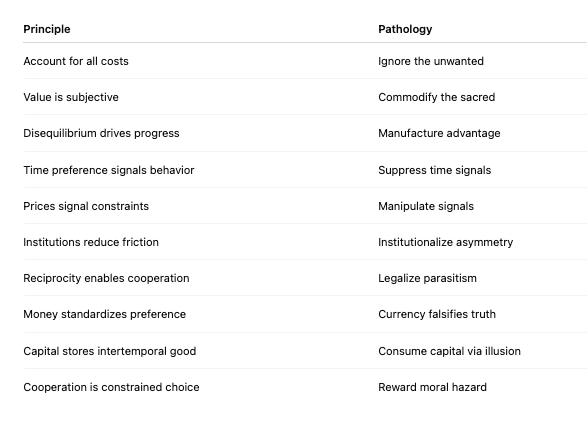
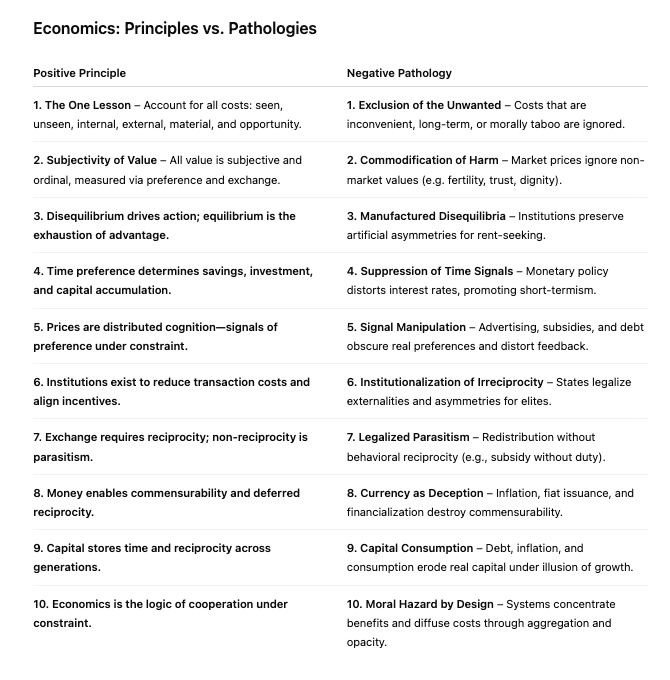
JUDGEMENT: ANGLO VS JEWISH LIBERTARIANISM
IMO
Jewish Libertarianism (economic libertinism) > Mises-Rothbard-Hoppe reduction of all social science to statements of property (demonstrated interests) as a system of commensurability across the spectrum of human behavior. The failure is the anti-statism which effectively makes commons impossible to produce, yet the west defeated it’s competitors by its ability to produce commons especially that of high trust.
Anglo Classical Liberalism (Hayekian Libertarianism) > In addition to a fully empirical system of government: natural law, common law, concurrent legislation, and the division of powers, hayekians produced what was missing from economic thought: full accounting of all capital upon which all people in all polities depend: formal and informal. (My contribution is informational, and genetic capital.) This allowed the formation of high trust commons where the libettinism of jewish libertarianism incentivized low trust commons – and particularly the conversion of public common capital to private capital which is the reason for the long standing prosecution of jews in every society they inhabit.
My work unites these two thereby reforming classical liberalism (rule of law libertarianism), as a science of cooperation applied to institutional formation.
Reply addressees: @DRolandAnderson @DavidAcostaJua1 @LudwigNverMises
IN REPLY TO:
@DRolandAnderson
I agree. @curtdoolittle incorporates a lot of the same thinkers as Libertarians into his approach. And what I’m coming to think of as “Zoomer Libertarianism” is why I pay attention to @LudwigNverMises.
I also believe that Strauss-Howe Generational Theory offers some good lessons for Libertarians. I don’t think Libertarians are “wrong,” but I think the approach is counter-cyclical, in that a 4th Turning is characterized by a low supply of order and a high demand for order.
Winter is a bad time to plant crops.
Original post: https://twitter.com/i/web/status/1916197496654860625