|
Just as we evolve property from common to private;
Just as we evolve the suppression of parasitism from criminal, to fraudulent, to free riding, to conspiratorial, to warfare;
Just as we evolve argument from mysticism to reason, to rationalism, to empiricism, to testimonialism;
We also evolve truth from justificationary, to moral, to legal, to scientific, to testimonial.
Each thing we do removes frictions AND costs. |
Theme: Property
-
We Evolve A Reductions in Frictions and Costs
-
Propertarianism for the Practical
By William Butchman —“My chief interest in Propertarianism is practical. I want to know the truth so that I can use it to help my people. I am not interested in the truth outside of my genetic self interest. I am not a good man attempting to do good in the universe. I am a selfish man who selfishly loves his people. In exactly the same way I would use any new weaponry to defeat our enemies, I will use Propertarianism to defeat them. I don’t want our people to be the Good Guys. I want our people to rule. I seek nothing more than our Sovereignty over every domain that we can master.”—
-
Propertarianism for the Practical
By William Butchman —“My chief interest in Propertarianism is practical. I want to know the truth so that I can use it to help my people. I am not interested in the truth outside of my genetic self interest. I am not a good man attempting to do good in the universe. I am a selfish man who selfishly loves his people. In exactly the same way I would use any new weaponry to defeat our enemies, I will use Propertarianism to defeat them. I don’t want our people to be the Good Guys. I want our people to rule. I seek nothing more than our Sovereignty over every domain that we can master.”—
-
Overview of Propertarianism’s Main Themes
OVERVIEW OF PROPERTARIANISM’S MAIN THEMES Quick Note Turned into a Post. If you watch (1) the intertemporal division of perception, (2) the intercultural division of perception (circumpolar people), and (3) listen to this podcast (civilizational strategies); And if you catch that consistently across the personal, interpersonal, national, and civilizational strategies, that I CONSISTENTLY try to draw your attention to the three possible means of governance (coercion): religion/gossp/ostracization, trade/remuneration, and law/order/violence, you will begin to see the pattern that I work with that is VERY DIFFERENT from the idealism of ‘equality’ or even near equality. And if you then grasp that all human intuition, mind, emotion, reason, exists for the simple purpose of acquisition. And our intuitions vary only be reproductive strategy(gender) and our desirability(class). And that our emotional reward system is nothing more than evidence of changes in the state of property. And that we act to acquire property in toto. And that we negotiate for acquiring what we desire to fulfill our strategy. And that we signal by a thousand means in order to improve our negotiating position. And if you are enough of a philosopher to grasp that I divide categories of argument into the equivalent of increasingly articulate mathematical disciplines. (see my hierarchies of argument) – and we use them to honestly, dishonestly, wishfully, foolishly, and rarely truthfully, use them to negotiate with one another. And if you then you bring in the various dimensions by which I ask we test propositions (testimonialism’s six dimensional tests of due diligence necessary for warranty of propositions), And that the only way we make use of information across all our perceptions, is when we cooperate (Trade) voluntarily. And then that we can ‘calculate’ together fastest, most competitively, if we make use of (1)natural, judge-discovered, common law, jury, (2) a market for reproduction (marriage and family), (3) a market for the production of good and services in support of the market for reproduction, (4) and a market for the production of commons. And that we have domesticated mankind through incremental suppression of parasitism thereby enforcing production. And that we have only now to expand our suppression of parasitism to counter the development of media, so that we prevent propaganda and deceit in every walk of life. Then you have social science as I describe it in Propertarianism. (Natural Law), and the solutions to the majority of current problems. Stop lying, stop parasitism, and stop involuntary association, and that’s what it takes. My next series of thought will be criticisms of the attempt to preserve the monopoly of territory on the continent by the federal government. And I will continue to work on religion while I do that.
-
Overview of Propertarianism’s Main Themes
OVERVIEW OF PROPERTARIANISM’S MAIN THEMES Quick Note Turned into a Post. If you watch (1) the intertemporal division of perception, (2) the intercultural division of perception (circumpolar people), and (3) listen to this podcast (civilizational strategies); And if you catch that consistently across the personal, interpersonal, national, and civilizational strategies, that I CONSISTENTLY try to draw your attention to the three possible means of governance (coercion): religion/gossp/ostracization, trade/remuneration, and law/order/violence, you will begin to see the pattern that I work with that is VERY DIFFERENT from the idealism of ‘equality’ or even near equality. And if you then grasp that all human intuition, mind, emotion, reason, exists for the simple purpose of acquisition. And our intuitions vary only be reproductive strategy(gender) and our desirability(class). And that our emotional reward system is nothing more than evidence of changes in the state of property. And that we act to acquire property in toto. And that we negotiate for acquiring what we desire to fulfill our strategy. And that we signal by a thousand means in order to improve our negotiating position. And if you are enough of a philosopher to grasp that I divide categories of argument into the equivalent of increasingly articulate mathematical disciplines. (see my hierarchies of argument) – and we use them to honestly, dishonestly, wishfully, foolishly, and rarely truthfully, use them to negotiate with one another. And if you then you bring in the various dimensions by which I ask we test propositions (testimonialism’s six dimensional tests of due diligence necessary for warranty of propositions), And that the only way we make use of information across all our perceptions, is when we cooperate (Trade) voluntarily. And then that we can ‘calculate’ together fastest, most competitively, if we make use of (1)natural, judge-discovered, common law, jury, (2) a market for reproduction (marriage and family), (3) a market for the production of good and services in support of the market for reproduction, (4) and a market for the production of commons. And that we have domesticated mankind through incremental suppression of parasitism thereby enforcing production. And that we have only now to expand our suppression of parasitism to counter the development of media, so that we prevent propaganda and deceit in every walk of life. Then you have social science as I describe it in Propertarianism. (Natural Law), and the solutions to the majority of current problems. Stop lying, stop parasitism, and stop involuntary association, and that’s what it takes. My next series of thought will be criticisms of the attempt to preserve the monopoly of territory on the continent by the federal government. And I will continue to work on religion while I do that.
-
Clarification of Property, Possession, Rights
HOMESTEADING(CREATION) -> POSSESSION(DEFENSE) -> PROPERTY(NORM) -> PROPERTY RIGHTS(LAW) It’s probably clearer to label possession as my opinion and property as insured by third parties. I can possess material things, but I can have an interest in far more things. I’m going to try to correct this in my own usage.
I may hold possessions, but property is a normative construction, and property rights are a legal construction. And I think that is pretty much what the common law says.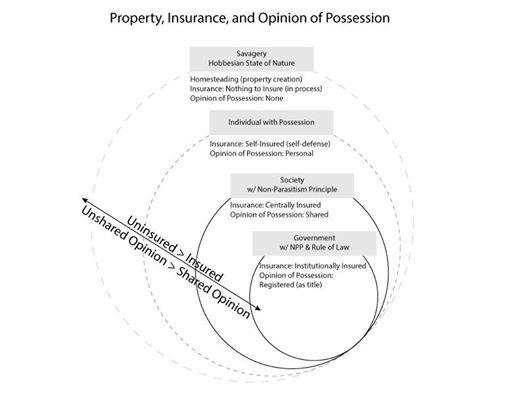
-
Clarification of Property, Possession, Rights
HOMESTEADING(CREATION) -> POSSESSION(DEFENSE) -> PROPERTY(NORM) -> PROPERTY RIGHTS(LAW) It’s probably clearer to label possession as my opinion and property as insured by third parties. I can possess material things, but I can have an interest in far more things. I’m going to try to correct this in my own usage.
I may hold possessions, but property is a normative construction, and property rights are a legal construction. And I think that is pretty much what the common law says.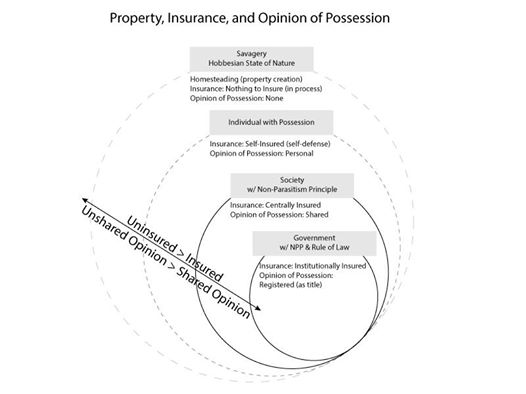
-
Just as we evolve property from common to private, Just as we evolve the suppres
Just as we evolve property from common to private,
Just as we evolve the suppression of parasitism from criminal, to fraudulent, to free riding, to conspiratorial, to warfare;
Just as we evolve from mysticism to reason, to rationalism, to empiricism, to testimonialism;
we also evolve truth from justificationary, to moral, to honesty, to scientific, to testimonial.
Each thing we do removes frictions.
Source date (UTC): 2016-09-17 09:17:00 UTC
-
Define “Crime” in Propertarian Terms
I use the word both as the name of the set of impositions against which we use the threat of force in retaliation, and as a specific subset of crimes: those that are physical and interpersonal. I would prefer not to use the word for both, but I can’t find a good substitute Criminal : imposition of costs by physical means. Unethical ; imposition of costs by informational means. Immoral : imposition of costs by external means Conspiratorial : organizing to impose sustainable costs. Warfare : Organizing to impose unsustainable costs (conquest) So I would say all imposition of costs is criminal in all cases. And I would say that imposition of costs by interpersonal physical means is criminal. To add to the confusion, just like we say we use the term moral for subjectively, normatively, and objectively moral rules, but only objectively moral is in fact moral; just as we say regulation and legislation are law, but only law is law – the others are commands. We can use the word ‘crime’ loosely, and we usually do, by referring to that which is enumerated in law. So there is normatively punishable crime and normatively unpunishable crime, versus objective crime. So how to get around this problem? I tend to speak in objective terms, and then use the adjective ‘normative’ or ‘legal’ to refer to normative and institutional crimes. Objective crime: those impositions of cost which we can and will retaliate against. Objective crimes: physical interpersonal crimes. Legal Crimes, or Crimes in Law: those crimes that are captured in law.
-
Define “Crime” in Propertarian Terms
I use the word both as the name of the set of impositions against which we use the threat of force in retaliation, and as a specific subset of crimes: those that are physical and interpersonal. I would prefer not to use the word for both, but I can’t find a good substitute Criminal : imposition of costs by physical means. Unethical ; imposition of costs by informational means. Immoral : imposition of costs by external means Conspiratorial : organizing to impose sustainable costs. Warfare : Organizing to impose unsustainable costs (conquest) So I would say all imposition of costs is criminal in all cases. And I would say that imposition of costs by interpersonal physical means is criminal. To add to the confusion, just like we say we use the term moral for subjectively, normatively, and objectively moral rules, but only objectively moral is in fact moral; just as we say regulation and legislation are law, but only law is law – the others are commands. We can use the word ‘crime’ loosely, and we usually do, by referring to that which is enumerated in law. So there is normatively punishable crime and normatively unpunishable crime, versus objective crime. So how to get around this problem? I tend to speak in objective terms, and then use the adjective ‘normative’ or ‘legal’ to refer to normative and institutional crimes. Objective crime: those impositions of cost which we can and will retaliate against. Objective crimes: physical interpersonal crimes. Legal Crimes, or Crimes in Law: those crimes that are captured in law.