—“People (division of labor) and prices (distribution of knowledge) have different long term incentives. People have children, prices do not.”—Luke Weinhagen
Source date (UTC): 2020-02-20 11:39:00 UTC
—“People (division of labor) and prices (distribution of knowledge) have different long term incentives. People have children, prices do not.”—Luke Weinhagen
Source date (UTC): 2020-02-20 11:39:00 UTC
ON FARMERS IN THE DIVISION OF LABOR
(The flip side of “I, Pencil”.) (probably an important lesson)
Military(organization of territory) <> Judiciary (organization of cooperation-contract) <> Finance (organization of money(stored time)) <> Entrepreneurship (Organization of opportunity, capital, people) <> Professionals (organization of production(calculation)) <> Managers (Organization of people) <> Producers (Organization of resources) <> Distributors (organization of distribution) <> Trade (organization of transactions) <> Consumers (organization of consumption) <> Parents (organization of reproduction) <> teachers, priests, public intellectuals politicians ( sedation, facilitation, and amelioration of stress arising from scarcity, individual and familial irrelevance, and alienation in the division of labor upon which they depend.)
Given the problem of “I,Pencil” (distribution of knowledge), an individual farmer has to input a lot of diverse knowledge and effort for low return on investment, in no small part because petroleum products, industrialization, fertilizer, feed were fully commoditized.
A farmer organizes primary resources (animals, food stuffs) and as such must be a skilled craftsman (organizers of specialized resources) at the very limit of craftsman’s capital (tools – no other craftsman requires so many tools).
But the returns on the organization of resources are small – there are few multipliers. As you move up the production hierarchy you are responsible for organizing more and more and more people – where there are multipliers.
This is why Marx is wrong. In order to organize people by rational incentives, one must produce marginal competitive differences by which to influence their choices.
As such the entire difficulty in organizing production is organizing the human beings in a vast network to engage in it with nothing other than the bribe of doing the work (payment).
Source date (UTC): 2020-02-20 08:41:00 UTC
photos_and_videos/TimelinePhotos_kg5QueHwVw/87045742_212213076843520_3179351546613727232_n_212213073510187.jpg ON FARMERS IN THE DIVISION OF LABOR
(The flip side of “I, Pencil”.) (probably an important lesson)
Military(organization of territory) <> Judiciary (organization of cooperation-contract) <> Finance (organization of money(stored time)) <> Entrepreneurship (Organization of opportunity, capital, people) <> Professionals (organization of production(calculation)) <> Managers (Organization of people) <> Producers (Organization of resources) <> Distributors (organization of distribution) <> Trade (organization of transactions) <> Consumers (organization of consumption) <> Parents (organization of reproduction) <> teachers, priests, public intellectuals politicians ( sedation, facilitation, and amelioration of stress arising from scarcity, individual and familial irrelevance, and alienation in the division of labor upon which they depend.)
Given the problem of “I,Pencil” (distribution of knowledge), an individual farmer has to input a lot of diverse knowledge and effort for low return on investment, in no small part because petroleum products, industrialization, fertilizer, feed were fully commoditized, and distribution.
A farmer organizes primary resources (animals, food stuffs) and as such must be a skilled craftsman (organizers of specialized resources) at the very limit of craftsman’s capital (tools – no other craftsman requires so many tools).
But the returns on the organization of resources are small – there are few multipliers. As you move up the production hierarchy you are responsible for organizing more and more and more people – where there are multipliers.
This is why Marx is wrong. In order to organize people by rational incentives, one must produce marginal competitive differences by which to influence their choices.
As such the entire difficulty in organizing production is organizing the human beings in a vast network to engage in it with nothing other than the bribe of doing the work (payment).
—-
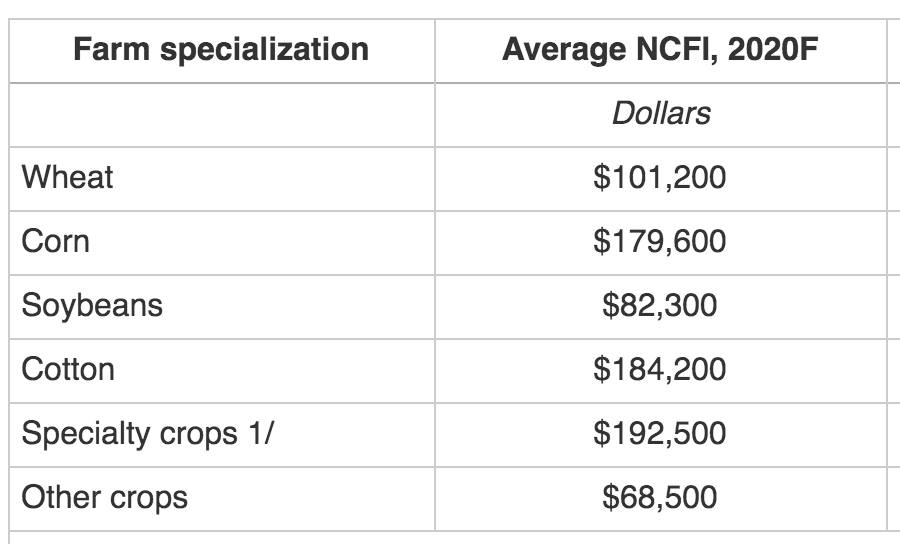
(See attached net income for farms)ON FARMERS IN THE DIVISION OF LABOR
(The flip side of “I, Pencil”.) (probably an important lesson)
Military(organization of territory) <> Judiciary (organization of cooperation-contract) <> Finance (organization of money(stored time)) <> Entrepreneurship (Organization of opportunity, capital, people) <> Professionals (organization of production(calculation)) <> Managers (Organization of people) <> Producers (Organization of resources) <> Distributors (organization of distribution) <> Trade (organization of transactions) <> Consumers (organization of consumption) <> Parents (organization of reproduction) <> teachers, priests, public intellectuals politicians ( sedation, facilitation, and amelioration of stress arising from scarcity, individual and familial irrelevance, and alienation in the division of labor upon which they depend.)
Given the problem of “I,Pencil” (distribution of knowledge), an individual farmer has to input a lot of diverse knowledge and effort for low return on investment, in no small part because petroleum products, industrialization, fertilizer, feed were fully commoditized, and distribution.
A farmer organizes primary resources (animals, food stuffs) and as such must be a skilled craftsman (organizers of specialized resources) at the very limit of craftsman’s capital (tools – no other craftsman requires so many tools).
But the returns on the organization of resources are small – there are few multipliers. As you move up the production hierarchy you are responsible for organizing more and more and more people – where there are multipliers.
This is why Marx is wrong. In order to organize people by rational incentives, one must produce marginal competitive differences by which to influence their choices.
As such the entire difficulty in organizing production is organizing the human beings in a vast network to engage in it with nothing other than the bribe of doing the work (payment).
—-
(See attached net income for farms)
Source date (UTC): 2020-02-20 08:41:00 UTC
P METHODOLOGY PRODUCES OPTIMUMS, THIS IS IDEAL
By: Luke Weinhagen (via Brandon Hayes) (edited for clarity)
1) Presentation of content creates a cost of consumption,
2) Brands compete on that cost to the producer and discount to the consumer:
3) P competence – creates the ability to generate functional output with P
4) P craftsmanship – creates the ability to generate functional output with P that survives market competition
Various markets will value differing aesthetics(interests, concerns, values), meaning different expressions of craftsmanship will survive in different markets.
So the first barrier is the development of competence (be able to make it your own), and the second barrier is developing and executing appropriate craftsmanship for a specific market (be able to speak it into your audience).
I do not know that any of us has cracked the code on a single way to bring P to every audience. We are still crafting our messages to audiences.
Bill demonstrated this very effectively recently. He expressed a desire to elevate his craftsmanship in P and created an audience, a market, receptive to this expression of P.
Others of us are going to have to slum it, speaking with less precision and using more colloquial language, in order to serve audiences receptive at that level.
Both function to improve P as inputs can be pulled back in from all markets. And in my opinion all increases in craftsmanship, regardless of market, serve to benefit the overall widespread adoption of P methodology.Updated Feb 15, 2020, 3:31 PM
Source date (UTC): 2020-02-15 15:31:00 UTC
It is very hard to make your first million. It is very easy to make every additional million.
After you have enough money saved that you can survive for one year without income you will feel very different about life – because everything left is now your choice.
Source date (UTC): 2020-02-15 02:41:13 UTC
Original post: https://twitter.com/i/web/status/1228509540699820032
Reply addressees: @NoahRevoy
Replying to: https://twitter.com/i/web/status/1228333484143497216
How long do you think it takes to reorganize an economy subject to externalization of capital intensive industries that employ labor, and all the required suppliers and vendors in each network in the chain of production? It will take at least twelve years.
Source date (UTC): 2020-02-11 16:23:49 UTC
Original post: https://twitter.com/i/web/status/1227267001560838144
Reply addressees: @AMCarbonaro @realDonaldTrump @SecPompeo
Replying to: https://twitter.com/i/web/status/1227266581996150784
IN REPLY TO:
Original post on X
Original tweet unavailable — we could not load the text of the post this reply is addressing on X. That usually means the tweet was deleted, the account is protected, or X does not expose it to the account used for archiving. The Original post link below may still open if you view it in X while signed in.
Original post: https://twitter.com/i/web/status/1227266581996150784
—“Homogeny is closer to equality, but absolute equality only exists as entropy(devolution). What we want is an equilibrium where benefits of division of labor most outweigh the costs of diverging interests.”—Martin Štěpán
(This is an example why I spent years at this task. To make new leadership for a new world. And look at these guys. Something happened. A new critical mass. It’s beautiful.)
Source date (UTC): 2020-02-08 09:47:00 UTC
I found that the number of responses (participants) wasn’t worth the time to run them, and that in general people aren’t that good at that level of work. It’s better to just get them to grasp the arguments
Source date (UTC): 2020-02-07 00:45:49 UTC
Original post: https://twitter.com/i/web/status/1225581394270859265
Reply addressees: @eruditenights
Replying to: https://twitter.com/i/web/status/1225578922336825345
IN REPLY TO:
@eruditenights
If you’re going to pursue the idea again
Original post: https://twitter.com/i/web/status/1225578922336825345
PRODUCTION OF WHAT?
Commons, Goods, Services, Information, and Incentives.
The problem demarcation between scientists that supply information and ‘intellectuals’ that provide incentives unbound by science: truth and reciprocity.
|PRODUCTION| Commons > Consumption: Goods > Services > Information > Incentives
Are there any good intellectuals? Or are they all priests selling false promise baiting the people into hazard?
Source date (UTC): 2020-02-06 07:34:00 UTC
Stuff is just like drugs. a fake high. build the biggest family that doesn’t bankrupt you. It has the highest returns of all.
…. I wish I had known that.
Source date (UTC): 2020-02-05 20:03:00 UTC