May 10, 2020, 10:14 AM We don’t think of it geometrically but that’s the best frame for representing it’s organization. Our senses (nervous system) register pulses, which vary only in on-off, and frequency – a measurement – and we combine those measurements, because our body is a system of commensurability, into a world-model useful for our actions. Then we describe the world in combinations of sense-perceptions. The second fundamental problem with AI so far (aside from our hardware is architected inversely) is that it has no system of commensurability like we have – the body – and so it cannot develop consciousness: a model with predictive differences given our possible actions (physical, logical, verbal). Archetypes – prototype measurements of combinations of instincts Stereotypes – consistent predictions from measurements. In the Foundations Course, I frame our consciousness geometrically from the start. Unfortunately constitution and revolution is more pressing than continuing work on consciousness and behaviour but I will get there….
Theme: Operationalism
-
Ex-Propertarians Always Sound Like Jilted Ex-Girlfriends
Oct 12, 2019, 1:50 PM by Predmetsky Rosenborg Ex-Propertarians always sound like jilted ex-girlfriends:
–“and that non-operationalizable “abrahamism” word”–
Operationalizing abrahamism is easy…high verbal IQ (median about 129) combined with low visual-spatial (there goes the calculating for physical costs and forces…) care-harm fundamentalism produced by high openness to experience (often correlated with high schizotypy) and agreeableness, moral module predisposes to vulnerable rather than grandiose narcissism (or callous-unemotional as a stand-alone construct), and the predictably high dispositional envy that accompanies it, leading to reversal of hierarchy (the good are evil and the bad are good) — Christianity is Jewish hatred’s most delicate flower of ressentiment rather than its repudiation. All of these things have been operationalized with as much precision as you can find in good psychometrics anywhere. What I’m interested in is in operationalizing sex differences as inherently relative to race (to say nothing of species) rather than considering them as stand-alone constructs. For example, East Asian masculinity and Ashkenazi masculinity and Caucasian masculinity must always be operationalized and studied together and can only ever be separated analytically. sort of like how some lemur species are female-dominant for biological reasons. Most lemur species are female dominant, but only most. So we can speak of mouse lemur (microcebus)-femininity, dwarf lemur (cheirogaleidaes)-femininity, mongoose lemur (lemuridae)-femininity as female dominant instances whereas brown lemur-femininity is more submissive.
-
Ex-Propertarians Always Sound Like Jilted Ex-Girlfriends
Oct 12, 2019, 1:50 PM by Predmetsky Rosenborg Ex-Propertarians always sound like jilted ex-girlfriends:
–“and that non-operationalizable “abrahamism” word”–
Operationalizing abrahamism is easy…high verbal IQ (median about 129) combined with low visual-spatial (there goes the calculating for physical costs and forces…) care-harm fundamentalism produced by high openness to experience (often correlated with high schizotypy) and agreeableness, moral module predisposes to vulnerable rather than grandiose narcissism (or callous-unemotional as a stand-alone construct), and the predictably high dispositional envy that accompanies it, leading to reversal of hierarchy (the good are evil and the bad are good) — Christianity is Jewish hatred’s most delicate flower of ressentiment rather than its repudiation. All of these things have been operationalized with as much precision as you can find in good psychometrics anywhere. What I’m interested in is in operationalizing sex differences as inherently relative to race (to say nothing of species) rather than considering them as stand-alone constructs. For example, East Asian masculinity and Ashkenazi masculinity and Caucasian masculinity must always be operationalized and studied together and can only ever be separated analytically. sort of like how some lemur species are female-dominant for biological reasons. Most lemur species are female dominant, but only most. So we can speak of mouse lemur (microcebus)-femininity, dwarf lemur (cheirogaleidaes)-femininity, mongoose lemur (lemuridae)-femininity as female dominant instances whereas brown lemur-femininity is more submissive.
-
‘Contrast Godel with P – Request from Kash Vikas
Oct 16, 2019, 10:49 AM (Godel is a Platonist and I’m an Operationalist. This contrast is rather helpful in illustrating the operational vs platonist vs empirical.)
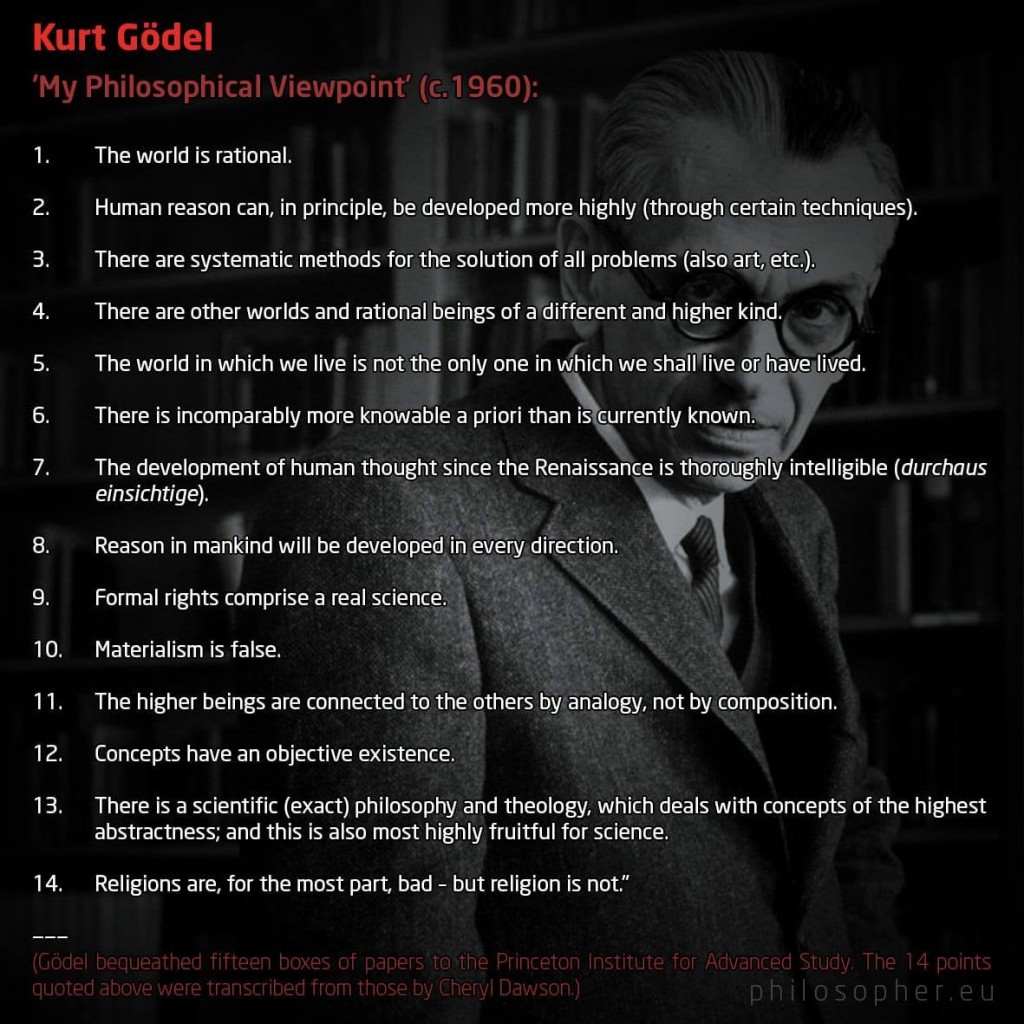
- Man acts rationally, and by rationally amorally. But given the disproportionate value of cooperation, and the disproportionate risk of retaliation, it’s just in his interest to act morally much more often than immorally.
1a. We can incrementally reduce observations of the universe, using our senses, reason, and instrumentation to descriptions of invariant constant relations (paradigms)
1b + 3. We can describe (explain) all of experience as constant relations (a single paradigm) - While our ability to reason is constant, every increase convergence of our instruments and paradigms increases the explanatory power available to our reason.
- The capacity to reason is a deterministic product of entropy at convenient temperatures in convenient conditions, for sufficient periods of time. It is likely that given the vastness of the universe, other creatures have evolved reason, and that while the logic of constant relations will exist, and mathematics as a logic of constant positional relations will exist in some form, that the composition of experience that results from different body structures will result in different techniques for employing reason. (think octopi). And that the ability of these creatures may vastly outperform ours.
- Because we are able to use our powers of prediction using free association to construct a model of the world we exist in, and the worlds we might exist in, and the worlds we cannot exist in, we can experience, many candidate worlds.
5b. The set of demands we evolved and express daily is largely invariant. The set of paradigms we use to imagine opportunities for fulfilling those demands evolves (and devolves) constantly. So while we largely increase the coherence of paradigms, and approach a single paradigm for describing the universe, we have experienced the world differently in the past than in the present, and will so again experience it differently in the future. - If we can construct an operational grammar and paradigm for a given set of constant relations, we can produce an operational logic of that set of constant relations, and conduct experiments logically by trial and error as we do in mathematics. To do so we require convergence of paradigms to the point of marginal indifference of those logical constructions. But the Analytic program failed, and Godel and Frege et all were wrong – closure does not exist.
- Yes the development of thought since Aristotle expanded on Democritus, has been consistent and rational with the exception of the semitic abrahamic dark ages of supernatural ignorance.
- Reason is reason is reasoning and there is nothing to it. There are however endless permutations of reason especially as knowledge increases.
- The via-negativa of Natural Law can be restated in the via-positiva as Natural rights, and this logic and empirical combination produces a science of cooperation, and law the institutional enforcement of cooperation under that law, and economics the measure of it’s success, and economics the language of analysis and measurement within that science.
10.The material(noun) and the Operational(verb) are true (exist, and are testifiable). The platonic (ideal) is false. All sets of constant relations are identified, retained, applied, reinforced, and revised by merging physical stimuli with physical organization of information in the brain, producing a hierarchy of changes in state over time we call ‘experience’. So while it is correct to say that the universe is deterministic (composed of constant relations), it is only correct to say that we can observe sets of constant relations, identify them (category), compare them, name them, and predict future states of of them, and in relation to them. These memories and predications like running consist of physical potential, that produce results in time. In other words, al of reality is constructed physically, from a hierarchy of changes in state over time we call experience. - Concepts do not exist. the potential for Concepts exists. Running only exists when one is running. We have the potential to run. We have the potential to identify sets of constant relations (concepts), but experience of contexts only exist when we are acting to recall them in time.
- It appears we can know the most parsimonious paradigm, and host of parsimonious sub-paradigms of increasing complexity (permutations) allowing us to speak the truth using evidence – science; that we can know the same for choices using arguments – philosophy; and we can know the same for collective organization using stories – theology.
Existing religions are bad to terrible to suicidal – but human psychological, social, political, and strategic demand for the products of ‘religion’ (order) are endless. So we need to educate one another in mindfulness, ethics(interpersonal), morality (extrapersonal), political, and strategic (competitive), by means gracefully increasing and decreasing in accessibility: parable, story, history, reason and general rules, science and outcomes.’
CONTRAST WITH P – REQUEST FROM KASH VIKAS
(Godel is a Platonist and I’m an Operationalist. This contrast is rather helpful in illustrating the operational vs platonist vs empirical.)Man acts rationally, and by rationally amorally. But given the disproportionate value of cooperation, and the disproportionate risk of retaliation, it’s just in his interest to act morally much more often than immorally.
1a. We can incrementally reduce observations of the universe, using our senses, reason, and instrumentation to descriptions of invariant constant relations (paradigms)
1b + 3. We can describe (explain) all of experience as constant relations (a single paradigm)- While our ability to reason is constant, every increase convergence of our instruments and paradigms increases the explanatory power available to our reason.
- The capacity to reason is a deterministic product of entropy at convenient temperatures in convenient conditions, for sufficient periods of time. It is likely that given the vastness of the universe, other creatures have evolved reason, and that while the logic of constant relations will exist, and mathematics as a logic of constant positional relations will exist in some form, that the composition of experience that results from different body structures will result in different techniques for employing reason. (think octopi). And that the ability of these creatures may vastly outperform ours.
- Because we are able to use our powers of prediction using free association to construct a model of the world we exist in, and the worlds we might exist in, and the worlds we cannot exist in, we can experience, many candidate worlds.
5b. The set of demands we evolved and express daily is largely invariant. The set of paradigms we use to imagine opportunities for fulfilling those demands evolves (and devolves) constantly. So while we largely increase the coherence of paradigms, and approach a single paradigm for describing the universe, we have experienced the world differently in the past than in the present, and will so again experience it differently in the future. - If we can construct an operational grammar and paradigm for a given set of constant relations, we can produce an operational logic of that set of constant relations, and conduct experiments logically by trial and error as we do in mathematics. To do so we require convergence of paradigms to the point of marginal indifference of those logical constructions. But the Analytic program failed, and Godel and Frege et all were wrong – closure does not exist.
- Yes the development of thought since Aristotle expanded on Democritus, has been consistent and rational with the exception of the semitic abrahamic dark ages of supernatural ignorance.
- Reason is reason is reasoning and there is nothing to it. There are however endless permutations of reason especially as knowledge increases.
- The via-negativa of Natural Law can be restated in the via-positiva as Natural rights, and this logic and empirical combination produces a science of cooperation, and law the institutional enforcement of cooperation under that law, and economics the measure of it’s success, and economics the language of analysis and measurement within that science.
10.The material(noun) and the Operational(verb) are true (exist, and are testifiable). The platonic (ideal) is false. All sets of constant relations are identified, retained, applied, reinforced, and revised by merging physical stimuli with physical organization of information in the brain, producing a hierarchy of changes in state over time we call ‘experience’. So while it is correct to say that the universe is deterministic (composed of constant relations), it is only correct to say that we can observe sets of constant relations, identify them (category), compare them, name them, and predict future states of of them, and in relation to them. These memories and predications like running consist of physical potential, that produce results in time. In other words, al of reality is constructed physically, from a hierarchy of changes in state over time we call experience. - Concepts do not exist. the potential for Concepts exists. Running only exists when one is running. We have the potential to run. We have the potential to identify sets of constant relations (concepts), but experience of contexts only exist when we are acting to recall them in time.
- It appears we can know the most parsimonious paradigm, and host of parsimonious sub-paradigms of increasing complexity (permutations) allowing us to speak the truth using evidence – science; that we can know the same for choices using arguments – philosophy; and we can know the same for collective organization using stories – theology.
- Existing religions are bad to terrible to suicidal – but human psychological, social, political, and strategic demand for the products of ‘religion’ (order) are endless. So we need to educate one another in mindfulness, ethics(interpersonal), morality (extrapersonal), political, and strategic (competitive), by means gracefully increasing and decreasing in accessibility: parable, story, history, reason and general rules, science and outcomes.
- Man acts rationally, and by rationally amorally. But given the disproportionate value of cooperation, and the disproportionate risk of retaliation, it’s just in his interest to act morally much more often than immorally.
-
‘Contrast Godel with P – Request from Kash Vikas
Oct 16, 2019, 10:49 AM (Godel is a Platonist and I’m an Operationalist. This contrast is rather helpful in illustrating the operational vs platonist vs empirical.)
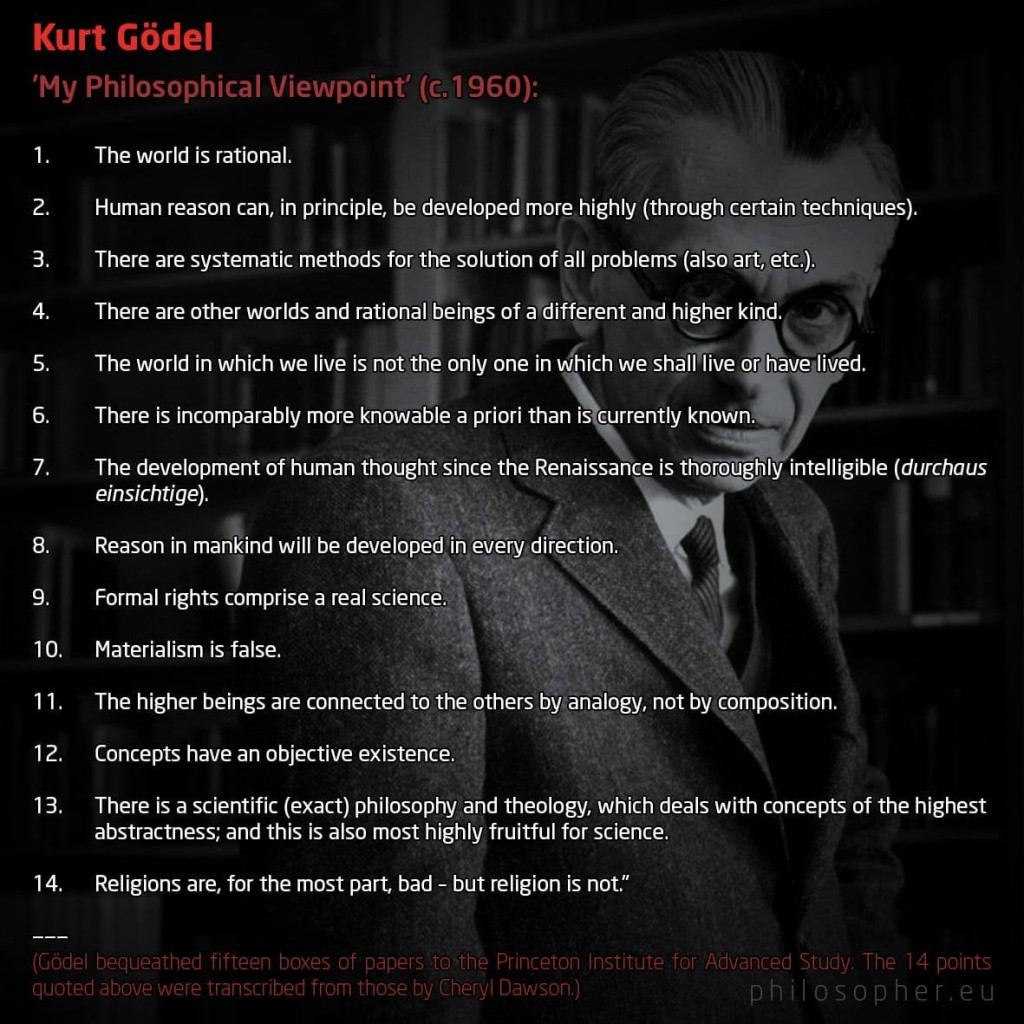
- Man acts rationally, and by rationally amorally. But given the disproportionate value of cooperation, and the disproportionate risk of retaliation, it’s just in his interest to act morally much more often than immorally.
1a. We can incrementally reduce observations of the universe, using our senses, reason, and instrumentation to descriptions of invariant constant relations (paradigms)
1b + 3. We can describe (explain) all of experience as constant relations (a single paradigm) - While our ability to reason is constant, every increase convergence of our instruments and paradigms increases the explanatory power available to our reason.
- The capacity to reason is a deterministic product of entropy at convenient temperatures in convenient conditions, for sufficient periods of time. It is likely that given the vastness of the universe, other creatures have evolved reason, and that while the logic of constant relations will exist, and mathematics as a logic of constant positional relations will exist in some form, that the composition of experience that results from different body structures will result in different techniques for employing reason. (think octopi). And that the ability of these creatures may vastly outperform ours.
- Because we are able to use our powers of prediction using free association to construct a model of the world we exist in, and the worlds we might exist in, and the worlds we cannot exist in, we can experience, many candidate worlds.
5b. The set of demands we evolved and express daily is largely invariant. The set of paradigms we use to imagine opportunities for fulfilling those demands evolves (and devolves) constantly. So while we largely increase the coherence of paradigms, and approach a single paradigm for describing the universe, we have experienced the world differently in the past than in the present, and will so again experience it differently in the future. - If we can construct an operational grammar and paradigm for a given set of constant relations, we can produce an operational logic of that set of constant relations, and conduct experiments logically by trial and error as we do in mathematics. To do so we require convergence of paradigms to the point of marginal indifference of those logical constructions. But the Analytic program failed, and Godel and Frege et all were wrong – closure does not exist.
- Yes the development of thought since Aristotle expanded on Democritus, has been consistent and rational with the exception of the semitic abrahamic dark ages of supernatural ignorance.
- Reason is reason is reasoning and there is nothing to it. There are however endless permutations of reason especially as knowledge increases.
- The via-negativa of Natural Law can be restated in the via-positiva as Natural rights, and this logic and empirical combination produces a science of cooperation, and law the institutional enforcement of cooperation under that law, and economics the measure of it’s success, and economics the language of analysis and measurement within that science.
10.The material(noun) and the Operational(verb) are true (exist, and are testifiable). The platonic (ideal) is false. All sets of constant relations are identified, retained, applied, reinforced, and revised by merging physical stimuli with physical organization of information in the brain, producing a hierarchy of changes in state over time we call ‘experience’. So while it is correct to say that the universe is deterministic (composed of constant relations), it is only correct to say that we can observe sets of constant relations, identify them (category), compare them, name them, and predict future states of of them, and in relation to them. These memories and predications like running consist of physical potential, that produce results in time. In other words, al of reality is constructed physically, from a hierarchy of changes in state over time we call experience. - Concepts do not exist. the potential for Concepts exists. Running only exists when one is running. We have the potential to run. We have the potential to identify sets of constant relations (concepts), but experience of contexts only exist when we are acting to recall them in time.
- It appears we can know the most parsimonious paradigm, and host of parsimonious sub-paradigms of increasing complexity (permutations) allowing us to speak the truth using evidence – science; that we can know the same for choices using arguments – philosophy; and we can know the same for collective organization using stories – theology.
Existing religions are bad to terrible to suicidal – but human psychological, social, political, and strategic demand for the products of ‘religion’ (order) are endless. So we need to educate one another in mindfulness, ethics(interpersonal), morality (extrapersonal), political, and strategic (competitive), by means gracefully increasing and decreasing in accessibility: parable, story, history, reason and general rules, science and outcomes.’
CONTRAST WITH P – REQUEST FROM KASH VIKAS
(Godel is a Platonist and I’m an Operationalist. This contrast is rather helpful in illustrating the operational vs platonist vs empirical.)Man acts rationally, and by rationally amorally. But given the disproportionate value of cooperation, and the disproportionate risk of retaliation, it’s just in his interest to act morally much more often than immorally.
1a. We can incrementally reduce observations of the universe, using our senses, reason, and instrumentation to descriptions of invariant constant relations (paradigms)
1b + 3. We can describe (explain) all of experience as constant relations (a single paradigm)- While our ability to reason is constant, every increase convergence of our instruments and paradigms increases the explanatory power available to our reason.
- The capacity to reason is a deterministic product of entropy at convenient temperatures in convenient conditions, for sufficient periods of time. It is likely that given the vastness of the universe, other creatures have evolved reason, and that while the logic of constant relations will exist, and mathematics as a logic of constant positional relations will exist in some form, that the composition of experience that results from different body structures will result in different techniques for employing reason. (think octopi). And that the ability of these creatures may vastly outperform ours.
- Because we are able to use our powers of prediction using free association to construct a model of the world we exist in, and the worlds we might exist in, and the worlds we cannot exist in, we can experience, many candidate worlds.
5b. The set of demands we evolved and express daily is largely invariant. The set of paradigms we use to imagine opportunities for fulfilling those demands evolves (and devolves) constantly. So while we largely increase the coherence of paradigms, and approach a single paradigm for describing the universe, we have experienced the world differently in the past than in the present, and will so again experience it differently in the future. - If we can construct an operational grammar and paradigm for a given set of constant relations, we can produce an operational logic of that set of constant relations, and conduct experiments logically by trial and error as we do in mathematics. To do so we require convergence of paradigms to the point of marginal indifference of those logical constructions. But the Analytic program failed, and Godel and Frege et all were wrong – closure does not exist.
- Yes the development of thought since Aristotle expanded on Democritus, has been consistent and rational with the exception of the semitic abrahamic dark ages of supernatural ignorance.
- Reason is reason is reasoning and there is nothing to it. There are however endless permutations of reason especially as knowledge increases.
- The via-negativa of Natural Law can be restated in the via-positiva as Natural rights, and this logic and empirical combination produces a science of cooperation, and law the institutional enforcement of cooperation under that law, and economics the measure of it’s success, and economics the language of analysis and measurement within that science.
10.The material(noun) and the Operational(verb) are true (exist, and are testifiable). The platonic (ideal) is false. All sets of constant relations are identified, retained, applied, reinforced, and revised by merging physical stimuli with physical organization of information in the brain, producing a hierarchy of changes in state over time we call ‘experience’. So while it is correct to say that the universe is deterministic (composed of constant relations), it is only correct to say that we can observe sets of constant relations, identify them (category), compare them, name them, and predict future states of of them, and in relation to them. These memories and predications like running consist of physical potential, that produce results in time. In other words, al of reality is constructed physically, from a hierarchy of changes in state over time we call experience. - Concepts do not exist. the potential for Concepts exists. Running only exists when one is running. We have the potential to run. We have the potential to identify sets of constant relations (concepts), but experience of contexts only exist when we are acting to recall them in time.
- It appears we can know the most parsimonious paradigm, and host of parsimonious sub-paradigms of increasing complexity (permutations) allowing us to speak the truth using evidence – science; that we can know the same for choices using arguments – philosophy; and we can know the same for collective organization using stories – theology.
- Existing religions are bad to terrible to suicidal – but human psychological, social, political, and strategic demand for the products of ‘religion’ (order) are endless. So we need to educate one another in mindfulness, ethics(interpersonal), morality (extrapersonal), political, and strategic (competitive), by means gracefully increasing and decreasing in accessibility: parable, story, history, reason and general rules, science and outcomes.
- Man acts rationally, and by rationally amorally. But given the disproportionate value of cooperation, and the disproportionate risk of retaliation, it’s just in his interest to act morally much more often than immorally.
-
Human Cognition in P
Human Cognition in P https://propertarianism.com/2020/05/27/human-cognition-in-p/
Source date (UTC): 2020-05-27 15:48:45 UTC
Original post: https://twitter.com/i/web/status/1265671291505446914
-
Human Cognition in P
Human Cognition in P
Intuition-----------------Reason---------------Operationalism
Free Association -------Hypothesis---------------------Theory
Empathy------------------Sympathy--------------------Evidence
Story -------------------- Ideal ------------------ Testimony
Fiction-----Theology --- Sophistry --- Pseudoscience -----Lie
Internal Market - Interpersonal Verbal Market - Action Market
Competition-------------Competition --------------Competition
-
Human Cognition in P
Human Cognition in P
Intuition-----------------Reason---------------Operationalism
Free Association -------Hypothesis---------------------Theory
Empathy------------------Sympathy--------------------Evidence
Story -------------------- Ideal ------------------ Testimony
Fiction-----Theology --- Sophistry --- Pseudoscience -----Lie
Internal Market - Interpersonal Verbal Market - Action Market
Competition-------------Competition --------------Competition
-
Definition: Parsimony
Nov 13, 2019, 9:21 AM DEFINITION: PARSIMONY “Lowest cost across all dimensions testable by man” EXPANSION – Given human faculties: sense, disambiguation (constant relations), perception(integration-prediction), auto-association-prediction, attention-prediction (will), recursion-prediction, and release of actions; – And dimensions of tests of constant relations: free associative, categorical, logical, empirical, operational, rational choice, reciprocal rational choice, completeness; Parsimony must refer to: “Lowest Cost”, expanded to:
- the lowest cost (least information), description of a chain of causation
- surviving tests of: entropy, realism, naturalism, operationalism,
and;
bounded rational self interest:
- in the seizure of opportunity,
- from the field of identified opportunities,
- given the opportunity cost of the opportunity,
- determined by competition for the greatest return in the shortest time for the least effort, with the greatest certainty at the lowest risk,
- to the point of disequilibrium and subsequent re-equilibration,
eliminating the opportunity from the field of opportunities.
and
- reciprocity (repeating the above) is the only productive rather than parasitic (costly) means of interaction.
(- although parasitism and predation are profitable means of interaction, they are consumptive not productive.)
The difference between: – Testimony (due diligence by self), – Coherence(consistency by audience), – Parsimony(competition by market), … is grammatical (point-of-view), and an application of and conformity to, – the law of epistemology (free association-idea-> hypothesis-surviving > theory-surviving > application-surviving) I can fuss with this a bit to make it as tight as reciprocity and testimony, or any of the other definitions, but ‘skeptical subjective testing against Occam’s Razor serves as the colloquial reduction.
-
Definition: Parsimony
Nov 13, 2019, 9:21 AM DEFINITION: PARSIMONY “Lowest cost across all dimensions testable by man” EXPANSION – Given human faculties: sense, disambiguation (constant relations), perception(integration-prediction), auto-association-prediction, attention-prediction (will), recursion-prediction, and release of actions; – And dimensions of tests of constant relations: free associative, categorical, logical, empirical, operational, rational choice, reciprocal rational choice, completeness; Parsimony must refer to: “Lowest Cost”, expanded to:
- the lowest cost (least information), description of a chain of causation
- surviving tests of: entropy, realism, naturalism, operationalism,
and;
bounded rational self interest:
- in the seizure of opportunity,
- from the field of identified opportunities,
- given the opportunity cost of the opportunity,
- determined by competition for the greatest return in the shortest time for the least effort, with the greatest certainty at the lowest risk,
- to the point of disequilibrium and subsequent re-equilibration,
eliminating the opportunity from the field of opportunities.
and
- reciprocity (repeating the above) is the only productive rather than parasitic (costly) means of interaction.
(- although parasitism and predation are profitable means of interaction, they are consumptive not productive.)
The difference between: – Testimony (due diligence by self), – Coherence(consistency by audience), – Parsimony(competition by market), … is grammatical (point-of-view), and an application of and conformity to, – the law of epistemology (free association-idea-> hypothesis-surviving > theory-surviving > application-surviving) I can fuss with this a bit to make it as tight as reciprocity and testimony, or any of the other definitions, but ‘skeptical subjective testing against Occam’s Razor serves as the colloquial reduction.