Four years of art criticism. The primary rule of which was ‘no empty words’. One had to make thoughtful compliments and thoughtful criticisms.
It sticks with you.
DIMENSIONS:
1) Craft Scale (Craftsmanship(presence of resources))
2) Design Scale (Aesthetics (presence of resources))
3) Content (“Meaning” (presence of resources)) Scale (Population)
4) Monument Scale (Capital (Presence of resources))
Using triangulation you can rate any of ‘art, craft, or design’, by these measures. Value remains subjective but capital remains objective. Sorry, just how it is.
But what I like to shock people with, is that beauty = fertility: the presence of resources. We judge art like we judge fertility in each other.
It really is that simple.
Theme: Measurement
-
Four years of art criticism. The primary rule of which was ‘no empty words’. One
Four years of art criticism. The primary rule of which was ‘no empty words’. One had to make thoughtful compliments and thoughtful criticisms. It sticks with you. DIMENSIONS: 1) Craft Scale (Craftsmanship(presence of resources)) 2) Design Scale (Aesthetics (presence of resources)) 3) Content (“Meaning” (presence of resources)) Scale (Population) 4) Monument Scale (Capital (Presence of resources)) Using triangulation you can rate any of ‘art, craft, or design’, by these measures. Value remains subjective but capital remains objective. Sorry, just how it is. But what I like to shock people with, is that beauty = fertility: the presence of resources. We judge art like we judge fertility in each other. It really is that simple. -
Four years of art criticism. The primary rule of which was ‘no empty words’. One
Four years of art criticism. The primary rule of which was ‘no empty words’. One had to make thoughtful compliments and thoughtful criticisms.
It sticks with you.
DIMENSIONS:
1) Craft Scale (Craftsmanship(presence of resources))
2) Design Scale (Aesthetics (presence of resources))
3) Content (“Meaning” (presence of resources)) Scale (Population)
4) Monument Scale (Capital (Presence of resources))
Using triangulation you can rate any of ‘art, craft, or design’, by these measures. Value remains subjective but capital remains objective. Sorry, just how it is.
But what I like to shock people with, is that beauty = fertility: the presence of resources. We judge art like we judge fertility in each other.
It really is that simple.
Source date (UTC): 2017-09-27 16:50:00 UTC
-
Mind Blowing Version Two
It’s really that simple. And yes, we can produce a periodic table of speech. I swear I could spend a whole year just documenting what this whole thing means, and adding variations to it. -
Mind Blowing Version Two
It’s really that simple. And yes, we can produce a periodic table of speech. I swear I could spend a whole year just documenting what this whole thing means, and adding variations to it. -
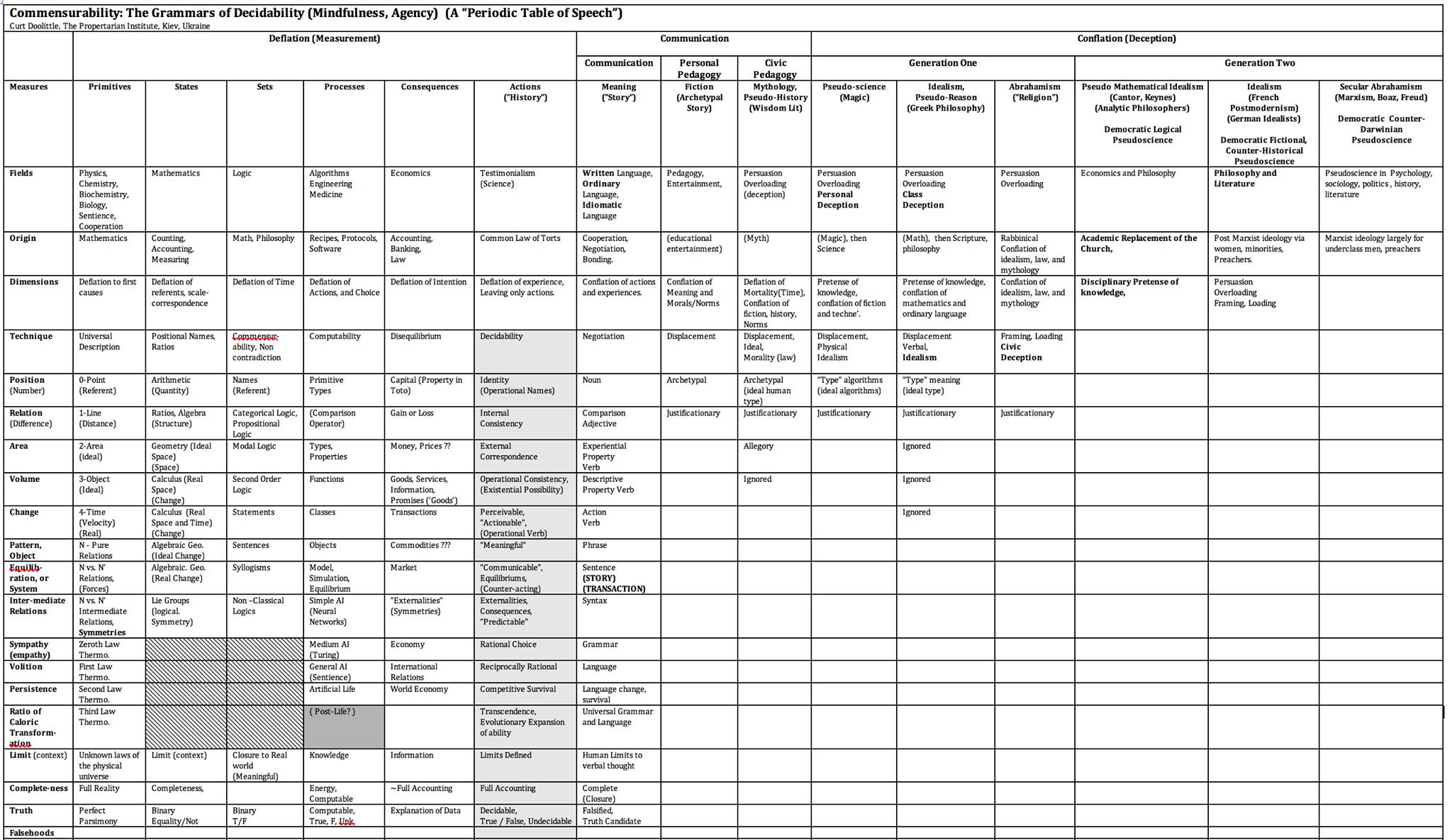
photos_and_videos/TimelinePhotos_43196237263/21768570_10155750234557264_37181375
photos_and_videos/TimelinePhotos_43196237263/21768570_10155750234557264_3718137554012735853_o_10155750234557264.jpg MIND BLOWING VERSION TWO
It’s really that simple. And yes, we can produce a periodic table of speech.
I swear I could spend a whole year just documenting what this whole thing means, and adding variations to it.Mea CulbaI can’t read it!Sep 25, 2017 3:32pmCurt DoolittleNonsense. Do I need to educate you on basics? click to open the theater view. download the image. Open it your browser and zoom it. The image is fine.Sep 25, 2017 4:11pmMea CulbaIt’s just my cellphone then! SorrySep 25, 2017 4:16pmGünther Shroomacherwould be great to have higher resolutionSep 26, 2017 9:47amMIND BLOWING VERSION TWO
It’s really that simple. And yes, we can produce a periodic table of speech.
I swear I could spend a whole year just documenting what this whole thing means, and adding variations to it.
Source date (UTC): 2017-09-25 14:36:00 UTC
-
“What do believe is the qualitative difference between human and animal language
—“What do believe is the qualitative difference between human and animal language?”—Bob Robertson As far as I know animals do not possess language, it only exists within humans. All other creatures merely manage to communicate. Charles Hockett (1967) introduced a generally accepted check list for language, a set of features that all human languages possess. His seven key properties are: 1 – productivity (the ability to create and understand new utterances): system which makes it possible to construct an unlimited number of sentences from a limited set of rules. 2 – arbitrariness (when signs/words do not resemble the things they represent), 3 – displacement (the ability to refer to the past and to things not present), and 4 – duality of pattern (the combination of a phonological system and a grammatical system), 5 – interchangeability (the ability to transmit and to receive messages by exchanging roles), 6 – specialization (when the only function of speech is communication and the speaker does not act out his message), 7 – cultural transmission (the ability to teach/learn from other individuals, e.g. by imitation). As far as I know the reason humans can speak is simply brain size and complexity (long chains). But I won’t go into all of it here. But the ability to imagine futures, imagine stories, ‘self-observe’ and describe those stories in a series of symbols, using a series of rules’ takes a great deal of processing power. While we can see elements of these patterns in parrots, corvids, dolphins, and the apes, we must teach them, and they say very simple things – because they only think very simple things. Assuming we selected and trained enough chimpanzees to use sign language to build a self sustaining community of them, and assuming we could leave them on an island for a few centuries, it’s possible that sign language would persist. I suspect the problem is that it’s hard to produce a community of chimps with the intelligence necessary for perpetuation. -
“What do believe is the qualitative difference between human and animal language
—“What do believe is the qualitative difference between human and animal language?”—Bob Robertson As far as I know animals do not possess language, it only exists within humans. All other creatures merely manage to communicate. Charles Hockett (1967) introduced a generally accepted check list for language, a set of features that all human languages possess. His seven key properties are: 1 – productivity (the ability to create and understand new utterances): system which makes it possible to construct an unlimited number of sentences from a limited set of rules. 2 – arbitrariness (when signs/words do not resemble the things they represent), 3 – displacement (the ability to refer to the past and to things not present), and 4 – duality of pattern (the combination of a phonological system and a grammatical system), 5 – interchangeability (the ability to transmit and to receive messages by exchanging roles), 6 – specialization (when the only function of speech is communication and the speaker does not act out his message), 7 – cultural transmission (the ability to teach/learn from other individuals, e.g. by imitation). As far as I know the reason humans can speak is simply brain size and complexity (long chains). But I won’t go into all of it here. But the ability to imagine futures, imagine stories, ‘self-observe’ and describe those stories in a series of symbols, using a series of rules’ takes a great deal of processing power. While we can see elements of these patterns in parrots, corvids, dolphins, and the apes, we must teach them, and they say very simple things – because they only think very simple things. Assuming we selected and trained enough chimpanzees to use sign language to build a self sustaining community of them, and assuming we could leave them on an island for a few centuries, it’s possible that sign language would persist. I suspect the problem is that it’s hard to produce a community of chimps with the intelligence necessary for perpetuation. -
“What do believe is the qualitative difference between human and animal language
—“What do believe is the qualitative difference between human and animal language?”—Bob Robertson
As far as I know animals do not possess language, it only exists within humans. All other creatures merely manage to communicate.
Charles Hockett (1967) introduced a generally accepted check list for language, a set of features that all human languages possess. His seven key properties are:
1 – productivity (the ability to create and understand new utterances): system which makes it possible to construct an unlimited number of sentences from a limited set of rules.
2 – arbitrariness (when signs/words do not resemble the things they represent),
3 – displacement (the ability to refer to the past and to things not present), and
4 – duality of pattern (the combination of a phonological system and a grammatical system),
5 – interchangeability (the ability to transmit and to receive messages by exchanging roles),
6 – specialization (when the only function of speech is communication and the speaker does not act out his message),
7 – cultural transmission (the ability to teach/learn from other individuals, e.g. by imitation).
As far as I know the reason humans can speak is simply brain size and complexity (long chains). But I won’t go into all of it here. But the ability to imagine futures, imagine stories, ‘self-observe’ and describe those stories in a series of symbols, using a series of rules’ takes a great deal of processing power.
While we can see elements of these patterns in parrots, corvids, dolphins, and the apes, we must teach them, and they say very simple things – because they only think very simple things.
Assuming we selected and trained enough chimpanzees to use sign language to build a self sustaining community of them, and assuming we could leave them on an island for a few centuries, it’s possible that sign language would persist. I suspect the problem is that it’s hard to produce a community of chimps with the intelligence necessary for perpetuation.
Source date (UTC): 2017-09-23 06:58:00 UTC
-
coherence = commensurability
coherence = commensurability