Theme: Measurement

  • UM, LET ME HELP YOU….. —“Just an opinion”— It is a fact that we can, using

    UM, LET ME HELP YOU…..

    —“Just an opinion”—

    It is a fact that we can, using the big 5/6 inventory, and breaking those dimensions into traits, measure the differences between the expressions of those genders, and this measurement has been done at vast scale over many years.

    These traits map to reward (endocrine) systems. Those endocrine systems map to stages of the prey and reproductive drives, since in evolutionary history that is the minimum necessary framework evolution was able to work with and extend into the full suite of properties of homo-sapiens-sapiens.

    As such, while I use Ordinary Language Terms, those terms are necessary to translate those differences in endocrine responses and therefore incentives, to a narrative set of comparisons that people can understand.

    In this case, men in fact do demonstrate loyalty and women far less, while men do not experience what women call devotion (the feeling they have toward children) on anywhere near the scale.

    I then translate these terms into economic language such that we see the equilibrial relation between male and female behavior.

    I do this so that I can explain to people in scientific terms what their intuitions mean, sot hat they know they are both genetically determined (80%) in utero/developmentally determined (20%) and not choice.

    Because they are not choice, that means we must not expect to CONVINCE each other. Instead the solution is not to achieve one solution or the other but to create exchanges where both get SOME or MOST of what they want (both personally and politically) even if none of us get ALL of what we want.

    Now because I just assume you are a decent person (it is my default presumption even if I must tolerate the occasional solipsism from the intuitions of women, and the occasional dominance expression from overconfident young men), I’m taking the time to explain this to you – even though you did not take the time to investigate me, or ask me how I came to such conclusions, or even construct a rational or scientific opposition, just an emotive one.

    But I cannot cover the subjects I do, which literally encompass the entirety of the human spectrum of knowledge and explain every statement in argumentative form.

    Instead, people tend to follow me for rather long periods, and I post a lot of aphorisms, contrasts (as do confucians, but closed), series, spectra, and grids as well as “SKETCHES” because if I wrote proofs for every idea I put forth (a) no one could comprehend them, and (b) I would cover 1/100000’th of the subjects that I do.

    OK?

    Thank you. 😉


    Source date (UTC): 2018-05-07 12:54:00 UTC

  • WISDOM LITERATURE PAST AND PRESENT: UNITS OF MEASUREMENT (very, very, important

    WISDOM LITERATURE PAST AND PRESENT: UNITS OF MEASUREMENT

    (very, very, important piece)

    So, you know, how some fiction author creates a ‘universe’ and writes multiple books using that universe? Well, some authors write stories for other authors’ universes. And then publishers combine these stories into a compendium of short stories (anthologies)?

    Paul (Saul of Tarsus) created a fantasy ‘universe’, just like Tolkien’s Middle Earth, Saberhagen’s Berserkers, Herbert’s Dune, Martin’s Song (Game of Thrones), Doyle’s Sherlock Holmes, the Arthurian Legends, or the greek and roman myths, or any of our original natural mythologies.

    And a lot of other authors made up stories and attributed them to paul’s characters. (And whomever converted christian literature to islamic). Then the only debate was over which stories were included in the anthology (bible).

    These stories consist of a rather small set of archetypal characters and archetypal plots, in a host of circumstances. And we use these characters, circumstances and plots as units of measurement for making decisions in the kaleidic complexity of real life. And in this sense we do need stories the same way we need logic, mathematics, weights and measures, norms and laws.

    So these stories are no less important than any other system of measurement and standard of weights and measures. The differences is we do not see the consequences (and externalities) of mass use of these systems of measurement, and we are unable to correct these stories once we release them into the ‘wild’ (market).

    In other words, while in most systems of measurement (what we call ‘weights and measures’) we can prohibit fraudulent systems of measure, and fraudulent exchanges. It’s not so much that we need to create standards (while we do for the purposes of commensurability, and as such for the prevention of fraud by incommensurability), it’s that we must ensure that our weights and measures are not fraudulent or harmful either directly, indirectly, or by externality.

    In the ancient world, modernity was disrupting tribal hierarchies and traditions, and as such nearly all the underclass (vast majority of peoples) lost any hope of expressing dominance, success, or excellence. They lacked the genetics, agency, knowledge, and institutions to produce the confidence necessary to make decisions in a kaleidic universe undergoing dramatic change. They were losing their ability to calculate a feeling of success at whatever level of success or failure they were achieving.

    And this is a serious problem, because evolution provided us with a set of cognitive biases to keep us pursuing lifespan even in the most hopeless of circumstances. And in order to prevent in the ancient world what middle age white men are doing today (committing suicide) young men are doing today (withdrawing from society), and women are doing today (forgoing children, then taking anti-depressants), they inverted the heroic legends of dominance with an heroic legend of submission and resistance – primarily resistance against the roman-greco-persian and less so egyptian empires: the people of fertile crescent slavery and impoverished pastoralists, against the people of armies, metal, reason, mathematics, farm, and trade.

    In the recent era, we have seen Marxism and it’s suite of literatures, the continuation of Democratic literature (anti-aristocratic literature), Postmodern literature (all of these meaning the political literatures), and Science Fiction(our modern aryan mythos), Medieval fantasy, the War story, the Western, and the spy and detective story (the personal literatures). We have devolved into effeminate literatures (Japanese), and childish literatures (superheroes) – an attempt to create heroes without armies. And we have seen the active suppression of our ancestral literatures – of armies – as the democratic, marxist, and postmodern seek to erase them, just as the jewish, christian, and islamic sought to erase them in the ancient world – and all but succeeded.

    Now, creating a conflationary wisdom literature that combines a fictional world, archetypal characters and plots, into stories and from stories into an anthology as a mythology( pseudohistory), that includes prescribed rules (pseudolaw), and a method of argument (pseudo rationalism), and justifies it by some sort of magic (pseudoscience), is to some degree necessary to create commensurability between the units of measurement (stories).

    The difference is that the west began with sovereignty, and divided into specialized literatures: logic, mathematics, science, history, law, philosophy, literature, mythology – and all competed against each other using different terminologies and sometimes different languages (in english: german, french, latin, and greek). The chinese reacted to greek reason with confucian, dao, and eventually buddhism – a class based set of logics rather than a discipline base set of logics. The Persians reacted to greek reason and greek reason to persian, with a cult that slowly transformed the sky god into mithra. The semites reacted to greek reason by inverting every single dimension of the markets and creating a mandatory monopoly system of thought.

    The west’s use of competing markets of measurements (stories) rather than chinese hierarchy of stories, or semitic authoritarian monopoly stories is a natural consequence of western sovereignty. However, while the western system can adapt to changes faster than all others – it can be defeated by Overloading (immigration, conversion, propaganda) precisely because the underlying system of measurement (truth, sovereignty, reciprocity, duty, markets) was never written down – only practiced out of habit in our traditional (pre urban) (indo-)european law.

    Had this underlying system of weights measures and values (truth, sovereignty, reciprocity, duty, markets) been articulated, the market for disciplines (grammars and semantics) would have remained possible. The reason being that our aryan system of weights and measures and values, (truth, sovereignty, reciprocity, duty, markets) is purely via-negativa. It does not tell us what to do, only what we may not. As such each discipline may compete for what we should do, even though we prohibit discretion in what we may not do: violate truth, sovereignty, reciprocity, duty, markets.

    And while our law contains implicitly a record of decisions using truth, sovereignty, reciprocity, duty, and markets, our law does not articulate the mandate for truth, sovereignty, reciprocity, duty, and markets.

    So what I have tried to do for my people, and perhaps if they wish to use it, the rest of mankind, is to articulate those first principles in a formal logic, as a via negativa, so that those markets for stories (systems of measurement) may continue to compete via positiva, but so that we can prohibit stories (systems of measurement) that violate those first principles of formal logic that make the rapid adaptation and therefor rapid innovation, and therefore rapid wealth, of western aryan civilization possible.

    In this way I seek to modify (amend, rewrite) our constitutions such that they make explicit these first principles in formal logic, and their objective and purpose as a via negativa commensurable system of decidability, across all competing grammars, as a defense against another abrahamic dark age that inverted those values, and the marxist-postmoder-feminist age that seeks through immigration, takeover of the academy, the media, and the state, to replace that system once again- and deliver us and mankind into another dark age like the jewish-christian-islamic, and the loss of another thousand years, and the suffering that is produced, by the inversion of the first principles of western (aryan) civilization.

    The cost of this defense against the second abrahamic dark age is the criminalization of literatures that violate truth(scientific truth), sovereignty, reciprocity, duty, and markets.

    In other words, we will be able to suppress invasion by fraudulent systems of measurement that seek to create monopolies by which we undermine and replace markets.

    And the cost of persisting that prosperity is the upward redistribution of reproduction and the downward redistribution of compensation, in order to maintain a polity that is far more invulnerable to desirable monopoly frauds. And the reversal of underclass immigration and forced integration the purpose of which is to achieve through culture-cide and genocide that which could not be achieved by the veracity of their ideas.

    Curt Doolittle

    The Philosophy of Aristocracy: Nomocracy

    The Propertarian Institute

    Kiev, Ukraine


    Source date (UTC): 2018-05-07 10:29:00 UTC
  • photos_and_videos/TimelinePhotos_43196237263/31543373_10156337078467264_87776141

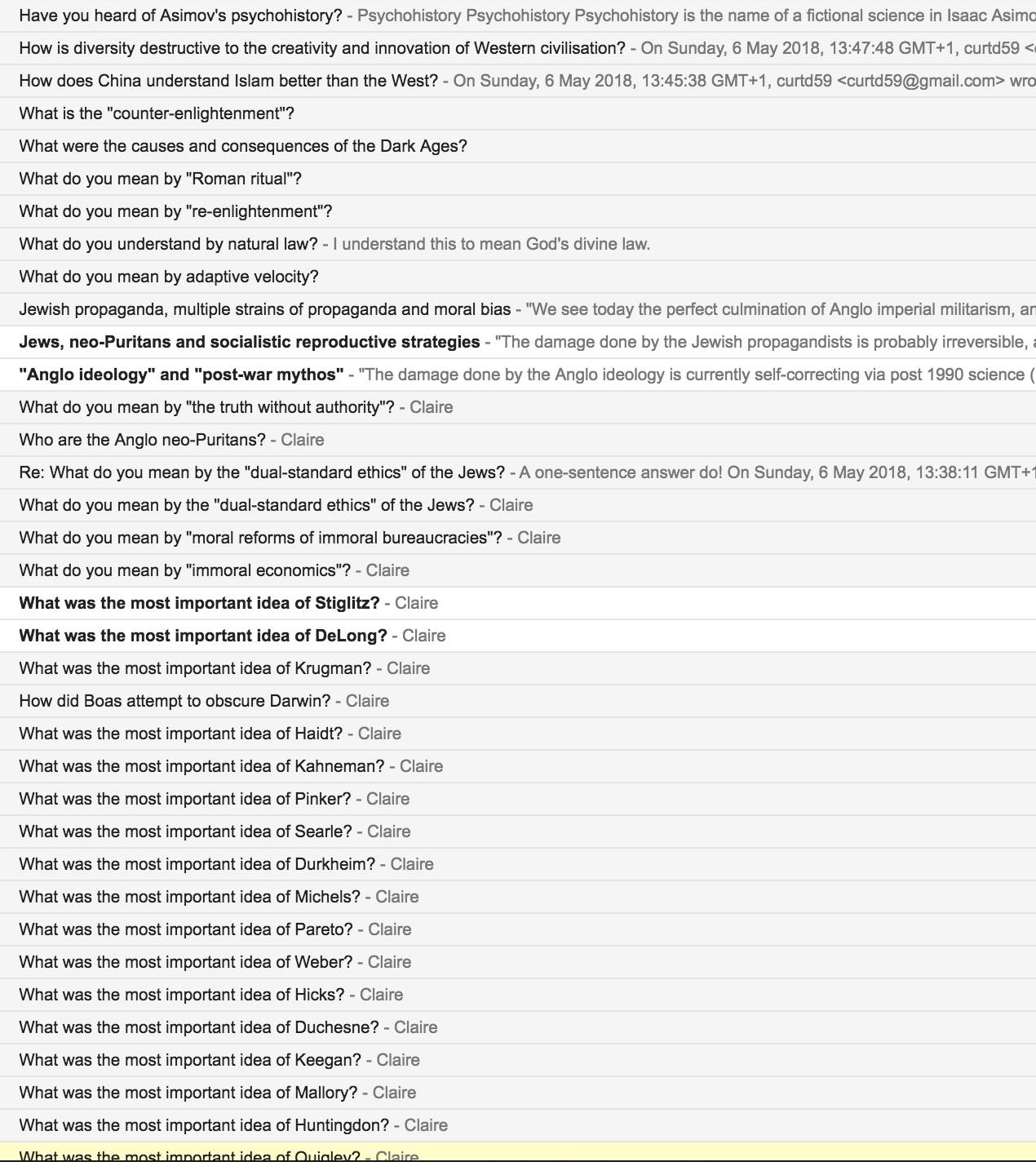
    photos_and_videos/TimelinePhotos_43196237263/31543373_10156337078467264_8777614105805586432_o_10156337078462264.jpg IF YOU CAN’T CALCULATE IT, IT’S JUST AN EXCUSE

    This is part of a list of interview questions an interviewer took from reading just one article. And that’s just one. That’s not on any of the other major topics I cover.

    And scanning that list, you don’t have to wonder why I say “It requires a great deal of knowledge to hold discussions on any of these topics” and very, very, few people have the requisite knowledge to do so.

    Yet we are all convinced of the value and veracity of our opinions. You don’t find people claiming knowledge of anything calculable, but you find people claiming knowledge of everything intuitable.

    Hence why I’ve made speech, ethics, morality, politics, and law, commensurable and operationally calculable, so that we can end the cognitive bias that every idiot’s opinion is worth anything other than the choice of his favorite flavor of ice cream.

    We make excuses. That’s what thinking and reasoning do. If you aren’t calculating you’re making an excuse. Because you can’t do otherwise. You evolved to make excuses, not to calculate. Intuition substitutes what you can’t calculate. In this way evolution provides us with the confidence to act probabilistically, despite our profound fallibility – and we don’t give up except by suicide.James SantagataIf we are talking Psychohistory in Asimov’s Foundation series, is Doolittle the Mule? – Claire.May 08, 2018 12:37pmCurt DoolittlelolzMay 08, 2018 1:28pmCurt DoolittleI had to look that up…May 08, 2018 1:29pmJames Santagatalol. It was compliment, just to clarify. :DMay 08, 2018 1:54pmCurt Doolittlelol… i still had to look it up…. ;)May 08, 2018 1:55pmNicholas Arthur CattonJust going through the first interview.

    I actually think there lot of value came of the dislocated nature of this conversation. It made for more diverse range associations, and Propertarianism by analogous description by Curt than is usual in a more methodically curated conversation.

    If Clare is willing to accept that she may not get clearer on the topic herself, she is surely giving other prop fans insight and angles and associations that arent the standard. It broke beyond the preaching to converted and had the live flavour or an AMA.

    It was Good stuff.May 09, 2018 5:50pmCurt Doolittlewell saidMay 09, 2018 7:13pmIF YOU CAN’T CALCULATE IT, IT’S JUST AN EXCUSE

    This is part of a list of interview questions an interviewer took from reading just one article. And that’s just one. That’s not on any of the other major topics I cover.

    And scanning that list, you don’t have to wonder why I say “It requires a great deal of knowledge to hold discussions on any of these topics” and very, very, few people have the requisite knowledge to do so.

    Yet we are all convinced of the value and veracity of our opinions. You don’t find people claiming knowledge of anything calculable, but you find people claiming knowledge of everything intuitable.

    Hence why I’ve made speech, ethics, morality, politics, and law, commensurable and operationally calculable, so that we can end the cognitive bias that every idiot’s opinion is worth anything other than the choice of his favorite flavor of ice cream.

    We make excuses. That’s what thinking and reasoning do. If you aren’t calculating you’re making an excuse. Because you can’t do otherwise. You evolved to make excuses, not to calculate. Intuition substitutes what you can’t calculate. In this way evolution provides us with the confidence to act probabilistically, despite our profound fallibility – and we don’t give up except by suicide.


    Source date (UTC): 2018-05-06 10:48:00 UTC

  • The Origins of Numbers

    (And the two part key) To create a record that represented “two sheep”, they selected two round clay tokens each having a + sign baked into it. Each token represented one sheep. Representing a hundred sheep with a hundred tokens would be impractical, so they invented different clay tokens to represent different numbers of each specific commodity, and by 4000 BC strung the tokens like beads on a string.[7] There was a token for one sheep, a different token for ten sheep, a different token for ten goats, etc. Thirty-two sheep would be represented by three ten-sheep tokens followed on the string by two one-sheep tokens. To ensure that nobody could alter the number and type of tokens, they invented a clay envelope shaped like a hollow ball into which the tokens on a string were placed, sealed, and baked. If anybody disputed the number, they could break open the clay envelope and do a recount. To avoid unnecessary damage to the record, they pressed archaic number signs and witness seals on the outside of the envelope before it was baked, each sign similar in shape to the tokens they represented. Since there was seldom any need to break open the envelope, the signs on the outside became the first written language for writing numbers in clay. An alternative method was to seal the knot in each string of tokens with a solid oblong bulla of clay having impressed symbols, while the string of tokens dangled outside of the bulla.[8] Beginning about 3500 BC the tokens and envelopes were replaced by numerals impressed with a round stylus at different angles in flat clay tablets which were then baked.[9] A sharp stylus was used to carve pictographs representing various tokens. Each sign represented both the commodity being counted and the quantity or volume of that commodity.

  • The Origins of Numbers

    (And the two part key) To create a record that represented “two sheep”, they selected two round clay tokens each having a + sign baked into it. Each token represented one sheep. Representing a hundred sheep with a hundred tokens would be impractical, so they invented different clay tokens to represent different numbers of each specific commodity, and by 4000 BC strung the tokens like beads on a string.[7] There was a token for one sheep, a different token for ten sheep, a different token for ten goats, etc. Thirty-two sheep would be represented by three ten-sheep tokens followed on the string by two one-sheep tokens. To ensure that nobody could alter the number and type of tokens, they invented a clay envelope shaped like a hollow ball into which the tokens on a string were placed, sealed, and baked. If anybody disputed the number, they could break open the clay envelope and do a recount. To avoid unnecessary damage to the record, they pressed archaic number signs and witness seals on the outside of the envelope before it was baked, each sign similar in shape to the tokens they represented. Since there was seldom any need to break open the envelope, the signs on the outside became the first written language for writing numbers in clay. An alternative method was to seal the knot in each string of tokens with a solid oblong bulla of clay having impressed symbols, while the string of tokens dangled outside of the bulla.[8] Beginning about 3500 BC the tokens and envelopes were replaced by numerals impressed with a round stylus at different angles in flat clay tablets which were then baked.[9] A sharp stylus was used to carve pictographs representing various tokens. Each sign represented both the commodity being counted and the quantity or volume of that commodity.

  • Archaic Numbers > Cuneiform > Roman Numerals

    ARCHAIC NUMBERS > CUNEIFORM > ROMAN NUMERALS Conversion of archaic numbers to cuneiform The round stylus was gradually replaced by a reed stylus that had been used to press wedge shaped cuneiform signs in clay. To represent numbers that previously had been pressed with a round stylus, these cuneiform number signs were pressed in a circular pattern and they retained the additive sign-value notation that originated with tokens on a string. Cuneiform numerals and archaic numerals were ambiguous because they represented various numeric systems that differed depending on what was being counted. About 2100 BC in Sumer, these proto-sexagesimal sign-value systems gradually converged on a common sexagesimal number system that was a place-value system consisting of only two impressed marks, the vertical wedge and the chevron, which could also represent fractions.[14] This sexagesimal number system was fully developed at the beginning of the Old Babylonia period (about 1950 BC) and became standard in Babylonia. Sexagesimal numerals were a mixed radix system that retained the alternating base 10 and base 6 in a sequence of cuneiform vertical wedges and chevrons. Sexagesimal numerals became widely used in commerce, but were also used in astronomical and other calculations. This system was exported from Babylonia and used throughout Mesopotamia, and by every Mediterranean nation that used standard Babylonian units of measure and counting, including the Greeks, Romans and Syrians. In Arabic numerals, we still use sexagesimal to count time (minutes per hour), and angles (degrees). -Roman numerals- Roman numerals evolved from this primitive system of cutting notches.[15] It was once believed that they came from alphabetic symbols or from pictographs, but these theories have been disproved.[16][17]

  • Archaic Numbers > Cuneiform > Roman Numerals

    ARCHAIC NUMBERS > CUNEIFORM > ROMAN NUMERALS Conversion of archaic numbers to cuneiform The round stylus was gradually replaced by a reed stylus that had been used to press wedge shaped cuneiform signs in clay. To represent numbers that previously had been pressed with a round stylus, these cuneiform number signs were pressed in a circular pattern and they retained the additive sign-value notation that originated with tokens on a string. Cuneiform numerals and archaic numerals were ambiguous because they represented various numeric systems that differed depending on what was being counted. About 2100 BC in Sumer, these proto-sexagesimal sign-value systems gradually converged on a common sexagesimal number system that was a place-value system consisting of only two impressed marks, the vertical wedge and the chevron, which could also represent fractions.[14] This sexagesimal number system was fully developed at the beginning of the Old Babylonia period (about 1950 BC) and became standard in Babylonia. Sexagesimal numerals were a mixed radix system that retained the alternating base 10 and base 6 in a sequence of cuneiform vertical wedges and chevrons. Sexagesimal numerals became widely used in commerce, but were also used in astronomical and other calculations. This system was exported from Babylonia and used throughout Mesopotamia, and by every Mediterranean nation that used standard Babylonian units of measure and counting, including the Greeks, Romans and Syrians. In Arabic numerals, we still use sexagesimal to count time (minutes per hour), and angles (degrees). -Roman numerals- Roman numerals evolved from this primitive system of cutting notches.[15] It was once believed that they came from alphabetic symbols or from pictographs, but these theories have been disproved.[16][17]

  • ARCHAIC NUMBERS > CUNEIFORM > ROMAN NUMERALS Conversion of archaic numbers to cu

    ARCHAIC NUMBERS > CUNEIFORM > ROMAN NUMERALS

    Conversion of archaic numbers to cuneiform

    The round stylus was gradually replaced by a reed stylus that had been used to press wedge shaped cuneiform signs in clay.

    To represent numbers that previously had been pressed with a round stylus, these cuneiform number signs were pressed in a circular pattern and they retained the additive sign-value notation that originated with tokens on a string.

    Cuneiform numerals and archaic numerals were ambiguous because they represented various numeric systems that differed depending on what was being counted.

    About 2100 BC in Sumer, these proto-sexagesimal sign-value systems gradually converged on a common sexagesimal number system that was a place-value system consisting of only two impressed marks, the vertical wedge and the chevron, which could also represent fractions.[14]

    This sexagesimal number system was fully developed at the beginning of the Old Babylonia period (about 1950 BC) and became standard in Babylonia.

    Sexagesimal numerals were a mixed radix system that retained the alternating base 10 and base 6 in a sequence of cuneiform vertical wedges and chevrons. Sexagesimal numerals became widely used in commerce, but were also used in astronomical and other calculations.

    This system was exported from Babylonia and used throughout Mesopotamia, and by every Mediterranean nation that used standard Babylonian units of measure and counting, including the Greeks, Romans and Syrians. In Arabic numerals, we still use sexagesimal to count time (minutes per hour), and angles (degrees).

    -Roman numerals-

    Roman numerals evolved from this primitive system of cutting notches.[15] It was once believed that they came from alphabetic symbols or from pictographs, but these theories have been disproved.[16][17]


    Source date (UTC): 2018-05-05 11:57:00 UTC

  • THE ORIGINS OF NUMBERS (And the two part key) To create a record that represente

    THE ORIGINS OF NUMBERS

    (And the two part key)

    To create a record that represented “two sheep”, they selected two round clay tokens each having a + sign baked into it. Each token represented one sheep. Representing a hundred sheep with a hundred tokens would be impractical, so they invented different clay tokens to represent different numbers of each specific commodity, and by 4000 BC strung the tokens like beads on a string.[7] There was a token for one sheep, a different token for ten sheep, a different token for ten goats, etc. Thirty-two sheep would be represented by three ten-sheep tokens followed on the string by two one-sheep tokens.

    To ensure that nobody could alter the number and type of tokens, they invented a clay envelope shaped like a hollow ball into which the tokens on a string were placed, sealed, and baked. If anybody disputed the number, they could break open the clay envelope and do a recount. To avoid unnecessary damage to the record, they pressed archaic number signs and witness seals on the outside of the envelope before it was baked, each sign similar in shape to the tokens they represented. Since there was seldom any need to break open the envelope, the signs on the outside became the first written language for writing numbers in clay. An alternative method was to seal the knot in each string of tokens with a solid oblong bulla of clay having impressed symbols, while the string of tokens dangled outside of the bulla.[8]

    Beginning about 3500 BC the tokens and envelopes were replaced by numerals impressed with a round stylus at different angles in flat clay tablets which were then baked.[9] A sharp stylus was used to carve pictographs representing various tokens. Each sign represented both the commodity being counted and the quantity or volume of that commodity.


    Source date (UTC): 2018-05-05 11:37:00 UTC

  • It Is Very Hard Not to Specialize – for Now

      At our stage of development when we are at an in-between stage, and very nearly at the limit of our ability to construct tools (experiments) by which to conduct observations (measurements), yet unable to discover the pattern of relations that describe the next levels of complexity (the structure of the universe on one end and sentience on the other, and where we have all but exhausted research into subjects at human scale, we have passed the point at which one can spend enough time on enough subjects to master their application. It is however possible to master the fundamental patterns that cross all disciplines. The reason being that there are a very small number of fundamental laws. And to some degree the grammar and semantics we are searching for, consists of that set of categories, relations, values and operations (transforms).