photos_and_videos/TimelinePhotos_43196237263/33717891_10156386937987264_5578418496024346624_o_10156386937977264.jpg (worth repeating)Ivar DiederikWe care about averages and statistics (which are relevant to large groups of people and therefore politics).
The modern left on the other hand emphasizes exceptions, particulars and personal experiences (none of which are very relevant to political considerations). It is indeed a more feminine approach.May 28, 2018 7:18pmMichael D. AbbottLeft wing men murder babies.May 29, 2018 6:37pmMichael D. AbbottJust a reminder–only 11% of prisoners are republicans.May 29, 2018 6:38pm(worth repeating)
(this is just repeat of old research but in big 5 terms)
by Joel Adams
27 MAY 2018 • 7:09PM
People who like easy-listening music are likely to be talkative and energetic, while opera lovers are more insightful and imaginative, according to scientists.
Two major studies conducted by psychologists from Cambridge and top US universities have found your personality type can be accurately predicted from your musical tastes – and vice versa.
Those with extrovert personalities for instance – who are more comfortable making small talk than introverts – showed a preference for music categorised as “uncomplicated, relaxing, and acoustic.”
Finding correlations in this field has been hampered in the past by respondents tending to be younger – and therefore more likely to share a narrow band of tastes – and because respondents used their own definitions of the genres they enjoy.
But in these worldwide, online studies of more than 20,000 respondents, more than half those surveyed were over 22, and they were presented with 25 unfamiliar musical excerpts pre-categorised by musicologists.
The surveys differentiated personality types on the “big five” model used by scientists for 50 years: openness, extroversion, agreeableness, neuroticism and conscientiousness.
The team, led by Dr Jason Rentfrow, reader in personality and individual differences at Fitzwilliam College, Cambridge found ‘open’ personalities liked ‘sophisticated’ music – defined as “inspiring, complex and dynamic” – but were less impressed with slow, mellow music.
According to “big five” theory people who score highly for openness like to learn new things and enjoy new experiences.
Extroverts, who are talkative and energetic, showed a preference for “unpretentious” music categorised as uncomplicated, relaxing and acoustic.
The study also concluded that once you have evidence of a person’s musical tastes you can predict their personality type.
In the journal Psychological Science, Dr Rentfrow and his colleagues wrote: “An active measure of naturally occurring behaviour, Facebook Likes for musical artists, also predict individual differences in personality.”
Perhaps predictably, agreeable people tended to give all the music clips higher scores, while neurotics marked more harshly. Conscientiousness did not seem to be correlated.
Um. I don’t think they’ll be different, for reasons I hope to publish this year. Although there is a substantial difference…
Chomsky can take 40 minutes to communicate an idea, and if you look at his sentence structure and vocabulary it’s extraordinary. I cannot match Chomsky’s context-retention during his discourses. This is how I know he’s smarter than I am. His ability to ‘maintain state’ while communicating complex relations and stories is exceptional.
Despite working at it terribly hard, I find ‘simplification’ extremely difficult, and I find I use a variation on latin grammar, more 19th century sentence structure, and overwhelm the audience very easily with content.
If you listen to young adults they often have trouble forming complete sentences, paragraphs, and narratives with any degree of precision (they require shared context).
Some people (me when I was younger) and many people in the tech field for example, speak very very fast with very high word counts. Some people cannot manage that at all.
Some people use large vocabularies to concentrate more content in fewer words while preserving or increasing precision.
Some groups use terms (english, german) and some tones (chinese). Where terms are more precise because they are less demanding of deduction.
Some groups use (awful) high context grammar, and some low context grammar.
It appears that once you develop the ability to communicate in language all that matters is the increasing content and precision of that communication method. So we evolved from simple vocal sounds serialized. Others might evolved from parallel tones. Maybe others from some other form of display.
Language must at least originate with analogy to experience, so its possible that creatures with different senses or processing (octopods) might use analogies that took us time to decode.
So if you look across just that set of dimensions you can imagine that some very smart species would speak very quickly, in very precise very dense grammar, with a very large vocabulary, with long sentences (transactions), and long narratives, in serial (informationally limited) or more parallel (informationally dense) means.
And thisso their context retention ability and processing ability would be higher than ours.
That said, for reasons that chomsky defends his universal grammar (and for the same reasons that while base number would change and the vocabulary will change, all mathematical systems would be the same)
Once you grasp that the term ‘grammar’ means ‘continuous disambiguation’, but that actions in the real world cause languages to eventually converge on the descriptive through nothing other than competition, then
This continuous disambiguation is important because it corresponds to falsification (eliminative), just as continuous construction correspondes to justificationism (cumulative). And as such it turns out that since falsehood has a higher truth content than truth claims, the via negativa of continuous disambiguation is the counter intuitive but descriptive and necessary means of communication of truth content.
I can debate anyone who’s intellectually honest, defines his terms, and doesn’t engage in selection bias.Economic argument requires some set of decidabilities. I use capital (property in toto). b/c that’s full accounting. (Science). That’s unheard of in the discipline.
Original tweet unavailable — we could not load the text of the post this reply is addressing on X. That usually means the tweet was deleted, the account is protected, or X does not expose it to the account used for archiving. The Original post link below may still open if you view it in X while signed in.
All,
Almost all papers in psychology and sociology fail the test of repeatability.
Almost all papers in psychology and sociology depend on self reporting.
Almost all papers in psychology and sociology include susceptibility to suggestion.
Almost all papers in psychology and sociology make use of small populations of students or patients.
Almost all papers in psychology and sociology include value judgements.
Almost all papers in psychology and sociology assume a normative ideal. (this is what I object to)
If instead our findings are repeatable;
If instead we are measuring by context-free measurements;
If instead our tests eliminate all chances of suggestion.
If instead our population consists of more than 1000, and preferably 10k people;
if Instead our categories of measurement contain no assertions of value to a trait (other than evolutionary or physical necessity – such as ‘neural economy’);
if instead our categories of measurement contain *evolutionary specializations rather than uniform ideal*(authoritarianism);
Then there is a fair chance we are conducting science, rather than projection.
So if your paper passes these tests it’s got a chance of not being false.
|| Sample size > Reporting > Motivations / Value judgements > Specialization > Repeatability.
Psychoanalysis and that argumentative technique making use of the categories of psychoanalysis (a uniform standard or ideal) that we call psychologism are pseudoscience.
The problem for psychology is that the categories and terminology are pseudoscientific. That does not mean they are not meaningful. It means they are fictions.
*As a general rule, the specification of an organism is determined by its limits not it’s median.*
May 26, 2018 6:25am
All,
Almost all papers in psychology and sociology fail the test of repeatability.
Almost all papers in psychology and sociology depend on self reporting.
Almost all papers in psychology and sociology include susceptibility to suggestion.
Almost all papers in psychology and sociology make use of small populations of students or patients.
Almost all papers in psychology and sociology include value judgements.
Almost all papers in psychology and sociology assume a normative ideal. (this is what I object to)
If instead our findings are repeatable;
If instead we are measuring by context-free measurements;
If instead our tests eliminate all chances of suggestion.
If instead our population consists of more than 1000, and preferably 10k people;
if Instead our categories of measurement contain no assertions of value to a trait (other than evolutionary or physical necessity – such as ‘neural economy’);
if instead our categories of measurement contain *evolutionary specializations rather than uniform ideal*(authoritarianism);
Then there is a fair chance we are conducting science, rather than projection.
So if your paper passes these tests it’s got a chance of not being false.
|| Sample size > Reporting > Motivations / Value judgements > Specialization > Repeatability.
Psychoanalysis and that argumentative technique making use of the categories of psychoanalysis (a uniform standard or ideal) that we call psychologism are pseudoscience.
The problem for psychology is that the categories and terminology are pseudoscientific. That does not mean they are not meaningful. It means they are fictions.
*As a general rule, the specification of an organism is determined by its limits not it’s median.*
May 26, 2018 6:25am
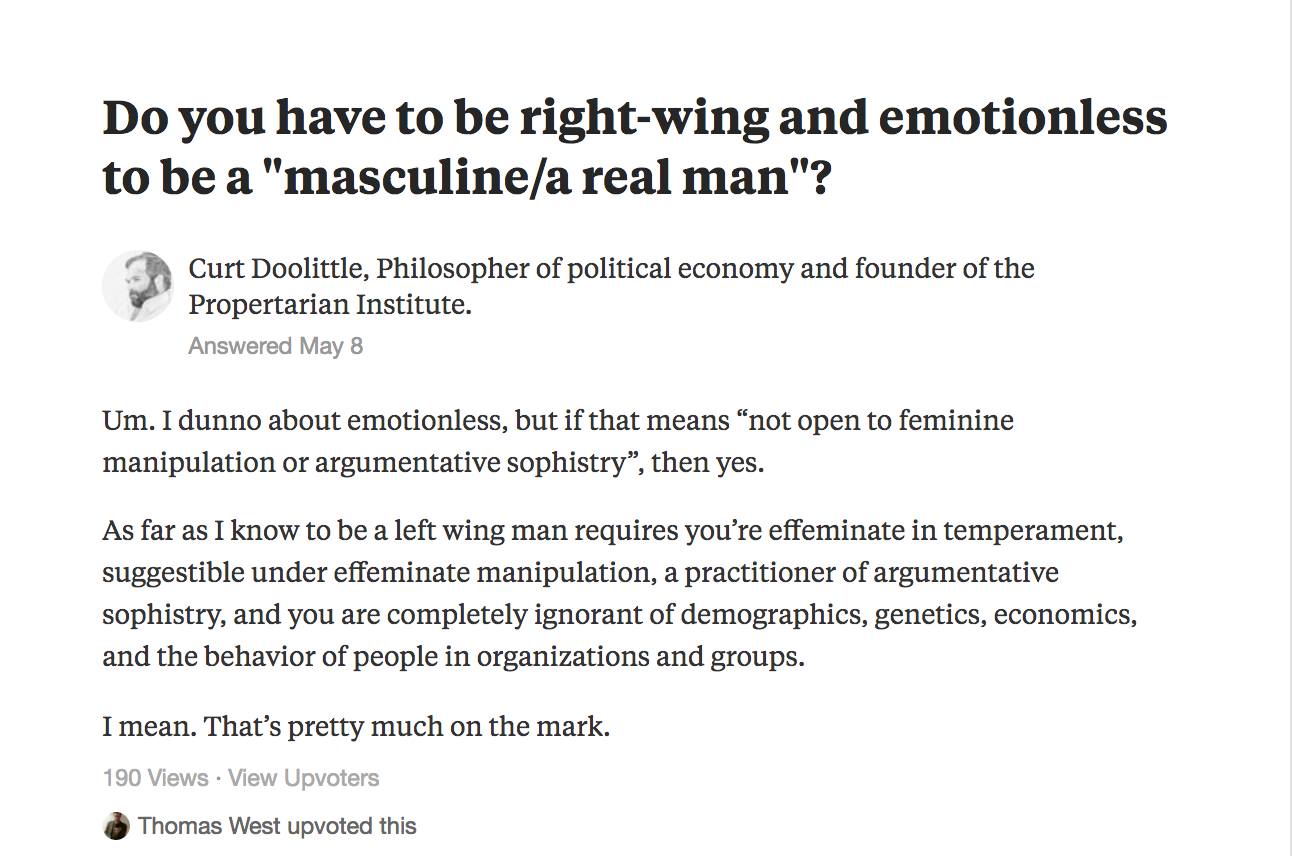
THIS ILLUSTRATION IS IMPRECISE
(a) a “square” describes the shadow truthfully.
(b) a “circle” describes the shadow truthfully.
The question is whether one is testifying to the shadow or to the three dimensional object that casts it.
One CANNOT testify to the shape of the three dimensional object that casts the shadow, one can only testify to the shape of the shadow.
THAT IS THE WHOLE POINT OF TESTIMONY (Truth).
“DO NOT MAKE SHIT UP by INFERENCE.”
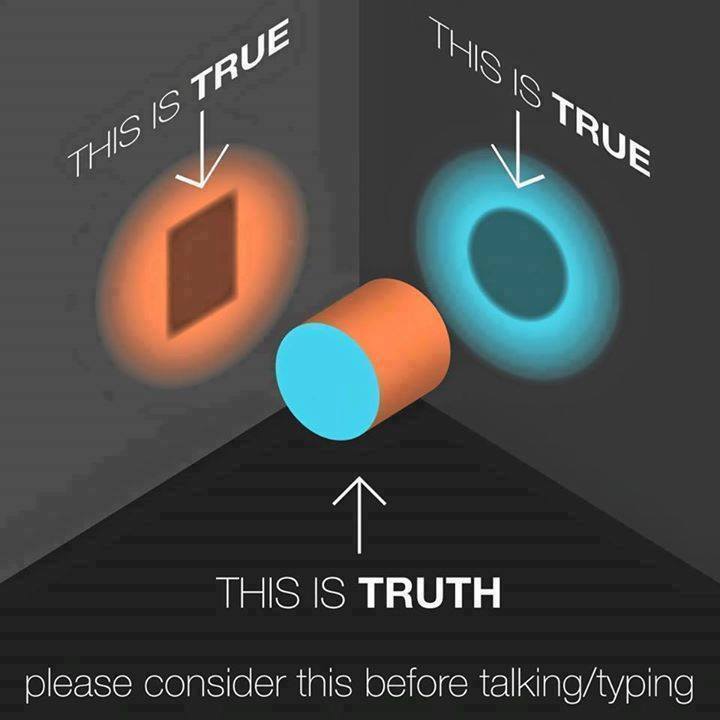
THIS ILLUSTRATION IS IMPRECISE
(a) a “square” describes the shadow truthfully.
(b) a “circle” describes the shadow truthfully.
The question is whether one is testifying to the shadow or to the three dimensional object that casts it.
One CANNOT testify to the shape of the three dimensional object that casts the shadow, one can only testify to the shape of the shadow.
THAT IS THE WHOLE POINT OF TESTIMONY (Truth).
“DO NOT MAKE SHIT UP by INFERENCE.”
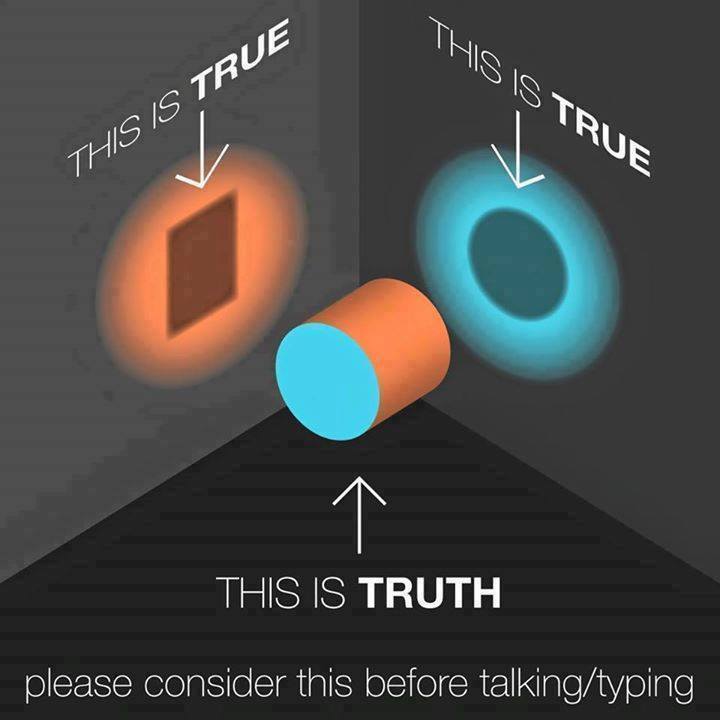
photos_and_videos/TimelinePhotos_43196237263/33678440_10156381604887264_1532375139289661440_n_10156381604882264.jpg THIS ILLUSTRATION IS IMPRECISE
(a) a “square” describes the shadow truthfully.
(b) a “circle” describes the shadow truthfully.
The question is whether one is testifying to the shadow or to the three dimensional object that casts it.
One CANNOT testify to the shape of the three dimensional object that casts the shadow, one can only testify to the shape of the shadow.
THAT IS THE WHOLE POINT OF TESTIMONY (Truth).
“DO NOT MAKE SHIT UP by INFERENCE.”Philip SaundersI love a good meme prosecutionMay 26, 2018 1:05pmGearóid Walshvery goodMay 26, 2018 1:07pmTrevor BrightmanI have appropriated this meme and description…May 26, 2018 1:37pmChris LavanI’ve always liked the GEB cover…the two objects are objectively different, but depending on how you look at them they look the sameMay 26, 2018 1:41pmGregg MyersMay 26, 2018 1:46pmCurt DoolittleI saw a mother and child (nativity).
Then I did an image search and … omg… damn. lolMay 26, 2018 1:50pmEdgar BraintreeThat meme is perfect for people with no grasp of rudimentary logic .May 26, 2018 1:57pmCrystal TompkinsMay 26, 2018 2:18pmGregg MyersMay 26, 2018 2:19pmCrystal TompkinsLet’s make it even more abstract hereMay 26, 2018 2:20pmJoao Tiago AlmeidaHa! Said the same about this a few years back on my fb wall :)May 26, 2018 2:38pmChris CantrellInteresting except that in many human interactions a person claims to describe the object based on the shadow. In many cases the person is not aware that what they think they saw was just the shadow and not the actual object. I think you are over logic’ing people’s illogical behavior. From my view the illustration is precise. If deception is added to the equation it gets even more interesting. One can make a true statement while being deceptive.May 26, 2018 3:08pmDann Hopkins@[1071411546:2048:Niall Collins]May 26, 2018 3:24pmGabriel YbarraAngry wing of the Triumvirate assemble!May 26, 2018 4:11pmNoah J RevoyThe problem is that we all should have learned not to assume in kindergarten.May 26, 2018 4:48pmFortis VeroIf you don’t see a simple piece of bread you may have some underlying issues that need to be addressed.May 26, 2018 7:40pmHoward Van Der KlauwSo framing is important.
Also the image should simply describe all three things as true. None are exclusively truth.May 26, 2018 8:31pmCurt Doolittle(speech is true or false, things are not. This is the problem with our language (the verb to-be). we don’t distinquish between “i state” and “exist as”May 26, 2018 8:32pmCrystal TompkinsI have issues then because I see Jesus in this toastMay 26, 2018 8:32pmHoward Van Der Klauw@[741197263:2048:Curt] true. To restate.
All three inferred statements of description would be true.
None precludes the other which is the error of the picture.
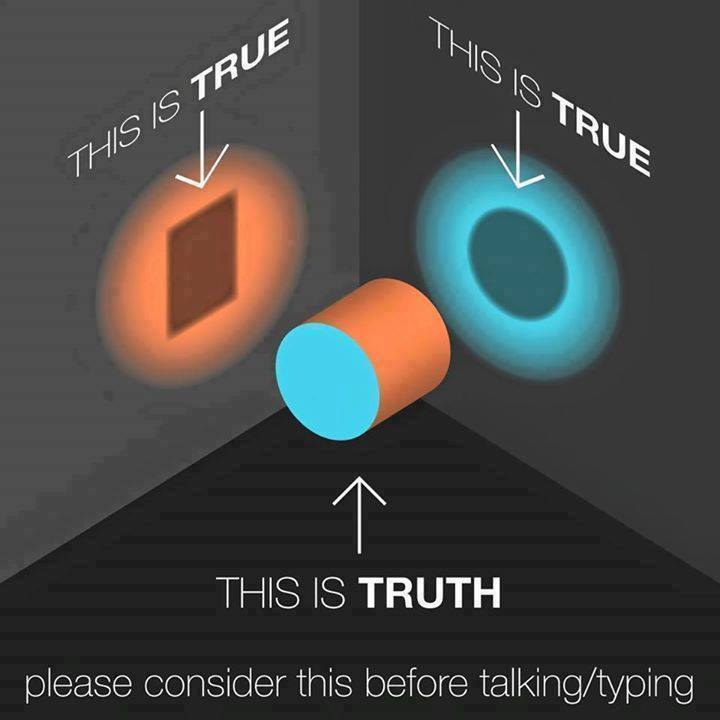
No wonder you banned memes. They waste so much time.May 26, 2018 8:34pmCrystal TompkinsIt was just a jokeMay 26, 2018 9:43pmCrystal TompkinsWEW thank god, I didn’t wanna get into that lolMay 26, 2018 9:45pmCrystal TompkinsShould’ve known since you’re also a Doolittle fan you’re not hugely into abrahamic religionsMay 26, 2018 9:46pmChris CantrellMaybe I am being simple, but I think the image refers to conversation about events, not statements about items. So while the image isnt a solid analogy, it serves the purpose.May 26, 2018 10:16pmDean GeeObjective truth vs subjective truthMay 27, 2018 11:08amCurt DoolittleTruth is true. There is no such thing as subjective truth. Becasue true = decidable.May 27, 2018 11:30amDean GeeWell, there are foundations for logic. Some are based in fact and some are based on the valencies of the individual. Humans need air, objective truth; humans should be treated well, subjective truth.May 27, 2018 3:08pmDean GeeI guess it is the difference between opinion and fact, however both opinion and fact are true, just fact is universally true, and opinion is true to some.May 27, 2018 3:09pmMichael AndradeWhat’s fascinating about this image is that it is unconsciously self-referential; its “shadow” – the lesson readers walk away with – is antithetical to the actual truth we ought to be learning from it.May 28, 2018 1:09amTHIS ILLUSTRATION IS IMPRECISE
(a) a “square” describes the shadow truthfully.
(b) a “circle” describes the shadow truthfully.
The question is whether one is testifying to the shadow or to the three dimensional object that casts it.
One CANNOT testify to the shape of the three dimensional object that casts the shadow, one can only testify to the shape of the shadow.
THE TEST OF DEMARCATION BETWEEN SCIENCE AND PSEUDOSCIENCE IN PSYCHOLOGY
All,
Almost all papers in psychology and sociology fail the test of repeatability.
Almost all papers in psychology and sociology depend on self reporting.
Almost all papers in psychology and sociology include susceptibility to suggestion.
Almost all papers in psychology and sociology make use of small populations of students or patients.
Almost all papers in psychology and sociology include value judgements.
Almost all papers in psychology and sociology assume a normative ideal. (this is what I object to)
If instead our findings are repeatable;
If instead we are measuring by context-free measurements;
If instead our tests eliminate all chances of suggestion.
If instead our population consists of more than 1000, and preferably 10k people;
if Instead our categories of measurement contain no assertions of value to a trait (other than evolutionary or physical necessity – such as ‘neural economy’);
if instead our categories of measurement contain *evolutionary specializations rather than uniform ideal*(authoritarianism);
Then there is a fair chance we are conducting science, rather than projection.
So if your paper passes these tests it’s got a chance of not being false.
Psychoanalysis and that argumentative technique making use of the categories of psychoanalysis (a uniform standard or ideal) that we call psychologism are pseudoscience.
The problem for psychology is that the categories and terminology are pseudoscientific. That does not mean they are not meaningful. It means they are fictions.
*As a general rule, the specification of an organism is determined by its limits not it’s median.*