Theme: Institution

  • Rock, Paper, Scissors: Three Coercive Technologies, and Three Social Classes

    Rock, Paper, Scissors: Three Coercive Technologies, and Three Social Classes

    theecoercivetechnologies

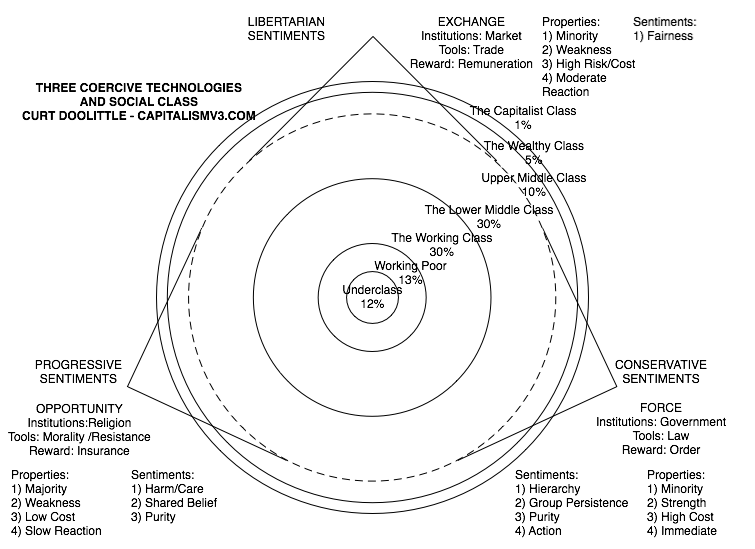
    There are three means of coercing groups of people with institutions 1) Force, or the threat of force A person has a VIOLENCE INCENTIVE to behave in a particular way when it has been made known to him that failure to do so will result in some form of physical aggression being directed at him by other members of the collectivity in the form of inflicting pain or physical harm on him or his loved ones, depriving him of his freedom of movement, or perhaps confiscating or destroying his treasured possessions. 2) Remuneration or payment A person has a REMUNERATIVE INCENTIVE to behave in a particular way if it has been made known to him that doing so will result in some form of material reward he will not otherwise receive. If he behaves as desired, he will receive some specified amount of a valuable good or service (or money with which he can purchase whatever he wishes) in exchange. 3) Moral claims (collective goods) A person has a MORAL INCENTIVE to behave in a particular way when he has been taught to believe that it is the “right” or “proper” or “admirable” thing to do. If he behaves as others expect him to, he may expect the approval or even the admiration of the other members of the collectivity and enjoy an enhanced sense of acceptance or self-esteem. If he behaves improperly, he may expect verbal expressions of condemnation, scorn, ridicule or even ostracism from the collectivity, and he may experience unpleasant feelings of guilt, shame or self-condemnation. And a persuasive argument can consist of one or more of these strategies, often in great complexity. People give priority one or more different weighted combinations, or perhaps ‘chordic’ representations of these strategies. They do so out of habit, and class inclination, just as they follow religious and class sentiments due to their upbringing. People who belong to institutions have different capacities for adopting these strategies. Force requires discipline and long Time Bias. Remuneration requires cunning and invention. Moral claims require loyalty to consensus, and absorption of, and therefore payment of, opportunity costs. Different social classes have different time biases and consist of people with different time preferences, requiring different types of discipline under different social and economic conditions. ie: it is easier to have a long time preference if one is genetically disposed to better impulse control, and lives in greater security. It is easier to have a short time preference if one is more persuaded by impulses, less disciplined, and in an environment of scarcity. The social classes are organized by intelligence. Intelligence is the ability to absorb content in real time, to learn abstractions in time, and to permute those abstractions in application to problems in real time. Intelligence regresses toward the mean over generations. THerefore class membership is an indicator of the likelihood of class mobility, and upper class position is difficult to maintain. While we use the word ‘middle class’, and most people in the west live middle class lifestyles, the middle class means possessing disposable income and participating in the market. Therefore the majority of citizens are in the upper proletariat and lower middle classes, which we call the working, white collar working and craftsman classes. There are different costs to these institutions: Force is extremely expensive. Creating non-corruption, and order (some network of property definitions and their means of transfer). Property is a term for a scarce good that must used, consumed or transformed in the process of production, even if that process is human sustenance. Remunerative institutions require the complex task of concentrating capital then maintaining it in a constantly changing kaleidic and competitive environment. Moral claims require constant advocacy, verbal skill, maintenance of numerous relationships, and constant payment of opportunity costs. The Social classes have different access to each of these forms of coercion. Those in the institutional class, or upper class, have access to force in the form of policy and law. Those in the capitalist class, or middle, have access to capital : money, and market institutions. In each strategy people form elites, and organizations for utilizing those strategies. The elites create philosophical frameworks. Each of these frameworks consists of moral claims, and institutional means of perpetuating those claims, and the social benefits of adopting those claims. Each of these institutions is open to corruption, which is the privatization of opportunity and reward, for personal consumption at group expense. Corruption is fraud. Each of these strategies, their organizations, institutionas and elites compete against other strategies, organizations and elites, and each attempts to use it’s organization for discounts against other organizations. This competition is analogous to the game of Rock, Paper, Scissors, if more complicated: each group can sucessfully compete against one another under most circumstances, but can defeat and be defeated by some other combination of forces. The human mind is comfortable with identity and causality. It can with practice, understand a one dimensional causal spectrum. It can, with effort, understand two dimensions of cuasality. It can with more effort understand three dimensions of a causal spectrum. Human emotions for example, consist of probably no more than three stimuli: dominance, pleasure and activiation. And that all human emotions, in their seemingly infinite varieity can be described as using these three axis of stimuli. Likewise, human social behavior consists of three different forms of coercion, in some combination, and this leads set of axis leads to seemingly infinite variety. But it only seems infinite. At it’s base, there are only three forms of social organization.These three forms can be combined, as they are in the majority of the population in some manner or another. Or they can be used as one of three specializtions, each of which attempts to play rock, paper, scissors, with the other two.

  • Irrational Criticism Of Mubarak’s Replacement

    In a nation with no institutions other than tribal alliances, only members of the existing hierarchy can replace a leader, because the only institution that the society relies upon is loyalty to individuals, and religion, not to principles. In fact, this is the entire problem with the primitive civilization we call Islam. There is loyalty to family and tribe, loyalty to religion, but no loyalty to principles of government. We forget in the west, how miraculous and uncommon is our transfer or power between regimes. The anglo world is unique in it’s stability. Western culture is unique, and it’s method of government is unique. It is, since antiquity, based upon the balance of powers. The rest of the world lives under precisely the opposite postion: the concentration of power. We cannot hold others up to our standards. We can only help them understand that if they wish our economic prosperity, them must adopt our forms of loyalty. Loyalty first, to principles.

  • are getting there. Slowly. Accumulating people. Accumulating influence. All than

    http://blog.mises.org/15272/mises-org-is-the-10-in-a-most-influential-study/We are getting there. Slowly. Accumulating people. Accumulating influence. All thanks to Lou and crew at Mises.org. If we become influential does that mean that we’re mainstream? And if we’re mainstream does that mean that we’re no longer radicals? “Let Us Rid Economics Of The Ludic Fallacy.” Probabilism in economics is a failure.


    Source date (UTC): 2011-01-10 12:14:00 UTC

  • A Decidedly Christian Set Of Laws In 1603

    I hadn’t read Hugo Grotius’ Commentary before today. It is an interesting attempt to provide a coherent set of legal principles. Even if it is just very simply a recitation of Biblical principles with european legal conventions. I would never agree to place such faith in Magistrates, or any other officer of the state. They are only human beings, and not exceptional human beings at that. I give my violence to the state to use justly on my behalf, so that I may spend my time in other activities, in our division of knowledge and labor. That does not mean that it has the ability to act justly on my behalf, or the will to act justly on my behalf, nor has it demonstrated that it has the tendency to act justly on my behalf. I do not believe that any officer of the state is better equipped to make judgements over property than I am. And those are the only judgements a man need know. If he must do other than that, he submits to servitude. Now, once we possess a significant market, we must have administrators, and regulators of that market, and citizens who adhere to the manners, morals, ethics, taxes and regulations that prevent fraud, theft, and violence within that market, are it’s shareholders. Those shareholders will often seek to escape payment, or to transfer liability and risk onto others, or to draw more than their earnings from the corporation of the market that we call the state. I recognize that such thefts are invisible to men without the adminstration of the state to monitor them. As such, I agree that we must have courts and jurors. However, should these men, in the observance of their duties, abridge the laws of property, of theft, of violence, or fraud and deception in the course of their duties — even if it is to pursue just ends, or if such men, in the name of ease, or efficiency, or laziness or stupidity, or most importantly, the fallacy of just democratic law making, then I do not allow them to use my violence on my behalf, to seek reparation from my fellow men. And instead, I must withdraw my violence from the account of the state, and use it at my own discretion.

    Commentary on the Law of Prize and Booty [1603] by Hugo Grotius Table Of Rules And Laws Compiled From Chapter II Of The Commentary Rules rule i. What God has shown to be His Will, that is law. rule ii. What the common consent of mankind has shown to be the will of all, that is law. rule iii. What each individual has indicated to be his will, that is law with respect to him. rule iv. What the commonwealth has indicated to be its will, that is law for the whole body of citizens. rule v. What the commonwealth has indicated to be its will, that is law for the individual citizens in their mutual relations. rule vi. What the magistrate has indicated to be his will, that is law in regard to the whole body of citizens. rule vii. What the magistrate has indicated to be his will, that is law in regard to the citizens as individuals. rule viii. Whatever all states have indicated to be their will, that is law in regard to all of them. rule ix. In regard to judicial procedure, precedence shall be given to the state which is the defendant, or whose citizen is the defendant; but if the said state proves remiss in the discharge of its judicial duty, then that state shall be the judge, which is itself the plaintiff, or whose citizen is the plaintiff. Laws law i. It shall be permissible to defend [one’s own] life and to shun that which threatens to prove injurious. law ii. It shall be permissible to acquire for oneself, and to retain, those things which are useful for life. law iii. Let no one inflict injury upon his fellow. law iv. Let no one seize possession of that which has been taken into the possession of another. law v. Evil deeds must be corrected. law vi. Good deeds must be recompensed. law vii. Individual citizens should not only refrain from injuring other citizens, but should furthermore protect them, both as a whole and as individuals. law viii. Citizens should not only refrain from seizing one another’s possessions, whether these be held privately or in common, but should furthermore contribute individually both that which is necessary to [other] individuals and that which is necessary to the whole. law ix. No citizen shall seek to enforce his own right against a fellow citizen, save by judicial procedure. law x. The magistrate shall act in all matters for the good of the state. law xi. The state shall uphold as valid every act of the magistrate. law xii. Neither the state nor any citizen thereof shall seek to enforce his own right against another state or its citizens, save by judicial procedure. law xiii. In cases where [the laws] can be observed simultaneously, let them [all] be observed; when this is impossible, the law of superior rank shall prevail.

  • What does free speech have to do with copyright law?

    An interesting question from Mises.org:

    ” What does free speech have to do with copyright law?”

    It’s fascinating how this fairly simple set of ideas can exist in the public discourse without understanding the rational foundation upon which the concepts of free speech and copyright are based. a) Books, magazines, movies, plays, music (at least, in theory, music with lyrics), advertising, speeches, lectures, photographs, works of art, are products that market ideas (largely narratives.) Copyright law attempts to protect narratives from theft just as patents protect manufactured goods, from profiteering by copying and redistributing other people’s inventions. b) Any of these ‘narrative product’ may contain political speech.(content) c) Determination of political content is extremely difficult. Harmful or beneficial political content is hard to judge (pornography for example), and therefore the law (as a profession) seeks to avoid having to make those decisions. d) Free speech as a practical constitutional concept rests on two assumptions: d.i – that the admitted harm that comes to society from free speech is offset by the protections we obtain from free speech. d.ii — And to narrow these protections to just those that are overtly political is extremely difficult to the point of practical impossibility. e) Some products are political by definition, and copyright can be used to deny political works to the market, and especially intellectual products that are purely social and political in nature. f) copyrights (like patents) should not allow a product to be held from the market, for the purpose of increasing it’s price. (Granted a monopoly.) So, speech and copyright law are effectively tied-concepts because they are mutually dependent. One cannot have copyright without speech, because all copyright is dependent upon speech. We would have far less speech (content) and experimentation (innovation) without copyrights. The scope of speech that needs protection is untestable, and perhaps unknowable, and it is therefore impossible to regulate by content. The argument from the Anarchist position is that copyrights AS THEY ARE CONSTRUCTED create a host of reasons for abusive government, regardless of the attempts of the creators of copyright law to prevent just such abuses. But the practical, measurable empirical evidence is that copyrights do improve innovation, wihc in turn, improves competitiveness, which in turn, reduces prices. The Hoppian/Rothbardian solution, even if they would not advocate it, would be to privatize copyright protections, so that we are not burdened by abusive government, or the costs of administering other people’s works. Again, the fundamental problem here is that it is very difficult to develop criteria by which one thing is equal to another thing, for the purposes of copyright. It is very difficult and expensive to regulate and jury. THe other is that artificially increasing prices of easily reproduced goods is counter to the premise on which the market is based. I think that the solution, as others have said above, is that reproduction for commercial or self use is different from reproduction for the purpose of distribution and sale. I think personal reproduction, even if it deprives the author of profits is within the speech and copyright objectives. I do not see that there is an argument wherein the authors have the right to prevent you from doing whatever it is once you’ve purchased a commercial product from within the market. I do see that someone concentrating capital for the purpose of profiteering from activity in the market, based upon the innovations of others, without paying a commission for doing so, is simply theft, and is not beneficial. The market political theory requires us to innovate, even if innovation is simply opening up new markets.. I do not see the value in copying. That’s just parasitism. Markets exist and function because of enfranchisement, not parasitism. I do not think that the market philosophy (even in libertarianism) supports parasitism. I know libertarians do not support rent seeking (parasitism) by the use of organs of the state. Why should we tolerate parasitism in absence of the state? Or is it that we care more about the state than we do about the very market society which we hope to entrust with our social order? That is the incongruity in Anarchist thought. Government exists to improve the competitiveness of the market for the purposes of decreasing prices and increasing choices. Without a market, there can be no government. There can be slavery, but no government. We pay for the market by forgone opportunities for violence, for theft. Violence and theft are epistemologically simple tasks. However, markets invite fraud BECAUSE they prohibit violence (retribution for theft). And as far as I can tell, copyright law is simply fraud protection. Others are welcome to debate me on this. But I doubt efforts will result in success.

  • Privatization From Obama?

    While the devil is in the details, and I have less than zero confidence in this president, he proposed a structural change in the way we ‘purchase’ infrastructure projects, that would effectively privatize the process, rather than continue the current (corrupt) process of relying upon earmarks. From The NYT:

    Mr. Obama … called for what the White House is describing as an “infrastructure bank” that would focus on paying for national and regional transportation projects by pooling private money with public investment. He said the bank would eliminate a patchwork system in which transportation projects are financed through Congressional earmarks rather than based on merit.

    From The White House

    The President proposes to fund a permanent infrastructure bank. This bank would leverage private and state and local capital to invest in projects that are most critical to our economic progress. This marks an important departure from the federal government’s traditional way of spending on infrastructure through earmarks and formula-based grants that are allocated more by geography and politics than demonstrated value. Instead, the Bank will base its investment decisions on clear analytical measures of performance, competing projects against each other to determine which will produce the greatest return for American taxpayers.

    Impressive. Now, let’s see it work.

  • Question: “Can you be anti-capitalist and pro market?”

    On Straight Dope, there is a thread on whether one can be anti-capitalist but pro-market. I’ve captured my response below. DEFINITIONS 1) Capitalism (distributed planning and control using the technologies of property and the pricing system). Or politically: a bias toward letting the market solve problems of production. 2) Socialism (centralized planning and control in the necessary absence of the pricing system). Or politically: a bias toward political centralization of solving problems of production. 3) Mixed Economy ( distributed planning and control using property and pricing system, with redistribution of wealth through taxation). Or politically, letting the market solve problems of production, while centralizing some amount of the wealth generated for redistribution and investment in outcomes where the market process is unable to concentrate capital. 4) Market: the voluntary production of property for the purpose of speculating on it’s voluntary trade. The speculative pricing assigned to the goods or services. The reliance upon prices to determine the products to be produced, and the factors of production to be consumed. Implies the regulation of products into the market. and implies the defense of property rights and conflict resolution within the market of goods and services by a third party. 5) Trade: the voluntary transfer of property from one individual to another. (which implies knowledge of the purchaser, and the irrelevance of third parties) DISCUSSION Early Leftist were traditional luddites who confused the necessity of ownership of the means of production (property) with the ability to redistribute the results of that system of ownership: It is not necessary to control the means of production in order to redistribute wealth. While property and prices are necessary for complex production, and incentives are necessary to encourage people to produce, it appears that we can determine rules of property use, and we can determine some level of redistribution while maintaining sufficient incentives to produce. At least, that has been the general course of events over the past century. Contrarily, unstated but implied in that statement, such a redistribution will affect the ability to consume, but not ‘organized control over’ what is produced. This may disappoint some. However, since all groups are led by elites and elites must make decisions on production, the such centralized control creates only the illusion of proletariat control over what is produced. You cannot have a market (speculative production in anticipation of trade wherein prices communicate relative demand) without prices and property. This is logically impossible. While communists have forever posited the opposite, people will not produce excess for market purposes without the incentive to do so (and will resort to black markets, and therefore recreate the market). If what you define as “anti-capitalist” (i suspect) is having a number of people with knowledge and relationships and control of property concentrate resources toward productive ends that you disagree with, then you can indeed be “anti-capitalist”. If you define anti-capitalist as a status-criticism, wherein you dislike the fact that you are most likely a permanent member of the proletariat, which decreases your access to mates and opportunity, then you indeed can be an ant-capitalist. Those are sentimental objections. (Despite the fact that our society is largely run by the middle class and upper proletariat.) But if you mean that you dislike the nature of prices and property, then you’re just illogical, and the result of your beliefs would result in destitute poverty, murder and war. The market evolved because of the limitation of the human mind. We cannot replace it without making the human mind far better than it is. And perhaps far better than it can be. Redistribution is a biological sentiment in the human animal that evolved because it is necessary for group-persistence: to retain competitive ability against other groups, and to insure the group’s survival. Universal egalitarian equality, which is a member of the set of leftist sentiment of “harm/care/nurture” or the sentiment of eliminating the sensation of status differences, or the sentiment eliminating the material differences between people’s access to resources, is simply an illogical construct regardless of which sentiment is being applied: Because we need incentives to produce, and we must over produce and divide our labor to reduce prices. (“We are not wealthier than cave men, everything is just infinitely cheaper due to the division of labor”) Because people will always seek status differences even under socialism. Because the iron law of oligarchy mandates that elites and leaders emerge, and once they emerge they form a self-serving bureaucracy. Because it is impossible for more than a family sized group of people to agree on both the means and ends of doing anything meaningful in a division of labor sufficient to produce low prices. (this last, is the virtue of what we call the market). Participating in the market is also voluntary. One can consume the goods of the market without participating in the market one’s self. Some people, in fact, a majority of people, are not sufficiently competitive in any form of production that they can conceive of, or afford to speculate in the market. So they TRADE their productivity rather than SPECULATE on by producing goods or services for the market. To be a member of a market economy, one only needs to refrain from theft. To be a ‘good’ member of a market economy, once needs additionally to refrain from fraud and deception. But these are the means by which we obtain citizenship in the market, not participate in the market. To enter the market itself, means that you risk capital and compete in the arena that is the market, and are willing and able to accept losses. The problem for the proletariat is that their value-system is predicated on self-production for consumption purposes, and trading for goods that cannot be self produced. People only a century ago would put to market only their over-production, and purchase from the market only for goods that they could not produce themselves. Except there is precious little in modern society that a person can produce himself, let alone, produce for market consumption himself. This necessitates an uncomfortable uncertainty for those people who must speculate in order to survive in the market. Hence leftist sentiments of the family, epistemology of the family, organization of the family, production of the family must compete with rightist sentiments of the market.

    [callout]It is quite likely that the right and left will both fail. That we will instead of succeeding in incorporating all people into the market (the error of the right) or incorporating all people into the luddite familial structure (the error of the left) that we will adopt the european and south american models of a wealthy urban and rural groups, and a ring of abject destitute hyper-breeding poverty around the urban cores, wherein the upper and middle classes pay the permanent proletariat just enough to subsist, and we emerge with a tiered society both geographically, genetically, and materially. [/callout]

    It is quite likely that the right and left will both fail. That we will instead of succeeding in incorporating all people into the market (the error of the right) or incorporating all people into the luddite familial structure (the error of the left) that we will adopt the european and south american models of a wealthy urban and rural groups, and a ring of abject destitute hyper-breeding poverty around the urban cores, wherein the upper and middle classes pay the permanent proletariat just enough to subsist, and we emerge with a tiered society both geographically, genetically, and materially. And this end result will in no small part be due to the christian error of egalitarianism sentiments that deny the productive differences of human beings in the real and material world – the majority of which differences derive from the ability and rate at which one can learn and apply abstractions (IQ) in a dynamic and rapidly moving economy. While neither left or right can achieve it’s idealistic ends, leftism is an attempt to enslave the productive (innovative) class’s attempt to increase production and increase prices for the purpose of status enhancement. But by that restraint doom all people to poverty. This is the strategy behind all monotheistic religions. They are resistance movements that attempt to make status among the proletariat a spiritual rather than material construct. Capitalism (or right-ism) on the other hand is an attempt to keep sufficient productive resources in the hands of market producers that all society benefits, despite the fact that the proletariat feels increasingly left behind and deprived of status because of the accelerating rate at which the productive classes (those who take speculative risks and thereby increase choices and decrease prices) seemingly depart from the lower classes, despite the fact that in all but the rarest circumstances (catastrophic health care) that the difference between the quintiles is one of symbolic status and diversity of forms of entertainment, rather than differences in material well being. As it stands Quantitative Keynesianism is the socialist research program, and Anarcho capitalism is the capitalist research program. The difference between these methods lies in both their ambitions and their methods. By applying 19th century advances in the mathematics of the natural world (closed probabilism) to the aggregate symbols of production of the economy (monetary values), it became possible to try to fulfill some methods of the socialist program by using capitalism for socialistic ends. The problem for the capitalists, and the reason for the failure of the Austrian (qualitative) program’s emphasis on micro-economic behavior, is that they do not have a method of mathematics to provide sufficient explanatory power equal to the left’s program, despite knowing, with absolute certainty, that the Keynesian program must fail. This is because despite the efforts of Poincare, Mandelbrot, Hayek, Popper, Mises, and Parsons, more recently Taleb, and a host of others, there appears to be no symbolic language that can represent the plasticity and organic behavior of the property-pricing system and how it reacts to human knowledge. (This is typically called ‘Hume’s Problem’ of Induction.) It appears, at least at this point in time, that we will need a vast amount of data, on the order of many times that of the Google indexes, to provide us with enough of a basis from which to derive the patterns in that symbolic information. Even if we could find that information, we could find the patterns, and develop a mathematics of economics and the social sciences, the question would remain whether these innovations would have any material impact on the fact that humans are of pedagogical NECESSITY, epistemic status seekers, and that there are those who lead that pack of humanity and those who are forever followers in it, and the envy of the followers, and the arrogance of the leaders mandate that we will remain competitive, and that the problem of human difference is both permanent and valuable to the division of knowledge and labor.

  • CONTROVERSIAL REALITY : A CONTRARIAN’S VIEW OF THE AGENCY, BUSINESS AND SOCIETY

    AdAge and The Decline In Car Driving Among The Young The advertising industry’s most important publication, Ad Age, recently posted an article entitled “Is Digital Revolution Driving Decline in U.S. Car Culture?” wherein the author describes the decline in driving among the young, and the readership leaves comment after comment positing reasons for the change, most of which belie political sentiments. This kind of economic commentary can be found daily on any economics blog. And it’s fascinating to see the difference between the interpretations of different subcultures of the same data. Economists make fewer errors in their reasoning. Reporters try to create sensationalism and readership by appealing to the common errors that people tend to make, most importantly the error of confirmation bias : seeking what you agree with and ignoring what you don’t. Humans demonstrate a cognitive bias wherein they overestimate their own ‘normalcy’, or how likely people are to think like them. This is particularly true of people in the agency business for a variety of reasons – and thinking otherwise might not necessarily be beneficial to one’s career in the agency business. This business is a ‘magnet’ for group-thinkers, because the profession requires that you think about ‘groups’ for a living. THE REALITIES OF CITIES Most people in history were confined to 20 mile arduous around their home. Cities are, and always have been, notoriously dirty and noisy, often crime ridden, and push people into small spaces from which they desire ‘vacations’. (The Un-Heavenly City by Banfield.) In a recent conversation I had with a Chinese intellectual I was surprised at how little he understood the ‘toxicity’ of human beings living in density. It’s hard on them. (Selection in urban environments comes from disease resistance. – Plagues and Peoples by McNeil) People like density because it decreases opportunity costs – everything is close-by and because it’s dense, businesses and services are better capitalized and better funded because they have a higher opportunity of being funded – as long as they don’t require much space, or as long as what they sell is expensive enough to pay the cost of that density. But because of the expense of that proximity, raising children is for the poor who have no other choice but to live in kennels where the cost per human is low, and the wealthy who can afford to make the choice, not the middle class, who must live elsewhere. Therefore, Cars and Suburbia Are Synonymous. Because costs of a the quality of residences decrease with distance from urban centers, allowing more space at lower cost. Most urban downtown cores are surrounded by slums. Paris, Vienna, NY, Chicago and most impressively LA. Most dense urban areas outside of the west are almost entirely slums. London seems to have done a better job of controlling it’s development than most other cities. The reason for this is simply a tragedy of the commons that occurs when people move into very high density. It’s fixable with serious political effort, but there is a high cost of projecting that effort. WHY PEOPLE DRIVE CARS People drive cars because 1) Increasing opportunities for experience (we all this ‘the sense of freedom’) 2) Increased opportunities for mating outside of one’s group (this is obvious) 3) Permitting distance between home and job once jobs industrialized 4) Permitting the easy transpiration of ‘stuff’ to one’s residence 5) Ease of childrearing, especially once women enter the work force. 6) Increasing Leisure Time not spent traveling. 7) Status – because status will always be with us, because it determines access to mates, jobs, opportunities, knowledge and experiences, and because people are imitative and need a way of knowing what to imitate in order to get attention, opportunities, and mates. CHANGES IN DRIVING BEHAVIOR The actual reasons for the shift In Driving: 1) Cheap credit inflated residential prices, mortgages and rents. Wages were stickier, so young people whose primary social function is mate-seeking chose urban locations in exchange for car ownership and geographic freedom. This phenomenon will change once they find mates and seek suburban life for their children, as well as increase their household incomes by marring. So in other words, preferences will not change, just demographic distributions. (Just like political preferences.) 2) Unemployment over the past two years has decreased the tolerance for high fixed costs and younger people are abandoning or delaying the luxury of driving. They are just delaying it, and will reverse it when possible. 3) It’s a lot less ‘boring’ to stay at home when you have so many forms of entertainment available. 4) People live in increasing density, so that the need to travel in order to ‘sample’ enough people to identify friends and potential mates is lower, and to some degree is simply easier on the web. 5) Increased Populations Of Immigrant Urban Poor and their children who are most likely to consume public services, and least likely to have risk capital available for automobiles. These aren’t in any order, but I’ll leave it to the reader to determine the impact of adding 30M people over a 20 year period. PUBLIC TRANSPORTATION Public transportation has a statistically insignificant to statistically minor impact on commuting everywhere except New York City. In fact, NYC is so dominant, that it skews the entire country. If you remove NYC from the analysis then the dominance of car culture is obvious. By contrast, many rail systems (Portland Oregon for example) are catastrophic losses, and suffer from insufficient ridership to cover the costs. In europe people do not own homes, they rent and save. National cultures are also more homogenous. People are gregarious in homogenous societies and isolationist in heterogeneous societies. Contrary to what is commonly believed. Diversity decreases willingness for public investment. Everywhere. in general, if a people can afford the independence of a car, in any culture, they adopt it. That is what the statistics illustrate, and there is no evidence that that preference will change unless the cost of urban homes decreases per square foot and the cost of personal transpiration increases dramatically. Why? Because at any point, either TIME or MONEY is more important. At the point where time is more scarce than money, a car becomes your preferred method of transport. At the point where you have a family and must transport them, and STUFF a car becomes your preferred method of transport. No matter what your income bracket. People do not change their lifestyle, political or class biases, except that they become more conservative as they age. There is no shift going on that is not purely economic and demographic in origins. Agencies who are supposed to promote goods and services can only create loyalty inducing narratives for people if they understand why people make decisions. And bringing your biases to the table only makes it increasingly difficult to create messages and campaigns that resonate with consumers – because consumers increasingly resonate with the truth. Good advertising is the truth spoken succinctly and creatively.

  • Who Was Hayek, What Are Austrians, And Why Should I Care? (In 1500 Words)

    On Old School Economics, someone asks:

    Can anyone summarize the basic tenets of this school of economics and what are Hayeks contributions? I’ve been looking all over the place and have found some websites that are a bit confusing so if you could make a list, it would be helpful.

    Hayek is one of a line of Austrian thinkers. The term ‘Austrians’ was originally, like ‘capitalism’, derogatory: meaning essentially ‘those quaint hicks’. Austrianism is a micro-economic (versus macro), rhetorical (versus mathematical), approach to political science and economic theory. This approach suggests that we can analyze the behavior of individuals in economic affairs and from that deduce the best macro policy. It assumes (Like all systems of natural law) that people are not terribly plastic, and that they will ‘always act as humans with self interest’ and that we should enact policies that work in tandem with human behavior rather than trying to change human behavior.

    [callout] The Austrians used insights gained from calculus (the relative movement of bodies) to create the principle of ‘Marginal Utility’ (wherein each unit of a group of resources changes in value to the owner as they are sold) and the ‘Subjective Theory Of Value’, wherein the value of an object is in what others will pay for it, thus explaining the essentially speculative, and therefore unsettling, nature of capitalism. [/callout]

    Historically, the Austrian school is a German reaction to the English school’s theory of value. The English (and then marxist) schools, embraced the Labor Theory Of Value, wherein the value of an object has to do with what work went into it. The Austrians used insights gained from calculus (relative movement of bodies) to create the principle of ‘Marginal Utility’ (wherein each unit of a group of resources changes in value to the owner as they are sold) and the ‘Subjective Theory Of Value’, wherein the value of an object is in what others will pay for it, thus explaining the essentially speculative, and therefore unsettling, nature of capitalism. This theory created a much more complex world of things for economists to measure: if all values are subjective, and if each unit of a resource has a different value, then the world consists of an infinite number of unique objects whose value cannot be known until it is sold, and our attempts to measure them in real time are limited to our ability to make wide generalizations and averages about the economy. After these initial insights, Austrians also contributed to theories of money, trade cycles, business cycles, and in particular theories of money and interest. But they all depended upon the basic innovation: relativism (like Einstein’s relative motion of bodies) and therefore subjectivism – again, the application of calculus to human affairs. (The depth of this cognitive insight into the nature of relativism might not be apparent to most people, nor the complexity of created by it. Pi For example is forever inaccurate because it is an approximation of an infinite number of triangles. It’s insolvable using the technology of mathematics as we understand it. Economics to some degree, must make similar averages and assumptions and there is simply no way around it. In fact, the only measure of what we may do, is what we did. There may be no mathematics to explain our economic activities other than the record of our economic activities, because we invent the future, we don’t discover it. ) Austrian theory, which explained the workings of money and information in the market economy, provided the analytical and mathematical methodology with which to argue against the socialist’s attempt to revert from the increasingly complex relativistic market economy to the simplicity of the predictable the village economy. Hayek contributed to this body of economic and political theory in a range of areas. But he is particularly read for his application of the limits of knowledge to political and economic systems. These limits of knowledge are embodied in three essays. They are easy to read. And you can read them a hundred times and learn from them on every reading. 1) “Economics and Knowledge” 2) “The Use of Knowledge in Society” 3) “The Pretense of Knowledge” (To which I would add one more “Coping with Ignorance” and another by Karl Popper: “sources of knowledge and ignorance”. THey were friends and popper’s essay is insightful. ) And after reading those, the one book he referred to as a ‘pamphlet’: “The Road To Serfdom”.

    [callout]One critic has stated that “all of Hayek can be understood in a few essays”. Which is true. Of course, all philosophers can be reduced to one insight. However, his insight is profound.[/callout]

    One critic has stated that “all of Hayek can be understood in a few essays”. Which is true. Of course, all philosophers can be reduced to one insight. However, his insight is profound. Along with Ludwig Von Mises, Hayek helped undermined the advance of socialism in what was called the ‘Socialist Calculation Debate”, in which he and Mises argue: first, that as populations increase and specialize in a division of knowledge and labor, the knowledge needed to coordinate production in time is so vast and so rapidly changing that it is impossible for a central authority to obtain and use that information. Second, that prices are the vehicle by which we communicate and coordinate with one another and by destroying prices you destroy that ability to coordinate our activities. Third, that without prices and competition there is no incentive for people to participate in ‘problem solving’ necessary for efficient production, and instead, production will atrophy through entropy. Fourth, that people will simply turn to recreating the price-market in the form of a black market. There are an infinite number of additions to this list, but the central themes are the same: we must increasingly coordinate our actions in increasingly large numbers, producing increasingly complex goods using increasingly fragmentary knowledge. And that without these tools we cannot coordinate our activities. For most of his career Hayek was unhappy that ‘The Road To Serfdom’ was so well respected compared to his more ‘scientific works’ as he put it. But he changed his mind later in life. We should note that Hayek’s ideas are not arguments against redistribution or redistributive public services, so much as arguments against interference in the market economy, and the necessity of using the market economy to provide services. The contemporary reader may not understand that the scope of socialism has changed from one of outright management of the economy to incremental management of the economy. Others have followed Hayek and stated that the behavior of people in a bureaucracy is the problem, not necessarily government itself, when we see government as limited to the use of ‘earnings’ for the provision of public services. Others have theorized that the entire state can be privatized as it was under the large monarchies and can accomplish the same ends. And it appears that this might be true. Hayek’s strengths are also his weaknesses: he was a polite gentleman, and thus his arguments are often ‘softly spoken’. WHen he refutes someone else, he assumes that they are making a simple intellectual error and that he’s helping them correct it. He assumes all men have the best of ambitions. And in doing so does not expose their motivations. In particular he did not refute Keynes, who simply gave socialism a nicer name, and allowed government to change it’s purpose to that of reducing unemployment and increasing redistribution from that of creating competitive capital, and changing society from a system of saving for the purpose of inter-generational lending, to one of consumption and inter-generational dependence. This gentle conservatism perhaps limited the scope of his theory. But for whatever the reason, his theory was too limited. Among all theorists back to Hamilton and Jefferson, Hayek came the closest to solving the problem of political economy in an industrial society: but failed. He gives us warnings about what not to do, and why not to do it, but despite his efforts, he failed to tell us what we should do. Or at least, he failed to sufficiently innovate such that we could implement a society that would preserve our anglo-saxon ‘rights as englishmen’: those rights and obligations as a fraternal order of peers participating in a republican self-government operating a market economy. Which is really what the conservative movement is, and always will be, about.

    [callout]he failed to sufficiently innovate such that we could implement a society that would preserve our anglo-saxon ‘rights as englishmen’: those rights and obligations as a fraternal order of peers participating in a republican self-government operating a market economy. Which is really what the conservative movement is, and always will be, about. [/callout]

    He tried to solve the problem of political economy in the industrial age, but he failed, along with Mises, Popper and Parsons. Socialism is not an innovation. It is Luddism: the attempt to make comprehensible a market economy, which exists precisely because it is so complex and incomprehensible that we must use the pricing system and a division of knowledge and labor to administer it. But that does not mean we know how to govern a complex and diverse empire using the traditional republican methodology of opposing powers using debate and consensus over abstractions and an unaccountable legislature relying on intuition and hearsay because the numbers that they have to work with are of such imprecision and speculation that they are meaningless. And when, under fiat paper money, they are not limited by the opinions and willingness of others to comply with their ambitions. Republicanism is a methodology for operating the extended family we refer to as the city-state in a hard-money economy: people with shared economic incentives and shared values.

    [callout]Republicanism is a methodology for operating the extended family we refer to as the city-state in a hard-money economy: people with shared economic incentives and shared values[/callout]

    We have not yet solved the problem of Imperial Government under Fiat Money. Hayek thought too small and failed us. The libertarian answer is a Luddite response as well: either reduce government and our states to city states (classical liberals) or fully embrace a market government (Rothbardian-Hoppian Anarchists). And so far, we are left with creeping socialism and no sufficient answer to the problem of preserving our freedom from within competing empires. These articles can be read at http://hayekcenter.org/?page_id=11.

  • The Institutional Solution: A Solution To Current Socialist Sentiments And Incrementalism

    Mark, over on CARPE DIEM quotes Mises, who said:

    The champions of socialism call themselves progressives, but they recommend a system which is characterized by rigid observance of routine and by a resistance to every kind of improvement. They call themselves liberals, but they are intent upon abolishing liberty. They call themselves democrats, but they yearn for dictatorship. They call themselves revolutionaries, but they want to make the government omnipotent. They promise the blessings of the Garden of Eden, but they plan to transform the world into a gigantic post office. Every man but a subordinate clerk in a bureau. What an alluring utopia! What a noble cause to fight!

    [callout title=’Conservatism’] “…. liberals are too conservative to embrace capitalism.”[/callout]

    And to which he recieves a number of interesting comments, but one that deserves an answer:

    “Aren’t some rules necessary? Aren’t some goals the proper purpose of government?”

    Of course, rules of the market are necessary. The purpose of government is to administer markets. Without markets there is nothing to defend, so defense is a subset of market activity. Without markets there is nothing to redistribute, so redistribution is a subset of market activity. Without contracts and property there are not disputes to resolve so the judiciary is a subset of market activity. Without types of property to register, to codify, and to determine the properties of, there is no reason to legislate. Government, in the sense that we have a military force, we make and adjudicate laws, and redistribute some income, is unnecessary without a market. In fact, there is only one form of government: a government that administers a market. All abuses of government are abuses of the definitions of property for the purpose of reverse redistribution from the common to the authority by use of force. Government itself is a MARKET ACTIVITY. Otherwise it is just organized theft or fraud. In this sense, I am not sure that redistribution is a government activity, or if it should be separated from market governance. This is, actually, the underlying problem with our form of government: it is based on the city-state history of europe, and the simplicity of those states. Parliaments took over from kings. Multi-houses took over to balance power. But we did not develop houses for separate purposes. Instead, they all must agree on solutions that can be universally proposed, rather than each devoted to proposals limited to their scope of knowledge and influence. In three different pieces today I’ve tried to convey the idea that the market and property in themselves are institutions that were created by ‘regulation’. This does not mean that we have full power over the market, it means that the market is a deliberate institution, not an invisible hand, that has been paid for. And by following the chain of causation we can both understand it’s costs, and understand it’s limits, and in understanding it’s limits, understand how and when to increase regulation of the market: we can increase it along with the abstractions that are traded in it. Because all forms of property are defined by different ‘properties’. Life, real property (land), Improvements (immovable property), several property (movable property), opportunities, commitments, abstractions (patents and trademarks), and cooperative tools (morals and ethics), and to some degree metaphysical abstractions such as funding the implied costs hidden in our social conventions. If we can ACT on it, then it is a function of trade, exchange, cost and cooperation. Property is just a subset of market activities that require physical resources. However, the majority of trade is made in lower cost people’s actions and people’s forgone opportunity to act.

    [callout title=’Foregone Opportunities Are Costs’] “… civilization’s institutions are built almost entirely out of the cost of forgone opportunity.”[/callout]

    In fact, civilization’s institutions are built almost entirely out of the cost of forgone opportunity. The minority of our costs go to institutions like buildings and monuments and roads and bridges. The majority of social costs go to forgone opportunity, the respect for property, ad the maintenance and definition of different kinds of property, and the institutions we use to register and account for property of all kinds, from Cars, and Houses to Marriages and Trademarks. If you grasp this concept of the forgone opportunity economy, libertarianism as it is currently constructed by the Jewish arm of the movement (Rothbard and Friedman) fails for ethical, economic, and rational reasons, while the Christian arm of the movement (classical liberals and Hayekians) fail because of their failure to articulate their movement in something other than historical analogy and post-religoius moralism. Despite being right (in both senses of the term) they cannot articulate why they are so. And the problem is worse for conservatives who rely on unarticulated habits so old they have been reduced to sentiments and invective. I don’t make those errors. I’m trying to give conservatives a language for competing with socialists, who have been developing a form of articulated argument for a century and a half, despite achieving massive murder and destruction. But back to the current state of affairs: I think socialists are just moving gradually, at the extremes via incrementalism. they are able to make these incremental violations by taking advantage of the limited ability of human memories to sense change in time, and they can do so because we have not institutionalized the government such that we can isolate market legislation from redistributive legislation. This is effectively the corruptive influence on our government. I refer to this form of corruption as ‘pooling’. That is, institutions cannot have mixed purposes without MIXING those purposes. The socialist movement has abandoned it’s pursuit of control over the means of production as technique for achieving redistribution and focuses instead on direct partial redistribution wherever they can find an opportunity. But they have not abandoned Ponzi schemes that confuse insurance, which is a probabilistic cost, with redistribution, which is a certain cost. Social security was a probabilistic insurance scheme when few people lived to collect it. But it’s a certain cost today. Nor have they abandoned totalitarian administration of scarcities like health care and retirement income, nor addressed that the scarcity of these services (not commodities, but services which require people, which cannot be solved by increases in production, only that increases in production in one commodity industry can drive down the quality of people in another service industry. I do not think that the influence of, or driving force of the left’s ambition of social status equality versus freedom from poverty is adequately discussed in the literature. Since tomorrows luxuries become today’s commodities, poverty is constantly redefined, and status redefined, and redeveloped on a constant basis. Status is their objective, not redistribution alone. Nor do we sufficiently discuss the fact that people do NOT integrate, do not acculturate but hunker down in their own communities. And where they do integrate, it’s a status ambition by the middle classes, and not integration so much as cooperation. In fact, the general shift has been away from ‘becoming an american’ to living in the ‘american empire’ under the ‘american code of laws’, while retaining one’s cultural identity. This is, in many ways, a strategy for attainment of social status. Nor do we discuss the EFFORT required of those to whom we redistribute money on the maintenance of their property and our institutions – and their lack of effort expenditure even when they are property holders. Since American exceptionalism is likely to have passed it’s prime – the world has adopted western political, economic, and production technologies in what will (for IQ, geographic, and cultural reasons) likely be a permanent global labor class, which will put permanent economic pressure on our middle and lower classes – we will not be able to assume a world of infinite inter-temporal redistribution based on the assumption of growth any longer. If we can reinstitute mandatory savings instead of inter-temporal redistribution, and temporal redistribution into savings rather than consumption, we can probably correct most of the errors that socialists have burdened us with, and put the “saving-sensitiblty” back into the cultural vernacular. Redistributing earnings into savings is a form of reallocation that is both logical and moral in a society that employs fiat money borrowed against the future efforts of the working classes. But monetary redistribution is one thing. Risk redistribution is another. Inter-temporal monetary and risk redistribution are something else altogether because they are incalculable. (Taleb/Mandelbrot/Hakey/Mises). Conservatives and libertarians on the other hand, must understand that the market itself (not trade, but the market) as well as the institutions of property and contract and objective truth, are all forms of regulation.

    [callout title=The Market Is A Form Of Regulation]Conservatives and libertarians on the other hand, must understand that the market itself (not trade, but the market) as well as the institutions of property and contract and objective truth, are all forms of regulation.[/callout]

    Markets as we understand them are distortions of human behavior. Even the competitive benefits of the market are obtained by the efforts of people to circumvent the market converted to good use. Western civilization differs from other civilizations by it’s consistent application of the gladiatorial rules to market exchanges – they are presumed to be fair. And by fair we mean, that one can only win if the other wins as well. There are limits to the fairness of market activity: if one attempts to circumvent the market’s purpose for existence (prosperity) and the reason markets were created (to take advantage of trade routes conquests) and whom they were created by (the fraternal order of soldiers, which is our cultural source of individual responsibility), then the activity is not a market activity and instead is either Fraud or Theft. Not morally, but materially. Because the market is PAID for via foregone opportunities to commit fraud or theft. These are material costs. So there is no such thing as a ‘free market’. We pay to create it by foregone opportunity. It exists because we register these costs of foregone opportunity as rules of the market. And a market can only exists where trade routes are paid for and sanctioned by a division of labor’s specialists at holding land and trade routes: the risk taking soldiers. George Soros and Goldman Sachs circumvented the market, and privatized wins while socializing losses. This is not a market activity. France nationalized the Rothschild’s, and it’s a miracle that England did not nationalize Soros’ money because it privatized wins and socialized losses. The purpose of markets is not to replace the military class with the banking class. It’s to make the banking class, the military class, the merchant class, the clerical class, the craftsman class and the laboring class all benefit by increased division of labor and knowledge that leads to increasing production (Yield per man hour) and decreasing prices. Socialists do not want to ENTER the market because they are afraid to lose – they are stuck in a world of trade rather than markets. This is their fundamental problem. The market is a Circus: a Gladitorium. It is a boxing ring. It is gambling. It is risk. The rewards of the market come from RISK – not TRADE but RISK. It is this market speculation that constantly leads to wins for the spectators. The difference between conservatives and liberals, between conservatives and socialists, is in the difference between the Market, risk and opportunity economy, and the Trade and craftsman economy – progressives are regressive Luddites just as was Marx: seeking to return to the trade economy rather than the market economy. To some degree liberals are the equivalent of color blind. They do not see that the benefits that they live upon are the result of material risk taking. Conservatives do. And it is convenient for them not to see it Liberals like Krugman are simply buried under silly cultural mythos that they mask as economic doctrine – confusing preference and cultural bias with market truth. Krugman’s only objective is to undermine the western white military hierarchy and replace it with the debt slavery of politicized bankers. Libertarians (Rothbardians) are simply buried under the silly cultural mythos that they mask as economic doctrine – confusing the practicality of a RELIGION that favors only one minority class, without understanding the opportunity and forgone opportunity costs, as well as material defense coasts to both capture land, maintain trade routes, and establish and police the rules of the market. LIbertarians (Hayekians) have not produced a synthetic strategy for implementing calculative (rational and calculable) institutions that can replace the political institution of legislative debate (non-rational and incalculable). Although they are probably the most sensible group in the economic sphere. This is a solvable problem some of us are working on diligently. Libertarians (Friedman Monetarists) have been proven wrong by current events, as was Keynes, for exactly the reasons Hayek demonstrated. They are too close the the science to see it’s costs – and too happy to have others pay for the tragic cost of their experiments.

    [callout title=It’s A Problem Of Institutions]The anarcho capitalist libertarians have developed this philosophical structure but it emphasizes free trade and personal property as a means of achieving a class-based exit from the influence of political institutions rather than the wholesale reformation of those institutions.[/callout]

    As Godel demonstrated and as Taleb says, there are a class of problems impervious to statistical analysis. Numbers and models are an extension of our senses. They are not descriptions of future courses of events. But rationality goes out the window under universal egalitarian democracy rather than meritocratic republicanism: as others have said here, progressives have engineered a dependent class, the inverse of the historical politically dependent classes, and that dependent class is accumulating political power slowly but constantly. And what they do not achieve by dependence they achieve by immigration. So, I see no reason to celebrate until we develop a Post- Conservative, Post-Classical Liberal, Post-Libertarian, Post-AnarchoCapitalist solution. That solution must achieve calculative temporal redistribution, savings rather than intertemporal ponzi schemes, and increase the complexity of government (market making) such that we have institutions that cannot pool their interests in order to change the government’s job from market making, to market exploiting. This is the great myth of left liberalism and right libertarianism: that the market simply ‘exists’ because of an invisible hand. Trade exists. A market of risk tolerance that allows the concentration of capital does not exist without the force of violence to prevent violence, and to compensate and punish for fraud. And only silly libertarians think so.

    [callout title=Fixing Liberarianism] For the anarcho capitalists to correct their system, requires they integrate the forgone opportunity economy into their articulation of the explicit economy.[/callout]

    The anarcho capitalist libertarians have developed this philosophical structure, but emphasize free trade (and personal property as a means of achieving a class based exit from the influence of political institutions) rather than the wholesale reformation of those institutions so that they do not have to escape those institutions. For the anarcho capitalists to correct their system, requires they integrate the forgone opportunity economy into their articulation of the explicit economy. And in doing so this would force them to realize that their principle of non-violence is simply a silly religious dictum, and a false starting point for any theory of market activity to give their ‘class’ power in society. Rather than understanding that their class must share power in society in order to create the very markets that they depend upon. My position is that we cannot fix those institutions without crisis or violence. But perhaps, the threat of violence can achieve the crisis which will allow the reformation of the institutions for the protection of all. This strategy would put the republic back into place, while realizing that a republic of farmers is a republic of equals, and a republic of an advanced industrialized society competing in globalized economy requires that we have a more complex political system than the farmer-system we inherited from the classical liberals who were our founders.

    [callout title=The Virtue Of Violence]My position is that we cannot fix those institutions without crisis or violence. But perhaps, the threat of violence will encourage the crisis which will in turn allow the reformation of the institutions for the benefit of all.[/callout]

    All we can know for certain is that the socialist method is, and always will be, a failure, given any significant period of time, and the calculative libertarian method will always be a success given any significant period of time.