Theme: Incentives

  • WHAT DOES NEOLIBERAL MEAN? (“Think Regan Era”) (cc: @whatifalthist) ORIGIN: It r

    WHAT DOES NEOLIBERAL MEAN?
    (“Think Regan Era”) (cc: @whatifalthist)

    ORIGIN:
    It represents a revival and adaptation of classical liberal economic principles, emphasizing free markets, deregulation, and a reduced role for the state in economic affairs.

    At about the same time, both Communist-socialist Revolutions had failed globally, and the Keynesian Revolution failed in the anglosphere (domestically).

    Neoliberalism is a return to classical liberalism while retaining the inescapable traps of the experiments with marxism, socialism, communism and keynesianism.

    LIST OF -ISMS:
    Conservative: Traditional values, free markets with some protectionism, limited economic regulation but strong state in law and order.
    Classical Liberal: Individual liberty, free markets, limited government, protection of individual rights.
    Neoliberalism: Market-driven, minimal government intervention, deregulation, and privatization.
    Libertarian: Personal freedom, minimal government, extreme free-market capitalism.
    Liberal (in americas): Social equality, mixed economy, government intervention for welfare and rights protection.
    Progressive: Social reform, economic equality, strong government intervention, and regulatory measures.
    Left: Collective rights, extensive government intervention, social and economic equity, ranging from social democracy to socialism.

    HISTORY

    Classical Liberalism (19th Century):
    Foundations: Classical liberalism, championed by thinkers like Adam Smith, David Ricardo, and John Stuart Mill, emphasized free markets, limited government intervention, individual liberty, and private property rights.
    Economic Policies: Advocated for laissez-faire economic policies, believing that free markets would lead to efficient allocation of resources and economic prosperity.

    Rise of Keynesian Economics (Early to Mid-20th Century):
    Great Depression and World War II: The economic hardships of the Great Depression and the subsequent global conflicts led to a questioning of classical liberalism’s ability to manage economic crises.
    John Maynard Keynes: Keynesian economics emerged, advocating for active government intervention to manage economic cycles, stimulate demand, and ensure full employment. This led to the adoption of welfare state policies and regulatory frameworks in many Western countries.

    Critique and Response (Mid-20th Century):
    Post-War Consensus: By the mid-20th century, Keynesian economics and welfare state policies had become the norm in many Western democracies. However, there were growing concerns about the limitations of these policies, including high inflation, stagnation, and inefficiencies in state-run enterprises.
    Chicago School and Austrian School: Economists like Friedrich Hayek, Milton Friedman, and others associated with the Chicago School and Austrian School began to critique Keynesian economics. They argued that excessive government intervention distorted markets, led to inefficiencies, and undermined individual freedoms.
    Emergence of Neoliberalism (1970s-1980s):
    Stagflation: The economic crises of the 1970s, characterized by high inflation and stagnant growth (stagflation), further discredited Keynesian policies and created an opening for neoliberal ideas.
    Adoption by Policymakers: Neoliberalism gained prominence as a policy response to these economic challenges. Leaders like Margaret Thatcher in the UK and Ronald Reagan in the US embraced neoliberal policies, advocating for tax cuts, deregulation, privatization, and reduced government spending.

    KEY FEATURES OF NEOLIBERALISM

    Economic Liberalization:
    Free Markets: Emphasis on free markets as the most efficient way to allocate resources.
    Deregulation: Reducing government regulations on businesses and industries to promote competition and innovation.

    Privatization:
    Public to Private: Transferring ownership of state-owned enterprises and services to the private sector to increase efficiency and reduce public expenditure.

    Fiscal Austerity:
    Government Spending: Reducing government spending, particularly on welfare programs, to reduce budget deficits and national debt.
    Tax Cuts: Implementing tax cuts, particularly for businesses and high-income earners, to stimulate investment and economic growth.

    Globalization:
    Trade and Investment: Promoting open international trade and investment, removing barriers to the flow of goods, services, and capital.

    CONTEXTS AND IMPACT

    Global Spread:
    International Institutions: Neoliberal policies were promoted by international institutions like the International Monetary Fund (IMF) and the World Bank, especially in developing countries through structural adjustment programs.
    Policy Influence: Neoliberalism influenced economic policies worldwide, leading to widespread deregulation, privatization, and market-oriented reforms.

    Criticism and Backlash:
    Inequality and Social Impact: Critics argue that neoliberal policies have contributed to increasing economic inequality, social dislocation, and the erosion of public services.
    Financial Crises: The deregulation of financial markets has been linked to financial crises, such as the 2008 global financial crisis, leading to renewed calls for regulatory oversight and reform.

    Conclusion
    Neoliberalism evolved as a response to the perceived failures of Keynesian economic policies and the economic challenges of the mid-20th century. It sought to revive and adapt classical liberal principles to promote free markets, deregulation, privatization, and reduced government intervention.

    While it has significantly influenced global economic policies, neoliberalism has also faced substantial criticism for its social and economic impacts, leading to ongoing debates about the role of the state and markets in modern economies


    Source date (UTC): 2024-06-07 17:48:59 UTC

    Original post: https://twitter.com/i/web/status/1799136485741907968
  • Greed is only an incentive. What matters is the actions and consequences. Our la

    Greed is only an incentive. What matters is the actions and consequences. Our laws didn’t keep pace with innovations in fraud and deception. That’s fixable.


    Source date (UTC): 2024-06-07 17:15:55 UTC

    Original post: https://twitter.com/i/web/status/1799128166889562307

    Reply addressees: @DylanGTech @whatifalthist

    Replying to: https://twitter.com/i/web/status/1798823868108616174

  • INCENTIVES: THE FIRST WORLD WAR’S PROPONENTS Strategic Intersets The proponents

    INCENTIVES: THE FIRST WORLD WAR’S PROPONENTS

    Strategic Intersets
    The proponents feared that if the Allies were defeated, the balance of power in Europe would shift in favor of the Central Powers (Germany, Austria-Hungary, and the Ottoman Empire). This shift could threaten U.S. interests and influence globally. By supporting the Allies, the U.S. could help shape the post-war world order in a way that favored democratic values and American strategic interests​​.

    Economic Interests
    Financial Stakes: American businesses and banks had significant financial investments in the success of the Allied powers. The U.S. had extended large loans to Britain and France, and the victory of these countries was crucial for ensuring the repayment of these loans. A defeat of the Allies would likely result in financial losses for American investors and could have severe economic repercussions domestically​ (History Hit)​.
    Trade and Commerce: The war had already disrupted international trade routes, and American businesses were concerned about the long-term impacts on global trade. By entering the war, the U.S. could protect its commercial interests and ensure that it remained a dominant player in international trade after the war


    Source date (UTC): 2024-06-06 23:53:54 UTC

    Original post: https://twitter.com/i/web/status/1798865935153119234

  • More correctly brad helped me understand how to get through to you two. 😉 You s

    More correctly brad helped me understand how to get through to you two. 😉
    You see, I see the world as incentives. And I ignore what people say as nothing more than misdirecting, obscuring, excusing or advocating their incentives.
    For some reason it’s extremely difficult to get across the complexity of influences that produce such things as the world wars and the solutions proposed after them. So in my view you attribute too much to the negative influences that brought about the condition and I attribute too much to the positive ambitions as a consequence of of the wars. So if you want to draw attention to the bad actors – especially the financial sector and ‘the enemy’s stated goal of ending the monarchies’, I have no problem with that. On the other hand you’d need to recognize that there were moral men with moral ambitions that precisely because they were anglo-scotts-dutch-german protestant moralists, believe they were doing the best thing for mankind – and they were and it worked. If they had other ambitions Patton could have destroyed russia and macarthur china and we would have an even better world fully transformed out of the age of empires.
    That they were duped into fighting the wrong enemy. That they were naive in understanding the internal and external enemy. That they were naive in believing the nature of man would reject the false promises of the enemy. That they failed to purge them in the McCarthy era. That they failed to sop them in the sixties. That they continue to fail to stop them – is still a matter of that damned protestant evangelical optimism and nw European heroism, white man’s burden, and aristocratic mercy is not the same as that they were and still are conspiratorial. Just the opposite.
    And this is exactly what the Russian elites think, and why they call us fools. And its why muslim immigrants refer to europeans as easy ‘victims’. It’s why the jews continue to take advantage of americans – which Bebe has said not so directly but repeatedly. Our morals are both our internal asset and our external risk.
    The smithians were correct. But only if one understands that we europeans domesticated warfare, But the rest of the world still practices TOTAL WAR.
    Which is what I am trying to get across, and somehow for some reason, Luke is opposing that and … well, it caused me to say ‘Ok, I’ve had enough of fighting this team’ for a while and maybe it’s time I just gave up on trying.
    So, you know, I don’t know why this is so hard for y’all to get but brad tried to explain both of your positions to me and he says I’m creating the wrong impression and I think I’m trying to counter a failure to recognize the moral ambitions and the success of those ambitions despite the naivety that both provides those ambitions and allows their undermining.

    Reply addressees: @AutistocratMS


    Source date (UTC): 2024-06-06 23:26:21 UTC

    Original post: https://twitter.com/i/web/status/1798858999934181376

    Replying to: https://twitter.com/i/web/status/1798845052959277407

  • ELON (all) The only way reproduction will change is if: 1. The childless are tax

    ELON (all)
    The only way reproduction will change is if:
    1. The childless are taxed heavily to pay for the children of the childbearing,
    and;
    2. Retirement benefits are determined by the number of children.


    Source date (UTC): 2024-06-06 19:45:24 UTC

    Original post: https://twitter.com/i/web/status/1798803398013407539

    Reply addressees: @elonmusk

    Replying to: https://twitter.com/i/web/status/1798360824853282923

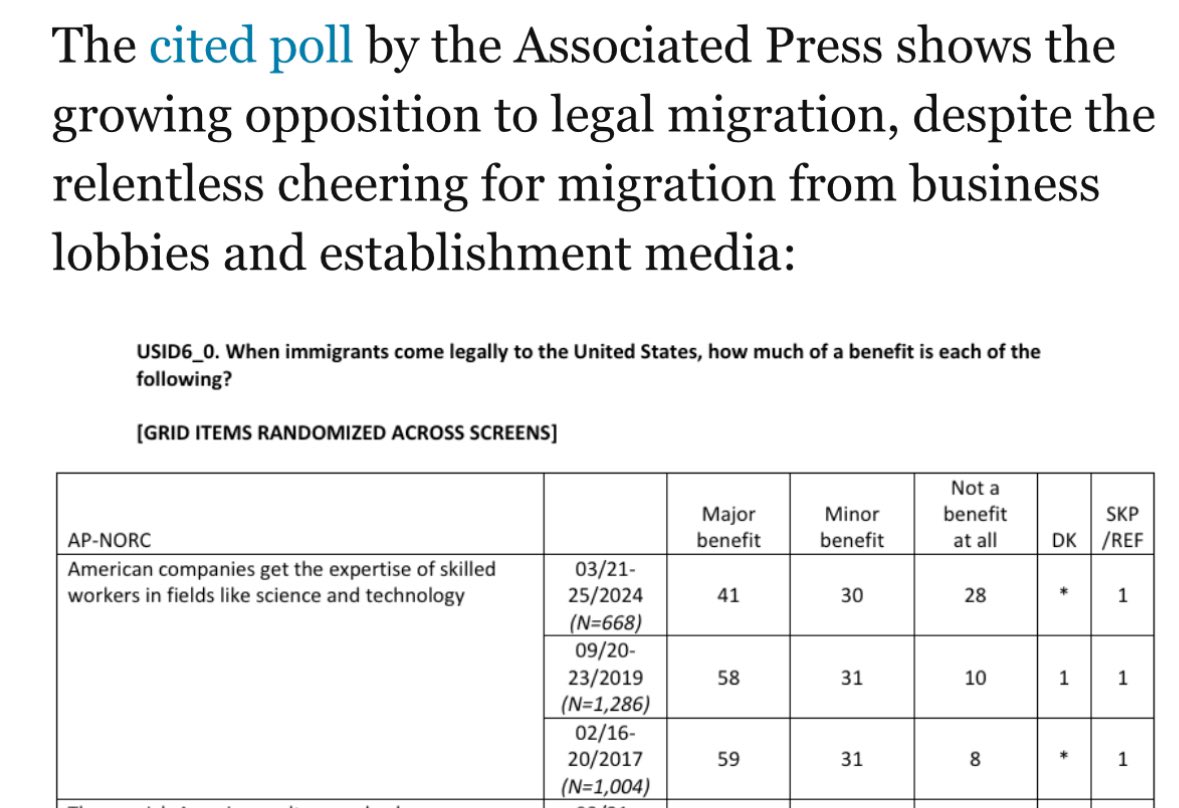
  • RT @USTechWorkers: Keep exposing the phoniness of “high skilled” immigration

    RT @USTechWorkers: Keep exposing the phoniness of “high skilled” immigration. https://t.co/93di7itmnW


    Source date (UTC): 2024-06-06 18:25:33 UTC

    Original post: https://twitter.com/i/web/status/1798783303287492859

  • ANSWERING THE HARD QUESTION –“Q: Are there any legitimate weaknesses of capital

    ANSWERING THE HARD QUESTION
    –“Q: Are there any legitimate weaknesses of capitalism as an economic system?”–

    All economies are and always have been mixed economies and extreme attempts at economies always fail for reasons we understand.

    Because government is the world’s most profitable business, and governments are both the insurers of last resort and investors of last resort and as such government investment in production (not consumption) will produce strategic advantage where it’s possible.

    We seek a consistent government-economic relationship because it reduces our adaptive burden allowing us to maximize personal consumption in time.

    Yet the distribution of private-sector state production of anything is dependent upon whether a population is in a state of plenty, going concern, or stress.

    The primary problem of the twentieth century was the mixture of the false promise of endless growth in population and economy, with the adaoption of intergenerational transfer instead of intergenerational savings. This is why the developed world MUST collapse.

    We list the spectrum of political biases without explaining that the only thing that matters is rule of law to protect against extreme economies on one hand, and to allow us to shift between economies as needed on the other. Oddly americans are better at this becuase of the general prohibition on state power outside of warfare and crisis. And that is the correct division of labor. But the left wants to violate the laws of nature in the material world just as they do so by social construction of words in the imaginary world. And that’s never possible. It’s just endemic in the feminine mind.

    Capitalism without rule of law is private sector privatization of public capital incentivizing private corruption exhausting incentives (today) and destroying the legitimacy of the government, just as socialism-communism is public sector socialization of private capital, producing public sector corruption, destroying incentives for production, and destroying government legitimacy.

    We have just about the best system but our rule of law is insufficient for defense against private sector corruption (the financial sector and the global business sector) as well as public sector corruption (the credentialist elites).

    Both of those problems are easily fixed by law with the power to force the adoption of those laws into the constitution and law.

    LIST:
    Capitalism: bias to the private sector in the production of goods services information.
    Classical Liberalism: Redistribution of the proceeds of private sector production to the production of commons lowering indirect costs while preserving direct costs. Maximizing incentives for all.
    Democratic Socialism: Redistribution of the proceeds of private sector production for the public consumption of goods services and information.
    Fascism: State Direction of Private Production for Strategic Purposes lowering direct returns on private production to produce indirect returns for the population.
    Socialism: bias to the public sector for the production of goods services and information at the cost of incentive for private production and returns on capital.

    Neither anarchism or communism are possible so they aren’t worth discussing.

    Cheers
    CD

    Reply addressees: @whatifalthist


    Source date (UTC): 2024-06-06 18:20:33 UTC

    Original post: https://twitter.com/i/web/status/1798782043125399552

    Replying to: https://twitter.com/i/web/status/1798609370194067678

  • ORIGINAL SIN Brad’s explaining original sin: “Human being s are wired to gain as

    ORIGINAL SIN
    Brad’s explaining original sin: “Human being s are wired to gain as much as they can at the lowest cost possible.” Its the ‘lowest cost possible’ part that’s the door to all sin. 😉 https://twitter.com/WerrellBradley/status/1798034535017508971

  • ORIGINAL SIN Brad’s explaining original sin: “Human being s are wired to gain as

    ORIGINAL SIN
    Brad’s explaining original sin: “Human being s are wired to gain as much as they can at the lowest cost possible.” Its the ‘lowest cost possible’ part that’s the door to all sin. 😉


    Source date (UTC): 2024-06-04 22:08:54 UTC

    Original post: https://twitter.com/i/web/status/1798114731820994561

  • RT @WerrellBradley: INTRINSIC FLAW OF HUMAN NATURE Human beings are hard-wired t

    RT @WerrellBradley: INTRINSIC FLAW OF HUMAN NATURE

    Human beings are hard-wired to seek to gain as much as they can at as little cost (to t…


    Source date (UTC): 2024-06-04 19:31:49 UTC

    Original post: https://twitter.com/i/web/status/1798075200543830365