Theme: Governance

  • THE ORIGIN OF THE NATION STATE The City State is a natural consequence of market

    THE ORIGIN OF THE NATION STATE

    The City State is a natural consequence of markets, and the enforced dominion of some set of rules in order to gain access to the benefits that market.

    The Nation State is a declared, involuntary, genetic and cultural empire enforcing dominion over city states and surrounding territories. The empire is a cross genetic and cultural involuntary organization, enforcing dominion over all political orders in a territory ostensibly for the common good – and in many ways the claim is true.

    Prior to the nation state, multi-ethnic, military, legislative, and commercial, empires, usually ruled by a monarch from the dominant ethnic group, were the common form of cultural, economic, political, and military organization.

    As markets expanded, and wealth expanded, and ‘cognizance’ of the greater world expanded “as an inadvertent byproduct of 15th-century intellectual discoveries in political economy, capitalism, mercantilism, political geography, and geography combined together with cartography and advances in map-making technologies.” Or stated differently, accounting, record keeping, literacy, and map making made people aware of both their competitors and their economic opportunities for preserving competition against them – for preserving their sovereignty. The result was somewhat of a ‘big sort’ in europe that is currently occuring in the United States, as people in the USA re-nationalize after ‘filling up’ the new continent.

    This is the positive, romantic, or ‘opportunistic’ side of the story. But the other side of the story is negative, pragmatic, and defensive.

    The modern Nation State was invented by Napoleon for use in funding his invention of Total War. The Nation State evolved everywhere else in response to Napoleon’s invention of total war: either as a defense against it, or as a siezure of opportunity to replicate it.

    Before Napoleon, only tropical empires could marshall the resources necessary for sustained expansionary conquest and control. Napoleon was the first European to successfully bring Oriental Despotism to Europe with the same level of mobilization of the populace as the Egyptians, Babylonians, and Chinese had been able to do, due given their relative ease of controlling irrigation by flooding of rivers and concentrated production, compared to small farms distributed over large territories with distributed production in what we call Christendom (Europa major).

    The combination of Post-Templar Self-Defended Credit, in the form of Jewish-Credit Under State Protection, superior methods of record keeping (accounting), the increases in agrarian and mechanical production in Europe due to the second ‘agrarian revolution’, produced in no small part through rapid expansion of literacy and print, and the windfalls from the transfer of trade from the Mediterranean to the Atlantic, and the ability to manufacture muskets in vast numbers thereby eliminating the advantage of a professional warrior class made a Napoleon possible – but only because of the backwardness of the French Monarchy, which, like the church, had stagnated in comparison to her faster-evolving neighbors.

    This combination of extremely backward governance, and extreme opportunity to mobilize is usually seen only when there is an extraordinary excesses of young males lacking opportunities for income and sex. But when combined with extraordinary credit and community license to restructure all of society by violence, the momentum of the movement created an opportunity for despotism equal to that which had been available in the ancient river empires.

    As far as I know this is the origin of the second phase of the nation state: total war. The technological ability to organize distributed production under the same level of control as concentrated flood river production.

    To take this further we must also address cosmopolitan universalism on the one hand(Profits for Some), and the clash of civilizations on the other (Norms for All).


    Source date (UTC): 2016-09-29 03:35:00 UTC
  • THE FIRST QUESTIONS OF PHILOSOPHY, ETHICS, AND GOVERNMENT (important piece) (man

    THE FIRST QUESTIONS OF PHILOSOPHY, ETHICS, AND GOVERNMENT

    (important piece) (man is a rational actor)

    – The first question of Philosophy: As asked by Camus: “Why do we not commit suicide?”

    – The first question of Ethics: As I find it: “Why do I not kill you and take your things?”

    – The first question of Government: As I find it: “Why do we not plunder, enslave, or kill you?”

    THE ANSWER TO EACH QUESTION IS THE SAME

    – We do not commit suicide because the greater future opportunities we buy by not doing so.

    – We do not kill one another, because of the greater future opportunities we buy by not doing so.

    – We do not plunder and enslave one another, because of the greater future opportunities we buy by not doing so.

    BUT EACH DECISION IS REVERSIBLE

    – We commit suicide when we buy no greater future opportunities by not doing so.

    – We kill one another when we buy no greater future opportunities by not doing so.

    – We plunder, enslave or kill one another, when we buy no greater future opportunities by not doing so.

    SO MAN IS MERELY RATIONAL OR IRRATIONAL IN HIS CHOICES

    Now, I am a rational man. I choose rationally. If I were a less rational man, perhaps I would choose irrationally instead. A rational man might choose suicide, murder, and war. But In this context (sense), reason is not always the best choice compared to irrationality, because we cannot reason the future given the information in the present.

    SO WE CHOOSE TO MAKE THE RATIONAL CHOICE TO FAVOR THE UNKNOWN UNLESS THE KNOWS ARE INTOLERABLE

    So it is always better to choose life, cooperation, and rule than it is to choose death, conflict, and war. That is, unless the certainty of suffering in the meantime is unbearable.

    Curt Doolittle

    The Propertarian Institute

    Kiev, Ukraine


    Source date (UTC): 2016-09-26 03:41:00 UTC

  • Donald Trump and Hillary Clinton walk in to a bar. Donald leans over, and with a

    Donald Trump and Hillary Clinton walk in to a bar.

    Donald leans over, and with a smile on his face, says,

    “The media is really tearing you apart for that Scandal.”

    Hillary: “You mean my lying about Benghazi?”

    Trump: “No, the other one.”

    Hillary: “You mean the massive voter fraud?”

    Trump: “No, the other one.”

    Hillary: “You mean the military not getting their votes counted?”

    Trump: “No, the other one.”

    Hillary: “Using my secret private server with classified material to Hide my Activities?”

    Trump: “No, the other one.”

    Hillary: “The NSA monitoring our phone calls, emails and everything Else?”

    Trump: “No, the other one.”

    Hillary: “Using the Clinton Foundation as a cover for tax evasion, Hiring Cronies, And taking bribes from foreign countries?”

    Trump: “No, the other one.”

    Hillary: “You mean the drones being operated in our own country without The Benefit of the law?”

    Trump: “No, the other one.”

    Hillary: “Giving 123 Technologies $300 Million, and right afterward it Declared Bankruptcy and was sold to the Chinese?”

    Trump: “No, the other one.”

    Hillary: “You mean arming the Muslim Brotherhood and hiring them in the White House?”

    Trump: “No, the other one.”

    Hillary: “Whitewater, Watergate committee, Vince Foster, commodity Deals?”

    Trump: “No the other one:”

    Hillary: “Turning Libya into chaos?”

    Trump: “No the other one:”

    Hillary: “Being the mastermind of the so-called “Arab Spring” that only brought chaos, death and destruction to the Middle East and North Africa?”

    Trump: “No the other one:”

    Hillary: “Leaving four Americans to die in Benghazi?”

    Trump: “No the other one:”

    Hillary: “Trashing Mubarak, one of our few Muslim friends?”

    Trump: “No the other one:”

    Hillary: “The funding and arming of terrorists in Syria, the destruction and destabilization of that nation, giving the order to our lapdogs in Turkey and Saudi Arabia to give sarin gas to the “moderate” terrorists in Syria that they eventually used on civilians, and framed Assad, and had it not been for the Russians and Putin, we would have used that as a pretext to invade Syria, put a puppet in power, steal their natural resources, and leave that country in total chaos, just like we did with Libya?

    Trump: “No the other one:”

    Hillary: “The creation of the biggest refugees crisis since WWII?”

    Trump: “No the other one:”

    Hillary: “Leaving Iraq in chaos? “

    Trump: “No, the other one.”

    Hillary: “The DOJ spying on the press?”

    Trump: “No, the other one.”

    Hillary: “You mean HHS Secretary Sibelius shaking down health insurance Executives?”

    Trump: “No, the other one.”

    Hillary: “Giving our cronies in SOLYNDRA $500 MILLION DOLLARS and 3 Months Later they declared bankruptcy and then the Chinese bought it?”

    Trump: “No, the other one.”

    Hillary: “The NSA monitoring citizens’ ?”

    Trump: “No, the other one.”

    Hillary: “The State Department interfering with an Inspector General Investigation on departmental sexual misconduct?”

    Trump: “No, the other one.”

    Hillary: “Me, The IRS, Clapper and Holder all lying to Congress?”

    Trump: “No, the other one.”

    Hillary: “Threats to all of Bill’s former mistresses to keep them quiet?”

    Trump: “No, the other one.”

    Hillary: “You mean the INSIDER TRADING of the Tyson chicken deal I did where I invested $1,000 and the next year I got $100,000?”

    Trump: “No, the other one.”

    Hillary: “You mean when Bill met with Attorney General, Loretta Lynch, just before my hearing with the FBI to cut a deal?”

    Trump” “No, the other one.”

    Hillary: ” You mean the one where my IT guy at Platte River Networks asked Reddit for help to alter emails?”

    Trump” “No, the other one.”

    Hillary: “You mean where the former Haitian Senate President accused me and my foundation of asking him for bribes?”

    Trump” “No, the other one.”

    Hillary: “You mean that old video of me laughing as I explain how I got the charges against that child rapist dropped by blaming the young girl for liking older men and fantasizing about them. Even though I knew the guy was guilty?

    Trump” “No, the other one.”

    Hillary: “You mean that video of me coughing up a giant green lunger into my drinking glass then drinking it back down?”

    Trump” “No, the other one.”

    Hillary: “You mean that video of me passing out on the curb and losing my shoe?”

    Trump” “No, the other one.”

    Hillary: “You mean when I robbed Bernie Sanders of the Democratic Party Nomination by having the DNC rig the nomination process so that I would win?”

    Trump” “No, the other one.”

    Hillary: “You mean how so many people that oppose me have died in mysterious was?”

    Trump” “No, the other one.”

    Hillary: “Travel Gate? When seven employees of the White House Travel Office were fired so that friends of Bill and mine could take over the travel business? And when I lied under oath during the investigation by the FBI, the Department of Justice, the White House itself, the General Accounting Office, the House Government Reform and Oversight Committee, and the Whitewater Independent Counsel?”

    Trump” “No, the other one.”

    Hillary: “The scandal where, (while I was Secretary if State), the State Department signed off on a deal to sell 20% of the USA’s uranium to a Canadian corporation that the Russians bought, netting a $145 million donation from Russia to the Clinton Foundation and a $500,000 speaking gig for Bill from the Russian Investment Bank that set up the corporate buyout?. That scandal?”

    Trump” “No, the other one.”

    Hillary: “That time I lied when I said I was under sniper fire when I got off the plane in Bosnia?”

    Trump” “No, the other one.”

    Hillary: “That time when after I became the First Lady, I improperly requested a bunch of FBI files so I could look for blackmail material on government insiders?”

    Trump” “No, the other one.”

    Hillary: “That time when Bill nominated Zoe Baird as Attorney General, even though we knew she hired illegal immigrants and didn’t pay payroll taxes on them?”

    Trump” “No, the other one.”

    Hillary: “When I got Nigeria exempted from foreign aid transparency guidelines despite evidence of corruption because they gave Bill a $700,000 in speaking fees?”

    Trump” “No, the other one.”

    Hillary: “That time in 2009 when Honduran military forces allied with rightist lawmakers ousted democratically elected President Manuel Zelaya, and I as then-Secretary of State sided with the armed forces and fought global pressure to reinstate him?”

    Trump: “No, the other one.”

    Hillary: “I give up! … Oh wait, I think I’ve got it! When I stole the White House furniture, silverware, when Bill left Office?”

    Trump: “THAT’S IT! I almost forgot about that one”.


    Source date (UTC): 2016-09-25 12:56:00 UTC

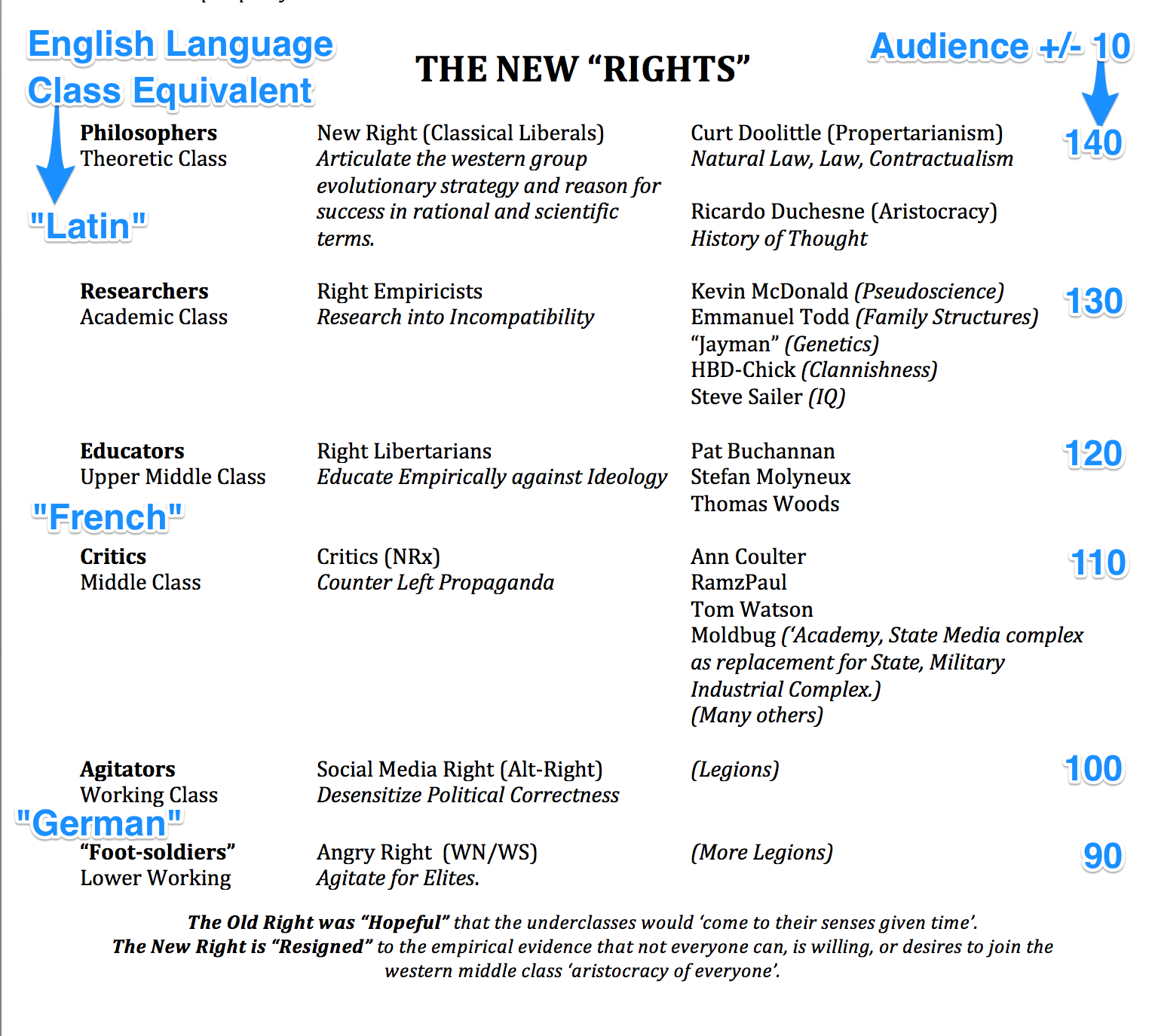
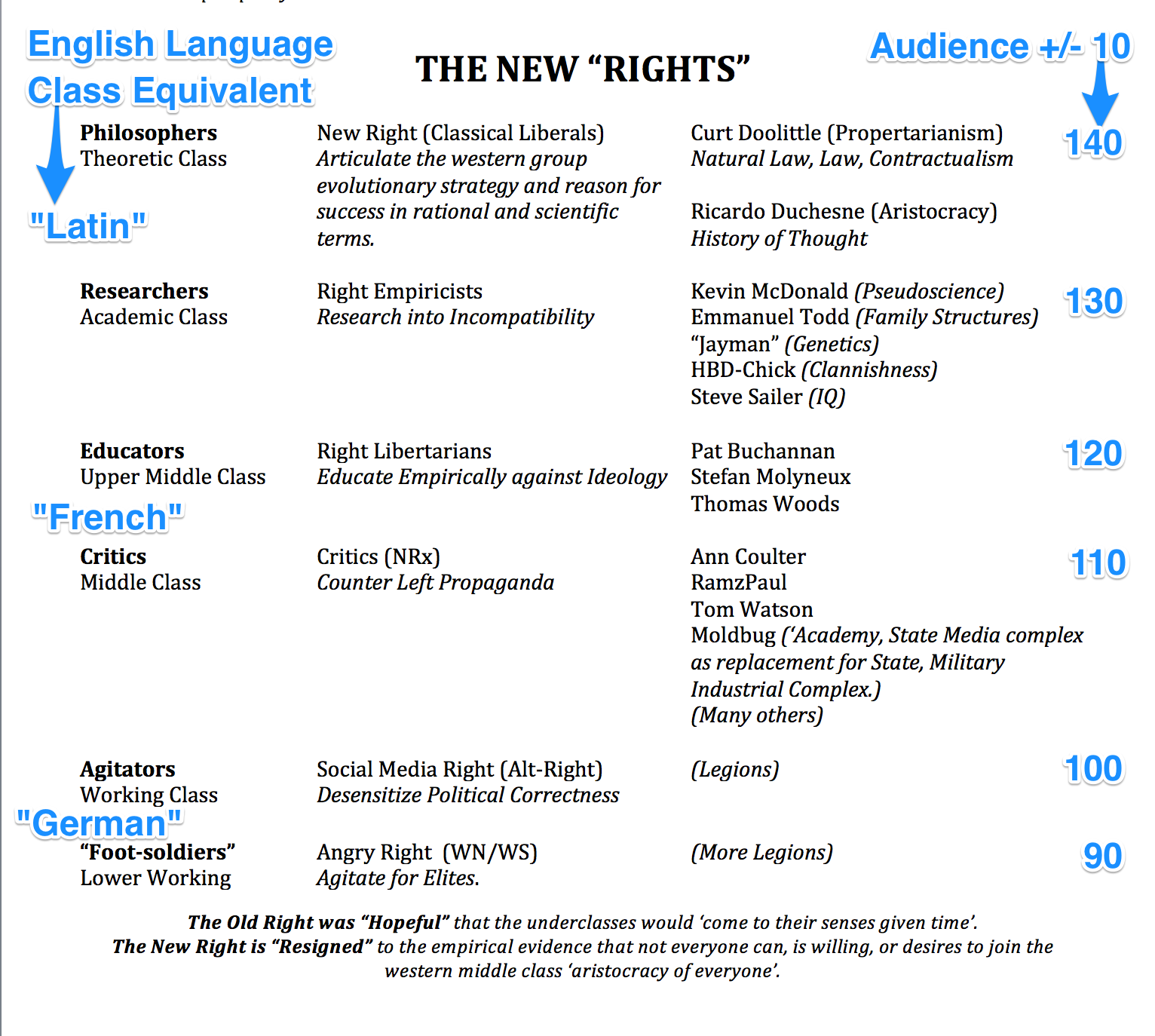
  • The New “Right” Class Structures

    I got a lot of heat for this so I pulled it and sat on it for a week. And this morning I’ve added some notes to it for clarity. And sorry if it pisses people off, but it’s right. It is what it is.

    class-notated.png
  • The New “Right” Class Structures

    I got a lot of heat for this so I pulled it and sat on it for a week. And this morning I’ve added some notes to it for clarity. And sorry if it pisses people off, but it’s right. It is what it is.

    class-notated.png
  • “I wonder if in one hundred years we just need a roomful of geniuses and the int

    –“I wonder if in one hundred years we just need a roomful of geniuses and the internet to run the whole world.”–Adam Voight

    Yeah. That’s what I’m thinking. Except that word ‘run’ is an experiential analogy, and not an operational or descriptive statement.

    So, what I worry about is whether it is analogy for “serve”, “farm”, or “enslave”.

    …(!!!!)


    Source date (UTC): 2016-09-23 05:05:00 UTC

  • Untitled

    https://www.quora.com/Why-does-the-1-7-Jewish-population-in-USA-have-so-much-political-power/answer/Curt-Doolittle?srid=u4Qv&share=eb0b9e37

    Source date (UTC): 2016-09-23 02:01:00 UTC

  • Monopoly State Education?

    Q&A: —“What are your thoughts on universal public education being provided by the state.”— GREAT QUESTION WHEREAS (1) Education provides both offensive and defensive benefits. So (a) Offensively, it increases the possibility of productivity (a commons). And (b) Defensively it reduces crime(loss), insurance(restitution) and welfare (prevention) costs. (Humans are really expensive things.) While we probably teach largely the wrong things today, and that we teach them poorly, (not enough repetition of basic operations), that does not mean that we cannot teach the right things. After Defense (external), and Law and order(internal), education is probably the most important offensive and defensive capability a group can add to the commons. So I am pretty sure education needs to be mandatory in order to avoid externalizing costs of failing to educate (prevention) on fellow shareholders (citizens), due to loss, restitution. ( Same with driving a vehicle without insurance. Or driving aggressively. You’re exporting risk onto others. ) Failing to educate is just like failing to respect property. It’s just more indirect. Now, if you have the right of exit, and your offspring have the right of exit, and you leave the market (territory), that’s not the case. But then you lose the benefits of being a member of the market (territory). So it’s your choice. It’s pretty hard to find a market that will allow entry of an uneducated person. It’s just going to force costs on shareholders (citizens) (2) So if education is both a necessary good, and a moral obligation, then the question is only (a)whether universal provision by the state is a necessary or preferable, and (b) whether the monopoly provision of it by the state is necessary or preferable. Well first we have to answer the externality question. Does universal provision by the state solve the problem of the costs of loss, restitution, and prevention? Well yes. It does. Does the scale of that provisioning convey any price benefits? Actually no. Because the bureaucracy consumes a disproportionate amount of the funds, without any measurable positive impact, and arguably negative. Does universal education using the same curriculum have positive or negative consequences. Well the answer is that any education must provide some minimum: reading, writing, basic math, basic personal accounting, basic principles of contract, basic principles of the economy. Basic principles of natural law, basic principles of physical laws. Note that I’ve included no mythology in that list. No justificationism. Does universal education need mythology? Well I think that teaching anything antithetical to natural and physical law, antithetical to contract, accounting, mathematics, and reading (the common tongue), is something that exports costs onto others through the propagation of falsehoods. Can I teach my own children mythology at home, or in religious school? Of course you can. If it is taught as spiritual, as faith, as psychology, but not in conflict with physical, natural, contactual, mathematical, literacy, or rhetorical, grammatical, and logical truth. There are no ancient texts that cannot be translated into ratio-scientific language as necessary and possible traditions of the time. There are no normative family and cultural traditions that cannot likewise be explained. There is no harm in prayer, ritual, and faith, even if there is harm in conflating spiritual(experiential) and truthful(testimonial). It’s very hard to argue with the sermon on the mount. And it’s not hard to state that them miracles are fairy tales meant to educated us on how we should aspire to behave toward one another. CLOSING So like anything, when we want to produce a private good (education) for common goods (costs of loss, restitution, and prevention), then the market will succeed at providing some goods (private education, church education, public education) just as it will succeed at providing other goods (private health care, church health care, state health care), and many other goods (private investor banking, commercial banking, credit unions, and state treasury support). So the problem we have had in the past, is not the failure to understand this problem, but the failure to require truth, while preserving faith. Because man does not live by truth alone unless he lives in a large primitive tribe where he is saturated by information supplied by peers and there is no meaningful information available to him that is not shared by those peers. Even in those circumstances we require faith in order to ease the various sufferings, and to cause the community to unite in celebration of the service of the common good. Ergo, we must warranty all speech, products and services against error, bias, wishful, thinking, suggestion, pseudoscience, and deceit. And we must warranty the minimum (not ultimate) services that an individual must possess in order not to be a burden on others such that he invokes moral hazard, and by invoking moral hazard, creates the incentive in the commons to abandon perfect-care of the commons. This is a profoundly important issue: preservation of the incentive to preserve and expand the commons. And as long as one warranties minimum provision, no falsehood, and treats myths as necessary goods as long as they do not violate the natural and physical and contractual and logical law, then there is no reason we cannot provide public (insured education), private education(market provided education), and community education (church, etc), My suggestion, as always with regard to the professions, is (a) that I don’t believe anyone that is not a grandmother or grandfather should teach anything to anyone. Otherwise we have a person without life experience conveying the necessities of surviving life’s experiences. (b) that it’s the teachers who are paid, not organizations, and that the teachers contribute some part of their fees to the maintenance of the organization. And that organizations that desire capital investment can lend against future earnings. And that we can only lend against future earnings if the citizenry is to insure the loan. These are the terms by which teachers can teach, schools can form. Not in the interests of the school owners, but in the interest of the teachers and the students. I think all education should be paid for as deductions from future earnings (payroll fees). And current costs covered from the treasury. Why? Because it’s an investment that produces guaranteed returns, if we keep honest statistics on the performance of different degree programs and their classes. (Early childhood ed is a very bad investment, right behind Sociology). Then universities and schools will not charge money for the modern equivalent of “indulgences” which they give people paper in exchange for participating in nonsense for years, all at the public expense. In university, paying teachers directly and separating teaching and researching staff, and paying them accordingly. (the way oxford and Cambridge were started) We can let the market regulate education by using the courts to punish people who teach untruths contrary to natural, physical, contractual, and logical laws. If we did this in just one generation we would change the world for the better nearly as much as we changed the world with greek reason, British science, and enlightenment literacy. Truth is as important an innovation as were literacy, reason, and science. It’s just unfortunate that it took us this long to discover what it means. So that’s my position: Private(wealthy), civic(middle), and public(lower) institutions for the purpose of education, paid for out of future earnings, teaching the minimums, requiring warranty, and separating spirituality and myth from action and truth. What will rapidly occur is that government schools will rapidly improve else the stigma close them, and as usual the wealthy will innovate and the rest benefit. Curt Doolittle The Propertarian Institute Kiev, Ukraine

  • Monopoly State Education?

    Q&A: —“What are your thoughts on universal public education being provided by the state.”— GREAT QUESTION WHEREAS (1) Education provides both offensive and defensive benefits. So (a) Offensively, it increases the possibility of productivity (a commons). And (b) Defensively it reduces crime(loss), insurance(restitution) and welfare (prevention) costs. (Humans are really expensive things.) While we probably teach largely the wrong things today, and that we teach them poorly, (not enough repetition of basic operations), that does not mean that we cannot teach the right things. After Defense (external), and Law and order(internal), education is probably the most important offensive and defensive capability a group can add to the commons. So I am pretty sure education needs to be mandatory in order to avoid externalizing costs of failing to educate (prevention) on fellow shareholders (citizens), due to loss, restitution. ( Same with driving a vehicle without insurance. Or driving aggressively. You’re exporting risk onto others. ) Failing to educate is just like failing to respect property. It’s just more indirect. Now, if you have the right of exit, and your offspring have the right of exit, and you leave the market (territory), that’s not the case. But then you lose the benefits of being a member of the market (territory). So it’s your choice. It’s pretty hard to find a market that will allow entry of an uneducated person. It’s just going to force costs on shareholders (citizens) (2) So if education is both a necessary good, and a moral obligation, then the question is only (a)whether universal provision by the state is a necessary or preferable, and (b) whether the monopoly provision of it by the state is necessary or preferable. Well first we have to answer the externality question. Does universal provision by the state solve the problem of the costs of loss, restitution, and prevention? Well yes. It does. Does the scale of that provisioning convey any price benefits? Actually no. Because the bureaucracy consumes a disproportionate amount of the funds, without any measurable positive impact, and arguably negative. Does universal education using the same curriculum have positive or negative consequences. Well the answer is that any education must provide some minimum: reading, writing, basic math, basic personal accounting, basic principles of contract, basic principles of the economy. Basic principles of natural law, basic principles of physical laws. Note that I’ve included no mythology in that list. No justificationism. Does universal education need mythology? Well I think that teaching anything antithetical to natural and physical law, antithetical to contract, accounting, mathematics, and reading (the common tongue), is something that exports costs onto others through the propagation of falsehoods. Can I teach my own children mythology at home, or in religious school? Of course you can. If it is taught as spiritual, as faith, as psychology, but not in conflict with physical, natural, contactual, mathematical, literacy, or rhetorical, grammatical, and logical truth. There are no ancient texts that cannot be translated into ratio-scientific language as necessary and possible traditions of the time. There are no normative family and cultural traditions that cannot likewise be explained. There is no harm in prayer, ritual, and faith, even if there is harm in conflating spiritual(experiential) and truthful(testimonial). It’s very hard to argue with the sermon on the mount. And it’s not hard to state that them miracles are fairy tales meant to educated us on how we should aspire to behave toward one another. CLOSING So like anything, when we want to produce a private good (education) for common goods (costs of loss, restitution, and prevention), then the market will succeed at providing some goods (private education, church education, public education) just as it will succeed at providing other goods (private health care, church health care, state health care), and many other goods (private investor banking, commercial banking, credit unions, and state treasury support). So the problem we have had in the past, is not the failure to understand this problem, but the failure to require truth, while preserving faith. Because man does not live by truth alone unless he lives in a large primitive tribe where he is saturated by information supplied by peers and there is no meaningful information available to him that is not shared by those peers. Even in those circumstances we require faith in order to ease the various sufferings, and to cause the community to unite in celebration of the service of the common good. Ergo, we must warranty all speech, products and services against error, bias, wishful, thinking, suggestion, pseudoscience, and deceit. And we must warranty the minimum (not ultimate) services that an individual must possess in order not to be a burden on others such that he invokes moral hazard, and by invoking moral hazard, creates the incentive in the commons to abandon perfect-care of the commons. This is a profoundly important issue: preservation of the incentive to preserve and expand the commons. And as long as one warranties minimum provision, no falsehood, and treats myths as necessary goods as long as they do not violate the natural and physical and contractual and logical law, then there is no reason we cannot provide public (insured education), private education(market provided education), and community education (church, etc), My suggestion, as always with regard to the professions, is (a) that I don’t believe anyone that is not a grandmother or grandfather should teach anything to anyone. Otherwise we have a person without life experience conveying the necessities of surviving life’s experiences. (b) that it’s the teachers who are paid, not organizations, and that the teachers contribute some part of their fees to the maintenance of the organization. And that organizations that desire capital investment can lend against future earnings. And that we can only lend against future earnings if the citizenry is to insure the loan. These are the terms by which teachers can teach, schools can form. Not in the interests of the school owners, but in the interest of the teachers and the students. I think all education should be paid for as deductions from future earnings (payroll fees). And current costs covered from the treasury. Why? Because it’s an investment that produces guaranteed returns, if we keep honest statistics on the performance of different degree programs and their classes. (Early childhood ed is a very bad investment, right behind Sociology). Then universities and schools will not charge money for the modern equivalent of “indulgences” which they give people paper in exchange for participating in nonsense for years, all at the public expense. In university, paying teachers directly and separating teaching and researching staff, and paying them accordingly. (the way oxford and Cambridge were started) We can let the market regulate education by using the courts to punish people who teach untruths contrary to natural, physical, contractual, and logical laws. If we did this in just one generation we would change the world for the better nearly as much as we changed the world with greek reason, British science, and enlightenment literacy. Truth is as important an innovation as were literacy, reason, and science. It’s just unfortunate that it took us this long to discover what it means. So that’s my position: Private(wealthy), civic(middle), and public(lower) institutions for the purpose of education, paid for out of future earnings, teaching the minimums, requiring warranty, and separating spirituality and myth from action and truth. What will rapidly occur is that government schools will rapidly improve else the stigma close them, and as usual the wealthy will innovate and the rest benefit. Curt Doolittle The Propertarian Institute Kiev, Ukraine

  • Revolutions In Strategic Context

    Aug 13, 2016 12:18pm Everyone knows how to fix Ukraine. But no one in the country has the power to do it. And the only external group willing to use power to do it, will just make it worse (Russians). Even though the optimum people to do it are their genetic siblings right next door (Poland). And other peoples (the Americans, Canadians, and Germans) have demonstrated a willingness to pay for it. (yes really). Ukraine’s problem is a Jewish-libertarian’s dream: about 40 oligarchs (rich people) who range from men of commercial achievement and character, to Russian ex-gangsters, to families that control judicial corruption, to jews looking to restore Ukraine to their undeclared homeland. Very few people know how to fix the United States of America. But because of our arms, our traditions of legal revolt, and culture of aristocratic martial tradition, we have the ability and power to enact that change. We just need to have the will to do it. But because of that same culture we need a moral license, a set of demands, a plan of transition, and a means of revolt, in order to execute our will. Now, every major revolution in the anglo world (anglo-saxon-contractualism) has occurred in no small part, because of expansion of the methods of communication and innovations in technology. We have the ability to communicate and coordinate vast numbers of people that no prior era has ever imagined. Washington had nothing at all but pocket change, character, and some helpful propagandists who used the printing press. Stalin did what he did and had nothing on par with the tools we have at our disposal. Mao did what he did, and he nad nothing on part with the tools we have at our disposal. Napoleon had a lot more going for him than we do. Cromwell had more at his disposal than we do. But whether one is inside the government or outside the government, it does not matter if one has a set of demands, a plan of transition, a means of raising the cost of the status quo through insurrection, a small minority of males willing to risk life and limb, and a communication system capable of distributing information, tactics, and strategy to participants. The world has never been so fragile and in such great transition as it is today – or at least, it has not since the Marxist (Jewish) enlightenment inspired the lower classes to seek power as much as the empirical (anglo) enlightenment inspired the middle classes to seek power. But the difference today is that we cannot, under duress, return to the farm. THere are but a few days of food water and energy in the pipline, and in a momentum economy, like a momentum stock market, the system is increasingly vulnerable to shocks. (Thank your Keynesians for their efforts at ‘balanced equilibrium, rather than your Classical Liberals, for their “changes in capital”). We can more easily fix america than any group ever chose to fix any nation in history. Curt Doolittle The Philosophy of Aristocracy The Propertarian Institute (I have no idea where I am at the moment)