Theme: Governance

  • Unpacking “Democracy Requires Homogeneity”

    October 13th, 2018 4:18 PM UNPACKING “DEMOCRACY REQUIRES HOMOGENEITY” by Richard Nikoley

    —“Markets allow us to cooperate on means despite disparate ends. Democracy, only on same ends. Democracy requires homogeneity.”— CD

    Let me unpack this a bit for those unfamiliar. Markets, or trade, is inherently win-win or the trade doesn’t happen and there is no market. When you buy a pound of apples for $1, it’s because you want the apples more than you want the dollar and the tradesman wants the dollar more than he wants the pound of apples. This happens billions of times a day, globally. How many trades do you do in a single day, on average? 5-10, maybe? Multiply that by 7 Billion. That’s upwards of 70 billion trades daily and as a win-win, that’s a lot of happiness. We should be thankful. Moreover, markets are typically ideologically, racially, gender, culturally, etc. agnostic or neutral. It’s the great mediator. Traders tend not to care a bit who the other person is or what they believe, and yet they serve each other. How amazing. How fortunate we are. Now, contrast that with democracy. Democracy is winner take all. Either you keep your dollar AND get his pound of apples, or he keeps his apples and gets your dollar. It’s windfall win-lose. It only tends to work reasonably well in homogenous populations or institutions. Think Japan and Scandinavian counties (as they used to be before the Muslim influx). Relatively small populations of largely the same race, culture, national history. Or, consider a large public company where directors are elected quasi-democratically by shareholders, but everyone is more or less on the same page of making capital gains and paying dividends. Democracy does not scale to something like a European Union or a United States. Totally dumb idea, especially extending the franchise to those with no stake (no property, no financial assets, no business concern with employees, etc.).

  • The influence of billionaires

    October 13th, 2018 4:16 PM

    —“The influence of billionaires who donate to elections cannot be overstated. I did an analysis of this once. It is unbelievable. Soros himself really does have incredible power. Also Adelson and Simons and a few others. There are a couple on the right as well. Think tanks and donations to politicians … that is where the power is. That is the reason to try to make a billion – to influence politics.”—Michael Churchill

  • Pareto Generations in The USA

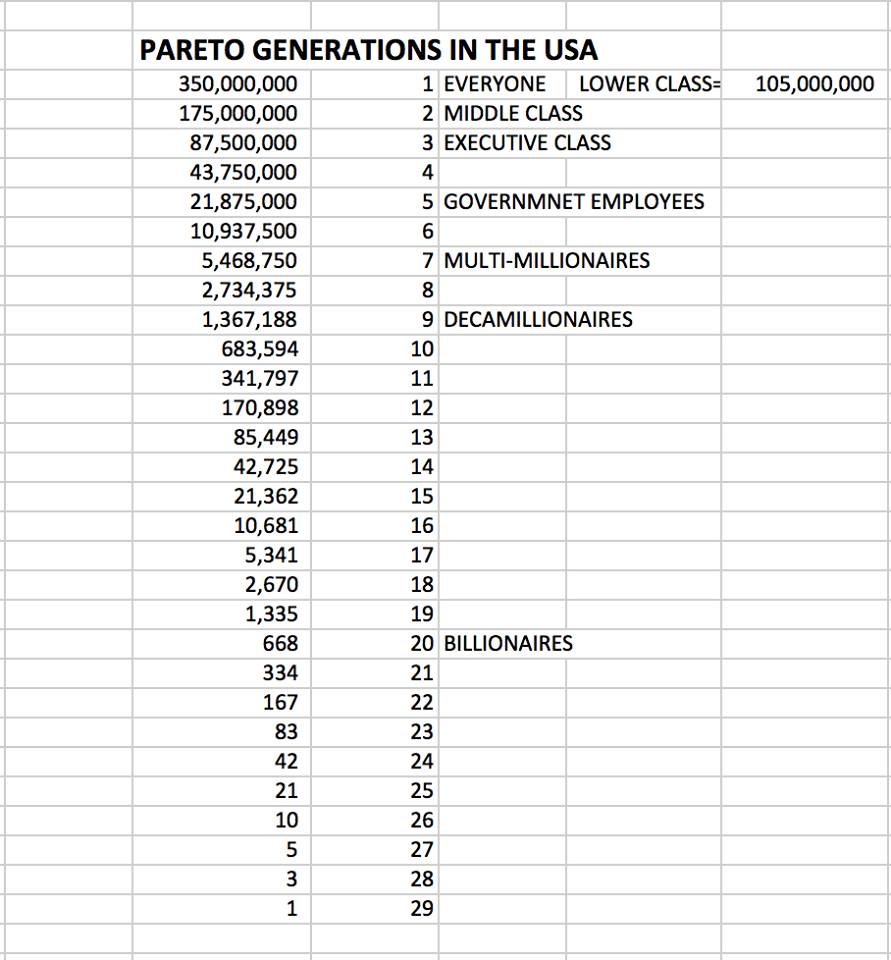
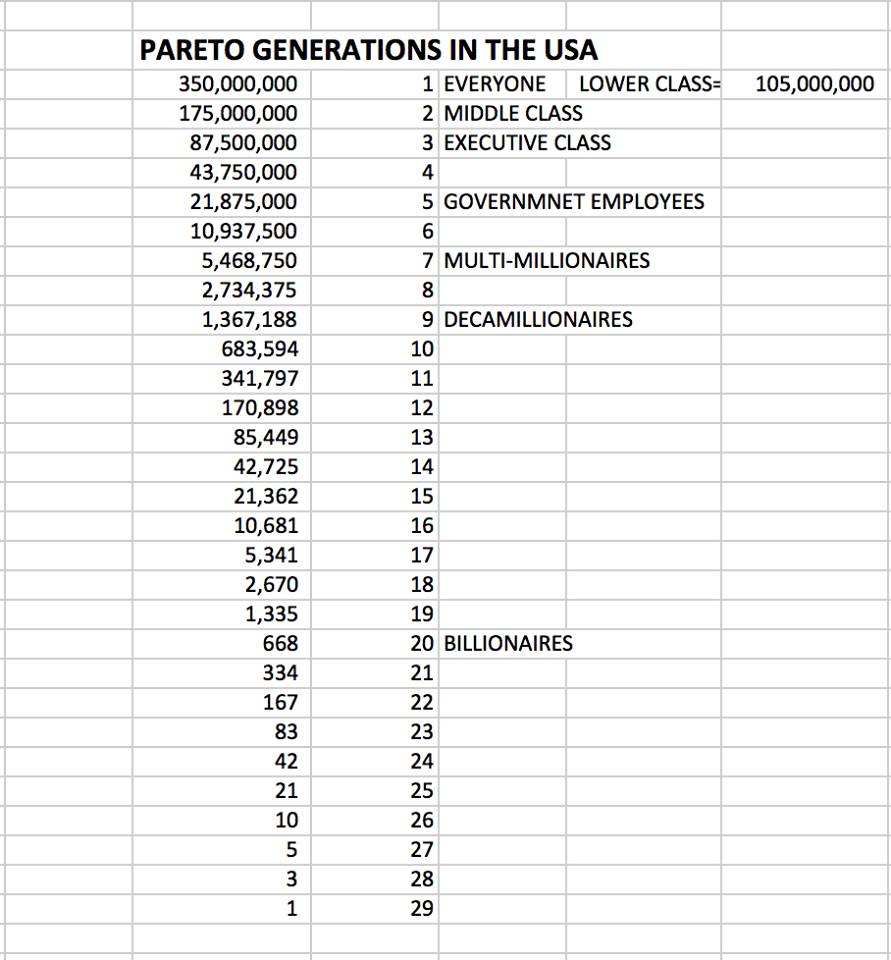
    Pareto Generations in The USA

    October 13th, 2018 2:41 PM CONTEXT PARETO GENERATIONS IN THE USACurt Doolittle Last two are Gates and Bezos, but they are not the most powerful. The most influential are the people in the fed, and who head the major financial institutions, and who donate most to election campaigns. Michael Churchill The influence of billionaires who donate to elections cannot be overstated. I did an analysis of this once. It is unbelievable. Soros himself really does have incredible power. Also Adelson and Simons and a few other cats. There are a couple on the right as well. Think tanks and donations to politicians … that is where the power is. That is the reason to try to make a billion.  

    44039989_10156705261017264_419247159515283456_n.jpg
  • far as I know universal suffrage has been the subject of criticism throughout al

    https://notesonliberty.com/2018/10/13/liberalism-democracy-and-polarization/As far as I know universal suffrage has been the subject of criticism throughout all of history, and the evidence of the 20th century that it provides little but the slow road to authoritarian redistributionism. The only reason that it’s been possible in the 20th century is the luxury of the returns on the debt possible under fiat money capitalism, at the cost of continuous dygenia (reduction of and now the reversal of, intergenerational human capital).

    There is a vast difference between those of us who understand both micro, macro, political, and human capital economics, and grasp that political systems are simply those we can afford in the moment, and nothing more. And that the only way to preserve the liberty created by western civilization is to continue the eugenic program of the ancient and medieval manorialists: meritocratic tripartism (slave-serf-freman-citizen-nobleman meritocracy) or the british invention of adding houses for each of the classes as they contribute to responsibility for management of the economy: Monarch, Landed Nobility (Regions), Commons (small business owners), and Church (proxy for the working classes). The mistake they made was not adding a new house for the working classes, and another for women upon their enfranchisement. This would let us continue the historical market for commons between the classes, rather than under liberalism(classical liberalism in the english speaking world).

    The result instead was underclass rule, and the use of propaganda and media to (lie to) use ideological hyperbole to obtain power by non-market means.

    Majoritarian democracy is and can only be, a monopoly. We had the nearly perfect government. Rule of law resulting in markets for commons, as well as markets for goods, services and information. However, the middle class seizure of power from the landed aristocracy, and the inclusion of the underclass as a means of opposing the rise of marxism-communism, merely kicked the political can down the road.

    And we are all standing around looking at that can wondering where to kick it next.

    Curt Doolittle

    The Propertarian Institute

    Kiev, Ukraine

    RE: https://notesonliberty.com/2018/10/13/liberalism-democracy-and-polarization/


    Source date (UTC): 2018-10-13 17:27:00 UTC

  • UNPACKING “DEMOCRACY REQUIRES HOMOGENEITY” by Richard Nikoley —“Markets allow

    UNPACKING “DEMOCRACY REQUIRES HOMOGENEITY”

    by Richard Nikoley

    —“Markets allow us to cooperate on means despite disparate ends. Democracy, only on same ends. Democracy requires homogeneity.”— CD

    Let me unpack this a bit for those unfamiliar.

    Markets, or trade, is inherently win-win or the trade doesn’t happen and there is no market. When you buy a pound of apples for $1, it’s because you want the apples more than you want the dollar and the tradesman wants the dollar more than he wants the pound of apples.

    This happens billions of times a day, globally. How many trades do you do in a single day, on average? 5-10, maybe? Multiply that by 7 Billion. That’s upwards of 70 billion trades daily and as a win-win, that’s a lot of happiness. We should be thankful.

    Moreover, markets are typically ideologically, racially, gender, culturally, etc. agnostic or neutral. It’s the great mediator. Traders tend not to care a bit who the other person is or what they believe, and yet they serve each other. How amazing. How fortunate we are.

    Now, contrast that with democracy. Democracy is winner take all. Either you keep your dollar AND get his pound of apples, or he keeps his apples and gets your dollar. It’s windfall win-lose.

    It only tends to work reasonably well in homogenous populations or institutions. Think Japan and Scandinavian counties (as they used to be before the Muslim influx). Relatively small populations of largely the same race, culture, national history. Or, consider a large public company where directors are elected quasi-democratically by shareholders, but everyone is more or less on the same page of making capital gains and paying dividends.

    Democracy does not scale to something like a European Union or a United States.

    Totally dumb idea, especially extending the franchise to those with no stake (no property, no financial assets, no business concern with employees, etc.).


    Source date (UTC): 2018-10-13 16:18:00 UTC

  • “The influence of billionaires who donate to elections cannot be overstated. I d

    —“The influence of billionaires who donate to elections cannot be overstated. I did an analysis of this once. It is unbelievable. Soros himself really does have incredible power. Also Adelson and Simons and a few others. There are a couple on the right as well. Think tanks and donations to politicians … that is where the power is. That is the reason to try to make a billion – to influence politics.”—Michael Churchill


    Source date (UTC): 2018-10-13 16:16:00 UTC

  • A BROTHERHOOD OF UPGRADES by Tom McSweeny Restore the brotherhoods (tribal), res

    A BROTHERHOOD OF UPGRADES

    by Tom McSweeny

    Restore the brotherhoods (tribal), restore the militia (local), restore the think tanks (national), restore the monarchies (international).

    Brotherhood of upgrades – look what has been achieved in the last few years here, the quality of community and info that has been discovered, presented and discussed. We’ve put in hours to digest, debate, contribute to varying (and increasingly, hopefully) degrees. We’ve come a long way. It’s great to see in myself and others how we’ve changed over the years, in our worldviews coming more in line with reality as is (Curt), debunking practices (Bill…first came across you with the takedown of meditation) in the quality of our arguments (James slaying it), and now to see the effects go further as it spreads (watch the world turn once the book is out and the advocates increase (thanks to the back and forth training on the likes of fb) worldwide. (And i’d encourage any who don’t pitch in to do so….the learning is in the back and forth for us all).

    Militia – you’ve nailed this as far as I’m concerned. Decentralised, reciprocal insurance of property. A living network exchanging info and protection to self similar.

    Think tanks / courtiers – though now seemingly corrupted and not spending their time working out the best way for the nation and it’s people… A pretty good investment for a nation if they could be returned to that. Get the synthesizers and measurers pushing policy based on data rather than feels. Lot of big questions to face that are simply going to escalate through time (e.g. highly reproductive invasive demographics in democracies) which require answers and action.

    Monarchies – practical, judge of last resort, easier to make deals with fewer decision makers involved.

    Hierarchy. The brotherhood nourishes the militia, nourishes the think tanks, nourishes the monarchy. For best results, all in that hierarchy are invested intergenerationally with skin in the game through time. Fail in that, with undue influence at any level by those without investment, we get mess and dysgenia.

    The importance of getting this right cannot be ignored. At all. Not even a little bit.

    Love you guys.


    Source date (UTC): 2018-10-13 10:16:00 UTC

  • France Is the Enemy of Europe (really) and The West

    October 12th, 2018 1:26 PM FRANCE IS THE ENEMY OF EUROPE (Really) AND THE WEST [L]ong term, while She can feed herself, and provide her own energy, and capture enough taxation to project local power, France has been, and will continue to be, the Enemy of European civilization – attempting at all times to drag her into feminine mediterraneanism and semiticism, while Germany must continuously expand her trade to maintain her position, and integrate with eastern europe, and russia for agrarian production (poland, ukraine), labor (poland, ukraine, russia), and resources (russia), while maintaining her relations with italy (seaports, aesthetics). Only Russia understands the threat to eurasia because only Russia faces it all along her borders. France has surrendered to it, but then France of the north may be German, but France of the south is Mediterranean, and Paris is but new Jerusalem in postmodern sophist rather than semitic supernatural prose, sold to gullible women and men of the academy who cannot produce by commercial, scientific, and military means. (WHY IS CURT STARTING THIS DISCUSSION? France, not Germany, is positioned to dominate europe upon the withdrawal of the USA from functioning as the word’s police force.)

  • The Prussian Order (martial) vs Others

    October 12th, 2018 2:51 PM THE PRUSSIAN ORDER (MARTIAL) VS OTHERS [R]ussia longs for the Prussian Order but cannot produce it – loyalty for russians is a matter of family not state. Germany has been castigated for it, and broken to prevent its revival. Britain virtue-spirals her pretense of superiority to it meanwhile dying off after 500 years of rule. France is it’s feminine enemy to the last. America produces it and would maintain it if not for underclass immigration and population replacement. Some of us simply prefer the martial established male order. some of us the commercial ascendent male order, and some of us the cult feminine order. It’s semitic universalism in french postmodern and jewish marxist, russian orthodox, and western utopianism that resists it. Greek, Roman, German, British, American, Australian Masculinism of the Militia. Russia has missed her window when she allowed the jewish bolsheviks to kill her own. France lost it in 1789 when she killed her own. There is a small chance that we can restore germany if we leave her to her own devices. There is a good chance we can restore the british empire if we make the right choices. But that choice will come at the point of a gun. Therefore “SO BE IT.”

  • A Question About Hoppe, and Private States as Corporations

    October 12th, 2018 1:56 PM (good read for libertarians esp, but all in general.)

    —“Hey Curt, I have a question about a subject I’ve been rolling around in my mind for a while, and you said you’re always happy to answer questions, so here goes: I’m starting from Hoppe’s incentives-based analysis which showed a monarchy is preferable to a democracy when running a State. What’s been bugging me about that, is how do you prevent the fall and decline of a new monarchy, just like the way all other monarchies collapsed?”—

    [W]ell, monarchies collapsed because of 1) gunpowder crushing the value of professional warriors who were committed to preservation of the hierarchy, 2) the conversion from agrarian production to trade as the source of wealth, and therefore the rise of middle/upper-middle class power and influence, 3) the failure to adapt to that power change at the rate it was occurring, 4) the french conquest of europe forcing the unification of germany, 5) the use of democracy by the middle class to seize power from the monarchies, by extending the franchise, 6) the communist-socialist movement, attempt to overthrow middle class rule and 7) the american prevention of the restoration of the monarchies after the first and second world wars: “There never would have been a hitler if a Hohenzollern had been on the throne.” I mean. Monarchies are still extant where americans(anglos) or communists(jews) didn’t destroy them. And those are the most successful countries. America wold not be in current position if she had a constitutional monarchy instead of a bureaucratic oligarchical presidency.

    —“Since there wasn’t any model I knew of in history (and that’s perhaps a dark spot you could illuminate) which answered this issue, I had to synthesize a new model, injecting some ideas from Moldbug’s formalism. “—

    As an aside, Most men, I would give the same advice: “Read more and deduce from a position of ignorance less.”

    —“Since the base rationale of running a State as a monarchy is keeping it in trust and for profit why not literally run the monarchy as a corporation? The king can be both the owner and CEO, the aristocracy can be the board of directors, and instead of treating the people like subjects, you treat them like employees, which keeps them more vested in the well being of the organization, aligned with its purposes, and leaves more room for meritocratic advancement.”—

    I guess I’m confused but that was Hoppe’s point right? That a monarchy was a privately held corporation and the territory and capital its assets and the people could move between these territories, and monarchies competed for productive talent (the way current states compete for rent seekers). Therefore the monarchy would have intergenerational incentives to preserve and accumulate capital (mutliple-producing-commons), where ‘rentiers’ would try to (and did) consume all that capital – and are now consuming even genetic capital. The problem is the difference between via-positiva (government producing commons), and via-negativa (law producing limitations on actions). As you grow from small to large the monarch like a ceo must distribute the labor of governance until his only remaining function is ‘judge of last resort’ in matters that cannot be resolved by others: usually great questions of the day, and whether to go to war. So the monarchies (france in particular) that modernized (Prussia, most germany, everyone other than france and italy which were endemically corrupt), were able to produce professional administrators (ministers) and bureaucracies (bureaucrats), that worked in the people and monarchy’s interests – and were successful. But as scale increases this becomes increasingly harder. So many small kingdoms (market) that trade is preferable to one large empire that manages (monopoly), except in war, but napoleon and russia set off the wars of expansion, with germany (wwii) trying to reverse that conquest of central europe (german civilization). The problem is in producing those organizations that perform the functions of investor in competitive commons and industries, justice, treasury, insurer of last resort. And the argument is that privately held services do a better job than do bureaucracies because bureaucracies are not subject to market competition. However, like all start ups, it may require a investment in producing the capability before the service is capable of functioning in the market. So the optimum appears to be in creating a monopoly bureaucracy until it is competent, then privatizing that industry by selling it to investors, while retaining majority interest (in control of it). Ergo. yes private market organizations that compete for the accumulation of intergenerational capital are in the long term in the interests of the people within them, just as collectivist corporations that constitute monopolies that consume all capital and intergenerational compaital are in the long term againsts the intersets of the people in them.

    —“It also seems rather conductive to promoting a “libertarian social order”.”—

    Well that’s his point now, isn’t it? 😉

    —“There are also historical small scale examples where this was attempted in the form of company towns or campuses run by corporations, which as far as I know usually turned up pretty well.”–

    That’s libertarian nonsense. The only such organizations exist as border regions under the protection of strong states. No examples in history exist otherwise. Fringe players assume risks in order to settle border territories and hold them in the State’s name against settle ment by competitors, and in exchange pay little or no taxes because of the service they are providing the state. This same activity is not possible without state protection. this is why all libertarianism is nonsense: one holds territory because one can fight to hold it from competitors. That is reality. Economies make it possible to afford the men, resources, and tools to fight to hold that territory, and use the surpluses for consumption and capital accumulation.

    —“I’m really curious to hear your thoughts on the idea, and if there is any literature on the model”—

    Well now you have them. 😉 Your intuition was on but I think you missed hoppe’s point. Hoppe wanted to create ‘free cities’ of germany like rothbard wanted to create ‘free cities’ of ukraine. The similarity is that germany and ukraine were territories under the protection of great powers. And that is the only reason free cities were allowed: to hold (reserve) territory in the name of a power. Hoppe and rothbard both practice the same denialism: war is the most profitable industry for the winner. The military comes first before all other commons. The military makes possible rule of law. Rule of law makes possible commerce. Commerce makes possible wealth. Wealth attracts population and reproduction and trade continuously, and the military capacity and legal capacity must keep pace with the increasing demand by others to conquer and tax that territory.

    —“Keep up the excellent work, I really enjoy your posts”—

    Hugs. Let’s fight the good fight. 😉