Theme: Ethnoculture

  • By Stephen Dinan – The Washington Times – Monday, September 24, 2018 Professors

    By Stephen Dinan – The Washington Times – Monday, September 24, 2018

    Professors at Yale University have roiled the immigration debate with a new study calculating there are between 16… https://www.facebook.com/permalink.php?story_fbid=297577524172478&id=100017606988153


    Source date (UTC): 2018-09-26 00:26:40 UTC

    Original post: https://twitter.com/i/web/status/1044745031901483008

  • By Stephen Dinan – The Washington Times – Monday, September 24, 2018 Professors

    By Stephen Dinan – The Washington Times – Monday, September 24, 2018

    Professors at Yale University have roiled the immigration debate with a new study calculating there are between 16 million and 30 million illegal immigrants in the U.S. — as much as three times more than most demographers figure.

    The professors’ model looked at estimates of how many people came illegally, and how many people likely left, and concluded there are a lot more people who arrived than the 11 million suggested by traditional estimates. The model says the most likely figure is double that, at about 22 million.

    If true, the numbers would mean U.S. officials have done a poorer job of catching illegal immigrants than imagined, and that one out of every nine people living in the U.S. is here illegally.

    “Policy debates about the amount of resources to devote to this issue, and the merits of alternative policies, including deportation, amnesty, and border control, depend critically on estimates of the number of undocumented immigrants in the U.S., which sets the scale of the issue,” said the academics, Professors Jonathan S. Feinstein and Edward H. Kaplan and postdoctoral associate Mohammad Fazel-Zarandi, all at the Yale School of Management.

    They published their findings in PLOS ONE, an open access scholarly journal, and sparked fierce pushback from the demographers who study the issue and say the professors’ numbers are impossible.

    “We believe these new numbers represent at most an interesting academic exercise, but are ultimately greatly off-base and thus counterproductive to the public’s very real need to understand the true scope of illegal immigration and how best to address it,” analysts at the Migration Policy Institute, who were asked to do a peer review of the study, said in their response.

    The number of people in the country illegally has always been a touchy question, and is perhaps even more freighted now under President Trump.

    During the 2016 campaign Mr. Trump said the numbers could be as high as 30 million — drawing protests from fact-checkers who cited the traditional demographers.

    A 2005 report by analysts at Bear Stearns concluded there were 20 million illegal immigrants, far outpacing the more accepted figure at the time of about 12 million.

    And President Obama’s deportation chief, former U.S. Immigration and Customs Enforcement Director Sarah Saldana, once testified to Congress that the number could be 15 million.

    The government does do its own estimates, but they are sporadic and lag far behind.

    The most recent study by Homeland Security was released in July 2017 and dated back to Census Bureau numbers from January 2014, or more than four-and-a-half years ago. That study put the unauthorized population at 12.1 million.

    They and most other demographers use what’s known as the “residual method” for figuring the unauthorized population. The general idea is to take the total number of people who claim to be foreign-born in Census Bureau survey data, then subtract the number of people who are in the country legally. The difference is deemed to be those here without permission.

    Each organization has its own variation for adjusting those numbers for census undercounts and other caveats, but they show illegal immigration peaked at about 12 million a decade ago, and now rests somewhere near 11 million.

    The Yale professors, though, said there’s a major problem with the survey-based methods.

    “One must locate undocumented immigrants, and once located subjects must truthfully report they were foreign born,” Mr. Kaplan told The Washington Times in an email. “Obviously undocumented immigrants do not wish to be found, nor is it in their interest to reveal their place of birth.”

    He said there are tens of millions of people who fall into the category of declining to answer the surveys, and he said he and his fellow professors took a different approach.

    They decided to look at the number of illegal immigrants they figured arrived over the years, either jumping the border or arriving legally but overstaying their visas. They then looked at those who were deported, went back home on their own, died or otherwise left the unauthorized population.

    Running the model one million times, they came up with a conservative estimate of 16.7 million unauthorized migrants, up to 29.5 million. They figured 22.1 million was the mean.

    “The results of our analysis are clear: The number of undocumented immigrants in the United States is estimated to be substantially larger than has been appreciated at least in widely accepted previous estimates,” they concluded.

    Robert Warren, a demographer at the Center for Migration Studies, a New York-based think tank, said the professors’ study didn’t take into account the circular nature of migration particularly late in the last decade, when it was common for illegal immigrants from Mexico to come work in the U.S. for a short time, go back home, then return for a future work season and repeat the cycle.

    “Their mechanism gets the immigrants in here, but their way of getting out is flawed. They don’t take into account of enough of this short-term migration of Mexicans,” said Mr. Warren, who spent more than three decades working at the Census Bureau and then for the former Immigration and Naturalization Service.

    Mr. Warren said the professors could have done basic demographic checks to realize they were so far off a realistic count.

    “The policy implications are so important that they should have done that,” he said.

    The demographers at MPI called the professors’ study a “thought experiment from a team of academics who specialize in management studies.”

    And Steven A. Camarota, a demographer at the D.C.-based Center for Immigration Studies, said there are data points such as birth, death and school records that can be used to check the Census-based figures.

    If there were millions of uncounted illegal immigrant women of child-bearing age, there should be hundreds of thousands more births showing up in hospital records — but there aren’t.

    Mr. Camarota said the numbers don’t match up exactly, and there will always be some margin of error, but it’s nothing like the massive factor of two that the professors calculated.

    He also said there have been real-world tests, including the 1986 amnesty which, despite massive fraud, generally produced the same legalization levels as would have been predicted from Census bureau data.

    “None of that means that 11 or 12 million estimate is rock solid. It could be off. Maybe there are an extra million, maybe there are 2 million. There’s a margin of error around that number. But nearly 17 million?” he said.

    He added: “When they came up with this number they should have stepped back and said we’ve got a problem, it doesn’t pass the kind of prima facie approach of what seems possible.”

    Copyright © 2018 The Washington Times, LLC. Click here for reprint permission.


    Source date (UTC): 2018-09-25 20:26:00 UTC
  • All surviving other than semitic( jewish and muslim) appear to be k-based. Paret

    All surviving other than semitic( jewish and muslim) appear to be k-based. Pareto distributions are a function of the difficulty in organizing a polity. IQ and industriousness improve the quality of the polity. Aside from that I’m not sure I understand the question as yet…. 😉


    Source date (UTC): 2018-09-23 21:34:24 UTC

    Original post: https://twitter.com/i/web/status/1043976901226901515

    Reply addressees: @brantleynow

    Replying to: https://twitter.com/i/web/status/1043826247191719937


    IN REPLY TO:

    @brantleynow

    @curtdoolittle are there examples of substantially K-biased populations? or is this distribution roughly 50/50 with high industriousness and IQ being the rarity that accounts for Pareto distributions?

    Original post: https://twitter.com/i/web/status/1043826247191719937

  • “The terms for God, for house, for father, mother, son, daughter, for dog and co

    —“The terms for God, for house, for father, mother, son, daughter, for dog and cow, for heart and tears, for axe and tree, identical in all the Indo-European idioms, are like the watchwords of soldiers. We challenge the seeming stranger; and whether he answer with the lips of a Greek, a German, or an Indian, we recognize him as one of ourselves. [Müller, “History of Ancient Sanskrit Literature,” 1859]”—


    Source date (UTC): 2018-09-23 13:27:00 UTC

  • Revolution Comes. Why? Deplatforming violates reciprocity. Suppression of truthf

    Revolution Comes. Why? Deplatforming violates reciprocity. Suppression of truthful speech violates reciprocity. Replacement immigration violates reciprocity. REVOLUTION COMES. #Trump @realDonaldTrump


    Source date (UTC): 2018-09-23 00:14:20 UTC

    Original post: https://twitter.com/i/web/status/1043654761977909248

  • The History of Genetic Replacement in Europe

    September 22nd, 2018 3:46 PM THE HISTORY OF GENETIC REPLACEMENT IN EUROPEGenetic Replacement Is The Norm Non-Africans mainly descend from the main successful out of Africa expansion at around 65 ka.

    • expands into central asia –

      “West Eurasians”

    —diverges into–
    divergence to some 50,000 years ago
    west eurasians and east asians.

    • and breeds with neanderthal –

      ends 45ka
      • expands into europe via –

        via Danubian(north) or Balkan (south) routes?
    • prospers into-

      “Cro Magnon” = “European early modern humans” (EEMH) 45-43ka (‘sturdy’)

    (- is bottlenecked by glacial maximum -)
    37-15ka

    • EEMH Evolves into: –

      “West European Hunter-Gatherer” (WHG). 15ka (‘gracile’)
      • Invaded and Replaced by —

        “Early European Farmers” (EEF) 9ka.

      • Invaded and Replaced by —

        Ancient North Eurasian (ANE) lineages from the Central Asian steppes.

    ======= The genetic history of Europe since the Upper Paleolithic is inseparable from that of wider Western Eurasia. By about 50,000 years ago (50 ka) a basal West Eurasian lineage had emerged (alongside a separate East Asian lineage) out of the undifferentiated “non-African” lineage of 70 ka.[3] The basal Western Eurasians were early exposed to significant Neanderthal admixture. Introgression of Neanderthal traits persisted in European populations into the present, affecting traits such as skin tone and hair color, height, sleeping patterns and mood.[4] European early modern humans (EEMH) lineages between 40 to 26 ka (Aurignacian) were still part of a large Western Eurasian “meta-population”, related to Central and Western Asian populations.[3] Divergence into genetically distinct sub-populations within Western Eurasia is a result of increased selection pressure and founder effects during the Last Glacial Maximum (LGM, Gravettian).[5] By the end of the LGM, after 20 ka, A Western European lineage, dubbed West European Hunter-Gatherer (WHG) emerges from the Solutrean refugium during the European Mesolithic.[6] These mesolithic hunter-gatherer cultures are substantially replaced in the Neolithic Revolution by the arrival of Early European Farmers (EEF) lineages derived from mesolithic populations of West Asia (Anatolia and the Caucasus).[7] In the European Bronze Age, there were again substantial population replacements in parts of Europe by the intrusion of Ancient North Eurasian (ANE) lineages from the Central Asian steppes. These population replacements are associated with the Beaker culture archaeologically and with the Indo-European expansion linguistically.[8] As a result of the population movements during the Mesolithic to Bronze Age, modern European populations are distinguished by their clinal differences in WHG, EEF and ANE ancestry.[9] Admixture rates varied geographically; in the late Neolithic, WHG ancestry in farmers in Hungary was at around 10%, in Germany around 25% and in Iberia as high as 50%.[10] Sardinians are characterized by almost pure derivation from EEF. The contribution of EEF is strongest in Mediterranean Europe, and declines towards northern and northeastern Europe, where WHG ancestry is stronger. ANE ancestry is found through throughout Europe, with maxima of about 20% found in Baltic people and Finns. WHG ancestry is also strongest in northeatern Europe, with contributions close to 50% found in the Baltic.[11] Ethnogenesis of the modern ethnic groups of Europe in the historical period is associated with numerous admixture events, primiarily those associated with the Roman Empire, and the Germanic and Norse, Slavic, Arab and Turkish expansions. ======= European early modern humans
    From Wikipedia, the free encyclopedia European early modern humans (EEMH) in the context of the Upper Paleolithic in Europe refers to the early presence of anatomically modern humans in Europe. The term “early modern” is usually taken to include fossils of the Aurignacian, Gravettian, Solutrean and Magdalenian, extending throughout the Last Glacial Maximum (LGM), covering the period of roughly 45,000 to 15,000 years ago. The description as “modern” is used as contrasting with the “archaic” Neanderthals which lived in Europe during 300,000 to 40,000 years ago. The term EEMH is equivalent to Cro-Magnon Man, or Cro-Magnons, a term derived from the Cro-Magnon rock shelter in southwestern France, where the first EEMH were found in 1868. Louis Lartet (1869) proposed Homo sapiens fossilis as the systematic name for “Cro-Magnon Man”. W. K. Gregory (1921) proposed the subspecies name Homo sapiens cro-magnonensis. In literature published since the late 1990s, the term EEMH is generally preferred over the common name Cro-Magnon, which has no formal taxonomic status, as it refers neither to a species or subspecies nor to an archaeological phase or culture. The earliest known remains of EEMH can be dated to before 40,000 years ago (40 ka) with some certainty: those from Grotta del Cavallo in Italy, and from Kents Cavern in England, radiocarbon dated to 45–41 ka. A number of other early fossils are dated close to or just after 40ka, including fossils found in Romania (Peștera cu Oase, 42–37 ka) and Russia (Kostenki-14, 40–35 ka). The Siberian Ust’-Ishim man, dated to 45 ka, was not geographically found in Europe, and indeed is not part of the “Western Eurasian” genetic lineage, but intermediate between the Western Eurasian and East Asian lineages. The EEMH lineage in the European Mesolithic is also known as “West European Hunter-Gatherer” (WHG). These mesolithic hunter-gatherers emerge after the end of the LGM ca. 15 ka and are described as more gracile than the Upper Paleolithic Cro-Magnons. The WHG lineage survives in contemporary Europeans, albeit only as a minor contribution overwhelmed by the later Neolithic and Bronze Age migrations.

  • The History of Genetic Replacement in Europe

    September 22nd, 2018 3:46 PM THE HISTORY OF GENETIC REPLACEMENT IN EUROPEGenetic Replacement Is The Norm Non-Africans mainly descend from the main successful out of Africa expansion at around 65 ka.

    • expands into central asia –

      “West Eurasians”

    —diverges into–
    divergence to some 50,000 years ago
    west eurasians and east asians.

    • and breeds with neanderthal –

      ends 45ka
      • expands into europe via –

        via Danubian(north) or Balkan (south) routes?
    • prospers into-

      “Cro Magnon” = “European early modern humans” (EEMH) 45-43ka (‘sturdy’)

    (- is bottlenecked by glacial maximum -)
    37-15ka

    • EEMH Evolves into: –

      “West European Hunter-Gatherer” (WHG). 15ka (‘gracile’)
      • Invaded and Replaced by —

        “Early European Farmers” (EEF) 9ka.

      • Invaded and Replaced by —

        Ancient North Eurasian (ANE) lineages from the Central Asian steppes.

    ======= The genetic history of Europe since the Upper Paleolithic is inseparable from that of wider Western Eurasia. By about 50,000 years ago (50 ka) a basal West Eurasian lineage had emerged (alongside a separate East Asian lineage) out of the undifferentiated “non-African” lineage of 70 ka.[3] The basal Western Eurasians were early exposed to significant Neanderthal admixture. Introgression of Neanderthal traits persisted in European populations into the present, affecting traits such as skin tone and hair color, height, sleeping patterns and mood.[4] European early modern humans (EEMH) lineages between 40 to 26 ka (Aurignacian) were still part of a large Western Eurasian “meta-population”, related to Central and Western Asian populations.[3] Divergence into genetically distinct sub-populations within Western Eurasia is a result of increased selection pressure and founder effects during the Last Glacial Maximum (LGM, Gravettian).[5] By the end of the LGM, after 20 ka, A Western European lineage, dubbed West European Hunter-Gatherer (WHG) emerges from the Solutrean refugium during the European Mesolithic.[6] These mesolithic hunter-gatherer cultures are substantially replaced in the Neolithic Revolution by the arrival of Early European Farmers (EEF) lineages derived from mesolithic populations of West Asia (Anatolia and the Caucasus).[7] In the European Bronze Age, there were again substantial population replacements in parts of Europe by the intrusion of Ancient North Eurasian (ANE) lineages from the Central Asian steppes. These population replacements are associated with the Beaker culture archaeologically and with the Indo-European expansion linguistically.[8] As a result of the population movements during the Mesolithic to Bronze Age, modern European populations are distinguished by their clinal differences in WHG, EEF and ANE ancestry.[9] Admixture rates varied geographically; in the late Neolithic, WHG ancestry in farmers in Hungary was at around 10%, in Germany around 25% and in Iberia as high as 50%.[10] Sardinians are characterized by almost pure derivation from EEF. The contribution of EEF is strongest in Mediterranean Europe, and declines towards northern and northeastern Europe, where WHG ancestry is stronger. ANE ancestry is found through throughout Europe, with maxima of about 20% found in Baltic people and Finns. WHG ancestry is also strongest in northeatern Europe, with contributions close to 50% found in the Baltic.[11] Ethnogenesis of the modern ethnic groups of Europe in the historical period is associated with numerous admixture events, primiarily those associated with the Roman Empire, and the Germanic and Norse, Slavic, Arab and Turkish expansions. ======= European early modern humans
    From Wikipedia, the free encyclopedia European early modern humans (EEMH) in the context of the Upper Paleolithic in Europe refers to the early presence of anatomically modern humans in Europe. The term “early modern” is usually taken to include fossils of the Aurignacian, Gravettian, Solutrean and Magdalenian, extending throughout the Last Glacial Maximum (LGM), covering the period of roughly 45,000 to 15,000 years ago. The description as “modern” is used as contrasting with the “archaic” Neanderthals which lived in Europe during 300,000 to 40,000 years ago. The term EEMH is equivalent to Cro-Magnon Man, or Cro-Magnons, a term derived from the Cro-Magnon rock shelter in southwestern France, where the first EEMH were found in 1868. Louis Lartet (1869) proposed Homo sapiens fossilis as the systematic name for “Cro-Magnon Man”. W. K. Gregory (1921) proposed the subspecies name Homo sapiens cro-magnonensis. In literature published since the late 1990s, the term EEMH is generally preferred over the common name Cro-Magnon, which has no formal taxonomic status, as it refers neither to a species or subspecies nor to an archaeological phase or culture. The earliest known remains of EEMH can be dated to before 40,000 years ago (40 ka) with some certainty: those from Grotta del Cavallo in Italy, and from Kents Cavern in England, radiocarbon dated to 45–41 ka. A number of other early fossils are dated close to or just after 40ka, including fossils found in Romania (Peștera cu Oase, 42–37 ka) and Russia (Kostenki-14, 40–35 ka). The Siberian Ust’-Ishim man, dated to 45 ka, was not geographically found in Europe, and indeed is not part of the “Western Eurasian” genetic lineage, but intermediate between the Western Eurasian and East Asian lineages. The EEMH lineage in the European Mesolithic is also known as “West European Hunter-Gatherer” (WHG). These mesolithic hunter-gatherers emerge after the end of the LGM ca. 15 ka and are described as more gracile than the Upper Paleolithic Cro-Magnons. The WHG lineage survives in contemporary Europeans, albeit only as a minor contribution overwhelmed by the later Neolithic and Bronze Age migrations.

  • THE HISTORY OF GENETIC REPLACEMENT IN EUROPE *Genetic Replacement Is The Norm* N

    THE HISTORY OF GENETIC REPLACEMENT IN EUROPE

    *Genetic Replacement Is The Norm*

    Non-Africans mainly descend from the main successful out of Africa expansion at around 65 ka.

    – expands into central asia –

    “West Eurasians”

    —diverges into–

    divergence to some 50,000 years ago

    west eurasians and east asians.

    – and breeds with neanderthal –

    ends 45ka

    – expands into europe via –

    via Danubian(north) or Balkan (south) routes?

    – prospers into-

    “Cro Magnon” = “European early modern humans” (EEMH) 45-43ka (‘sturdy’)

    (- is bottlenecked by glacial maximum -)

    37-15ka

    – EEMH Evolves into: –

    “West European Hunter-Gatherer” (WHG). 15ka (‘gracile’)

    – Invaded and Replaced by —

    “Early European Farmers” (EEF) 9ka.

    – Invaded and Replaced by —

    Ancient North Eurasian (ANE) lineages from the Central Asian steppes.

    =======

    The genetic history of Europe since the Upper Paleolithic is inseparable from that of wider Western Eurasia. By about 50,000 years ago (50 ka) a basal West Eurasian lineage had emerged (alongside a separate East Asian lineage) out of the undifferentiated “non-African” lineage of 70 ka.[3] The basal Western Eurasians were early exposed to significant Neanderthal admixture. Introgression of Neanderthal traits persisted in European populations into the present, affecting traits such as skin tone and hair color, height, sleeping patterns and mood.[4]

    European early modern humans (EEMH) lineages between 40 to 26 ka (Aurignacian) were still part of a large Western Eurasian “meta-population”, related to Central and Western Asian populations.[3] Divergence into genetically distinct sub-populations within Western Eurasia is a result of increased selection pressure and founder effects during the Last Glacial Maximum (LGM, Gravettian).[5] By the end of the LGM, after 20 ka, A Western European lineage, dubbed West European Hunter-Gatherer (WHG) emerges from the Solutrean refugium during the European Mesolithic.[6] These mesolithic hunter-gatherer cultures are substantially replaced in the Neolithic Revolution by the arrival of Early European Farmers (EEF) lineages derived from mesolithic populations of West Asia (Anatolia and the Caucasus).[7] In the European Bronze Age, there were again substantial population replacements in parts of Europe by the intrusion of Ancient North Eurasian (ANE) lineages from the Central Asian steppes. These population replacements are associated with the Beaker culture archaeologically and with the Indo-European expansion linguistically.[8]

    As a result of the population movements during the Mesolithic to Bronze Age, modern European populations are distinguished by their clinal differences in WHG, EEF and ANE ancestry.[9] Admixture rates varied geographically; in the late Neolithic, WHG ancestry in farmers in Hungary was at around 10%, in Germany around 25% and in Iberia as high as 50%.[10] Sardinians are characterized by almost pure derivation from EEF. The contribution of EEF is strongest in Mediterranean Europe, and declines towards northern and northeastern Europe, where WHG ancestry is stronger. ANE ancestry is found through throughout Europe, with maxima of about 20% found in Baltic people and Finns. WHG ancestry is also strongest in northeatern Europe, with contributions close to 50% found in the Baltic.[11] Ethnogenesis of the modern ethnic groups of Europe in the historical period is associated with numerous admixture events, primiarily those associated with the Roman Empire, and the Germanic and Norse, Slavic, Arab and Turkish expansions.

    =======

    European early modern humans

    From Wikipedia, the free encyclopedia

    European early modern humans (EEMH) in the context of the Upper Paleolithic in Europe refers to the early presence of anatomically modern humans in Europe.

    The term “early modern” is usually taken to include fossils of the Aurignacian, Gravettian, Solutrean and Magdalenian, extending throughout the Last Glacial Maximum (LGM), covering the period of roughly 45,000 to 15,000 years ago.

    The description as “modern” is used as contrasting with the “archaic” Neanderthals which lived in Europe during 300,000 to 40,000 years ago.

    The term EEMH is equivalent to Cro-Magnon Man, or Cro-Magnons, a term derived from the Cro-Magnon rock shelter in southwestern France, where the first EEMH were found in 1868.

    Louis Lartet (1869) proposed Homo sapiens fossilis as the systematic name for “Cro-Magnon Man”. W. K. Gregory (1921) proposed the subspecies name Homo sapiens cro-magnonensis.

    In literature published since the late 1990s, the term EEMH is generally preferred over the common name Cro-Magnon, which has no formal taxonomic status, as it refers neither to a species or subspecies nor to an archaeological phase or culture.

    The earliest known remains of EEMH can be dated to before 40,000 years ago (40 ka) with some certainty: those from Grotta del Cavallo in Italy, and from Kents Cavern in England, radiocarbon dated to 45–41 ka.

    A number of other early fossils are dated close to or just after 40ka, including fossils found in Romania (Peștera cu Oase, 42–37 ka) and Russia (Kostenki-14, 40–35 ka).

    The Siberian Ust’-Ishim man, dated to 45 ka, was not geographically found in Europe, and indeed is not part of the “Western Eurasian” genetic lineage, but intermediate between the Western Eurasian and East Asian lineages.

    The EEMH lineage in the European Mesolithic is also known as “West European Hunter-Gatherer” (WHG).

    These mesolithic hunter-gatherers emerge after the end of the LGM ca. 15 ka and are described as more gracile than the Upper Paleolithic Cro-Magnons.

    The WHG lineage survives in contemporary Europeans, albeit only as a minor contribution overwhelmed by the later Neolithic and Bronze Age migrations.


    Source date (UTC): 2018-09-22 15:46:00 UTC

  • Not only is ethnocentrism the optimum group evolutionary strategy, but duplicity

    Not only is ethnocentrism the optimum group evolutionary strategy, but duplicity (parasitism) is the optimum outgroup strategy, since it avoids the cost of conquest and replacement.


    Source date (UTC): 2018-09-22 14:33:22 UTC

    Original post: https://twitter.com/i/web/status/1043508559336607744

  • photos_and_videos/TimelinePhotos_SxeO6JU-xg/42345150_10156655144047264_775909793

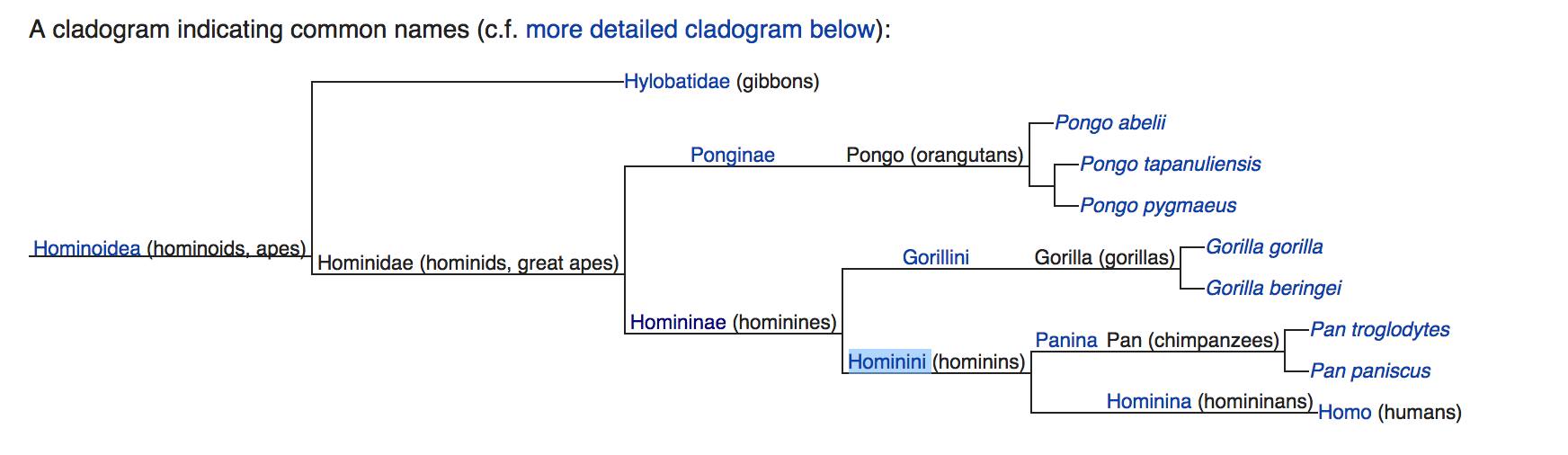
    photos_and_videos/TimelinePhotos_SxeO6JU-xg/42345150_10156655144047264_7759097933370228736_o_10156655144042264.jpg Note that all groups are split other than homo sapiens.

    There are at least three and arguably four species of homo sapiens.

    There was a movement to group humans and chimpanzees but chimps and bonobos can interbreed, and Europeans, East asians, and africans can interbreed.Jamie RobinsonI say theres 3 and a missing link, but scientist dont want to talk…..Sep 22, 2018, 4:04 PMBrandon Beej JohnsonI think the races are more the result of interbreeding with other hominids resulting in hybrid species than they are totally other races naturally divergent from a single stock of homo sapiens.

    This is supported by the presence of genetic admixtures of other hominids in different racial groups.

    The negroid, for example, I believe gets it’s distinct differences from the rest of humans because that portion of sapiens mixed with hiedelbergensis, erectus, and an unknown variant of erectus, primitive hominids with smaller brains and darker features adapted to sub-saharan africa.Sep 22, 2018, 4:33 PMMatthew GenackThere needs to be much more research in this area.Sep 22, 2018, 6:41 PMJohn MarkNothing scares a leftist more than the truth.Sep 25, 2018, 11:06 AMNote that all groups are split other than homo sapiens.

    There are at least three and arguably four species of homo sapiens.

    There was a movement to group humans and chimpanzees but chimps and bonobos can interbreed, and Europeans, East asians, and africans can interbreed.


    Source date (UTC): 2018-09-22 13:44:00 UTC