Theme: Ethnoculture

  • Conflict 3: The Evolution of Man

    The Evolution of Man

    The story of cycles of hyper adaptation, expansion, and hybridization – and the limits of that cycle.

    LIFE

    • Life: Organization, Metabolism, and Homeostasis defeat entropy by taking advantage of entropy, and influence in, participation in, or production of reproduction of the information necessary to reproduce genetic information and processes, and adaptation is necessary to evolve into those conditions. As far as I know, genes function as the “life” form with the cell to body of the individual or cell to bodies of the group a carrier. 
    • Species:  “Populations that do not regularly breed with one another.” Preference and capacity for reproductive cooperation by morphological, phenotypical, behavioral, identification and preference.
    • Evolution: the tendency of a population of organisms to adapt to opportunities in a given environment, through mutation, regulation, expression, interbreeding, and hybridization.
      • Mutation:
      • Regulation: 
      • Expression:
      • Regulatory Transfer (Epigenetic): 
      • Interbreeding: the capture of or transfer of traits 
      • Speciation: The creation of a new species, often from the evolution of another species
      • Hybridization: The emergence of a new species from the intermixture of other species
    • Co-Evolution: two or more organisms evolving in adaptation to one another.
    • Homoplasy (convergent Evolution)
    • Endomism ( restricted to a certain area – divergent evlution)
    • Stenotropic – narrow habitat preferences – adapted to narrow habitats.
    • Punctuated Equilibrium:  Long periods of consistency of a species interrupted by rapid changes to a species, group of species, or ecology.

    MAN

    • Morphology (Major: Size Shape Organization, performative difference)
    • Phenotype (Minor: small – any visible difference)
    • Physiology (functions of living organisms and their organs and organic processes).
    • Metabolism Metabolically (the conversion and distribution of energy)
    • Behavior; The sets and series of actions produced by an organism in response to a particular situation or stimulus.
    • Cognition
    • Intelligence: the rate of cognitive adaptation

    THE GENETIC CYCLE

    ( … )

    Hyper Adaptability

    Human hyper-adaptability can be maximized across the spectrum of human abilities:

    Physiologically (Skeleton, organs, organic processes),
    … Morphologically (Features),
    … … Behaviorally(socially),
    … … … Cognitively(neurology),
    … … … … Conceptually(ideas),
    … … … … … Informationally(knowledge),
    … … … … … … Technologically(material),
    … … … … … … … Institutionally(organizational).

    The story of mankind, as we shall see, is the sequential exhaustion of opportunity of adaptability across that spectrum – and that story is the primary lesson of our present study. And that lesson will lead us to very different understandings compared to our ancestral cyclical(natural) and linear(technological) understandings of the universe, of mankind, our present condition, and our future potential.

    The seed that I would like to plant, that I hope will grow for the remainder of our journey together, is that evidentiary(scientific) truth, (free of pretense of knowlege by ignorance, error, bias, wishful thinking, deceit, and fraud), provides humans with new opportunity for adaptability, if willing to pay the cost of adaptation today in exchange for the continuous benefits of adaptation tomorrow – and thereafter.

    And this is a critical insight, because only one group of people on earth, and in human history, chose to pay the high cost of truth (adaptation) while all other peoples chose to not pay the costs of adaptation. This is why europeans institutionalized truth-before-face, truth-before-dominance_hierarchy, truth-before-desirability, truth-regardless-of costs: maximum adaptability. It is this choice, first among the other uniquensses of european peoples and their civilization, that caused european peoples to evolve – not first – but faster than all other peoples combined, in the steppe, mediterranean, continental, and sea ages.  The question is – do we have the will to continue dragging mankind out of it’s continuous efforts to resist adaptation by resisting the truth?

    Why Is Evolutionary History Confusing?

    1. Academic disciplinary specialization
    2. Non-Operational, or arbitrary names
    3. Difficulting in forming a coherent narrative prior to genetic evidence and contemporary techniques (and costs).
    4. The postwar attempt to undermine the sciences

    A Narrative Provides a System of Measurement for Testing Coherence of cross Disciplinary Dnformation
    To make human history into a coherent (accross time) and consistent (using the same systems of comparison) we need to produce a narrative (explanation) of the evolution of man from his first emergence to the present. In doing so we produce a system of measurement (skeleton) upon which we can draw consistent and coherent deductions about mankind – free of our tendency to error, bias, wishful thinking, deciet and fraud. (Partcularly political fraud.) And while adademic specialization, non operational names, and lack of a coherent narrative are confusing.

    The Game of Life, Time, Pattern Identification, and History


    Conaway’s game of life. Cellular Automaton.
    The Game of Rabbits and wolves.
    Robert Axelrod

    (the pattern you identify depends on yuor tiem horizon)

    (the time horizing determines your choice of decidability – goals)

    (the longest time horizion is the only universally decidable)

    Playedat high speed …exhaustion of opportunities.

    Timeline of Mankind

    The Beginning

    (Geologic)
    The Cenozoic (66M BC to Present): The period of Mammals, beginning 66 million years ago, beginning with the K-T extinction event when an asteroid hit the earth. The terrestrial animals that succeeded in dominating both hemispheres were mammals – the Eutherians (placentals) in the northern hemisphere and the Metatherians (marsupials, now mainly restricted to Australia) in the southern hemisphere. The extinction of many groups allowed mammals and birds to greatly diversify so that large mammals and birds dominated the Earth. The continents also moved into their current positions, and the Earth’s climate had begun a drying and cooling trend, culminating in the glaciations of the Pleistocene Epoch, and only partially offset by the Paleocene-Eocene Thermal Maximum.

    The Paleolithic

    (Historical)
    Pre-History: c. 3.3M BC – 300,000 BC) The period between the appearance of Homo (“humans”; first stone tools c. three million years ago) and the invention of writing systems (for the Ancient Near East: 3,000 BC).

    (Human)
    The Paleolithic
    (“Old Stone Age”) (3.3M BC to 9700 BC), is the period in human prehistory beginning with original development of stone tools. It extends from the earliest known use of stone tools by hominins c. 3.3 million years ago, to the end of the Pleistocene in 9700 BC, and covers 99% of the time period of human technological prehistory.

    (Human)
    Paleolithic >
    The Lower Paleolithic (c. 3.3M BC – 300,000 BC) Homo, Homo erectus

    ( … )

    (Climate)
    The Quaternary: (“Fourth Period”) (2.6M BC to Present)
    The Period of Glaciations.
    The current geological period, the Quaternary, is marked by warm and cold episodes, cold phases called glacials (Quaternary ice age) lasting about 100,000 years, and which are then interrupted by the warmer interglacials which lasted about 10,000–15,000 years. The last cold episode of the last glacial period ended about 10,000 years ago. Earth is currently in an interglacial period of the Quaternary, called the Holocene.

    The Quaternary represents the entire time during which recognizable humans existed. The major geographical changes during this time period included the emergence of the Strait of Bosphorus and Skagerrak during glacial epochs, which respectively turned the Black Sea and Baltic Sea into fresh water, followed by their flooding (and return to salt water) by rising sea level; the periodic filling of the English Channel, forming a land bridge between Britain and the European mainland; the periodic closing of the Bering Strait, forming the land bridge between Asia and North America; and the periodic flash flooding of Scablands of the American Northwest by glacial water. The current extent of Hudson Bay, the Great Lakes and other major lakes of North America are a consequence of the Canadian Shield’s readjustment since the last ice age; different shorelines have existed over the course of Quaternary time.

    (Climate)
    Quaternary >
    The Pleistocene (“Mostly New”, “Ice Age”):
    (2.6M BC to 9700 BC) The Period of Glaciations, that includes the emergence of Homo Sapiens.

    The Period of:

    • Climate Era, (Man is the product of climate, and in particular – the cold.)
    • Genetics (species, competitors, skeletal evidence),
    • Region (Climate, Resources, Geological Evidence),
    • Archaeology (or Technology, species, Region, Conitions, Resources, ),
    • Migration (Cumulative Evidence) (Genetics, Climate, Resources, Technology, Subrace – genetic and technological evidence)
    • Strategy (group organizing strategy)
    • Culture (or Informal Institutions) (organization, strategy, proto-civilization)
    • Language (or Measurements) (Climate, organization, technology, resources,’nations’)
    • Mythology (“metaphysics”)
    • Methods of persuasion

    The Geography and Ecology of Africa

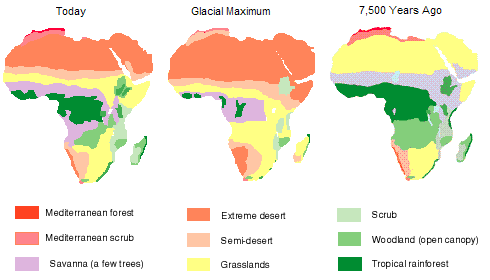
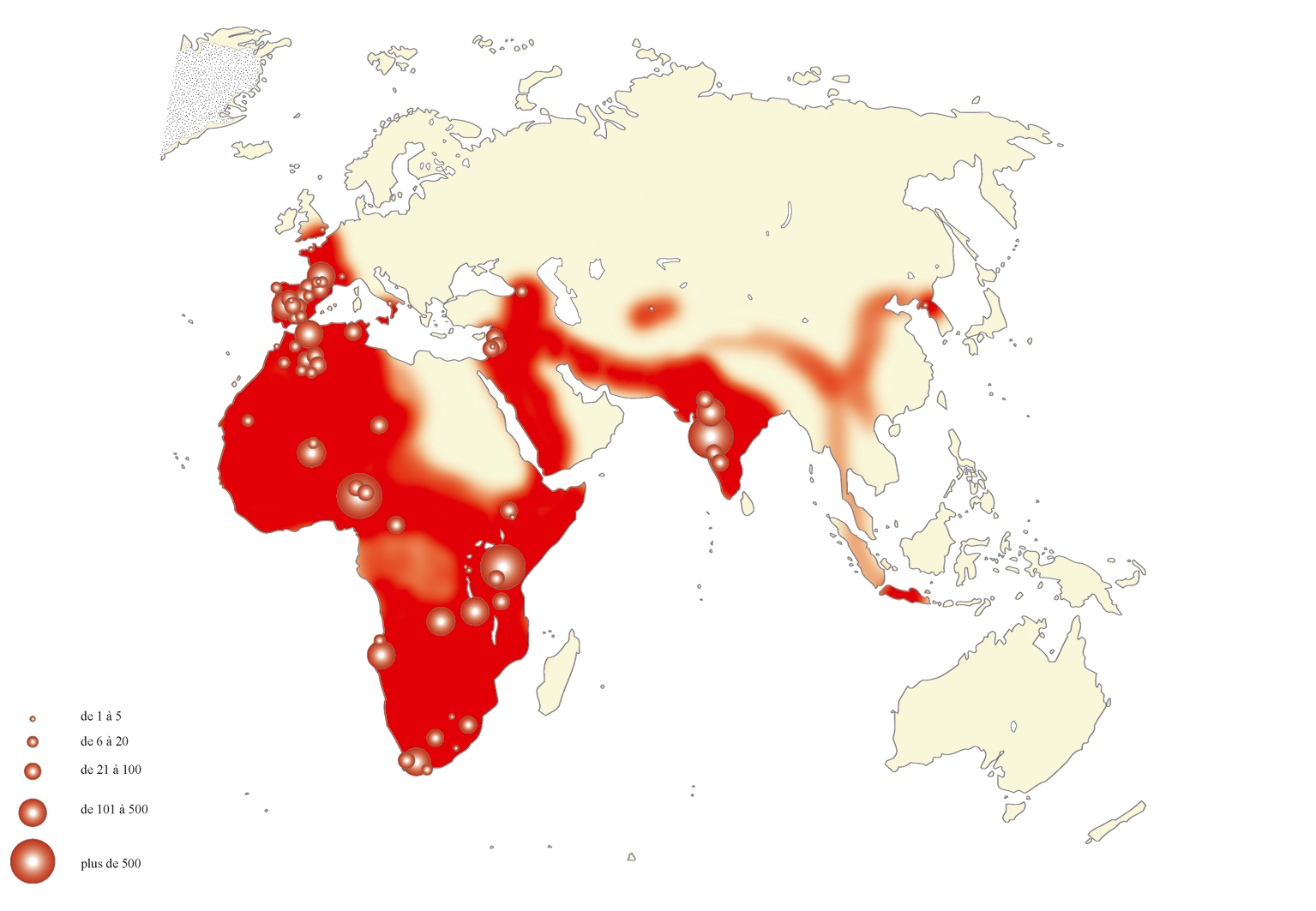
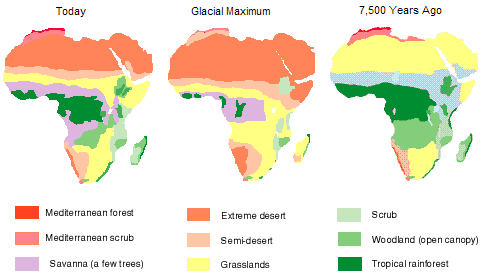
    Today’s Sahara, 5500 years ago, was wet and tropical. But it rapidly turned into desert. The climate patterns that affect the Sahara region are regulated by the climate of the high latitudes and the arctic and are very sensitive to change. This means that north Africa’s rainfall switches on and off like a lightbulb. South of the Sahara varies more like Eurasia with gradual changes in climate as the planet’s cycles pass. 

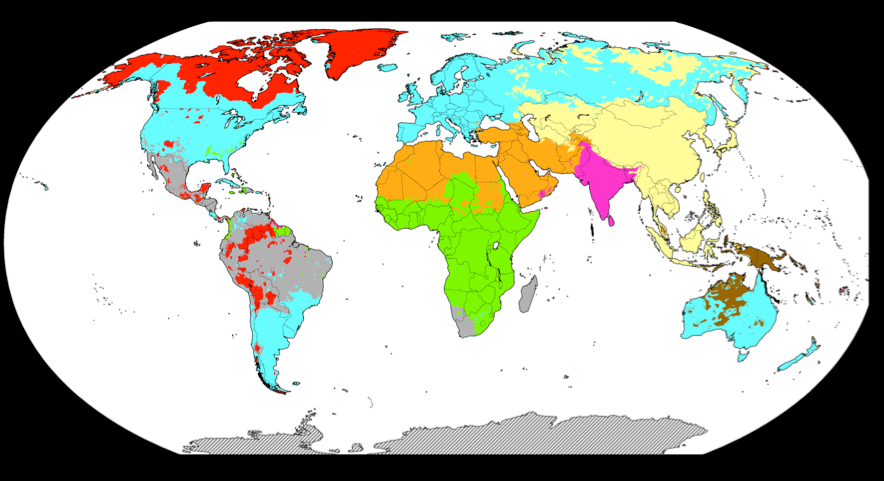
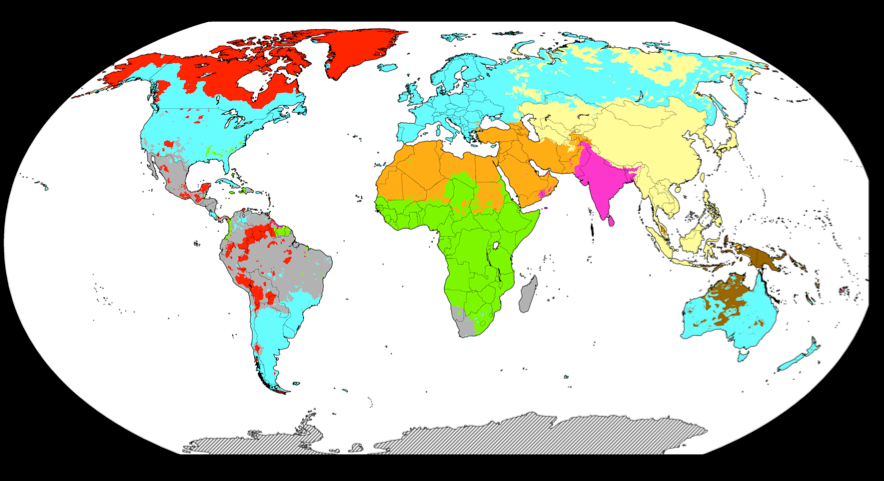
    This map doesn’t provide enough detail but it does explain the difference between hot, temperate, and cold climates.
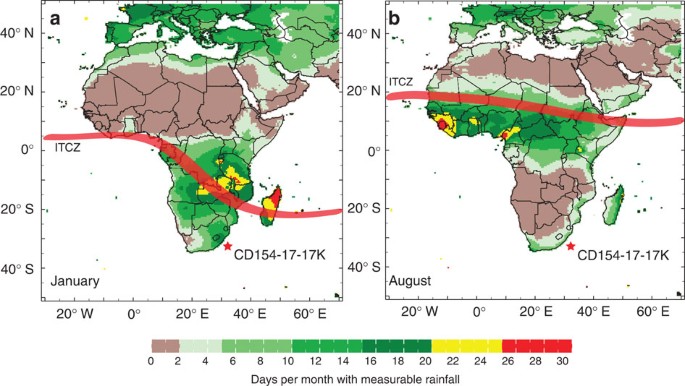
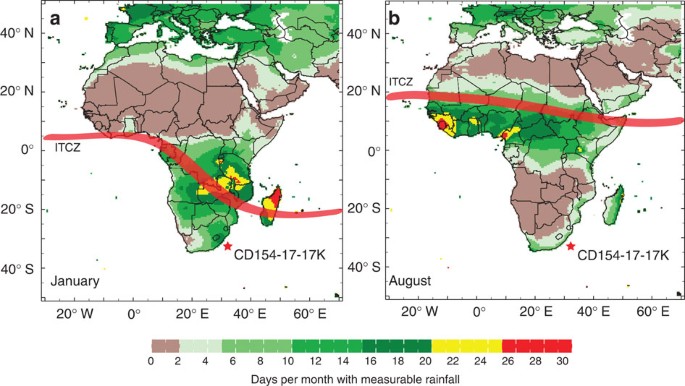
    This map shows the seasonal rainfall patterns.
     

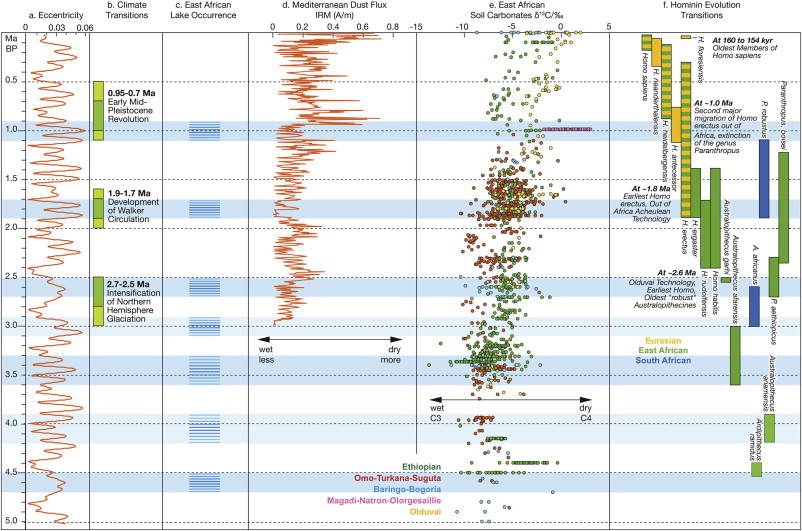
    Climate Causes Adaptation

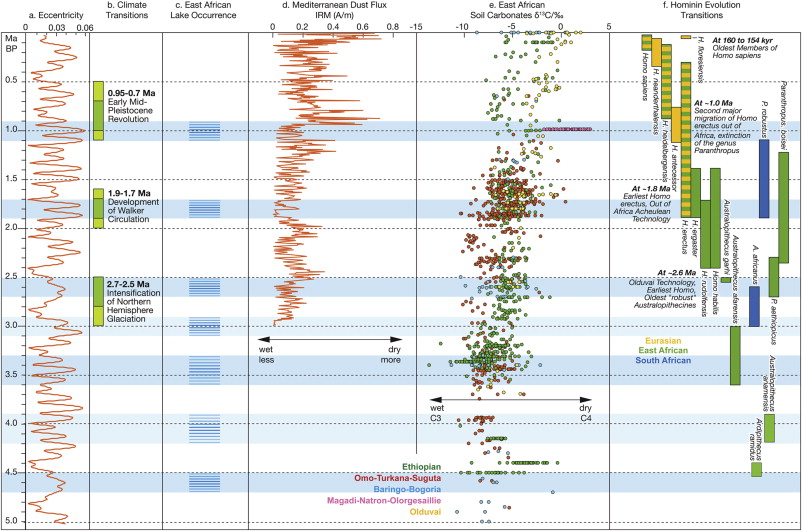
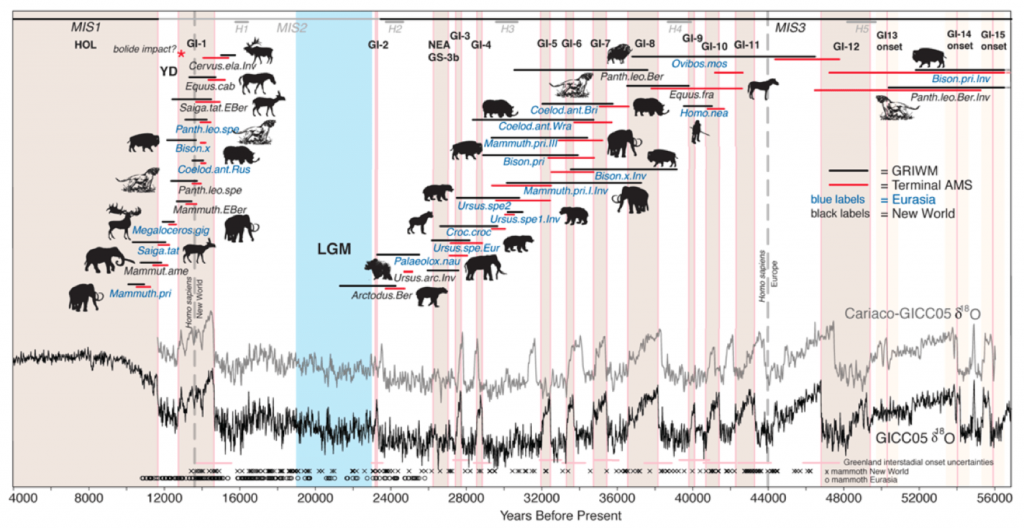
    Climactic events cause new adaptive genealogical events. Or change by crisis and opportunity create pressure for adaptability. This chart illustrates that early hominins were adapted to local environmental niches, whether grassland or forest, and during warmer and drier eras could range and intermix, and during cooler and water eras were isolated from one another. This sinusoidal back and forth by the climate cause speciation and hybridization. So after each climactic event new groups emerged.
    Genus Homo

    (Human)
    Paleolithic >
    Lower Paleolithic >
    Homo (~2.4M BC) Roughly 2.4 million years ago Homo habilis had appeared in East Africa: the first known human species, and the first known to make stone tools.

    Leaps

    • Metabolic Efficiency, and Homeostatic Regulation – Increased Possibility of Starvation
    • Food Sharing
    • Bigger Brains
    • Stone Tools
    • Early Birth,
    • Increased Child Care

    Primates are more metaboliclaly efficient than other animals. Humans are more metabolically efficient than other primates. To achieve that you need food sharing and body fat. That’s why humans are the fattest primate. Even athletic humans have 15% body fat. Even lazy zoo chimps have least than 50%. Other animals aren’t maximized like humans, beacue the risk of starvation is too high.

    The use of tools conferred a crucial evolutionary advantage, and required a larger and more sophisticated brain to co-ordinate the fine hand movements required. A larger brain equires a larger skull, and thus requires the female to have a wider birth canal for the newborn’s larger skull to pass through. But if the female’s birth canal grew too wide, her pelvis would be so wide that she would lose the ability to run, which was a necessary skill 2 million years ago.

    The solution was to give birth at an early stage of fetal development, before the skull grew too large to pass through the birth canal. This adaptation enabled the human brain to continue to grow, at the cost of the need to care for helpless infants for long periods of time forced humans to become less mobile. Human bands increasingly stayed in one place for long periods, so that females could care for infants, while males hunted food and fought with other bands that competed for food sources. As a result, humans became even more dependent on tool-making to compete with other animals and other humans, and relied less on body size and strength.

    Species Homo Erectus

    (Human)
    Paleolithic >
    Lower Paleolithic >
    Homo erectus
    (~2M BC) (‘upright man’) Homo erectus was a species of archaic human that appeared about 2 million years ago. It’s the first recognisable members of the genus Homo (human). Homo Erectus was the first human ancestor to spread throughout the Old World, extending across Eurasia from the Iberian Peninsula in the west to Java in the east. 

    Leaps:

    • Persistence Hunting
    • Superpredatory Kill Rate
    • Better Food, Greater Caloric Intake
    • Fire
    • Gradual but Continuous virtuous cycle of somatic improvement (evolution of brains and brawn)
    • Cooperation, Division of labor, and Food Sharing
    • Monogamy / Pairing off?
    • Proto Language?

    H. Erectus had a humanlike gait and body proportions, and was the first human species to have exhibited a flat face, prominent nose, and likely had sparse body hair coverage. Brain capacity varied widely depending on the population, ranging from 546–1,251 cc (33.3–76.3 cu in), and maximum brain size matured early on in life, meaning a shorter childhood and reduced parental care compared to modern humans. Size also ranged widely from 146–185 cm (4 ft 9 in–6 ft 1 in) in height and 40–68 kg (88–150 lb) in weight. H. erectus men and women may have been roughly the same size as each other (exhibit reduced sexual dimorphism) like modern humans, which could indicate monogamy in line with general trends exhibited in primates. Skin colour potentially varied with location, but as we have seen, primates have light skin, and dark skin was the evolutionary result of losing hair, just as clothing and higher latitudes the result of losing dark skin.

    H. Erectus is associated with the Acheulean (Ah-ch-yoo-LEE-an) stone tool industry, and is thought to have been the earliest human ancestor capable of using fire, hunting and gathering in coordinated groups, caring for injured or sick group members, seafaring, and possibly art-making. Sites generally show consumption of medium to large animals, such as bovines or elephants, and a high reliance on meat is associated with increasing brain size. Though groups were more social than ancestor species. It’s unclear if H. Erectus was anatomically capable of speech, though it is postulated they communicated using some proto-language.

    The Result Of Multiple Species: Evolution by Hybridization

    African populations of H. erectus are the direct ancestors of several human species, such as H. heidelbergensis and H. antecessor, and Asian populations of H. floresiensis and possibly to H. luzonensis, and several proposed subspecies with varying levels of possibiity. H. heidelbergensis generally considered to have been the direct ancestor to Neanderthals and Denisovans, and possibly modern humans.

    Erectus..-> Heidelbergensis > Antecessor > Sapiens
    … … … … -> Eurasia: Neandertal |Denisovian -> Extinct
    … … … … -> Asia: Floresiensis  | Luzonensis -> Extinct 

    MOVE ME: Interbreeding occurred between H. sapiens and archaic humans in Eurasia, Oceania and Africa, indicating that modern population groups, while mostly derived from early H. sapiens, are to a lesser extent also descended from regional variants of archaic humans.

    Baboons as an Example: hybridization. olive baboon super-baboon, reticulate species, … we cannot take the morphological variation in early homo populations for territorial isolation. 

    Earlier hominids appear to be stenotopic: adapted to an ecological niche.  H. Erectus is NOT stenotopic. Instead, it’s analogous to the “super-baboon”: a “super hominid”.  It found an adaptive strategy that gave it a wider habitat opportunity. As such the many hominid species in Africa, need not be reproductively isolated, As such, we may never, and likely will not,  identify a single ancestor of Homo Erectus.

    Extraordinary Success of Homo Erectus

    H. Erectus gradually increased it’s body size and doubled its brain size. But doing so requires extra energy. The 30kg Australopithecus would need 1200 calories a day, and 52kg homo Erectus would need 50% more calories per day and much more when lactating.  Erectus had smaller teeth and lower bite force, so they were getting higher quality food – not more, but better.

    They were hunters and gatherers, which required intense cooperation and food sharing, hunting, scavaging, and foraging, and tool-making, fire, and food processing.  And the hunter-gatherer complex creates an interesting but simple system of feedback that serves their interests: cooperative huntering and gathering favors two kinds of skills: cognitive and social – meaning brains, and athleticism – meaning brawn. These two skills lead to increasing energy availability. And increasing energy availability leads to more opportunities for cognitive, social, and athletic evolution.

    Or more formally, 

    1. selection for better hunter-gathering abilities (brains and braw)
    2. Produces more available energy (especially for mothers and offspring)
    3. That energy for mothers and offspring can be put to an increase in cellular investment (maintenance), reproductive investment (offspring), or somatic investment (biological adaptation – especially by regulatory adaptation).

    Which is an exceptionally effective feedback model for evolution.

    But where did that investment go?

    • Hominids are comparatively slow and awkward compared to quadruped prey.
    • Hunting and savaging is difficult and risky.
    • And hominids lack both weapons (fangs, claws) and defenses (fur).
    • And competing with carnivores like lions and such is entering an exclusive and dangerous club.

    Walking upright.

    Fossil footprints of Homo Erectus show cooperating groups of males living and hunting together, with bone structure, musculature, and walking behavior identical to ours. Although we might note that except for the arch, flat footed feet that are distinctively human are found in europe and the mediterranean just after it flooded at 5.7m years ago.

    Running.

    Most of these features are present in and evolved first in the Genus Homo. 

    • Decoupled Head and Shoulders
    • Oral Heat Dumping
    • Enlarged Semicircular Canals
    • Nuchal Ligament
    • Reduced Arm Mass
    • Enlarged Cranial Gluteus Maximus
    • Narrow Waist
    • Short Femoral Neck
    • Long Legs (although not uncommon in other species)
    • High percentage of slow-twitch fibers
    • Large Elastic Ventricles
    • Long Leg Tendons
    • Short Calcaneus
    • Elastic Energy Storage in Arch
    • Short toes

    Running Gave us Persistence Hunting

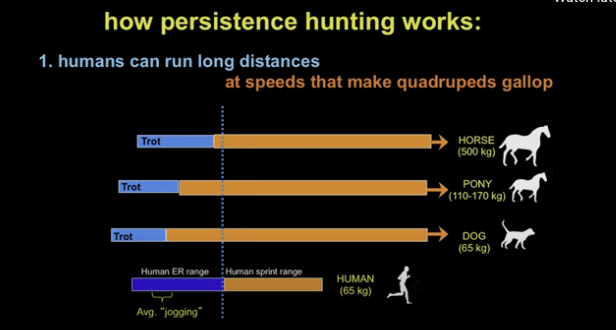
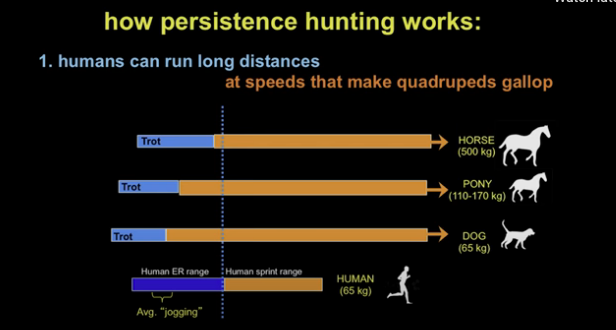
    Our ancestors likely started out scavenging, but we evolved Persistence Hunting: because we can run longer than all other animals.  Why, because we can dissipate heat extremely well. We can run and breathe. We can run and sweat. And they don’t dissipate heat well, they can’t sweant and most importantly – they pant to dissipate heat. But when they run(gallop) they can’t pant. While quadrupeds can gallop faster than humans can run, humans can run a marathon above the trot-gallop transition speed of most game – forcing them game into gallop where it can’t pant and dissipate heat. In the middle of the day, in the heat, they chose a big animal, forced it to gallop away until it hides to rest. The track it, then chase it again, and repeat. Over about 15-30 km, half of which they spend walking, they can drive big game into hyperthermia so that it just dies from overheating. The technique is about 75% successful which puts man up with the domestic cat and the African dog (wolf) as the most successful predators on earth. The African hunter-gatherers call this The Great Dance.  
    Fellow Super Predatory Kill Rates

    African wild dogs – 85% successful kills (but only hold 30%)
    Man – 70% successful kills
    Domestic cat (in wild) – 70% successful kills
    Cheetah – 58% successful kills
    Leopard – 38% successful kills
    Lion – 30% successful kills
    Wolves – 14% successful kills
    Polar bear – 10% successful kills
    Tiger – 5% successful kills

    Cooperation

    But we can divide labor, we can share food, we can share food capture and preparation.

    We can share food preparation. We can’t chew raw meat, Human teeth are poorly adapted for chewing raw meat but you can slice it, and pound it even before cooking.  

    Using persistence hunting, food preparation, rates of reproduction, hunter-gatherer population density, we can estimate that it would take only 50-100k years for Erectus to ‘fill’ Africa and create pressure to migrate out of Africa, and disperse into the south pacific. 

    Failings

    Evidence suggests that they were social, but lazy and incurious, taking advantage of running, and their success at running down game, but not seeking innovation or excellence in tools.

    Exceptional Success

    Homo erectus first appeared about 1.8 million years ago and, based on the fossil evidence, quickly populated Africa, Asia and Europe. Though it is unclear whether the species arose in Africa or Asia, a million years later the widespread populations were still similar enough to be considered a single species, White argued. The largest number of Homo erectus specimens are from Asia, including the first specimen – “Java Man.”

    The onset of the Ice Ages about 950,000 years ago likely split the Homo erectus populations and led to their divergent evolution. The African population of Homo erectus probably gave rise to modern Homo sapiens, the European branch perhaps became the Neandertals, while the Asian population went extinct.

    Anthropological “splitting” that’s common today gives the wrong impression of the biology of these early human ancestors. The different names indicate an apparent diversity that is not at least initially subsantive. Homo erectus is a biologically successful organism, not a whole series of different human ancestors, all but one of which went extinct.”

    By the time Homo erectus disappeared some 400,000 years ago, its various populations had clearly diverged, since 500,000-year-old fossils from Asia, including “Peking Man,” differ significantly from African fossils of the same age, particularly in the size of the cranium.

    The last known record of morphologically recognisable H. erectus are from Java, around 117–108,000 years ago. The disappearance of H. erectus is a matter of dispute but as we see throuhout history, as soon as members of Genus Homo are able to use tools, more advanced generations replace more primitive peoples, rather rapidly. 

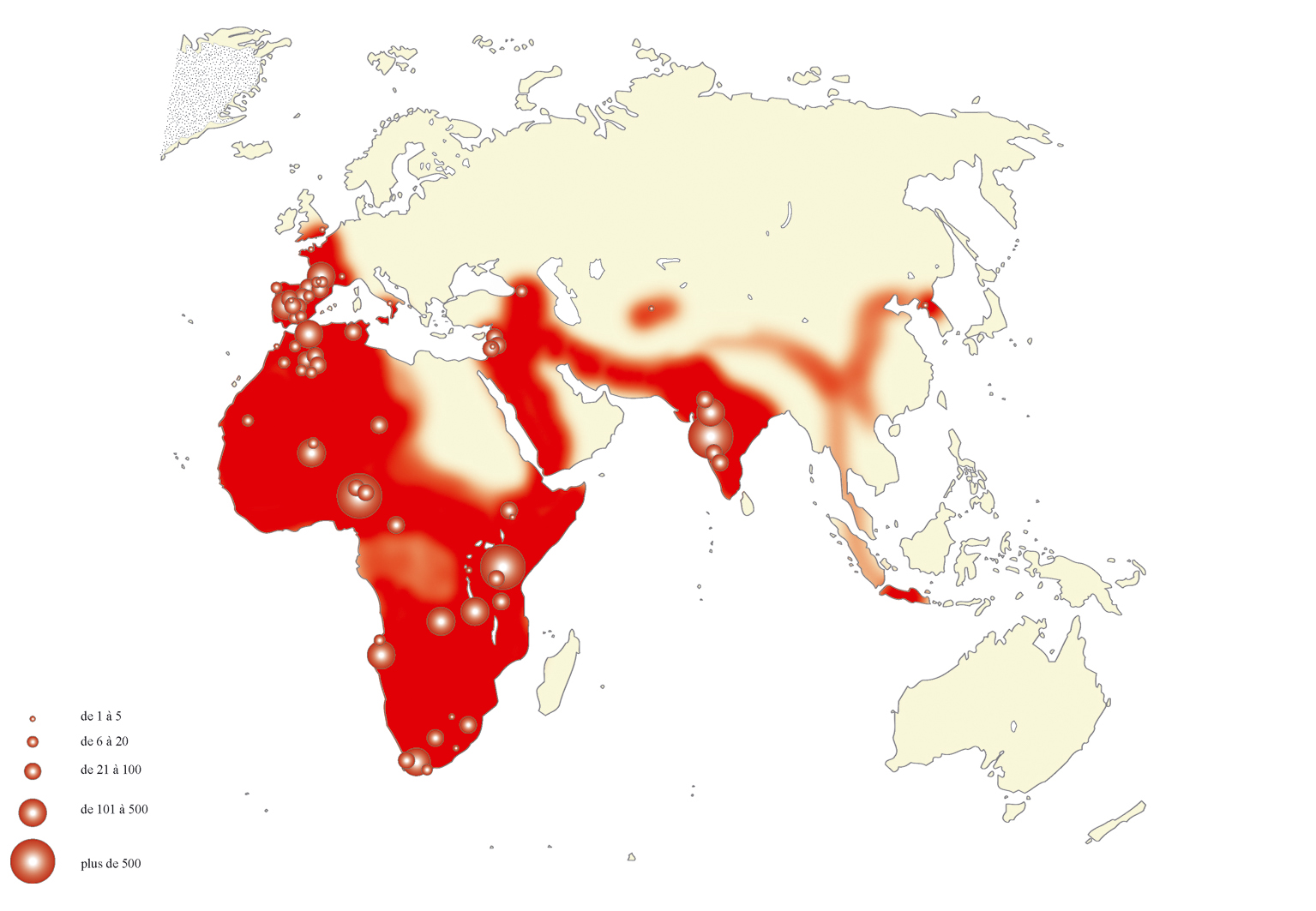
    We want to make two observations: (a) the route out of africa thru the horn and iberia, and (b) the date they appear to disappear ~100k BC. And later on, when we discuss ‘Geography in Everything’, it won’t be a surprise.
    (Human)
    Paleolithic >
    Lower Paleolithic >
    Homo antecessor (1.2M BC and 800,000 BC) An archaic human species of the Lower Paleolithic, present in Western Europe (Spain, England and France), with “a unique mix of modern and primitive traits”. It’s the oldest direct fossil record of the presence of Homo in Europe, and for reasons of hybridization we covered above, is classified as a European variety of H. Erectus, a new species, or an early form of H. heidelbergensis. (This author suggests that H. antecessor is arguably european in phenotypic appearance).

    (Human)
    Paleolithic >
    Middle Paleolithic >
    Homo Heidelbergensis (700,000 BC to 300,000 BC)  ( … ) 

    Leaps:

    • Larger body
    • Bigger Brain
    • Bigger Face
    • Body Fat
    • Beginning of neoteny (slower life)


    Generation One: Early  Homo Sapiens

    (Human)
    Paleolithic >
    Middle Paleolithic >
    Generation One:
    Early Homo sapiens
    (H. sapiens) (~300,000 BC to 50,000 BC) evolves out of ancestral Homo erectus (or an intermediate species such as the hypothesized Homo antecessor, or in Europe as Homo heidelbergensis ) in Africa roughly 500,000 years ago. Between 350,000 and 260,000 years ago populations in East and South Africa merged, while North-African populations dispersed and hybridized into the Neandertals. H. sapiens disperse almost immediately with North African archaeological finds 315,000 years ago, in West Asia by 270,000 South Africa about 259,000 years ago, and in Greece 210,000 years ago.


    Generation Two: Anatomically Modern Humans

    (Human)
    Paleolithic >
    Middle Paleolithic >
    Generation Two:
    Homo Sapiens – Anatomically Modern Human
    (AMH) (~200,000 BC ) distinguishes Homo sapiens that are anatomically consistent with the range of phenotypes (physical body shapes and in particular skeletons) seen in contemporary humans from extinct archaic human species. This distinction is useful especially for times and regions where anatomically modern and archaic humans co-existed such as in Paleolithic Europe. The oldest known skeleton of an anatomically modern human(AMH) dates to about 196,000 years ago.  (Or approximately 200k BC).

    Limited Technology: It’s unclear to what extent these early modern humans had developed social abilities, techniques, and institutions such as language, music, religion, etc. They spread throughout Africa over the following approximately 50,000 years.

    Maximization of Physical Form  (Exhaustion of Physical Adaptivity): Most importantly is that the physical features that produced human super-predation have completed their evolution: limited digestion, narrow waisted, long legged, tall, narrow pelvis, hairless, hands free to manipulate tools and carry resource, and the ability to out disspate heat and together to out-endure every other living animal on earth except other humans. A group of humans with simple heat hardenend spears can run-down or walk-down anything living until it’s exhausted, and kill it safely.

    Generation Three: Anatomical Modernity: Basal Modern Human Populations Spread Across and Out of Africa

    (Climate)
    Quaternary >
    The Upper Pleistocene (“Upper Ice Age”) : Physically Modern Humans
    (127,000 BC to 9700 BC) The period covering the evolution of modern humans.

    (Climate)
    Crisis:  The Megadroughts (Spanning 50,000 years, from ~130,000 BC to 80,000 BC) African megadroughts occurred from 130,000 to 80,000 years ago, during the last interglacial period,

    Basal Modern Humans

    (Human)
    Paleolithic >
    Middle Paleolithic >
    Generation Three:
    Basal Modern Human (BMH):
    These megadroughts result in the origin of basal population of contemporary human populations by 130,000 years ago that spread until 75000 years ago – roughly mirroring the droughts. The BMH were morphologically modern, but not technologically or culturally modern – they weren’t substantially different in technology from neanderthals. 

    The First Great Split:
    Capoid-Khosian South migrate, Niger-Congo and Nilo-Saharan migrate Central and West, and East Africans Remain.

    During this period, from Around 100,000 BC–80,000 BC, three main lines of Homo sapiens diverged:

    1 – Bearers of mitochondrial haplogroup L1 (mtDNA) / A (Y-DNA) colonizing Southern Africa (the ancestors of the Khoisan/Capoid peoples). The Khoi-San represent an “ancestral population cluster” located in southwestern Africa (near the coastal border of Namibia and Angola).
    2 – Bearers of haplogroup L2 (mtDNA) / B (Y-DNA) settling Central and West Africa (the ancestors of Niger–Congo and Nilo-Saharan speaking peoples).
    3 – Bearers of haplogroup L3 remained in East Africa. 

    The Failed Migrations:
    The Failed North Migration Out of Africa (Levantine Corridor). They also spread north along the nile, through the Levantine corridor and into West Asia 80,000 to 100,000 years ago,  but either went extinct or retreated back to Africa 70,000 to 80,000 years ago, possibly replaced by southbound Neanderthals escaping the colder regions of ice-age Europe. Genetic evidence suggests that admixture with Neanderthals occurred during this period – meaning likely a consequence of survival under duress – possibly competitive duress.

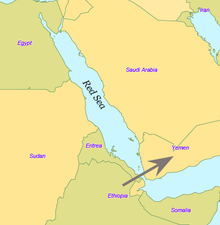
    The Failed East Migration out of Africa (Red Sea Crossing): They also migrated the route through the present-day Bab-el-Mandeb Strait on the Red Sea (at that time, with a much lower sea level and narrower extension), crossing to the Arabian Peninsula and settling in places like the present-day United Arab Emirates (125,000 years ago) and Oman (106,000 years ago), and the Indian Subcontinent (75,000 years ago), and perhaps even southern China (67,000 years ago – although evidence is uncertain), and South Asia and Australia (50,000 years ago.) Although no reliable human remains have yet been found in these places, the similarities between the stone tools and what little remains we have, suggest that their creators were all modern humans. But these migrations from Africa didn’t leave traces in the results of genetic analyses, suggesting that those anatomically modern humans didn’t survive in large numbers and were assimilated by our major antecessors, or died out.
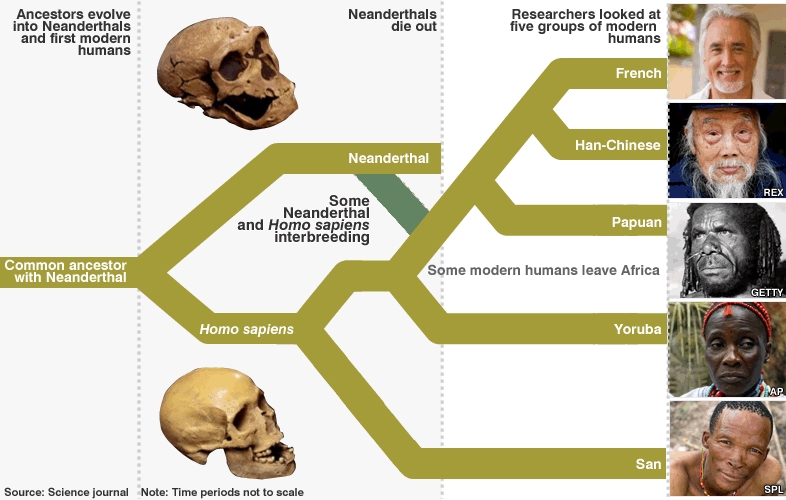
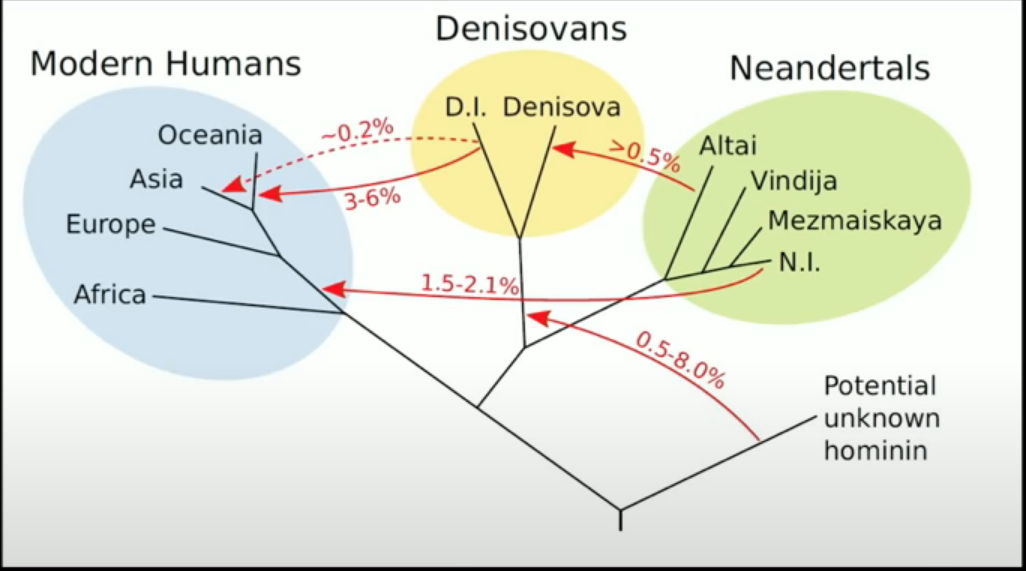
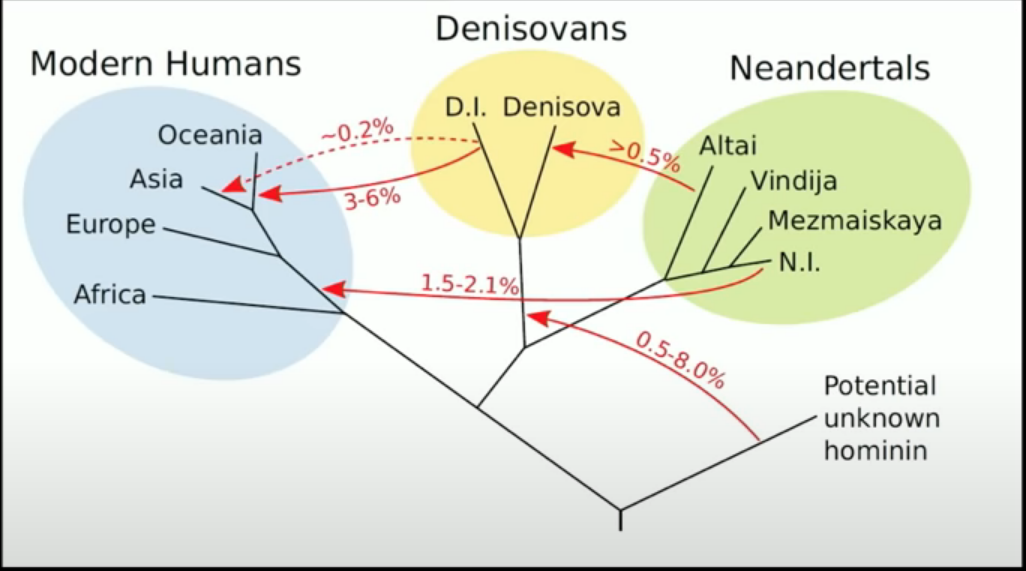
    Neanderthal Aside: The archeological community is desperately overcompensating for previous denials of human hybridization with neanderthals, The assumption of complete replacement has been revised in the 2010s with the discovery of admixture events (introgression) of populations of H. sapiens with populations of archaic humans over the period of between roughly 100,000 and 30,000 years ago, both in Eurasia and in Sub-Saharan Africa. Neanderthal admixture, in the range of 1-4%, is found in all modern populations outside of Africa, including in Europeans, Asians, Papua New Guineans, Australian Aboriginals, Native Americans, and other non-Africans. This suggests that interbreeding between Neanderthals and anatomically modern humans took place after the recent “out of Africa” migration, likely between 60,000 and 40,000 years ago.[86][87][88] Recent admixture analyses have added to the complexity, finding that Eastern Neanderthals derive up to 2% of their ancestry from anatomically modern humans who left Africa some 100 kya.[89] The extent of Neanderthal admixture (and introgression of genes acquired by admixture) varies significantly between contemporary racial groups, being absent in Africans, intermediate in Europeans and highest in East Asians. Certain genes related to UV-light adaptation introgressed from Neanderthals have been found to have been selected for in East Asians specifically from 45,000 years ago until around 5,000 years ago.[90] The extent of archaic admixture is of the order of about 1% to 4% in Europeans and East Asians, and highest among Melanesians (the last also having Denisova hominin admixture at 4% to 6% in addition to neanderthal admixture). Cumulatively, about 20% of the Neanderthal genome is estimated to remain present spread in contemporary populations.

    Crisis: Near Extinction
    The Population Bottleneck 70,000 Years Ago. Genetic evidence suggests that today’s humans are descended from a very small population of between 1,000 and 10,000 breeding pairs that existed about 70,000 years ago. It’s possible that the Toba Super Volcanic Event (74,000 years ago), and the global consequences, may have pushed humans, already fragile becuase of the climate, to the brink of extinction. It may have just put additional migratory pressure on the small population too seek better food sources, or its effects may have have been negligible. Either way, the result was a tiny population and another effort colonize the world outside of africa.

    Opportunity and Crisis: Red Sea floods
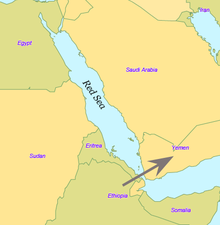
    The barrier across Bab-el-Mandeb, between Ethiopia and Yemen underwent an outbreak flooding similar to that found in the Mediterranean. The Lake Toba event, approximately 70,000 years ago, caused a massive drop in sea levels, exposing the barrier and enabling modern Homo sapiens to leave Africa via an alternative route than Sinai. Saline evaporites found on the floor of the Red Sea confirms that this dam has closed at various periods in the past. Rising sea levels during earlier interglacial periods suggest that this area was subject to outburst flooding.

    Generation Four: Behavioral Modernity: The First Great Leap Forward

    Generation Four: The “Great Leap Forward” leading to full behavioral modernity sets in only after this separation. Rapidly increasing sophistication in tool-making and behaviour is apparent from about 80,000 years ago, and the migration out of Africa follows towards the very end of the Middle Paleolithic, some 60,000 years ago.

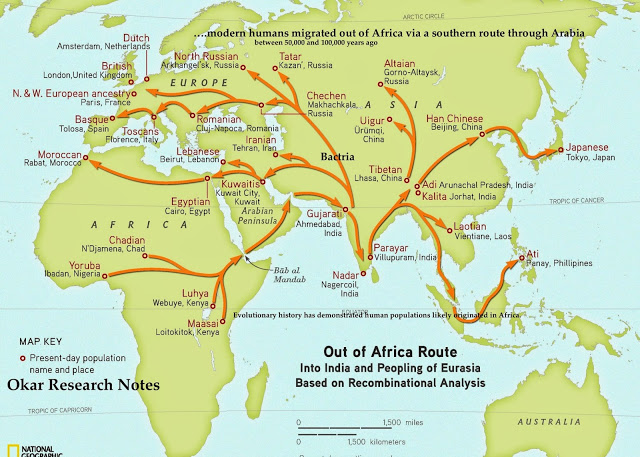
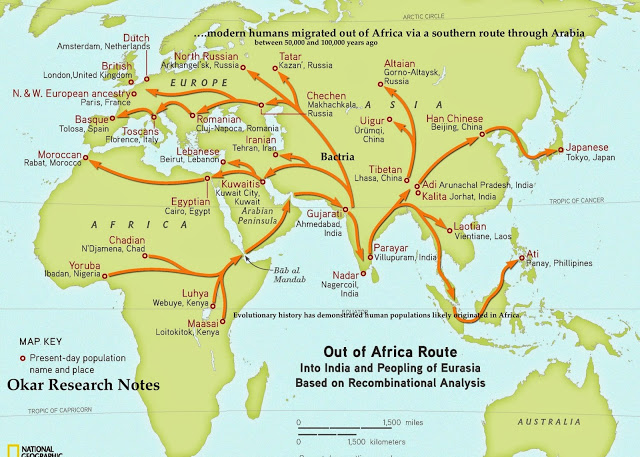
    Recent Out of Africa Migration: At the end of the Megadrought, beginning around 70,000-50,000 years ago, Basal Contemporary Humans (BCH) re-populated Eurasia. In this expansion, bearers of mt-DNA haplogroup L3 left East Africa, likely reaching Arabia via the Bab-el-Mandeb (the mouth of the Red Sea), and in the Great Coastal Migration spread across Arabia, into South Asia (India), Maritime South Asia (southeast asia) and Oceania between 65,000-50,000 years ago.

    Likely Opportunity: Exploitation of ocean fishing. 
    Rate of Migration: Surviving hunter-gatherers migrate by a kilometer (half-mile) per year.
    Scale of Migration: Disturbingly small – the number of those that migrated and survived may have been small. Very small. As little as one hundred people.

    Dispersal: The From the Port of Africa to the Ports Of Eurasia

    Routes Out of Africa: Uncertainty. We are not entirely clear on the routes modern humans took as they migrated from east africa.  There are at least three routes out of the region and into eurasia:

    West: Strait of Gibraltar: The Strait of Gibraltar is only 14 km wide with heavy currents. A decrease in sea levels during the Pleistocene due to glaciation would not have brought this down to less than 10 km. Some researchers have also suggested the route across Sicily but this fails both archeological evidence, and rational incentives given the knowledge at the time.

    North: The Levantine Corridor across the Nile delta and the Sinai Peninsula into the Levant. And the strait of Gibraltar. Archaeological remains suggest repeated use of the Levantine corridor and genetic analysis of human populations suggests that this route was more important for migration and trade over time. But that doesn’t tell us about human dispersal out of Africa. Recent evidence suggests that while early H. sapiens spread north through the Levantine corridor 80,000 to 100,000 years ago, these humans either went extinct or retreated back to Africa 70,000 to 80,000 years ago, possibly replaced by southbound Neanderthals escaping the colder regions of ice-age Europe.

    South: The Bab-el-Mandeb strait (Red Sea Route) is 20km wide, then an island, then 2km wide. The Red Sea straight is a more likely dispersal route given the pattern of human dispersal, and the distribution of, and rates of differentiation of different peoples of the world. But while it’s a narrow strait it’s not as obvious a route as the Levantine corridor.  And despite the distance, during this period of drought, the sea level was lower, making the straight passable. But perhaps more importantly, today’s Persian gulf is a likely candidate for Eden – with rivers feeding what was at the time, a lush region of fertile land and marshes for hunting game. And while evidence is still emerging, there was some sort of industrial complex producing tools and trading with East Africa during the period. So it’s difficult to believe from the archaeology that the southern route

    Migration occurs in all directions: north up the red sea, into the Levant, east then north along the Persian Gulf and Mesopotamian rivers, and then east along the coast, and back across are all equally plausible. Like Johnny Appleseed, they seeded groups behind them as they spread. And those seeds took everywhere along the southern route all the way to Australia.  It’s this evidence of following the seas, crossing visible horizons of water, and tools for fishing, that weakens objections to the southern route as the primary means of modern human dispersal.
     

    Generation Five: Behaviorally Modern Humans: The Full Toolkit


    (Human)
    Paleolithic >
    Upper Paleolithic (50,000 BC to 9700 BC) >
    Behaviorally Modern Humans >
    Generation Five: Physically, Culturally, Behaviorally, and Technologically Modern.

    The people who dispersed along this route appear to have been technologically and culturally modern as well as physically modern. Instead of a few primitive stone tools, they had specialized hunting, the use of aquatic (ocean) resources, blade and microlithic technology, fishing tools, bone shaped as a tool, hearths, significant artifact diversity, and elaborate graves, systematic processing and use of pigment, and art and decoration. Art becomes common as does increased geographic range and long-distance trade.

    They traveled over longer distances. From these coastal expansions, they spread into Eurasia, East and North Asia by about 45,000 years ago. The earliest of these migrations reached present-day Australia, with humans arriving between 50,000 and 40,000 years ago.

    They maintained a nomadic lifestyle of hunting and gathering, and some populations began to establish seasonal or permanent human settlements. These settlements are some of the first known organized, permanent civilizations. Ancient humans designed these establishments to include sleeping quarters, kitchens, butchering areas, and underground storage in order to preserve food.

    They emerged into a world of west Eurasian Neanderthals, east Eurasian and Asian Denisovans, and likely remnants of earlier  – perhaps three or four different hominids, with multiple branches in isolated regions such as the islands; and possibly remains of Eomo Erectus or others. We these ancestors adapted morphologically, and quickly – possibly because of the rate at which they could spread. And they were sexually opportunistic ( indiscriminate ) and mixed with Neanderthals, Denisovans, and one or more Ghost (lost) populations. So sustained admixture (Hybridization) between archaic humans and modern humans occurred both in Africa. And in 30k years, by 30K years ago, we had hybridized and exterminated the previous species of hominids (competitors).

    Travel, Communication and Trade: The greatest contributions of the Upper Paleolithic Revolution were over-water travel, the establishment of long-range trade routes, and the development of complex spoken languages.

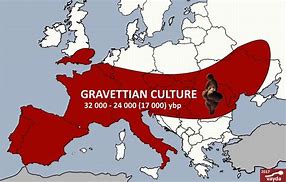
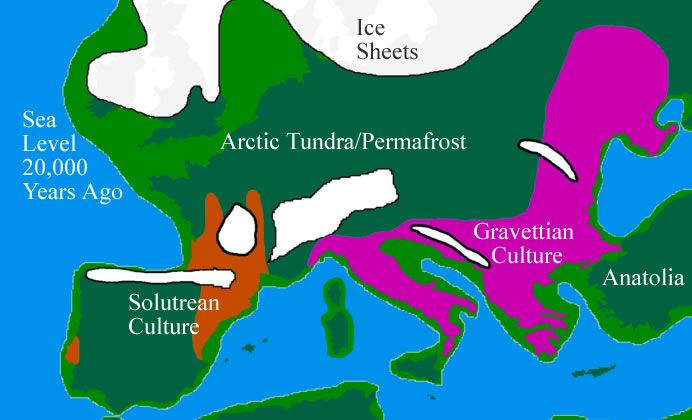
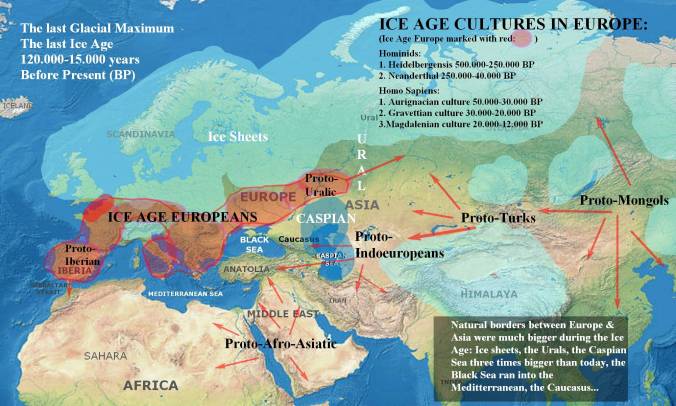
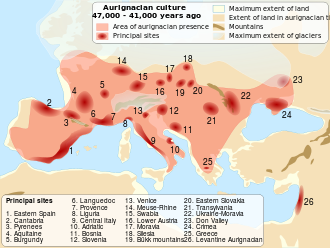
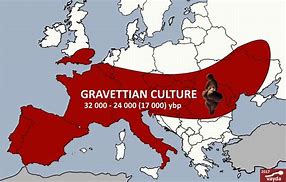
    The Upper Paleolithic Revolution: This expansion results in The Upper Paleolithic Revolution between 50,000 and 10,000 years ago, just before the widespread practice of agriculture. It produces fully modern behavior, including figurative art, music, self-ornamentation, trade, burial rites etc. is evident by 30,000 years ago. The oldest unequivocal examples of prehistoric art date to this period, the Aurignacian and the Gravettian periods of prehistoric Europe, such as the Venus figurines and cave painting (Chauvet Cave) and the earliest musical instruments (the bone pipe of Geissenklösterle, Germany, dated to about 36,000 years ago).

    Rapid Adaptive Speciation

    The First Invisible Age

    t looks like no one really knows. The best candidates for the various dispersals are around the pre-flood Persian gulf just like the neolithic expansion around upper Mesopotamian rivers, just like the later expansion around the black sea. But some authors advocate the Levantine corridor and basal Eurasian in the Sinai. AFAIK this is an artifact of the availability of data the same way we know so much more about europe and the levant than the rest of the world.

    A Gradual Process or Incremental Revolutions? ( … )


    Divisions: Origins of The Basal Populations

    The Coastal Dispersal:  Southern route across the then-passable Red Sea Straight, across the Saudi Arabian peninsula (Today’s Yemen), across the then-closed Persian gulf with its two freshwater lakes, and along the Coast of India to the Indus River Valley, then the Ganges, and continuing along the coast to southeast Asia, eventually reaching then-combined Australia–New Guinea landmass. Subsequent migrations, partly driven by agricultural expansions, have largely erased the genetic evidence of this early dispersal, with the possible exception of certain ‘refugia’ populations, such as Southeast Asian hunter-gatherers (e.g., Malaysian Semang and Filipino Negrito groups), Andamanese and indigenous Australians.

    The Basal Eurasians – “We Don’t Know”

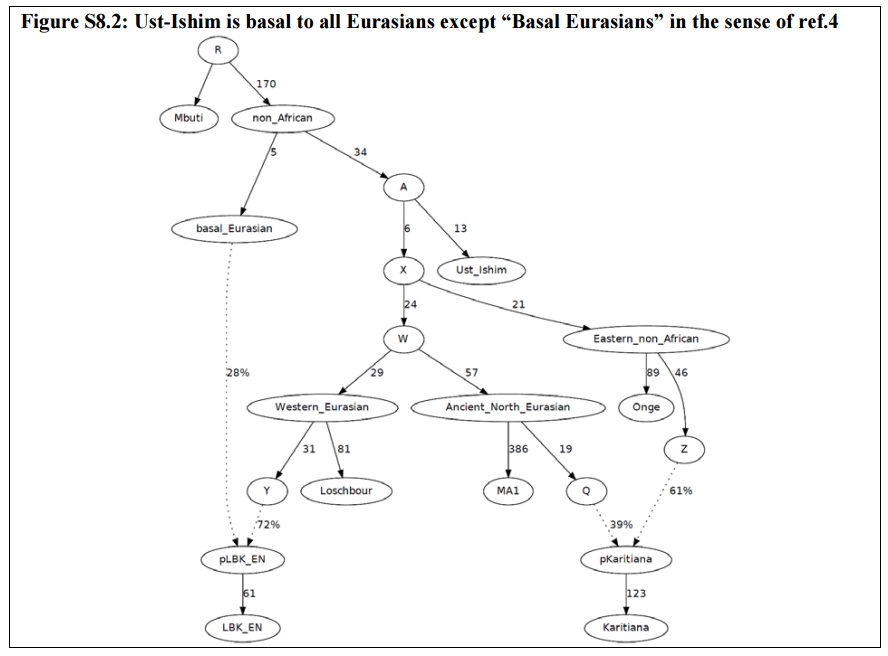
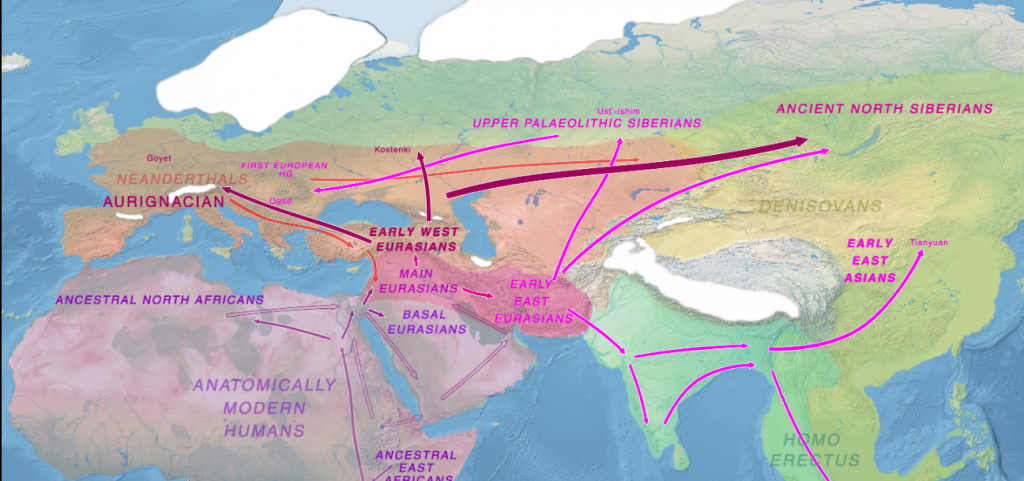
    The Basal South Eurasian Dispersal: (South of the black sea, caucuses, and Caspian sea) By …. the basal south Eurasians have formed by spreading from today’s Persian gulf and Pakistan, into today’s Iran, Caucuses and Anatolia, and into Mesopotamia, the Levant, and north Africa.

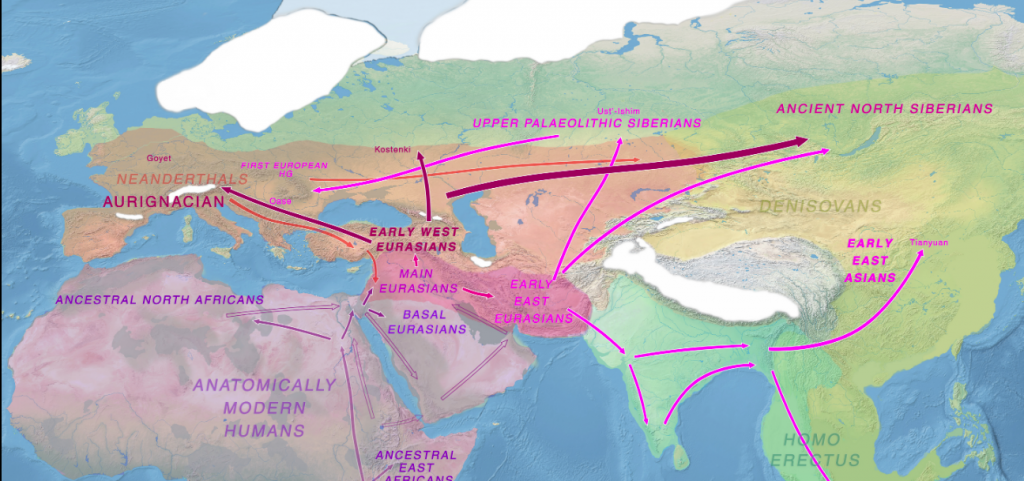
    Basal West Eurasian Dispersal (West of the Urals and north of the Caucuses)  ( … ) By … the basal central Eurasians have formed by spreading north (we don’t know how) east of the Caspian, and into today’s Russia.

    Basal East Eurasian Dispersal (east of the Urals and North of the Himalayas) … ) by … the basal east Eurasians have formed by spreading north and east (we don’t know how) into today’s Tibet, Mongolia, and Siberia. This group appears to have split off into today’s north China, Korea, and Japan.

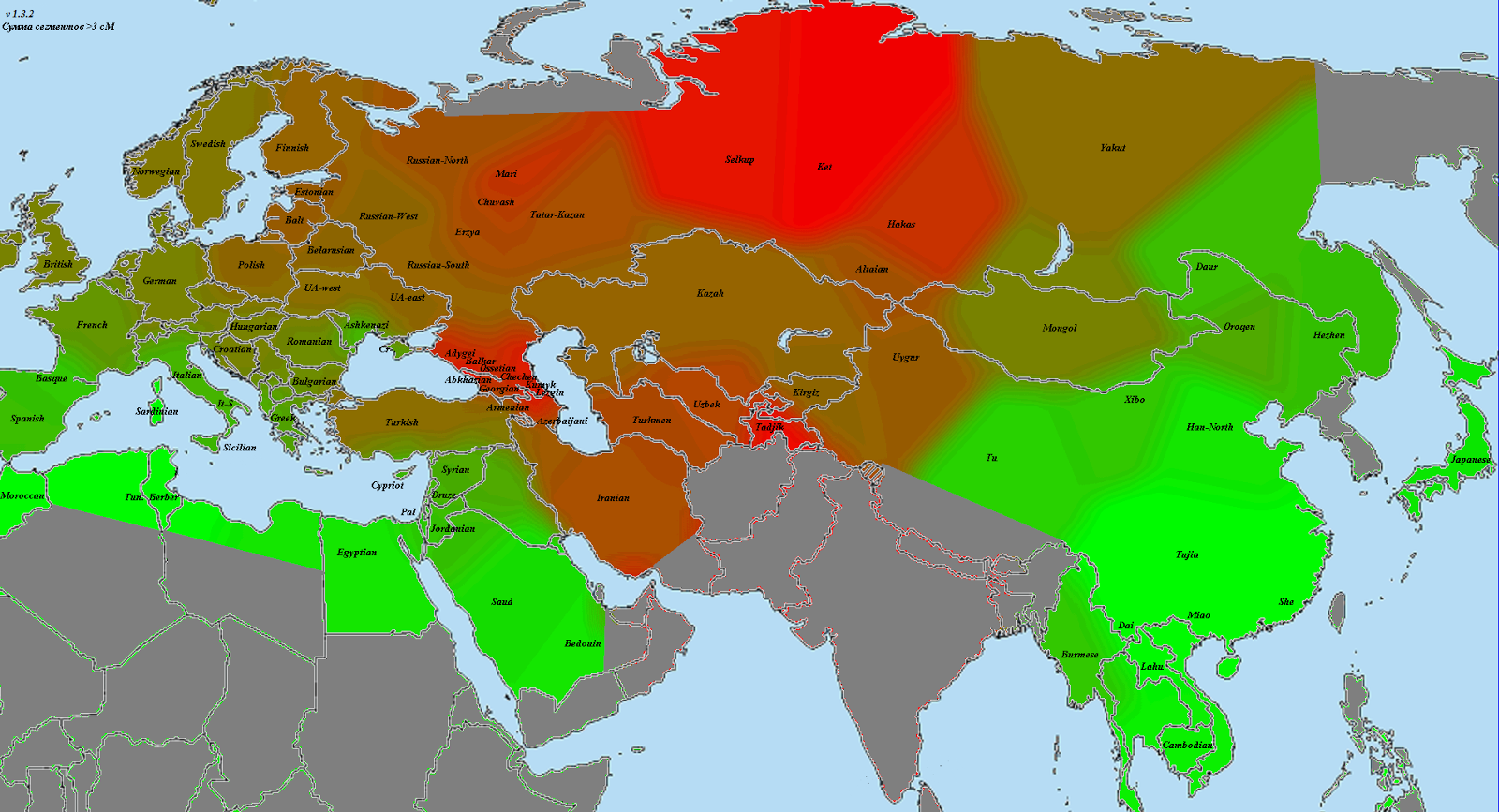
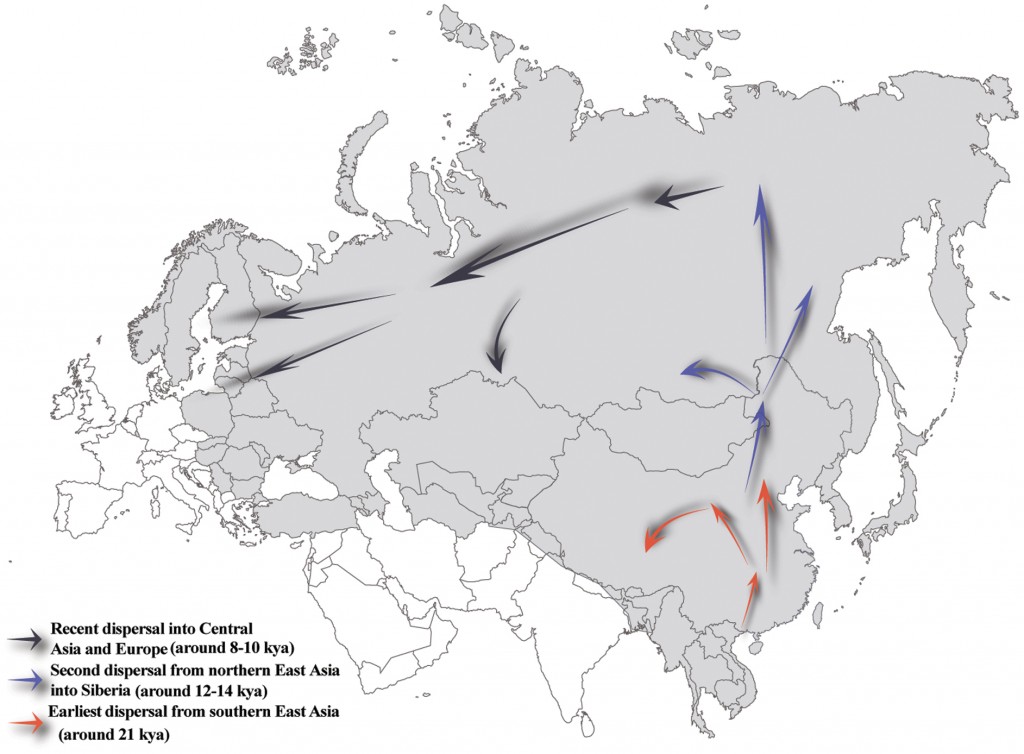
    The Basal East Asian Dispersal: A branch of these early arrivals 60000 years ago, migrated northward, and settled East Asia. However, the genetic history of East Asia consists of three waves of immigrants from the south, followed by two waves of migrants from the north and west, including a smaller, later dispersal between 15–50 kya or 40-30 ka) arrived from the north of the Himalayas.  This immigration pattern produced a north-south cline of east asians that we still observe today.

    Like the rest of Eurasia, while East Asia consisted of divergent groups, the agrarian expansion dominated the genetic expansion and somewhat homogenized the regional populations in east and south asia just as it did in central Eurasia and western Europe.  But unlike the indo european expansion in Eurasia, and like the southwest Eurasians of the middle east, the East Asians were relatively unaffected by the indo european expansion, and as such had less hybridization with the west Eurasians.

    The Future will produce:

    The Basal Ancient North Eurasians will not evolve until 24, 000 BC, and it’s their admixture with eastern and western hunter-gatherers that provides the genetic basis for the cultural and technological revolution of the indo Europeans.

    The Basal Early Americans (Amerindians) will evolve from admixture between north Asians and ancient north Eurasians thereafter.

    The Basal Modern Europeans evolve only 5000 years ago, by the hybridization of western and eastern hunter-gatherers, early neolithic farmers, and Steppe pastoralists.
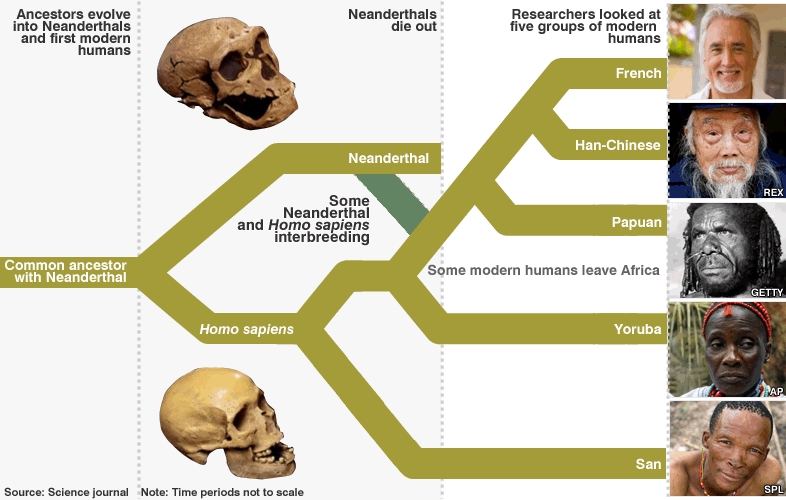
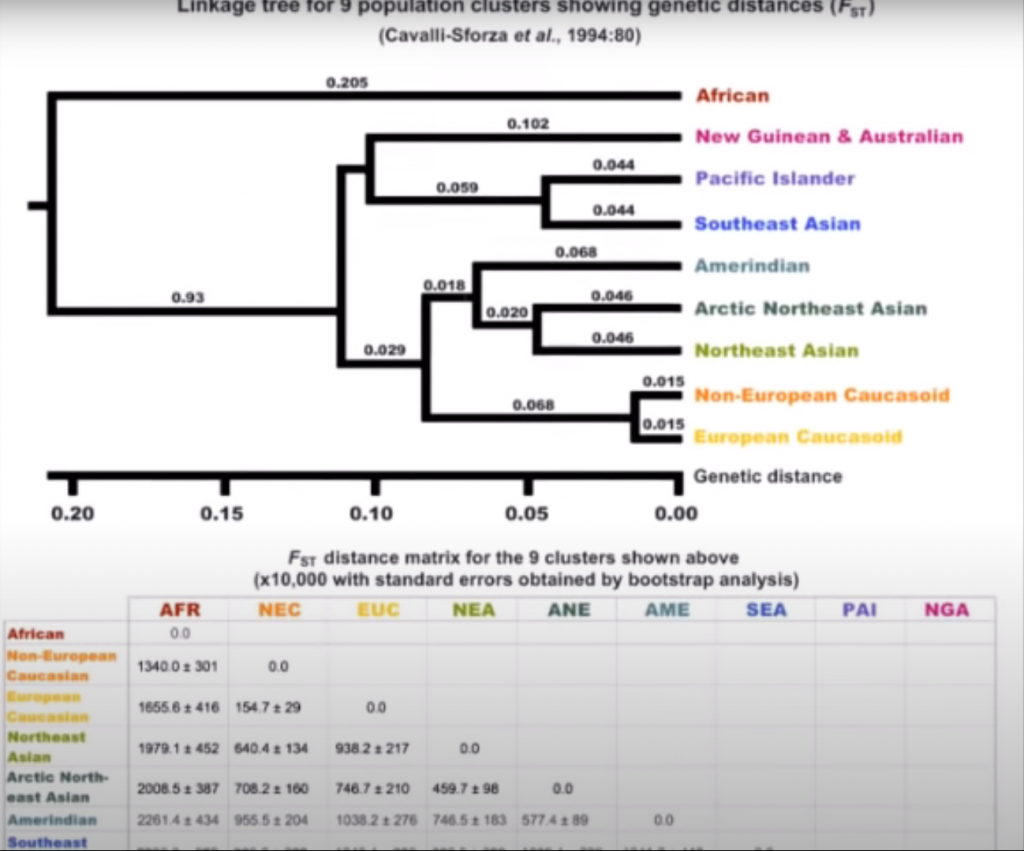
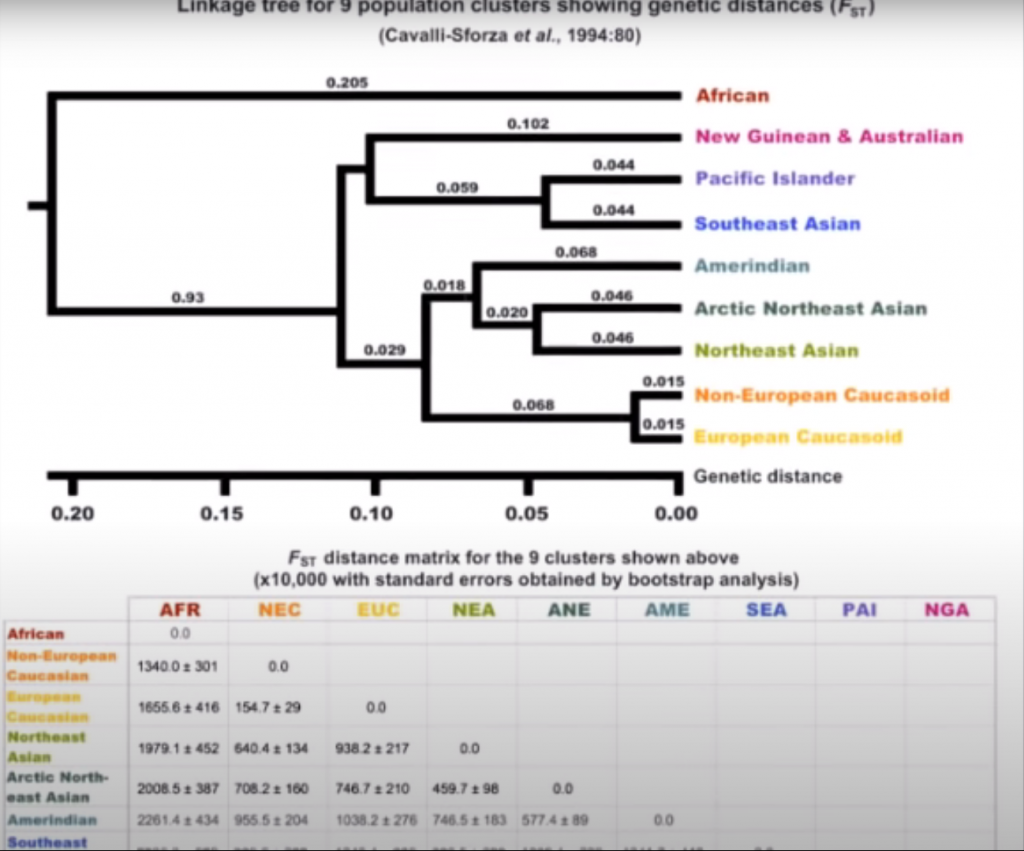
    A simplified but accurate illustration of the sequence of the evolution of the races (subspecies) as man spread across and adapted to local environments.


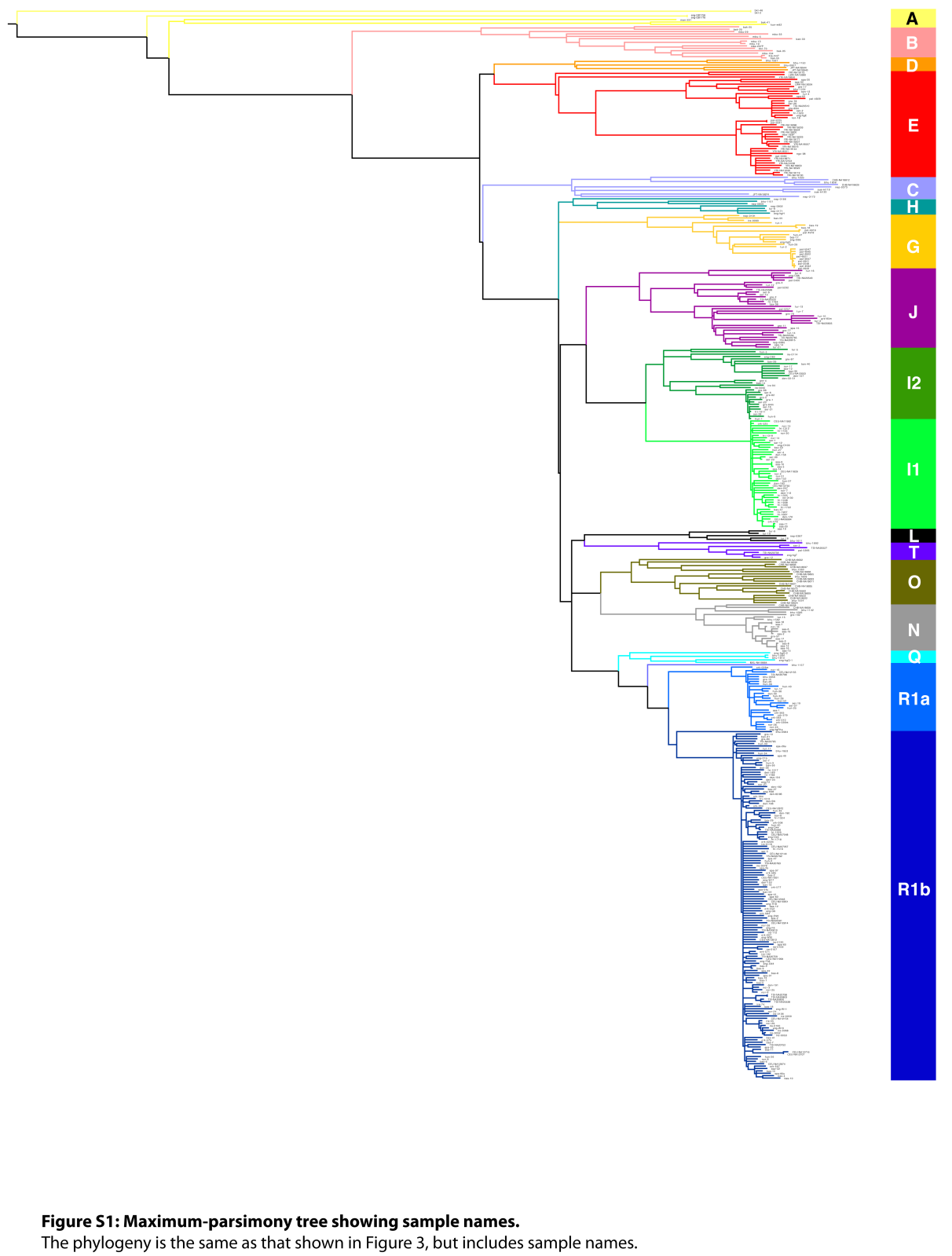
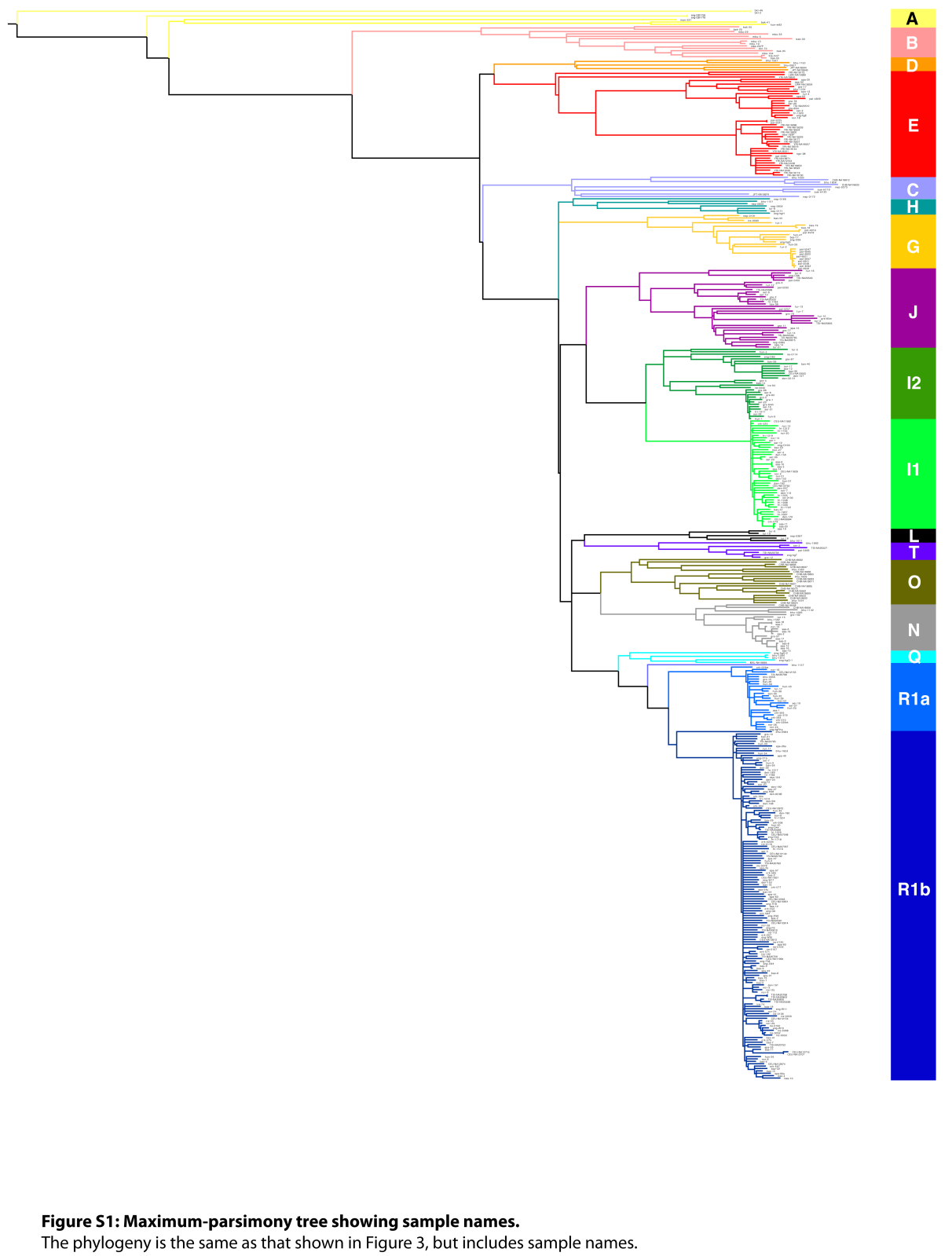
    The tree of the evolution of the races by their haplogroup


  • Conflict 3: The Evolution of Man

    The Evolution of Man

    The story of cycles of hyper adaptation, expansion, and hybridization – and the limits of that cycle.

    LIFE

    • Life: Organization, Metabolism, and Homeostasis defeat entropy by taking advantage of entropy, and influence in, participation in, or production of reproduction of the information necessary to reproduce genetic information and processes, and adaptation is necessary to evolve into those conditions. As far as I know, genes function as the “life” form with the cell to body of the individual or cell to bodies of the group a carrier. 
    • Species:  “Populations that do not regularly breed with one another.” Preference and capacity for reproductive cooperation by morphological, phenotypical, behavioral, identification and preference.
    • Evolution: the tendency of a population of organisms to adapt to opportunities in a given environment, through mutation, regulation, expression, interbreeding, and hybridization.
      • Mutation:
      • Regulation: 
      • Expression:
      • Regulatory Transfer (Epigenetic): 
      • Interbreeding: the capture of or transfer of traits 
      • Speciation: The creation of a new species, often from the evolution of another species
      • Hybridization: The emergence of a new species from the intermixture of other species
    • Co-Evolution: two or more organisms evolving in adaptation to one another.
    • Homoplasy (convergent Evolution)
    • Endomism ( restricted to a certain area – divergent evlution)
    • Stenotropic – narrow habitat preferences – adapted to narrow habitats.
    • Punctuated Equilibrium:  Long periods of consistency of a species interrupted by rapid changes to a species, group of species, or ecology.

    MAN

    • Morphology (Major: Size Shape Organization, performative difference)
    • Phenotype (Minor: small – any visible difference)
    • Physiology (functions of living organisms and their organs and organic processes).
    • Metabolism Metabolically (the conversion and distribution of energy)
    • Behavior; The sets and series of actions produced by an organism in response to a particular situation or stimulus.
    • Cognition
    • Intelligence: the rate of cognitive adaptation

    THE GENETIC CYCLE

    ( … )

    Hyper Adaptability

    Human hyper-adaptability can be maximized across the spectrum of human abilities:

    Physiologically (Skeleton, organs, organic processes),
    … Morphologically (Features),
    … … Behaviorally(socially),
    … … … Cognitively(neurology),
    … … … … Conceptually(ideas),
    … … … … … Informationally(knowledge),
    … … … … … … Technologically(material),
    … … … … … … … Institutionally(organizational).

    The story of mankind, as we shall see, is the sequential exhaustion of opportunity of adaptability across that spectrum – and that story is the primary lesson of our present study. And that lesson will lead us to very different understandings compared to our ancestral cyclical(natural) and linear(technological) understandings of the universe, of mankind, our present condition, and our future potential.

    The seed that I would like to plant, that I hope will grow for the remainder of our journey together, is that evidentiary(scientific) truth, (free of pretense of knowlege by ignorance, error, bias, wishful thinking, deceit, and fraud), provides humans with new opportunity for adaptability, if willing to pay the cost of adaptation today in exchange for the continuous benefits of adaptation tomorrow – and thereafter.

    And this is a critical insight, because only one group of people on earth, and in human history, chose to pay the high cost of truth (adaptation) while all other peoples chose to not pay the costs of adaptation. This is why europeans institutionalized truth-before-face, truth-before-dominance_hierarchy, truth-before-desirability, truth-regardless-of costs: maximum adaptability. It is this choice, first among the other uniquensses of european peoples and their civilization, that caused european peoples to evolve – not first – but faster than all other peoples combined, in the steppe, mediterranean, continental, and sea ages.  The question is – do we have the will to continue dragging mankind out of it’s continuous efforts to resist adaptation by resisting the truth?

    Why Is Evolutionary History Confusing?

    1. Academic disciplinary specialization
    2. Non-Operational, or arbitrary names
    3. Difficulting in forming a coherent narrative prior to genetic evidence and contemporary techniques (and costs).
    4. The postwar attempt to undermine the sciences

    A Narrative Provides a System of Measurement for Testing Coherence of cross Disciplinary Dnformation
    To make human history into a coherent (accross time) and consistent (using the same systems of comparison) we need to produce a narrative (explanation) of the evolution of man from his first emergence to the present. In doing so we produce a system of measurement (skeleton) upon which we can draw consistent and coherent deductions about mankind – free of our tendency to error, bias, wishful thinking, deciet and fraud. (Partcularly political fraud.) And while adademic specialization, non operational names, and lack of a coherent narrative are confusing.

    The Game of Life, Time, Pattern Identification, and History


    Conaway’s game of life. Cellular Automaton.
    The Game of Rabbits and wolves.
    Robert Axelrod

    (the pattern you identify depends on yuor tiem horizon)

    (the time horizing determines your choice of decidability – goals)

    (the longest time horizion is the only universally decidable)

    Playedat high speed …exhaustion of opportunities.

    Timeline of Mankind

    The Beginning

    (Geologic)
    The Cenozoic (66M BC to Present): The period of Mammals, beginning 66 million years ago, beginning with the K-T extinction event when an asteroid hit the earth. The terrestrial animals that succeeded in dominating both hemispheres were mammals – the Eutherians (placentals) in the northern hemisphere and the Metatherians (marsupials, now mainly restricted to Australia) in the southern hemisphere. The extinction of many groups allowed mammals and birds to greatly diversify so that large mammals and birds dominated the Earth. The continents also moved into their current positions, and the Earth’s climate had begun a drying and cooling trend, culminating in the glaciations of the Pleistocene Epoch, and only partially offset by the Paleocene-Eocene Thermal Maximum.

    The Paleolithic

    (Historical)
    Pre-History: c. 3.3M BC – 300,000 BC) The period between the appearance of Homo (“humans”; first stone tools c. three million years ago) and the invention of writing systems (for the Ancient Near East: 3,000 BC).

    (Human)
    The Paleolithic
    (“Old Stone Age”) (3.3M BC to 9700 BC), is the period in human prehistory beginning with original development of stone tools. It extends from the earliest known use of stone tools by hominins c. 3.3 million years ago, to the end of the Pleistocene in 9700 BC, and covers 99% of the time period of human technological prehistory.

    (Human)
    Paleolithic >
    The Lower Paleolithic (c. 3.3M BC – 300,000 BC) Homo, Homo erectus

    ( … )

    (Climate)
    The Quaternary: (“Fourth Period”) (2.6M BC to Present)
    The Period of Glaciations.
    The current geological period, the Quaternary, is marked by warm and cold episodes, cold phases called glacials (Quaternary ice age) lasting about 100,000 years, and which are then interrupted by the warmer interglacials which lasted about 10,000–15,000 years. The last cold episode of the last glacial period ended about 10,000 years ago. Earth is currently in an interglacial period of the Quaternary, called the Holocene.

    The Quaternary represents the entire time during which recognizable humans existed. The major geographical changes during this time period included the emergence of the Strait of Bosphorus and Skagerrak during glacial epochs, which respectively turned the Black Sea and Baltic Sea into fresh water, followed by their flooding (and return to salt water) by rising sea level; the periodic filling of the English Channel, forming a land bridge between Britain and the European mainland; the periodic closing of the Bering Strait, forming the land bridge between Asia and North America; and the periodic flash flooding of Scablands of the American Northwest by glacial water. The current extent of Hudson Bay, the Great Lakes and other major lakes of North America are a consequence of the Canadian Shield’s readjustment since the last ice age; different shorelines have existed over the course of Quaternary time.

    (Climate)
    Quaternary >
    The Pleistocene (“Mostly New”, “Ice Age”):
    (2.6M BC to 9700 BC) The Period of Glaciations, that includes the emergence of Homo Sapiens.

    The Period of:

    • Climate Era, (Man is the product of climate, and in particular – the cold.)
    • Genetics (species, competitors, skeletal evidence),
    • Region (Climate, Resources, Geological Evidence),
    • Archaeology (or Technology, species, Region, Conitions, Resources, ),
    • Migration (Cumulative Evidence) (Genetics, Climate, Resources, Technology, Subrace – genetic and technological evidence)
    • Strategy (group organizing strategy)
    • Culture (or Informal Institutions) (organization, strategy, proto-civilization)
    • Language (or Measurements) (Climate, organization, technology, resources,’nations’)
    • Mythology (“metaphysics”)
    • Methods of persuasion

    The Geography and Ecology of Africa

    Today’s Sahara, 5500 years ago, was wet and tropical. But it rapidly turned into desert. The climate patterns that affect the Sahara region are regulated by the climate of the high latitudes and the arctic and are very sensitive to change. This means that north Africa’s rainfall switches on and off like a lightbulb. South of the Sahara varies more like Eurasia with gradual changes in climate as the planet’s cycles pass. 

    This map doesn’t provide enough detail but it does explain the difference between hot, temperate, and cold climates.

    This map shows the seasonal rainfall patterns.


    Climate Causes Adaptation

    Climactic events cause new adaptive genealogical events. Or change by crisis and opportunity create pressure for adaptability. This chart illustrates that early hominins were adapted to local environmental niches, whether grassland or forest, and during warmer and drier eras could range and intermix, and during cooler and water eras were isolated from one another. This sinusoidal back and forth by the climate cause speciation and hybridization. So after each climactic event new groups emerged.

    Genus Homo

    (Human)
    Paleolithic >
    Lower Paleolithic >
    Homo (~2.4M BC) Roughly 2.4 million years ago Homo habilis had appeared in East Africa: the first known human species, and the first known to make stone tools.

    Leaps

    • Metabolic Efficiency, and Homeostatic Regulation – Increased Possibility of Starvation
    • Food Sharing
    • Bigger Brains
    • Stone Tools
    • Early Birth,
    • Increased Child Care

    Primates are more metaboliclaly efficient than other animals. Humans are more metabolically efficient than other primates. To achieve that you need food sharing and body fat. That’s why humans are the fattest primate. Even athletic humans have 15% body fat. Even lazy zoo chimps have least than 50%. Other animals aren’t maximized like humans, beacue the risk of starvation is too high.

    The use of tools conferred a crucial evolutionary advantage, and required a larger and more sophisticated brain to co-ordinate the fine hand movements required. A larger brain equires a larger skull, and thus requires the female to have a wider birth canal for the newborn’s larger skull to pass through. But if the female’s birth canal grew too wide, her pelvis would be so wide that she would lose the ability to run, which was a necessary skill 2 million years ago.

    The solution was to give birth at an early stage of fetal development, before the skull grew too large to pass through the birth canal. This adaptation enabled the human brain to continue to grow, at the cost of the need to care for helpless infants for long periods of time forced humans to become less mobile. Human bands increasingly stayed in one place for long periods, so that females could care for infants, while males hunted food and fought with other bands that competed for food sources. As a result, humans became even more dependent on tool-making to compete with other animals and other humans, and relied less on body size and strength.

    Species Homo Erectus

    (Human)
    Paleolithic >
    Lower Paleolithic >
    Homo erectus
    (~2M BC) (‘upright man’) Homo erectus was a species of archaic human that appeared about 2 million years ago. It’s the first recognisable members of the genus Homo (human). Homo Erectus was the first human ancestor to spread throughout the Old World, extending across Eurasia from the Iberian Peninsula in the west to Java in the east. 

    Leaps:

    • Persistence Hunting
    • Superpredatory Kill Rate
    • Better Food, Greater Caloric Intake
    • Fire
    • Gradual but Continuous virtuous cycle of somatic improvement (evolution of brains and brawn)
    • Cooperation, Division of labor, and Food Sharing
    • Monogamy / Pairing off?
    • Proto Language?

    H. Erectus had a humanlike gait and body proportions, and was the first human species to have exhibited a flat face, prominent nose, and likely had sparse body hair coverage. Brain capacity varied widely depending on the population, ranging from 546–1,251 cc (33.3–76.3 cu in), and maximum brain size matured early on in life, meaning a shorter childhood and reduced parental care compared to modern humans. Size also ranged widely from 146–185 cm (4 ft 9 in–6 ft 1 in) in height and 40–68 kg (88–150 lb) in weight. H. erectus men and women may have been roughly the same size as each other (exhibit reduced sexual dimorphism) like modern humans, which could indicate monogamy in line with general trends exhibited in primates. Skin colour potentially varied with location, but as we have seen, primates have light skin, and dark skin was the evolutionary result of losing hair, just as clothing and higher latitudes the result of losing dark skin.

    H. Erectus is associated with the Acheulean (Ah-ch-yoo-LEE-an) stone tool industry, and is thought to have been the earliest human ancestor capable of using fire, hunting and gathering in coordinated groups, caring for injured or sick group members, seafaring, and possibly art-making. Sites generally show consumption of medium to large animals, such as bovines or elephants, and a high reliance on meat is associated with increasing brain size. Though groups were more social than ancestor species. It’s unclear if H. Erectus was anatomically capable of speech, though it is postulated they communicated using some proto-language.

    The Result Of Multiple Species: Evolution by Hybridization

    African populations of H. erectus are the direct ancestors of several human species, such as H. heidelbergensis and H. antecessor, and Asian populations of H. floresiensis and possibly to H. luzonensis, and several proposed subspecies with varying levels of possibiity. H. heidelbergensis generally considered to have been the direct ancestor to Neanderthals and Denisovans, and possibly modern humans.

    Erectus..-> Heidelbergensis > Antecessor > Sapiens
    … … … … -> Eurasia: Neandertal |Denisovian -> Extinct
    … … … … -> Asia: Floresiensis  | Luzonensis -> Extinct 

    MOVE ME: Interbreeding occurred between H. sapiens and archaic humans in Eurasia, Oceania and Africa, indicating that modern population groups, while mostly derived from early H. sapiens, are to a lesser extent also descended from regional variants of archaic humans.

    Baboons as an Example: hybridization. olive baboon super-baboon, reticulate species, … we cannot take the morphological variation in early homo populations for territorial isolation. 

    Earlier hominids appear to be stenotopic: adapted to an ecological niche.  H. Erectus is NOT stenotopic. Instead, it’s analogous to the “super-baboon”: a “super hominid”.  It found an adaptive strategy that gave it a wider habitat opportunity. As such the many hominid species in Africa, need not be reproductively isolated, As such, we may never, and likely will not,  identify a single ancestor of Homo Erectus.

    Extraordinary Success of Homo Erectus

    H. Erectus gradually increased it’s body size and doubled its brain size. But doing so requires extra energy. The 30kg Australopithecus would need 1200 calories a day, and 52kg homo Erectus would need 50% more calories per day and much more when lactating.  Erectus had smaller teeth and lower bite force, so they were getting higher quality food – not more, but better.

    They were hunters and gatherers, which required intense cooperation and food sharing, hunting, scavaging, and foraging, and tool-making, fire, and food processing.  And the hunter-gatherer complex creates an interesting but simple system of feedback that serves their interests: cooperative huntering and gathering favors two kinds of skills: cognitive and social – meaning brains, and athleticism – meaning brawn. These two skills lead to increasing energy availability. And increasing energy availability leads to more opportunities for cognitive, social, and athletic evolution.

    Or more formally, 

    1. selection for better hunter-gathering abilities (brains and braw)
    2. Produces more available energy (especially for mothers and offspring)
    3. That energy for mothers and offspring can be put to an increase in cellular investment (maintenance), reproductive investment (offspring), or somatic investment (biological adaptation – especially by regulatory adaptation).

    Which is an exceptionally effective feedback model for evolution.

    But where did that investment go?

    • Hominids are comparatively slow and awkward compared to quadruped prey.
    • Hunting and savaging is difficult and risky.
    • And hominids lack both weapons (fangs, claws) and defenses (fur).
    • And competing with carnivores like lions and such is entering an exclusive and dangerous club.

    Walking upright.

    Fossil footprints of Homo Erectus show cooperating groups of males living and hunting together, with bone structure, musculature, and walking behavior identical to ours. Although we might note that except for the arch, flat footed feet that are distinctively human are found in europe and the mediterranean just after it flooded at 5.7m years ago.

    Running.

    Most of these features are present in and evolved first in the Genus Homo. 

    • Decoupled Head and Shoulders
    • Oral Heat Dumping
    • Enlarged Semicircular Canals
    • Nuchal Ligament
    • Reduced Arm Mass
    • Enlarged Cranial Gluteus Maximus
    • Narrow Waist
    • Short Femoral Neck
    • Long Legs (although not uncommon in other species)
    • High percentage of slow-twitch fibers
    • Large Elastic Ventricles
    • Long Leg Tendons
    • Short Calcaneus
    • Elastic Energy Storage in Arch
    • Short toes

    Running Gave us Persistence Hunting

    Our ancestors likely started out scavenging, but we evolved Persistence Hunting: because we can run longer than all other animals.  Why, because we can dissipate heat extremely well. We can run and breathe. We can run and sweat. And they don’t dissipate heat well, they can’t sweant and most importantly – they pant to dissipate heat. But when they run(gallop) they can’t pant. While quadrupeds can gallop faster than humans can run, humans can run a marathon above the trot-gallop transition speed of most game – forcing them game into gallop where it can’t pant and dissipate heat. In the middle of the day, in the heat, they chose a big animal, forced it to gallop away until it hides to rest. The track it, then chase it again, and repeat. Over about 15-30 km, half of which they spend walking, they can drive big game into hyperthermia so that it just dies from overheating. The technique is about 75% successful which puts man up with the domestic cat and the African dog (wolf) as the most successful predators on earth. The African hunter-gatherers call this The Great Dance.  

    Fellow Super Predatory Kill Rates

    African wild dogs – 85% successful kills (but only hold 30%)
    Man – 70% successful kills
    Domestic cat (in wild) – 70% successful kills
    Cheetah – 58% successful kills
    Leopard – 38% successful kills
    Lion – 30% successful kills
    Wolves – 14% successful kills
    Polar bear – 10% successful kills
    Tiger – 5% successful kills

    Cooperation

    But we can divide labor, we can share food, we can share food capture and preparation.

    We can share food preparation. We can’t chew raw meat, Human teeth are poorly adapted for chewing raw meat but you can slice it, and pound it even before cooking.  

    Using persistence hunting, food preparation, rates of reproduction, hunter-gatherer population density, we can estimate that it would take only 50-100k years for Erectus to ‘fill’ Africa and create pressure to migrate out of Africa, and disperse into the south pacific. 

    Failings

    Evidence suggests that they were social, but lazy and incurious, taking advantage of running, and their success at running down game, but not seeking innovation or excellence in tools.

    Exceptional Success

    Homo erectus first appeared about 1.8 million years ago and, based on the fossil evidence, quickly populated Africa, Asia and Europe. Though it is unclear whether the species arose in Africa or Asia, a million years later the widespread populations were still similar enough to be considered a single species, White argued. The largest number of Homo erectus specimens are from Asia, including the first specimen – “Java Man.”

    The onset of the Ice Ages about 950,000 years ago likely split the Homo erectus populations and led to their divergent evolution. The African population of Homo erectus probably gave rise to modern Homo sapiens, the European branch perhaps became the Neandertals, while the Asian population went extinct.

    Anthropological “splitting” that’s common today gives the wrong impression of the biology of these early human ancestors. The different names indicate an apparent diversity that is not at least initially subsantive. Homo erectus is a biologically successful organism, not a whole series of different human ancestors, all but one of which went extinct.”

    By the time Homo erectus disappeared some 400,000 years ago, its various populations had clearly diverged, since 500,000-year-old fossils from Asia, including “Peking Man,” differ significantly from African fossils of the same age, particularly in the size of the cranium.

    The last known record of morphologically recognisable H. erectus are from Java, around 117–108,000 years ago. The disappearance of H. erectus is a matter of dispute but as we see throuhout history, as soon as members of Genus Homo are able to use tools, more advanced generations replace more primitive peoples, rather rapidly. 

    We want to make two observations: (a) the route out of africa thru the horn and iberia, and (b) the date they appear to disappear ~100k BC. And later on, when we discuss ‘Geography in Everything’, it won’t be a surprise.

    (Human)
    Paleolithic >
    Lower Paleolithic >
    Homo antecessor (1.2M BC and 800,000 BC) An archaic human species of the Lower Paleolithic, present in Western Europe (Spain, England and France), with “a unique mix of modern and primitive traits”. It’s the oldest direct fossil record of the presence of Homo in Europe, and for reasons of hybridization we covered above, is classified as a European variety of H. Erectus, a new species, or an early form of H. heidelbergensis. (This author suggests that H. antecessor is arguably european in phenotypic appearance).

    (Human)
    Paleolithic >
    Middle Paleolithic >
    Homo Heidelbergensis (700,000 BC to 300,000 BC)  ( … ) 

    Leaps:

    • Larger body
    • Bigger Brain
    • Bigger Face
    • Body Fat
    • Beginning of neoteny (slower life)


    Generation One: Early  Homo Sapiens

    (Human)
    Paleolithic >
    Middle Paleolithic >
    Generation One:
    Early Homo sapiens
    (H. sapiens) (~300,000 BC to 50,000 BC) evolves out of ancestral Homo erectus (or an intermediate species such as the hypothesized Homo antecessor, or in Europe as Homo heidelbergensis ) in Africa roughly 500,000 years ago. Between 350,000 and 260,000 years ago populations in East and South Africa merged, while North-African populations dispersed and hybridized into the Neandertals. H. sapiens disperse almost immediately with North African archaeological finds 315,000 years ago, in West Asia by 270,000 South Africa about 259,000 years ago, and in Greece 210,000 years ago.


    Generation Two: Anatomically Modern Humans

    (Human)
    Paleolithic >
    Middle Paleolithic >
    Generation Two:
    Homo Sapiens – Anatomically Modern Human
    (AMH) (~200,000 BC ) distinguishes Homo sapiens that are anatomically consistent with the range of phenotypes (physical body shapes and in particular skeletons) seen in contemporary humans from extinct archaic human species. This distinction is useful especially for times and regions where anatomically modern and archaic humans co-existed such as in Paleolithic Europe. The oldest known skeleton of an anatomically modern human(AMH) dates to about 196,000 years ago.  (Or approximately 200k BC).

    Limited Technology: It’s unclear to what extent these early modern humans had developed social abilities, techniques, and institutions such as language, music, religion, etc. They spread throughout Africa over the following approximately 50,000 years.

    Maximization of Physical Form  (Exhaustion of Physical Adaptivity): Most importantly is that the physical features that produced human super-predation have completed their evolution: limited digestion, narrow waisted, long legged, tall, narrow pelvis, hairless, hands free to manipulate tools and carry resource, and the ability to out disspate heat and together to out-endure every other living animal on earth except other humans. A group of humans with simple heat hardenend spears can run-down or walk-down anything living until it’s exhausted, and kill it safely.

    Generation Three: Anatomical Modernity: Basal Modern Human Populations Spread Across and Out of Africa

    (Climate)
    Quaternary >
    The Upper Pleistocene (“Upper Ice Age”) : Physically Modern Humans
    (127,000 BC to 9700 BC) The period covering the evolution of modern humans.

    (Climate)
    Crisis:  The Megadroughts (Spanning 50,000 years, from ~130,000 BC to 80,000 BC) African megadroughts occurred from 130,000 to 80,000 years ago, during the last interglacial period,

    Basal Modern Humans

    (Human)
    Paleolithic >
    Middle Paleolithic >
    Generation Three:
    Basal Modern Human (BMH):
    These megadroughts result in the origin of basal population of contemporary human populations by 130,000 years ago that spread until 75000 years ago – roughly mirroring the droughts. The BMH were morphologically modern, but not technologically or culturally modern – they weren’t substantially different in technology from neanderthals. 

    The First Great Split:
    Capoid-Khosian South migrate, Niger-Congo and Nilo-Saharan migrate Central and West, and East Africans Remain.

    During this period, from Around 100,000 BC–80,000 BC, three main lines of Homo sapiens diverged:

    1 – Bearers of mitochondrial haplogroup L1 (mtDNA) / A (Y-DNA) colonizing Southern Africa (the ancestors of the Khoisan/Capoid peoples). The Khoi-San represent an “ancestral population cluster” located in southwestern Africa (near the coastal border of Namibia and Angola).
    2 – Bearers of haplogroup L2 (mtDNA) / B (Y-DNA) settling Central and West Africa (the ancestors of Niger–Congo and Nilo-Saharan speaking peoples).
    3 – Bearers of haplogroup L3 remained in East Africa. 

    The Failed Migrations:
    The Failed North Migration Out of Africa (Levantine Corridor). They also spread north along the nile, through the Levantine corridor and into West Asia 80,000 to 100,000 years ago,  but either went extinct or retreated back to Africa 70,000 to 80,000 years ago, possibly replaced by southbound Neanderthals escaping the colder regions of ice-age Europe. Genetic evidence suggests that admixture with Neanderthals occurred during this period – meaning likely a consequence of survival under duress – possibly competitive duress.

    The Failed East Migration out of Africa (Red Sea Crossing): They also migrated the route through the present-day Bab-el-Mandeb Strait on the Red Sea (at that time, with a much lower sea level and narrower extension), crossing to the Arabian Peninsula and settling in places like the present-day United Arab Emirates (125,000 years ago) and Oman (106,000 years ago), and the Indian Subcontinent (75,000 years ago), and perhaps even southern China (67,000 years ago – although evidence is uncertain), and South Asia and Australia (50,000 years ago.) Although no reliable human remains have yet been found in these places, the similarities between the stone tools and what little remains we have, suggest that their creators were all modern humans. But these migrations from Africa didn’t leave traces in the results of genetic analyses, suggesting that those anatomically modern humans didn’t survive in large numbers and were assimilated by our major antecessors, or died out.

    Neanderthal Aside: The archeological community is desperately overcompensating for previous denials of human hybridization with neanderthals, The assumption of complete replacement has been revised in the 2010s with the discovery of admixture events (introgression) of populations of H. sapiens with populations of archaic humans over the period of between roughly 100,000 and 30,000 years ago, both in Eurasia and in Sub-Saharan Africa. Neanderthal admixture, in the range of 1-4%, is found in all modern populations outside of Africa, including in Europeans, Asians, Papua New Guineans, Australian Aboriginals, Native Americans, and other non-Africans. This suggests that interbreeding between Neanderthals and anatomically modern humans took place after the recent “out of Africa” migration, likely between 60,000 and 40,000 years ago.[86][87][88] Recent admixture analyses have added to the complexity, finding that Eastern Neanderthals derive up to 2% of their ancestry from anatomically modern humans who left Africa some 100 kya.[89] The extent of Neanderthal admixture (and introgression of genes acquired by admixture) varies significantly between contemporary racial groups, being absent in Africans, intermediate in Europeans and highest in East Asians. Certain genes related to UV-light adaptation introgressed from Neanderthals have been found to have been selected for in East Asians specifically from 45,000 years ago until around 5,000 years ago.[90] The extent of archaic admixture is of the order of about 1% to 4% in Europeans and East Asians, and highest among Melanesians (the last also having Denisova hominin admixture at 4% to 6% in addition to neanderthal admixture). Cumulatively, about 20% of the Neanderthal genome is estimated to remain present spread in contemporary populations.

    Crisis: Near Extinction
    The Population Bottleneck 70,000 Years Ago. Genetic evidence suggests that today’s humans are descended from a very small population of between 1,000 and 10,000 breeding pairs that existed about 70,000 years ago. It’s possible that the Toba Super Volcanic Event (74,000 years ago), and the global consequences, may have pushed humans, already fragile becuase of the climate, to the brink of extinction. It may have just put additional migratory pressure on the small population too seek better food sources, or its effects may have have been negligible. Either way, the result was a tiny population and another effort colonize the world outside of africa.

    Opportunity and Crisis: Red Sea floods
    The barrier across Bab-el-Mandeb, between Ethiopia and Yemen underwent an outbreak flooding similar to that found in the Mediterranean. The Lake Toba event, approximately 70,000 years ago, caused a massive drop in sea levels, exposing the barrier and enabling modern Homo sapiens to leave Africa via an alternative route than Sinai. Saline evaporites found on the floor of the Red Sea confirms that this dam has closed at various periods in the past. Rising sea levels during earlier interglacial periods suggest that this area was subject to outburst flooding.

    Generation Four: Behavioral Modernity: The First Great Leap Forward

    Generation Four: The “Great Leap Forward” leading to full behavioral modernity sets in only after this separation. Rapidly increasing sophistication in tool-making and behaviour is apparent from about 80,000 years ago, and the migration out of Africa follows towards the very end of the Middle Paleolithic, some 60,000 years ago.

    Recent Out of Africa Migration: At the end of the Megadrought, beginning around 70,000-50,000 years ago, Basal Contemporary Humans (BCH) re-populated Eurasia. In this expansion, bearers of mt-DNA haplogroup L3 left East Africa, likely reaching Arabia via the Bab-el-Mandeb (the mouth of the Red Sea), and in the Great Coastal Migration spread across Arabia, into South Asia (India), Maritime South Asia (southeast asia) and Oceania between 65,000-50,000 years ago.

    Likely Opportunity: Exploitation of ocean fishing. 
    Rate of Migration: Surviving hunter-gatherers migrate by a kilometer (half-mile) per year.
    Scale of Migration: Disturbingly small – the number of those that migrated and survived may have been small. Very small. As little as one hundred people.

    Dispersal: The From the Port of Africa to the Ports Of Eurasia

    Routes Out of Africa: Uncertainty. We are not entirely clear on the routes modern humans took as they migrated from east africa.  There are at least three routes out of the region and into eurasia:

    West: Strait of Gibraltar: The Strait of Gibraltar is only 14 km wide with heavy currents. A decrease in sea levels during the Pleistocene due to glaciation would not have brought this down to less than 10 km. Some researchers have also suggested the route across Sicily but this fails both archeological evidence, and rational incentives given the knowledge at the time.

    North: The Levantine Corridor across the Nile delta and the Sinai Peninsula into the Levant. And the strait of Gibraltar. Archaeological remains suggest repeated use of the Levantine corridor and genetic analysis of human populations suggests that this route was more important for migration and trade over time. But that doesn’t tell us about human dispersal out of Africa. Recent evidence suggests that while early H. sapiens spread north through the Levantine corridor 80,000 to 100,000 years ago, these humans either went extinct or retreated back to Africa 70,000 to 80,000 years ago, possibly replaced by southbound Neanderthals escaping the colder regions of ice-age Europe.

    South: The Bab-el-Mandeb strait (Red Sea Route) is 20km wide, then an island, then 2km wide. The Red Sea straight is a more likely dispersal route given the pattern of human dispersal, and the distribution of, and rates of differentiation of different peoples of the world. But while it’s a narrow strait it’s not as obvious a route as the Levantine corridor.  And despite the distance, during this period of drought, the sea level was lower, making the straight passable. But perhaps more importantly, today’s Persian gulf is a likely candidate for Eden – with rivers feeding what was at the time, a lush region of fertile land and marshes for hunting game. And while evidence is still emerging, there was some sort of industrial complex producing tools and trading with East Africa during the period. So it’s difficult to believe from the archaeology that the southern route

    Migration occurs in all directions: north up the red sea, into the Levant, east then north along the Persian Gulf and Mesopotamian rivers, and then east along the coast, and back across are all equally plausible. Like Johnny Appleseed, they seeded groups behind them as they spread. And those seeds took everywhere along the southern route all the way to Australia.  It’s this evidence of following the seas, crossing visible horizons of water, and tools for fishing, that weakens objections to the southern route as the primary means of modern human dispersal.


    Generation Five: Behaviorally Modern Humans: The Full Toolkit


    (Human)
    Paleolithic >
    Upper Paleolithic (50,000 BC to 9700 BC) >
    Behaviorally Modern Humans >
    Generation Five: Physically, Culturally, Behaviorally, and Technologically Modern.

    The people who dispersed along this route appear to have been technologically and culturally modern as well as physically modern. Instead of a few primitive stone tools, they had specialized hunting, the use of aquatic (ocean) resources, blade and microlithic technology, fishing tools, bone shaped as a tool, hearths, significant artifact diversity, and elaborate graves, systematic processing and use of pigment, and art and decoration. Art becomes common as does increased geographic range and long-distance trade.

    They traveled over longer distances. From these coastal expansions, they spread into Eurasia, East and North Asia by about 45,000 years ago. The earliest of these migrations reached present-day Australia, with humans arriving between 50,000 and 40,000 years ago.

    They maintained a nomadic lifestyle of hunting and gathering, and some populations began to establish seasonal or permanent human settlements. These settlements are some of the first known organized, permanent civilizations. Ancient humans designed these establishments to include sleeping quarters, kitchens, butchering areas, and underground storage in order to preserve food.

    They emerged into a world of west Eurasian Neanderthals, east Eurasian and Asian Denisovans, and likely remnants of earlier  – perhaps three or four different hominids, with multiple branches in isolated regions such as the islands; and possibly remains of Eomo Erectus or others. We these ancestors adapted morphologically, and quickly – possibly because of the rate at which they could spread. And they were sexually opportunistic ( indiscriminate ) and mixed with Neanderthals, Denisovans, and one or more Ghost (lost) populations. So sustained admixture (Hybridization) between archaic humans and modern humans occurred both in Africa. And in 30k years, by 30K years ago, we had hybridized and exterminated the previous species of hominids (competitors).

    Travel, Communication and Trade: The greatest contributions of the Upper Paleolithic Revolution were over-water travel, the establishment of long-range trade routes, and the development of complex spoken languages.

    The Upper Paleolithic Revolution: This expansion results in The Upper Paleolithic Revolution between 50,000 and 10,000 years ago, just before the widespread practice of agriculture. It produces fully modern behavior, including figurative art, music, self-ornamentation, trade, burial rites etc. is evident by 30,000 years ago. The oldest unequivocal examples of prehistoric art date to this period, the Aurignacian and the Gravettian periods of prehistoric Europe, such as the Venus figurines and cave painting (Chauvet Cave) and the earliest musical instruments (the bone pipe of Geissenklösterle, Germany, dated to about 36,000 years ago).

    Rapid Adaptive Speciation

    The First Invisible Age

    t looks like no one really knows. The best candidates for the various dispersals are around the pre-flood Persian gulf just like the neolithic expansion around upper Mesopotamian rivers, just like the later expansion around the black sea. But some authors advocate the Levantine corridor and basal Eurasian in the Sinai. AFAIK this is an artifact of the availability of data the same way we know so much more about europe and the levant than the rest of the world.

    A Gradual Process or Incremental Revolutions? ( … )


    Divisions: Origins of The Basal Populations

    The Coastal Dispersal:  Southern route across the then-passable Red Sea Straight, across the Saudi Arabian peninsula (Today’s Yemen), across the then-closed Persian gulf with its two freshwater lakes, and along the Coast of India to the Indus River Valley, then the Ganges, and continuing along the coast to southeast Asia, eventually reaching then-combined Australia–New Guinea landmass. Subsequent migrations, partly driven by agricultural expansions, have largely erased the genetic evidence of this early dispersal, with the possible exception of certain ‘refugia’ populations, such as Southeast Asian hunter-gatherers (e.g., Malaysian Semang and Filipino Negrito groups), Andamanese and indigenous Australians.

    The Basal Eurasians – “We Don’t Know”

    The Basal South Eurasian Dispersal: (South of the black sea, caucuses, and Caspian sea) By …. the basal south Eurasians have formed by spreading from today’s Persian gulf and Pakistan, into today’s Iran, Caucuses and Anatolia, and into Mesopotamia, the Levant, and north Africa.

    Basal West Eurasian Dispersal (West of the Urals and north of the Caucuses)  ( … ) By … the basal central Eurasians have formed by spreading north (we don’t know how) east of the Caspian, and into today’s Russia.

    Basal East Eurasian Dispersal (east of the Urals and North of the Himalayas) … ) by … the basal east Eurasians have formed by spreading north and east (we don’t know how) into today’s Tibet, Mongolia, and Siberia. This group appears to have split off into today’s north China, Korea, and Japan.

    The Basal East Asian Dispersal: A branch of these early arrivals 60000 years ago, migrated northward, and settled East Asia. However, the genetic history of East Asia consists of three waves of immigrants from the south, followed by two waves of migrants from the north and west, including a smaller, later dispersal between 15–50 kya or 40-30 ka) arrived from the north of the Himalayas.  This immigration pattern produced a north-south cline of east asians that we still observe today.

    Like the rest of Eurasia, while East Asia consisted of divergent groups, the agrarian expansion dominated the genetic expansion and somewhat homogenized the regional populations in east and south asia just as it did in central Eurasia and western Europe.  But unlike the indo european expansion in Eurasia, and like the southwest Eurasians of the middle east, the East Asians were relatively unaffected by the indo european expansion, and as such had less hybridization with the west Eurasians.

    The Future will produce:

    The Basal Ancient North Eurasians will not evolve until 24, 000 BC, and it’s their admixture with eastern and western hunter-gatherers that provides the genetic basis for the cultural and technological revolution of the indo Europeans.

    The Basal Early Americans (Amerindians) will evolve from admixture between north Asians and ancient north Eurasians thereafter.

    The Basal Modern Europeans evolve only 5000 years ago, by the hybridization of western and eastern hunter-gatherers, early neolithic farmers, and Steppe pastoralists.
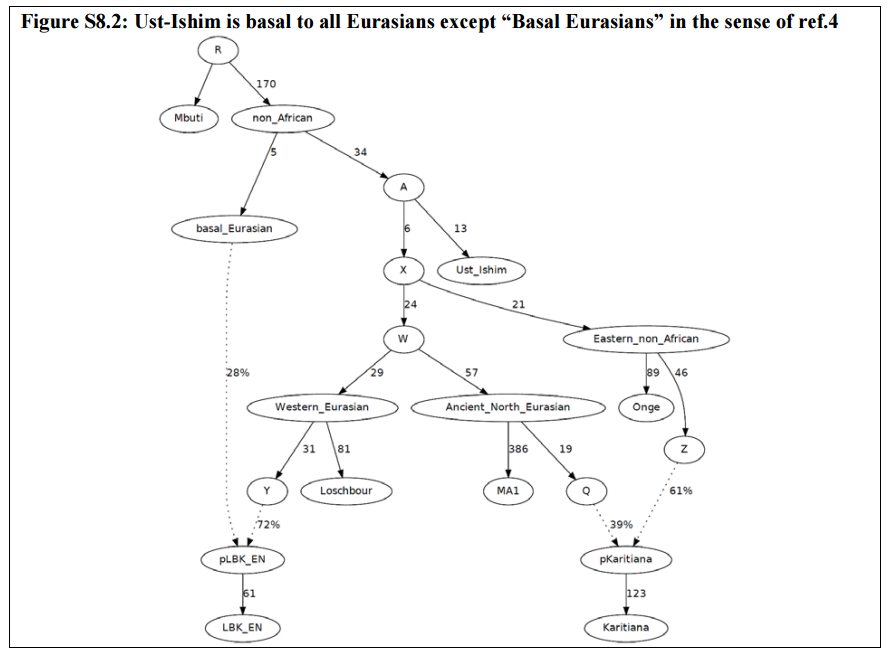
    A simplified but accurate illustration of the sequence of the evolution of the races (subspecies) as man spread across and adapted to local environments.
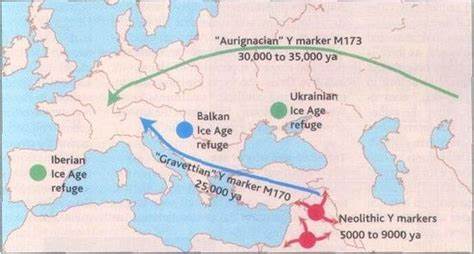


    The tree of the evolution of the races by their haplogroup


  • Conflict 4: Conquest of the World

    Generation Six: Expansion and Exploitation: The Second Great Leap Forward

    ( … )

    Origins: Persian Gulf and Indus River Urhiemat

    The South Eurasian Urheimat


    The North Eurasian Urheimat


    Cultures of the Upper Paleolithic

    Generation Six: Regional Adaptation

    We won’t cover each of these cultures here, instead limit our discussion to those cultures that represent changes in technology in response to environmental demands. 
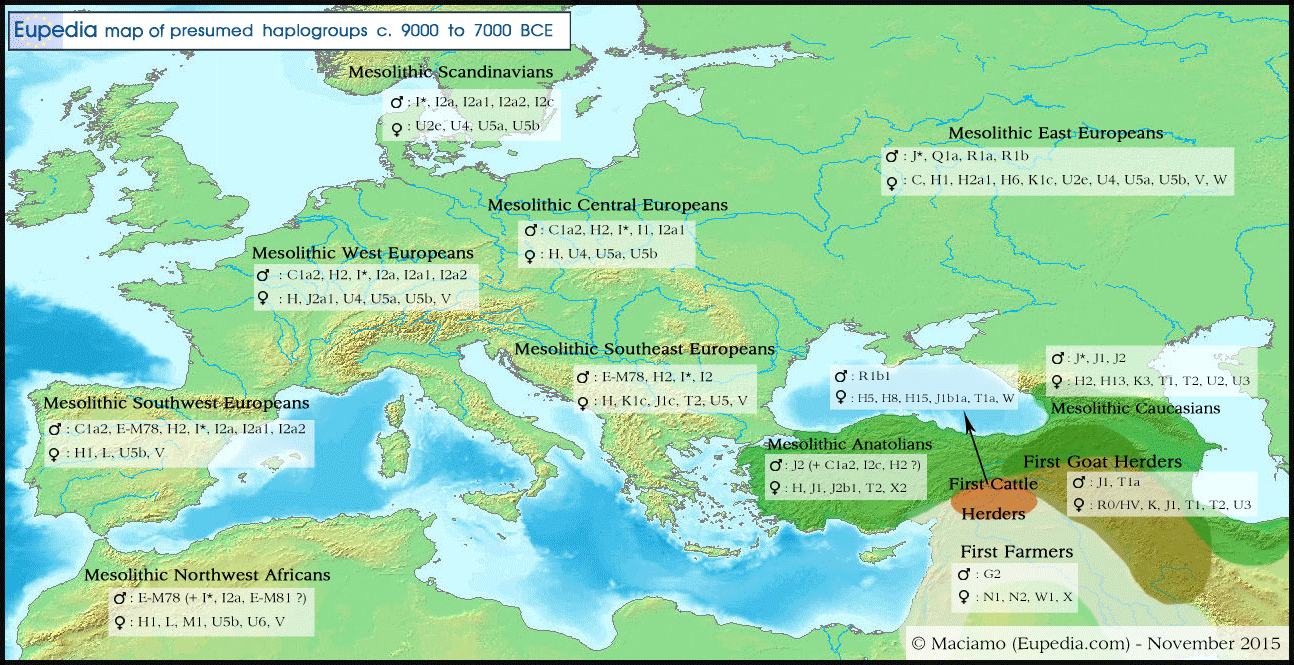
    SW Asia (Fertile Crescent)
    +Emiran (50–40 ka)
    Ahmarian (46–42 ka)
    Baradostian (36–18 ka)
    Aurignacian (35–29 ka)
    Zarzian (20–10 ka)
    Kebaran (18–12.5 ka)
    Trialetian (16–8 ka)
    +Natufian (14.5–11.5 ka)
    Khiamian (12.2–10.8 ka)
    Europe
    Bohunician (48–40 ka)
    +Châtelperronian (44.5–36 ka)
    Lincombian-Ranisian-Jerzmanowician (43–32 ka)
    +Aurignacian (43–26 ka)
    +Szeletian (41,000-37,000)
    Périgordian (35–20 ka)
    +Gravettian (33–24 ka)
    +Pavlovian (29–25 ka)
    +Solutrean (22–17 ka)
    +Epigravettian (20–10 ka)
    +Magdalenian (17–12 ka)
    Hamburg (15.5–13.1 ka)
    Federmesser (14–12.8 ka)
    +Azilian (14–10 ka)
    +Ahrensburg (13–12 ka)
    +Swiderian (11–8 ka)
    Africa
    Khormusan (42–18 ka)
    Iberomaurusian (25–11 ka)
    Mushabian
    Halfan (22–14 ka)
    Qadan (15—11 ka)
    Sebilian (15–11 ka)
    Eburran (15–5 ka)
    Magosian (10–8 ka)

    Siberia
    Mal’ta–Buret’ (24–15 ka)
    Afontova Gora (21–12 ka)

    SW Asia

    (Human)
    Paleolithic >
    Middle Paleolithic to Upper Paleolithic >
    The Emiran, Bohunician, and Ahmarian Complex (??? BC to 40,000 BC) Anatomically Modern Humans spread in Eurasia. These are also the first people that appear to successfully compete with the Neanderthals.
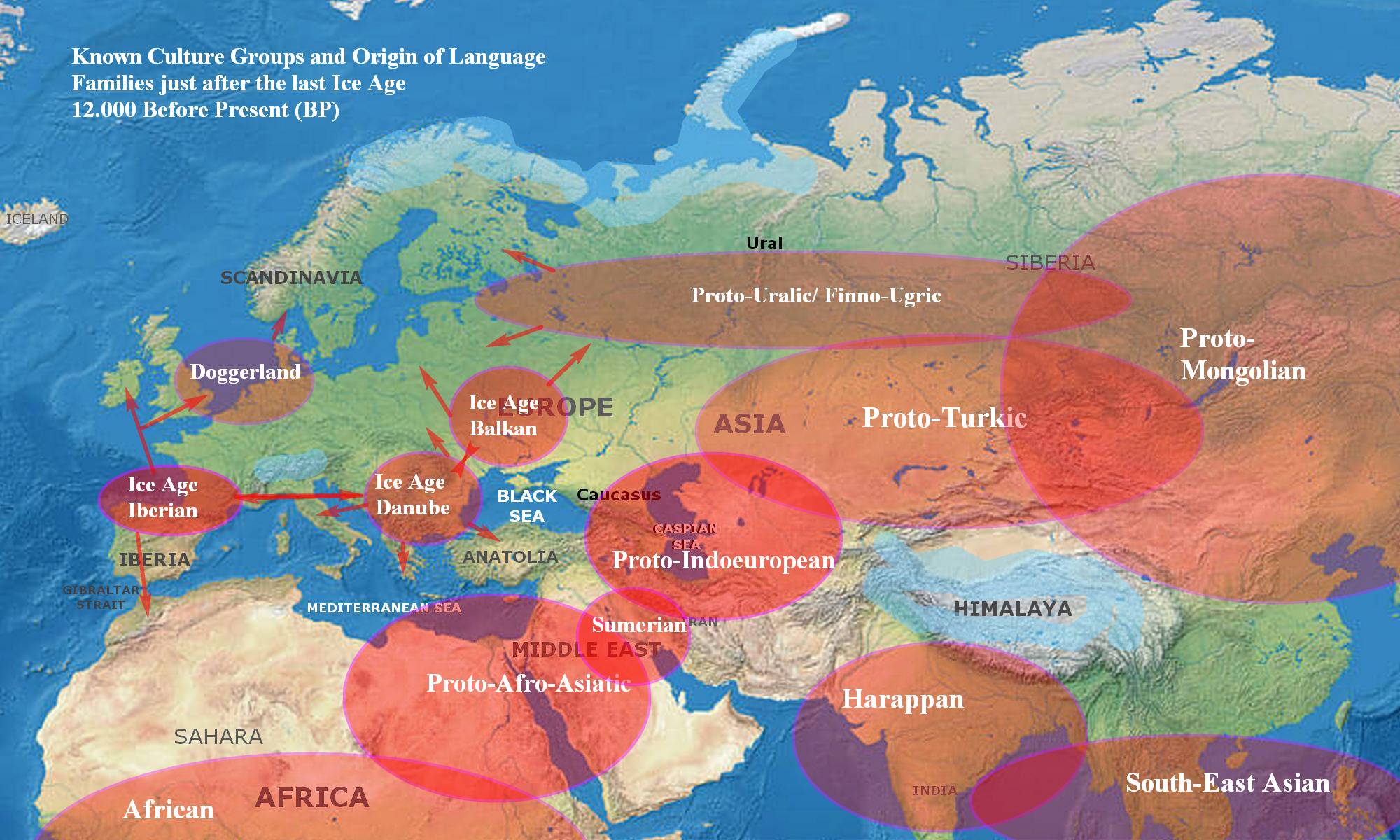
    SW Asia (Levant) >
    Emiran Culture (First Anatomically Modern Eurasians) (50,000 BC to 40000 BC) existed in the Levant (Syria, Lebanon, Israel, Palestine), and Arabia between the Middle Paleolithic and the Upper Paleolithic periods. It is the oldest known of the Upper Paleolithic cultures and remains an enigma as it transitionally has no African progenitor this culture is indigenous to the Levant, and the possible Uriheimat of West Eurasians. The tools of this culture are noticably primitive compared to later work products.

    SW Asia (Levant) >
    Ahmarian(Elongated, Curved Blades) (
    44,000 BC to 40,000 BC): The Ahmarian period together with the Emiran period, both from the Levant, are among the very first periods of the Upper Paleolithic, corresponding to the first stages of the expansion of Homo sapiens out of Africa. From this stage, the first modern humans migrated to Europe to form the beginning of the European Upper Paleolithic, including the Aurignacian culture, where they become known as the Cro-Magnons

    Ahmarian blades are usually elongated with some curves. The technical knowledge of the Ahmarian culture, along with the other lithic industries, is considered the likely source of the abrupt and rapid takeover of the world in all directions as evidenced by the crossing of the Bering Strait towards America. Ahmarian technology, which included the complex of blade/bladelet-knapping techniques is also linked to the tools used by the hunter-gatherers of southwestern Asia. 

    SW Asia (Iran-Iraq: Zagros Mountains) >
    Baradostian (34,000 BC – 16,000 BC)

    (Human)
    Paleolithic >
    Upper Paleolithic >
    Europe >
    Basal West Europeans (46,000 BC to 13,000 BC) – West Hunter Gatherer
    (WHG),  European Early (Anatomically) Modern Humans (EEMH), or “Cro-Magnon” and their conquest of Europe.  The founder population of all later EEMH was established by 35,000 BC, and Europe would remain in genetic isolation from the rest of the world until 12,000 BC.

    The Invasion and Transition

    Mousterian, Châtelperronian, Perigordian (Neanderthal) (44,500–36,000)Mousterian industry, and lasted from c. 45,000 to c. 40,000 BP, and Catelperronian Neanderthal cultures and the earliest Upper Palaeolithic industry in Central and Southwestern France, as well as in Northern Spain. Châtelperronian culture may represent a community of Neanderthals who had to some extent adopted the culture of the modern Homo sapiens that had established themselves in the surrounding area, which would account for the signs of a hybrid culture found. These hypothetical Neanderthal hold-outs would be analogous to more recent Native Americans in North and South America who adopted European technologies such as firearms or domestication of horses in order to survive in an environment dominated by more technologically advanced competitors

    Neanderthals In Refuge (by 35,000 BC) Evidence for continued Neanderthal presence in the Iberian Peninsula.

    The Completion of the Conquest of Europe

    (Europe: Central and SE Europe) >
    Bohunician Industry
    (48,000 BC to 40,000 BC) (First Anotomicaly Modern Europeans) is the candidate for representing the first wave of anatomically modern humans in Europe.

    Bohunician technology resembles the Mousterian, as do the contemporary assemblages of the Szeletian, Emiran and Ahmarian all these cultures apper to be related.


    Szeletian Culture  (39,000 BC to 35,000 BC)  Austria, Moravia, northern Hungary, and southern Poland. It is dated years before the present (BP), most original and also the most aboriginal Upper Palaeolithic culture in Central Europe.

    Uluzzian Culture (45,000–39,500) of Italy and Greece


    The Formation of a Wholly European Culture

    Europe to SW Asia
    Aurignacian
    (41,000 BC to 24,000 BC): The Upper Paleolithic developed in Europe some time after the Levant, where the Emiran period and the Ahmarian period form the first periods of the Upper Paleolithic, corresponding to the first stages of the expansion of Homo sapiens out of Africa. They then migrated to Europe and created the first European culture of modern humans, the Aurignacian.

    An Early Aurignacian or Proto-Aurignacian stage is dated between about 43,000 and 37,000 years ago. The Aurignacian proper lasts from about 37,000 to 33,000 years ago. A Late Aurignacian phase transitional with the Gravettian dates to about 33,000 to 26,000 years ago.

    One of the oldest examples of figurative art, the Venus of Hohle Fels, comes from the Aurignacian and is dated to between 40,000 and 35,000 years ago. The German Lion-man figure is given a similar date range. The Bacho Kiro site in Bulgaria is one of the earliest known Aurignacian burials.

    A “Levantine Aurignacian” culture is known from the Levant, with a type of blade technology very similar to the European Aurignacian, following chronologically the Emiran and Early Ahmarian in the same area of the Near East, and also closely related to them. The Levantine Aurignacian may have preceded European Aurignacian, but there is a possibility that the Levantine Aurignacian was rather the result of reverse influence from the European Aurignacian: this remains unsettled.

    The Last Wholly European Culture

    Central and Eastern Europe 
    Gravettian
    (33,000 BC to 22,000 BC) The Gravettian succeeds the Aurignacian, and is the last wholly unified European culture. West and Central Europe were extremely cold during this period. The Gravettians were hunter-gatherers who lived in this bitterly cold period of European prehistory, and Gravettian lifestyle was shaped by the climate as glacial and environmental changes forced them to adapt. They lived in caves or semi-subterranean or rounded dwellings which were typically arranged in small “villages”.

    Archaeologists usually divide the culture into two regional variants: the western Gravettian, known mainly from cave sites in France, Spain and Britain, and the eastern Gravettian in Central Europe and Russia. The eastern Gravettians, which include the Pavlovian culture, were specialized mammoth hunters, whose remains are usually found not in caves but in open air sites.

    The Gravettians are known for their Venus figurines, which were typically made as either ivory or limestone carvings.  And they were technologically innovative, producing new arts and artifacts.

    During the post glacial period, evidence of the culture begins to disappear from northern Europe but was continued in areas around the Mediterranean

    Afterward, the Soultrean abrubtly replaces it in Fance, and it continues as the Epigravettian in Italy, Balkans, Ukraine, and Russia. 


    Crisis: The Last Glacial Maximum

    The second ice age, or Würm glaciation, of 28,000 to 10,000 years ago.

    Last Glacial Maximum (LGM) (~10,000 years from ~23,000 BC to 13,000 BC)

    There have been five major ice ages in earth’s history lasting from tens to a hundred million years. The last ice age started about 2.58 million years ago beginning with the spread of ice sheets in the Northern Hemisphere. Since then, the world has experienced cycles of glaciation with ice sheets advancing (glacial periods, glacials) and retreating (interglacial periods, interglacials) on 40,000- and 100,000-year time scales.

    So the paleolithic revolution is interrupted the most recent glacial cycle (LGM) The peopling of the Americas occurred during this time, with East and Central Asia populations reaching the Bering land bridge after about 35 ka, and expanding into the Americas by about 15 ka. The Holocene glacial retreat begins 11.7 ka (10th millennium BC), marking the beginning of the earliest forms of farming in the Fertile Crescent.

    (Human)
    Paleolithic >
    Upper Paleolithic >
    Northern Austria and Southern Poland

    Pavlovian (Ice Shelf Mammot Hunters, Weaving) (27,000 BC – 23,000 BC) Pavolvians are related to the Gravettians, and they  lived in the region of Moravia, northern Austria and southern Poland. They used sophisticated stone age technology to survive in the tundra on the fringe of the ice sheets around the Last Glacial Maximum. Its economy was principally based on the hunting of mammoth herds for meat, fat fuel, hides for tents and large bones and tusks for building winter shelters.

    Archaeologists have excavated flint implements, polished and drilled stone artifacts, bone spearheads, needles, digging tools, flutes, bone ornaments, drilled animal teeth, and seashells. Art or religious finds include bone carvings and figurines of humans and animals made of mammoth tusk, stone, and fired clay. Textile impressions made into wet clay give the oldest proof of the existence of weaving by humans.

    Basal North Eurasians

    (Human)
    Paleolithic >
    Upper Paleolithic >
    The Basal North Eurasian Dispersal

    Around 24,000 years ago, around the last glacial maximum,  a group of people in Siberia, evolve into Ancient North Eurasians (ANE). This group was extraordinarily successful. The mutation and subsecquent evolution of blond hair evolved in the ANE population. And their evolution contributed to a cline (in order influence) of Native Americans, Europeans, Central Asians, South Asians, and some East Asians. Later dilution of Native american ANE ancestry is the result of a second migration into the Americas 5000 years ago, that all but eradicated earlier groups.

    Distribution of Ancient North Eurasian Genetics


    The Ice Age Migrations

    The Resulting Cline West Eurasians After The ANE Expansion:

    • West Siberian Hunter-Gatherer (WSG)  had about 30% EHG ancestry, 50% ANE ancestry, and 20% East Asian ancestry.
    • Eastern European Hunter-Gatherer (EHG) is dominated by the Ancient North Euraasian (ANE) contribution (75%).
    • Scandinavian Hunter-Gatherer (SHG) were descended from Western Hunter-Gatherers who initially settled Scandinavia from the south, and later populations of EHG who entered Scandinavia from the north through the coast of Norway.
    • Western Hunter-Gatherers (WHG) and EHG lineages merged in Eastern Europe, after the end of the Last Glacial Maximum, accounting for early presence of ANE ancestry in Mesolithic Europe. Evidence suggests that as Ancient North Eurasians migrated West from Eastern Siberia, they absorbed Western Hunter-Gatherers and other West Eurasian populations as well.
    • Caucasian Hunter-Gatherer (CHG) dated ~26 kya, lacked ANE-admixture, by ~13 kya carried 36% ANE-derived admixture.
    • Iran Neolithic (Iran_N) individuals dated ~8.5 kya carried 50% ANE-derived admixture and 50% Caucuses-related admixture,marking them as different from other Near-Eastern and Anatolian Neolithics who didn’t have ANE admixture. Iran Neolithics were later replaced by Iran Chalcolithics, who were a mixture of Iran Neolithic and Near Eastern Levant Neolithic.

    This neolithic Iranian and Eastern European composition of 50% ANE will provide an interesting pattern in the milennia to come.

    Basal Siberian American Dispersals: 

    [ ADD IMAGE OF NORTH AMERICAN DISPERSAL ]

    ( … )


    Cultures of Post Glacial Maxium Europe

    Soultrean Culture (Advanced Flint) (19,000 BC to 15,000 BC) The Soultrean period in western europe (France, spain portugal) was a transitional stage between the flint implements of the Mousterian (Neanderthal) and the bone implements of the Magdalenian epochs. The period refers to the development of highly advanced flintmaking techniques that hadn’t been seen before and weren’t rediscovered for millennia. It includes relatively finely worked, bifacial points made with lithic reduction percussion and pressure flaking rather than cruder flintknapping. Knapping was done using antler batons, hardwood batons and soft stone hammers. This method permitted the working of delicate slivers of flint to make light projectiles and even elaborate barbed and tanged arrowheads. Large thin spearheads; scrapers with edge not on the side but on the end; flint knives and saws, but all still chipped, not ground or polished; long spear-points, with tang and shoulder on one side only, are also characteristic implements of this industry. Bone and antler were used as well. They used these tools to hunt horse, reindeer, mammoth, cave lion, rhinoceros, bear and aurochs.

    The Oldest Dryas stadial (15,000 BC)

    Magdalenian Culture (Bone) (15,000 BC to 12,000 BC) cultures above the Alps were primarily reindeer hunters, although Magdalenian sites also contain extensive evidence for the hunting of red deer, horses, and other large mammals present in Europe toward the end of the last glacial period including blue foxes, Arctic hares, and other polar creatures, but included tigers and other typically tropical species. The culture was geographically widespread, stretched from Portugal in the west to Poland in the east, and as far north as France, the Channel Islands, England, and Wales. Archaology shows progress in arts and culture. It was characterized by a cold and dry climate, and the extinction of the mammoth. The use of bone and ivory as implements, begun in the preceding Solutrean epoch, increased, making the period essentially a bone period. Bone instruments are quite varied: spear-points, harpoon-heads, borers, hooks and needles. Cave sites such as Lascaux contain the best known examples of Magdalenian cave art. but most archeological remains consist of bone related artwork.

    Magdalenian humans appear to have been of short stature, dolichocephalic (long skuled), with a low retreating forehead and prominent brow ridges.  Human bones show cut marks and breakage, consistent with cannibalism with both flesh and bone marrow being consumed. Some skulls were cleaned of soft tissues, then had the facial regions removed, with the remaining brain case retouched, possibly to make the broken edges more regular. This manipulation suggests the shaping of skulls to produce skull cups.

    The analyses suggested that 70-80% of their ancestry evolved from the Aurignacian culture of about 35,000 BP, from the Goyet Caves in modern Belgium. And that these people didn’t settle in europe but followed herds.

    Epigravettian cultures below the alps the Italian Peninsula, is a similar culture appearing at the same time. Its known range extends from southeast France to the western shores of the Volga river in Russia.


    Azilian culture (Decline) (14,000 BC to 12,000 BC) emerges when the climate begins to warm. The effects of melting ice sheets would have diminished the food supply and probably impoverished the previously well-fed Magdalenian manufacturers, or at least those who had not followed the herds of horse and reindeer out of the glacial refugium to new territory. As a result, Azilian tools and art were cruder and less expansive than their Ice Age predecessors – or simply different. They occupied a region similar to the Magdalenian, and in most cases the same sites. The remains are fewer and comparatively simple – indicating a smaller group of people. As the glaciers retreated, sites increasingly reach into the slopes of the Cantabrian Mountains as high as 1,000 metres above sea level, though presumably the higher ones were only occupied in the summers.  the Azilian represents the tail end of the Magdalenian as the warming climate brought about changes in human behaviour in the area.

    The Bølling interstadial. (13,000 BC)

    Arhensburg Culture (12,900 BC to 11700 BC) 

    The Older Dryas stadial, Allerød interstadial. (12,000 BC)

     ( … )

    Post Glacial Great Migrations

    (Human)
    Genetics >
    West Eurasians >
    Europeans >
    European Hunter Gatherers Repopulate Europe: European hunter-gatherers (EHG) survived the Ice Age in pockets of the warmer Mediterranean climate, in today’s Spain, Italy, and either the Balkans or Greece. As the climate warmed, they followed the retreating ice north, and recolonized Europe, resulting in three groups distinct groups: Western (WHG), Scandinavia(SHG), and Eastern (EHG) european hunter-gatherers. WHGs inhabited an area stretching from the British Isles in the west to the Carpathians in the east

    The Glacial Maximum The repopulation of europe by three primary groups as the glaciers receded. The resulting hunter-gatherer repopulation of europe at the end of the Ice age.


    European Hunter-Gatherer (EHG), or Western Hunter Gatherer(WHG) refers to the group of descendents of hunter-gatherers of Western, Northern, Southern, and Central Europe. During the Mesolithic, the WHGs inhabited an area stretching from the British Isles in the west to the Carpathians in the east.

    Eastern European Hunter-Gatherers ( EEHG, or EHG) inhabited an area stretching from the Baltic Sea to the Urals and downwards to the Pontic-Caspian steppe. The border between WHGs and EHGs ran roughly from the lower Danube, northward along the western forests of the Dnieper towards the western Baltic Sea.

    Scandianvian Hunter Gathereers (SHG)s were an equal mix of Western Hunter-Gatherers (WHGs) initially populating Scandinavia from the south during the Holocene, and Eastern Hunter-Gatherers (EHGs), who later entered Scandinavia from the north along the Norwegian coast.

    West Eurasians: Together these peoples, living in somewhat vertical bands across the Eurasian continent enter the ‘human era’ we call the Holocene, as the “West Eurasians“.


    Approximate distribution of the human groups at the end of the hunter gatherer age, and just prior to the agrarian expansion.

    This list should demonstrate – perphas obviously – that the reason these traits evolve by latitude (female, vitamin d, calcium): female dimorphism, and neoteny ( youth, fertility) – are the reasons for reproductive success of these traits where these traits are both reproductively beneficial and not biologically harmful.

    The Proto Populations – Subraces (Subspecies) and Languages

    So far we have been discussing genetic groups of hunter gatherers. But at the end of the paleolithic we find the proto-peoples that represent the primary subraces, their languages, and their subcultures that still exist today.

    See the source image

    Proto-Indo European = Proto Iranic


    Major Populations – The Distribution of the Races (Species)


    Crisis Repeated: The Younger Dryas Period: Humans Seek Refuge

    (Climate)
    Quaternary > Pleistocene > Upper Pleistocene >
    The Younger Dryas Stadial (~1,300 years, from ~10,900 BC to around 9,700 BC)
    Just after the end of that ice age, the Younger Dryas Period was a major and abrupt reversal that changed the world climate from roughly 10,900BC to around 9,700 BC – lasting for ~1,300 years. The temperatures dropped substantially creating a near-glacial period.  There are two competing theories of the cause, with the flooding of the north atlantic by lake Agaziz in north america, or an impact in Greenland or both.

    Crises: The Anthropocene Extinction

    (Ecology)
    Quaternary > Pleistocene > Anthropocene
    Anthropocen Extinction

    Also known as the “sixth extinction”, as it is possibly the sixth mass extinction event. Mass extinctions are characterized by the loss of at least 75% of species within a geologically short period of time. There is no general agreement on where the Holocene, or anthropogenic, extinction begins, and the Quaternary extinction event, which includes climate change resulting in the end of the last ice age, ends, or if they should be considered separate events at all. The literature conflates Quaternary(climate), Holocene(Climate) with Anthropocene(Ecology), so we disambiguate the terms. 

    The more important question is whether the Anthropocene Extinction begins as soon as modern humans leave africa, because whether island, island-continent, subcontinent, or continent, mankind kills all megafauna as fast as they migrate – about 1km per year. 

    Crisis: The Persian Gulf Deluge (Flood)

    ( … )


  • Conflict 4: Conquest of the World

    Generation Six: Expansion and Exploitation: The Second Great Leap Forward

    ( … )

    Origins: Persian Gulf and Indus River Urhiemat

    The South Eurasian Urheimat


    The North Eurasian Urheimat


    Cultures of the Upper Paleolithic

    Generation Six: Regional Adaptation

    We won’t cover each of these cultures here, instead limit our discussion to those cultures that represent changes in technology in response to environmental demands. 

    SW Asia (Fertile Crescent)
    +Emiran (50–40 ka)
    Ahmarian (46–42 ka)
    Baradostian (36–18 ka)
    Aurignacian (35–29 ka)
    Zarzian (20–10 ka)
    Kebaran (18–12.5 ka)
    Trialetian (16–8 ka)
    +Natufian (14.5–11.5 ka)
    Khiamian (12.2–10.8 ka)
    Europe
    Bohunician (48–40 ka)
    +Châtelperronian (44.5–36 ka)
    Lincombian-Ranisian-Jerzmanowician (43–32 ka)
    +Aurignacian (43–26 ka)
    +Szeletian (41,000-37,000)
    Périgordian (35–20 ka)
    +Gravettian (33–24 ka)
    +Pavlovian (29–25 ka)
    +Solutrean (22–17 ka)
    +Epigravettian (20–10 ka)
    +Magdalenian (17–12 ka)
    Hamburg (15.5–13.1 ka)
    Federmesser (14–12.8 ka)
    +Azilian (14–10 ka)
    +Ahrensburg (13–12 ka)
    +Swiderian (11–8 ka)
    Africa
    Khormusan (42–18 ka)
    Iberomaurusian (25–11 ka)
    Mushabian
    Halfan (22–14 ka)
    Qadan (15—11 ka)
    Sebilian (15–11 ka)
    Eburran (15–5 ka)
    Magosian (10–8 ka)

    Siberia
    Mal’ta–Buret’ (24–15 ka)
    Afontova Gora (21–12 ka)

    SW Asia

    (Human)
    Paleolithic >
    Middle Paleolithic to Upper Paleolithic >
    The Emiran, Bohunician, and Ahmarian Complex (??? BC to 40,000 BC) Anatomically Modern Humans spread in Eurasia. These are also the first people that appear to successfully compete with the Neanderthals.

    SW Asia (Levant) >
    Emiran Culture (First Anatomically Modern Eurasians) (50,000 BC to 40000 BC) existed in the Levant (Syria, Lebanon, Israel, Palestine), and Arabia between the Middle Paleolithic and the Upper Paleolithic periods. It is the oldest known of the Upper Paleolithic cultures and remains an enigma as it transitionally has no African progenitor this culture is indigenous to the Levant, and the possible Uriheimat of West Eurasians. The tools of this culture are noticably primitive compared to later work products.

    SW Asia (Levant) >
    Ahmarian(Elongated, Curved Blades) (
    44,000 BC to 40,000 BC): The Ahmarian period together with the Emiran period, both from the Levant, are among the very first periods of the Upper Paleolithic, corresponding to the first stages of the expansion of Homo sapiens out of Africa. From this stage, the first modern humans migrated to Europe to form the beginning of the European Upper Paleolithic, including the Aurignacian culture, where they become known as the Cro-Magnons

    Ahmarian blades are usually elongated with some curves. The technical knowledge of the Ahmarian culture, along with the other lithic industries, is considered the likely source of the abrupt and rapid takeover of the world in all directions as evidenced by the crossing of the Bering Strait towards America. Ahmarian technology, which included the complex of blade/bladelet-knapping techniques is also linked to the tools used by the hunter-gatherers of southwestern Asia. 

    SW Asia (Iran-Iraq: Zagros Mountains) >
    Baradostian (34,000 BC – 16,000 BC)

    (Human)
    Paleolithic >
    Upper Paleolithic >
    Europe >
    Basal West Europeans (46,000 BC to 13,000 BC) – West Hunter Gatherer
    (WHG),  European Early (Anatomically) Modern Humans (EEMH), or “Cro-Magnon” and their conquest of Europe.  The founder population of all later EEMH was established by 35,000 BC, and Europe would remain in genetic isolation from the rest of the world until 12,000 BC.

    The Invasion and Transition

    Mousterian, Châtelperronian, Perigordian (Neanderthal) (44,500–36,000)Mousterian industry, and lasted from c. 45,000 to c. 40,000 BP, and Catelperronian Neanderthal cultures and the earliest Upper Palaeolithic industry in Central and Southwestern France, as well as in Northern Spain. Châtelperronian culture may represent a community of Neanderthals who had to some extent adopted the culture of the modern Homo sapiens that had established themselves in the surrounding area, which would account for the signs of a hybrid culture found. These hypothetical Neanderthal hold-outs would be analogous to more recent Native Americans in North and South America who adopted European technologies such as firearms or domestication of horses in order to survive in an environment dominated by more technologically advanced competitors

    Neanderthals In Refuge (by 35,000 BC) Evidence for continued Neanderthal presence in the Iberian Peninsula.

    The Completion of the Conquest of Europe

    (Europe: Central and SE Europe) >
    Bohunician Industry
    (48,000 BC to 40,000 BC) (First Anotomicaly Modern Europeans) is the candidate for representing the first wave of anatomically modern humans in Europe.

    Bohunician technology resembles the Mousterian, as do the contemporary assemblages of the Szeletian, Emiran and Ahmarian all these cultures apper to be related.


    Szeletian Culture  (39,000 BC to 35,000 BC)  Austria, Moravia, northern Hungary, and southern Poland. It is dated years before the present (BP), most original and also the most aboriginal Upper Palaeolithic culture in Central Europe.

    Uluzzian Culture (45,000–39,500) of Italy and Greece


    The Formation of a Wholly European Culture

    Europe to SW Asia
    Aurignacian
    (41,000 BC to 24,000 BC): The Upper Paleolithic developed in Europe some time after the Levant, where the Emiran period and the Ahmarian period form the first periods of the Upper Paleolithic, corresponding to the first stages of the expansion of Homo sapiens out of Africa. They then migrated to Europe and created the first European culture of modern humans, the Aurignacian.

    An Early Aurignacian or Proto-Aurignacian stage is dated between about 43,000 and 37,000 years ago. The Aurignacian proper lasts from about 37,000 to 33,000 years ago. A Late Aurignacian phase transitional with the Gravettian dates to about 33,000 to 26,000 years ago.

    One of the oldest examples of figurative art, the Venus of Hohle Fels, comes from the Aurignacian and is dated to between 40,000 and 35,000 years ago. The German Lion-man figure is given a similar date range. The Bacho Kiro site in Bulgaria is one of the earliest known Aurignacian burials.

    A “Levantine Aurignacian” culture is known from the Levant, with a type of blade technology very similar to the European Aurignacian, following chronologically the Emiran and Early Ahmarian in the same area of the Near East, and also closely related to them. The Levantine Aurignacian may have preceded European Aurignacian, but there is a possibility that the Levantine Aurignacian was rather the result of reverse influence from the European Aurignacian: this remains unsettled.

    The Last Wholly European Culture

    Central and Eastern Europe 
    Gravettian
    (33,000 BC to 22,000 BC) The Gravettian succeeds the Aurignacian, and is the last wholly unified European culture. West and Central Europe were extremely cold during this period. The Gravettians were hunter-gatherers who lived in this bitterly cold period of European prehistory, and Gravettian lifestyle was shaped by the climate as glacial and environmental changes forced them to adapt. They lived in caves or semi-subterranean or rounded dwellings which were typically arranged in small “villages”.

    Archaeologists usually divide the culture into two regional variants: the western Gravettian, known mainly from cave sites in France, Spain and Britain, and the eastern Gravettian in Central Europe and Russia. The eastern Gravettians, which include the Pavlovian culture, were specialized mammoth hunters, whose remains are usually found not in caves but in open air sites.

    The Gravettians are known for their Venus figurines, which were typically made as either ivory or limestone carvings.  And they were technologically innovative, producing new arts and artifacts.

    During the post glacial period, evidence of the culture begins to disappear from northern Europe but was continued in areas around the Mediterranean

    Afterward, the Soultrean abrubtly replaces it in Fance, and it continues as the Epigravettian in Italy, Balkans, Ukraine, and Russia. 


    Crisis: The Last Glacial Maximum

    The second ice age, or Würm glaciation, of 28,000 to 10,000 years ago.

    Last Glacial Maximum (LGM) (~10,000 years from ~23,000 BC to 13,000 BC)

    There have been five major ice ages in earth’s history lasting from tens to a hundred million years. The last ice age started about 2.58 million years ago beginning with the spread of ice sheets in the Northern Hemisphere. Since then, the world has experienced cycles of glaciation with ice sheets advancing (glacial periods, glacials) and retreating (interglacial periods, interglacials) on 40,000- and 100,000-year time scales.

    So the paleolithic revolution is interrupted the most recent glacial cycle (LGM) The peopling of the Americas occurred during this time, with East and Central Asia populations reaching the Bering land bridge after about 35 ka, and expanding into the Americas by about 15 ka. The Holocene glacial retreat begins 11.7 ka (10th millennium BC), marking the beginning of the earliest forms of farming in the Fertile Crescent.

    (Human)
    Paleolithic >
    Upper Paleolithic >
    Northern Austria and Southern Poland

    Pavlovian (Ice Shelf Mammot Hunters, Weaving) (27,000 BC – 23,000 BC) Pavolvians are related to the Gravettians, and they  lived in the region of Moravia, northern Austria and southern Poland. They used sophisticated stone age technology to survive in the tundra on the fringe of the ice sheets around the Last Glacial Maximum. Its economy was principally based on the hunting of mammoth herds for meat, fat fuel, hides for tents and large bones and tusks for building winter shelters.

    Archaeologists have excavated flint implements, polished and drilled stone artifacts, bone spearheads, needles, digging tools, flutes, bone ornaments, drilled animal teeth, and seashells. Art or religious finds include bone carvings and figurines of humans and animals made of mammoth tusk, stone, and fired clay. Textile impressions made into wet clay give the oldest proof of the existence of weaving by humans.

    Basal North Eurasians

    (Human)
    Paleolithic >
    Upper Paleolithic >
    The Basal North Eurasian Dispersal

    Around 24,000 years ago, around the last glacial maximum,  a group of people in Siberia, evolve into Ancient North Eurasians (ANE). This group was extraordinarily successful. The mutation and subsecquent evolution of blond hair evolved in the ANE population. And their evolution contributed to a cline (in order influence) of Native Americans, Europeans, Central Asians, South Asians, and some East Asians. Later dilution of Native american ANE ancestry is the result of a second migration into the Americas 5000 years ago, that all but eradicated earlier groups.

    Distribution of Ancient North Eurasian Genetics


    The Ice Age Migrations

    The Resulting Cline West Eurasians After The ANE Expansion:

    • West Siberian Hunter-Gatherer (WSG)  had about 30% EHG ancestry, 50% ANE ancestry, and 20% East Asian ancestry.
    • Eastern European Hunter-Gatherer (EHG) is dominated by the Ancient North Euraasian (ANE) contribution (75%).
    • Scandinavian Hunter-Gatherer (SHG) were descended from Western Hunter-Gatherers who initially settled Scandinavia from the south, and later populations of EHG who entered Scandinavia from the north through the coast of Norway.
    • Western Hunter-Gatherers (WHG) and EHG lineages merged in Eastern Europe, after the end of the Last Glacial Maximum, accounting for early presence of ANE ancestry in Mesolithic Europe. Evidence suggests that as Ancient North Eurasians migrated West from Eastern Siberia, they absorbed Western Hunter-Gatherers and other West Eurasian populations as well.
    • Caucasian Hunter-Gatherer (CHG) dated ~26 kya, lacked ANE-admixture, by ~13 kya carried 36% ANE-derived admixture.
    • Iran Neolithic (Iran_N) individuals dated ~8.5 kya carried 50% ANE-derived admixture and 50% Caucuses-related admixture,marking them as different from other Near-Eastern and Anatolian Neolithics who didn’t have ANE admixture. Iran Neolithics were later replaced by Iran Chalcolithics, who were a mixture of Iran Neolithic and Near Eastern Levant Neolithic.

    This neolithic Iranian and Eastern European composition of 50% ANE will provide an interesting pattern in the milennia to come.

    Basal Siberian American Dispersals: 

    [ ADD IMAGE OF NORTH AMERICAN DISPERSAL ]

    ( … )


    Cultures of Post Glacial Maxium Europe

    Soultrean Culture (Advanced Flint) (19,000 BC to 15,000 BC) The Soultrean period in western europe (France, spain portugal) was a transitional stage between the flint implements of the Mousterian (Neanderthal) and the bone implements of the Magdalenian epochs. The period refers to the development of highly advanced flintmaking techniques that hadn’t been seen before and weren’t rediscovered for millennia. It includes relatively finely worked, bifacial points made with lithic reduction percussion and pressure flaking rather than cruder flintknapping. Knapping was done using antler batons, hardwood batons and soft stone hammers. This method permitted the working of delicate slivers of flint to make light projectiles and even elaborate barbed and tanged arrowheads. Large thin spearheads; scrapers with edge not on the side but on the end; flint knives and saws, but all still chipped, not ground or polished; long spear-points, with tang and shoulder on one side only, are also characteristic implements of this industry. Bone and antler were used as well. They used these tools to hunt horse, reindeer, mammoth, cave lion, rhinoceros, bear and aurochs.

    The Oldest Dryas stadial (15,000 BC)

    Magdalenian Culture (Bone) (15,000 BC to 12,000 BC) cultures above the Alps were primarily reindeer hunters, although Magdalenian sites also contain extensive evidence for the hunting of red deer, horses, and other large mammals present in Europe toward the end of the last glacial period including blue foxes, Arctic hares, and other polar creatures, but included tigers and other typically tropical species. The culture was geographically widespread, stretched from Portugal in the west to Poland in the east, and as far north as France, the Channel Islands, England, and Wales. Archaology shows progress in arts and culture. It was characterized by a cold and dry climate, and the extinction of the mammoth. The use of bone and ivory as implements, begun in the preceding Solutrean epoch, increased, making the period essentially a bone period. Bone instruments are quite varied: spear-points, harpoon-heads, borers, hooks and needles. Cave sites such as Lascaux contain the best known examples of Magdalenian cave art. but most archeological remains consist of bone related artwork.

    Magdalenian humans appear to have been of short stature, dolichocephalic (long skuled), with a low retreating forehead and prominent brow ridges.  Human bones show cut marks and breakage, consistent with cannibalism with both flesh and bone marrow being consumed. Some skulls were cleaned of soft tissues, then had the facial regions removed, with the remaining brain case retouched, possibly to make the broken edges more regular. This manipulation suggests the shaping of skulls to produce skull cups.

    The analyses suggested that 70-80% of their ancestry evolved from the Aurignacian culture of about 35,000 BP, from the Goyet Caves in modern Belgium. And that these people didn’t settle in europe but followed herds.

    Epigravettian cultures below the alps the Italian Peninsula, is a similar culture appearing at the same time. Its known range extends from southeast France to the western shores of the Volga river in Russia.


    Azilian culture (Decline) (14,000 BC to 12,000 BC) emerges when the climate begins to warm. The effects of melting ice sheets would have diminished the food supply and probably impoverished the previously well-fed Magdalenian manufacturers, or at least those who had not followed the herds of horse and reindeer out of the glacial refugium to new territory. As a result, Azilian tools and art were cruder and less expansive than their Ice Age predecessors – or simply different. They occupied a region similar to the Magdalenian, and in most cases the same sites. The remains are fewer and comparatively simple – indicating a smaller group of people. As the glaciers retreated, sites increasingly reach into the slopes of the Cantabrian Mountains as high as 1,000 metres above sea level, though presumably the higher ones were only occupied in the summers.  the Azilian represents the tail end of the Magdalenian as the warming climate brought about changes in human behaviour in the area.

    The Bølling interstadial. (13,000 BC)

    Arhensburg Culture (12,900 BC to 11700 BC) 

    The Older Dryas stadial, Allerød interstadial. (12,000 BC)

     ( … )

    Post Glacial Great Migrations

    (Human)
    Genetics >
    West Eurasians >
    Europeans >
    European Hunter Gatherers Repopulate Europe: European hunter-gatherers (EHG) survived the Ice Age in pockets of the warmer Mediterranean climate, in today’s Spain, Italy, and either the Balkans or Greece. As the climate warmed, they followed the retreating ice north, and recolonized Europe, resulting in three groups distinct groups: Western (WHG), Scandinavia(SHG), and Eastern (EHG) european hunter-gatherers. WHGs inhabited an area stretching from the British Isles in the west to the Carpathians in the east

    The Glacial Maximum The repopulation of europe by three primary groups as the glaciers receded. The resulting hunter-gatherer repopulation of europe at the end of the Ice age.


    European Hunter-Gatherer (EHG), or Western Hunter Gatherer(WHG) refers to the group of descendents of hunter-gatherers of Western, Northern, Southern, and Central Europe. During the Mesolithic, the WHGs inhabited an area stretching from the British Isles in the west to the Carpathians in the east.

    Eastern European Hunter-Gatherers ( EEHG, or EHG) inhabited an area stretching from the Baltic Sea to the Urals and downwards to the Pontic-Caspian steppe. The border between WHGs and EHGs ran roughly from the lower Danube, northward along the western forests of the Dnieper towards the western Baltic Sea.

    Scandianvian Hunter Gathereers (SHG)s were an equal mix of Western Hunter-Gatherers (WHGs) initially populating Scandinavia from the south during the Holocene, and Eastern Hunter-Gatherers (EHGs), who later entered Scandinavia from the north along the Norwegian coast.

    West Eurasians: Together these peoples, living in somewhat vertical bands across the Eurasian continent enter the ‘human era’ we call the Holocene, as the “West Eurasians“.


    Approximate distribution of the human groups at the end of the hunter gatherer age, and just prior to the agrarian expansion.

    This list should demonstrate – perphas obviously – that the reason these traits evolve by latitude (female, vitamin d, calcium): female dimorphism, and neoteny ( youth, fertility) – are the reasons for reproductive success of these traits where these traits are both reproductively beneficial and not biologically harmful.

    The Proto Populations – Subraces (Subspecies) and Languages

    So far we have been discussing genetic groups of hunter gatherers. But at the end of the paleolithic we find the proto-peoples that represent the primary subraces, their languages, and their subcultures that still exist today.

    See the source image

    Proto-Indo European = Proto Iranic


    Major Populations – The Distribution of the Races (Species)


    Crisis Repeated: The Younger Dryas Period: Humans Seek Refuge

    (Climate)
    Quaternary > Pleistocene > Upper Pleistocene >
    The Younger Dryas Stadial (~1,300 years, from ~10,900 BC to around 9,700 BC)
    Just after the end of that ice age, the Younger Dryas Period was a major and abrupt reversal that changed the world climate from roughly 10,900BC to around 9,700 BC – lasting for ~1,300 years. The temperatures dropped substantially creating a near-glacial period.  There are two competing theories of the cause, with the flooding of the north atlantic by lake Agaziz in north america, or an impact in Greenland or both.

    Crises: The Anthropocene Extinction

    (Ecology)
    Quaternary > Pleistocene > Anthropocene
    Anthropocen Extinction

    Also known as the “sixth extinction”, as it is possibly the sixth mass extinction event. Mass extinctions are characterized by the loss of at least 75% of species within a geologically short period of time. There is no general agreement on where the Holocene, or anthropogenic, extinction begins, and the Quaternary extinction event, which includes climate change resulting in the end of the last ice age, ends, or if they should be considered separate events at all. The literature conflates Quaternary(climate), Holocene(Climate) with Anthropocene(Ecology), so we disambiguate the terms. 

    The more important question is whether the Anthropocene Extinction begins as soon as modern humans leave africa, because whether island, island-continent, subcontinent, or continent, mankind kills all megafauna as fast as they migrate – about 1km per year. 

    Crisis: The Persian Gulf Deluge (Flood)

    ( … )


  • Human Capital consists in: – Homogeneity of the population – Demo. Age Distribut

    Human Capital consists in:
    – Homogeneity of the population
    – Demo. Age Distribution
    – Demo. IEC: IQ, Executive Function, and Conscientiousness
    – Manners, Norms, Ethics, Morals, Traditions, Myths, Metaphysics
    – Fitness, Mindfulness, Norms, Education, Training, Experience, Science


    Source date (UTC): 2021-05-19 20:27:43 UTC

    Original post: https://twitter.com/i/web/status/1395113963621425154

  • We don’t classify any region of africa as steppe as far as I know because there

    We don’t classify any region of africa as steppe as far as I know because there are no winters.

    It is possible that I am misusing nilotic in the broader sense rather than the narrower sense, and that this is a mistake of miscasting a hybrid.


    Source date (UTC): 2021-05-18 16:19:11 UTC

    Original post: https://twitter.com/i/web/status/1394689030617456642

    Reply addressees: @jonathanmizero @MaMo_ @kenationalist__

    Replying to: https://twitter.com/i/web/status/1394684363393183745

  • FWIW: i’m increasingly concerned that the agrarian age hybridized and commonized

    FWIW: i’m increasingly concerned that the agrarian age hybridized and commonized the world, and that we’re in a period of demand for re-speciation that mustn’t fail. So it’s more a question of leaving behind than wanting to continue to rule the ‘farm animals’.


    Source date (UTC): 2021-05-18 10:06:53 UTC

    Original post: https://twitter.com/i/web/status/1394595336732254210

    Reply addressees: @Imperius__13 @Jamie0605 @JoFloHoosier @nytimes

    Replying to: https://twitter.com/i/web/status/1394594224046329857

  • Ergo the difference in civilizations is immutable, because the group strategy, m

    Ergo the difference in civilizations is immutable, because the group strategy, mythology, wisdom literature, informal and formal institutions suit the competencies of the different civilizations because of the differences in the races. it’s not complicated – so just stop lying. https://twitter.com/curtdoolittle/status/1394417574855729154

  • A civilization is constructed by a race. The races differ by a half standard dev

    A civilization is constructed by a race. The races differ by a half standard deviation or more from one another. The cumulative effect of four major races, and the multiple hybrid races between them generates demand for authority, theology, wisdom lit, and science accordingly.


    Source date (UTC): 2021-05-17 22:20:31 UTC

    Original post: https://twitter.com/i/web/status/1394417574855729154

  • Be offended if you want. But none of us are aware of our group strategies – we a

    Be offended if you want. But none of us are aware of our group strategies – we a

    Be offended if you want. But none of us are aware of our group strategies – we are just animals running cultural software on significantly different biological hardware.
    By understanding that we are bots, and changing our software we stop the coming dark age of the ‘woke cult’. https://twitter.com/curtdoolittle/status/1394413713730510863 https://t.co/1LkAWhTRtC