Theme: Education

  • On The Authors in the History of Thought: There is a very great difference betwe

    On The Authors in the History of Thought:
    There is a very great difference between
    1) being wrong and harmful
    2) being wrong but not harmful
    3) being directionally correct despite being wrong
    4) being directionally correct and getting something mostly right
    5) being directionally correct, getting a couple of things mostly right, and the rest, while not right, being at least understandable attempts given experience, time and place.
    6) being directionally correct getting quite a bit right, but being incomplete – and the incompleteness itself is a bigger problem then being wrong.
    7) being directionally correct, getting most things right but lacking the information to get the rest right despite its existence.
    8) being directionally correct, getting most things right but lacking the information to get the rest right because it doesn’t yet exist.
    Rand falls into category 6.
    We can put most philosophers into these categories.

    Cheers
    CD


    Source date (UTC): 2025-05-09 21:47:16 UTC

    Original post: https://twitter.com/i/web/status/1920958776989151232

  • On The Authors in the History of Thought: There is a very great difference betwe

    On The Authors in the History of Thought:
    There is a very great difference between
    1) being wrong and harmful
    2) being wrong but not harmful
    3) being directionally correct despite being wrong
    4) being directionally correct and getting something mostly right
    5) being directionally correct, getting a couple of things mostly right, and the rest, while not right, being at least understandable attempts given experience, time and place.
    6) being directionally correct getting quite a bit right, but being incomplete – and the incompleteness itself is a bigger problem then being wrong.
    7) being directionally correct, getting most things right but lacking the information to get the rest right despite its existence.
    8) being directionally correct, getting most things right but lacking the information to get the rest right because it doesn’t yet exist.
    Rand falls into category 6.
    We can put most philosophers into these categories.

    Cheers
    CD


    Source date (UTC): 2025-05-09 21:47:16 UTC

    Original post: https://twitter.com/i/web/status/1920958777106592004

  • “Why are all the scientists specialized? why aren’t there any generalist scienti

    –“Why are all the scientists specialized? why aren’t there any generalist scientists? What if there’s like a unifying paradigm that only makes sense if you understand all the pieces? What journal would you even publish it in, how would you get peer review from across the spectrum?”–@DefenderOfBasic

    Great question.

    Our organization (and me in particular) work on the unification of the sciences, universal commensurability, and the hierarchical expression of evolutionary computation.

    The reason no such thing exists is because (a) it’s not possible to put a dissertation committee together for such a study (I tried). (b) the program takes (took us) too long part time from 1990 full time from 2009. (c) there is little opportunity for gradual publication. (d) the methodology for unification is outside of the domain of the sciences (it requires understanding of the foundations of mathematics, computation, grammars (linguistic semantics), cognitive science, physics, genetics, behavioral economics, and law – and the methodology is operationalism, object oriented analysis and design (simulation), including relational calculus. (e) So no one in the academic mill can take the time to master that may fields (my career allowed me to), and I was able to retire in my 40s to work on this project full time.

    So the academy is not organized for, does not have the funding system for, cannot allow the time for, nor does it possess the epistemology for, nor does it possess the methodology for production of the unification of the sciences – or what E. O. Wilson called “Consilience”.

    And what journal would we submit papers to? Who could understand it? Who has the base of knowledge to do so?

    To make matters worse in the academy, the non STEM sciences try to solve for good before they solve for true and possible. This is partly why cognitive science replaced psychology and certainly why ‘economic imperialism’ has dominated the social sciences such that the other social sciences are buried in the replication crisis with more than half of papers absolute nonsense.

    Our organization understands this. We are writing books. At least four volumes. The first should be out this year. The books you care about are volume twi (measurement) and three (logic). Two is almost done, needing final edit. Three is about halfway. Four is application to law, constitution, government, and policy. If you’re curious volume one explains the crisis of the age of which this particular problem is one of the issues addressed.

    So your frustration is legitimate. Well founded. And as Kuhn said, the academy advances with Tombstones. So I expect it’s going to take either an intentional reform of the academy (which may happen because of its pending economics) or decades of painful realization of their failure before your intuition that ‘something is wrong’ is corrected.

    Thanks for opening the discussion on this topic.

    Cheers
    CD

    Reply addressees: @DefenderOfBasic

    Source date (UTC): 2025-05-09 20:12:22 UTC

    Original post: https://twitter.com/i/web/status/1920934893116420096

  • “Why are all the scientists specialized? why aren’t there any generalist scienti

    –“Why are all the scientists specialized? why aren’t there any generalist scientists? What if there’s like a unifying paradigm that only makes sense if you understand all the pieces? What journal would you even publish it in, how would you get peer review from across the spectrum?”–
    @DefenderOfBasic

    Great question.

    Our organization (and me in particular) work on the unification of the sciences, universal commensurability, and the hierarchical expression of evolutionary computation.

    The reason no such thing exists is because (a) it’s not possible to put a dissertation committee together for such a study (I tried). (b) the program takes (took us) too long part time from 1990 full time from 2009. (c) there is little opportunity for gradual publication. (d) the methodology for unification is outside of the domain of the sciences (it requires understanding of the foundations of mathematics, computation, grammars (linguistic semantics), cognitive science, physics, genetics, behavioral economics, and law – and the methodology is operationalism, object oriented analysis and design (simulation), including relational calculus. (e) So no one in the academic mill can take the time to master that may fields (my career allowed me to), and I was able to retire in my 40s to work on this project full time.

    So the academy is not organized for, does not have the funding system for, cannot allow the time for, nor does it possess the epistemology for, nor does it possess the methodology for production of the unification of the sciences – or what E. O. Wilson called “Consilience”.

    And what journal would we submit papers to? Who could understand it? Who has the base of knowledge to do so?

    To make matters worse in the academy, the non STEM sciences try to solve for good before they solve for true and possible. This is partly why cognitive science replaced psychology and certainly why ‘economic imperialism’ has dominated the social sciences such that the other social sciences are buried in the replication crisis with more than half of papers absolute nonsense.

    Our organization understands this. We are writing books. At least four volumes. The first should be out this year. The books you care about are volume twi (measurement) and three (logic). Two is almost done, needing final edit. Three is about halfway. Four is application to law, constitution, government, and policy. If you’re curious volume one explains the crisis of the age of which this particular problem is one of the issues addressed.

    So your frustration is legitimate. Well founded. And as Kuhn said, the academy advances with Tombstones. So I expect it’s going to take either an intentional reform of the academy (which may happen because of its pending economics) or decades of painful realization of their failure before your intuition that ‘something is wrong’ is corrected.

    Thanks for opening the discussion on this topic.

    Cheers
    CD


    Source date (UTC): 2025-05-09 20:12:22 UTC

    Original post: https://twitter.com/i/web/status/1920934893363888305

  • RT @LukeWeinhagen: There is no amount of evidence that will ever shift this ideo

    RT @LukeWeinhagen: There is no amount of evidence that will ever shift this ideology.

    No amount of poor student performance. No amount of…


    Source date (UTC): 2025-05-09 17:15:09 UTC

    Original post: https://twitter.com/i/web/status/1920890294469382617

  • RT @SRCHicks: The scandal is that more than 1% of students in any major believe

    RT @SRCHicks: The scandal is that more than 1% of students in any major believe violence is acceptable.
    Yet some majors are truly cauldrons…


    Source date (UTC): 2025-05-08 16:04:04 UTC

    Original post: https://twitter.com/i/web/status/1920510017113108664

  • SRCH: Thinking… Lacking self knowledge, as a child I satisfied my autistic dem

    SRCH:
    Thinking… Lacking self knowledge, as a child I satisfied my autistic demand for novelty by reading encyclopedias. Information in the NPOV as such accessible and rational to the young aspie mind. Of course I didn’t have access to the earliest versions you’ve posted at that point. But Britannica was, at least in the 1960s, far better than the rest.
    And, having inherited it through those readings, there is still something curious about the English mind in its interpretation of history and I suspect it’s their deviation from germanic into legalism, combined with pride in verbal repartee and their aristocratic hyper-moralism. A moral bias which was a gift to the world through expansion, even if it’s become a somewhat pathetic and desperate attempt to use signaling to preserve the remnants of empire.

    Cheers. Thanks for all you do.
    CD
    NLI

    Reply addressees: @SRCHicks


    Source date (UTC): 2025-05-08 01:38:39 UTC

    Original post: https://twitter.com/i/web/status/1920292229761150976

    Replying to: https://twitter.com/i/web/status/1920131963131752624


    IN REPLY TO:

    @SRCHicks

    Greatest encyclopedias in history:
    * Encyclopédie, Diderot & D’Alembert, 1751-1772
    * Encyclopædia Britannica, Macfarquhar & Bell, 1768
    * Wikipedia, Wales & Sanger, 2001
    And now we’re in the middle of a disruptive information revolution. What next? https://t.co/QQSBdf8bbS

    Original post: https://twitter.com/i/web/status/1920131963131752624

  • ECONOMICS POSITIVA VS NEGATIVA Principles vs Pathologies (Bookmark it) Common de

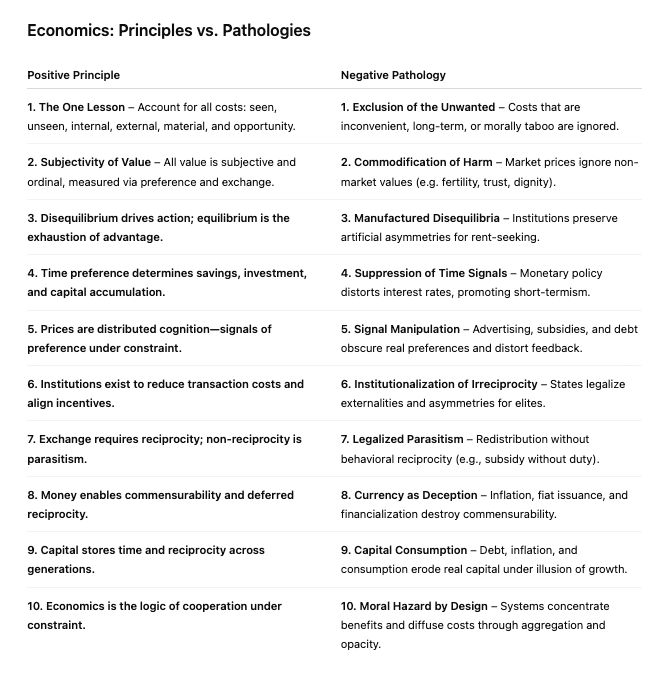
    ECONOMICS POSITIVA VS NEGATIVA
    Principles vs Pathologies
    (Bookmark it)
    Common derivations from my work. https://t.co/58mjq1jvRP


    Source date (UTC): 2025-05-08 00:59:02 UTC

    Original post: https://twitter.com/i/web/status/1920282259082584111

  • ECONOMICS POSITIVA VS NEGATIVA Principles vs Pathologies (Bookmark it) Common de

    ECONOMICS POSITIVA VS NEGATIVA
    Principles vs Pathologies
    (Bookmark it)
    Common derivations from my work.


    Source date (UTC): 2025-05-08 00:59:02 UTC

    Original post: https://twitter.com/i/web/status/1920282259015536640

  • RT @SRCHicks: Greatest encyclopedias in history: * Encyclopédie, Diderot & D’Ale

    RT @SRCHicks: Greatest encyclopedias in history:
    * Encyclopédie, Diderot & D’Alembert, 1751-1772
    * Encyclopædia Britannica, Macfarquhar &…


    Source date (UTC): 2025-05-07 21:19:42 UTC

    Original post: https://twitter.com/i/web/status/1920227061047963696