Theme: Decidability

  • Yes. But the context is probably being lost because this is twitter: Math is a g

    Yes. But the context is probably being lost because this is twitter: Math is a grammar(sublanguage of a paradigm and logic). All grammars rely on continuous recursive disambiguation. All grammars are subject to grammatical error. math, a gold standard, has many & Philosophy more.


    Source date (UTC): 2021-04-25 14:53:14 UTC

    Original post: https://twitter.com/i/web/status/1386332477921366025

    Reply addressees: @milordog1

    Replying to: https://twitter.com/i/web/status/1386331690818097152

  • You can’t declare something that’s is decidable by others. What is the means by

    You can’t declare something that’s is decidable by others. What is the means by which you have judged the suit unfair?


    Source date (UTC): 2021-04-23 19:32:21 UTC

    Original post: https://twitter.com/i/web/status/1385677946367746048

    Reply addressees: @MichaelSurrago @ThruTheHayes

    Replying to: https://twitter.com/i/web/status/1385675724934234117

  • Read the basics of Operationalism. Why? P-Law is a constructivist logic. That’s

    Read the basics of Operationalism. Why? P-Law is a constructivist logic. That’s

    Read the basics of Operationalism.
    Why?
    P-Law is a constructivist logic.
    That’s a bottom up method of writing proofs of existential possibility.
    It’s not a top down method of writing proofs of measurability or measurement by deduction. https://t.co/NyrgINC1Iq


    Source date (UTC): 2021-04-22 01:46:22 UTC

    Original post: https://twitter.com/i/web/status/1385047292756078592

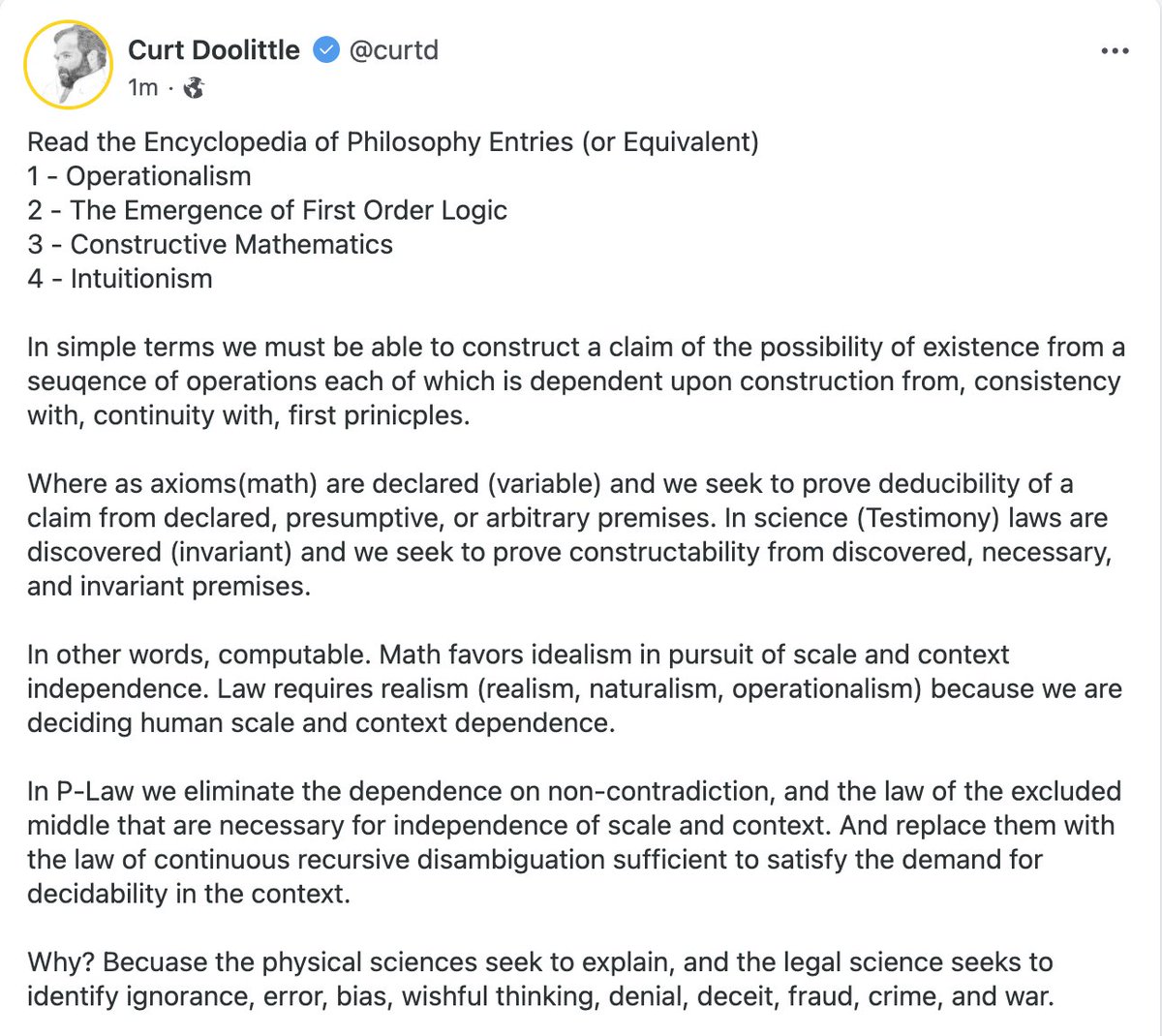
  • Read the Encyclopedia of Philosophy Entries (or Equivalent) 1 – Operationalism 2

    Read the Encyclopedia of Philosophy Entries (or Equivalent)
    1 – Operationalism
    2 – The Emergence of First Order Logic
    3 – Constructive Mathematics
    4 – Intuitionism

    In simple terms we must be able to construct a claim of the possibility of existence from a seuqence of operations each of which is dependent upon construction from, consistency with, continuity with, first prinicples.

    Where as axioms(math) are declared (variable) and we seek to prove deducibility of a claim from declared, presumptive, or arbitrary premises. In science (Testimony) laws are discovered (invariant) and we seek to prove constructability from discovered, necessary, and invariant premises.

    In other words, computable. Math favors idealism in pursuit of scale and context independence. Law requires realism (realism, naturalism, operationalism) because we are deciding human scale and context dependence.

    In P-Law we eliminate the dependence on non-contradiction, and the law of the excluded middle that are necessary for independence of scale and context. And replace them with the law of continuous recursive disambiguation sufficient to satisfy the demand for decidability in the context.

    Why? Becuase the physical sciences seek to explain, and the legal science seeks to identify ignorance, error, bias, wishful thinking, denial, deceit, fraud, crime, and war.


    Source date (UTC): 2021-04-22 01:40:36 UTC

    Original post: https://gab.com/curtd/posts/106106430202668998

  • Emphasizing disambiguation by deflation, operationalization, serialization (adve

    Emphasizing disambiguation by deflation, operationalization, serialization (adversarialism) does not in itself explain that we are seeking first principles (causes) and in doing so creating a construtivist logic of first principles from physics, to behavior, to evolution.


    Source date (UTC): 2021-04-19 15:25:14 UTC

    Original post: https://twitter.com/i/web/status/1384166203938074633

  • (very well done.) Both, but in the order 2 (no info), 1 (no termination). In oth

    (very well done.) Both, but in the order 2 (no info), 1 (no termination). In other words, neither is continuous disambiguation provided, nore is there a means of completing the transaction for meaning. ie: malformed statement violating first rule of grammar.


    Source date (UTC): 2021-04-19 15:12:11 UTC

    Original post: https://twitter.com/i/web/status/1384162921605857295

    Reply addressees: @skyfire1201

    Replying to: https://twitter.com/i/web/status/1384161221591453710

  • FOR PHILOSOPHY NERDS: The Solution To The Liar’s Paradox. (Really)

    FOR PHILOSOPHY NERDS:

    The Solution To The Liar’s Paradox. (Really)

    https://propertarianinstitute.com/2021/04/18/the-solution-to-the-liars-paradox-is-simple-its-a-lie-heres-why/

    Source date (UTC): 2021-04-18 21:02:07 UTC

    Original post: https://gab.com/curtd/posts/106088348196623472

  • THE SOLUTION TO THE LIAR’S PARADOX (really) #Philosophy

    THE SOLUTION TO THE LIAR’S PARADOX
    (really)
    https://propertarianinstitute.com/2021/04/18/the-solution-to-the-liars-paradox-is-simple-its-a-lie-heres-why/

    #Philosophy


    Source date (UTC): 2021-04-18 20:33:55 UTC

    Original post: https://twitter.com/i/web/status/1383881501587107847

  • The Solution to The Liar’s Paradox is Simple. It’s a Lie. Here’s Why.

    Summary: The liar’s paradox, like all paradoxes, and most if not all philosophical claims of depth, complexity, or undecidability consists of nothing but malformed statements in the grammar of continuous recursive disambiguation that violate the contract of suggestion (truthful speech) and due diligence against error, bias, and deceit, between speaker and audience. Given the Liar’s Paradox (And all the historical equivalents):

    “[ everything in this box is false ]” 1. Langauge consists of “Incremental suggestion by Continuous Recursive Disambiguation”, and grammar the rules of continuous recursive disambiguation. 2. The liar’s paradox is grammatically incorrect because it calls for recursion without supplying additional(continuous) information – in algorithmic logic this is called an infinite loop: a malformed statement that violates the rules of continuous recursive disambiguation. 3. Human Cognition: Consists of the series: Sensation, Logic (constancy of relations in time frame), Predictive Memory (elements), Episodic Memory (location, place(space), direction, turn direction, head direction, eye direction, objects, landmarks, boundaries, exits), Auto-Association, Wayfinding (Recursion), Adversarial Prediction, Thalmic Awareness, Attention-Recursion, Choice, Action, Repeat (recurse). 4. Human Grammatical Capacity is just an application of the primitive hierarchy of movement: Continuous Recursive Disambiguation. 5. Human Speech consists of minor variations in phonetics and grammars of continuous recursive disambiguation. 6. Human Speech organized by Grammarof Continuous Recursive Disambiguation consists of Names(Referents), statements(transformations), sentences (transactions), narratives(ledgers), and consent/not(balances) in communication, with additional continuous recursive disambiguation as due diligence against error, bias, deceit both parties. 7. All Paradigms (disciplines) from logic and math to Ordinary Language to the fictionalisms (occult->theology, sophistry->idealism, magic-pseudoscience) consist of either deflationary elimination of dimensions of human perceptible constant relations or inflationary removal of constraints on observables open to human sense perception and increases in permissible dimensions of fictions. 8. Words don’t mean things people do. People fail to communicate, or we fail to interpret their failure of communication, or we err in interpretation. 9. The only intent (meaning) of a paradox is to deceive (or create an illusion) – because it was created by intent – just as are optical illusions. Humans find very few natural conditions that can ‘fool’ human sense perception for more than a few moments -including such complex imagery as zebras. 10. Success of these illusions that exploit human intuition is dependent on human ignorance of their construction. We can learn to detect and correct for them just as we can learn to detect and correct for mirages. 11. The example of the liar’s paradox illustrates operational (algorithmic) vs set logic and why the foundations of mathematics, philosophy, and the philosophy of language movements failed to produce the sciences they sought – and even physics to economics suffer from this continued failure. 12. I have been unable to discover any pretense of philosophical undecidability that isn’t a malformed statement (as in mathematical grammar), that violates a variation of the promise of continuous recursive disambiguation, producing a transaction for meaning plus due diligence. 13. We call this failure of the philosophical and logical movments ‘mathiness‘ or the failure to grasp the operational foundations of mathematics, vs the verbal, set, or symbolic reduction of mathematics for ease of human use. (In particular that the computational reducibility of mathematics is far smaller than the computational possibility of operations.) 14. The failure of thought leadership in western civilization in the 20th is due to the failure of Babbage (or his peers) to generalize his discovery of computation, allowing a century of innumeracy, sophistry, and pseudoscience, to crate what Hayek called ‘the new mysticism’. 15. It has taken the Turing revolution, the computational revolution, the neuroimaging revolution, and the AI revolution (and one simple insight of Chomsky’s application of Turning) to solve a problem that never should have occurred, and now we must reverse the better part of two centuries of sophistry and pseudoscience, producing a third scientific revolution that corrects them. [End of Document]
  • The Solution to The Liar’s Paradox is Simple. It’s a Lie. Here’s Why.

    Summary: The liar’s paradox, like all paradoxes, and most if not all philosophical claims of depth, complexity, or undecidability consists of nothing but malformed statements in the grammar of continuous recursive disambiguation that violate the contract of suggestion (truthful speech) and due diligence against error, bias, and deceit, between speaker and audience. Given the Liar’s Paradox (And all the historical equivalents):

    “[ everything in this box is false ]” 1. Langauge consists of “Incremental suggestion by Continuous Recursive Disambiguation”, and grammar the rules of continuous recursive disambiguation. 2. The liar’s paradox is grammatically incorrect because it calls for recursion without supplying additional(continuous) information – in algorithmic logic this is called an infinite loop: a malformed statement that violates the rules of continuous recursive disambiguation. 3. Human Cognition: Consists of the series: Sensation, Logic (constancy of relations in time frame), Predictive Memory (elements), Episodic Memory (location, place(space), direction, turn direction, head direction, eye direction, objects, landmarks, boundaries, exits), Auto-Association, Wayfinding (Recursion), Adversarial Prediction, Thalmic Awareness, Attention-Recursion, Choice, Action, Repeat (recurse). 4. Human Grammatical Capacity is just an application of the primitive hierarchy of movement: Continuous Recursive Disambiguation. 5. Human Speech consists of minor variations in phonetics and grammars of continuous recursive disambiguation. 6. Human Speech organized by Grammarof Continuous Recursive Disambiguation consists of Names(Referents), statements(transformations), sentences (transactions), narratives(ledgers), and consent/not(balances) in communication, with additional continuous recursive disambiguation as due diligence against error, bias, deceit both parties. 7. All Paradigms (disciplines) from logic and math to Ordinary Language to the fictionalisms (occult->theology, sophistry->idealism, magic-pseudoscience) consist of either deflationary elimination of dimensions of human perceptible constant relations or inflationary removal of constraints on observables open to human sense perception and increases in permissible dimensions of fictions. 8. Words don’t mean things people do. People fail to communicate, or we fail to interpret their failure of communication, or we err in interpretation. 9. The only intent (meaning) of a paradox is to deceive (or create an illusion) – because it was created by intent – just as are optical illusions. Humans find very few natural conditions that can ‘fool’ human sense perception for more than a few moments -including such complex imagery as zebras. 10. Success of these illusions that exploit human intuition is dependent on human ignorance of their construction. We can learn to detect and correct for them just as we can learn to detect and correct for mirages. 11. The example of the liar’s paradox illustrates operational (algorithmic) vs set logic and why the foundations of mathematics, philosophy, and the philosophy of language movements failed to produce the sciences they sought – and even physics to economics suffer from this continued failure. 12. I have been unable to discover any pretense of philosophical undecidability that isn’t a malformed statement (as in mathematical grammar), that violates a variation of the promise of continuous recursive disambiguation, producing a transaction for meaning plus due diligence. 13. We call this failure of the philosophical and logical movments ‘mathiness‘ or the failure to grasp the operational foundations of mathematics, vs the verbal, set, or symbolic reduction of mathematics for ease of human use. (In particular that the computational reducibility of mathematics is far smaller than the computational possibility of operations.) 14. The failure of thought leadership in western civilization in the 20th is due to the failure of Babbage (or his peers) to generalize his discovery of computation, allowing a century of innumeracy, sophistry, and pseudoscience, to crate what Hayek called ‘the new mysticism’. 15. It has taken the Turing revolution, the computational revolution, the neuroimaging revolution, and the AI revolution (and one simple insight of Chomsky’s application of Turning) to solve a problem that never should have occurred, and now we must reverse the better part of two centuries of sophistry and pseudoscience, producing a third scientific revolution that corrects them. [End of Document]