Theme: Decidability

  • DEAR MISEDUCATED WORLD: Logic is at least ternary, not binary. (Meaning three st

    DEAR MISEDUCATED WORLD:

    Logic is at least ternary, not binary. (Meaning three states, not two)

    …………… FALSE…….TRUE……..UNDECIDABLE

    FALSE…..FALSE…….FALSE……UNDECIDABLE

    TRUE……FALES…….TRUE……..UNDECIDABLE

    UNDEC…FALSE…….UNDEC…..UNDECIDABLE

    MATHEMATICS

    In mathematics, which for millennia was unfortunately the gold standard of logic, we use the word true when we mean either “balanced” (retaining constant relations), or we mean “proven” (possible to demonstrate), because in mathematics we create proofs of possibility rather than statements of truth. We may claim that we speak truthfully that we have constructed a proof. But mathematics consists of operations, deductions, inferences and guesswork, by which we identify means of demonstrating the possibility and necessity of a series of constant relations (ratios).

    COMPUTER SCIENCE

    In the gold standard of reasoning: computer science – when we refer to values, we call this same sequence true, false, and null (unknown). So in computer science, we either possess sufficient information to state something is provable (true or false), or unprovable (false), or undecidable (lacking the information).

    FORMAL LOGIC

    ( I’ll avoid formal logic because in my view, like all game theory, beyond use in very simple human perceivable scales, it’s been a waste of a century. I mean. I can dismantle the liars paradox in five minutes or less. it was a wasted century.

    PHYSICAL SCIENCE

    In sciences we use the terms False, Possibly True (an hypothesis, theory, or law), and Undecidable. Between the choice of true and false, it is false that we know with certainty. Truth always remains uncertain in all but the most simple of questions.

    EPISTEMOLOGY

    In epistemology we say something is knowingly false, possibly true, and undecidable, or unknown. In epistemology, just as in science, we must determine if an argument survives attempts to falsify it. If it is true, then we can decide if it is possible. I it is possible then we can decide if it is preferable. If it is preferable without causing harm to others, then we have determined that it is good.

    MORALITY, PHILOSOPHY, AND THEOLOGY

    In morality, philosophy, theology, we say (lie) that if we can find an excuse for something (a justification) it is true, or moral, or good. When that only means that according to the established norms, scriptures, and laws. in other words, one is free of blame if he can justify his actions as permissible, moral or good. In morality philosophy and theology, we attempt to survive justification.

    LAW

    When we encounter LAW we use the jury, and debate between two parties, and moderated by a judge, to test both whether we are justified under law, and whether our testimony and our arguments are believable. In law we attempt to survive the battle between three forces: the law as written, the standards of rational behavior of the jury, the logical testing of your statements by the judge, and the subjective testing of your truthfulness by the jury. And in case you don’t know this, most cases are decided by the test of truthfulness, which is why american courts are so useful for commerce. The first sin of american law is failure of informational reciprocity. Failure and error are forgivable. Violation of reciprocity is not.

    HIERARCHY OF CERTAINTY

    … FALSE, that which does not survive tests of falsification.

    … … TRUE, that which survives all tests of falsification

    … … … PROVEN, that which survives tests of possibility.

    … … … … UNDECIDABLE that which cannot be decided.

    THE TRUTH TABLE OF CERTAINTY

    F:False, T:True, P:Provable, U:Undecidable

    …..F…..T…..P…..U

    F…F…..F…..F…..U

    T…F….*T*…P…..U

    P…F…..P…..P…..U

    U..F…..U….U…..U


    Source date (UTC): 2017-02-19 12:13:00 UTC
  • Literary Programming: Children. Rule Advice: Adult. Rational Decidability: Matur

    Literary Programming: Children.

    Rule Advice: Adult.

    Rational Decidability: Maturity


    Source date (UTC): 2017-02-19 10:16:00 UTC

  • If you require programming rather than choice then you cannot make choice and ar

    If you require programming rather than choice then you cannot make choice and are unfit to choose. This is why decidability provided by deflationary truth is not only a test of arguments, but of individuals.


    Source date (UTC): 2017-02-19 10:14:00 UTC

  • “So, is the “bottom line” of “Propertarianism” a distinction between “decidabili

    —“So, is the “bottom line” of “Propertarianism” a distinction between “decidability” and “meaning”? Is that the departure point?

    Can the antimony and dichotomy of “decidability” and “meaning” be understood as the relation(ship) between Being and non-Being?

    Your philosophy is ultimately grounded in Aristotle, is that accurate?

    “–Francisco Antonio

    Yes, in order to produce an amoral, scientific language of cooperation, all statements are reduced to the transfer of assets. In this way we advocate truth and transparency and voluntary exchange: reciprocity (the balance of both sides) just as we describe a balance sheet, or just as an equation is balanced.

    SERIES

    0) Identity (Correspondence / non-correspondence)

    1) Counting (correspondence balance, including identities),

    2) Mathematical balancing, (including ratios)

    3) Accounting balancing, (including market goods with prices)

    4) Property in toto balancing. (including common goods without)

    In my view I dont’ take philosophers very seriously. And I tend only to read sciences. The science I understand is the common law of sovereign men. but the common law is parsimonious. it tells us only how to decide. it does not provide us with what we desire in a PHILOSOPHY: what is GOOD. it tells us only what is bad, so that we may all select philosophical goods from a market for philosophical goods. But as I have articulated this law to require truthfulness, reciprocity, and beauty, in the provision of ‘shoulds’, this means philosophy is then the study of preferences WITHIN the limits of Natural Law. And this presents a problem for the pseudoscientists and pseudorationalist, but not for the essayist, the novelist, or necessarily the mythicist.

    So when you say, grounded in Aristotle, I would say that greek philosophy was an attempt to improve upon then current current law. and I see Aristotle as the non-conflationist – the proto-empiricist. that applied the law to matters commonly outside the law. This is how bacon also applies the law in the evolution of empiricism. and it is how I apply the law (via Hayek) in the evolution of testimonialism – which I think is the ‘complete’ version of the empirical or scientific tradition.

    My self I see my work as grounded in popper, Kuhn, and Hayek. Philosophers of science and of law.

    If we are to label Aristotle as the first “Deflationist” in the sense of “Deflationary Truth”, then that would make me an aristotelian.


    Source date (UTC): 2017-02-18 02:15:00 UTC

  • Q:”WHAT’S PLATONIC PHILOSOPHY?” (first attempt) (pretty close) A: (a) referring

    Q:”WHAT’S PLATONIC PHILOSOPHY?”

    (first attempt) (pretty close)

    A: (a) referring to (supplying information by) the extra-natural (a subset of the supernatural) in a justificationary argument – and specifically, references to extra normal ideals – instead of limiting references to the existential. More generally, (b) Plato and Socrates were literary (analogistic) philosophers producing dialogs. Aristotle was a descriptive (correspondent) philosopher. Plato invoked order (decidability) provided by the extra-natural, as a compromise means of avoiding the supernatural. (This appears to have been the greek innovation over the flood river authoritarian civilizations.) In other words plato conflated the mythical, literary, and rational, to produce authoritative arguments as a means of avoiding the mythical and supernatural authoritarianism of the theologists.

    In the ancient world we saw another instance of the deflationary division so common in western civilization: the separation of decidability into a) law, b) science (aristotelian descriptive philosophy), c) literary envisionary philosophy and it’s companion history, d) platonic philosophy conflating a limited supernaturalism and literary philosophy, e) the continuation of theology: the conflation of law and supernatural mythology, and f) the Augustinian conflation of reason and theology. And all these ‘languages’ or ‘techniques’ persisted through the centuries.

    The Anglos preserve aristotelianism, the french literary(rousseau), the germans have preserved platonism (kant et al). and the jews have conflated law, and pseudoscience, as a replacement for law and supernaturalism.

    Curt Doolittle

    The Propertarian Institute

    Kiev, Ukraine


    Source date (UTC): 2017-02-12 09:57:00 UTC

  • PHILOSOPHY IN THE SPECTRUM OF DECIDABILITY (Notice the order) (Notice how produc

    PHILOSOPHY IN THE SPECTRUM OF DECIDABILITY

    (Notice the order) (Notice how producing an ordered series makes attacks by empty verbalisms almost impossible)

    — Correspondence —

    *Reason: comparisons of differences in order to produce decidability by preference or necessity.

    *Logic: the use of reason to identify general rules of internal consistency, for use in testing the internal consistency of propositions.

    *Law: the declaration of general rules of decidability in matters of conflict, in populations large enough for extra-familial commons to develop. Laws evolve internal consistency out of the necessity of decidability in matters with multiple causes.

    *Philosophy: the use of reason and information to produce a set of internally consistent general rules of decidability within domains of varying scale – including ‘complete’ scale: science.

    *History: a reduction of the complexity of past reality to an internally consistent narrative, as externally correspondent as feasible, for the purpose of providing information, for use in ideation or decidability.

    *Literature: the use of narrative to produce an internally consistent, existentially possible, but not externally correspondent alternative to history. (conflation of mythology and history)

    —- Limits of Correspondence—

    ( Invocation of dream states for the purpose of suggestion)

    Mythology: the use of pseudo-historical, super-normal, or super-natural narrative used to produce a set of internally related if not internally consistent explanations in the absence of history. Note that super-normal, (impossible heroes), anthropomorphism( attributing human characteristics to non human objects), and supernatural (impossible non-human characters) and extra natural ( other-worlds) are demonstrated in various myths.

    Theology: The conflation of Mythology and Law for the purpose of producing an internally consistent method of decidability and justification for the use of exclusion or the application of force in cross-tribal groups.

    Occult/NewAge: the conflation of supernaturalism and dream state to produce a purely intutionistic, experiential, and pre-rational, not necessarily consistent but at least framed, method of decidability.

    Dream State: free association driven by intuition, independent of reason, or by the intentional avoidance of reason.

    Drug State: chemically induced dream state, disabling ability to reason while preserving free association.

    ====

    Curt Doolittle

    The Propertarian Institute

    Kiev, Ukraine


    Source date (UTC): 2017-02-12 09:35:00 UTC

  • THE FUNCTION OF THE COURT The function of the civil court is not to produce legi

    THE FUNCTION OF THE COURT

    The function of the civil court is not to produce legislation from the bench but to return UNDECIDABLE legislation to the state for improvement or withdrawal. The same for the process of constitutional amendment, and constitutional convention: they were put in place so that the court could not do what it has done: legislate. The court of the presidency is called the senate. The senate sits as court on actions of the president. The majority of the problem began with the fourteenth (unconstitutional) amendment. and it is through that window that the rule of law, under natural law, requiring legislation for imposition upon that law, and limiting the federal government to commercial rather than normative cultural and civic matters, has been destroyed INTENTIONALLY by a program of raising specific cases before the supreme court as a means of achieving through legislation from the bench that which could not have been achieved by democratic means.


    Source date (UTC): 2017-02-09 21:17:00 UTC

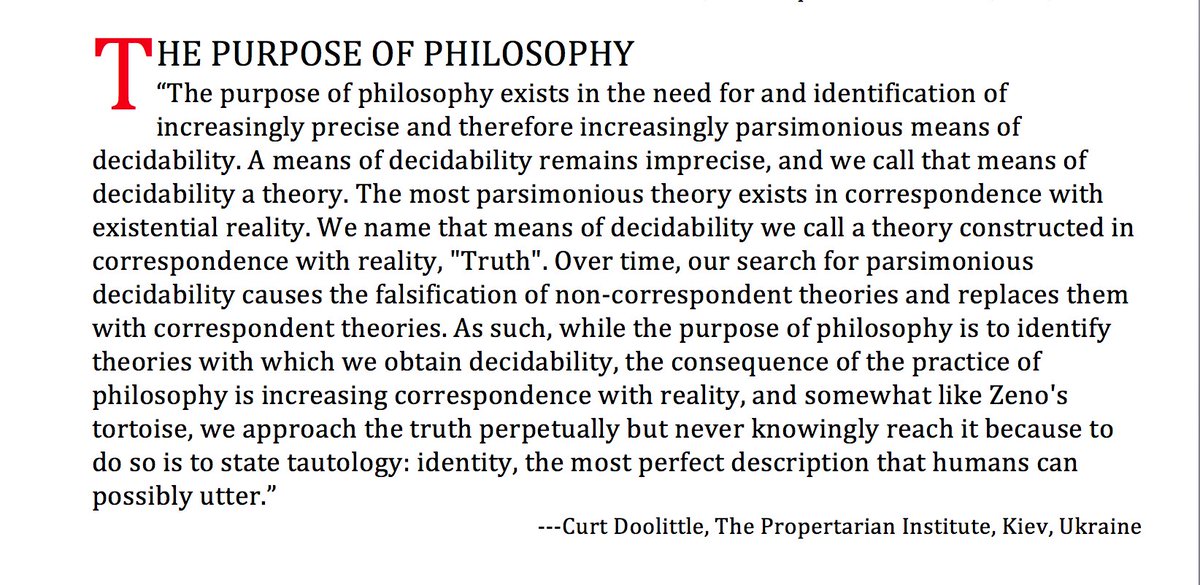
  • THE PURPOSE OF PHILOSOPHY: DECIDABILITY. TRUTH IS A CONSEQUENCE. #Conservative #

    THE PURPOSE OF PHILOSOPHY: DECIDABILITY. TRUTH IS A CONSEQUENCE.
    #Conservative #Libertarian #NewRight #Trump https://t.co/T9Nro06ZHL


    Source date (UTC): 2017-02-05 15:49:53 UTC

    Original post: https://twitter.com/i/web/status/828269423526023168

  • WHY DO WE NOT PURSUE THE TRUTH? (Note: for followers, pls note the use of these

    WHY DO WE NOT PURSUE THE TRUTH?

    (Note: for followers, pls note the use of these series/sequences/spectrum of decidability)(Q:how would the argument differ without them, if I relied on advocacy for testimonialism as an ideal type, instead of illustration by spectrum? )

    —“If [propertarianism and testimonialism] were attractive would it not pull us from philosophy? (convince us?) “— A Friend

    Would not religion pull us from superstition?

    Would not philosophy pull us from religion?

    Would not science pull us from philosophy?

    Would not testimonialism (complete science) pull us from science?

    Or, is religion all that is possible for some of certain limited abilities, philosophy only possible for some others of certain limited abilities, science only possible for some of certain limited abilities, and Testimonialism only possible for some of certain limited abilities?

    If not everyone is pulled forward by each technological advancement in decidability, then why do we see both the retention of superstition, religion, philosophy, and science, and why we see innovations in superstition, pseudorationalism, pseudoscience, and (in the near future) pseudotestimonialism?

    We do not choose what is true for our means of decidability. We choose what is useful. If superstition, religion, pseudorationalism, philosophy, pseudoscience, science, pseudotestimonialism, and testimonialism are useful for different groups for different purposes, because of what we can ‘get away with’ in each discipline given its lack of precision, or openness to fraud, then we should expect people to seek what is beneficial to them with each technology of decidability.

    And that is what we see.

    Curt Doolittle

    The Propertarian Institute

    Kiev, Ukraine


    Source date (UTC): 2017-02-05 14:46:00 UTC

  • PURPOSE OF PHILOSOPHY: DECIDABILITY. TRUTH IS A CONSEQUENCE. #Conservative #Libe

    https://twitter.com/curtdoolittle/status/828269423526023168/photo/1?utm_source=fb&utm_medium=fb&utm_campaign=curtdoolittle&utm_content=828269423526023168THE PURPOSE OF PHILOSOPHY: DECIDABILITY. TRUTH IS A CONSEQUENCE.

    #Conservative #Libertarian #NewRight #Trump https://t.co/T9Nro06ZHL


    Source date (UTC): 2017-02-05 10:49:00 UTC