Theme: Decidability

  • photos_and_videos/TimelinePhotos_43196237263/21762741_10155736915752264_89432209

    photos_and_videos/TimelinePhotos_43196237263/21762741_10155736915752264_89432209

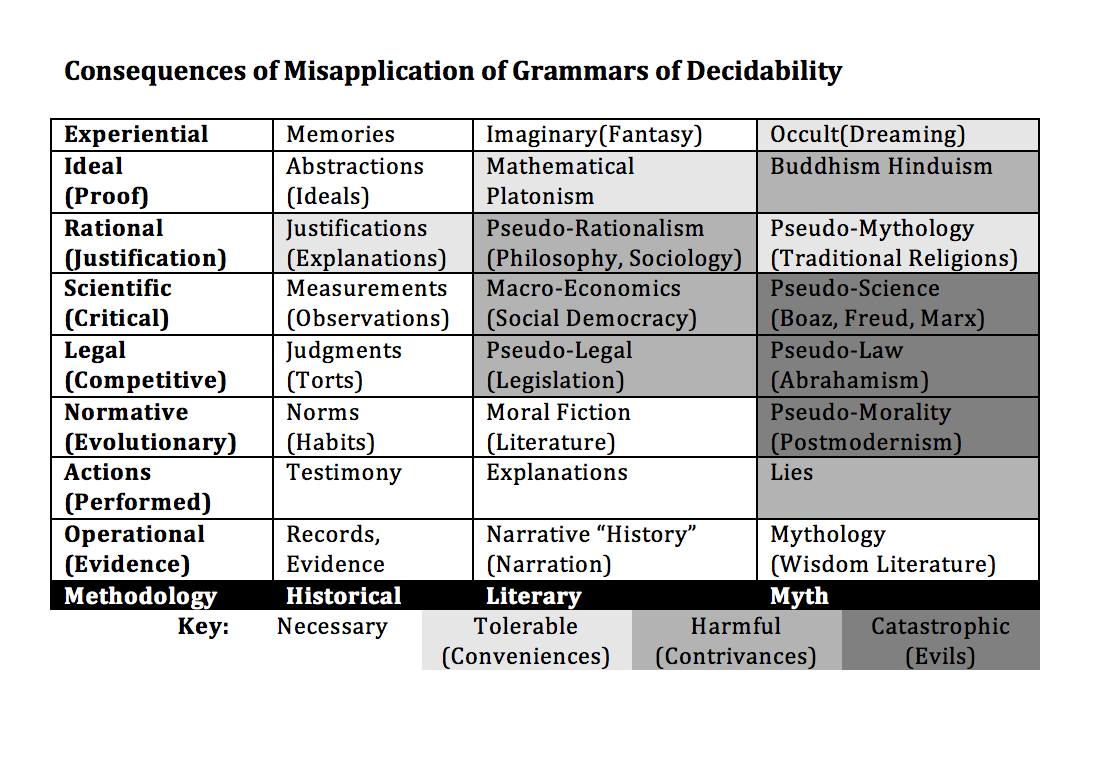
    photos_and_videos/TimelinePhotos_43196237263/21762741_10155736915752264_894322098281463268_o_10155736915752264.jpg Luke Thomas@[1059559839:2048:Philip Bunn] I think “misapplication of grammars” is most aptSep 21, 2017 10:25am


    Source date (UTC): 2017-09-20 16:37:00 UTC

  • The Grammars Of Decidability

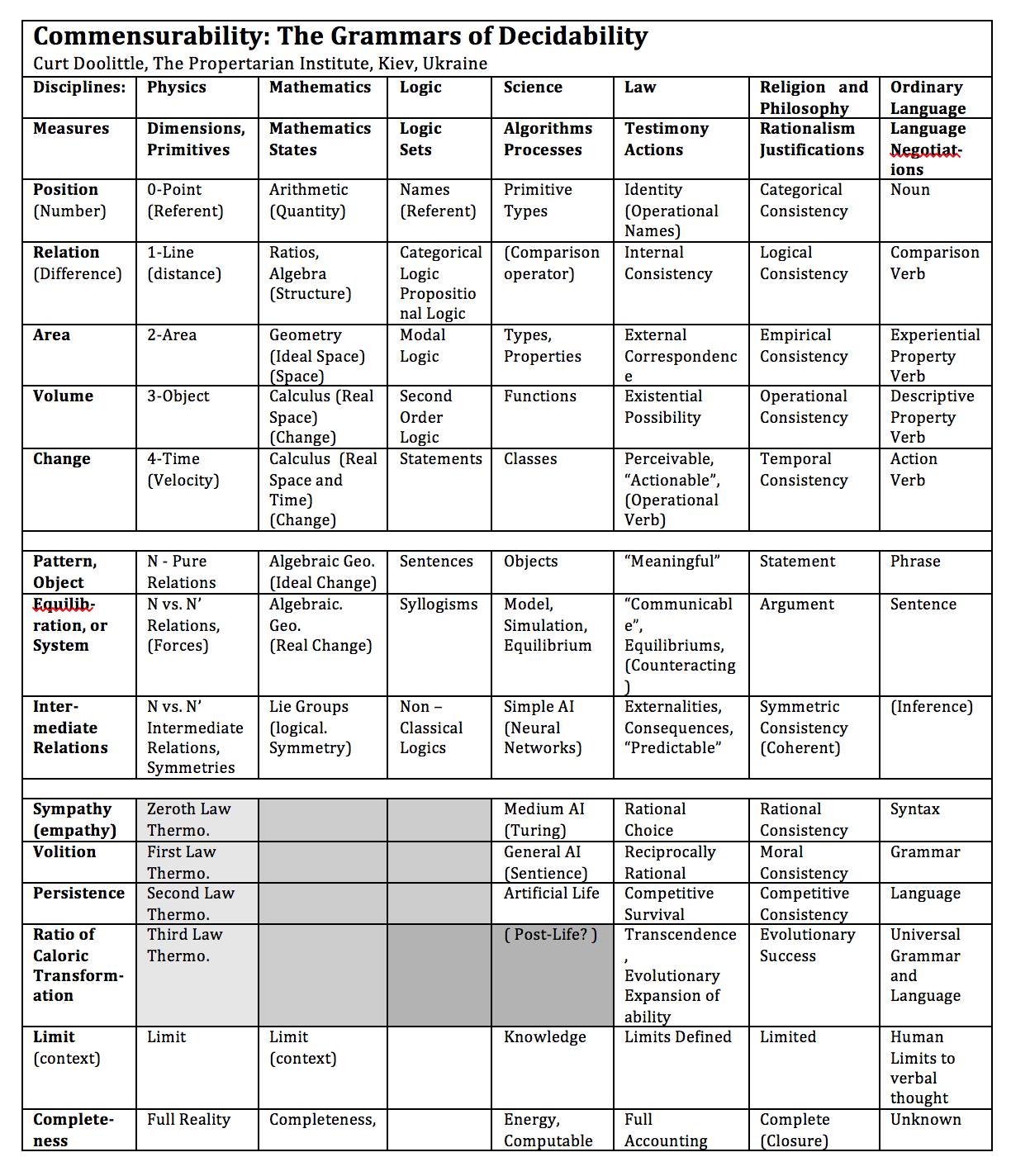
    Brain breaking, maybe, but informative if you grok it. Can I get feedback on this from fellow supergeeks? In order to show Testimonial grammar I’m trying to demonstrate the scope of each grammar (language) we have developed for making comparisons. I want to do this so that I can recategorize natural language from just ‘verbs’ to categories of verbs. And just names to names of types, functions, classes, objects, etc…. Lots to write about on this topic. Lots also to write about on axiomatic vs algorithmic vs rational, vs theoretic etc.
  • The Grammars Of Decidability

    Brain breaking, maybe, but informative if you grok it. Can I get feedback on this from fellow supergeeks? In order to show Testimonial grammar I’m trying to demonstrate the scope of each grammar (language) we have developed for making comparisons. I want to do this so that I can recategorize natural language from just ‘verbs’ to categories of verbs. And just names to names of types, functions, classes, objects, etc…. Lots to write about on this topic. Lots also to write about on axiomatic vs algorithmic vs rational, vs theoretic etc.
  • photos_and_videos/TimelinePhotos_43196237263/21686716_10155736641582264_25381813

    photos_and_videos/TimelinePhotos_43196237263/21686716_10155736641582264_25381813

    photos_and_videos/TimelinePhotos_43196237263/21686716_10155736641582264_2538181367473503859_o_10155736641582264.jpg Graham NearyComparison verb? “Is bigger than”?Sep 20, 2017 1:28pmCurt Doolittleany comparison whatsoever, but yes, bigger, smaller, etc…Sep 20, 2017 2:15pmGraham NearyComparative adjectivesSep 20, 2017 2:28pmCurt Doolittlethx ;)Sep 20, 2017 2:28pmCurt DoolittleI suppose I could add Fiction, Deception, and Fictionalism next to it, and then cover the entire spectrum.Sep 20, 2017 2:47pmLincoln ThurmanQuadrivum:

    Arithmetic = number in itself.

    Geometry = number in space.

    Music = number in time.

    And,

    Astronomy = number in time and space.

    Maybe some input.Sep 20, 2017 4:57pmMea CulbaCideSep 21, 2017 1:09amTHE GRAMMARS OF DECIDABILITY

    Brain breaking, maybe, but informative if you grok it.

    Can I get feedback on this from fellow supergeeks?

    In order to show Testimonial grammar I’m trying to demonstrate the scope of each grammar (language) we have developed for making comparisons.

    I want to do this so that I can recategorize natural language from just ‘verbs’ to categories of verbs. And just names to names of types, functions, classes, objects, etc….

    Lots to write about on this topic. Lots also to write about on axiomatic vs algorithmic vs rational, vs theoretic etc.


    Source date (UTC): 2017-09-20 13:13:00 UTC

  • RE: (from previous post) “One does not argue from preferences, beliefs or princi

    RE: (from previous post) “One does not argue from preferences, beliefs or principles but from truth or falsehood, possibility or impossibility, gain or loss, volition or non-volition, reciprocity or non-reciprocity.” —“Are my questions or experience less important because your education level and living standards are better than mine? Does that make me a lesser person because or is my ignorance irrelevant and therefore my principles irrelevant.”– A Friend. I don’t make theological, ideal, or pseudo moral arguments, and that is what you have (unintentionally) done. So…   Let me translate your “question” into propertarian language: “I have endeavored to be an ethical and moral man, and therefore born a cost on behalf of the polity, the civilization, and mankind, and therefore I feel reciprocity is due me; and that you owe me a debt and should bear the cost of answering my questions and educating me; and that my concerns should influence other’s actions; and do so despite the fact that I demand my level of knowledge and compliance serve as a means of decidability, rather than some objective measure that is not so dependent upon my levels of knowledge and ability.” Well, in the family that argument works, and in a small organization that might work, but in a polity and across polities there are no such obligations, and questionable value to them. What I said was that one’s self is a measure of nothing true – only one’s ability, ignorance and knowledge. And that arguments to principle, belief, and preference tell us nothing other than “i want…” or “i demand…. in exchange for my cooperation”. And so that instead we ask FIRST whether questions consist of truth or falsehood, possibility or impossibility, gain or loss, volition or non-volition(rational), reciprocity or non-reciprocity(moral). AND THEN determine if they are preferable AFTERWARD. And we search for true, possible, gainful, volitional, and moral answers until we find one that suits one’s preferences – or determine doing so is impossible. And in this search for a true, possible, gainful, volitional, and moral solution, one learns how to discourse truthfully, possibly, gainfully, volitionally, and morally. I would say, that in defense of reciprocity, that if you will discourse honestly with me, then as long as I am not harmed or otherwise deprived of another opportunity more rewarding, then it is not a loss to cooperate with you for your benefit, and perhaps mine – and perhaps the net result might be some (very) minor civic good. And so, given that my present choice is to bang my head on the virtual wall of my current tome in order to determine how to demonstrate that all grammars function as instruments of measurement, I choose to discourse with you, rather than bank my head on the virtual wall – in the hope that it will do some civic (and moral) good. 😉
  • RE: (from previous post) “One does not argue from preferences, beliefs or princi

    RE: (from previous post) “One does not argue from preferences, beliefs or principles but from truth or falsehood, possibility or impossibility, gain or loss, volition or non-volition, reciprocity or non-reciprocity.” —“Are my questions or experience less important because your education level and living standards are better than mine? Does that make me a lesser person because or is my ignorance irrelevant and therefore my principles irrelevant.”– A Friend. I don’t make theological, ideal, or pseudo moral arguments, and that is what you have (unintentionally) done. So…   Let me translate your “question” into propertarian language: “I have endeavored to be an ethical and moral man, and therefore born a cost on behalf of the polity, the civilization, and mankind, and therefore I feel reciprocity is due me; and that you owe me a debt and should bear the cost of answering my questions and educating me; and that my concerns should influence other’s actions; and do so despite the fact that I demand my level of knowledge and compliance serve as a means of decidability, rather than some objective measure that is not so dependent upon my levels of knowledge and ability.” Well, in the family that argument works, and in a small organization that might work, but in a polity and across polities there are no such obligations, and questionable value to them. What I said was that one’s self is a measure of nothing true – only one’s ability, ignorance and knowledge. And that arguments to principle, belief, and preference tell us nothing other than “i want…” or “i demand…. in exchange for my cooperation”. And so that instead we ask FIRST whether questions consist of truth or falsehood, possibility or impossibility, gain or loss, volition or non-volition(rational), reciprocity or non-reciprocity(moral). AND THEN determine if they are preferable AFTERWARD. And we search for true, possible, gainful, volitional, and moral answers until we find one that suits one’s preferences – or determine doing so is impossible. And in this search for a true, possible, gainful, volitional, and moral solution, one learns how to discourse truthfully, possibly, gainfully, volitionally, and morally. I would say, that in defense of reciprocity, that if you will discourse honestly with me, then as long as I am not harmed or otherwise deprived of another opportunity more rewarding, then it is not a loss to cooperate with you for your benefit, and perhaps mine – and perhaps the net result might be some (very) minor civic good. And so, given that my present choice is to bang my head on the virtual wall of my current tome in order to determine how to demonstrate that all grammars function as instruments of measurement, I choose to discourse with you, rather than bank my head on the virtual wall – in the hope that it will do some civic (and moral) good. 😉
  • RE: (from previous post) “One does not argue from preferences, beliefs or princi

    RE: (from previous post) “One does not argue from preferences, beliefs or principles but from truth or falsehood, possibility or impossibility, gain or loss, volition or non-volition, reciprocity or non-reciprocity.”

    —“Are my questions or experience less important because your education level and living standards are better than mine? Does that make me a lesser person because or is my ignorance irrelevant and therefore my principles irrelevant.”– A Friend.

    I don’t make theological, ideal, or pseudo moral arguments, and that is what you have (unintentionally) done.

    So…

    Let me translate your “question” into propertarian language: “I have endeavored to be an ethical and moral man, and therefore born a cost on behalf of the polity, the civilization, and mankind, and therefore I feel reciprocity is due me; and that you owe me a debt and should bear the cost of answering my questions and educating me; and that my concerns should influence other’s actions; and do so despite the fact that I demand my level of knowledge and compliance serve as a means of decidability, rather than some objective measure that is not so dependent upon my levels of knowledge and ability.”

    Well, in the family that argument works, and in a small organization that might work, but in a polity and across polities there are no such obligations, and questionable value to them.

    What I said was that one’s self is a measure of nothing true – only one’s ability, ignorance and knowledge. And that arguments to principle, belief, and preference tell us nothing other than “i want…” or “i demand…. in exchange for my cooperation”.

    And so that instead we ask FIRST whether questions consist of truth or falsehood, possibility or impossibility, gain or loss, volition or non-volition(rational), reciprocity or non-reciprocity(moral). AND THEN determine if they are preferable AFTERWARD. And we search for true, possible, gainful, volitional, and moral answers until we find one that suits one’s preferences – or determine doing so is impossible.

    And in this search for a true, possible, gainful, volitional, and moral solution, one learns how to discourse truthfully, possibly, gainfully, volitionally, and morally.

    I would say, that in defense of reciprocity, that if you will discourse honestly with me, then as long as I am not harmed or otherwise deprived of another opportunity more rewarding, then it is not a loss to cooperate with you for your benefit, and perhaps mine – and perhaps the net result might be some (very) minor civic good.

    And so, given that my present choice is to bang my head on the virtual wall of my current tome in order to determine how to demonstrate that all grammars function as instruments of measurement, I choose to discourse with you, rather than bank my head on the virtual wall – in the hope that it will do some civic (and moral) good.

    😉


    Source date (UTC): 2017-09-14 16:57:00 UTC
  • One’s experience is just a matter of ignorance vs knowledge. The truth or falseh

    One’s experience is just a matter of ignorance vs knowledge. The truth or falsehood, possibility or impossibility, gain or loss, volition or non-volition(of others) are all decidable whether you’re ignorant or knowledgeable. Using “principle, belief, or preference” is merely evidence of ignorance, and therefore irrelevance.
  • One’s experience is just a matter of ignorance vs knowledge. The truth or falseh

    One’s experience is just a matter of ignorance vs knowledge. The truth or falsehood, possibility or impossibility, gain or loss, volition or non-volition(of others) are all decidable whether you’re ignorant or knowledgeable. Using “principle, belief, or preference” is merely evidence of ignorance, and therefore irrelevance.
  • One’s experience is just a matter of ignorance vs knowledge. The truth or falseh

    One’s experience is just a matter of ignorance vs knowledge. The truth or falsehood, possibility or impossibility, gain or loss, volition or non-volition(of others) are all decidable whether you’re ignorant or knowledgeable.

    Using “principle, belief, or preference” is merely evidence of ignorance, and therefore irrelevance.


    Source date (UTC): 2017-09-14 15:37:00 UTC