Theme: Decidability

  • P-Law for Dummies

    Mar 27, 2020, 10:53 AM

    1. Learn the dimensions of consistency necessary for claims one has performed the due diligence against ignorance, error, bias, and deceit that are necessary for claims of testimonial truth: categorical, logical, operational, empirical, rational, reciprocal consistency, limits, completeness, and coherence.
    2. Learn how to disambiguate by operationalization and serialization of terms into series (types) so that conflation and subsequent errors and deceits of conflation and inference are impossible. This will unite the different fields into a common vocabulary.

    3. Learn how to write in complete, promissory, operational vocabulary, free of the verb to be (eliminate pretense of knowledge) – this will unite the fields into a common grammar.

    4. Write definitions in that operational vocabulary and grammar that describe man and mankind from the individual to the species to prevent misrepresentation.

    5. Take the natural law of tort (demonstrated interest), the demand for reciprocity as a test of decidability in matters of conflict (productive, fully informed, voluntary transfer, free of negative externality, warrantied, and within limits of restitution possible by the actors.)

    6. Write all constitution, legislation, regulation, and finding of the courts in this language, grammar, and programmatic structure

    7. Restate the constitution, and in particular the bill of rights in these strictly constructed terms, closed to arbitrary interpretation, to fully enumerate all rights, obligations, and inalienability of those rights and obligations.

    8. Expand the law of fraud from commercial speech to political (and academic) speech, in public, in matters public, to the public, and grant universal standing in matters of the commons. (Reduce the barrier to class actions against false, and irreciprocal speech

    9. Plug the primary hole in western law of tort that was exploited during the twentieth century: Criminalize baiting into hazard using false and unwarrantable promise. The effect of this will be to suppress lying by the state, the financial sector, the commercial sector, the media, the academy,

    10. Restore universal applicability so that those issuing legislation, regulation, and findings of the court, are liable for their actions, prohibiting violation of the constitution and strict construction.

    11. Require the court assent all legislation and regulation. Provide means by which the undecidable is returned to the legislature for settlement – rather than the court.

    This sequence will outlaw the entire postwar attempt to reverse the Darwinian revolution that explained, and justified western civilizations’ thousands of years of self domestication with criteria for reproduction, and aggressive hanging of criminals, dragging mankind out of ignorance, superstition, poverty, hard labor, starvation, disease, and the vicissitudes of nature by the false promises of french socialism, german secular theology, jewish marxism, neo-marxism, postmodernism, feminism, and human-biodiversity-denialism, that are positioned as a war against european supremacy – but is nothing more than the attempt to end the reason for the west (and east asia’s) success: Self domestication through negative eugenics (limiting underclass reproduction and survival) are more important than even education and literacy and the primary diver for raising mankind to its current condition. The anti-semitism in Propertarianism is not a genetic criticism, but anti-abrahamic: the use of the abrahamic method of deceit that institutionalized as a group strategy the female means of warfare by undermining from within by the fomentation of conflict between men. Judaism, christianity, and islam, in the old world, and marxism(class warfare to undermine formal institutions), postmodernism (social construction to undermine soft institutions), feminism (to undermine familial institutions), and human science denialism (to undermine the optimum group strategy of ethnocentrism for developing high trust, high investment commons, and high redistribution).

    —“I categorize P as describing the intellectual foundations of western civlization that the populists are currently demanding, but don’t know how to express in rational and scientific terms.”—

    P-law completes the scientific method as one of due diligence; completes the darwinian revolution of decision by competition in evolution; and unites the physical, cognitive, psychological, social, political and economic sciences into one discipline: testimony by realism, naturalism, operationalism, empiricism, rational choice, reciprocity, within limits, completeness, and restitutability. This is why we think y’all (Critics) are rather dimwits. You latch onto what you grasp. You do not seek to understand. And in doing so maintain ignorance and immorality and the destruction of western civlization and its benefits to mankind, out of your own laziness and arrogance. P completes the Aristotelian project. Doolittle is not special. Like Aristotle, Smith, Hume, and Darwin, he is just living at a point in time where cognitive science, Turing’s revolution, economics, and evidence of the past century have combined with the internet’s discount on the acquisition and access to research publications, making possible the completion of the synthesis of disciplines to reform the laws we live under such that we prevent another semitic dark age brought about by the the most advanced system of deception invented by man: the weaponization and institutionalization of the female means of undermining by false promise (seduction) from within.
  • An Education in The Terms Proof and Truth

    Oct 7, 2019, 8:02 PM Lets discuss the term ‘proof’. A mathematician creates a PROOF, not a truth. When we promise a proof is ‘true’ we mean we promise we have DEMONSTRATED a deduction is possible or necessary. The person makes the truth claim since only people can make truth claims: promises. A promise we don’t err. That’s what ‘true’ means because it’s all it can existentially mean. We use the term ideal truth meaning ‘ that most parsimonious testimony we would give if we were omnipotent and omniscient and produced a vocabulary consisting entirely of operational names.” Because only then would we be possibly free of error. But testimonial truth is only that most parsimonious description we can make in present language with present knowledge, having performed due diligence against ignorance, error, bias, wishful thinking, suggestion, fictionalism, and deceit. In logic when we say a proposition ‘is true’ we mean that the constant relations stated or implied in the premise or premises are not inconstant. That we don’t err. Now in law, we say proof but it means beyond reasonable doubt. In other words, it must falsify all other possibilities. We cannot promise we don’t err. We can only promise we have performed due diligence. There are no non-trivial logical proofs. Or as others have said all logic is just tautology. Or stated differently, there is no possibility of closure without appeal to information external to the set. Or stated more clearly, non-tautological logical statements are meaningless without appeal to context. So there are no non-tautological, no-trivial proofs of anything other than the internal consistency of deductions from invariant constant relations (meaning mathematics of the single dimension of positional name). Instead, all epistemology regardless of context consists of the sequence: perception, free association, hypotheses, theory, (and possibly law), with each step in that series consisting of falsification by a process of elimination, by the mind (hypothesis), by actions (theory), by market (‘law’ or ‘settled science’) until sufficient new knowledge evolves to improve it’s precision. And where that falsification is performed by tests of the consistency of identity, internal consistency (logic), external correspondence, operational possibility, and if involving choice, rational choice, and if involving human interaction reciprocity, warrantied or not by due diligence in scope and parsimony. So grow the f–k up and leave your secular version of scriptural interpretation (pilpul) in the dark ages of semitic ignorance where they belong. If you can understand this you know more about truth than the upper tenth of one percent.

  • An Education in The Terms Proof and Truth

    Oct 7, 2019, 8:02 PM Lets discuss the term ‘proof’. A mathematician creates a PROOF, not a truth. When we promise a proof is ‘true’ we mean we promise we have DEMONSTRATED a deduction is possible or necessary. The person makes the truth claim since only people can make truth claims: promises. A promise we don’t err. That’s what ‘true’ means because it’s all it can existentially mean. We use the term ideal truth meaning ‘ that most parsimonious testimony we would give if we were omnipotent and omniscient and produced a vocabulary consisting entirely of operational names.” Because only then would we be possibly free of error. But testimonial truth is only that most parsimonious description we can make in present language with present knowledge, having performed due diligence against ignorance, error, bias, wishful thinking, suggestion, fictionalism, and deceit. In logic when we say a proposition ‘is true’ we mean that the constant relations stated or implied in the premise or premises are not inconstant. That we don’t err. Now in law, we say proof but it means beyond reasonable doubt. In other words, it must falsify all other possibilities. We cannot promise we don’t err. We can only promise we have performed due diligence. There are no non-trivial logical proofs. Or as others have said all logic is just tautology. Or stated differently, there is no possibility of closure without appeal to information external to the set. Or stated more clearly, non-tautological logical statements are meaningless without appeal to context. So there are no non-tautological, no-trivial proofs of anything other than the internal consistency of deductions from invariant constant relations (meaning mathematics of the single dimension of positional name). Instead, all epistemology regardless of context consists of the sequence: perception, free association, hypotheses, theory, (and possibly law), with each step in that series consisting of falsification by a process of elimination, by the mind (hypothesis), by actions (theory), by market (‘law’ or ‘settled science’) until sufficient new knowledge evolves to improve it’s precision. And where that falsification is performed by tests of the consistency of identity, internal consistency (logic), external correspondence, operational possibility, and if involving choice, rational choice, and if involving human interaction reciprocity, warrantied or not by due diligence in scope and parsimony. So grow the f–k up and leave your secular version of scriptural interpretation (pilpul) in the dark ages of semitic ignorance where they belong. If you can understand this you know more about truth than the upper tenth of one percent.

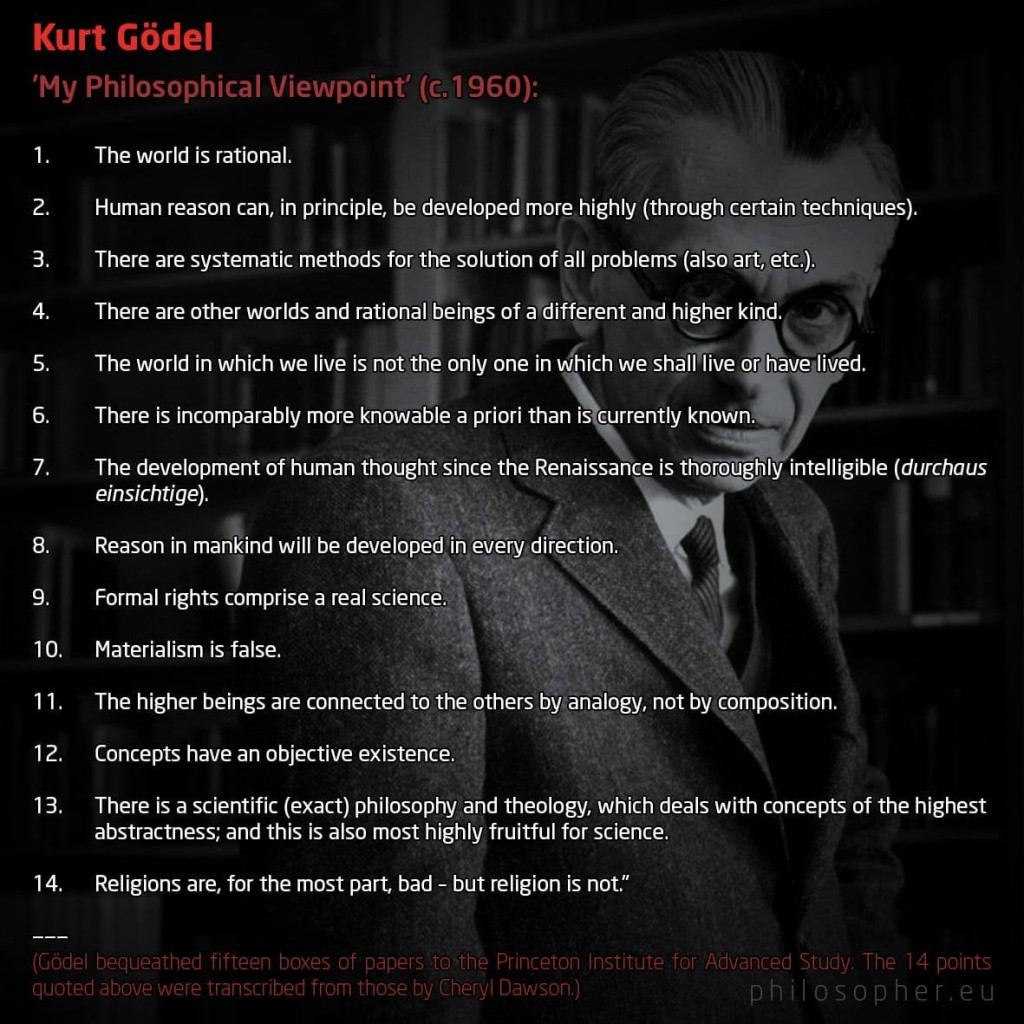
  • ‘Contrast Godel with P – Request from Kash Vikas

    ‘Contrast Godel with P – Request from Kash Vikas https://propertarianism.com/2020/05/27/contrast-godel-with-p-request-from-kash-vikas/


    Source date (UTC): 2020-05-27 16:58:39 UTC

    Original post: https://twitter.com/i/web/status/1265688880025493505

  • ‘Contrast Godel with P – Request from Kash Vikas

    Oct 16, 2019, 10:49 AM (Godel is a Platonist and I’m an Operationalist. This contrast is rather helpful in illustrating the operational vs platonist vs empirical.)

    1. Man acts rationally, and by rationally amorally. But given the disproportionate value of cooperation, and the disproportionate risk of retaliation, it’s just in his interest to act morally much more often than immorally.
      1a. We can incrementally reduce observations of the universe, using our senses, reason, and instrumentation to descriptions of invariant constant relations (paradigms)
      1b + 3. We can describe (explain) all of experience as constant relations (a single paradigm)
    2. While our ability to reason is constant, every increase convergence of our instruments and paradigms increases the explanatory power available to our reason.
    3. The capacity to reason is a deterministic product of entropy at convenient temperatures in convenient conditions, for sufficient periods of time. It is likely that given the vastness of the universe, other creatures have evolved reason, and that while the logic of constant relations will exist, and mathematics as a logic of constant positional relations will exist in some form, that the composition of experience that results from different body structures will result in different techniques for employing reason. (think octopi). And that the ability of these creatures may vastly outperform ours.
    4. Because we are able to use our powers of prediction using free association to construct a model of the world we exist in, and the worlds we might exist in, and the worlds we cannot exist in, we can experience, many candidate worlds.
      5b. The set of demands we evolved and express daily is largely invariant. The set of paradigms we use to imagine opportunities for fulfilling those demands evolves (and devolves) constantly. So while we largely increase the coherence of paradigms, and approach a single paradigm for describing the universe, we have experienced the world differently in the past than in the present, and will so again experience it differently in the future.
    5. If we can construct an operational grammar and paradigm for a given set of constant relations, we can produce an operational logic of that set of constant relations, and conduct experiments logically by trial and error as we do in mathematics. To do so we require convergence of paradigms to the point of marginal indifference of those logical constructions. But the Analytic program failed, and Godel and Frege et all were wrong – closure does not exist.
    6. Yes the development of thought since Aristotle expanded on Democritus, has been consistent and rational with the exception of the semitic abrahamic dark ages of supernatural ignorance.
    7. Reason is reason is reasoning and there is nothing to it. There are however endless permutations of reason especially as knowledge increases.
    8. The via-negativa of Natural Law can be restated in the via-positiva as Natural rights, and this logic and empirical combination produces a science of cooperation, and law the institutional enforcement of cooperation under that law, and economics the measure of it’s success, and economics the language of analysis and measurement within that science.
      10.The material(noun) and the Operational(verb) are true (exist, and are testifiable). The platonic (ideal) is false. All sets of constant relations are identified, retained, applied, reinforced, and revised by merging physical stimuli with physical organization of information in the brain, producing a hierarchy of changes in state over time we call ‘experience’. So while it is correct to say that the universe is deterministic (composed of constant relations), it is only correct to say that we can observe sets of constant relations, identify them (category), compare them, name them, and predict future states of of them, and in relation to them. These memories and predications like running consist of physical potential, that produce results in time. In other words, al of reality is constructed physically, from a hierarchy of changes in state over time we call experience.
    9. Concepts do not exist. the potential for Concepts exists. Running only exists when one is running. We have the potential to run. We have the potential to identify sets of constant relations (concepts), but experience of contexts only exist when we are acting to recall them in time.
    10. It appears we can know the most parsimonious paradigm, and host of parsimonious sub-paradigms of increasing complexity (permutations) allowing us to speak the truth using evidence – science; that we can know the same for choices using arguments – philosophy; and we can know the same for collective organization using stories – theology.
    11. Existing religions are bad to terrible to suicidal – but human psychological, social, political, and strategic demand for the products of ‘religion’ (order) are endless. So we need to educate one another in mindfulness, ethics(interpersonal), morality (extrapersonal), political, and strategic (competitive), by means gracefully increasing and decreasing in accessibility: parable, story, history, reason and general rules, science and outcomes.’
      CONTRAST WITH P – REQUEST FROM KASH VIKAS
      (Godel is a Platonist and I’m an Operationalist. This contrast is rather helpful in illustrating the operational vs platonist vs empirical.)

    12. Man acts rationally, and by rationally amorally. But given the disproportionate value of cooperation, and the disproportionate risk of retaliation, it’s just in his interest to act morally much more often than immorally.
      1a. We can incrementally reduce observations of the universe, using our senses, reason, and instrumentation to descriptions of invariant constant relations (paradigms)
      1b + 3. We can describe (explain) all of experience as constant relations (a single paradigm)

    13. While our ability to reason is constant, every increase convergence of our instruments and paradigms increases the explanatory power available to our reason.
    14. The capacity to reason is a deterministic product of entropy at convenient temperatures in convenient conditions, for sufficient periods of time. It is likely that given the vastness of the universe, other creatures have evolved reason, and that while the logic of constant relations will exist, and mathematics as a logic of constant positional relations will exist in some form, that the composition of experience that results from different body structures will result in different techniques for employing reason. (think octopi). And that the ability of these creatures may vastly outperform ours.
    15. Because we are able to use our powers of prediction using free association to construct a model of the world we exist in, and the worlds we might exist in, and the worlds we cannot exist in, we can experience, many candidate worlds.
      5b. The set of demands we evolved and express daily is largely invariant. The set of paradigms we use to imagine opportunities for fulfilling those demands evolves (and devolves) constantly. So while we largely increase the coherence of paradigms, and approach a single paradigm for describing the universe, we have experienced the world differently in the past than in the present, and will so again experience it differently in the future.
    16. If we can construct an operational grammar and paradigm for a given set of constant relations, we can produce an operational logic of that set of constant relations, and conduct experiments logically by trial and error as we do in mathematics. To do so we require convergence of paradigms to the point of marginal indifference of those logical constructions. But the Analytic program failed, and Godel and Frege et all were wrong – closure does not exist.
    17. Yes the development of thought since Aristotle expanded on Democritus, has been consistent and rational with the exception of the semitic abrahamic dark ages of supernatural ignorance.
    18. Reason is reason is reasoning and there is nothing to it. There are however endless permutations of reason especially as knowledge increases.
    19. The via-negativa of Natural Law can be restated in the via-positiva as Natural rights, and this logic and empirical combination produces a science of cooperation, and law the institutional enforcement of cooperation under that law, and economics the measure of it’s success, and economics the language of analysis and measurement within that science.
      10.The material(noun) and the Operational(verb) are true (exist, and are testifiable). The platonic (ideal) is false. All sets of constant relations are identified, retained, applied, reinforced, and revised by merging physical stimuli with physical organization of information in the brain, producing a hierarchy of changes in state over time we call ‘experience’. So while it is correct to say that the universe is deterministic (composed of constant relations), it is only correct to say that we can observe sets of constant relations, identify them (category), compare them, name them, and predict future states of of them, and in relation to them. These memories and predications like running consist of physical potential, that produce results in time. In other words, al of reality is constructed physically, from a hierarchy of changes in state over time we call experience.
    20. Concepts do not exist. the potential for Concepts exists. Running only exists when one is running. We have the potential to run. We have the potential to identify sets of constant relations (concepts), but experience of contexts only exist when we are acting to recall them in time.
    21. It appears we can know the most parsimonious paradigm, and host of parsimonious sub-paradigms of increasing complexity (permutations) allowing us to speak the truth using evidence – science; that we can know the same for choices using arguments – philosophy; and we can know the same for collective organization using stories – theology.
    22. Existing religions are bad to terrible to suicidal – but human psychological, social, political, and strategic demand for the products of ‘religion’ (order) are endless. So we need to educate one another in mindfulness, ethics(interpersonal), morality (extrapersonal), political, and strategic (competitive), by means gracefully increasing and decreasing in accessibility: parable, story, history, reason and general rules, science and outcomes.
  • P-Decidabilty Is a Dangerous Idea!

    P-Decidabilty Is a Dangerous Idea! https://propertarianism.com/2020/05/27/p-decidabilty-is-a-dangerous-idea/


    Source date (UTC): 2020-05-27 16:09:33 UTC

    Original post: https://twitter.com/i/web/status/1265676526051344386

  • P-Decidabilty Is a Dangerous Idea!

    Oct 25, 2019, 4:44 PM by Duke Newcomb This decidability is a dangerous idea. If the you-know-whos were to figure out the stuff we talk about and what we really mean, they’d SHUT IT DOWN! Decidability may be more of an antipode to parasitism than reciprocity. A decidable institution could hit such an escape velocity that it would shake off or burn off parasites along the way. It could not just counter the small hats’ group strategy as enforced reciprocity does, it could foreclose on its use. Perhaps that’s wishful thinking on my part, but mein Gott, this idea seems highly radioactive and long half-lived

  • P-Decidabilty Is a Dangerous Idea!

    Oct 25, 2019, 4:44 PM by Duke Newcomb This decidability is a dangerous idea. If the you-know-whos were to figure out the stuff we talk about and what we really mean, they’d SHUT IT DOWN! Decidability may be more of an antipode to parasitism than reciprocity. A decidable institution could hit such an escape velocity that it would shake off or burn off parasites along the way. It could not just counter the small hats’ group strategy as enforced reciprocity does, it could foreclose on its use. Perhaps that’s wishful thinking on my part, but mein Gott, this idea seems highly radioactive and long half-lived

  • There Is No Fermi Paradox

    Oct 30, 2019, 10:36 AM As in all things there is no paradox, just an open question, no paradoxes exist. One can falsify the fermi question. It is falsifiable.We have failed to falsify it. One cannot disprove, only fail to provide a proof of possibility in an axiomatic system like mathematics, and reality is a theoretic system, not axiomatic. At present it is falsifiable, un-falsified, and undecidable, and therefore all we can say is that “we don’t know yet”. The most obvious reasons are: 1 – Technological (EMR is a primitive technology) 2 – Differences are such that we would be of no trading (cooperative) value; interfering would only create a competitor; and it is too early for a colonization effort to have reached us given the recent development of EMR broadcasting. 3 – Time and distance window of opportunity 4 – We are in a calm location between arms, in a calm (dying) galaxy, and have had long enough period of growth to ‘bake’ in necessary conditions 5 – I am concerned that the spinning liquid iron core of our planet that creates its defensive field is rarer than we imagine, and as such it is much harder for life to have time to bake. taken to the extreme, the question may be, now many planets can survive four to five billion years, in a safe rural area of a galaxy, in the habitable (water) zone, while maintaining a spinning liquid iron core?

  • There Is No Fermi Paradox

    Oct 30, 2019, 10:36 AM As in all things there is no paradox, just an open question, no paradoxes exist. One can falsify the fermi question. It is falsifiable.We have failed to falsify it. One cannot disprove, only fail to provide a proof of possibility in an axiomatic system like mathematics, and reality is a theoretic system, not axiomatic. At present it is falsifiable, un-falsified, and undecidable, and therefore all we can say is that “we don’t know yet”. The most obvious reasons are: 1 – Technological (EMR is a primitive technology) 2 – Differences are such that we would be of no trading (cooperative) value; interfering would only create a competitor; and it is too early for a colonization effort to have reached us given the recent development of EMR broadcasting. 3 – Time and distance window of opportunity 4 – We are in a calm location between arms, in a calm (dying) galaxy, and have had long enough period of growth to ‘bake’ in necessary conditions 5 – I am concerned that the spinning liquid iron core of our planet that creates its defensive field is rarer than we imagine, and as such it is much harder for life to have time to bake. taken to the extreme, the question may be, now many planets can survive four to five billion years, in a safe rural area of a galaxy, in the habitable (water) zone, while maintaining a spinning liquid iron core?