Definition of Cooperation
(a request) https://t.co/maU6ztpP5H
Source date (UTC): 2023-11-04 17:10:43 UTC
Original post: https://twitter.com/i/web/status/1720851077669532026
Definition of Cooperation
(a request) https://t.co/maU6ztpP5H
Source date (UTC): 2023-11-04 17:10:43 UTC
Original post: https://twitter.com/i/web/status/1720851077669532026
DISAMBIGUATION: COOPERATION
(from the archives)
DEFINITION
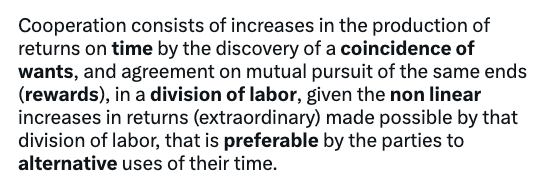
Cooperation consists of increases in the production of returns on time by the discovery of a coincidence of wants, and agreement on mutual pursuit of the same ends (rewards), in a division of labor, given the non linear increases in returns (extraordinary) made possible by that division of labor, that is preferable by the parties to alternative uses of their time.
The Evolution of Cooperation:
1) Acquisitiveness: To survive and reproduce, humans must acquire and inventory many categories of resources, and evolved to demonstrate constant acquisitiveness of those resources.
2) Demonstgrated Interests(“property”): The scope of those things they act upon, or choose not to act upon, in anticipation of obtaining as inventory (a store of value), constitute their demonstrated definition of property-en-toto.* (See Butler Schaeffer) “That which and organism defends.”
3) Value: Human emotions evolved to reflect changes in state of demonstrated interests. As such nearly all emotions can be expressed in terms of reactions to property. (imposed costs here, pre-moral, but also pre-cooperation, and only defense and retaliation, not cooperation)
4) Non-Conflict: That which humans act to obtain without imposition upon in-group members they evolved to intuit as their demonstrated interests (property), and demonstrate this intuition by defense of their inventory, and by their punishment of transgressors.
5) Cooperative Production: That which humans act in concert with one another to produce a change in state that is prefereable to other potential changes in state at some point in time.
6) Moral (cooperative) Intuitions(instincts): Moral intuitions reflect prohibitions on free riding by members with whom one cooperates in production and reproduction. (This is where free riding enters.)
7) Distribution of Intuitions by Reproductive Strategy: Moral intuitions vary in intensity to suit one’s reproductive strategy. This intensity and distribution of moral intuition varies between males and females, as well as between classes and between groups.
8) Variation By Family Structure: Moral rules reflect prohibitions on free riding given the structure of the family in relation to the necessary and available structure of production.
9) Resolution of Disputes: Property rights were developed in law as the positive enumeration in contractual form, of those moral rules which any polity (corporation) agrees to enforce with the promise of violence for the purpose of restitution or punishment. Conversely, any possible property rights not expressed, the community (corporation) is unwilling to adjudicate, restore or punish, or has not yet discovered the need to construct.
10) Instrumentation: Property rights are necessary for the instrumental measurement of moral prohibitions because of the unobservability of changes in human emotional states, and our inability to determine truth from falsehood. And as such we require an observable proxy for evidence of changes in state.
11) Family: As a general rule, as the division of knowledge and labor increases, so must the atomicity of property rights, and as a consequence, the size of the family must decline {Consanguineous, Punaluan, Pairing (Serial Marriage), Hetaeristic, Traditional, Stem, Nuclear, Absolute Nuclear}.
12) Transaction Costs: As the division of labor increases, relationships increase in distance from kin, increase in anonymity, decrease common interest, and the incentive to seize opportunities rather than adhere to agreements increases. This decrease creates the problem of trust, which increases costs of insuring any agreement is fulfilled, and decreases the overall number of possible agreements and the number of participants in any structure of production.
13) Trust (ethics in production): As a general rule, for the size of the family to decrease, and division of labor to increase in multi-part complexity then trust must increase, and trust can only increase with expansion of property rights to include prohibitions on unethical actions. Mere ostracization, boycotting and reputation are insufficient to preserve agreements (contracts).
14) Moral Competition (ethics in political production): (morals property rights, cheating) As a general rule, the scope of moral prohibitions expressed as property rights, must increase to limit demand for authority.
15) Demand for Authority: As a general rule, if a delay in the production of property rights evolves, then demand for authority will fill the vacuum with some form of authority to either suppress retaliation (conflict) or to prevent circumstances leading to conflict, or both.
THE REASONS FOR THE EVOLUTION OF COOPERATION
INGROUP COOPERATION
1) The disproportionately high return on cooperation.
2) The differences in abilities at different ages.
3) The difference in reproductive role and strategy between the genders.
4) The differences in abilities among men.
5) The local structure of production: the division of knowledge and labor.
6) The local structure of the reproduction: family and inheritance rights.
7) The distribution of property rights between the individual, family, group and the commons.
8) The degree of suppression of, and intolerance for, free riding both in and out of family.
9) calculative, cooperative technology available for economic signaling and coordination. (objective truth, numbers, money, prices, interest, writing, contract, and accounting).
10) The use of formal institutions to perpetuate these constraints.
11) The competition from groups with alternate structures of production, family, inheritance, property rights, free riding, cooperative technologies, and formal institutions.
OUTGROUP COOPERATION
12) The geographical distribution of nature-given factors of production. (note that this is last.)
PROPERTY RIGHT
OBVERSE: A prohibition on the imposition of costs against those categories of property that in-group members are willing to enforce by means of organized violence.
REVERSE: a warranty by peers (right) that they will either enforce restitution for impositions of costs upon certain categories of your property, and/or that they will not retaliate against you for your acts of retaliation or restitution for such impositions.
RESULT?
(i) PROPERTY: that which we demonstrate that we have born costs to acquire without imposing costs upon others with whom we cooperate.
(ii) COOPERATION: constructing an asymmetry of incentives such that we choose to concentrate efforts by dividing labor in order to obtain the disproportionate rewards of doing so versus the alternatives.
(iii) MORALITY: that which we require in order to rationally cooperate.
(iv) RIGHT: Sanction of retaliation in case of abridgment. OBLIGATION: Requirement of performance.
(v) LAW (PROPERTY RIGHT): that which we promise to one another to insure.
—END OF ANALYSIS–
Source date (UTC): 2023-11-04 17:09:48 UTC
Original post: https://twitter.com/i/web/status/1720850845363834880
AG: Personal request. Please let spelling and grammar issues slip, at least on my contentious debates. While it does ‘register a point’ it interferes with the development of trust necessary to change someone’s mind – they will resist the knowledge even if it’s overwhelmingly evident it’s true.
Most of the time all I do is plant a seed so that the opposing party has the opportunity to ‘own’ their point of view either way. I don’t really want agreement. Just to give the opposition the chance to make a different decision.
Hugs. Respect. Just asking a favor.
Thx 😉
Reply addressees: @Argent_Griffin @DaynaRutherfo13 @J58039716
Source date (UTC): 2023-11-03 22:14:21 UTC
Original post: https://twitter.com/i/web/status/1720565101957156864
Replying to: https://twitter.com/i/web/status/1720563227929543112
Oops. Forgot the main point. 😉
Law as in natural law of reciprocity – contractualism.
Not ‘rules’ or ‘commands’ from an authority.
Europe retained trifunctionalism. Because it can with law first. China with state-first developed philosophy instead of religion, but failed at law for reasons I’ve explained elsewehre and why Confucius, failing at politics, failing at law, directed civilization to the family and hierarchy of families and harmony. Where law creates adversarial competition for the benefit of the commons seeking utililty at the cost of disruption. Harmony does not tolerate ‘distruption’. The middle east CONFLATED Religion, law and state. And failed at all three.
Reply addressees: @matthewolivan @whatifalthist
Source date (UTC): 2023-11-01 16:11:22 UTC
Original post: https://twitter.com/i/web/status/1719748980320481280
Replying to: https://twitter.com/i/web/status/1719748174955286632
IN REPLY TO:
Unknown author
No. The Jewish emphasis on scriptural law was a counter-reaction to greco-roman law oncde t hey saw the effect of it. So they resurrected pre-500bc remnants and adopted the use of the law themselves. You will find almost all semitic behavior after the bronze age collapse, is just reaction to the superiority of the social, political, military, and technological advantages of indo europeans whether iranic, anatolian, or european.
Likewise islam is largely the result of a counter-reaction against the Nicean effort to standardize the bible as law, with a law that was intolerable for the arabs and their tribalism. Before nicea christianity was ascendent in the orient.
Original post: https://x.com/i/web/status/1719748174955286632
Because european civ doesn’t begin with farming and the sedentary cultures, it begins with cattle herding, metalworking, wheel, horse, war, and MANEUVER (ooda loops), producing conquest, expansion, heroism, militarism, sky worshipping … and … get ready “military reporting” or what we call ‘testimony’. Farming is what you conquer the helots to do – so to speak. It is a fundamentally realist not experientialist understanding of the world. So the west begins with realism, naturalism, empiricism(observables), contractualism, and testimony to all. Which is just military reporting, and testimony before the jury, applied to all of life.
And as usual, Rudyard is correct in his observation. The east has had little impact.
Buy the reason the east does what it does is because CONFUCIUS FAILED to solve the problem of politics, and so having failed, he directed the society to the production of a hierarchy of families, and the perception of harmony to preserve it … becuase they failed to produce contract, law, rule of law. The evolution of the east is STATE command first not peer LAW first. The evolution of the west is law first not state first. The evolution of the middle east is religion first, state second and failed state and law. India roughly maintained religion and custom instead of law, and failed at the state. The only way to get to european civ is the same way we did it (by accident). Sovereignty > Reciprocity > Contract (democracy) > Testimony (empirical truth) > aristocracy (meritocracy) > Markets in everything. THereby preserving the trifunctional competition between feminine faith, masculine state, and neutral trade.
I disagree with paradoxes (there aren’t any – really), the world isn’t an illusion – under testimony it’s just measurements using senses as a measure. Under technocracy and military it’s about market-coordinated voluntary actions in groups not invidiual imaginary life to escape the boredom of agrarian life. Family is just the first unit of cultural production. It’s militaries, states, and trade that build societies and civilizations. People who live in mind-world are just the peasants whose lives are dicated by those with ability, capacity, agency, and allies. If you can life in the mind instead of in the world the question is why would you? What incentives cause you to prefer the mind and self generated feelings vs experience of reality and reality generated feelings? (Powerlessness)
ie: nietzche was not quite right. It’s not slave vs master, it’s not even peasant vs aristocracy. It’s feminine vs masculine.
Reply addressees: @whatifalthist
Source date (UTC): 2023-10-31 17:40:50 UTC
Original post: https://twitter.com/i/web/status/1719409104911843328
Replying to: https://twitter.com/i/web/status/1719235488400204262
RT @J58039716: A rule of evolution: Competition drives adaptation.
Europe has competing narratives that are mutually exclusive and will i…
Source date (UTC): 2023-10-30 19:51:21 UTC
Original post: https://twitter.com/i/web/status/1719079564121423937
If the feminine mind did not hold the unconstrained vision, mothers would give up on their children. If the masculine mind did not hold the constrained vision, no group would survive the disorder. So, we see feminine opportunity and masculine scarcity. Evolution always divides the labor. Among humans it divides the cognitive labor of “TIME and SCALE”.
(Note: See Thomas Sowell: A Conflict of Visions)
Source date (UTC): 2023-10-28 13:14:19 UTC
Original post: https://twitter.com/i/web/status/1718254870413578240
RT @Josh_Ebner: @J58039716 @curtdoolittle Yes, understood.
In the West, as Curt noted, the loyalty group is the broader people, and as s…
Source date (UTC): 2023-10-27 17:10:00 UTC
Original post: https://twitter.com/i/web/status/1717951794716758183
RT @IvarDiederik: “In contrast, civilizations where loyalty and trust have not historically scaled beyond the family or local community fac…
Source date (UTC): 2023-10-27 15:19:42 UTC
Original post: https://twitter.com/i/web/status/1717924037643411842
HONOR: WHAT IT MEANS, CIVILIZATIONAL DIFFERENCES, WHAT DIFFERENCES TELL US, AND THE CONSEQUENCES
(understanding honor in different civilizations)
CURTD
What is the definition of the term “Honor”. And, what are the civilizational (meaning cultural) differences in the definition…
Source date (UTC): 2023-10-27 15:05:07 UTC
Original post: https://twitter.com/i/web/status/1717920364829823094