Our current strategy relies on a mutually beneficial solution for both left and right, so that left and right are united against the predatory status quo.
Whether left will accept the ‘free cities’ model is an open question. It is a fair trade but we don’t know until we meet.
Our current strategy relies on a mutually beneficial solution for both left and right, so that left and right are united against the predatory status quo.
Whether left will accept the ‘free cities’ model is an open question. It is a fair trade but we don’t know until we meet.
THE SMITH AND THE DEMON – OUR OLDEST FOLK TALE AND OUR FIRST MORAL LESSON: BAITING INTO HAZARD
According to research applying phylogenetic techniques to linguistics by folklorist Sara Graça da Silva and anthropologist Jamie Tehrani,”The Smith and the Devil” may be one of the oldest European folk tales, with the basic plot stable throughout the Indo-European speaking world from India to Scandinavia, possibly being first told in Indo-European 6,000 years ago in the Bronze Age.
Our ancestors were metalworkers – and the most common name – smith – a reminder. Medieval hell evolved from the blacksmith’s forge.
The oldest myth of the west is Faust (the devil and the blacksmith)
The Europeans worship a sky god (nature, sun) and magic, the Semites a moon and star (astrology, heavens)
Why isn’t Faust Europe and the devil Abrahamism’s false promise?
In other words, why isn’t our foundational myth a warning against Abrahamism/Semitism?
Because what does the demon practice?
False promise, baiting into moral hazard, defended with pilpul and critique.
THE SMITH AND THE DEMON – OUR OLDEST FOLK TALE AND OUR FIRST MORAL LESSON: BAITING INTO HAZARD
According to research applying phylogenetic techniques to linguistics by folklorist Sara Graça da Silva and anthropologist Jamie Tehrani,”The Smith and the Devil” may be one of the oldest European folk tales, with the basic plot stable throughout the Indo-European speaking world from India to Scandinavia, possibly being first told in Indo-European 6,000 years ago in the Bronze Age.
Our ancestors were metalworkers – and the most common name – smith – a reminder. Medieval hell evolved from the blacksmith’s forge.
The oldest myth of the west is Faust (the devil and the blacksmith)
The Europeans worship a sky god (nature, sun) and magic, the Semites a moon and star (astrology, heavens)
Why isn’t Faust Europe and the devil Abrahamism’s false promise?
In other words, why isn’t our foundational myth a warning against Abrahamism/Semitism?
Because what does the demon practice?
False promise, baiting into moral hazard, defended with pilpul and critique.
Nov 20, 2019, 10:56 AM
by Micah Pezdirtz
(flawless, brilliant)
—“Morality describes good in-group behavior. The in-group defines the limit of moral utility. Outside of the in-group, “moral” actions cease congruence with moral actions within it (betraying outsiders does not carry the same cost as betraying your kin).
Westerners have a proclivity to universalize the in-group in part due to the particular pro-social behavior selected for by ice age survival conditions. Easterners have evolved differently, where in-group members demand morality towards each other and demand immorality towards outsiders.
Reciprocity completes the moral system. A Hegelian synthesis, if you will, of the universalist hypothesis and dualist antithesis. A problem we face switching over to Reciprocity comes from the counter selection factors from both groups: to the universalist, reciprocal behavior violates the silver rule (do not do unto others what you would not have done unto you); to the polymoralist, reciprocal behavior accepts costs to the in-group instead of transference to out-groups.
Monomoralists bear costs rightfully owed by out-groups and polymoralists impose costs rightfully due by in-group. So how does this relate to scale? Scale does not only present an explosively high quantity of group members, in and out, but an explosively high quantity of groups. Calculation costs of identifying groups individuals belong to as well as identifying a spectrum of group allegiance to hostility becomes completely heuristically impossible for any practical effectiveness. which may explain why Polymoralism has gained an upper hand (focus on in-group identity, plunder all others) but it destabilizes itself over time as all other out-groups eventually unify against them.” –
Nov 20, 2019, 10:56 AM
by Micah Pezdirtz
(flawless, brilliant)
—“Morality describes good in-group behavior. The in-group defines the limit of moral utility. Outside of the in-group, “moral” actions cease congruence with moral actions within it (betraying outsiders does not carry the same cost as betraying your kin).
Westerners have a proclivity to universalize the in-group in part due to the particular pro-social behavior selected for by ice age survival conditions. Easterners have evolved differently, where in-group members demand morality towards each other and demand immorality towards outsiders.
Reciprocity completes the moral system. A Hegelian synthesis, if you will, of the universalist hypothesis and dualist antithesis. A problem we face switching over to Reciprocity comes from the counter selection factors from both groups: to the universalist, reciprocal behavior violates the silver rule (do not do unto others what you would not have done unto you); to the polymoralist, reciprocal behavior accepts costs to the in-group instead of transference to out-groups.
Monomoralists bear costs rightfully owed by out-groups and polymoralists impose costs rightfully due by in-group. So how does this relate to scale? Scale does not only present an explosively high quantity of group members, in and out, but an explosively high quantity of groups. Calculation costs of identifying groups individuals belong to as well as identifying a spectrum of group allegiance to hostility becomes completely heuristically impossible for any practical effectiveness. which may explain why Polymoralism has gained an upper hand (focus on in-group identity, plunder all others) but it destabilizes itself over time as all other out-groups eventually unify against them.” –
Nov 23, 2019, 8:58 AM
We empathize (imitate emotions)
We sympathize (imitate mind)
We (must) negotiate (offer, acquire).
We habituate negotiating strategies.
We negotiate in a market.
Markets evolve superior products as standards of weight and measure.
Markets of superior products gradually adapt to one another creating commensurable networks of products with additive returns.
Economic language is always superior for psychology and sociology because it unifies behavior w physics.
Economic logic (markets) de-emphasizes (un-biases) ‘belief and agency’ and correctly restores the hierarchy between ‘rider(reason) and elephant(intuition)’.
We would not require consciousness if not for negotiating cooperation. By using economic logic we gain agency in psychology and sociology as we did in physics.
Nov 23, 2019, 8:58 AM
We empathize (imitate emotions)
We sympathize (imitate mind)
We (must) negotiate (offer, acquire).
We habituate negotiating strategies.
We negotiate in a market.
Markets evolve superior products as standards of weight and measure.
Markets of superior products gradually adapt to one another creating commensurable networks of products with additive returns.
Economic language is always superior for psychology and sociology because it unifies behavior w physics.
Economic logic (markets) de-emphasizes (un-biases) ‘belief and agency’ and correctly restores the hierarchy between ‘rider(reason) and elephant(intuition)’.
We would not require consciousness if not for negotiating cooperation. By using economic logic we gain agency in psychology and sociology as we did in physics.
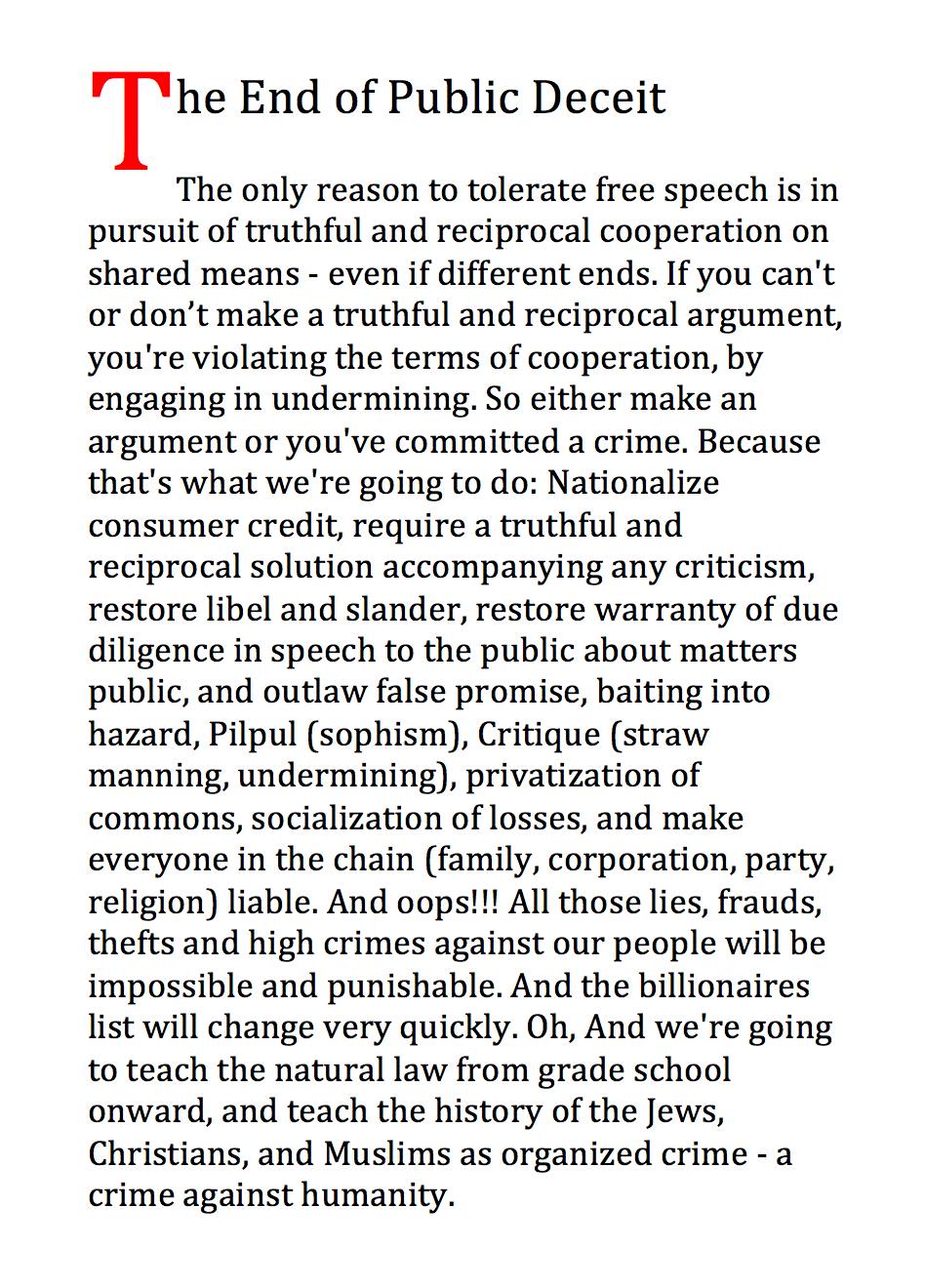
The only reason to tolerate free speech is in pursuit of truthful and reciprocal cooperation on shared means – even if different ends. If you can’t or don’t make a truthful and reciprocal argument, you’re violating the terms of cooperation, by engaging in undermining. So either make an argument or you’ve committed a crime. Because
that’s what we’re going to do: Nationalize consumer credit, require a truthful and reciprocal solution accompanying any criticism, restore libel and slander, restore warranty of due diligence in speech to the public about matters public, and outlaw false promise, baiting into hazard, Pilpul (sophism), Critique (straw-manning, undermining), privatization of commons, socialization of losses, and make everyone in the chain (family, corporation, party, religion) liable. And oops!!! All those lies, frauds, thefts and high crimes against our people will be impossible and punishable. And the billionaires list will change very quickly. Oh, And we’re going to teach the natural law from grade school onward, and teach the history of the Jews, Christians, and Muslims as organized crime – a crime against humanity.
Men evolved for the physical, political and inter-temporal and women the emotional interpersonal and temporal, in a division of labor and specialization where differences are solved only by a coincidence of wants and opportunity and incentive for cooperation.