Apr 17, 2020, 7:18 AM —“Voters drain the liberal states they live in then move the more conservative States and drain those dates and move again roaming parasites.”—Corey Ihler
Theme: Class
-
Roving Liberal Parasites
-
I Don’t Spend Time Refuting Marxism. But It’s Trivially Easy
Apr 18, 2020, 1:37 PM
—“Is there an article in which you relate these claims to the specific Marxist tenets, like surplus value, the labor theory of value, historical materialism, alienated labour, and so on? … I noticed you didn’t mention any of these in your comment here, so I’m not sure we’re really talking about the same thing.”—Morus Alba
It is not necessary to refute marx since it’s been done for decades. Just the fallacy of the labor theory of value eradicates most of the work; the claim on profits without claim on risk and loss; the claim that the primary beneficiary of industrialization is not the working classes and the poor; the claim of equality and oppression rather than natural sortition by genetic ability individual and family; the claim of society as corporal over family and polity for family; the claim of oppression rather than continuation of natural selection; The means of argument and it’s monopoly proposition to undermine trifuncationalism, markets, and rule of law. I mean, I don’t think I need to do anything other than state correctly that it’s a pseudoscientific authoritarian religion that repeats the false promise of the supernatural authoritarian religion of judaism, christianity, and islam and sold to the poor in the modern world as freedom from physical law, just as freedom from physical law was sold to the underclases in the ancient world – and that gave us the dark ages of ignorance by judaism, christianity, and islam. That’s why we don’t teach marx in economics, only non-science. So if you want me to refute a given marxist proposition I will because it’s trivially easy. If you want me to refute ashkenazi capitalism I’ll refute that just as easily. If you want me to refute neoconservatism I’ll do that easily. If you want me to refute postmodernism or feminism I’ll do those just as easily. My goal of course is to expand the law so that false promise of freedom from physical, natural and evolutionary law, by baiting people into hazard is as illegal in political fraud as the same strategy is in commercial fraud. So most of my work is in exposing the strategy of abrahamic deception – which is as sophisticated a means of deceit as aristotelianism is a means of truth production – and writing laws that not only reverse it’s harms, but which prevent its future use … thereby restoring us to trifuncationalism, sovereignty, reciprocity, the natural law and jury, and markets in all aspects of life, including the suppression of the reproduction of the unproductive classes so that they do not return man to middle eastern ignorance and poverty as did christianity and islam, nor tolerate survival by parasitism as we have seen with judaism’s profiting from baiting host peoples into hazard with tax collection, usury, gambling, prostitution, drug and alcohol sales on credit, organized crime. propaganda, and rent seeking. BY ANALOGY We humans are just monkeys running software with more memory and cpu power. I’m removing ‘memory leak’ from the human software. And law ist he means by which we program humans via negativa, without needing to program them via-positiva, and therefore leaving them open to competition in adversarial markets continuing our rapid evolution during this brief geological respite between crisis that threaten mankind.
-
I Don’t Spend Time Refuting Marxism. But It’s Trivially Easy
Apr 18, 2020, 1:37 PM
—“Is there an article in which you relate these claims to the specific Marxist tenets, like surplus value, the labor theory of value, historical materialism, alienated labour, and so on? … I noticed you didn’t mention any of these in your comment here, so I’m not sure we’re really talking about the same thing.”—Morus Alba
It is not necessary to refute marx since it’s been done for decades. Just the fallacy of the labor theory of value eradicates most of the work; the claim on profits without claim on risk and loss; the claim that the primary beneficiary of industrialization is not the working classes and the poor; the claim of equality and oppression rather than natural sortition by genetic ability individual and family; the claim of society as corporal over family and polity for family; the claim of oppression rather than continuation of natural selection; The means of argument and it’s monopoly proposition to undermine trifuncationalism, markets, and rule of law. I mean, I don’t think I need to do anything other than state correctly that it’s a pseudoscientific authoritarian religion that repeats the false promise of the supernatural authoritarian religion of judaism, christianity, and islam and sold to the poor in the modern world as freedom from physical law, just as freedom from physical law was sold to the underclases in the ancient world – and that gave us the dark ages of ignorance by judaism, christianity, and islam. That’s why we don’t teach marx in economics, only non-science. So if you want me to refute a given marxist proposition I will because it’s trivially easy. If you want me to refute ashkenazi capitalism I’ll refute that just as easily. If you want me to refute neoconservatism I’ll do that easily. If you want me to refute postmodernism or feminism I’ll do those just as easily. My goal of course is to expand the law so that false promise of freedom from physical, natural and evolutionary law, by baiting people into hazard is as illegal in political fraud as the same strategy is in commercial fraud. So most of my work is in exposing the strategy of abrahamic deception – which is as sophisticated a means of deceit as aristotelianism is a means of truth production – and writing laws that not only reverse it’s harms, but which prevent its future use … thereby restoring us to trifuncationalism, sovereignty, reciprocity, the natural law and jury, and markets in all aspects of life, including the suppression of the reproduction of the unproductive classes so that they do not return man to middle eastern ignorance and poverty as did christianity and islam, nor tolerate survival by parasitism as we have seen with judaism’s profiting from baiting host peoples into hazard with tax collection, usury, gambling, prostitution, drug and alcohol sales on credit, organized crime. propaganda, and rent seeking. BY ANALOGY We humans are just monkeys running software with more memory and cpu power. I’m removing ‘memory leak’ from the human software. And law ist he means by which we program humans via negativa, without needing to program them via-positiva, and therefore leaving them open to competition in adversarial markets continuing our rapid evolution during this brief geological respite between crisis that threaten mankind.
-
The university system has been handing out ‘indulgences’ instead of ‘diplomas’ f
The university system has been handing out ‘indulgences’ instead of ‘diplomas’ for decades. And selecting against the best for a long time, because the ‘best’ requires three properties: ability, conscientiousness, and morality. Without at test for morality it’s pointless.
Source date (UTC): 2020-05-20 13:53:26 UTC
Original post: https://twitter.com/i/web/status/1263105556010549249
Reply addressees: @StevePender
Replying to: https://twitter.com/i/web/status/1263103997176676352
-
(It’s not true.) Liberals (tiny) < democrates (huge) <- the uncommitted -> repub
(It’s not true.)
Liberals (tiny) < democrates (huge) <- the uncommitted -> republicans (large) > libertarians (tiny)
Republicans are smarter than Democrats (Achievement – male bias).
Liberals smarter than Conservatives (Degrees – female bias).
Libertarians the smartest.
Source date (UTC): 2020-05-19 22:21:33 UTC
Original post: https://twitter.com/i/web/status/1262871041287864327
Reply addressees: @JulieBorowski
Replying to: https://twitter.com/i/web/status/1262869651102609409
-
Man – Organization – Sortition – Vertical Class
Definition of Class: ValueHorizontal and Vertical Classes
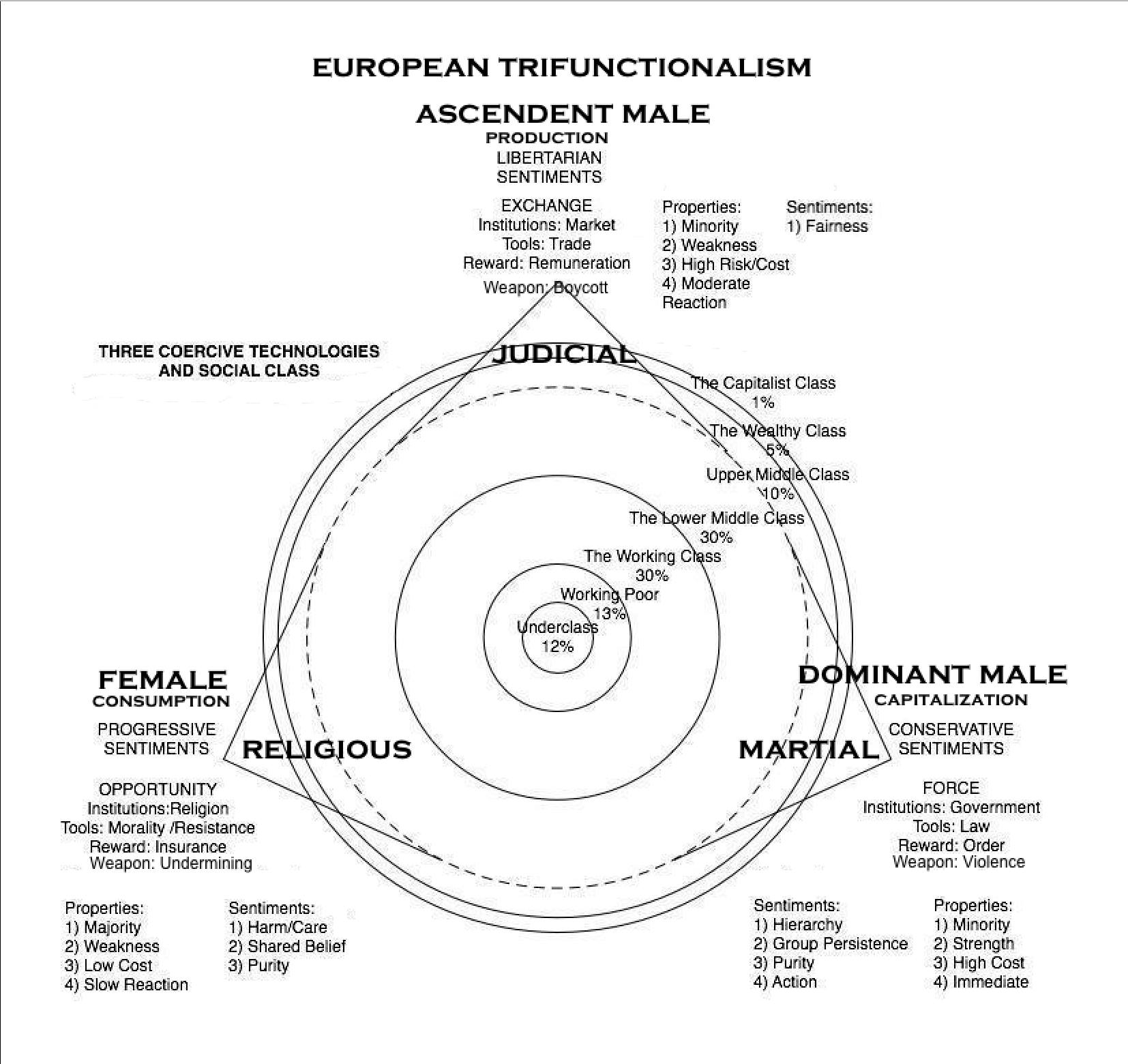
—“Curt, I’d like to ask about your break down of class. It seems based on IQ and income level is that a correct assessment?”— Um… well, I use genetic, social, occupational, and economic classes – even though they overlap a great deal as horizontal classes. And I use the three specializations in means of coercion as vertical classes. But since there is such a high correlation between genetic classes and all other horizontal classes, unless I say otherwise, I am generally referring to genetic classes. And genetic class refers to a portfolio of fitnesses that include IQ as well as personality, morphology, and health. So with that qualification, I think I would say that just as IQ a high predictor in life, it is not the only predictor. But for purpose of general argument it is as good a rule of thumb as any other.Vertical or Ability and Value Classes
For all intents and purposes, with wide individual variation, physical attractiveness (which yes, is a universal), physical fitness, General Intelligence, and personality, serve as a rough indicator of class. For all intents and purposes, intelligence serves as a personality trait – and perhaps the dominant personality trait. For all intents and purposes, personality and physique require exercise in order to produce individual fitness. (This being the primary failure of the 20th century – personality training.)
Reproductive Classes
Elite – Extremely desirable Upper – Desirable throughout life. Middle – Desirable through fertility, Upper Lower – Desirable during peak fertility. Lower – Desirable only as ‘settling’ (last resort) Lowest – Undesirable
Social Classes
( status, opportunity )
Economic Classes
( ability economy, siezure )
The Functions of The Economic Classes
Upper (Asset Capital – Power) Tool of Coercion: Force – Military, Law, Sheriff
1) Upper – Production of Order (sovereignty) Rule Economy (Aristocracy Profit from the Organization of Labor+K)
Middle (Knowledge Capital) Tool of Coercion: Remuneration – Organization, Distribution and Trade2) Upper Middle – Organization of Production (liberty) Capitalism ( Organization of Labor+Knowledge )
3) Middle – Organization of Transformation (freedom) Market Economy ( Voluntarily Organized Labor+K)
4) Lower Middle (working) Transformation (participation) Mixed Economy ( Voluntary + Involuntarily Organized Labor+K)
Lower (Physical Capital) Tool of Coercion: Gossip (resistance) – Production, Dist. and Trade5) Lower (working) Labor (participation) Command Economy ( Lower – Involuntarily Organized Labor+K)
Dependent (No Capital)6) Dependent – Production of Generations (pos. Freedom) Dependent Economy (Dependents – Redistributions from Labor+K)
The Middle Class
The common definition is:
—”the social group between the upper(not working) and working (laboring) classes, including professional and business workers and their families(managerial).”—
I would use:
***”People who calculate, organize, manage, production, distribution, and trade.”***
Because I think it is the best book yet available, I tend to use Paul Fussel’s book “Class”, and most people who read it are forever changed by it. The British and American Systems The British system, which is more economically descriptive, if expanded, would be superior to the American which is politically descriptive. We have simply had ‘diversity’ longer, so we have ‘softer’ categories in order to eliminate the ‘uncomfortable’ truth that we’re racially stratified as well as occupationally stratified. The British and American Class Models British ???? – American Upper Out of Sight Class (the 80 major money families in the states) British ???? – American Upper Class (live on money) For example, our tech people are hardly classifiable as elites, other than perhaps the Gates’ who have made the transition from commercial to entirely humanitarian occupation. British Elite – American Upper Middle Class (in America, we refer to elites as people who have political power, not economic power, and who hold utopian visions of the future.) Members of the elite class are the top 6% of British society with very high economic capital (particularly savings), high social capital, and very ‘highbrow’ cultural capital. Occupations such as chief executive officers, IT and telecommunications directors, marketing and sales directors; functional managers and directors, barristers and judges, financial managers, higher education teachers,[24] dentists, doctors and advertising and public relations directors were strongly represented.[25] However, those in the established and ‘acceptable’ professions, such as academia, law, and medicine are more traditional upper-middle-class identifiers with IT and sales being the preserve of the economic if not social middle class. British Established middle class – American Middle Class Members of the established middle class, about 25% of British society, reported high economic capital, high status of mean social contacts, and both high highbrow and high emerging cultural capital. Well-represented occupations included electrical engineers, occupational therapists, midwives, environmental professionals, police officers, quality assurance and regulatory professionals, town planning officials, and special needs teaching professionals.[26] British Technical middle class – American Lower Middle Class The technical middle class, about 6% of British society, shows high economic capital, very high status of social contacts, but relatively few contacts reported, and moderate cultural capital. Occupations represented include medical radiographers, aircraft pilots, pharmacists, natural and social science professionals and physical scientists, and business, research, and administrative positions.[27] British New affluent workers – American Upper Working Class New affluent workers, about 15% of British society, show moderately good economic capital, relatively poor status of social contacts, though highly varied, and moderate highbrow but good emerging cultural capital. Occupations include electricians and electrical fitters; postal workers; retail cashiers and checkout operatives; plumbers and heating and ventilation engineers; sales and retail assistants; housing officers; kitchen and catering assistants; quality assurance technicians.[27] British Traditional working class – American Middle Working Class The traditional working class, about 15% of British society, shows relatively poor economic capital, but some housing assets, few social contacts, and low highbrow and emerging cultural capital. Typical occupations include electrical and electronics technicians; care workers; cleaners; van drivers; electricians; residential, day, and domiciliary care [27] British Emergent service sector – American lower working class The emergent service sector, about 19% of British society, shows relatively poor economic capital, but reasonable household income, moderate social contacts, high emerging (but low highbrow) cultural capital. Typical occupations include bar staff, chefs, nursing auxiliaries and assistants, assemblers and routine operatives, care workers, elementary storage occupations, customer service occupations, musicians.[27] British Precariat – American upper proletarian class The precariat, about 15% of British society, shows poor economic capital, and the lowest scores on every other criterion. Typical occupations include cleaners, van drivers, care workers, carpenters and joiners, caretakers, leisure and travel service occupations, shopkeepers and proprietors, and retail cashiers. British ???? – American Lower proletarian class British ???? – American out-of-sight lower class.
The Four Middle Classes Criteria
- Genetic Middle Class (reproductive, associative, economic value – ie: reproductively desirable)
- Social Middle Class (bourgeoise manners, ethics, morals, traditions)
- Occupational Middle Class (managerial or small business)
- Economic Middle Class (free capital for consumption and signaling – ie: home-owner)
To some degree these overlap considerably. But there is quite a bit of rotation in and out of the middle, even if there very little rotation out of the upper middle (professional class), lots of rotation out of the lower upper class (financiers and politicals) and upper-class (families who maintain excellence over many generations). So I use all four circles, and I tend to suggest that it’s all genetics, and it’s whether you succeed socially, occupationally, and economically that can change the appearance of what class you’re in. American culture is still fairly favorable for anyone in the middle class to move up socially, economically, and occupationally, and by offspring, some small chance, if you marry well, genetically. SUMMARY the middle class contains those people in the four middle class criteria, and divided by specialization into the people who persuade, people who trade, and people who defend limits.
Class Rotation
(… individual rotation vs family and clan rotation)(… the difficulty in defeating the red queen) WHY SO LITTLE SOCIAL ROTATION? IT’S PRETTY MUCH ALL NATURE. –“If genetics dominates, then the persistence rate should be the same at the top and at the bottom of the social hierarchy. Moreover, endogamous social groups—groups whose members do not marry outside the group—will be completely persistent in their status, high or low. Groups that are on average high or low on the social scale will not succeed or fail socially because of any distinctive culture that they adopted. Instead their success or failure will be the result purely of their positive or negative selection from a larger population. The more distinctive they are now in social status, the smaller a share they will be of the descendants of their parent population.”– (INVOLUNTARY REDISTRIBUTION IS GENOCIDE) –“Only if genetics is the main element in determining economic success, if nature trumps nurture, is there a built-in mechanism that explains the observed regression. That mechanism is the intermarriage of the children of rich and educated lineages with successful, upwardly mobile children of poor and uneducated lineages. Even though there is strong assortative mating—because this is based on the social phenotype created in part by luck—those of higher-than-average innate talent tend to mate with those of lesser ability and regress to the mean. Similarly, those of lower-than-average innate talent tend to marry unlucky offspring of higher average innate talent.”– ITS ALL GENES – THE WORLD IS A MUCH FAIRER PLACE THAN IT SEEMS. –” 1) First, it means the world is a much fairer place than we intuit. Innate talent, not inherited privilege, is the main source of economic success. 2) Second, it suggests that the large investment made by the upper classes in the care and raising of their children is of no avail in preventing long-run downward mobility: the wealthy Manhattan attorneys who hire coaches for their toddlers to ensure placement in elite kindergartens cannot prevent the eventual regression of their descendants to the mean. 3) Third, government interventions to increase social mobility are unlikely to have much impact unless they affect the rate of intermarriage between levels of the social hierarchy and between ethnic groups. 4) Fourth, emphasis on racial, ethnic, and religious differences allows persistent social stratification through the barriers they create to this intermarriage. In order for a society to increase social mobility over the long run, it must achieve the cultural homogeneity that maximizes intermarriage rates between social groups. “– Justification. Dunning Kreuger. Envy. Reproductive Strategy. All guarantee that despite the fact his is true, it is in the lower majority’s interests to deny it. Unless we pay them well to have but one child, and punish them severely for having more. Personally I think that’s a pretty good deal. I’d have just one child if someone would pay me 10-20K a year for it, and would take it away if I had more. I don’t advocate redistribution for the purpose of equality. I advocate it for the purpose of suppressing breeding, and paying people to assist in the construction of property rights and the commons that facilitates the voluntary organization of production
-
Man – Organization – Sortition – Vertical Class
Definition of Class: ValueHorizontal and Vertical Classes
—“Curt, I’d like to ask about your break down of class. It seems based on IQ and income level is that a correct assessment?”— Um… well, I use genetic, social, occupational, and economic classes – even though they overlap a great deal as horizontal classes. And I use the three specializations in means of coercion as vertical classes. But since there is such a high correlation between genetic classes and all other horizontal classes, unless I say otherwise, I am generally referring to genetic classes. And genetic class refers to a portfolio of fitnesses that include IQ as well as personality, morphology, and health. So with that qualification, I think I would say that just as IQ a high predictor in life, it is not the only predictor. But for purpose of general argument it is as good a rule of thumb as any other.Vertical or Ability and Value Classes
For all intents and purposes, with wide individual variation, physical attractiveness (which yes, is a universal), physical fitness, General Intelligence, and personality, serve as a rough indicator of class. For all intents and purposes, intelligence serves as a personality trait – and perhaps the dominant personality trait. For all intents and purposes, personality and physique require exercise in order to produce individual fitness. (This being the primary failure of the 20th century – personality training.)
Reproductive Classes
Elite – Extremely desirable Upper – Desirable throughout life. Middle – Desirable through fertility, Upper Lower – Desirable during peak fertility. Lower – Desirable only as ‘settling’ (last resort) Lowest – Undesirable
Social Classes
( status, opportunity )
Economic Classes
( ability economy, siezure )
The Functions of The Economic Classes
Upper (Asset Capital – Power) Tool of Coercion: Force – Military, Law, Sheriff
1) Upper – Production of Order (sovereignty) Rule Economy (Aristocracy Profit from the Organization of Labor+K)
Middle (Knowledge Capital) Tool of Coercion: Remuneration – Organization, Distribution and Trade2) Upper Middle – Organization of Production (liberty) Capitalism ( Organization of Labor+Knowledge )
3) Middle – Organization of Transformation (freedom) Market Economy ( Voluntarily Organized Labor+K)
4) Lower Middle (working) Transformation (participation) Mixed Economy ( Voluntary + Involuntarily Organized Labor+K)
Lower (Physical Capital) Tool of Coercion: Gossip (resistance) – Production, Dist. and Trade5) Lower (working) Labor (participation) Command Economy ( Lower – Involuntarily Organized Labor+K)
Dependent (No Capital)6) Dependent – Production of Generations (pos. Freedom) Dependent Economy (Dependents – Redistributions from Labor+K)
The Middle Class
The common definition is:
—”the social group between the upper(not working) and working (laboring) classes, including professional and business workers and their families(managerial).”—
I would use:
***”People who calculate, organize, manage, production, distribution, and trade.”***
Because I think it is the best book yet available, I tend to use Paul Fussel’s book “Class”, and most people who read it are forever changed by it. The British and American Systems The British system, which is more economically descriptive, if expanded, would be superior to the American which is politically descriptive. We have simply had ‘diversity’ longer, so we have ‘softer’ categories in order to eliminate the ‘uncomfortable’ truth that we’re racially stratified as well as occupationally stratified. The British and American Class Models British ???? – American Upper Out of Sight Class (the 80 major money families in the states) British ???? – American Upper Class (live on money) For example, our tech people are hardly classifiable as elites, other than perhaps the Gates’ who have made the transition from commercial to entirely humanitarian occupation. British Elite – American Upper Middle Class (in America, we refer to elites as people who have political power, not economic power, and who hold utopian visions of the future.) Members of the elite class are the top 6% of British society with very high economic capital (particularly savings), high social capital, and very ‘highbrow’ cultural capital. Occupations such as chief executive officers, IT and telecommunications directors, marketing and sales directors; functional managers and directors, barristers and judges, financial managers, higher education teachers,[24] dentists, doctors and advertising and public relations directors were strongly represented.[25] However, those in the established and ‘acceptable’ professions, such as academia, law, and medicine are more traditional upper-middle-class identifiers with IT and sales being the preserve of the economic if not social middle class. British Established middle class – American Middle Class Members of the established middle class, about 25% of British society, reported high economic capital, high status of mean social contacts, and both high highbrow and high emerging cultural capital. Well-represented occupations included electrical engineers, occupational therapists, midwives, environmental professionals, police officers, quality assurance and regulatory professionals, town planning officials, and special needs teaching professionals.[26] British Technical middle class – American Lower Middle Class The technical middle class, about 6% of British society, shows high economic capital, very high status of social contacts, but relatively few contacts reported, and moderate cultural capital. Occupations represented include medical radiographers, aircraft pilots, pharmacists, natural and social science professionals and physical scientists, and business, research, and administrative positions.[27] British New affluent workers – American Upper Working Class New affluent workers, about 15% of British society, show moderately good economic capital, relatively poor status of social contacts, though highly varied, and moderate highbrow but good emerging cultural capital. Occupations include electricians and electrical fitters; postal workers; retail cashiers and checkout operatives; plumbers and heating and ventilation engineers; sales and retail assistants; housing officers; kitchen and catering assistants; quality assurance technicians.[27] British Traditional working class – American Middle Working Class The traditional working class, about 15% of British society, shows relatively poor economic capital, but some housing assets, few social contacts, and low highbrow and emerging cultural capital. Typical occupations include electrical and electronics technicians; care workers; cleaners; van drivers; electricians; residential, day, and domiciliary care [27] British Emergent service sector – American lower working class The emergent service sector, about 19% of British society, shows relatively poor economic capital, but reasonable household income, moderate social contacts, high emerging (but low highbrow) cultural capital. Typical occupations include bar staff, chefs, nursing auxiliaries and assistants, assemblers and routine operatives, care workers, elementary storage occupations, customer service occupations, musicians.[27] British Precariat – American upper proletarian class The precariat, about 15% of British society, shows poor economic capital, and the lowest scores on every other criterion. Typical occupations include cleaners, van drivers, care workers, carpenters and joiners, caretakers, leisure and travel service occupations, shopkeepers and proprietors, and retail cashiers. British ???? – American Lower proletarian class British ???? – American out-of-sight lower class.
The Four Middle Classes Criteria
- Genetic Middle Class (reproductive, associative, economic value – ie: reproductively desirable)
- Social Middle Class (bourgeoise manners, ethics, morals, traditions)
- Occupational Middle Class (managerial or small business)
- Economic Middle Class (free capital for consumption and signaling – ie: home-owner)
To some degree these overlap considerably. But there is quite a bit of rotation in and out of the middle, even if there very little rotation out of the upper middle (professional class), lots of rotation out of the lower upper class (financiers and politicals) and upper-class (families who maintain excellence over many generations). So I use all four circles, and I tend to suggest that it’s all genetics, and it’s whether you succeed socially, occupationally, and economically that can change the appearance of what class you’re in. American culture is still fairly favorable for anyone in the middle class to move up socially, economically, and occupationally, and by offspring, some small chance, if you marry well, genetically. SUMMARY the middle class contains those people in the four middle class criteria, and divided by specialization into the people who persuade, people who trade, and people who defend limits.
Class Rotation
(… individual rotation vs family and clan rotation)(… the difficulty in defeating the red queen) WHY SO LITTLE SOCIAL ROTATION? IT’S PRETTY MUCH ALL NATURE. –“If genetics dominates, then the persistence rate should be the same at the top and at the bottom of the social hierarchy. Moreover, endogamous social groups—groups whose members do not marry outside the group—will be completely persistent in their status, high or low. Groups that are on average high or low on the social scale will not succeed or fail socially because of any distinctive culture that they adopted. Instead their success or failure will be the result purely of their positive or negative selection from a larger population. The more distinctive they are now in social status, the smaller a share they will be of the descendants of their parent population.”– (INVOLUNTARY REDISTRIBUTION IS GENOCIDE) –“Only if genetics is the main element in determining economic success, if nature trumps nurture, is there a built-in mechanism that explains the observed regression. That mechanism is the intermarriage of the children of rich and educated lineages with successful, upwardly mobile children of poor and uneducated lineages. Even though there is strong assortative mating—because this is based on the social phenotype created in part by luck—those of higher-than-average innate talent tend to mate with those of lesser ability and regress to the mean. Similarly, those of lower-than-average innate talent tend to marry unlucky offspring of higher average innate talent.”– ITS ALL GENES – THE WORLD IS A MUCH FAIRER PLACE THAN IT SEEMS. –” 1) First, it means the world is a much fairer place than we intuit. Innate talent, not inherited privilege, is the main source of economic success. 2) Second, it suggests that the large investment made by the upper classes in the care and raising of their children is of no avail in preventing long-run downward mobility: the wealthy Manhattan attorneys who hire coaches for their toddlers to ensure placement in elite kindergartens cannot prevent the eventual regression of their descendants to the mean. 3) Third, government interventions to increase social mobility are unlikely to have much impact unless they affect the rate of intermarriage between levels of the social hierarchy and between ethnic groups. 4) Fourth, emphasis on racial, ethnic, and religious differences allows persistent social stratification through the barriers they create to this intermarriage. In order for a society to increase social mobility over the long run, it must achieve the cultural homogeneity that maximizes intermarriage rates between social groups. “– Justification. Dunning Kreuger. Envy. Reproductive Strategy. All guarantee that despite the fact his is true, it is in the lower majority’s interests to deny it. Unless we pay them well to have but one child, and punish them severely for having more. Personally I think that’s a pretty good deal. I’d have just one child if someone would pay me 10-20K a year for it, and would take it away if I had more. I don’t advocate redistribution for the purpose of equality. I advocate it for the purpose of suppressing breeding, and paying people to assist in the construction of property rights and the commons that facilitates the voluntary organization of production
-
Man – Cooperation – Virtues
Virtues
Capitalization: Virtues
Signaling: Manners
Negative manners, ethics, morals, and law are universal. Positive manners, ethics, and morals are agency and therefore class dependent. We had it right until Christianity imposed a universalist slave monopoly. Just as the Ashkenazi have tried through marxism, libertarianism, and neo-conservatism to impose a universalist monopoly of the working, trading, and ruling classes. 1) Reciprocity is demonstrably universal by rationally, logically, and empirically. This is a via-negativa prohibition. 2) The criteria for reciprocity in any given condition varies given the portfolio of existing traditional, cultural, normative, ethical, moral, legal and institutional changes. 3) Within these portfolios all actions are decidable (and are decided) by reciprocity. 4) As such as with laws, a set of norms, matters, ethics, morals evolve as rules of thumb covering the majority of cases and questions. 5) Individuals and groups can be educated in the method of determining reciprocity within these local portfolios as well as any other portfolio they can gain sufficient general knowledge of to explain. 6) Because we begin in ignorance, and grow and learn more about the world we first imitate simple rules, come to understand general rules, and eventually in later age, come to undrestand outcomes and handle exceptions. 7) And we increasingly rely on adversarial competition in markets to test our ideas, and adversarial competition before more knowledgable ‘judges and juries’ for resolution of differences (errors, biases, deceits). 8) Some portfolios evolve to diverge from reciprocity. This does not alter the demand for reciprocity. It generates demand for the rebalancing of the portfolio so that it consist of a collection of interdependent demands for reciprocity rather than irreciprocity. Some portfolios are temporally disadvantageous but cumulatively advantageous, (western) some are temporally advantageous but cumulatively stagnating (east asian) and some are temporally advantageous but cumulatively disastrous and (jewish), some are temporally advantageous and cumulatively catastrophic (muslim). Some create capital rapidly and expand capital externally (european). Some create limited capital slowly and expand capital externally (chinese). Some create capital at the expense of others (jewish). Some consume capital at the expense of others (muslim). Justificationism was false. Falsificationism was only half of the story. It’s western Adversarialism that discovered and maintained truth in all walks of life. There is a universal via negativa. Anything that is not irreciprocal within the local portfolio of manners, ethics morals, norms, laws, traditions is ethical and moral. When conflicts occur across portfolios they are easily decided by reciprocity independent of the local portfolios of manners, ethics morals norms laws traditions. Virtues consist of cultivating knowledge and habits that (a) suppress impulse the exports costs in favor of excellence (bearing costs), (a) minimize chances of irreciprocity, (b) bias our cost neutral decisions to the benefit the commons rather than the self. As such, just as some virtues are true and false to their pretense, some are true and false in combination with others. And we can only test whether virtues are true by adversarialism: competition. Worse, virtue signaling in and over itself is the most hyper consumptive of false virtues.
-
Man – Cooperation – Virtues
Virtues
Capitalization: Virtues
Signaling: Manners
Negative manners, ethics, morals, and law are universal. Positive manners, ethics, and morals are agency and therefore class dependent. We had it right until Christianity imposed a universalist slave monopoly. Just as the Ashkenazi have tried through marxism, libertarianism, and neo-conservatism to impose a universalist monopoly of the working, trading, and ruling classes. 1) Reciprocity is demonstrably universal by rationally, logically, and empirically. This is a via-negativa prohibition. 2) The criteria for reciprocity in any given condition varies given the portfolio of existing traditional, cultural, normative, ethical, moral, legal and institutional changes. 3) Within these portfolios all actions are decidable (and are decided) by reciprocity. 4) As such as with laws, a set of norms, matters, ethics, morals evolve as rules of thumb covering the majority of cases and questions. 5) Individuals and groups can be educated in the method of determining reciprocity within these local portfolios as well as any other portfolio they can gain sufficient general knowledge of to explain. 6) Because we begin in ignorance, and grow and learn more about the world we first imitate simple rules, come to understand general rules, and eventually in later age, come to undrestand outcomes and handle exceptions. 7) And we increasingly rely on adversarial competition in markets to test our ideas, and adversarial competition before more knowledgable ‘judges and juries’ for resolution of differences (errors, biases, deceits). 8) Some portfolios evolve to diverge from reciprocity. This does not alter the demand for reciprocity. It generates demand for the rebalancing of the portfolio so that it consist of a collection of interdependent demands for reciprocity rather than irreciprocity. Some portfolios are temporally disadvantageous but cumulatively advantageous, (western) some are temporally advantageous but cumulatively stagnating (east asian) and some are temporally advantageous but cumulatively disastrous and (jewish), some are temporally advantageous and cumulatively catastrophic (muslim). Some create capital rapidly and expand capital externally (european). Some create limited capital slowly and expand capital externally (chinese). Some create capital at the expense of others (jewish). Some consume capital at the expense of others (muslim). Justificationism was false. Falsificationism was only half of the story. It’s western Adversarialism that discovered and maintained truth in all walks of life. There is a universal via negativa. Anything that is not irreciprocal within the local portfolio of manners, ethics morals, norms, laws, traditions is ethical and moral. When conflicts occur across portfolios they are easily decided by reciprocity independent of the local portfolios of manners, ethics morals norms laws traditions. Virtues consist of cultivating knowledge and habits that (a) suppress impulse the exports costs in favor of excellence (bearing costs), (a) minimize chances of irreciprocity, (b) bias our cost neutral decisions to the benefit the commons rather than the self. As such, just as some virtues are true and false to their pretense, some are true and false in combination with others. And we can only test whether virtues are true by adversarialism: competition. Worse, virtue signaling in and over itself is the most hyper consumptive of false virtues.
-
Man – Organization – Elite Classes
Horizontal Class – Elites
Horizontal or Reproductive and Influence Class
Reproductive class refers a rough division of humans into a distribution by their reproductive value. There is a competition between the classes, as there is a competition between all living organisms – and there must be for evolution continue and the species to persist. The competition between the classes is dysgenic at the bottom and eugenic at the top. In other words, classes are the result of evolution in action. And the question of whether an action is eugenic or dysgenic provides us with complete moral decidability in the broadest possible ethical and moral questions facing mankind. There are no moral dilemmas. There are no morally undecidable questions.
Horizontal Classes
Definition of Horizontal Class: Reproductive StrategyThree Dominance Hierarchies What dominance hierarchies (classes) can man climb?
- Physical (force)
- Economic (exchange)
- Gossip (insurance, inclusion, exclusion)
We can climb all three of them – and we do. If we can.
Three Elite Classes
( … ) 1) The Military2) The Priesthood: talk/gossip/rallying/shaming, Academy, Politics. 3) The Judiciary: violence, order, law, war And 4) The Burghers: trade, enterpreneurship, finance, treasury. 5. Those who Work
Combinations
And a persuasive argument can consist of one or more of these strategies, often in great complexity.
Force/Punishment/Limits < Exchange > Demand/Inclusion/Exclusion
It is possible and often preferable to combine all three forms of power in order to coerce people most effectively. Conversely, it is possible and preferable to create an institutional framework in politics that restricts the ability to combine different forms of power in an effort to constrain power. All known societies employ all three sorts of incentives to at least some degree in order to evoke from its members the necessary degree of cooperation for the society to survive and flourish. However, different societies differ radically in the relative proportions of these different kinds of incentives used within their characteristic mix of incentives. Or, more romantically:
—“Human life can for convenience be divided into four major spheres, the pursuit of power (politics), the pursuit of wealth (economics), the pursuit of [mindfulness] salvation and meaning (religion), the pursuit of social and sexual warmth (kinship).”— McFarlane
People give priority one or more different weighted combinations, or perhaps ‘chordic’ representations of these strategies. They do so out of habit, and class inclination, just as they follow religious and class sentiments due to their upbringing. People who belong to institutions have different capacities for adopting these strategies. Force requires discipline and long Time Bias. Remuneration requires cunning and invention. Moral claims require loyalty to consensus, and absorption of, and therefore payment of, opportunity costs. Different social classes have different time biases and consist of people with different time preferences, requiring different types of discipline under different social and economic conditions. ie: it is easier to have a long time preference if one is genetically disposed to better impulse control, and lives in greater security. It is easier to have a short time preference if one is more persuaded by impulses, less disciplined, and in an environment of scarcity. Under markets, the social classes are organized by intelligence (otherwise by violence, or corruption, or propaganda and deceit). Intelligence is the ability to absorb content in real-time, to learn abstractions in time, and to permute those abstractions in application to problems in real-time. Intelligence regresses toward the mean over generations. Therefore class membership is an indicator of the likelihood of class mobility, and upper-class position is difficult to maintain. While we use the word ‘middle class’, and most people in the west live middle-class lifestyles, the middle class means possessing disposable income and participating in the market. Therefore the majority of citizens are in the upper proletariat and lower-middle classes, which we call the working, white-collar working and craftsman classes. There are different costs to these institutions: Force is extremely expensive. Creating non-corruption, and order (some network of property definitions and their means of transfer). Property is a term for a scarce good that must be used, consumed or transformed in the process of production, even if that process is human sustenance. Remunerative institutions require the complex task of concentrating capital then maintaining it in a constantly changing kaleidic and competitive environment. Moral claims require constant advocacy, verbal skill, maintenance of numerous relationships, and constant payment of opportunity costs. Social classes have different access to each of these forms of coercion. Those in the institutional class, or upper class, have access to force in the form of policy and law. Those in the capitalist class, or middle, have access to capital: money, and market institutions. In each strategy, people form elites and organizations for utilizing those strategies. The elites create philosophical frameworks. Each of these frameworks consists of moral claims, and institutional means of perpetuating those claims, and the social benefits of adopting those claims. Each of these institutions is open to corruption, which is the privatization of opportunity and reward, for personal consumption at group expense. Corruption is a fraud. Each of these strategies, under the organizations, institutions, and elites, compete against other strategies, organizations, and elites, and each attempts to use its own organizations to obtain discounts against other organizations. This competition is analogous to the game of Rock, Paper, Scissors, if more complicated: each group can successfully compete against one another under most circumstances but can defeat and be defeated by some other combination of forces. The human mind is comfortable with identity and causality. It can with practice, understand a one-dimensional causal spectrum. It can, with effort, understand two dimensions of causality. It can with more effort to understand three dimensions of a causal spectrum. Human emotions for example, consist of probably no more than three stimuli: Dominance-Submission, Pleasure, and Activation. And that all human emotions, in their seemingly infinite variety can be described as using these three axes of stimuli. Likewise, human social behavior consists of three different forms of coercion, in some combination, and this set of axes leads to seemingly infinite variety. But it only seems infinite. At it’s base, there are only three forms of social organization. These three forms can be combined, as they are in the majority of the population in some manner or another. Or they can be used as one of three specializations, each of which attempts to play rock, paper, scissors, with the other two. All known societies employ all three sorts of incentives to at least some degree in order to evoke from its members the necessary degree of cooperation for the society to survive and flourish. However, different societies differ radically in the relative proportions of these different kinds of incentives used within their characteristic mix of incentives.