Theme: Class

  • Spiral Dynamics is Instead Rainbow Dynamics

    Spiral Dynamics is Instead Rainbow Dynamics

    SPIRAL DYNAMICS FAILS FULL ACCOUNTING AND LIMITS
    It’s fundamentally a leftist pseudoscience, but we can fix that.
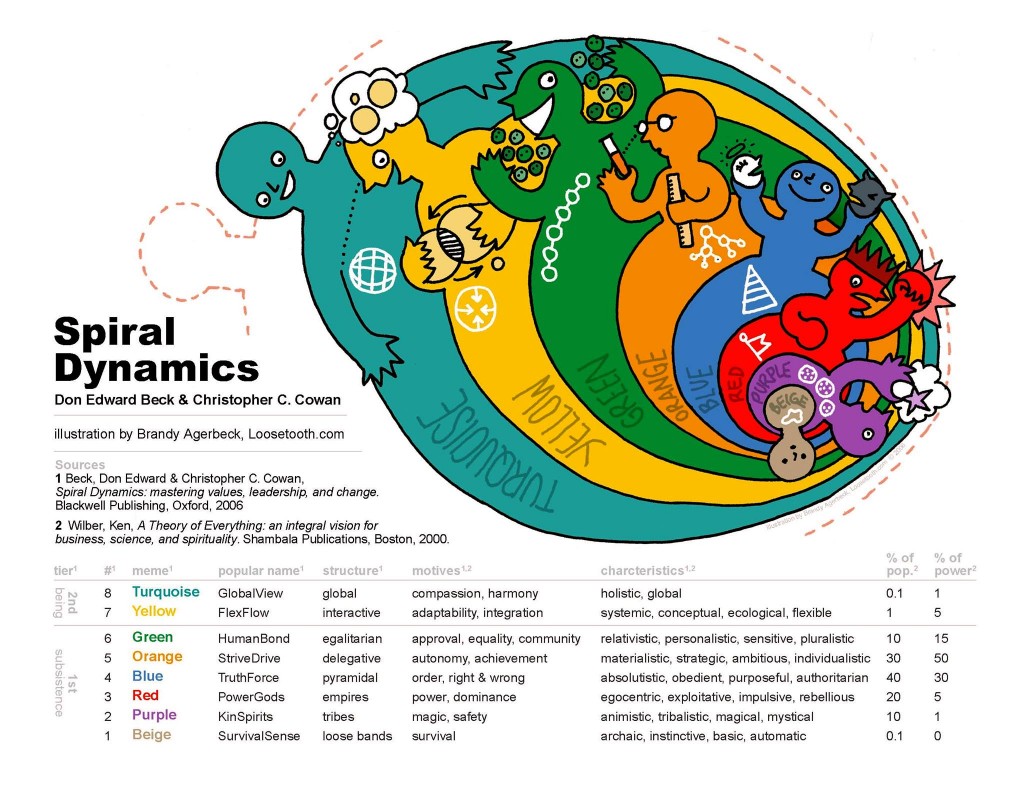
    I’m Blue. Red<-Blue->Orange (conservative libertarian)

    If you add the extremes of female end of the spectrum like the chart begins of the extremes of male end of the spectrum then this ‘color spectrum’ just reflects the male to female brain structure and resulting bias. In other words, he’s cherry-picking the negative male (authoritarianism) an ignoring the negative female (communism).

    By representing it as a hierarchy he reinforces the left’s message. By representing it as a male-female spectrum we find ‘choice’ (rule of law) as the top of a triangle (orange).

    So as usual “stick with consistency between physics, biology, and sentience” and avoid these arbitrary organizations of information.

    <– self-female-internal-prey — psychotic – solipsistic – || empathic <- balanced -> analytic || – aspie – psychopathic — self-male-external-predator –>

    <-- Female ------------Ascendant Male - Established Male -->
    ...Socialist ..........Libertarian .....Conservative.......
    ...Global Empathic.....Local Pragmatic..Tribal Analytic......
    ...Plenty-Consumption..Trade ...........Scarcity Capitalization

    P-LAW LESSON
    Spiral Dynamics is an excample of a failure of “Limits” and “Full accounting”, and it violates the laws of (a) extrapolating a line instead of discovering a curve, (b) equlibria (c) between three axis that are necessary in all evolutionary systems.

    THE CRAYON LESSON
    There isn’t any truth that can be written in crayon (non-equlibrating, mono-dimensional systems). Humans evolved to throw things. Our consciousness tends to think in the most trivial ‘linearly predictable’ terms. We fail to educate people out of linear and into equilibrial patterns of thought. In other words, most humans are still medieval in mind.

    CAUSALITY
    What causes instinctual differences in preference for these conditions?

    So try the Testimonial checklist:

    1 – realism, naturalism, operationalism? (unanswered)
    2 – internally consistent? (yes)
    3 – operationally possible (unanswered)
    4 – externally correspondent (sure)
    5 – rational (yes)
    6 – reciprocal (unanswered)
    … … fully informed (no)
    … … free of negative externality (fails)
    7 – limited (no) and complete (no)
    8 – warrantable and liable (no)

    So? Internally consistent, externally correspondent, rational but noncausal and incomplete.

    It’s incomplete because it doesn’t take communal to the point of failure(limits) while it takes individual to the point of failure (limits). This creates the impression that one is looking at a hierarchy rather than an equilibrium.

    (All systems require three points, not two, in order to produce an equilibrium. Or rather an equilibrium compromise(center) evolves between two or more limits. The entirety of the physical universe consists of equilibrium (states) between extremes. ) For example, personalities may include many dimensions but they bias male or female and they cluster in three archetypes: female, ascendent male, and dominant male.

    Equilibrium in this case is the same as all other human instinctual, ethical, moral, political, conceptual: Dominant Male Force (red), Ascendant Male Empirical Trade (orange), and (Undermining) Female Empathy (Off the chart).

    So it should be “Rainbow Dynamics” not Spiral Dynamics.

    Authoritarian Hierarchy (?-genic)
    ... Beige (Totalitarianism)
    ... ... Purple 
    ... ... ... Red 
    ----------
    ... ... ... ... Blue 
    ... ... ... ... ... Orange (Markets) (Meritocracy) (Eugenic)
    ... ... ... ... Green 
    ----------
    ... ... ... Yellow 
    ... ... Turquoise 
    ... [Pink?] 
    (Communism)Authoritarian Equality (Dysgenic)
    

    1 – How do you make SD consistent with the rest of the explanation of causality? (biology)
    2 – What is the operational means of describing it? Cause? I just changed it to causal. (Reproductive strategy.)
    3 – How can our interests AFFORD to swing from individual to communal? (because of market wealth)
    4 – What happens if we reach communal or global? (Failure)
    5 – Is anything communal calculable or global? (No)
    6 – To whose disadvantage is this global-harmony communal communist condition? (The Best short-term, evolution medium-term, human survival long-term.)
    7 – Why do authoritarian France, China, Russia, Turkey, Iran, North Korea exist? (The pursuit of Power to Stay in power).
    8 – Why do only religions practice globalism? (underclass expansion of dysgenia)
    9 – Isn’t that what separates a religion (imaginary) from a government (material)? (the Material reality)

    The spiral is instead a description of ‘population’ we’re calculating on behalf of, and population we can afford to calculate on behalf of is a description of wealth to do so.

    ADDING SPIRAL DYNAMICS TO BIG 5 AND MEYERS BRIGGS.
    So, just as I’ve explained the causality and difference between big 5 vs the Meyers Briggs, we can add spiral dynamics to the list. All of these ‘ways of thinking’ are incomplete because they discontiguous with causality.
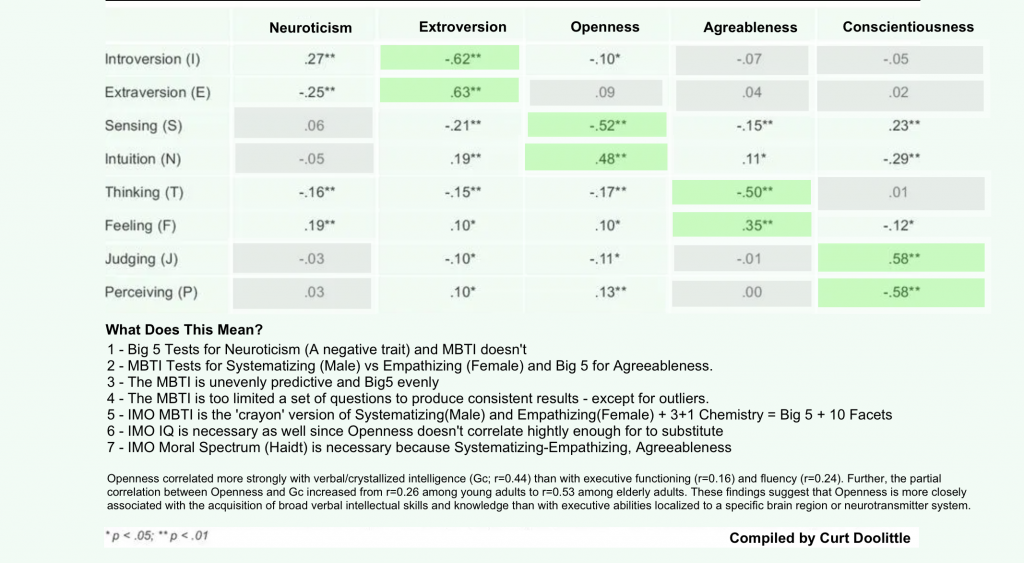


    The underlying causality is the structure of the brain and the structure of the brain that gives rise to differences begins almost entirely by sex differences, the quality of the brain. The ‘quality’ of development of the brain, and the sequence of human development in the brain of a given quality.

    So it’s not that any of these three systems of thought is ‘false’ it’s that they are incomplete, and as incomplete they serve two undesirable ends: (a) they prevent knowledge of causality (they cause ignorance), (b) they encourage inductive and deductive falsehoods. And so half-truths pollute the informational commons just as much as lies do.

    In the case of Big 5 it obscures male-female (the undesirable truth); MB doesn’t obscure male-female, but obscures neuroticism (the negative); Spiral Dynamics obscures the negative consequences of ‘global’ (unaccountable, and unmeasurable) thought (the negative), and that the equilibrium point is markets.

    All these systems obscure the undesirable truth. They put forth a FALSE PROMISE THAT BAITS INTO HAZARD.

    Karl Popper’s short, wonderful essay, on The Sources of Knowledge and Ignorance, teaches a very important lesson: that useful but incomplete, or useful but false knowledge, causes ignorance. (Hence my stance on Abrahamism). Likewise, Hayek’s Use of Knowledge in Society examines the problem at scale and explains why market trial and error are the unintuitive but optimum means of human organization.

    Cheers
  • Correct. Kin selection forces kin preference, race differences in neoteny force

    Correct. Kin selection forces kin preference, race differences in neoteny force differences in reproductive desirability, class sizes cause competitive advantage, group conflict increases with intersocial dependence, and intersocial dependence increases with declines in ability.

    Reply addressees: @MindTrained

  • Correct. Kin selection forces kin preference, race differences in neoteny force

    Correct. Kin selection forces kin preference, race differences in neoteny force differences in reproductive desirability, class sizes cause competitive advantage, group conflict increases with intersocial dependence, and intersocial dependence increases with declines in ability.


    Source date (UTC): 2020-08-15 00:49:10 UTC

    Original post: https://twitter.com/i/web/status/1294435931588636672

    Reply addressees: @MindTrained

    Replying to: https://twitter.com/i/web/status/1294373185555582976

  • 4 – Almost all taxes are provided by a minority of men between 35-65. So I mean,

    4 – Almost all taxes are provided by a minority of men between 35-65.

    So I mean, yes. Men are disposable today too. And that’s why the incels are angry. Historically this many unmarried unsexed men led to civil wars. But those were farmers and these guys play video games. 😉

    Reply addressees: @TruthQuest11 @MrMatt444 @DegenRolf

  • 4 – Almost all taxes are provided by a minority of men between 35-65. So I mean,

    4 – Almost all taxes are provided by a minority of men between 35-65.

    So I mean, yes. Men are disposable today too. And that’s why the incels are angry. Historically this many unmarried unsexed men led to civil wars. But those were farmers and these guys play video games. 😉


    Source date (UTC): 2020-08-14 16:20:50 UTC

    Original post: https://twitter.com/i/web/status/1294308006465867776

    Reply addressees: @TruthQuest11 @MrMatt444 @DegenRolf

    Replying to: https://twitter.com/i/web/status/1294307500850905088


    IN REPLY TO:

    Unknown author

    @TruthQuest11 @MrMatt444 @DegenRolf 3 – And do so to produce less than replacement population.
    In other words, if 2/3 of men disappeared it wouldn’t matter other than the ability to resist invasion – but the state has made it impossible to resist invasion, so these men are replaced by state-pliable immigrants.

    Original post: https://x.com/i/web/status/1294307500850905088

  • Definition Sentiments: Machiavelli vs Pareto vs Haidt vs Hayek vs Doolittle

    Definition Sentiments: Machiavelli vs Pareto vs Haidt vs Hayek vs Doolittle https://t.co/pXm5eSR3aX

  • Definition Sentiments: Machiavelli vs Pareto vs Haidt vs Hayek vs Doolittle

    Definition Sentiments: Machiavelli vs Pareto vs Haidt vs Hayek vs Doolittle https://propertarianinstitute.com/2020/08/07/definition-sentiments-machiavelli-vs-pareto-vs-haidt-vs-hayek-vs-doolittle/


    Source date (UTC): 2020-08-07 11:26:52 UTC

    Original post: https://twitter.com/i/web/status/1291697310733344768

  • Definition Sentiments: Machiavelli vs Pareto vs Haidt vs Hayek vs Doolittle

    Definition Sentiments: Machiavelli vs Pareto vs Haidt vs Hayek vs Doolittle

    SENTIMENTSENTIMENTSRESIDUESDERIVATIONS â€“ Sentiments are a set of culture and class value judgments, that while rational and economic in nature, are unarticulated, since they are taught by habit, tradition, family, environment, narrative, and allegorical experience. Unarticulated Social Portfolio Contents.

    1) MACHIAVELLI
    Machiavelli breaks people into two dominant classes: the conservative defenders of status quo (violent ‘lions’), and the radical promoters of change (cunning ‘foxes’). In his view of society, the power constantly passes from ‘foxes’ to ‘lions’ and vice versa. (He did not imagine ‘managers’, the managerial society, the use of credit by bankers, and their use of ‘calculation’.)

    NOTE: Machiavelli did not say that “The ends justify the means.” The correct translation would be ‘one must consider the result’. Or ‘one must keep in mind the outcome’. This is a typically teleological and consequentialist view of ethics. He is much maligned, and unjustly so. He is the first political scientist after Aristotle.

    2) PARETO
    Pareto’s Class I and II residues are an extension and amplification of certain aspects of political theorizing set down in the fifteenth century by Niccolo Machiavelli. Machiavelli divided humans into two classes, foxes and lions. The qualities he ascribes to these two classes of men resemble quite closely the qualities typical of Pareto’s Class I and Class II residue types. Men with strong Class I residues are the “foxes,” tending to be manipulative, innovative, calculating, and imaginative. Entrepreneurs prone to taking risks, inventors, scientists, authors of fiction, politicians, and creators of complex philosophies fall into this category. Class II men are “lions” and place much more value on traits such as good character and devotion to duty than on sheer wits. They are the defenders of tradition, the guardians of religious dogma, and the protectors of national honor. For society to function properly there must be a balance between these two types of individuals; the functional relationship between the two is complementary.

    RESIDUES
    Pareto defines the following ‘Residues’.

    • Class I (Foxes) is the “instinct for combinations.” This is the manifestation of sentiments in individuals and in society that tends towards progressiveness, inventiveness, and the desire for adventure. Class I Foxes attempt to use VERBALISMS to influence the “TIE BREAKER” decisions in a society in order to alter the spending in the SOCIAL PORTFOLIO to change the properties of the ETHICAL ACCOUNTS in the SOCIAL ORDER, in order to transfer opportunity, POWER and wealth from one group to another.That this transfer needs to occur on a regular basis in order for society to adapt, is not in question. Whether or not social stability, the competitiveness of the society is preserved or increased, or whether the power will end up in hands who would materially better the society rather than just reallocate its wealth and power is always open to question.
    • Class II (Lions) residues have to do with what Pareto calls the “preservation of aggregates” and encompass the more conservative side of human nature, including loyalty to society’s enduring institutions such as family, church, community, and nation and the desire for permanency and security.
    • Class III residues (Group Rituals) have to do with the need to express sentiments through external action. Pareto’s Religious and patriotic ceremonies and pageantry stand out as examples of these residues and will include such things as saluting the flag, participating in a Christian communion service, marching in a military parade, and so on. In other words, human beings tend to manifest their feelings in symbols.
    • Class IV residues (Moral Sentiments), the SOCIAL PORTFOLIO, are the social instinct, embracing manifestations of sentiments in support of the individual and societal discipline that is indispensable for maintaining the social structure. This includes phenomena such as self-sacrifice for the sake of family and community and concepts such as the hierarchical arrangement of societies.
    • Class V is that quality in a society that stresses individual integrity and the integrity of the individual’s possessions and appurtenances – ‘things that belong together’, or PROPERTY DEFINITIONS. These residues contribute to social stability, systems of criminal and civil law being the most obvious examples.
    • Class VI, which is the sexual instinct or the tendency to see social events in sexual terms.

    These residues are universal to all societies. However, each society creates multiple ‘Derivations’ that justify these sentiments. These derivations vary from society to society.

    DERIVATIONS

    Pareto uses the term “derivations,” for ostensibly logical justifications that people employ to rationalize their essentially non-logical, sentiment-driven actions. Pareto names four principle classes of derivations:

    • Derivations of assertion; statements of a dogmatic or aphoristic nature, for example the saying, “honesty is the best policy.”
    • Derivations of authority; authority, is an appeal to people or concepts held in high esteem by tradition. To cite the opinion of one of the American Founding Fathers on some topic of current interest is to draw from Class II derivations.
    • Derivations that are in agreement with common sentiments and principles: appeals to “universal judgement,” the “will of the people,” the “best interests of the majority,” or similar sentiments.
    • Derivations of verbal proof: Relying upon various verbal gymnastics, metaphors, allegories, and so forth.

    3) HAIGHT â€“ MORAL FOUNDATIONS THEORY

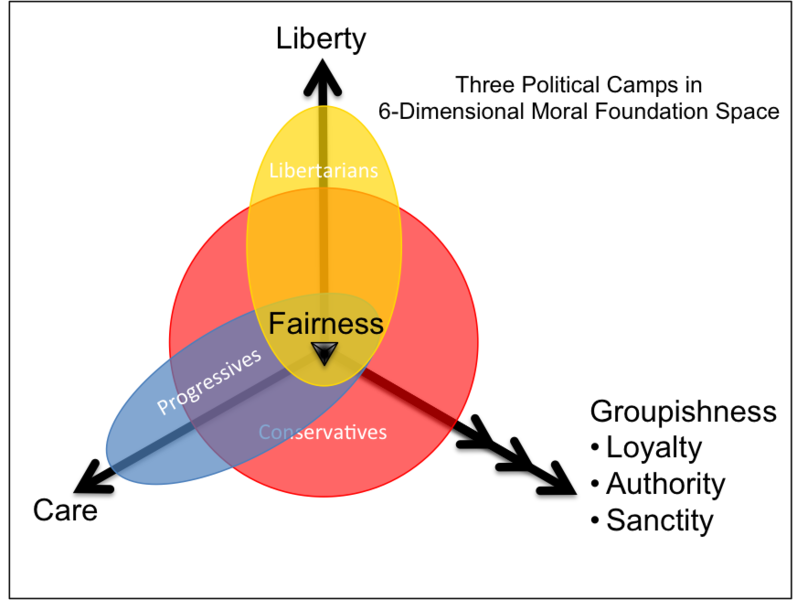
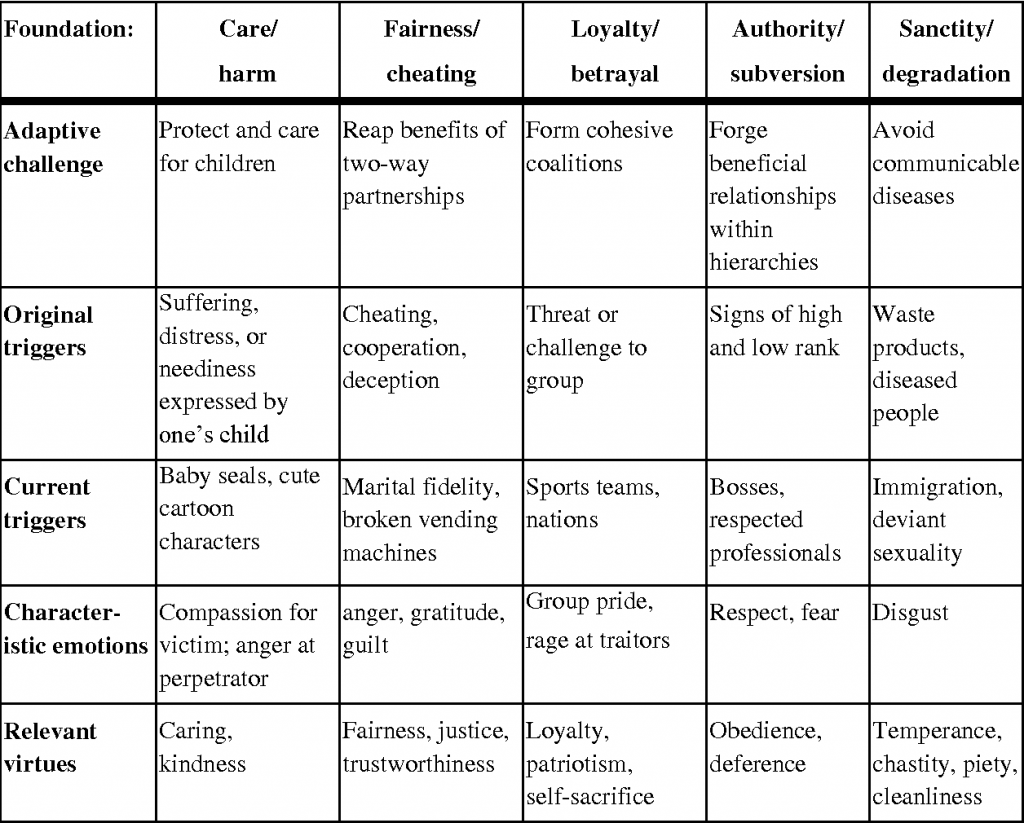
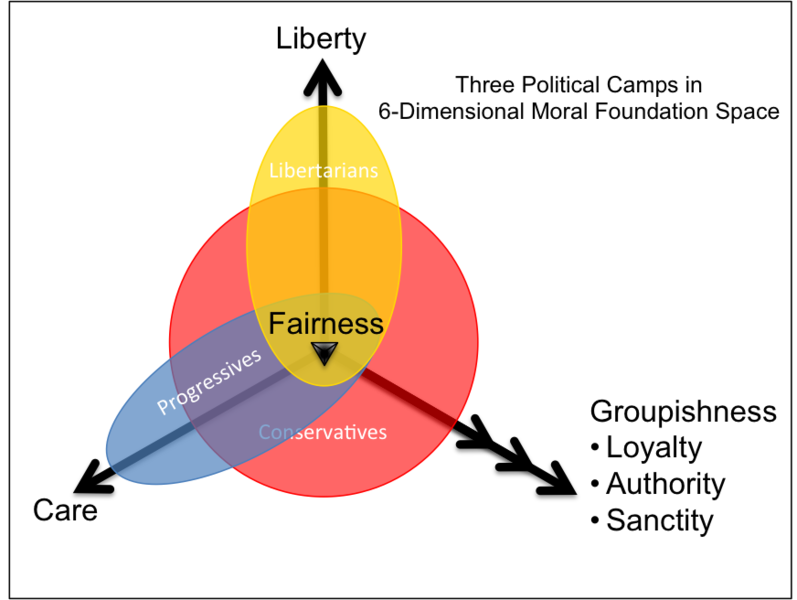
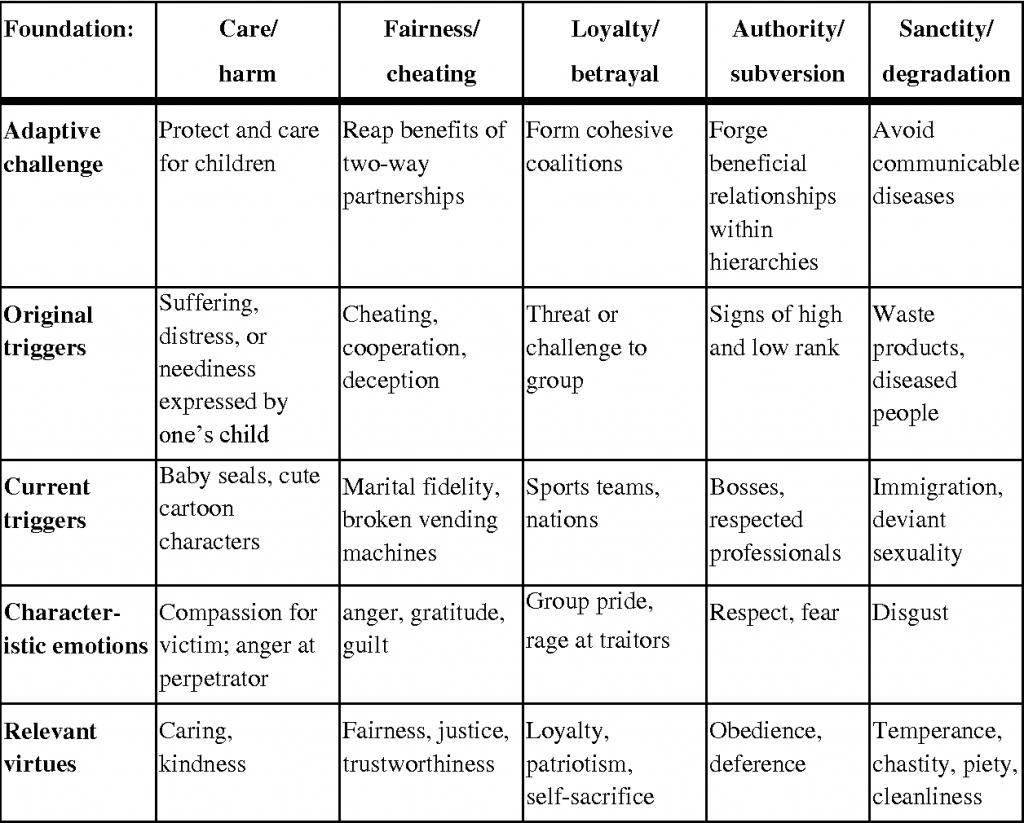
    Jonathan Haidt has improved on Pareto and Machiavelli with Moral Foundations Theory. MFT reduces human political preferences to six sensibilities:

    Moral Foundations Theory:

    • 1) Care/harm: This foundation is related to our long evolution as mammals with attachment systems and an ability to feel (and dislike) the pain of others. It underlies virtues of kindness, gentleness, and nurturance.
    • 2) Fairness/cheating: This foundation is related to the evolutionary process of reciprocal altruism. It generates ideas of justice, rights, and autonomy. [Note: In our original conception, Fairness included concerns about equality, which are more strongly endorsed by political liberals. However, as we reformulated the theory in 2011 based on new data, we emphasize proportionality, which is endorsed by everyone, but is more strongly endorsed by conservatives]
    • 3) Liberty/oppression: This foundation is about the feelings of reactance and resentment people feel toward those who dominate them and restrict their liberty. Its intuitions are often in tension with those of the authority foundation. The hatred of bullies and dominators motivates people to come together, in solidarity, to oppose or take down the oppressor.
    • 4) Loyalty/betrayal: This foundation is related to our long history as tribal creatures able to form shifting coalitions. It underlies virtues of patriotism and self-sacrifice for the group. It is active anytime people feel that it’s “one for all, and all for one.”
    • 5) Authority/subversion: This foundation was shaped by our long primate history of hierarchical social interactions. It underlies virtues of leadership and followership, including deference to legitimate authority and respect for traditions.
    • 6) Sanctity/degradation: This foundation was shaped by the psychology of disgust and contamination. It underlies religious notions of striving to live in an elevated, less carnal, more noble way. It underlies the widespread idea that the body is a temple which can be desecrated by immoral activities and contaminants (an idea not unique to religious traditions).

    SENTIMENT MAP – (undone)

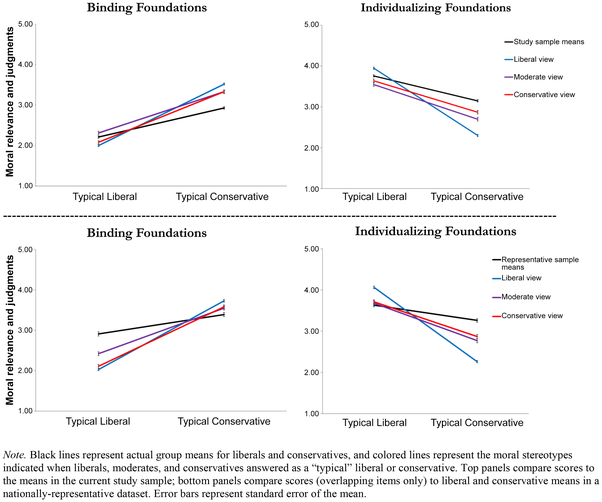
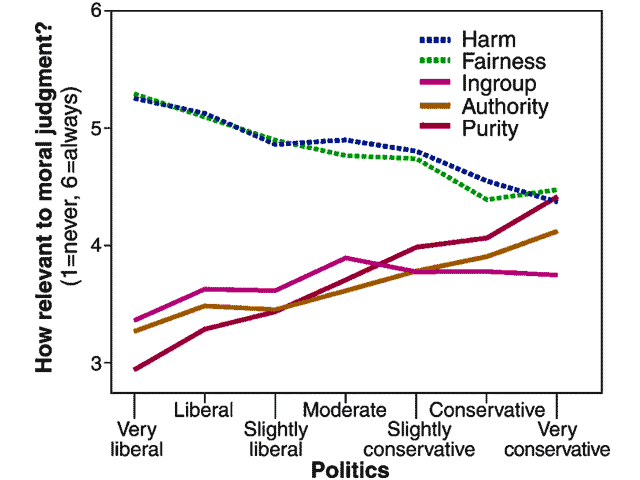
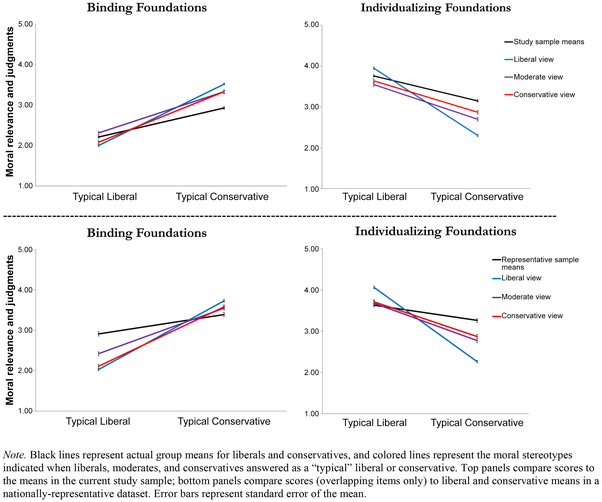
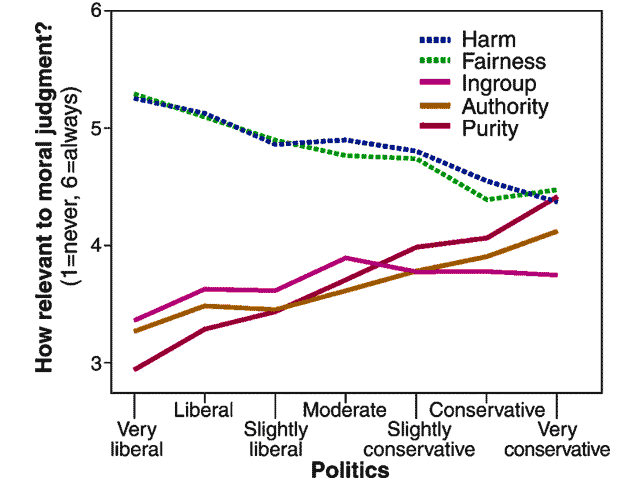
    Haidt found that Americans who identified as liberals tend to value care and fairness considerably higher than loyalty, respect, and purity. Self-identified conservative Americans value all five values more equally, though at a lower level than the liberal concern for care and fairness. Both groups gave care the highest over-all weighting, but conservatives valued fairness the lowest, whereas liberals valued purity the lowest. Similar results were found across the political spectrum in other countries.

    4) AXELROD – (undone)

    5) HAYEK – (undone)

    6) DOOLITTLE – (undone) Like Hayek I categorize institutions, traditions, norms, values as capital. I reduce all equivalents to “Residues and Derivations” to basic instincts, and group competitive strategies, and logics within them. And I convert Haidt’s moral intuitions to property rights, and property rights to explain political and economic biases. Why? To unify all thought from biology, to instinct, to group strategy to means of arguing for it. The result is that “residues and derivations’ are no longer arbitrary – but rationally explicable. The reason is, that incompatible (competing) intuitions can’t survive internal consistency even if narratives that justify them fail any or every test of rational consistency.

  • Definition Sentiments: Machiavelli vs Pareto vs Haidt vs Hayek vs Doolittle

    Definition Sentiments: Machiavelli vs Pareto vs Haidt vs Hayek vs Doolittle

    SENTIMENTSENTIMENTSRESIDUESDERIVATIONS â€“ Sentiments are a set of culture and class value judgments, that while rational and economic in nature, are unarticulated, since they are taught by habit, tradition, family, environment, narrative, and allegorical experience. Unarticulated Social Portfolio Contents.

    1) MACHIAVELLI
    Machiavelli breaks people into two dominant classes: the conservative defenders of status quo (violent ‘lions’), and the radical promoters of change (cunning ‘foxes’). In his view of society, the power constantly passes from ‘foxes’ to ‘lions’ and vice versa. (He did not imagine ‘managers’, the managerial society, the use of credit by bankers, and their use of ‘calculation’.)

    NOTE: Machiavelli did not say that “The ends justify the means.” The correct translation would be ‘one must consider the result’. Or ‘one must keep in mind the outcome’. This is a typically teleological and consequentialist view of ethics. He is much maligned, and unjustly so. He is the first political scientist after Aristotle.

    2) PARETO
    Pareto’s Class I and II residues are an extension and amplification of certain aspects of political theorizing set down in the fifteenth century by Niccolo Machiavelli. Machiavelli divided humans into two classes, foxes and lions. The qualities he ascribes to these two classes of men resemble quite closely the qualities typical of Pareto’s Class I and Class II residue types. Men with strong Class I residues are the “foxes,” tending to be manipulative, innovative, calculating, and imaginative. Entrepreneurs prone to taking risks, inventors, scientists, authors of fiction, politicians, and creators of complex philosophies fall into this category. Class II men are “lions” and place much more value on traits such as good character and devotion to duty than on sheer wits. They are the defenders of tradition, the guardians of religious dogma, and the protectors of national honor. For society to function properly there must be a balance between these two types of individuals; the functional relationship between the two is complementary.

    RESIDUES
    Pareto defines the following ‘Residues’.

    • Class I (Foxes) is the “instinct for combinations.” This is the manifestation of sentiments in individuals and in society that tends towards progressiveness, inventiveness, and the desire for adventure. Class I Foxes attempt to use VERBALISMS to influence the “TIE BREAKER” decisions in a society in order to alter the spending in the SOCIAL PORTFOLIO to change the properties of the ETHICAL ACCOUNTS in the SOCIAL ORDER, in order to transfer opportunity, POWER and wealth from one group to another.That this transfer needs to occur on a regular basis in order for society to adapt, is not in question. Whether or not social stability, the competitiveness of the society is preserved or increased, or whether the power will end up in hands who would materially better the society rather than just reallocate its wealth and power is always open to question.
    • Class II (Lions) residues have to do with what Pareto calls the “preservation of aggregates” and encompass the more conservative side of human nature, including loyalty to society’s enduring institutions such as family, church, community, and nation and the desire for permanency and security.
    • Class III residues (Group Rituals) have to do with the need to express sentiments through external action. Pareto’s Religious and patriotic ceremonies and pageantry stand out as examples of these residues and will include such things as saluting the flag, participating in a Christian communion service, marching in a military parade, and so on. In other words, human beings tend to manifest their feelings in symbols.
    • Class IV residues (Moral Sentiments), the SOCIAL PORTFOLIO, are the social instinct, embracing manifestations of sentiments in support of the individual and societal discipline that is indispensable for maintaining the social structure. This includes phenomena such as self-sacrifice for the sake of family and community and concepts such as the hierarchical arrangement of societies.
    • Class V is that quality in a society that stresses individual integrity and the integrity of the individual’s possessions and appurtenances – ‘things that belong together’, or PROPERTY DEFINITIONS. These residues contribute to social stability, systems of criminal and civil law being the most obvious examples.
    • Class VI, which is the sexual instinct or the tendency to see social events in sexual terms.

    These residues are universal to all societies. However, each society creates multiple ‘Derivations’ that justify these sentiments. These derivations vary from society to society.

    DERIVATIONS

    Pareto uses the term “derivations,” for ostensibly logical justifications that people employ to rationalize their essentially non-logical, sentiment-driven actions. Pareto names four principle classes of derivations:

    • Derivations of assertion; statements of a dogmatic or aphoristic nature, for example the saying, “honesty is the best policy.”
    • Derivations of authority; authority, is an appeal to people or concepts held in high esteem by tradition. To cite the opinion of one of the American Founding Fathers on some topic of current interest is to draw from Class II derivations.
    • Derivations that are in agreement with common sentiments and principles: appeals to “universal judgement,” the “will of the people,” the “best interests of the majority,” or similar sentiments.
    • Derivations of verbal proof: Relying upon various verbal gymnastics, metaphors, allegories, and so forth.

    3) HAIGHT â€“ MORAL FOUNDATIONS THEORY

    Jonathan Haidt has improved on Pareto and Machiavelli with Moral Foundations Theory. MFT reduces human political preferences to six sensibilities:

    Moral Foundations Theory:

    • 1) Care/harm: This foundation is related to our long evolution as mammals with attachment systems and an ability to feel (and dislike) the pain of others. It underlies virtues of kindness, gentleness, and nurturance.
    • 2) Fairness/cheating: This foundation is related to the evolutionary process of reciprocal altruism. It generates ideas of justice, rights, and autonomy. [Note: In our original conception, Fairness included concerns about equality, which are more strongly endorsed by political liberals. However, as we reformulated the theory in 2011 based on new data, we emphasize proportionality, which is endorsed by everyone, but is more strongly endorsed by conservatives]
    • 3) Liberty/oppression: This foundation is about the feelings of reactance and resentment people feel toward those who dominate them and restrict their liberty. Its intuitions are often in tension with those of the authority foundation. The hatred of bullies and dominators motivates people to come together, in solidarity, to oppose or take down the oppressor.
    • 4) Loyalty/betrayal: This foundation is related to our long history as tribal creatures able to form shifting coalitions. It underlies virtues of patriotism and self-sacrifice for the group. It is active anytime people feel that it’s “one for all, and all for one.”
    • 5) Authority/subversion: This foundation was shaped by our long primate history of hierarchical social interactions. It underlies virtues of leadership and followership, including deference to legitimate authority and respect for traditions.
    • 6) Sanctity/degradation: This foundation was shaped by the psychology of disgust and contamination. It underlies religious notions of striving to live in an elevated, less carnal, more noble way. It underlies the widespread idea that the body is a temple which can be desecrated by immoral activities and contaminants (an idea not unique to religious traditions).

    SENTIMENT MAP – (undone)

    Haidt found that Americans who identified as liberals tend to value care and fairness considerably higher than loyalty, respect, and purity. Self-identified conservative Americans value all five values more equally, though at a lower level than the liberal concern for care and fairness. Both groups gave care the highest over-all weighting, but conservatives valued fairness the lowest, whereas liberals valued purity the lowest. Similar results were found across the political spectrum in other countries.

    4) AXELROD – (undone)

    5) HAYEK – (undone)

    6) DOOLITTLE – (undone) Like Hayek I categorize institutions, traditions, norms, values as capital. I reduce all equivalents to “Residues and Derivations” to basic instincts, and group competitive strategies, and logics within them. And I convert Haidt’s moral intuitions to property rights, and property rights to explain political and economic biases. Why? To unify all thought from biology, to instinct, to group strategy to means of arguing for it. The result is that “residues and derivations’ are no longer arbitrary – but rationally explicable. The reason is, that incompatible (competing) intuitions can’t survive internal consistency even if narratives that justify them fail any or every test of rational consistency.

  • 4) So he’s right. The only Europeans that ever existed were the aristocracy. And

    4) So he’s right. The only Europeans that ever existed were the aristocracy.

    And we, in our vanity, thought we could replace them.