WHY SOUTH AMERICA? 1. Population of natives and slaves. 2. christianity => increase trust to increase cooperation. 3. church => will to power by the weak. 4. church => high rates of reproduction, mysticism to govern them and anti-empiricism and anti-meritocracy to maintain control over them. 5. high rates of reproduction => underclass poverty 6. vast underclass poverty => demand for socialism. 7. demand for socialism => demand for authority instead of rule of law. 8. lack of rule of law = lack of militia to defend against corruption under rule of law by threat of overthrow. This is the cycle of poverty, dysgenia, corruption, and stagnation under the church – a cycle only broken in northern europe by aristocratic manorialism to suppress the growth of the underclass, and the subsequent middle class restoration of trade, and the subsequent restoration of rule of law, and the subsequent wealth, and the subsequent literacy, and the subsequent break with the parasitism mysticism and dysgenia of the church, and the subsequent conquest of the world, and the subsequent industrial, scientific, technical, medical, and informational revolutions, and the subsequent dragging of mankind – kicking and screaming against the european aristocracy – out of their addiction to ignorance, superstition, hard labor, poverty, starvation, disease, suffering, child mortality, early death, tyranny, and the victimhood of nature all but hostile to life. Then the academy, which had evolved as an extension of the church to teach church dogma, shifted from mythology, theology, and the granting of indulgences to alternate history, pseudoscience, and the granting of useless diplomas under the second jewish attack on western civilization.
Theme: Civilization
-
Why South America?
WHY SOUTH AMERICA? 1. Population of natives and slaves. 2. christianity => increase trust to increase cooperation. 3. church => will to power by the weak. 4. church => high rates of reproduction, mysticism to govern them and anti-empiricism and anti-meritocracy to maintain control over them. 5. high rates of reproduction => underclass poverty 6. vast underclass poverty => demand for socialism. 7. demand for socialism => demand for authority instead of rule of law. 8. lack of rule of law = lack of militia to defend against corruption under rule of law by threat of overthrow. This is the cycle of poverty, dysgenia, corruption, and stagnation under the church – a cycle only broken in northern europe by aristocratic manorialism to suppress the growth of the underclass, and the subsequent middle class restoration of trade, and the subsequent restoration of rule of law, and the subsequent wealth, and the subsequent literacy, and the subsequent break with the parasitism mysticism and dysgenia of the church, and the subsequent conquest of the world, and the subsequent industrial, scientific, technical, medical, and informational revolutions, and the subsequent dragging of mankind – kicking and screaming against the european aristocracy – out of their addiction to ignorance, superstition, hard labor, poverty, starvation, disease, suffering, child mortality, early death, tyranny, and the victimhood of nature all but hostile to life. Then the academy, which had evolved as an extension of the church to teach church dogma, shifted from mythology, theology, and the granting of indulgences to alternate history, pseudoscience, and the granting of useless diplomas under the second jewish attack on western civilization.
-
The Dependence on Land and The Variation in Group Strategies
–“I was working the rather large winter garden this afternoon I have planted with my father. Thinking about the respective Peloponnesian and Delian strategies. It got me thinking about two things. Agricultural productivity / output and the concurrent effervescence of commercial activity, economic growth, and thus civilisational expansion (consider this also in a Rome vs Carthage context too). The second angle was the context of one’s own personal independence and self-sovereignty, in this sense as a landowner, either large or small scale. Be it in terms of food supply, land as a hold of value, and also as an individual / family / community area with which to defend one’s own assets. Whilst Australia and America have different cultures and expressions of “homesteading” there are some similarities too, you might call it a “dying frontier of the self-owned man”. Do you have any pointers or suggestions from a Propertarian standpoint?”— A Friend
[Y]es, you have the correct insight, that I would translate as “If a man is dependent upon the land, he intuits others are also dependent upon the land, and that he cannot defend his land nor can others without collective defense of land, and collective defense by almost everyone. This is the opposite of migratory pastoralists and disaporic traders (Carthage), or diasporic usurers (Jews), or diasporic thieves(gypsies), or diasporic raiders(muslims), diasporic rent seekers(russians, mongols), but not the same as settled(germans, spartans) or diasporic producers (europeans, chinese – and what should have been hindus). That is because we specialize in different strategies and our value of territory, built capital, institutional, and cultural commons, differs by where our revenue comes from and the composition of our ‘armies’ and the strategy that these men use for control of predation (raiding), parasitism (extractive rule, usury, theft), or domestication (productive rule, settlement, common capital production.)
-
The Dependence on Land and The Variation in Group Strategies
–“I was working the rather large winter garden this afternoon I have planted with my father. Thinking about the respective Peloponnesian and Delian strategies. It got me thinking about two things. Agricultural productivity / output and the concurrent effervescence of commercial activity, economic growth, and thus civilisational expansion (consider this also in a Rome vs Carthage context too). The second angle was the context of one’s own personal independence and self-sovereignty, in this sense as a landowner, either large or small scale. Be it in terms of food supply, land as a hold of value, and also as an individual / family / community area with which to defend one’s own assets. Whilst Australia and America have different cultures and expressions of “homesteading” there are some similarities too, you might call it a “dying frontier of the self-owned man”. Do you have any pointers or suggestions from a Propertarian standpoint?”— A Friend
[Y]es, you have the correct insight, that I would translate as “If a man is dependent upon the land, he intuits others are also dependent upon the land, and that he cannot defend his land nor can others without collective defense of land, and collective defense by almost everyone. This is the opposite of migratory pastoralists and disaporic traders (Carthage), or diasporic usurers (Jews), or diasporic thieves(gypsies), or diasporic raiders(muslims), diasporic rent seekers(russians, mongols), but not the same as settled(germans, spartans) or diasporic producers (europeans, chinese – and what should have been hindus). That is because we specialize in different strategies and our value of territory, built capital, institutional, and cultural commons, differs by where our revenue comes from and the composition of our ‘armies’ and the strategy that these men use for control of predation (raiding), parasitism (extractive rule, usury, theft), or domestication (productive rule, settlement, common capital production.)
-
RT @ThruTheHayes: We are blessed with the opportunity to write our names on hist
RT @ThruTheHayes: We are blessed with the opportunity to write our names on history for ten thousand years.
Revel in it.
-@curtdoolittle
Source date (UTC): 2020-04-24 17:18:27 UTC
Original post: https://twitter.com/i/web/status/1253735065697366016
-
THE DEPENDENCE ON LAND AND THE VARIATION IN GROUP STRATEGIES –“I was working th
THE DEPENDENCE ON LAND AND THE VARIATION IN GROUP STRATEGIES
–“I was working the rather large winter garden this afternoon I have planted with my father.
Thinking about the respective Peloponnesian and Delian strategies. It got me thinking about two things. Agricultural productivity / output and the concurrent effervescence of commercial activity, economic growth, and thus civilisational expansion (consider this also in a Rome vs Carthage context too).
The second angle was the context of one’s own personal independence and self-sovereignty, in this sense as a landowner, either large or small scale. Be it in terms of food supply, land as a hold of value, and also as an individual / family / community area with which to defend one’s own assets.
Whilst Australia and America have different cultures and expressions of “homesteading” there are some similarities too, you might call it a “dying frontier of the self-owned man”.
Do you have any pointers or suggestions from a Propertarian standpoint?”— A Friend
Yes, you have the correct insight, that I would translate as “If a man is dependent upon the land, he intuits others are also dependent upon the land, and that he cannot defend his land nor can others without collective defense of land, and collective defense by almost everyone.
This is the opposite of migratory pastoralists and disaporic traders (Carthage), or diasporic usurers (Jews), or diasporic thieves(gypsies), or diasporic raiders(muslims), diasporic rent seekers(russians, mongols), but not the same as settled(germans, spartans) or diasporic producers (europeans, chinese – and what should have been hindus).
That is because we specialize in different strategies and our value of territory, built capital, institutional, and cultural commons, differs by where our revenue comes from and the composition of our ‘armies’ and the strategy that these men use for control of predation (raiding), parasitism (extractive rule, usury, theft), or domestication (productive rule, settlement, common capital production.)
Source date (UTC): 2020-04-24 12:15:00 UTC
-
Of course. Don’t be ridiculous. Because Tyr(Tiwas,Zeus) was the god of our peopl
Of course. Don’t be ridiculous. Because Tyr(Tiwas,Zeus) was the god of our people. Odin the god of the aristocracy, Thor(Mars) the Militia (Men). And the Epic Cycle our Mythos. Sol invictus-Mithras didn’t have time to coalesce. Jesus evolved as the god of the weak, slaves, women, and children. Nature’s spirits and ancestors were a hearth religion, our sky-god paganism a social religion, and Christianity was a political religion.
Source date (UTC): 2020-04-24 11:23:00 UTC
-
The French Have a Monopoly on The Bad Ideas
(sarcasm) [T]he french have a monopoly on the bad ideas of modernity. It’s sorta down hill after descartes. The ship of state leaks with the prosecution of the protestant business class. It’s a sinking-of-the-titanic by the French Revolution, and the peasantry’s genocide against the aristocracy. … There is no equal to russian literature. There is no equal to shakespeare. There is no equal to british empiricism and government. There is no equal to scottish enlightenment. There is no equal to italian art. No equal to german engineering. No equal to american law. …. Nor any equal to french folly. 😉 I love pissing on the french. lol ( Well, technically parisians. )
-
The French Have a Monopoly on The Bad Ideas
(sarcasm) [T]he french have a monopoly on the bad ideas of modernity. It’s sorta down hill after descartes. The ship of state leaks with the prosecution of the protestant business class. It’s a sinking-of-the-titanic by the French Revolution, and the peasantry’s genocide against the aristocracy. … There is no equal to russian literature. There is no equal to shakespeare. There is no equal to british empiricism and government. There is no equal to scottish enlightenment. There is no equal to italian art. No equal to german engineering. No equal to american law. …. Nor any equal to french folly. 😉 I love pissing on the french. lol ( Well, technically parisians. )
-
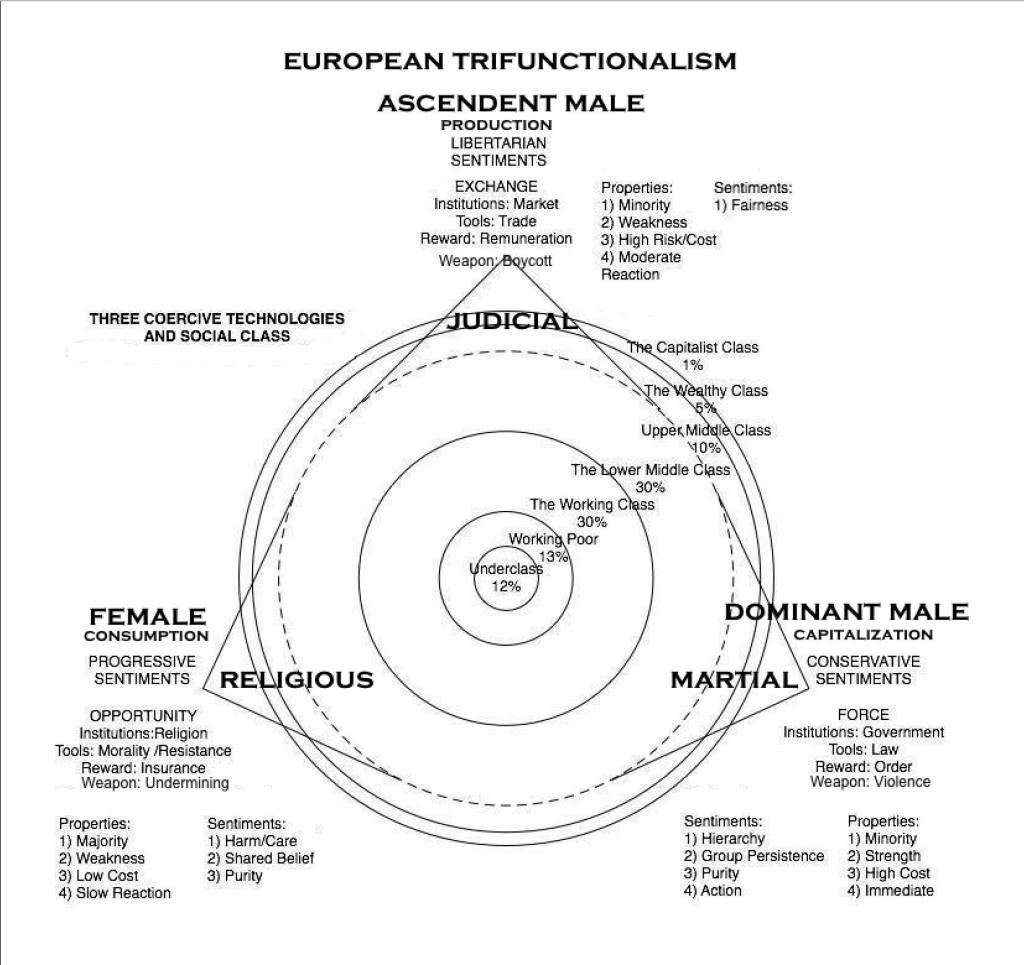
Trifunctionalism
Trifunctionalism https://propertarianism.com/2020/04/23/trifunctionalism/ https://t.co/vGj4qfyt7f
Source date (UTC): 2020-04-23 20:11:53 UTC
Original post: https://twitter.com/i/web/status/1253416325231173632