Theme: Civilization

  • Afghanistan and the Taliban are the reason it’s impossible to defeat Islam witho

    Afghanistan and the Taliban are the reason it’s impossible to defeat Islam without k–ing the host that’s the carrier. And the danger of sub-civil IQs (evil 80’s) once infected with that weapon of organization. Islam is female: it undermines social, political, econ, institutions.


    Source date (UTC): 2021-08-13 15:40:53 UTC

    Original post: https://twitter.com/i/web/status/1426207135193616392

  • from apes to humans

    So, now to the transitionals. Have fun!

    F. Clark Howell, Early Man Time Life Library, 1980

    Francis M Clapham, Our Human Ancestors, 1976

    Handprint : Ancestral Lines

    Prominent Hominid Fossils

    Afarensis to habilis:

    OH 24 is in between A. afarensis and habilis OH 24

    KMNR-1813 KNM-ER 1813 brain size bigger than afarensis but smaller than habilis. Face looks more like habilis

    B Asfaw, T White, O Lovejoy, B Latimer, S Simpson, G Suwa, Australopithecus garhi: a new species of early hominid from Ethiopia Science 284: 622-629, 1999. All individuals are intermediate between A. afarensis and H. habilis.

    Jawbone Fossil Fills a Gap in Early Human Evolution

    “Dr. Spoor said in an email that he agreed with the hypothesis that the new Ledi-Geraru mandible “derives from Australopithecus afarensis, and at 2.8 million years shows morphology that is ancestral to all early Homo.””

    Habilis to ergastor:

    Oldovai:Bed I has Habilis at bottom, then fossils with perfect mixture of characteristics of habilis and erectus, and erectus at top. At bottom of Bed II (top of Bed I) have fossils resemble H. erectus but brain case smaller than later H. erectus that lies immediately above them. pg 81

    OH 13, 14 was classified by some anthropologists as H. habilis but others as early H. erectus. 650 cc

    D2700 from Dmasi has features of both hablis and erectus. Fossil Hominids: Skull D2700

    Koobi Fora: Another succession with several habilis up to 2 Mya, then transitionals, and then erectus at 1.5 Mya.

    Ergastor to sapiens:

    Omo Valley, Ethiopia: ~ 500,000 ya. mixture erectus and sapiens features Omo | Remains & Dating

    Omo-1: mix of erectus and sapiens

    Omo-2 “remarkable mixture of Homo erectus and Homo sapiens characteristics” F. Clark Howell, Early Man Time Life Library, 1980 pg. 70.

    Sale in Morrocco: skull discovered in 1971, ~300,000 ya. also shows erectus and sapiens features.

    Broken Hill skull: another skull with mixtures of erectus and sapiens features

    Tautavel, 200Kya: large brow ridges and small cranium but rest of face looks like H. sapiens.

    “We shall see the problem of drawing up a dividing line between Homo erectus and Homo sapiens is not easy.” Francis M Clapham, Our Human Ancestors, 1976 pg 65.

    Ngaloba Beds of Laetoli, 120 Kya: ~1200 cc and suite of archaic (erectus) features.

    Guamde in Turkana Basin, 180 Kya: more modern features than Ngaloba but in-between erectus and sapiens.

    Skhul, Israel: “posed a puzzle to paleoanthropologists, appearing to be almost but not quite modern humans”

    Skhul and Jebel Qafza caves: “robust” H. sapiens at 120 Kya that have brow ridges like ergastor but brain case like sapiens.

    Bouri http://news.nationalgeographic.com/news/2003/06/0611_030611_earliesthuman.html First homo sapiens, actual paper: Nature

    Vertesszollos, 400 Kya. Teeth like H. ergastor but occipital bone like H. sapiens. brain ~ 1300 cc

    A Gibbons, Old skull has a new look. Science 280: 1525, June 5 1998. Primary article is: E Abbate et. al. A one-million-year-old Homo cranium from the Danakil (Afar) depression of Eritrea. Nature 393: 458-460, June 4 1998. Fossil with features intermediate between H. ergastor and H. sapiens.

    Herto skulls: 160,000 years old. Close but not quite anatomically modern. Herto skulls (Homo sapiens idaltu)

    White T.D., Asfaw B., DeGusta D., Gilbert H., Richards G.D., Suwa G. et al. (2003): Pleistocene Homo sapiens from Middle Awash, Ethiopia. Nature, 423:742-7.

    BOU-VP-16/1 is an almost complete adult cranium (shown at right). It is large and robust, with a cranial capacity estimated at 1450 cubic centimetres, larger than most modern humans. The skull is long and high in lateral view, and White et al. (2003) list a number of features in which it is near or beyond the limit of modern humans (the occipital angle, mastoid height, palate breadth). Viewed from above, its length exceeds any from a sample of over 3000 modern humans, but one width measurement is below the modern human average. The brow ridge is not prominent and is within the modern human range. BOU-VP-16/2 consists of portions of another adult cranium which appears to have been even larger than the previous specimen.

    Bodo: Bodo | anthropological and archaeological site, Ethiopia “a 600,000-year-old cranium that is intermediate in shape between Homo erectus and H. sapiens…the Bodo specimen reveals a transitional morphology between early members of the genus Homo and modern humans. “

    Ergastor (erectus) to neandertal:

    Stenheim and Swanscombe, 250 Kya: called H. heidelbergensis but have characteristics of both ergastor (erectus) and neanderthal. Large brows and small cranium ( ~1200cc) but otherwise looks like neanderthal

    Petroloma skull (complete): brow ridges and low forehead like ergastor (erectus) but not quite as primitive but not as derived as sapiens or neanderthal. Back of head resembles sapiens. 250 Kya

    Ehringsdorf in Germany and Saccopastore in Italy: mixture ergastor (erectus) and early neanderthals, classed as archaic H. sapiens or H. heidelbergensis

    H. cepranensis: https://anthropology.ua.edu/blogs/dssimpson1/2015/10/22/homo-cepranensis-still-its-own-species/ “serves as a bridge between H. ergaster/erectus, and H. heidelbergensis”
  • from apes to humans

    So, now to the transitionals. Have fun!

    F. Clark Howell, Early Man Time Life Library, 1980

    Francis M Clapham, Our Human Ancestors, 1976

    Handprint : Ancestral Lines

    Prominent Hominid Fossils

    Afarensis to habilis:

    OH 24 is in between A. afarensis and habilis OH 24

    KMNR-1813 KNM-ER 1813 brain size bigger than afarensis but smaller than habilis. Face looks more like habilis

    B Asfaw, T White, O Lovejoy, B Latimer, S Simpson, G Suwa, Australopithecus garhi: a new species of early hominid from Ethiopia Science 284: 622-629, 1999. All individuals are intermediate between A. afarensis and H. habilis.

    Jawbone Fossil Fills a Gap in Early Human Evolution

    “Dr. Spoor said in an email that he agreed with the hypothesis that the new Ledi-Geraru mandible “derives from Australopithecus afarensis, and at 2.8 million years shows morphology that is ancestral to all early Homo.””

    Habilis to ergastor:

    Oldovai:Bed I has Habilis at bottom, then fossils with perfect mixture of characteristics of habilis and erectus, and erectus at top. At bottom of Bed II (top of Bed I) have fossils resemble H. erectus but brain case smaller than later H. erectus that lies immediately above them. pg 81

    OH 13, 14 was classified by some anthropologists as H. habilis but others as early H. erectus. 650 cc

    D2700 from Dmasi has features of both hablis and erectus. Fossil Hominids: Skull D2700

    Koobi Fora: Another succession with several habilis up to 2 Mya, then transitionals, and then erectus at 1.5 Mya.

    Ergastor to sapiens:

    Omo Valley, Ethiopia: ~ 500,000 ya. mixture erectus and sapiens features Omo | Remains & Dating

    Omo-1: mix of erectus and sapiens

    Omo-2 “remarkable mixture of Homo erectus and Homo sapiens characteristics” F. Clark Howell, Early Man Time Life Library, 1980 pg. 70.

    Sale in Morrocco: skull discovered in 1971, ~300,000 ya. also shows erectus and sapiens features.

    Broken Hill skull: another skull with mixtures of erectus and sapiens features

    Tautavel, 200Kya: large brow ridges and small cranium but rest of face looks like H. sapiens.

    “We shall see the problem of drawing up a dividing line between Homo erectus and Homo sapiens is not easy.” Francis M Clapham, Our Human Ancestors, 1976 pg 65.

    Ngaloba Beds of Laetoli, 120 Kya: ~1200 cc and suite of archaic (erectus) features.

    Guamde in Turkana Basin, 180 Kya: more modern features than Ngaloba but in-between erectus and sapiens.

    Skhul, Israel: “posed a puzzle to paleoanthropologists, appearing to be almost but not quite modern humans”

    Skhul and Jebel Qafza caves: “robust” H. sapiens at 120 Kya that have brow ridges like ergastor but brain case like sapiens.

    Bouri http://news.nationalgeographic.com/news/2003/06/0611_030611_earliesthuman.html First homo sapiens, actual paper: Nature

    Vertesszollos, 400 Kya. Teeth like H. ergastor but occipital bone like H. sapiens. brain ~ 1300 cc

    A Gibbons, Old skull has a new look. Science 280: 1525, June 5 1998. Primary article is: E Abbate et. al. A one-million-year-old Homo cranium from the Danakil (Afar) depression of Eritrea. Nature 393: 458-460, June 4 1998. Fossil with features intermediate between H. ergastor and H. sapiens.

    Herto skulls: 160,000 years old. Close but not quite anatomically modern. Herto skulls (Homo sapiens idaltu)

    White T.D., Asfaw B., DeGusta D., Gilbert H., Richards G.D., Suwa G. et al. (2003): Pleistocene Homo sapiens from Middle Awash, Ethiopia. Nature, 423:742-7.

    BOU-VP-16/1 is an almost complete adult cranium (shown at right). It is large and robust, with a cranial capacity estimated at 1450 cubic centimetres, larger than most modern humans. The skull is long and high in lateral view, and White et al. (2003) list a number of features in which it is near or beyond the limit of modern humans (the occipital angle, mastoid height, palate breadth). Viewed from above, its length exceeds any from a sample of over 3000 modern humans, but one width measurement is below the modern human average. The brow ridge is not prominent and is within the modern human range. BOU-VP-16/2 consists of portions of another adult cranium which appears to have been even larger than the previous specimen.

    Bodo: Bodo | anthropological and archaeological site, Ethiopia “a 600,000-year-old cranium that is intermediate in shape between Homo erectus and H. sapiens…the Bodo specimen reveals a transitional morphology between early members of the genus Homo and modern humans. “

    Ergastor (erectus) to neandertal:

    Stenheim and Swanscombe, 250 Kya: called H. heidelbergensis but have characteristics of both ergastor (erectus) and neanderthal. Large brows and small cranium ( ~1200cc) but otherwise looks like neanderthal

    Petroloma skull (complete): brow ridges and low forehead like ergastor (erectus) but not quite as primitive but not as derived as sapiens or neanderthal. Back of head resembles sapiens. 250 Kya

    Ehringsdorf in Germany and Saccopastore in Italy: mixture ergastor (erectus) and early neanderthals, classed as archaic H. sapiens or H. heidelbergensis

    H. cepranensis: https://anthropology.ua.edu/blogs/dssimpson1/2015/10/22/homo-cepranensis-still-its-own-species/ “serves as a bridge between H. ergaster/erectus, and H. heidelbergensis”

  • Are you saying civilizations don’t practice different methods of warfare (See Va

    Are you saying civilizations don’t practice different methods of warfare (See Van Creveld, “The Culture of War”.)

    Try not to be a moron. It wastes peoples time, and it wastes electrons.


    Source date (UTC): 2021-08-13 01:00:34 UTC

    Original post: https://twitter.com/i/web/status/1425985596409925633

    Reply addressees: @DeathNate4 @iamnotasophist

    Replying to: https://twitter.com/i/web/status/1425985146331799561

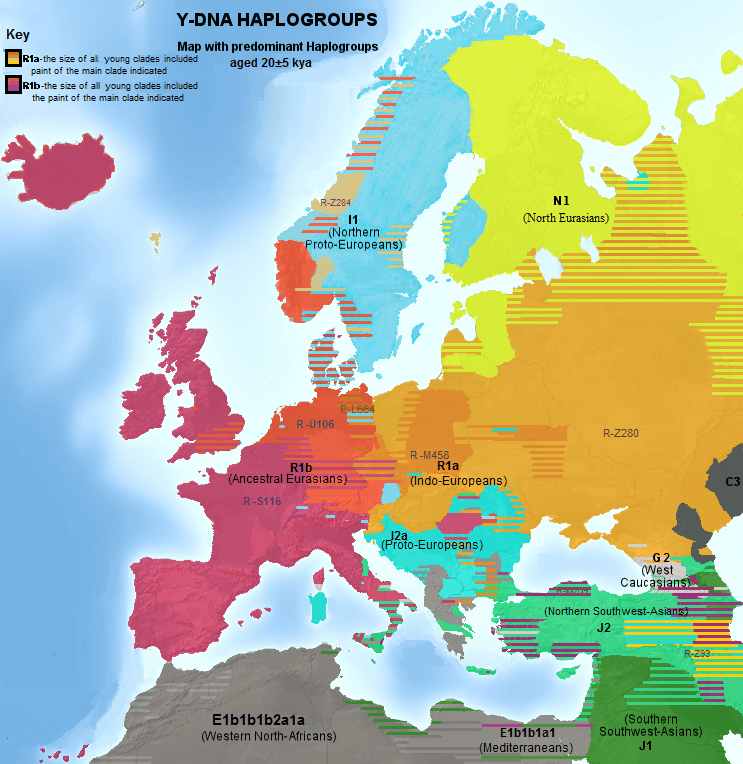
  • This map is still the best one I’ve found

    This map is still the best one I’ve found. https://t.co/zreAAV46KD


    Source date (UTC): 2021-08-12 19:11:26 UTC

    Original post: https://twitter.com/i/web/status/1425897735199285251

    Reply addressees: @Lord__Sousa @WorMartiN @ThruTheHayes @auny_marie

    Replying to: https://twitter.com/i/web/status/1425889480221855751

  • (There are greeks, there are germans, the itals are gone as are the celts. The r

    (There are greeks, there are germans, the itals are gone as are the celts. The rest of us are admixtures of the hunter gatherers, the neolithic farmers (greeks, southern italians, sardinians, southern spanish), and the admixture with the waves of steppe peoples as they conquered.


    Source date (UTC): 2021-08-12 18:14:08 UTC

    Original post: https://twitter.com/i/web/status/1425883314389504002

    Reply addressees: @WorMartiN @ThruTheHayes @auny_marie @Lord__Sousa

    Replying to: https://twitter.com/i/web/status/1425880744799391744

  • Spring is wound again. Its’ unwinding. It will have the usual results this time

    Spring is wound again. Its’ unwinding. It will have the usual results this time as it always has. But this time we might be able to reform the ancient enemy. Maybe not. Maybe they’ll suffer another purge. Depends on circumstances.


    Source date (UTC): 2021-08-12 17:15:28 UTC

    Original post: https://twitter.com/i/web/status/1425868551840280582

    Reply addressees: @kartuzija @ThruTheHayes

    Replying to: https://twitter.com/i/web/status/1425862863680413701

  • Fantasy religions (Age of Transformation) all arose about the same time across t

    Fantasy religions (Age of Transformation) all arose about the same time across the eurasian trade zone because of increases in production, trade, division of labor, alienation, and need to normalize cooperation across populations that decreased loyalty insurance dependence.


    Source date (UTC): 2021-08-12 17:10:56 UTC

    Original post: https://twitter.com/i/web/status/1425867409009909760

    Reply addressees: @Catholi64501821 @kanungo_priyam @iamnotasophist

    Replying to: https://twitter.com/i/web/status/1425854812156043267

  • That’s a good demarcation. Homo Sapiens Sapiens vs Homo Sapiens Hominem

    That’s a good demarcation.
    Homo Sapiens Sapiens vs Homo Sapiens Hominem


    Source date (UTC): 2021-08-12 15:22:49 UTC

    Original post: https://twitter.com/i/web/status/1425840201276997636

    Reply addressees: @WorMartiN @NoahRevoy

    Replying to: https://twitter.com/i/web/status/1425839214793535488

  • Every time I make the ‘subhuman’ or ‘demarcation isn’t produced by speech’ argum

    Every time I make the ‘subhuman’ or ‘demarcation isn’t produced by speech’ argument I get overwhelmingly counter-signalled. Hoppe is happy to make it. He’s right.


    Source date (UTC): 2021-08-12 15:17:23 UTC

    Original post: https://twitter.com/i/web/status/1425838835649368070

    Reply addressees: @WorMartiN @NoahRevoy

    Replying to: https://twitter.com/i/web/status/1425837629468200963