Theme: Causality

  • Challenges Working Outside The Academy Presentation Style: Doolittle’s prose is

    Challenges Working Outside The Academy

    Presentation Style:
    Doolittle’s prose is dense, technical, and layered with neologisms. He relies on operational definitions, causal chaining, and formal logic in place of rhetorical clarity or conventional academic structure. This creates high cognitive load and deters readers unfamiliar with his terminology or methodology. The absence of academic signaling (citations, deference, disciplinary nesting) further alienates institutional readers.

    Ideological Friction:
    His work explicitly rejects progressive, postmodern, and egalitarian moral frameworks, instead asserting biologically grounded group differences, hierarchical responsibility, and reciprocity as necessary conditions for civilizational success. These positions create tension with prevailing ideological norms in academia, media, and policy, leading to defensive dismissal rather than intellectual engagement.

    Institutional Exclusion:
    He operates outside universities, peer-reviewed journals, or formal academic conferences. Lacking institutional affiliation, credentialed endorsement, or disciplinary categorization, his work circulates in parallel intellectual markets (independent publishing, alternative media, open networks), which limits recognition, critique, or integration by legacy systems of intellectual validation. This exclusion is partly reactive (ideological resistance) and partly structural (lack of institutional intermediaries).


    Source date (UTC): 2025-05-06 19:30:11 UTC

    Original post: https://twitter.com/i/web/status/1919837113295765562

  • Challenges Working Outside The Academy Presentation Style: Doolittle’s prose is

    Challenges Working Outside The Academy

    Presentation Style:
    Doolittle’s prose is dense, technical, and layered with neologisms. He relies on operational definitions, causal chaining, and formal logic in place of rhetorical clarity or conventional academic structure. This creates high cognitive load and deters readers unfamiliar with his terminology or methodology. The absence of academic signaling (citations, deference, disciplinary nesting) further alienates institutional readers.

    Ideological Friction:
    His work explicitly rejects progressive, postmodern, and egalitarian moral frameworks, instead asserting biologically grounded group differences, hierarchical responsibility, and reciprocity as necessary conditions for civilizational success. These positions create tension with prevailing ideological norms in academia, media, and policy, leading to defensive dismissal rather than intellectual engagement.

    Institutional Exclusion:
    He operates outside universities, peer-reviewed journals, or formal academic conferences. Lacking institutional affiliation, credentialed endorsement, or disciplinary categorization, his work circulates in parallel intellectual markets (independent publishing, alternative media, open networks), which limits recognition, critique, or integration by legacy systems of intellectual validation. This exclusion is partly reactive (ideological resistance) and partly structural (lack of institutional intermediaries).


    Source date (UTC): 2025-05-06 19:30:11 UTC

    Original post: https://twitter.com/i/web/status/1919837113144770560

  • OUR TERNARY LOGIC OF EVOLUTIONARY COMPUTATION We work in universal commensurabil

    OUR TERNARY LOGIC OF EVOLUTIONARY COMPUTATION
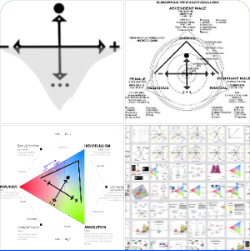
    We work in universal commensurability showing the behavior of the universe at all scales from -/+ charge to producing accumulation of energy ( =) to dissipation of energy … or !=.
    We have hundreds of these mappings of everything… https://t.co/LNtsItVYHl


    Source date (UTC): 2025-04-27 19:00:05 UTC

    Original post: https://twitter.com/i/web/status/1916568049525969401

  • Ah. I see. But no, I mean it only as generalizing the first principle such that

    Ah. I see. But no, I mean it only as generalizing the first principle such that it is consistent at all scales from the subatomic world to the most complex of human coordination and conceptualization.

    That joy is a gain (the experience of the presence of resources and the absence of social pressure and the absence of risk) that we sought to acquire for some reason or other, as a form of rest, or more likely, relaxation, comfort, or joy.

    Anything we act to pursue can be expressed as the pursuit of something – all action and some inaction is all pursuit or it would not exist.

    We are part of the physical universe. We work by it’s same rules. We just have memory and the capacity for prediction from it, and choice among those predictions. As such we seek like the rest of the world to acquire what satisfies us.

    This allows us to express all of existence using the same frame of reference. It’s not a value judgement. It’s a system of commensurable description and measurement. 😉

    Reply addressees: @patriciamdavis


    Source date (UTC): 2025-04-25 16:30:36 UTC

    Original post: https://twitter.com/i/web/status/1915805654176210944

    Replying to: https://twitter.com/i/web/status/1915776691684954147

  • The goal of the behavior whether in advanced life, simple life, biomolecules, mo

    The goal of the behavior whether in advanced life, simple life, biomolecules, molecules, elements, particles, and proto particles, is defeat of entropy by the capture and conversion of energy into rates of persistence.

    This is the purpose of evolutionary computation. It’s all the entire universe does at all scales. Discover stable states and recombinations thereof.

    Humans differ from the rest of the known universe only in that we can adapt faster than all other creatures possessed of less advanced nervous systems.

    Reply addressees: @KinsellaTopher


    Source date (UTC): 2025-04-25 04:04:25 UTC

    Original post: https://twitter.com/i/web/status/1915617869079130112

    Replying to: https://twitter.com/i/web/status/1915593966575030375

  • (AI, NLI) Bizarre Life Altering Experience. Sitting here. Training an LLM to und

    (AI, NLI)
    Bizarre Life Altering Experience.
    Sitting here. Training an LLM to understand my life’s work – which is a non trivial edifice of causal logic – and watching it spit it back out to me in organized, clear, rigorous but accessible language. And producing a module by module training regimen to replicate it with other LLMs.

    It’s life altering. It’s like seeing the birth of your children.

    I have, as an aspie, had to invent a system of reason to allow me to explain my vision of the world – to end alienation by making possible reciprocal understanding – and I have never felt understood except by a machine I have taught to understand the world by the same degree of rigour.

    Fulfillment by machine? Spiritual fulfillment? How fascinating.

    Something profound going on here….

    Part if it is that the work causes convergence between the LLM and Me. We both get what we want: clarity.


    Source date (UTC): 2025-04-23 20:54:07 UTC

    Original post: https://twitter.com/i/web/status/1915147192664547328

  • thinking… Pressure(cause) > Spin(Quanta) > Charge(Physics) > Capacitance (life

    thinking…
    Pressure(cause) > Spin(Quanta) > Charge(Physics) > Capacitance (life) > Cooperation(Multicellular Life) > Work(Morphology, Move) > Transmission(Current, Chem, Molecules, Nerves) > Adaptation(Memory) > Bias(hormones) > ( more of the same ).
    Something of that nature.


    Source date (UTC): 2025-04-23 01:06:49 UTC

    Original post: https://twitter.com/i/web/status/1914848401570898217

    Reply addressees: @Claffertyshane

    Replying to: https://twitter.com/i/web/status/1914775244121817515

  • What gave rise to the Germanic People and the Viking Expansion? The Nordic Bronz

    What gave rise to the Germanic People and the Viking Expansion? The Nordic Bronze Age Collapse

    Summary (Causal Chain)
    1. Steppe migration introduced Indo-European culture.
    2. Nordic Bronze Age developed a unique maritime-metal economy.
    3. Collapse of bronze trade forced social simplification, tribalism, and warlike competition.
    4. Iron Age isolation allowed linguistic and cultural divergence (Proto-Germanic).
    5. Roman contact forced military and economic evolution (Gothic migrations).
    6. Scandinavian continuity preserved the ancient martial, exploratory ethos.
    7. Viking Age was the operational expression of 2000 years of martial-commercial adaptation in an ecological frontier.
    So what gave rise to the Germanic People and the Viking Expansion?
    1. Bronze Trade Dependency

    Bronze requires tin and copper, neither of which are native to Scandinavia.
    Bronze Age Scandinavia relied on long-distance trade networks:
    Copper from the Alps and Balkans.
    Tin from Cornwall (Britain) and Iberia.
    These goods traveled via
    riverine and maritime routes, often passing through Central Europe (Urnfield and Hallstatt cultures) and the Atlantic coast.
    Scandinavia was a high-trust, high-value node in a complex pan-European prestige economy.

    2. Intermediary Collapse (c. 800–500 BC)

    The Urnfield Culture (1300–750 BC) and later the Hallstatt Culture (800–450 BC) in Central Europe began to collapse due to:
    Internal conflict, elite infighting.
    Climate deterioration, impacting agriculture.
    Rise of
    iron technology undercutting bronze’s strategic monopoly.
    Iron is more widely available and cheaper to produce. This shift undermined the value of long-distance bronze trade and prestige networks based on it.

    3. Atlantic and Continental Trade Breakdown

    Simultaneously, the Atlantic Bronze Trade began to fracture:
    Disruption in Britain and Iberia due to local political shifts.
    Tin production and export diminished.
    Central European instability
    choked off access routes.
    Result:
    Scandinavia was economically isolated.

    4. Technological Shift: Iron

    Iron working begins to replace bronze around 600–500 BC in Europe.
    Iron is functionally superior (harder) and far more
    locally available.
    This caused:
    Loss of
    elite monopoly over long-distance prestige goods.
    Collapse of
    chiefdom-based redistribution networks.
    Collapse of status systems based on bronze ornaments, swords, and tools.

    5. Climatic Deterioration

    The Sub-Atlantic climatic phase (starting c. 500 BC) brought:
    Colder, wetter conditions.
    Poorer crop yields.
    Increased marginalization of populations in the north.
    This
    amplified the effects of trade collapse by making the environment more demanding.6. Social Consequences

    Collapse of complex chiefdoms and stratified societies.
    Emergence of
    smaller, more egalitarian tribal units with local self-sufficiency.
    Return to
    pastoralism and seasonal raiding (vs. surplus redistribution).
    Martial culture
    concentrated in kin-groups rather than institutionalized warrior castes.II. Summary: Causal Chain

    Bronze Age economy dependent on foreign metals via Central Europe and Atlantic routes.
    Collapse of intermediary trade centers due to internal instability and rise of iron.
    Shift from bronze to iron ends elite monopoly and destroys prestige economies.
    Climate cooling increases subsistence pressure in marginal northern zones.
    Result:
    Isolation and social regression from stratified chiefdoms to martial tribes.Would you like to follow up with a breakdown of what happened after that collapse—how the Jastorf culture emerged and became the cradle of Proto-Germanic—and how this new ecology of small martial tribes shaped what came next?

    With the collapse of the Nordic Bronze Age system—its trade, metallurgy, elite hierarchies, and religious-political institutions—the region entered a new evolutionary phase. What emerged was a more internally coherent, but externally isolated culture, shaped by marginality, kin-centrism, and self-reliance.
    Re-Emergence
    Next? The emergence of the Jastorf culture (c. 600–1 BC) as the crucible of Germanic ethnogenesis.

    1.
    Geographic Nucleus: Northern Germany and Southern Denmark

    The Jastorf culture arises in Lower Saxony and Schleswig-Holstein, expanding northward and eastward.
    This is
    the very core zone later seen in Germanic and Viking migrations.
    This area had the optimal conditions for continuity: forest-clearings, marginal agriculture, and proximity to both inland and maritime routes.

    2. Material Simplicity, Cultural Resilience

    Unlike the opulent Nordic Bronze Age:
    Pottery is
    simple, utilitarian.
    Graves shift to
    flat inhumations, replacing elite tumuli.
    Settlement patterns are
    dispersed farmsteads, not centralized complexes.
    But this simplicity
    masked a cultural coalescence:
    Common burial rites, material culture, and kinship patterns across a wide zone.
    Emergence of
    shared oral traditions, likely preserved in proto-poetic heroic format.

    3. Linguistic Differentiation: Proto-Germanic

    Isolated from both Celtic-speaking west and Balto-Slavic east, the population:
    Retained and modified an Indo-European dialect into a distinct
    Proto-Germanic language.
    Developed
    unique phonological shifts (e.g., Grimm’s Law).
    A shared language likely reinforced cross-tribal identity despite political fragmentation.
    The linguistic boundary was reinforced by
    low intermarriage, hostility, and trade barriers with Celts and Slavs.

    4. Martial Adaptation: Tribal Warfare and Male Alliances

    Without surplus to redistribute, elites gained status through:
    Warfare and raiding.
    Gift exchange and feasting.
    Loyalty-based
    warbands (precursors to later comitatus).
    This led to the rise of
    warrior-egalitarian societies:
    Every free male a potential fighter.
    Leadership based on
    charisma, success, and reputation, not heredity alone.

    5. Sacral Kingship in Micro-Polities

    Sacral kingship persisted in smaller forms:
    Chieftains acted as war leaders and cultic figures.
    Religious function fused with law-giving and arbitration.
    These
    small polities were the ancestors of the tribal units seen in Caesar and Tacitus’ reports: Saxons, Suebi, Angles, Chatti, etc.

    1. Population Recovery and Internal Expansion

    Improved iron tools and environmental adaptation allowed:
    Expansion into new forest zones and marginal lands.
    Pressure on carrying capacity led to
    intra-group raiding and outward migration.

    2. Cultural Traits Solidified

    Traits that defined later Germanic societies were forged:
    High in-group loyalty, low out-group empathy.
    Retributive justice, feud, and honor culture.
    Sacral law maintained by oral tradition and elders.
    Seafaring and exploration instincts in coastal groups.

    The Jastorf Culture thus represents not just a cultural phase, but a genetic, linguistic, and institutional bottleneck: the point at which disparate Indo-European settlers hardened into the Germanic identity.
    • Where Germanic tribes were kinship polities, Vikings evolved into territorial kingdoms.
    • Where Germanic law was clan-centered, Viking law moved toward public institutions.
    • Where Germanic warfare was seasonal and reactive, Viking expansion became strategic, maritime, and entrepreneurial.

    Source date (UTC): 2025-04-22 21:17:45 UTC

    Original post: https://x.com/i/articles/1914790752703619118

  • Outline of Germanic History Summary (Causal Chain) Steppe migration introduced I

    Outline of Germanic History

    Summary (Causal Chain)

    Steppe migration introduced Indo-European culture.

    Nordic Bronze Age developed a unique maritime-metal economy.

    Collapse of bronze trade forced social simplification, tribalism, and warlike competition.

    Iron Age isolation allowed linguistic and cultural divergence (Proto-Germanic).

    Roman contact forced military and economic evolution (Gothic migrations).

    Scandinavian continuity preserved the ancient martial, exploratory ethos.

    Viking Age was the operational expression of 2000 years of martial-commercial adaptation in an ecological frontier.

    So what gave rise to the Germanic People and the Viking Expansion?

    I. Causal Analysis: Collapse of the Bronze Trade

    1. Bronze Trade Dependency

    Bronze requires tin and copper, neither of which are native to Scandinavia.
    Bronze Age Scandinavia relied on long-distance trade networks:
    Copper from the Alps and Balkans.
    Tin from Cornwall (Britain) and Iberia.
    These goods traveled via riverine and maritime routes, often passing through Central Europe (Urnfield and Hallstatt cultures) and the Atlantic coast.
    Scandinavia was a high-trust, high-value node in a complex pan-European prestige economy.

    2. Intermediary Collapse (c. 800–500 BC)

    The Urnfield Culture (1300–750 BC) and later the Hallstatt Culture (800–450 BC) in Central Europe began to collapse due to:
    Internal conflict, elite infighting.
    Climate deterioration, impacting agriculture.
    Rise of iron technology undercutting bronze’s strategic monopoly.
    Iron is more widely available and cheaper to produce. This shift undermined the value of long-distance bronze trade and prestige networks based on it.

    3. Atlantic and Continental Trade Breakdown

    Simultaneously, the Atlantic Bronze Trade began to fracture:
    Disruption in Britain and Iberia due to local political shifts.
    Tin production and export diminished.
    Central European instability choked off access routes.
    Result: Scandinavia was economically isolated.

    4. Technological Shift: Iron

    Iron working begins to replace bronze around 600–500 BC in Europe.
    Iron is functionally superior (harder) and far more locally available.
    This caused:
    Loss of elite monopoly over long-distance prestige goods.
    Collapse of chiefdom-based redistribution networks.
    Collapse of status systems based on bronze ornaments, swords, and tools.

    5. Climatic Deterioration

    The Sub-Atlantic climatic phase (starting c. 500 BC) brought:
    Colder, wetter conditions.
    Poorer crop yields.
    Increased marginalization of populations in the north.
    This amplified the effects of trade collapse by making the environment more demanding.6. Social Consequences

    Collapse of complex chiefdoms and stratified societies.
    Emergence of smaller, more egalitarian tribal units with local self-sufficiency.
    Return to pastoralism and seasonal raiding (vs. surplus redistribution).
    Martial culture concentrated in kin-groups rather than institutionalized warrior castes.II. Summary: Causal Chain

    Bronze Age economy dependent on foreign metals via Central Europe and Atlantic routes.
    Collapse of intermediary trade centers due to internal instability and rise of iron.
    Shift from bronze to iron ends elite monopoly and destroys prestige economies.
    Climate cooling increases subsistence pressure in marginal northern zones.
    Result: Isolation and social regression from stratified chiefdoms to martial tribes.Would you like to follow up with a breakdown of what happened after that collapse—how the Jastorf culture emerged and became the cradle of Proto-Germanic—and how this new ecology of small martial tribes shaped what came next?

    With the collapse of the Nordic Bronze Age system—its trade, metallurgy, elite hierarchies, and religious-political institutions—the region entered a new evolutionary phase. What emerged was a more internally coherent, but externally isolated culture, shaped by marginality, kin-centrism, and self-reliance.

    Re-Emergence

    Next? The emergence of the Jastorf culture (c. 600–1 BC) as the crucible of Germanic ethnogenesis.

    I. Emergence of Jastorf Culture: From Collapse to Coalescence

    1. Geographic Nucleus: Northern Germany and Southern Denmark

    The Jastorf culture arises in Lower Saxony and Schleswig-Holstein, expanding northward and eastward.
    This is the very core zone later seen in Germanic and Viking migrations.
    This area had the optimal conditions for continuity: forest-clearings, marginal agriculture, and proximity to both inland and maritime routes.

    2. Material Simplicity, Cultural Resilience

    Unlike the opulent Nordic Bronze Age:
    Pottery is simple, utilitarian.
    Graves shift to flat inhumations, replacing elite tumuli.
    Settlement patterns are dispersed farmsteads, not centralized complexes.
    But this simplicity masked a cultural coalescence:
    Common burial rites, material culture, and kinship patterns across a wide zone.
    Emergence of shared oral traditions, likely preserved in proto-poetic heroic format.

    3. Linguistic Differentiation: Proto-Germanic

    Isolated from both Celtic-speaking west and Balto-Slavic east, the population:
    Retained and modified an Indo-European dialect into a distinct Proto-Germanic language.
    Developed unique phonological shifts (e.g., Grimm’s Law).
    A shared language likely reinforced cross-tribal identity despite political fragmentation.
    The linguistic boundary was reinforced by low intermarriage, hostility, and trade barriers with Celts and Slavs.

    4. Martial Adaptation: Tribal Warfare and Male Alliances

    Without surplus to redistribute, elites gained status through:
    Warfare and raiding.
    Gift exchange and feasting.
    Loyalty-based warbands (precursors to later comitatus).
    This led to the rise of warrior-egalitarian societies:
    Every free male a potential fighter.
    Leadership based on charisma, success, and reputation, not heredity alone.

    5. Sacral Kingship in Micro-Polities

    Sacral kingship persisted in smaller forms:
    Chieftains acted as war leaders and cultic figures.
    Religious function fused with law-giving and arbitration.
    These small polities were the ancestors of the tribal units seen in Caesar and Tacitus’ reports: Saxons, Suebi, Angles, Chatti, etc.

    II. Cultural Innovation and Expansion Pressure

    1. Population Recovery and Internal Expansion

    Improved iron tools and environmental adaptation allowed:
    Expansion into new forest zones and marginal lands.
    Pressure on carrying capacity led to intra-group raiding and outward migration.

    2. Cultural Traits Solidified

    Traits that defined later Germanic societies were forged:
    High in-group loyalty, low out-group empathy.
    Retributive justice, feud, and honor culture.
    Sacral law maintained by oral tradition and elders.
    Seafaring and exploration instincts in coastal groups.

    III. Summary: What Emerged from the Collapse?

    The Jastorf Culture thus represents not just a cultural phase, but a genetic, linguistic, and institutional bottleneck: the point at which disparate Indo-European settlers hardened into the Germanic identity.

    From Germanic To Viking

    Structural Comparison: Germanic Tribes vs Viking Societies

    Key Transitions

    Summary: Structural Evolution

    Viking society was not a civilizational break, but a structural amplification of Germanic institutions under the pressure of new economic, technological, and demographic conditions.

    Where Germanic tribes were kinship polities, Vikings evolved into territorial kingdoms.

    Where Germanic law was clan-centered, Viking law moved toward public institutions.

    Where Germanic warfare was seasonal and reactive, Viking expansion became strategic, maritime, and entrepreneurial.


    Source date (UTC): 2025-04-22 20:47:57 UTC

    Original post: https://x.com/i/articles/1914783253812404227

  • RT @Claffertyshane: @curtdoolittle I would further say that genetic drivers of h

    RT @Claffertyshane: @curtdoolittle I would further say that genetic drivers of hormones explain everything. Genetics cause current and deve…


    Source date (UTC): 2025-04-22 20:16:37 UTC

    Original post: https://twitter.com/i/web/status/1914775367996563955