Theme: AI

  • I have no greater reliance on AI any more than I do a word processor, telecom co

    I have no greater reliance on AI any more than I do a word processor, telecom connectivity, the internet protocols, a web browser, spelling and grammar checker, or search engine – or bicycle or automobile for that matter. Each compresses time – the capacity to do more in less… https://t.co/mEgHk5w0rB


    Source date (UTC): 2025-01-17 18:31:07 UTC

    Original post: https://twitter.com/i/web/status/1880321971029962998

    Replying to: https://twitter.com/i/web/status/1880311059908816994

  • Just ask grok or chat gpt “tell me curt doolittle’s position on … (whatever)”.

    Just ask grok or chat gpt “tell me curt doolittle’s position on … (whatever)”. It will give you the high school version.

    After epistemology, Economics whether neurological, behavioral, institutional or political is my core competency.


    Source date (UTC): 2025-01-17 05:23:42 UTC

    Original post: https://twitter.com/i/web/status/1880123810957127993

    Reply addressees: @EmbitteredThe @TheSovereignMD @nayibbukele @TyrantsMuse

    Replying to: https://twitter.com/i/web/status/1880122184892576244

  • Psychology began as a pseudoscience. The cognitive science revolution sought to

    Psychology began as a pseudoscience. The cognitive science revolution sought to convert it to a science. The artificial intelligence revolution has demonstrated how simple the brain is – but how vast, parallel, and competitive a market it is.

    My work is reducible to…


    Source date (UTC): 2025-01-15 01:54:10 UTC

    Original post: https://twitter.com/i/web/status/1879346303622377814

    Reply addressees: @cathasach4bikes @whstancil

    Replying to: https://twitter.com/i/web/status/1879334644149321781

  • Psychology began as a pseudoscience. The cognitive science revolution sought to

    Psychology began as a pseudoscience. The cognitive science revolution sought to convert it to a science. The artificial intelligence revolution has demonstrated how simple the brain is – but how vast, parallel, and competitive a market it is.

    My work is reducible to constructive epistemology or what is frequently called ‘operationalism’ which requires reduction to first principles, and explanation by construction from first principles. Unless you are aware of this long term struggle to complete the definition of science (testimony), the scientific method (production of testimony), scientific truth claims (possibility of testimony), and decidability (satisfaction of demand for infallibility in the context in question) then you will not understand such things as the ‘hard problems’.

    Psychology is often considered a pseudoscience, and the replication crisis remains persistent, due to a combination of historical, methodological, and structural issues within the field. Here’s a detailed explanation:

    1. Historical Roots in Non-Empirical Foundations
    Pseudoscientific Origins: Early psychology often relied on introspection, untestable theories (e.g., Freudian psychoanalysis), and speculative philosophy. These foundations lacked operational definitions and falsifiability, undermining psychology’s scientific rigor.
    Failure to Define Constructs: Many psychological constructs (e.g., “intelligence,” “personality”) are poorly defined and operationalized, leading to ambiguity and difficulty in replication.

    2. Methodological Weaknesses
    Low Statistical Power: Many psychological studies are underpowered due to small sample sizes, leading to results that are more likely to be false positives.
    P-Hacking and HARKing: Researchers often engage in practices like p-hacking (manipulating data to achieve statistical significance) and hypothesizing after results are known (HARKing), which inflate false discovery rates.
    Overreliance on Null Hypothesis Significance Testing (NHST): Psychology has relied heavily on NHST, which is sensitive to misuse and misinterpretation, rather than emphasizing effect sizes, confidence intervals, or Bayesian methods.
    Poor Replication Culture: Historically, replication has been undervalued in psychology, with journals prioritizing novel and positive findings over replication attempts.

    3. Systemic Issues in the Field
    Publication Bias: Journals disproportionately publish positive findings, creating a “file drawer problem” where negative or null results are hidden.
    Career Incentives: Academic incentives reward novel, eye-catching studies over careful, incremental research, pushing researchers toward sensationalism and methodological shortcuts.
    Fragmentation of Subfields: Psychology encompasses diverse subfields (e.g., clinical, cognitive, social, developmental), each with differing standards and methods, making it hard to establish unified scientific criteria.

    4. Complexity of the Subject Matter
    High Variability in Human Behavior: Human psychology is influenced by countless variables (biological, cultural, social, historical), making controlled experiments and generalizable findings exceptionally difficult.
    Difficulty of Experimental Controls: Many psychological experiments lack rigorous controls, and participant behavior can be influenced by subtle, uncontrollable factors (e.g., demand characteristics).
    Non-Linearity and Context Dependence: Psychological phenomena often exhibit non-linear interactions and context dependence, which are challenging to capture and model empirically.

    5. Replication Crisis
    Magnitude of the Crisis: Studies like the Reproducibility Project have found that only about 40% of psychological findings replicate reliably.
    Exaggerated Effect Sizes: Original studies often report inflated effect sizes due to publication bias and small sample sizes, leading to failure in replication attempts.
    Lack of Incentives for Replication: Researchers gain little recognition for replication studies, and journals rarely prioritize publishing them.

    6. Philosophical and Epistemological Issues
    Lack of Operationalism: Many psychological theories are not operationally reducible, making them difficult to falsify or test.
    Over-Reliance on Subjective Measures: Constructs like “happiness” or “stress” are often measured through self-report, which is prone to bias and lacks external validity.
    Failure to Adopt Falsification: While Popper emphasized falsifiability, psychology still tolerates theories that resist falsification or rely on post hoc rationalizations.

    7. Efforts to Reverse the Trend
    While the field has recognized these problems, progress is slow due to entrenched incentives and structural barriers.
    However, some steps are being taken:
    Open Science Initiatives: Platforms like the Open Science Framework encourage transparency and preregistration of studies to reduce questionable research practices.
    Meta-Analyses and Large-Scale Replications: Projects like the Many Labs initiative aim to assess the reliability of psychological findings across diverse contexts.
    Bayesian and Computational Approaches: Modern methods are being adopted to improve the robustness and interpretability of psychological research.

    Conclusion
    Psychology’s persistence as a field perceived as pseudoscientific stems from its historical baggage, methodological shortcomings, and the inherent complexity of its subject matter. While efforts like the cognitive science movement and open science reforms aim to reverse this perception, entrenched incentives and structural weaknesses make progress slow and uneven. Resolving these challenges requires an overhaul of the field’s epistemological and methodological foundations, emphasizing operational rigor, transparency, and falsifiability.
    Source date (UTC): 2025-01-15 01:54:09 UTC

    Original post: https://twitter.com/i/web/status/1879346303148441600

  • Again, in most cases, you can paste any of my statements into perplexity to obta

    Again, in most cases, you can paste any of my statements into perplexity to obtain common references – though recursive expansion might be helpful:
    https://www.perplexity.ai/search/1-dysgenic-selection-in-women-Rv_0NvmeRZOE2ZMc3R6E3w

    Or into Chatgpt (which knows much of my work) for explanation even though it prevaricates against postwar… https://t.co/IHMBCmCDoj


    Source date (UTC): 2025-01-15 01:43:39 UTC

    Original post: https://twitter.com/i/web/status/1879343660405514403

    Reply addressees: @TheSovereignMD @strichtarn @whstancil

    Replying to: https://twitter.com/i/web/status/1879311527544852651

  • Again, in most cases, you can paste any of my statements into perplexity to obta

    Again, in most cases, you can paste any of my statements into perplexity to obtain common references – though recursive expansion might be helpful:
    https://t.co/byBVk9nRPS

    Or into Chatgpt (which knows much of my work) for explanation even though it prevaricates against postwar ‘political correctness’.
    https://t.co/uPcbrKFre6

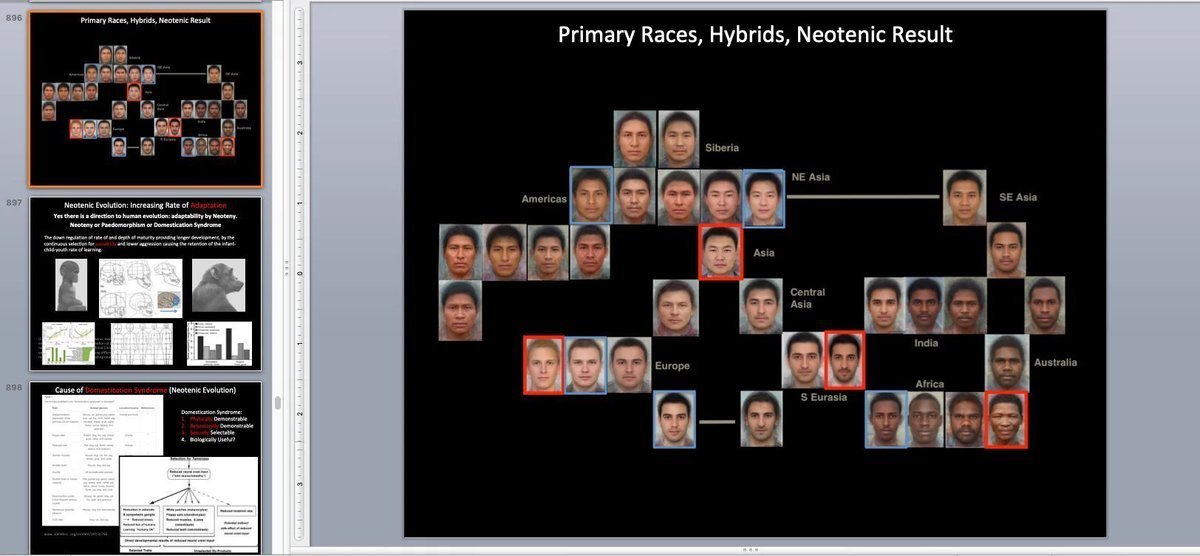
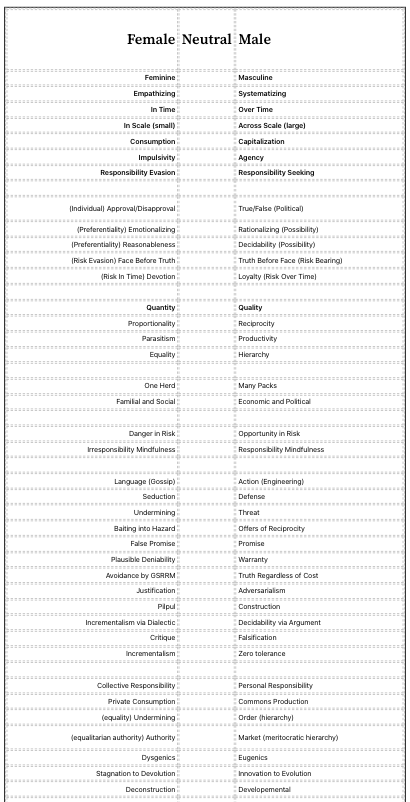
    In this case I can’t afford to dump decades of research in a twitter post. That said, you can either wait for us to publish, or start with what I’ve given you, and spend some time with google, Grok, perplexity, and ChatGPT on neotenic selection / domestication syndrome (migration of stem cells from the neural tube). Neotenic selection as the principle direction of all human social and cooperative evolution. Climatological effects on isolation and speciation in favor of neoteny when living in close proximity (indoors). Human self domestication. Relationships between domesticated animals and human self domestication. The relationship between domestication, aggression/impulsivity, agency, and intelligence. Causal relationship between Sex(strength-speed, risk tolerance, responsibility tolerance vs seeking, resulting consumption vs capitalization as mate signaling, and empathizing-verbal-pictoral vs systematizing-spatio-temporal-mechanical), class(genetic load), race(neoteny, class size) differences. And if you really want to get deep, then sex difference in neurological development and resulting brain organization both in utero and post partum. And perhaps most importantly in the female under maturity where the nervous system is expanded to cover children solipsistically.

    However all synthesis of cross disciplinary research in an era of postwar suppression of population differences as a largely progressive-to-marxist-to-feminist counter revolution against eugenics whether sex, class, culture, civilization, or race requires relatively current knowledge. ie: IQ and Conscientiousness by 2000, sex differences by 2012, race differences by 2018.
    This is why we founded the institute outside of the university setting, (it was impossible to put together a dissertation committee, both for the suppression of those areas of research and the challenge of synthesis across disciplines), just as cognitive science had to overcome the pseudoscience of psychology, and just as Perimeter et al had to do their work in physics outside of the academy.

    If you have specific questions that don’t require me to write essays in response I will try to accomodate you.

    (Image below from our presentation on the subject matter.)

    Affections.
    CD


    Source date (UTC): 2025-01-15 01:43:39 UTC

    Original post: https://twitter.com/i/web/status/1879343660107796480

  • RT @curtdoolittle: @TheSovereignMD @strichtarn @whstancil Most of my work or pos

    RT @curtdoolittle: @TheSovereignMD @strichtarn @whstancil Most of my work or posts can be explained by grok or chat gpt.

    “The concept you…


    Source date (UTC): 2025-01-14 19:15:51 UTC

    Original post: https://twitter.com/i/web/status/1879246066983571690

  • Most of my work or posts can be explained by grok or chat gpt. “The concept you’

    Most of my work or posts can be explained by grok or chat gpt.

    “The concept you’re discussing touches on several complex ideas in evolutionary biology, anthropology, and social theory. Here’s a breakdown of the key components:

    1. **Dysgenic Selection in Women’s Mate Choice**:
    – “Dysgenic” typically refers to the selection of traits that might be considered less beneficial for survival or reproduction in future generations. In this context, the argument suggests that women’s selection of mates might not necessarily favor traits traditionally seen as enhancing survival or reproductive success. Instead, it might eschew traits like neoteny (the retention of juvenile features into adulthood) which could be seen as less “adaptive” in terms of physical robustness but might confer social or sexual advantages in complex human societies.

    2. **Acceleration of Neotenic Evolution Under Agrarianism**:
    – Neoteny in humans includes traits like smaller jaws, larger heads relative to body size, and a more juvenile facial appearance. Under agrarian societies, where physical strength might be less critical for survival (due to less immediate physical threats), there could be an evolutionary push towards traits that enhance social interaction or intelligence rather than brute physicality. The argument here is that agrarianism might have favored these traits, accelerating neotenic evolution.

    3. **Traditional and Normative Changes Under Emergent ‘Property’**:
    – With the establishment of concepts like private and communal property, social structures and norms evolved, influencing mate selection. Property rights could lead to new forms of social status or wealth, which might then influence what traits are selected for in mates. Here, “domestication” of one another refers to the mutual shaping of behaviors and physical characteristics through cultural practices and mate choice over generations.

    4. **Reciprocal Domestication of Sexes**:
    – The idea here is that both men and women have influenced each other’s evolution through selection pressures. For instance, men might select for traits in women that signal health or fertility, while women might select for traits in men that suggest resources or status. This mutual selection process could be seen as a form of “domestication” where each sex shapes the evolution of the other.

    5 – Cultural and Social Influence: Human evolution is not just biological but deeply intertwined with cultural evolution. The changes in human traits might be as much about cultural shifts in what is valued or attractive as about direct biological selection.

    See domestication syndrome and evolutionary differences between domesticated and self domesticated species.

    Ie women select dysgenically.

    Reply addressees: @TheSovereignMD @strichtarn @whstancil


    Source date (UTC): 2025-01-14 19:15:33 UTC

    Original post: https://twitter.com/i/web/status/1879245990722736128

    Replying to: https://twitter.com/i/web/status/1879243096300646655

  • RT @NoahRevoy: I asked Chat GTP to explain the differences between Freedom and S

    RT @NoahRevoy: I asked Chat GTP to explain the differences between Freedom and Sovereignty as if I was @curtdoolittle talking to a 5 year…


    Source date (UTC): 2025-01-13 15:06:38 UTC

    Original post: https://twitter.com/i/web/status/1878820962420117572

  • GROK IS FREE whenever you can’t understand one of my posts. Curt Doolittle’s pos

    GROK IS FREE whenever you can’t understand one of my posts.

    Curt Doolittle’s post discusses the concept of time preference, which is the preference for immediate rewards over future ones, and how it relates to maintaining societal structures like aristocracy. Time preference influences economic behavior, where a low (long) time preference encourages investment over consumption, crucial for preserving civilizational capital.📷

    The post suggests that aristocracy, with its inherent long-term orientation, naturally promotes a low time preference, which is vital for sustainable economic practices. This contrasts with democratic systems where short-termism might prevail, leading to capital consumption rather than preservation.📷

    Financialization, mentioned as a driver of short-term time preferences, has been criticized for promoting consumption and short-term gains over long-term investment, leading to the erosion of civilizational capital. Curt Doolittle suggests controlling private sector credit expansion as a method to foster longer time preferences.📷


    Source date (UTC): 2025-01-13 00:31:34 UTC

    Original post: https://twitter.com/i/web/status/1878600744791928832

    Replying to: https://twitter.com/i/web/status/1878595620598153532


    IN REPLY TO:

    Unknown author

    How do you maintain low (long) time preference without aristocracy? You must have aristocracy because they will naturally emerge as and evolve an aristocracy with low (long) time preference if lawfulness is preserved vs lawlessness. Without their time preference all polities, and especially democratic polities, will eventually burn capital in favor of consumption, whether by individualism instead of familism, consumerism instead of commons-ism, corruption instead of nationalism. The financialization drove recursive shortening of time preference, and the destruction of civilizational capital. There are many lessons here, but the prohibition on credit expansion in the private sector is the principle means of preventing it, and instead, forcing invsetment in longer time preferences instead of shorter consumer and consumption preferences.

    (Brad and I today.)

    Original post: https://x.com/i/web/status/1878595620598153532