Theme: Agency

  • Man – Cooperation – Rationality

    Rationality

    Man Is Rational – Period.

    1 – Men are rational. Period. 2 – Men can rationally choose morality or immorality or evil. Period. 3 – Morality consist of reciprocity. Period. 4 – Reciprocity consists of productive, fully informed, warrantied, voluntary exchange, free of negative externality – period. 5 – The test of reciprocity is any change in property in toto (demonstrated property) Period. 6 – The purpose of reciprocity is the demand for restitution as a means of preventing retaliation cycles. 7 – The Purpose of preventing retaliation cycles, is to preserve the value of cooperation. 8 – The incremental suppression of retaliation cycles produces lower risk and higher experimental velocity, (that we call ‘trust’), thereby increasing the rate of returns on cooperation.

    Are Men Not Moral?

    Men are merely rational. We are capable of moral (cooperative) and immoral (parasitic), and evil (predatory) behaviors. We demonstrate that we are capable of moral, immoral, and evil behaviors. We choose good most often because it is rational. A few of us choose not good because it is rational – fairly often. A few of us choose evil – because it is rational given their emotional condition. We always manage our physical, emotional, and intellectual(frustration) budgets, and we We educate our young and each other in order to preserve the utility of cooperation for them, for ourselves, and the group, and to prevent retaliation for them, ourselves, and the group. The fact of the matter is that if you are strong, in the short term predation is most rewarding, at the cost of future retaliation. if you are not weak, In the medium-term cooperation is most rewarding. In the long term, if you are weak, parasitism is most rewarding. And this is what we see: a predatory upper class, a productive middle class, and a parasitic underclass. There are no possible perpetual motion machines, including those of a polity, economy, and kin group. We must always defeat the dark forces of time, ignorance, and scarcity, despite that some of us are strong and competent, some of us not weak but competent, and some of us weak and incompetent. We are, like all nature, bound by the basic laws of the universe, and in particular, the laws of thermodynamics. All civilization is merely an attempt to cooperate at larger and larger scales, by trading off near pleasures, for future returns.

    The Consequence of Rational Action

    All men are rational actors – neither moral nor immoral, but rational. We achieve the good by eliminating the utility of choosing the bad. We eliminate the utility of choosing the bad by the promise of violence for violations of reciprocity. We test for the violation of reciprocity by demand for fully informed, productive, warrantied, voluntary transfer free of negative-externality. We call this test of reciprocity Natural Law. We can only test this Natural Law by the use of independent judges and juries to discover violations of it by sympathetic testing. We can perform that sympathetic testing when observing testimony. We can sympathetically test from testimony because our ability to cooperate was made possible by an ability to sympathize with intent. By sympathizing with intent, we can discover malincentives and malintentions. We can then judge malincentives and malintentions, and record those judgments for future use in what we call the ‘common law.’. But for this system to work at all, those who testify, the jury, and the judges must give higher priority to the commons than to their self, kin, or organizational interests. And so they themselves must be subject to the same demand for reciprocity as those that they adjudicate. This is the secret to western civilization: the truthfulness of warrior cult spread across all men, via service in militia and army.

    The Contract of Aristocratic Cooperation

    We prefer to cooperate morally – meaning beneficially – with you. If we cannot cooperate beneficially with you on fully moral terms – meaning without parasitism, then we have only four choices: 1) Pay the cost of your parasitism and suffer the consequences, in exchange for avoiding the cost of defending against your parasitism. 2) Boycott you and bearing the costs of boycotting you in exchange for avoiding the cost of transforming you into a moral individual or group. 3) Colonize you and bear the cost of evolving you, in exchange for creating a valued member of mankind. 4) Conquering you and bearing the cost of exterminating you in exchange for freedom from your parasitism. So, you have a choice: limit your actions to productive, fully informed, warrantied, voluntary transfer, constrained to externalities under the same conditions. Or we will eventually colonize and reform you, or conquer and exterminate you. You may have the ambition of mere survival. Our ambition is to make mankind moral. For it is only in moral mankind that the evil and immoral are exterminated forever.

  • Man – Cooperation – Rationality

    Rationality

    Man Is Rational – Period.

    1 – Men are rational. Period. 2 – Men can rationally choose morality or immorality or evil. Period. 3 – Morality consist of reciprocity. Period. 4 – Reciprocity consists of productive, fully informed, warrantied, voluntary exchange, free of negative externality – period. 5 – The test of reciprocity is any change in property in toto (demonstrated property) Period. 6 – The purpose of reciprocity is the demand for restitution as a means of preventing retaliation cycles. 7 – The Purpose of preventing retaliation cycles, is to preserve the value of cooperation. 8 – The incremental suppression of retaliation cycles produces lower risk and higher experimental velocity, (that we call ‘trust’), thereby increasing the rate of returns on cooperation.

    Are Men Not Moral?

    Men are merely rational. We are capable of moral (cooperative) and immoral (parasitic), and evil (predatory) behaviors. We demonstrate that we are capable of moral, immoral, and evil behaviors. We choose good most often because it is rational. A few of us choose not good because it is rational – fairly often. A few of us choose evil – because it is rational given their emotional condition. We always manage our physical, emotional, and intellectual(frustration) budgets, and we We educate our young and each other in order to preserve the utility of cooperation for them, for ourselves, and the group, and to prevent retaliation for them, ourselves, and the group. The fact of the matter is that if you are strong, in the short term predation is most rewarding, at the cost of future retaliation. if you are not weak, In the medium-term cooperation is most rewarding. In the long term, if you are weak, parasitism is most rewarding. And this is what we see: a predatory upper class, a productive middle class, and a parasitic underclass. There are no possible perpetual motion machines, including those of a polity, economy, and kin group. We must always defeat the dark forces of time, ignorance, and scarcity, despite that some of us are strong and competent, some of us not weak but competent, and some of us weak and incompetent. We are, like all nature, bound by the basic laws of the universe, and in particular, the laws of thermodynamics. All civilization is merely an attempt to cooperate at larger and larger scales, by trading off near pleasures, for future returns.

    The Consequence of Rational Action

    All men are rational actors – neither moral nor immoral, but rational. We achieve the good by eliminating the utility of choosing the bad. We eliminate the utility of choosing the bad by the promise of violence for violations of reciprocity. We test for the violation of reciprocity by demand for fully informed, productive, warrantied, voluntary transfer free of negative-externality. We call this test of reciprocity Natural Law. We can only test this Natural Law by the use of independent judges and juries to discover violations of it by sympathetic testing. We can perform that sympathetic testing when observing testimony. We can sympathetically test from testimony because our ability to cooperate was made possible by an ability to sympathize with intent. By sympathizing with intent, we can discover malincentives and malintentions. We can then judge malincentives and malintentions, and record those judgments for future use in what we call the ‘common law.’. But for this system to work at all, those who testify, the jury, and the judges must give higher priority to the commons than to their self, kin, or organizational interests. And so they themselves must be subject to the same demand for reciprocity as those that they adjudicate. This is the secret to western civilization: the truthfulness of warrior cult spread across all men, via service in militia and army.

    The Contract of Aristocratic Cooperation

    We prefer to cooperate morally – meaning beneficially – with you. If we cannot cooperate beneficially with you on fully moral terms – meaning without parasitism, then we have only four choices: 1) Pay the cost of your parasitism and suffer the consequences, in exchange for avoiding the cost of defending against your parasitism. 2) Boycott you and bearing the costs of boycotting you in exchange for avoiding the cost of transforming you into a moral individual or group. 3) Colonize you and bear the cost of evolving you, in exchange for creating a valued member of mankind. 4) Conquering you and bearing the cost of exterminating you in exchange for freedom from your parasitism. So, you have a choice: limit your actions to productive, fully informed, warrantied, voluntary transfer, constrained to externalities under the same conditions. Or we will eventually colonize and reform you, or conquer and exterminate you. You may have the ambition of mere survival. Our ambition is to make mankind moral. For it is only in moral mankind that the evil and immoral are exterminated forever.

  • Man – Organization – Elite Classes

    Horizontal Class – Elites

    Horizontal or Reproductive and Influence Class

    Reproductive class refers a rough division of humans into a distribution by their reproductive value. There is a competition between the classes, as there is a competition between all living organisms – and there must be for evolution continue and the species to persist. The competition between the classes is dysgenic at the bottom and eugenic at the top. In other words, classes are the result of evolution in action. And the question of whether an action is eugenic or dysgenic provides us with complete moral decidability in the broadest possible ethical and moral questions facing mankind. There are no moral dilemmas. There are no morally undecidable questions.    

    Horizontal Classes


    Definition of Horizontal Class: Reproductive StrategyThree Dominance Hierarchies What dominance hierarchies (classes) can man climb?

    1. Physical (force)
    2. Economic (exchange)
    3. Gossip (insurance, inclusion, exclusion)

    We can climb all three of them – and we do. If we can.  

    Three Elite Classes

    ( … ) 1) The Military2) The Priesthood: talk/gossip/rallying/shaming, Academy, Politics. 3) The Judiciary: violence, order, law, war And 4) The Burghers: trade, enterpreneurship, finance, treasury. 5. Those who Work


    Combinations

    And a persuasive argument can consist of one or more of these strategies, often in great complexity.

    Force/Punishment/Limits < Exchange > Demand/Inclusion/Exclusion

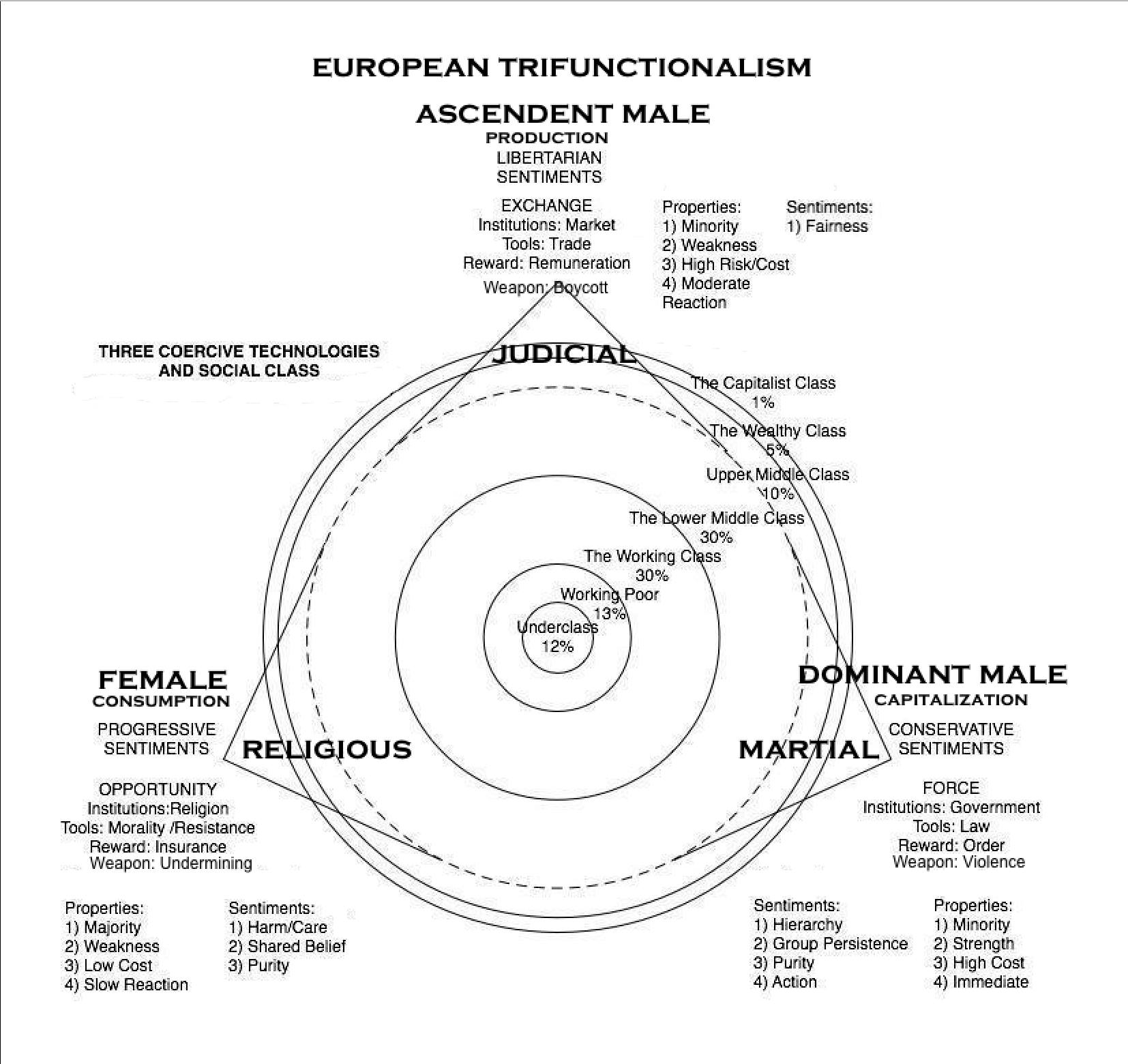
    It is possible and often preferable to combine all three forms of power in order to coerce people most effectively. Conversely, it is possible and preferable to create an institutional framework in politics that restricts the ability to combine different forms of power in an effort to constrain power. All known societies employ all three sorts of incentives to at least some degree in order to evoke from its members the necessary degree of cooperation for the society to survive and flourish. However, different societies differ radically in the relative proportions of these different kinds of incentives used within their characteristic mix of incentives.   Or, more romantically:

    —“Human life can for convenience be divided into four major spheres, the pursuit of power (politics), the pursuit of wealth (economics), the pursuit of [mindfulness] salvation and meaning (religion), the pursuit of social and sexual warmth (kinship).”— McFarlane

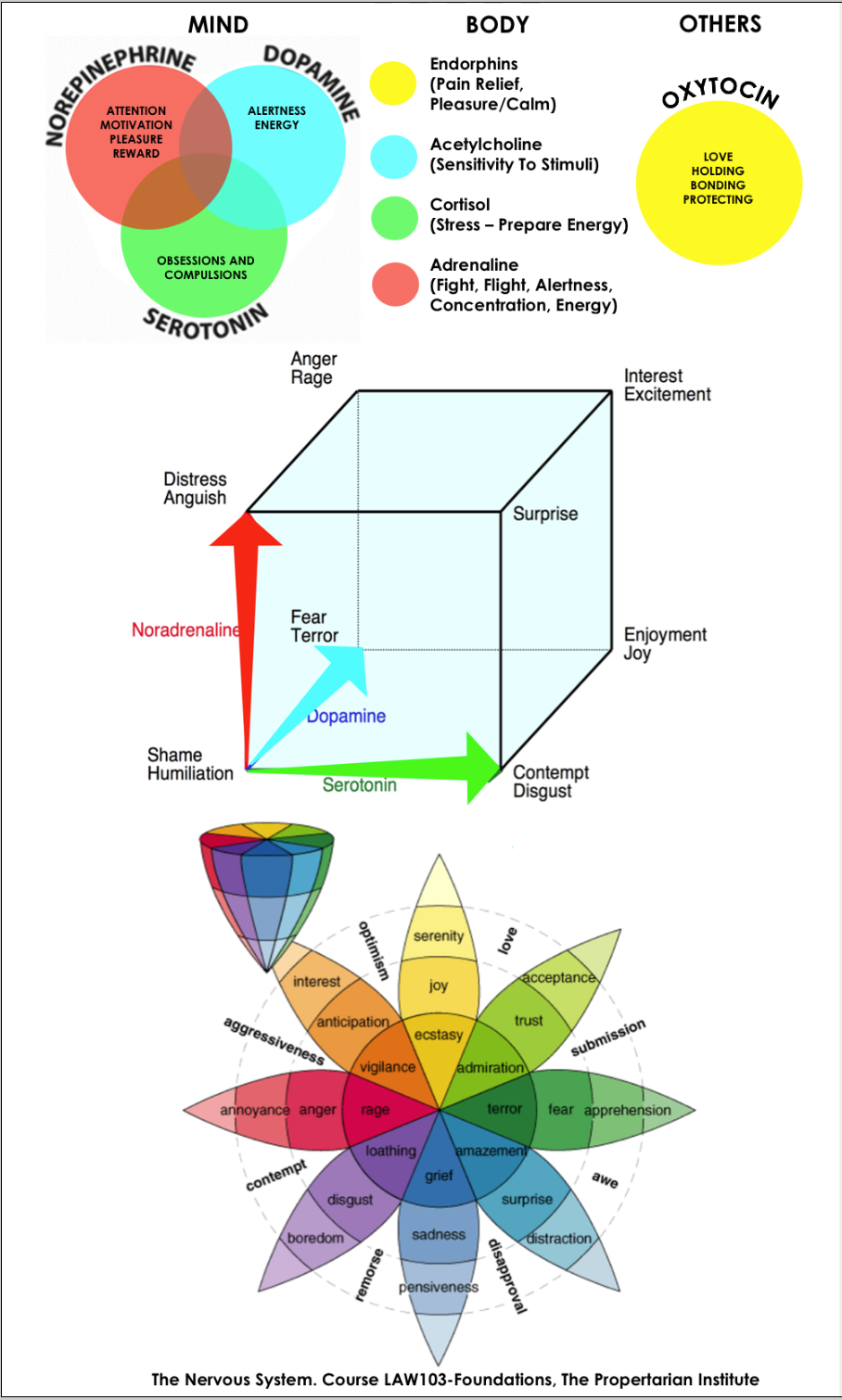
    People give priority one or more different weighted combinations, or perhaps ‘chordic’ representations of these strategies. They do so out of habit, and class inclination, just as they follow religious and class sentiments due to their upbringing. People who belong to institutions have different capacities for adopting these strategies. Force requires discipline and long Time Bias. Remuneration requires cunning and invention. Moral claims require loyalty to consensus, and absorption of, and therefore payment of, opportunity costs. Different social classes have different time biases and consist of people with different time preferences, requiring different types of discipline under different social and economic conditions. ie: it is easier to have a long time preference if one is genetically disposed to better impulse control, and lives in greater security. It is easier to have a short time preference if one is more persuaded by impulses, less disciplined, and in an environment of scarcity. Under markets, the social classes are organized by intelligence (otherwise by violence, or corruption, or propaganda and deceit). Intelligence is the ability to absorb content in real-time, to learn abstractions in time, and to permute those abstractions in application to problems in real-time. Intelligence regresses toward the mean over generations. Therefore class membership is an indicator of the likelihood of class mobility, and upper-class position is difficult to maintain. While we use the word ‘middle class’, and most people in the west live middle-class lifestyles, the middle class means possessing disposable income and participating in the market. Therefore the majority of citizens are in the upper proletariat and lower-middle classes, which we call the working, white-collar working and craftsman classes. There are different costs to these institutions: Force is extremely expensive. Creating non-corruption, and order (some network of property definitions and their means of transfer). Property is a term for a scarce good that must be used, consumed or transformed in the process of production, even if that process is human sustenance. Remunerative institutions require the complex task of concentrating capital then maintaining it in a constantly changing kaleidic and competitive environment. Moral claims require constant advocacy, verbal skill, maintenance of numerous relationships, and constant payment of opportunity costs. Social classes have different access to each of these forms of coercion. Those in the institutional class, or upper class, have access to force in the form of policy and law. Those in the capitalist class, or middle, have access to capital: money, and market institutions. In each strategy, people form elites and organizations for utilizing those strategies. The elites create philosophical frameworks. Each of these frameworks consists of moral claims, and institutional means of perpetuating those claims, and the social benefits of adopting those claims. Each of these institutions is open to corruption, which is the privatization of opportunity and reward, for personal consumption at group expense. Corruption is a fraud. Each of these strategies, under the organizations, institutions, and elites, compete against other strategies, organizations, and elites, and each attempts to use its own organizations to obtain discounts against other organizations. This competition is analogous to the game of Rock, Paper, Scissors, if more complicated: each group can successfully compete against one another under most circumstances but can defeat and be defeated by some other combination of forces. The human mind is comfortable with identity and causality. It can with practice, understand a one-dimensional causal spectrum. It can, with effort, understand two dimensions of causality. It can with more effort to understand three dimensions of a causal spectrum. Human emotions for example, consist of probably no more than three stimuli: Dominance-Submission, Pleasure, and Activation. And that all human emotions, in their seemingly infinite variety can be described as using these three axes of stimuli. Likewise, human social behavior consists of three different forms of coercion, in some combination, and this set of axes leads to seemingly infinite variety. But it only seems infinite. At it’s base, there are only three forms of social organization. These three forms can be combined, as they are in the majority of the population in some manner or another. Or they can be used as one of three specializations, each of which attempts to play rock, paper, scissors, with the other two. All known societies employ all three sorts of incentives to at least some degree in order to evoke from its members the necessary degree of cooperation for the society to survive and flourish. However, different societies differ radically in the relative proportions of these different kinds of incentives used within their characteristic mix of incentives.      

       
  • Man – Action – Acquisition

    Acquisition

    “Man Acquires”

    “All behavior is reducible to the incentive to acquire interests. we can enumerate those categories of interests we seek to acquire. we remember those things we have invested in as costs, and defend those costs. (our complex interests some of which are our possessions” 1 – Time is limited and the only infinite scarcity 2 – Man is a costly form of life in an unpredictable universe. 3 – Man must acquire resources to live within this unpredictable universe. 4 – Man must act (move) to acquire and inventory resources, 5 – Man must remember to decrease the cost to acquire and inventory resources. 6 – Man must defend that which he has acquired and inventoried. (His possession is demonstrated by what he defends from loss, and what he retaliates for imposition of costs upon.) Demonstrated BehaviorMan acts to obtain the greatest return, in the shortest time, with the least effort, with the greatest certainty, at the lowest risk.Demonstrated Interests

    Three Means of Acquisition

    ( … Three Means of Acquisition )

  • Man – Action – Acquisition

    Acquisition

    “Man Acquires”

    “All behavior is reducible to the incentive to acquire interests. we can enumerate those categories of interests we seek to acquire. we remember those things we have invested in as costs, and defend those costs. (our complex interests some of which are our possessions” 1 – Time is limited and the only infinite scarcity 2 – Man is a costly form of life in an unpredictable universe. 3 – Man must acquire resources to live within this unpredictable universe. 4 – Man must act (move) to acquire and inventory resources, 5 – Man must remember to decrease the cost to acquire and inventory resources. 6 – Man must defend that which he has acquired and inventoried. (His possession is demonstrated by what he defends from loss, and what he retaliates for imposition of costs upon.) Demonstrated BehaviorMan acts to obtain the greatest return, in the shortest time, with the least effort, with the greatest certainty, at the lowest risk.Demonstrated Interests

    Three Means of Acquisition

    ( … Three Means of Acquisition )

  • Man – Action – Agency

    Agency

    Agency refers to the capacity for human beings to identify opportunities and make choices that are consistent, correspondent, existentially possible, and coherent with and within reality, and to act upon them, unimpeded by knowledge limitation (ignorance), intellectual limitation(intelligence), mindfulness limitation (impulse), physical limitations(body), instrumental limitations(technologies), resource limitations, the impediments of others and their organizations into norms, laws, institutions, polities, and armies. Perfect Agency would require omniscience, omniscience, and complete insulation from impulse. So, Agency, like Truth, or infinity, or perfection, or godhood, or moving half-way across Zeno’s line, describes an infinitely logarithmic curve: There is always more to be had. In social pseudoscience, one’s social, economic, and political agency is limited by ‘structure’ (institutions), and their (socialist) implication is that differences in income are an institutional choice not a necessity of human cooperation (natural law). In social pseudoscience then, we are considered to be equal in ability but unequal in institutional benefit. So we extended Agency by correcting the falsehood of equality and necessity. We are constrained both internally and externally. We have five sets of internal faculties:

    – Physical abilities (actions), one of which is speech. – Senses – the five senses – Intuitions – Reason – Technical Knowledge (actionable knowledge) Each of these faculties grants us abilities – some more, some less, because we are individually physically, intuitionistically, and rationally better or worse in our abilities. We are further constrained by externalities:

    – Geography – Resources, – Institutions of Cooperation – meaning norms, traditions and laws, and the economy. We can work to improve our physical abilities – with training

    – We can improve our senses with discipline and instruments. – We can improve our intuitions with training. – We can improve our reason with training. – We can improve our speech – with training – We can improve our knowledge – with training We can work with others.

    – We can work with others to improve our geography, resources, and formal and informal institutions. – We can work with others to improve our productivity in goods services and information. As we improve our internal and external ability to act, intuit, think, and speak, we improve our Agency. The Three Acknowledgments of Agency:

    1) I acknowledge that I can exercise some level of control over my thoughts, feelings, and actions.

    2) I acknowledge that I am responsible to control my thoughts, feelings, and actions to the best of my ability (within my natural limits).

    3) I acknowledge that I must work to develop the mental, emotional, and physical fortitude necessary to exercise my Agency.

    “We are just another self-domesticating animal. Some of us more successful at it than others. Nothing more complex is at work.”

    Biological Origins: How Much Agency Do We Have?

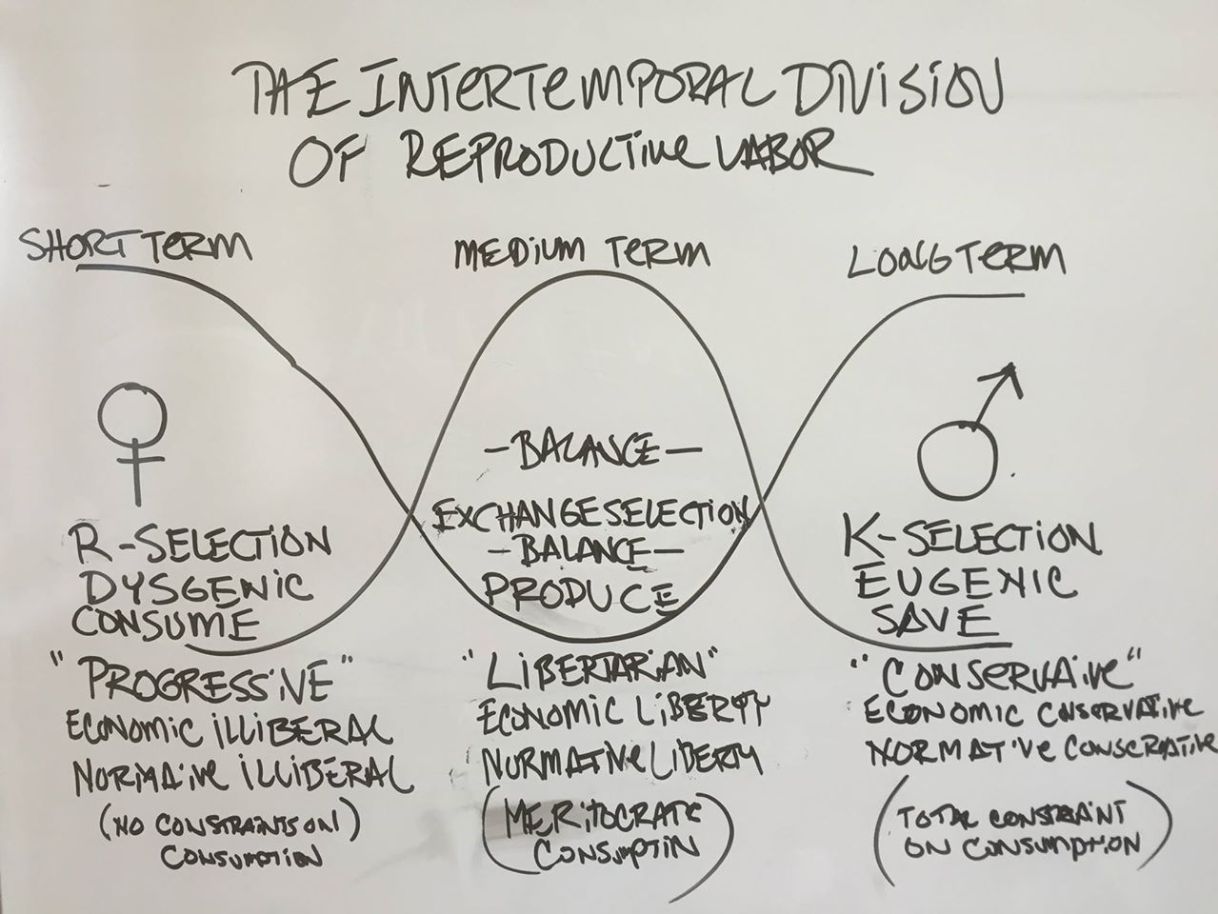
    Women and men demonstrably think very differently because of the difference between utility and truth, and between proportionality and reciprocity, and between dysgenia and eugenia. Why do we assume that this same cognitive bias is limited to gender rather than a balance between the genders and that different groups don’t just demonstrate the male cognitive bias or the female cognitive bias? Truth, Reciprocity, and Physical Violence that Ends when Ended, VERSUS Fraud, Proportionality, and Reputation Destruction that Never Ends until Destroyed. Violence and Threats VERSUS Shaming, Ridicule, Gossip, Straw Manning, Rallying, and Reputation Destruction. Those are the Male versus female competitive strategies. HERD <————–——> PACK Utility <———————> Truth Proportionality <—–—> Reciprocity Equality <——————> Meritocracy Dysgenia <—————–> Eugenia r <—————————–> K F<—————————–> M There is nothing in mankind that is complicated other than the lies we tell ourselves and others in order to achieve our desired ends. Male and female reproductive strategies are at odds. And we have little Agency in the choice of those strategies, at the individual, group, civilizational levels. Everything else is a consequence. So everywhere and everywhen, we discover compromises whether reciprocal or not in order to cooperate, or at least minimize conflict, between our different reproductive biases, interests, and strategies.

    There Is No Reason or Agency Among Animals.

    Speech provides the illusion that the rider controls the elephant, when in fact, there are very, very, few of us whose elephants correspond to reality, and as a consequence so do our riders. There is a reason that the animals do not argue rationally – because they lack agency, and because they lack agency, they are not in fact human. Just as children do not have the self-control of adults, many adults lack the self-control of others. While we may learn self-control of our bodies. We may learn self-control of our emotions. We may NOT learn self-control of our thoughts. We use the term ‘Agency’ to describe independence of our thoughts from physical and emotional impulses, from the bias of our intuitions, and from the bias of our thoughts. In this sense, some people are fully human (they have developed agency) or they are not fully human (they have not developed agency) and are still ‘animals’. Who Is and Isn’t Human? Is the line of demarcation between human and animal:

    1) Morphology? 2) Sentience? (Reaction to stimuli) 3) Awareness? (Sympathy-intent/Empathy-experience/Imitation-action) 4) Consciousness (time – space) 4) Speech? 5) Reason? (Agency) As far as I know, it is Reason and Agency that separate us from the animals.  That means very few of us are yet human. The rest are in different stages of domesticated animal. And I suspect that number (percentage) corresponds to the Pareto minimum. Our process of self-domestication is far from complete. It is merely sufficient for the west and to a lesser degree, east, to drag mankind out of ignorance, superstition, hard labor, filth, poverty, starvation, disease, plagues, suffering, child mortality, early death, continuous violence, and the vicissitudes of nature.

    |HUMAN| The gods we aspire to be < Trained Humans < untrained humans
     < trained animals < untrained animals < untrainable animals.

    We domesticated plants, those animals we could domesticate, and those humans we could domesticate. But we left the job unfinished.

    Reversal: Genetic Tolerance for Graceful Failure – Agency and Morality

    The evolutionary reason some of us have agency and most of us do not is that our reason is subject to temporal failure, and our information is subject to intertemporal failure, and instinct provides a very successful method of graceful failure in the face of limited information, limited time, and limited reason. Meanwhile, selection for success of those with Agency allows others to adopt new knowledge and understanding by imitation without abandoning their dependence upon intuition. This is the same reason we still have cheaters. While cooperation is most beneficial under ordinary circumstances, cheating (immorality), and predation (violence), are extremely valuable methods of graceful failure. The animal-majority is insurance in case we fail. But they are not to be taken seriously in what makes us succeed.

    SYSTEMS vs THE RIDER AND THE ELEPHANT

    System G (genes), System 0 (property), System 1 (intuition/search/continuous recursion), System 2 (steering, reason, calculation, computing) The ‘puppeteer’ (returns search results constantly) The mind handles exceptions (or disparate choices) Negotiation (morality) is an exception handler. I disagree with Chomsky, and I am fairly sure that Jeff Hawkins, and Kahnemann and his references, are correct: we just constantly search and re-search memory, and we pre-load any sequence of actions that have high value and then we become aware of the predicted outcome, and we choose to accept the proposition of our search, or we reject it, or we weigh it (research it, and reason with it). I like the “Systems” metaphors because they’re abstract. It is easier to understand the “Elephant and Rider” metaphor. And the ‘puppeteer’ metaphor is probably attributing too much agency to our intuition when it is just an acquisition machine. We act on behalf of our genes. The conscious mind (system 2: reasoning search) rides on the elephant of intuition (system 1: intuitionistic search), which is informed by our desire to acquire, inventory, and defend, which is biased by our reproductive strategy, which is biased by our genes.

    MAN IS A VICTIM OF HIS GENETIC BIASES

    We intuit that people – we and others – have agency. That the rider dominates the elephant. That is very hard to demonstrate when it appears the opposite. Developing Agency depends on the biological ability to do so, the market demand to do so, and the discipline to do so. So the elephant is a very simple machine, and the rider (consciousness) but a tool with which the elephant identifies opportunities, negotiates cooperation and executes conflict. In other words all we think and do as JUSTIFYING the commands of the elephant. And that very, very few of us are fully human and able to transcend the elephant. And that propertarianism is a means, like stoicism, like mathematics, of transcending the elephant – or rather COMPLETING THE TRANSCENDENCE OF MAN. All learning is continuous recursion. Epistemology and neurology are the same subject.

    THE CONSPIRACY OF THE ELEPHANTS

    There is no conspiracy among peoples with genetic and cultural homogeneity, any more than there is a conspiracy between women against men, or predators against prey, or competent against incompetent. We demonstrate differing degrees of neoteny, different moral intuitions, differing brain distributions, different endorphin distributions, and different morphology distributions for ancestral reasons. We all participate in the unconscious persistence of genetic, class, cultural, mythological, and institutional strategies. We can enumerate the properties of different group strategies, right down to the grammar of the speech and the methods of arguments, and the distributions of cognitive biases people and peoples use (which is one of the research programs what I work on). All of these properties and in group differences are both measurable at the individual and observable at the collective. One does not blame a dog for dragging it’s backside on the carpet. It’s a dog. One simply teaches the dog not to do so. One does not blame women for feminine cognitive biases and life preferences – they were an evolutionary necessity. One does not blame a competing group for pursuing its genetic interest at others expense – one simply creates norms, traditions, laws, institutions, and knowledge to prevent murder, violence, theft, fraud, fraud by omission, free riding, socialization of losses, privatization of commons, conspiracy, rent-seeking, producing pseudoscience, pseudo-rationalism, propaganda, systemic lying, advocating or practicing moral and ethical irreciprocity, attempts at conversion, at institutional erosion, asymmetric reproduction, invasion, conquest, war, and genocide in either short term or long term means. Either a group can defend itself against destructive, parasitic, and predatory competitors or it can’t. Groups compete. They compete by the means available to them. And groups learn to exploit every possible niche, from the most high trust, innovative, and productive, to the most low trust, parasitic, and destructive. But we cannot blame others for their immorality (free riding, parasitism and predation). We can only seek to defend ourselves against the immoral. There are no conspiracies. All our talk is just smoke and negotiation and deception on behalf of our genes. We are under the illusion that the rider drives the elephant, but the rider (our consciousness) is just a passenger on the elephant of our genes. Genes don’t conspire. They can’t.

    THE ILLUSION OF CONTROL

    Speech provides the illusion that the rider controls the elephant, when in fact, there are very, very, few of us whose elephants correspond to reality, and as a consequence so do our riders. There is a reason that the animals do not argue rationally – because they lack agency, and because they lack agency, they are not in fact humans
  • Man – Action – Agency

    Agency

    Agency refers to the capacity for human beings to identify opportunities and make choices that are consistent, correspondent, existentially possible, and coherent with and within reality, and to act upon them, unimpeded by knowledge limitation (ignorance), intellectual limitation(intelligence), mindfulness limitation (impulse), physical limitations(body), instrumental limitations(technologies), resource limitations, the impediments of others and their organizations into norms, laws, institutions, polities, and armies. Perfect Agency would require omniscience, omniscience, and complete insulation from impulse. So, Agency, like Truth, or infinity, or perfection, or godhood, or moving half-way across Zeno’s line, describes an infinitely logarithmic curve: There is always more to be had. In social pseudoscience, one’s social, economic, and political agency is limited by ‘structure’ (institutions), and their (socialist) implication is that differences in income are an institutional choice not a necessity of human cooperation (natural law). In social pseudoscience then, we are considered to be equal in ability but unequal in institutional benefit. So we extended Agency by correcting the falsehood of equality and necessity. We are constrained both internally and externally. We have five sets of internal faculties:

    – Physical abilities (actions), one of which is speech. – Senses – the five senses – Intuitions – Reason – Technical Knowledge (actionable knowledge) Each of these faculties grants us abilities – some more, some less, because we are individually physically, intuitionistically, and rationally better or worse in our abilities. We are further constrained by externalities:

    – Geography – Resources, – Institutions of Cooperation – meaning norms, traditions and laws, and the economy. We can work to improve our physical abilities – with training

    – We can improve our senses with discipline and instruments. – We can improve our intuitions with training. – We can improve our reason with training. – We can improve our speech – with training – We can improve our knowledge – with training We can work with others.

    – We can work with others to improve our geography, resources, and formal and informal institutions. – We can work with others to improve our productivity in goods services and information. As we improve our internal and external ability to act, intuit, think, and speak, we improve our Agency. The Three Acknowledgments of Agency:

    1) I acknowledge that I can exercise some level of control over my thoughts, feelings, and actions.

    2) I acknowledge that I am responsible to control my thoughts, feelings, and actions to the best of my ability (within my natural limits).

    3) I acknowledge that I must work to develop the mental, emotional, and physical fortitude necessary to exercise my Agency.

    “We are just another self-domesticating animal. Some of us more successful at it than others. Nothing more complex is at work.”

    Biological Origins: How Much Agency Do We Have?

    Women and men demonstrably think very differently because of the difference between utility and truth, and between proportionality and reciprocity, and between dysgenia and eugenia. Why do we assume that this same cognitive bias is limited to gender rather than a balance between the genders and that different groups don’t just demonstrate the male cognitive bias or the female cognitive bias? Truth, Reciprocity, and Physical Violence that Ends when Ended, VERSUS Fraud, Proportionality, and Reputation Destruction that Never Ends until Destroyed. Violence and Threats VERSUS Shaming, Ridicule, Gossip, Straw Manning, Rallying, and Reputation Destruction. Those are the Male versus female competitive strategies. HERD <————–——> PACK Utility <———————> Truth Proportionality <—–—> Reciprocity Equality <——————> Meritocracy Dysgenia <—————–> Eugenia r <—————————–> K F<—————————–> M There is nothing in mankind that is complicated other than the lies we tell ourselves and others in order to achieve our desired ends. Male and female reproductive strategies are at odds. And we have little Agency in the choice of those strategies, at the individual, group, civilizational levels. Everything else is a consequence. So everywhere and everywhen, we discover compromises whether reciprocal or not in order to cooperate, or at least minimize conflict, between our different reproductive biases, interests, and strategies.

    There Is No Reason or Agency Among Animals.

    Speech provides the illusion that the rider controls the elephant, when in fact, there are very, very, few of us whose elephants correspond to reality, and as a consequence so do our riders. There is a reason that the animals do not argue rationally – because they lack agency, and because they lack agency, they are not in fact human. Just as children do not have the self-control of adults, many adults lack the self-control of others. While we may learn self-control of our bodies. We may learn self-control of our emotions. We may NOT learn self-control of our thoughts. We use the term ‘Agency’ to describe independence of our thoughts from physical and emotional impulses, from the bias of our intuitions, and from the bias of our thoughts. In this sense, some people are fully human (they have developed agency) or they are not fully human (they have not developed agency) and are still ‘animals’. Who Is and Isn’t Human? Is the line of demarcation between human and animal:

    1) Morphology? 2) Sentience? (Reaction to stimuli) 3) Awareness? (Sympathy-intent/Empathy-experience/Imitation-action) 4) Consciousness (time – space) 4) Speech? 5) Reason? (Agency) As far as I know, it is Reason and Agency that separate us from the animals.  That means very few of us are yet human. The rest are in different stages of domesticated animal. And I suspect that number (percentage) corresponds to the Pareto minimum. Our process of self-domestication is far from complete. It is merely sufficient for the west and to a lesser degree, east, to drag mankind out of ignorance, superstition, hard labor, filth, poverty, starvation, disease, plagues, suffering, child mortality, early death, continuous violence, and the vicissitudes of nature.

    |HUMAN| The gods we aspire to be < Trained Humans < untrained humans
     < trained animals < untrained animals < untrainable animals.

    We domesticated plants, those animals we could domesticate, and those humans we could domesticate. But we left the job unfinished.

    Reversal: Genetic Tolerance for Graceful Failure – Agency and Morality

    The evolutionary reason some of us have agency and most of us do not is that our reason is subject to temporal failure, and our information is subject to intertemporal failure, and instinct provides a very successful method of graceful failure in the face of limited information, limited time, and limited reason. Meanwhile, selection for success of those with Agency allows others to adopt new knowledge and understanding by imitation without abandoning their dependence upon intuition. This is the same reason we still have cheaters. While cooperation is most beneficial under ordinary circumstances, cheating (immorality), and predation (violence), are extremely valuable methods of graceful failure. The animal-majority is insurance in case we fail. But they are not to be taken seriously in what makes us succeed.

    SYSTEMS vs THE RIDER AND THE ELEPHANT

    System G (genes), System 0 (property), System 1 (intuition/search/continuous recursion), System 2 (steering, reason, calculation, computing) The ‘puppeteer’ (returns search results constantly) The mind handles exceptions (or disparate choices) Negotiation (morality) is an exception handler. I disagree with Chomsky, and I am fairly sure that Jeff Hawkins, and Kahnemann and his references, are correct: we just constantly search and re-search memory, and we pre-load any sequence of actions that have high value and then we become aware of the predicted outcome, and we choose to accept the proposition of our search, or we reject it, or we weigh it (research it, and reason with it). I like the “Systems” metaphors because they’re abstract. It is easier to understand the “Elephant and Rider” metaphor. And the ‘puppeteer’ metaphor is probably attributing too much agency to our intuition when it is just an acquisition machine. We act on behalf of our genes. The conscious mind (system 2: reasoning search) rides on the elephant of intuition (system 1: intuitionistic search), which is informed by our desire to acquire, inventory, and defend, which is biased by our reproductive strategy, which is biased by our genes.

    MAN IS A VICTIM OF HIS GENETIC BIASES

    We intuit that people – we and others – have agency. That the rider dominates the elephant. That is very hard to demonstrate when it appears the opposite. Developing Agency depends on the biological ability to do so, the market demand to do so, and the discipline to do so. So the elephant is a very simple machine, and the rider (consciousness) but a tool with which the elephant identifies opportunities, negotiates cooperation and executes conflict. In other words all we think and do as JUSTIFYING the commands of the elephant. And that very, very few of us are fully human and able to transcend the elephant. And that propertarianism is a means, like stoicism, like mathematics, of transcending the elephant – or rather COMPLETING THE TRANSCENDENCE OF MAN. All learning is continuous recursion. Epistemology and neurology are the same subject.

    THE CONSPIRACY OF THE ELEPHANTS

    There is no conspiracy among peoples with genetic and cultural homogeneity, any more than there is a conspiracy between women against men, or predators against prey, or competent against incompetent. We demonstrate differing degrees of neoteny, different moral intuitions, differing brain distributions, different endorphin distributions, and different morphology distributions for ancestral reasons. We all participate in the unconscious persistence of genetic, class, cultural, mythological, and institutional strategies. We can enumerate the properties of different group strategies, right down to the grammar of the speech and the methods of arguments, and the distributions of cognitive biases people and peoples use (which is one of the research programs what I work on). All of these properties and in group differences are both measurable at the individual and observable at the collective. One does not blame a dog for dragging it’s backside on the carpet. It’s a dog. One simply teaches the dog not to do so. One does not blame women for feminine cognitive biases and life preferences – they were an evolutionary necessity. One does not blame a competing group for pursuing its genetic interest at others expense – one simply creates norms, traditions, laws, institutions, and knowledge to prevent murder, violence, theft, fraud, fraud by omission, free riding, socialization of losses, privatization of commons, conspiracy, rent-seeking, producing pseudoscience, pseudo-rationalism, propaganda, systemic lying, advocating or practicing moral and ethical irreciprocity, attempts at conversion, at institutional erosion, asymmetric reproduction, invasion, conquest, war, and genocide in either short term or long term means. Either a group can defend itself against destructive, parasitic, and predatory competitors or it can’t. Groups compete. They compete by the means available to them. And groups learn to exploit every possible niche, from the most high trust, innovative, and productive, to the most low trust, parasitic, and destructive. But we cannot blame others for their immorality (free riding, parasitism and predation). We can only seek to defend ourselves against the immoral. There are no conspiracies. All our talk is just smoke and negotiation and deception on behalf of our genes. We are under the illusion that the rider drives the elephant, but the rider (our consciousness) is just a passenger on the elephant of our genes. Genes don’t conspire. They can’t.

    THE ILLUSION OF CONTROL

    Speech provides the illusion that the rider controls the elephant, when in fact, there are very, very, few of us whose elephants correspond to reality, and as a consequence so do our riders. There is a reason that the animals do not argue rationally – because they lack agency, and because they lack agency, they are not in fact humans
  • Man – Sex Differences

    Man – Sex Gender Differences

    The Division Reproductive of Labor in Gender Specialization

    Dimensions of Evolutionary differences

    There are only a few directions the brain can evolve: 1) Neoteny (delay of maturity, retention of childlike features, giving more time for cognitive development). … a) developmental specialization (sense, physical, social, abstract), which for some reason we tend to vary in. … b) Prefrontal, cortical, inhibition (agency) – appears to be neotonic in origin. … c) Intelligence (I won’t get into that here) but there are many underlying variables including neocortical volume. The big 5/6 personality traits, and measured differences in brain volume and function can be described by these dimensions. 2) Sex: feminine and masculine, and this happens in early development. The differences in gender distributions of the big 5/6 (called ‘factors’, and their subfactors can be described by masculine and feminine differences, which are largely reduced to agreeableness, assertiveness, risk. We call these two resulting moral biases conservative (masculine pack) and liberal (feminine herd). And they reflect the different evolutionary strategies of males and females. Even so, all of us exist on a spectrum from the female mind to the male mind. There are pack (masculine minded) women, herd (feminine) minded men. Mental illness, anti social behavior, cognitive biases, moral intuition, use of language, vary consistently along this spectrum with very simple tests identifying the sex of the brain – regardless of sexual attraction, which is a developmental success or failure. One of the differences in cognitive biases between men and women is that men see differences and are slightly better at generalizing observations, and women the opposite at seeing similarity and individual empathy. This is our division of labor, and again – all of us are somewhere on this spectrum of masculine to feminine biases. And the cause of these differences is well understood, not only in hormones and developmental rehearsal of different biases, but in the structure of information processed in the brain, where one side (female) is language empathy and prey focused, and the other is action, objectivity, and predator focused.   3) Successful in Utero Development (… ouch …. ) 3) Distribution:  ( … )

    Similarities

    (There is no prescription for a human, we are limited only by failure.) Even so, all of us exist on a spectrum from the female mind to the male mind. There are pack (masculine minded) women, herd (feminine) minded men. And our differences ( . 2 )   Male vs Female Behavior 1 – Males mature rather slowly, and may not speak for two years after females, and in the absence of dominance play, even more slowly – maturing in their early twenties. Females mature rather quickly, and are increasingly quickly, and are generally mature by 16-18, although cognitive maturity (agency) seems to appear in mid thirties, where cognitive agency in males appears in late teens to early twenties. 2 – Females bear a higher cost of reproduction and are more dependent for others, during long years of child-caring and defense. Males have a near-zero cost of reproduction. However, in general, females and males favor female choice of mate – but after mating males appear to exhibit some form of ownership over females for a number of years. 3 – Male aggression is frequent and short term, seeking negotiation for position in the hierarchy of antagonists. In general, male aggressors are given status by males as long as they are creating order rather than threat. Female aggression is infrequent and never ending, seeking total destruction of antagonists. Males use dominance expression, threats and violence, women use disapproval, shaming, ridicule, rallying, gossip, and reputation destruction to cause panic and vulnerability in other females. Female aggressors are granted social status by females less aggressive. 4 – Female cognitive bias is equalitarian, and male cognitive bias hierarchical. This is evident in our moral biases, where females tend to more exclusively favor harm,care, and proportionality, and males tend to also favor reciprocity, sacredness, and hierarchy. These biases correspond to property rights today, and property rights correspond to political preferences. Liberal/Females favor individual property rights (Consumption): a. Care/harm for others, protecting them from harm. (The asset of life and body.) b. Proportionality/cheating, Justice, treating others in proportion to their actions. (The asset of goods.) c. Liberty/Oppression, characterizes judgments in terms of whether subjects are tyrannized. (The asset of time, opportunity.) Conservative/Males Favor Community property rights (Saving): d. In-Group Loyalty/In-Group Betrayal to/of your group, family, nation, polity. e. Respect/Authority/Subversion for tradition and legitimate authority. f. Purity/Sanctity/Degradation/Disgust, avoiding disgusting things, foods, actions. The male reproductive strategy among chimpanzees as well as humans evolved to kill off males in opposing groups and collect females and territory. And that females evolved to place greater emphasis on children and females than the (fungible) tribe – precisely because they could be captured and then reduced to lower status and possibly death under the females of another tribe – this is the origin of female behavior. Female attachment may exist but throughout history females have exposed more children to the elements than men have killed in war. In other words, females evolved the herd cognitive and moral biases, and males evolved the pack cognitive and moral biases. We ameliorated our sex differences in strategy, cognition, and moral intuition, by pairing-off, and controlling alphas. This compromise was generally in favor of females since the majority of females reproduced, and the minority of males reproduced. This persisted until (it appears) agrarianism where Behavioral Change In Females and Males 1 – Not so much reproductive independence as financial independence, and the end of the necessity of the two-person family at the cost of lower standards of living. 2 – Women fill the middle (easy) job roles in society and are better adapted to changing between those roles. There is no reason this trend will not continue. The question is, without the necessity of marriage (caretaking of a man in exchange for economic support) ‘marriage’ is just a mating ritual, and the purpose of marriage as an institution is ended. Women mature early, generalize, and adapt to the needs of the social order. Men mature later, specialize, then adapt, and integrate into social orders less easily. 3 – Women have expressed greater psychosis (crazy behavior) and are under heavy medication in the USA, where men are just lonely and committing suicide in large numbers after fifty.

    Gender Differences in Internal Hierarchy (Status) Conflict

    (men are horses and women are zebras)

    Gender Differences in Negotiation and Argument

    The Genders differ in their competition, conflict and warfare strategy. Males: Truth under threat of violence in the service of male solidarity in the preservation of the Tribe and Territory is the competitive strategy of males. Males fight for position in the hierarchy and end conflict with increases in loyalty to one another. — vs — Females: conformity under threat of reputation destruction in the service of female solidarity independent of Tribe and Territory is the competitive strategy of females. Females fight to destroy or kill without ending.

    Gender Differences in Acceptance of Blame – Truth vs Face

    ( … )

    Gender Differences in Antisocial Behavior

    ( … )

    Gender Differences in Attention

    ( … ) (many vs few)

    Gender Difference in Observation

    (…) personal, political

    Gender Differences In Interpretations of Generalizations

    One of the differences in cognitive biases between men and women is that men see differences and are slightly better at generalizing observations, and women the opposite at seeing similarity and individual empathy. This is our division of labor, and again – all of us are somewhere on this spectrum of masculine to feminine biases. And the cause of these differences is well understood, not only in hormones and developmental rehearsal of different biases, but in the structure of information processed in the brain, where one side (female) is language empathy and prey focused, and the other is action, objectivity, and predator focused. ( … ) Next curve

    Gender Differences in Friendship Construction

    Gender Differences in Loyalty vs Devotion

    Gender Differences in Adaptation

    Gender Differences in Political Bias

    interetemporal division of moral perception

    The Origins of Political Conflict in Gender Strategy

    Mothers must talk to their children in moral language in order to control them at low cost – their approval and disapproval – when children are dependent upon mother for cognitive processing and security. Women try to scale this technique to men where it only works in exchange for sex and affection instead of shared cognitive processing and security. Women try to scale this technique to politics where it only works by undermining political orders, by obscuring the physical and economic reality of parasitism they’re pursuing as if they are still feeding their own children, or trading sex with men for resources and security. This is why politics has become impossible. Because women have made us compete by undermining and lying rather than informing and educating the public. Because emotional appeals that justify intuitions of the ignorant semi-domesticated animal is much easier to distribute than knowledge, understanding, and necessity. This wouldn’t be possible and we had given women a separate house of commons, and retained the historical competition between women’s emotionality, manipulation, half-truths, and undermining, and men’s calculation under threat of physical retaliation. We cannot any longer use violence against our women for gossiping, rallying, ridiculing, shaming, moralizing, psychologizing to create deceit by obscuring truth with disapproval, in matters of truth and falsehood. So without a market for exchange-and-compromise on truthful contract terms, and without the ability to punish women’s approval before truth, and punish men’s face before truth, we are reduced to a small number of men perpetuating the origins of the success of western civilization and women’s privileges that derive from them, by demanding truth before face, truth before approval or disapproval, and contractual exchange on truthful reciprocal terms. The same is true for the Jewish (feminine lying) and Muslim (masculine lying) means of undermining western civilization’s universal demand for truth regardless of the cost in all circumstances. We are the only people who practice truth-before-face, and truth before approval, forcing contractual exchange on truthful reciprocal terms, dragging humanity out of ignorance and poverty. And expansion of the franchise to those who have not yet demonstrated truth before face (masculine), and truth before approval (feminine), was our only substantial mistake. And we made that mistake because we did not understand the oath of adulthood, the jury, the size of the jury, the thang, the senate, the senate and house of commons, the house of lords and house of commons, as markets between classes with different responsibilities and abilities and demonstrated FAMILY competencies, just as we had produced markets for goods, services, and information. And we have only realized today that the market for information is as, if not more important, than the market for goods and services in an information economy. As such we must restore our past mistakes, restore our markets, and restore our prosecution, and our zero tolerance, for anything other than truth-before-face, regardless of the cost to self or others, so that we may produce contracts of reciprocity. Postmodernism(Political Correctness, Denial of Cultural Racial and Class Differences) and Feminism(Denial of Gender Differences) are attempts to undermine the uniqueness of western civilization’s MALES. Males who speak Truth before Face, Truth Regardless of Status, Truth Regardless of offense; Truth regardless of the Competence Hierarchy, Truth regardless of the Dominance Hierarchy. The entirety of our way of life, Rule of Law, Sovereignty, Reciprocity and Jury and the reason, science, and technology that arose from it, are dependent upon the ond thing western men do that no other people do: and that is to report and report alone by speaking martial, empirical, testimonial, truth before face – anyone’s face – regardless of cost to self or others. This is the highest cost an individual can pay for his civilization. And institutionalizing it has only been done once: at the origins of western civilization, thousands of years ago. Why the change: women cannot bear it, that is why they are easy victims and practitioners of feminism and postmodernism. Women fight one another by undermining with words. So among women, because they have had so little time in the public sphere, truth before face has not been institutionalized. And just as women were sold christianity in the ancient world, they have been sold postmodernism and feminism in the modern world. And because they (a) spend 80% of the income (b) spend the majority of money (on unscientific non-STEM courses) in university, (c) consume 80% of tax revenues, (d) white women are the only group that defects against their males, and vote against truth before face, against meritocracy, and against defense of the commons from consumption. They have the entire Cathedral Complex (State, Academy, Media, Finance) working to cater to their denial, and doing so by degradation of men, truth before face, rule of law, and the entire western edifice that has made women’s freedom from labor and servitude possible. We spent millenia outlawing male anti-social behavior, but we have ceased outlawing female anti-social behavior, and face before truth, denial, and undermining are anti-social behaviors that must, like violence, be equally suppressed. That’s what our Natural Law did, and that’s what it must do again. It’s a test of Reciprocity: If men may not undermine by violence and force, women may not undermine by denial, gossiping, rallying, shaming, psychologizing, moralizing, ridiculing, and will limit themselves to truthful reciprocal speech, not disapproval and undermining as a substitute for truthful speech. If not then men will return the favor with their method of undermining, and then both genders lose.

  • Man – Personality

    Personality

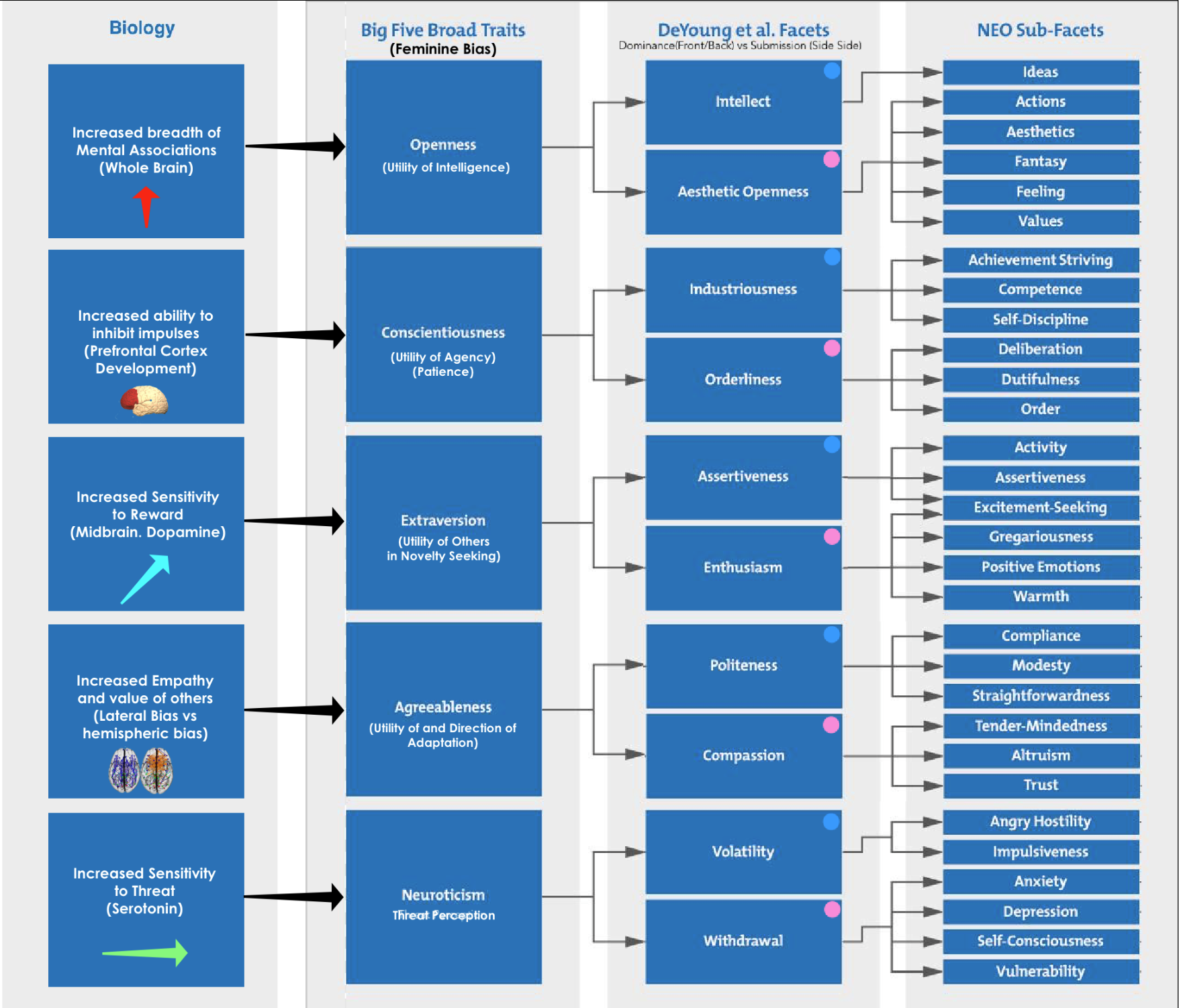
    intelligence, traits, big five personality traits   1 – Conscientiousness [the activity & in some cases overlapping into the agency dimension] (the most trainable of all the traits upwards although after 11-12 years old this becomes harder, and increasingly so into one’s 20s and 30s); Conscientiousness was associated with increased volume in the lateral prefrontal cortex, a region involved in planning and the voluntary control of behavior.   2 – Agreeableness [in some sense the agency dimension and separates men as disagreeable and women agreeable] (remarkably stable throughout life, although there are Kuhnian paradigm shifts [huge life-changing events or epiphanies usually] that slide extremely disagreeable people to the other end of the scale or vice versa I); Agreeableness was associated with increased volume in regions that process information about the intentions and mental states of other individuals.   3 – Neuroticism [the right hemisphere / threat perceiving / negative emotion dimension](immovable upwards in a similar way to IQ [we haven’t found a way other than drugs yet] and bad life events oft make neurotic people hyper-neurotic); Neuroticism was associated with increased volume of brain regions associated with threat, punishment, and negative emotions. 5 – Extraversion [the left hemisphere / opportunity perceiving / positive emotion dimension] (low-mid range trainability either way but high reversion rate so training has to be maintained); Extraversion was associated with increased volume of medial orbitofrontal cortex, a region involved in processing reward information. 4 – Openness [the creativity dimension, highly correlated with IQ] (the most interesting in that it appears people can train only toward their side of the fence…open people can ‘open the doors of perception’ [to use a Huxlian term] and closed people tend to become even more specialised as they mature, but cases of Kuhnian shifts have not been documented afaik, but there are almost always exceptions); Openness/Intellect did not have any significant correlation with the volume of any brain structures. 6 – IQ [pattern recognition] many things bring IQ down (smart professors not doing exercise for example) but nothing is known to raise it, yet. ( CD: I use male (compartmental) vs female (integrated) first. then the six dimensions that includes above, which then explains male-female difference in Factor TRAITS, including male vs female in IQ distribution as well. )   6) The underlying model of the mind is information processing not subjective experience, and while 5/6 Factor models do correspond to what we think we understand as brain structures, our understanding of those models are a REWARD system for processing information in a DISTRIBUTION, so that humans SPECIALIZE even within families, is problematic for the Diagnostic and Totalitarian thinkers (equality), and explanatory and useful for the Negotiation and Cooperative thinkers (inequality). So if we say that variations in personality reflect the necessity of using the same physical mental structure for the purpose of distributing information processing, then we describe man correctly, and we describe our industrial era norms as FALSE and DESTRUCTIVE. 7) Given my present understanding, a reframing of personality as reward system for information processing: a) Dominance(male) vs Submission (female) spectrum provides insight but it’s also so obvious that we all but ignore it. Whereas it’s contrasting dominance and submission with the other traits that provides explanatory power in why we act and feel as we do. b) Impulsivity vs patience related to patience-worry in that we can worry but not act, or worry and act, and the correlation between impulsivity and neuroticism are predictive. Why? Because it appears that neuroticism (patience/worry/obsession), is the cause of creativity. c) Conscientiousness should be reframed as reward for completing opportunities and reward for discovering new opportunities. d)Agreeableness should be desire to adapt to others vs desire to preserve context (individualism). e) Openness to Experience should be reframed as desire for adapting to information vs stress from adapting to information. f) Neuroticism should be reframed as acceptance(watching) vs worrying(excitement) vs obsession(chasing prey), where worrying is itself a time preference (living in the certain moment experiences vs projecting an uncertain future conditions, vs in pursuit of prey or idea), g) the autistic(male)-solipsistic(female) spectrum provides greater insight than all except intelligence and extroversion, and we are just beginning to understand it, and almost no one interprets it as a problem of processing information in a group of males and females with different reproductive demands. h) Intelligence is as important as extroversion in personality traits, in no small part because it appears that the limit of our minds to exhaust opportunities across these personality traits determines out resulting behavior (this is profoundly explanatory). Now, I placed the properties in that list in a particular order. That order is informative. It means that very few causal properties are involved, and we are not quite achieving our goal of understanding them. CAUSALITY a) Rate of Sexual Maturity b) Depth of Sexual Maturity c) Gender Differences d) Gender Dimorphic Differences e) Status (biological/reproductive), Demonstrated/Observed, Self Percieved f) Sense of Safety / Security g) Intelligence h) Culture h) Education and discipline   —–.     METHOD: Gender > Factor(dimension) > Trait (bias)   —–. personality aspects   —–.

    Screen Shot 2019-11-23 at 12.39.15 PM.png
    Screen Shot 2019-11-23 at 12.39.00 PM.png

    Clustering

    ( … Clustering) ASCENDENT FEMALE BIAS Average: These people score high in neuroticism and extraversion, but score low in openness. It is the most typical category, with women being more likely than men to fit into it. ASCENDENT MALE BIAS Self-Centered: These people score very high in extraversion, but score low in openness, agreeableness, and conscientiousness. Most teenage boys would fall into this category, according to Revelle, before (hopefully) maturing out of it. The number of people who fall into this category decreases dramatically with age. ESTABLISHED FEMALE BIAS Role Models: These people score high in every trait except neuroticism, and the likelihood that someone fits into this category increases dramatically as they age. “These are people who are dependable and open to new ideas,” says Amaral. “These are good people to be in charge of things.” Women are more likely than men to be role models. ESTABLISHED MALE BIAS Reserved: This type of person is stable emotionally without being especially open or neurotic. They tend to score lower on extraversion but tend to be somewhat agreeable and conscientious.  

    Intelligence

      A HIGH INTELLIGENCE (ALONE) DOESN’T MEAN YOU’RE SMART 1 – Measured Intelligence, or Intellectual Capability, is equivalent to a personality trait. There is such a high correlation between openness to experience and intelligence that this idea will go mainstream in the next decade if it has not already. Intelligence may be the most important personality trait other than conscientiousness. 2 – The remaining personality traits, (five or six factors, and ten or twelve dimensions) and their predictable gender biases, affect the application of intelligence. So like Anna Karenina’s “all healthy families are the same, and all unhealthy families are different”, or like the domestication of animals, which requires a certain combination of behaviors are present, demonstrated intelligence requires not only its presence as an ability, but the absence of traits that interfere with its expression. In other words, many things must go right, and if any of them goes wrong, we do not demonstrate that intelligence (or at least do not demonstrate it beneficially). 3) So, demonstrated intelligence depends upon the following: a) What we call ‘g’, or general intelligence (which has many components but all scale together), which is a loose measure of the rate at which you accumulate information and identify patterns – the obvious differences being the female verbal and the male spatial biases in brain structure. Despite claims as far as I know, it is not possible to alter it. b) What we call ‘Working Memory’ or ‘Short Term Memory‘ – the ability to preserve states over time. As far as I know, despite claims, it is not possible to alter it. c) General Knowledge – the totality of knowledge (information and experience) that we can draw from in identifying opportunities for patterns. (Hence why being well-read and thoroughly socialized are best things that you can do to improve your demonstrated intelligence. ) d) What we call “Personality Traits” that do not negatively interfere with the expression of one’s intellectual capacity/measured intelligence/g. The first is conscientiousness, and the second is agreeableness. e) The Preservation of Incentive to Act  (Dunning Kruger, consensus bias) ….Self Image, Guilt, Trauma, Rejection f) And the wildcard of “beliefs and wants”. One can increase the correspondence of one’s thoughts with the universe, or one can decrease the correspondence of one’s thoughts with the universe. If you want something that is impossible, or you believe something is false, you will constantly err, and accumulate errors. The more false and impossible beliefs and wants, the more error you will accumulate. g) The Polity  … “Demographic Distribution”  ( … ) h) The Genetics … “neoteny, group cog biases (feminine masculine)” i) The Culture  … Group Strategy j) The Economy ( … ) “…Degree of Development…” Our primary drive is status, whether self-image,  reputation or behavior of others toward us despite our self-image and reputation. And the majority of failures of intelligence are caused by the inability to develop, or lack of training in, the mindfulness (stoicism) to judge one’s value in the markets for communication, association, friendship, productive cooperation, reproduction(family), commons production, political production, and military production. So many of us wish the world were different, and go slightly foolish, anxious, depressed, or entirely mad, because we cannot tolerate a self-image that corresponds with reality. Meaning, we cannot develop a self-image that accurately describes our market value to others: Our Status. Otherwise, trauma causes similar dysfunctions, since trauma forces us to work constantly to avoid activating parts of our memories ( minds, brains), via association. This becomes exhausting. Which is why hallucinogens work so effectively at allowing us to observe experiences rather than feel them, and therefore create alternative pathways and weights that allow us to circumvent those traumas (land mines). 5) WHAT MEASURES WOULD I LIKE TO SEE INSTEAD? I prefer: 1) Moral biase: feminine(left) < balanced(libertarian) > masculine(conservative), 4) Gender bias: empathic-solipsistic < balanced > autistic-analytic 2) Trust: altruistic-trusting < balanced > not-trusting-selfish, 3) Relations: extraversion < balanced > introversion, 5) Discipline: rigid-organized(closing things off) < balanced > intuitive(preserving options)-irresponsible, 6) Patience: endurance-patience < balanced > frustration-impulsivity, 7) Stability; paranoia-fearfulness < balanced > confidence-steadiness, 8) Intelligence: verbal IQ in .5 std deviations from 100. (scale of -5 to +5 because more or less is irrelevant.) 9) Spatial IQ in .5 std deviations from 100.  

  • Man – Mind

    Man – Mind

    Action

    “Man Must Act” (dark forces of  need, time, and ignorance)

    |BEHAVIOR| property(acquisition/defense) > prey drive > gender drive >
     cooperation drive > personality > intuition > reason > calculation >
     computation > markets > symmetries.

    Minds

    ( … )

    Brain

    HUMAN FACULTIES 1. sense (neurons-nerves) 2. disambiguation (constant relations – cortex), 3. perception(integration-prediction – cortex), 4. intuition (auto-association-prediction) (hippocampus-cortex + valuation(emotion)) 5. attention (attention-prediction) (thalamus-hippoampus-cortex), 6. will (recursion-prediction) (prefrontal, thalamus, hippocampus, cortex) 7. and release of actions;

    Consciousness

    THE RULES OF CONSCIOUSNESS WHEREAS 1. Our attention rotates in a competition between sensation(observation and construction by prediction and reward identification), imagination (possibility by association), holding attention on a goal (possibility by continuous opportunity seizure), and releasing predicted actions (in pursuit of the goal). WHEREAS 2. We rotate between sensation (observation and construction by prediction), anticipating (goal prediction), and storing (remembering by stimulating and rehearsing), on a 1/10th of a second rotation (Theta) creating competition and choice. AND WHEREAS 3. There is no observer, other than the memory of an observation. 4. There are no observations other than sequences. 5. There is no comparison of observations other than to previous sequences. 6. There is no order in sequences other than that created by sequences. 7. There are no sequences other than those of sensations. 8. There is no existence sensed, other than those changes in time. 9. Without change we cannot sense time. THEREFORE Existence is a verb Experience is a verb Imagination is a verb Consciousness is a verb. Because Acting is a verb – and we can only act in time. AND THEREFORE Without action, we produce no existence, no experience, no sequence, no memory, no consciousness. AND THEREFORE There is no observer other than the observations (hierarchy of increasing of sequences of memories in time. AND THEREFORE We see what the camera sees. We do not record images, but sequences of related stimuli. “I AM, MEANING, I EXIST AS, THE HIERARCHY OF MY MEMORY IN MOTION”

    Arousal is not Consciousness

    Confusing Arousal with Consciousness is like confusing the light switch with the light. Just ’cause we can turn off the switch doesn’t tell us how the light is created. We can interfere with any number of parts (Colostrum) and shut down experience. That doesn’t tell us anything. The question is, how does that mushy wetware synthesize past memory present experience, and future prediction, from millions of nerves (measurements) into our rather amazing conflated experiences of past, present, and future? (cortical hierarchy, parahippocampal, perirhinal, entorhinal cortices, and subiculum.) How do we shift between narrow focus, near perception, environmental perception, self-perception, and deep introspection and imagination? (thalamus) Why is it we can react so quickly that we can hit a curveball with a bat? (basal ganglia, cerebellum, and cortical prediction) How do we Assemble memories and experience them? (Hippocampus) What is that feeling of me? (mostly, hippocampus) Why can’t we pin it down. “Cause it’s a verb not a noun”. The continuous change in state in a hierarchy of ever smaller cycles of time….

    Attention

    Neural Economy

    ( … ) Hayek’s knowledge, tradition, habits…. limiting burden of reason.

    The Will To Act

    (necessary  … preservation of the will to act … dunning kruger confidence )