Jan 29, 2020, 6:12 PM by Martin Štěpán The “accident of birth” argument falls apart when you reject dualism. I mean that accident of birth implies that it’s an accident your consciousness (soul) got assigned to your body rather that consciousness being produced by the body. So when someone asks me something like: “What if it was you in that situation?”, I respond with: “I am a product of a specific time, place, genetics and experience. It wouldn’t be me in that situation, it would be someone else.”
Theme: Agency
-
The Most Reliable Test of Whether Someone Has an Empathy Deficit
The Most Reliable Test of Whether Someone Has an Empathy Deficit https://propertarianism.com/2020/05/30/the-most-reliable-test-of-whether-someone-has-an-empathy-deficit/
Source date (UTC): 2020-05-30 14:57:02 UTC
Original post: https://twitter.com/i/web/status/1266745438092263428
-
The Most Reliable Test of Whether Someone Has an Empathy Deficit
Jan 30, 2020, 6:57 PM
—“Is cruelty to animals the most reliable test of whether someone has an empathy deficit?”—
It is very indicative of sociopathy and increased risk of people who will engage in criminal activity. It’s the most accurate I know of. As for ‘abusing or neglecting animals in frustration, it can be any number of factors including idiocy, incompetence, exhaustion, and poverty.
-
The Most Reliable Test of Whether Someone Has an Empathy Deficit
Jan 30, 2020, 6:57 PM
—“Is cruelty to animals the most reliable test of whether someone has an empathy deficit?”—
It is very indicative of sociopathy and increased risk of people who will engage in criminal activity. It’s the most accurate I know of. As for ‘abusing or neglecting animals in frustration, it can be any number of factors including idiocy, incompetence, exhaustion, and poverty.
-
A Huge Empathy Deficit in The Far East.
Jan 30, 2020, 7:02 PM
—“There seems to be a huge empathy deficit in the Far East. Intra-human cruelty can be brought on by moral violations, rather than an empathy deficit. But animals can’t violate, so….”– a friend.
The sphere of demand for empathy increases with the sphere of demand for cooperation. The chinese are disturbing because despite their long history of civilization that have an equally long history of disregard for human life, lack of responsibility for non-family members, lack of responsibility for the commons, and murderousness against their people that never existed in european civilization’s or indian civilization’s history. Look at how humans are displayed in chinese art, literature, and law., Compare to how they are depicted in greek, roman, continental, and anglo european art and literature. Art is the psychology of People are unattractive and despicable in much of chinese art. Once you see it you can’t unsee it. Compare with how the exceptional human form was central to european art. Videos today are very telling. And so we have evidence from around the world every day. Chinese stand by as children are kidnapped in broad daylight, or rapes are conduced in broad daylight. In general, asian civilization is relatively peaceful but it’s also, in its own way, despicable – just as their ‘face before truth’ is despicable by our standards.
-
A Huge Empathy Deficit in The Far East.
Jan 30, 2020, 7:02 PM
—“There seems to be a huge empathy deficit in the Far East. Intra-human cruelty can be brought on by moral violations, rather than an empathy deficit. But animals can’t violate, so….”– a friend.
The sphere of demand for empathy increases with the sphere of demand for cooperation. The chinese are disturbing because despite their long history of civilization that have an equally long history of disregard for human life, lack of responsibility for non-family members, lack of responsibility for the commons, and murderousness against their people that never existed in european civilization’s or indian civilization’s history. Look at how humans are displayed in chinese art, literature, and law., Compare to how they are depicted in greek, roman, continental, and anglo european art and literature. Art is the psychology of People are unattractive and despicable in much of chinese art. Once you see it you can’t unsee it. Compare with how the exceptional human form was central to european art. Videos today are very telling. And so we have evidence from around the world every day. Chinese stand by as children are kidnapped in broad daylight, or rapes are conduced in broad daylight. In general, asian civilization is relatively peaceful but it’s also, in its own way, despicable – just as their ‘face before truth’ is despicable by our standards.
-
Societies and Religions Serve the Empathic Personality Across a Spectrum of Low
Societies and Religions Serve the Empathic Personality Across a Spectrum of Low to High Neuroticism. https://propertarianism.com/2020/05/30/societies-and-religions-serve-the-empathic-personality-across-a-spectrum-of-low-to-high-neuroticism/
Source date (UTC): 2020-05-30 14:40:56 UTC
Original post: https://twitter.com/i/web/status/1266741389888573441
-
Societies and Religions Serve the Empathic Personality Across a Spectrum of Low to High Neuroticism.
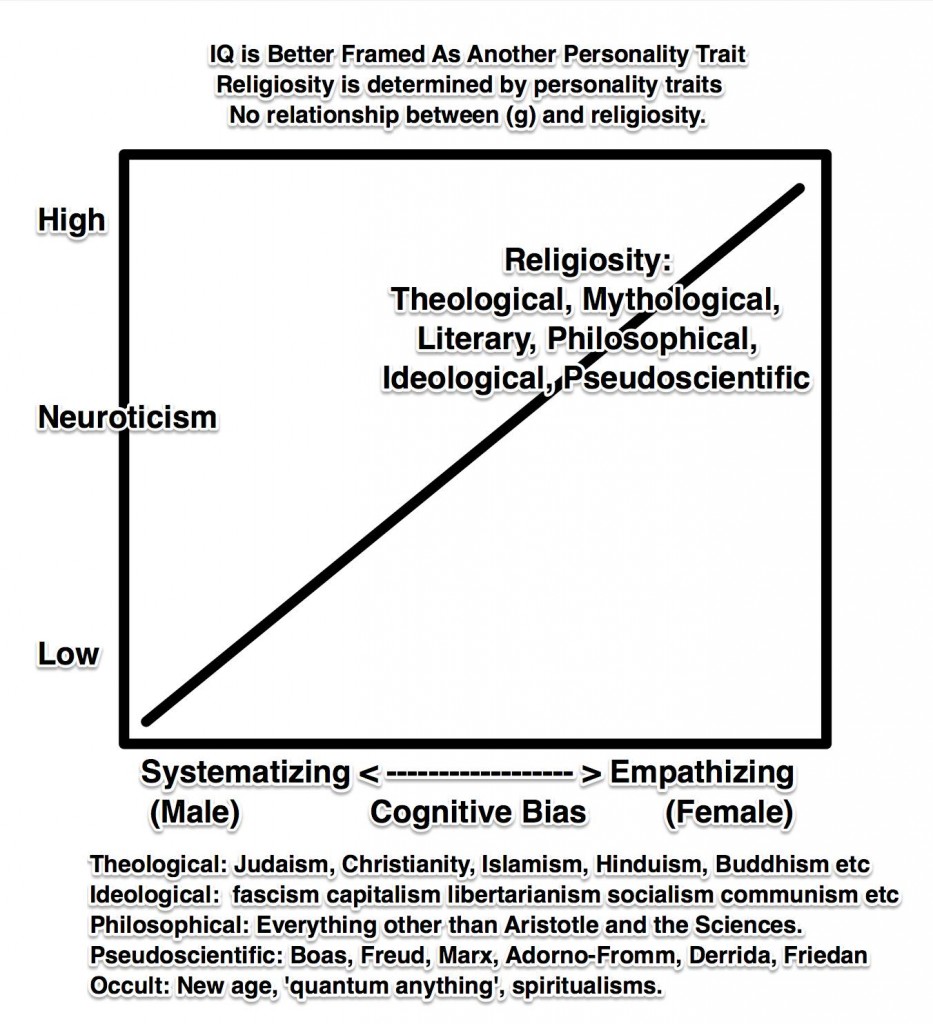
—“Are we talkin about run-of-the-mill Freemasonry or high-level secret handshake Freemasonry?”—Leif Erickson
What’s the difference besides the personalities of the people who go to them? Religiosity is driven not by intelligence per se, but by two factors: empath and neuroticism that influence how and what we learn. So think of societies and religions as serving the empathic personality across a spectrum of low to high neuroticism. Secret handshakes are higher trust providers at higher cost, and provide higher satisfaction because of more disciplined ritual to those with higher neuroticism. Organizations satisfy demand. Everyone wants everyone else to be satisfied on his or her terms. It’s not complicated.
-
What Type of Abnormal Abilities Do You Have when You Have a High Iq?
What Type of Abnormal Abilities Do You Have when You Have a High Iq? https://propertarianism.com/2020/05/30/what-type-of-abnormal-abilities-do-you-have-when-you-have-a-high-iq/
Source date (UTC): 2020-05-30 14:08:39 UTC
Original post: https://twitter.com/i/web/status/1266733263411961858
-
What Type of Abnormal Abilities Do You Have when You Have a High Iq?
Feb 7, 2020, 9:02 PM (copied from quora) We process much more information. That’s the major difference. In general you want a big round head, a lot of neural density, and the lowest possible friction of transmission (white matter). In addition to processing more information we often identify increasingly subtle (more remote) patterns. And because of this we can work longer at learning – and some of us (I am certainly one of them) feel anxiety, depression, or pain if we are not learning. So not only can we learn more, faster, but we can learn more because we can learn more hours per day. The more information we have, the more remote the patterns we see, the more we rely on that information and the less on intuition, norm, tradition, and the opinions and ideas of others. Additionally, some people have better short term memories and can hold larger static models. ( Hawking is a great example, but so are many others). I do not have this particular ability and I find that it is what differentiates me from the people who are above me. Additionally some people have superior verbal abilities and can describe what they think of more accessibly. (Noam Chomsky is smarter than I am, in both short term memory and verbal ability, and rarely loses his place no matter how convoluted the conversational route. ) Some of us have more discipline, more conscientiousness, and skepticism and we’re possibly more autistic (which is the result of high neuronal density anyway), and we simply make fewer errors than others. This is very rare. We mature at different rates. Some of us have exceptional abilities in childhood and have nervous breakdowns when we reach young adulthood. (This is a subject I study now and then.) Others mature normally. Others of us mature more slowly. Normies are quite frustrating really. I had the great fortune to have a very old professor of contract law, who told me my sophomore year that “The world is not meant for us. It is meant for them. We are prisoners of their world. And the best we can do is help them through it.” And I found that advice to be profoundly useful in ending the the feeling that normies run the world, like children at a birthday party running with scissors. 😉 —-Updated—- In response to other comments I added this bit of background. We commonly confuse Measurement of intelligence (g), with demonstrated intelligence, with applied intelligence, and with the personality trait of conscientiousness. Let’s disambiguate them so we explain the variables that affect it. Despite appearances, the brain is not a complicated organ. It consists almost entirely of nerve cells. They all do the same thing. And there are only really three or four kinds – depending upon where the ‘decision’ has to be made by the neuron. There are a LOT of these neurons and they’re connected in almost infinite ways. But, what they do is quite simple. How they do it is elegant, and infinitely complex, and it’s a vast parallel division of labor between them. Intelligence consists pretty much of (a) a volume of cells – more is better, (b) efficiency of the network (especially the control of attention) – meaning limiting information-loss as it calculates, (c) how that network grew in utero, and during the first two years, (d) lack of defects in anything that affects the network (and that’s a lot of possibility right there). IQ is our attempt to measure (g) which is about the same class of problem as how much water can get through a big city’s plumbing system, electrical grid, or traffic system, and still give you a shower, power your air conditioner, and get your goods delivered to shops. The formula for resistance in undersea cables and dendrites within neurons is the same. So, we think of (g) as something you ‘get’. But it’s not. It’s more a function how many neurons versus how little friction there is that hinders water, electricity, or traffic (information). The ‘economy’ of the neural synapse is an interesting example. A synapse can only manufacture so many chemicals at any rate. So a synapse can grow until we generate enough demand for more synapses at which point we grow more of them. And out of a set of synapses some will have the resources to discharge chemicals when the neuron fires, and some won’t. How many things can affect just that one micro economy? INTELLIGENCE The Series 1 – (g) intelligence potential … … demonstrated intelligence (you do things) … … … applied intelligence (you achieve things) Depends Upon: 2 – Trait Conscientiousness (stick to it, agency) 3 – Short Term Memory capacity (math in particular) 4 – General Knowledge (can also compensate for iq) 5 – Not wanting falsehoods (preference for truth) 6 – Lack of traumas or other defects At least those six dimensions affect demonstrated and applied intelligence. And despite postmodern (wishful thinking, denial,sophistry, and pseudoscience), measurement of IQ in psychology, and stereotypes in sociology are the two most accurate measurements in the human sciences. IMPORTANT: The data says something very clear though that should temper our interpretation: success is dependent almost entirely on conscientiousness (agency, delayed gratification, diligence). Intelligence determines the degree of complexity under which you can compete with others. But if you can manage to develop agency whether with trait conscientiousness or not, you can be successful in life anywhere along the bell curve (and the opposite is also true). MALE AND FEMALE BRAINS Despite pseudoscientific attempts to obscure it, sex differences in bias, cognition, intelligence, were settled by 2012. The primary differences being the rather obvious, lateral (female) white matter, synthetic, interpersonal, empathic, and generosity (dysgenia: quantity over quality) and the longitudinal (male) grey matter, analytic, political, physical, and parsimonious (eugenia: quality over quantity). So we see specialization in sex cognition as well as sex bias and preference. Stereotypes are largely true a the level of distributions, with bias and preference combined with conscientiousness causing predicted sortition into fields and contexts according to stereotypical differences – and unexpectedly, we see that as equality increases women and men demonstrate GREATER bias to stereotypical fields and contexts – not less. THEORY My current understanding is that intelligence provides a discount on acquisition of knowledge (identification and construction of patterns (networks of relations)), but also increases detection of error, bias, and deceit. This is why western and far eastern bureaucracies focused on promoting people with HIGH IQ’s: they are more successful at defending the polity and economy from ignorance, error, bais, wishful thinking, and deceit.