Source: Twitter X

  • RT @curtdoolittle: @programmabiliti @nobitanobi405 HERITABILITY AND UTILITY OF A

    RT @curtdoolittle: @programmabiliti @nobitanobi405 HERITABILITY AND UTILITY OF ADHD
    ADHD has a genetic component (70-80% ) that is highly h…


    Source date (UTC): 2024-11-24 19:09:09 UTC

    Original post: https://twitter.com/i/web/status/1860762597571883270

  • HERITABILITY AND UTILITY OF ADHD ADHD has a genetic component (70-80% ) that is

    HERITABILITY AND UTILITY OF ADHD
    ADHD has a genetic component (70-80% ) that is highly heritable and expressed in utero during development. ADHD is difficult to avoid, because it’s polygenic and results from the cumulative effect of many genes. Since it’s polygenic and not selected against it must serve some purpose.

    Possible Causes for the Perpetuation of ADHD Traits
    TL/DR; A distribution of cognitive styles insures a group can more successfully exploit opportunities of time space risk and reward rather than people who are in fact similar in cognitive styles. While quality differences between populations are due to neoteny, geographic adaptation, and genetic load most human variation is due to sex differences in cognition valuation and expression. As such almost all human behavior is causally reducible to those dimensions four dimensions of: sex, neoteny (race), geography (ethnicity), and load (class).

    1. Adaptive Advantages in Evolutionary Contexts
    Hyperfocus and Creativity:Traits associated with ADHD, such as hyperfocus during periods of intense interest, may have been advantageous for solving complex problems or innovating.
    Enhanced creativity and novel problem-solving skills would have been valuable in dynamic or changing environments.
    Exploration and Risk-Taking: High impulsivity and novelty-seeking behavior, common in ADHD, may have conferred survival benefits in hunter-gatherer societies:Foragers: Individuals prone to explore new territories, resources, or methods of survival may have benefited their groups.
    Scouts: High-risk, high-reward behaviors could have been advantageous for discovering food sources or avoiding threats.
    Rapid Response and Vigilance: ADHD-like traits may enhance alertness to environmental changes, benefiting individuals in roles requiring quick reactions or adaptability (e.g., during hunting or combat).

    2. Trade-Offs in Cognitive and Behavioral Traits
    Short-Term Advantages vs. Long-Term Costs: The impulsivity and distractibility of ADHD may lead to short-term successes in certain high-stakes or dynamic situations, offsetting the longer-term disadvantages.
    Specialization in Group Dynamics:
    In a tribal setting, individuals with ADHD-like traits may have filled unique niches, complementing those with more consistent focus and planning skills.
    Group success often depends on diverse personality and cognitive types.

    3. Balancing Selection
    Heterozygote Advantage: Genes associated with ADHD may confer advantages in heterozygous states, while homozygous expression results in more severe manifestations of the disorder.
    This dynamic maintains genetic diversity within the population.
    Environmental Dependence: Traits that are maladaptive in modern, sedentary, and structured societies may have been adaptive in ancestral environments.
    Selection pressures can shift, making certain traits less advantageous without entirely removing them.

    4. Gene-Pleiotropy and Overlap with Other Traits
    Shared Genetic Pathways: ADHD-associated genes may also influence other traits that are highly adaptive, such as intelligence, creativity, or social influence.
    For example, genes affecting dopamine signaling may enhance reward sensitivity, increasing motivation in some contexts despite leading to impulsivity in others.
    Pleiotropic Effects:Genes involved in ADHD may also play roles in other biological systems or behaviors, making them resistant to negative selection because they provide overall net benefits.

    5. Modern Mismatch with Evolutionary Context
    ADHD traits may have been adaptive in environments requiring high mobility, rapid adaptation, and risk-taking but are less so in modern settings that prioritize sustained attention, routine, and long-term planning.
    The rise of structured educational systems and workplace environments may have highlighted ADHD as a disorder rather than an adaptive variant.

    6. Weak Selection Pressure Against ADHD
    ADHD does not typically result in significantly reduced reproductive fitness: Many individuals with ADHD have children and pass on their genes.
    The disorder often manifests more as a variation in behavioral traits rather than as a catastrophic condition that would eliminate carriers from the gene pool.

    Examples of ADHD Traits in Historical or Evolutionary Contexts
    Explorers and Innovators: Risk-taking and novelty-seeking traits associated with ADHD likely drove exploration, discovery, and technological advances.
    Leaders in Crisis: Impulsivity and rapid decision-making may have been valuable in chaotic or high-pressure situations.
    Group Success: (THIS:) Diversity in cognitive styles ensured that groups could respond to a wider range of challenges and opportunities.

    Summary
    The persistence of ADHD in the population likely reflects a balance between its adaptive benefits in certain contexts and its modern disadvantages in structured, sedentary societies. ADHD traits are maintained because they provide group-level or individual-level advantages in dynamic, unpredictable environments, outweighing their costs under ancestral conditions. Natural selection operates on the totality of traits and their contributions to survival and reproduction, and ADHD traits appear to have played a meaningful role in human evolution.

    Cheers
    CD 😉

    Reply addressees: @programmabiliti @nobitanobi405


    Source date (UTC): 2024-11-24 19:08:58 UTC

    Original post: https://twitter.com/i/web/status/1860762553498136576

    Replying to: https://twitter.com/i/web/status/1860631175938658690

  • Yes but we have better health care for our costs. I’ve been seriously ill in the

    Yes but we have better health care for our costs. I’ve been seriously ill in the US, Canada, UK, Russia, and Ukraine. The best doctor care is of all places ukraine, because they can take as much time with you as they wish. The best serious care is in the USA by far without question. A great example is that when I was diagnosed with cancer I was in surgery in hours. I’ve never waited for an MRI or CAT scan.

    Reply addressees: @jeantudouglas


    Source date (UTC): 2024-11-24 18:53:43 UTC

    Original post: https://twitter.com/i/web/status/1860758714808201216

    Replying to: https://twitter.com/i/web/status/1860674175037510074

  • (Naxalt fallacy)

    (Naxalt fallacy)


    Source date (UTC): 2024-11-24 18:51:16 UTC

    Original post: https://twitter.com/i/web/status/1860758097880641632

    Reply addressees: @swpwilliams @antijudaic19165

    Replying to: https://twitter.com/i/web/status/1860678171181351160

  • Well by and large they have – at least in the occupied regions they’ve attacked.

    Well by and large they have – at least in the occupied regions they’ve attacked. Including the intentional mass murder of civilians, torture killing, and stealing children and relocating them to Russia to russify them. Besides UA would be ungovernable now. They’d almost have to.


    Source date (UTC): 2024-11-24 18:51:00 UTC

    Original post: https://twitter.com/i/web/status/1860758032151712078

    Reply addressees: @auny_marie

    Replying to: https://twitter.com/i/web/status/1860687468481179806

  • Exactly

    Exactly.


    Source date (UTC): 2024-11-24 18:49:17 UTC

    Original post: https://twitter.com/i/web/status/1860757597273636958

    Reply addressees: @AutistocratMS

    Replying to: https://twitter.com/i/web/status/1860703965614117092

  • This is one of those odd questions like “Do you consider climate change less dan

    This is one of those odd questions like “Do you consider climate change less dangerous than woke?” Silly question.

    They’re both dangerous. We just have more capacity to influence one domestically, than we do to influence one globally.


    Source date (UTC): 2024-11-24 18:48:54 UTC

    Original post: https://twitter.com/i/web/status/1860757502943711620

    Reply addressees: @AutistocratMS @SirSmokesAaLot

    Replying to: https://twitter.com/i/web/status/1860704568494969295

  • Q: “Curt, how dangerous is Russia (low-trust ex-mongol authoritarian forced-into

    Q: “Curt, how dangerous is Russia (low-trust ex-mongol authoritarian forced-into-land-expansion-because-geography) compared to the Middle East?”

    Excellent question.

    Analysis:

    The question requires evaluating the potential dangers posed by Russia and the Middle East, factoring… https://t.co/Tej5ROGSf4


    Source date (UTC): 2024-11-24 18:47:11 UTC

    Original post: https://twitter.com/i/web/status/1860757069030428686

    Reply addressees: @DwightExMachina

    Replying to: https://twitter.com/i/web/status/1860716786875818022

  • Q: “Curt, how dangerous is Russia (low-trust ex-mongol authoritarian forced-into

    Q: “Curt, how dangerous is Russia (low-trust ex-mongol authoritarian forced-into-land-expansion-because-geography) compared to the Middle East?”

    Excellent question.

    Analysis:

    The question requires evaluating the potential dangers posed by Russia and the Middle East, factoring in the geopolitical, economic, demographic, and cultural strategies and weaknesses of each. Both regions present distinct challenges to global stability, but their dangers manifest differently based on their structural conditions and ambitions.

    Part 1: Russia: A Declining but Aggressive Power
    Russia’s danger stems from its structural weaknesses, historical path dependencies, and current geopolitical strategies.

    Key Characteristics

    1. Resource Economy:
    – Dependency on Natural Resources: ~40% of government revenue comes from oil and gas exports. A resource-dependent economy limits diversification and long-term growth.
    – Vulnerable to sanctions and global shifts away from fossil fuels.

    2. Population Collapse:
    – Demographic Crisis: Population shrinking due to low birth rates, emigration, and high mortality rates. Projected to decline by ~15 million by 2050.
    – A smaller, aging population limits economic and military capacity.

    3. Corruption and Low Trust:
    – Ranked among the most corrupt nations (Transparency International).
    – Low trust in institutions hampers innovation, economic diversification, and societal cohesion.

    4. Geopolitical Compulsion for Expansion:
    – Historical Pattern: Russian strategy has always been to expand territorial control to create buffer zones against perceived external threats.
    – Geography offers no natural barriers, making defense difficult without territorial control.
    – Current actions (e.g., Ukraine invasion) reflect a desire to secure strategic depth and access to resources.

    5. Authoritarianism and Legacy of Mongol Rule:
    – The legacy of centralized, authoritarian rule creates a system resistant to reform and perpetuates a reliance on coercive power rather than trust-based governance.

    Danger Level:
    – Military Threat: Significant conventional military capability, nuclear arsenal, and willingness to use force make Russia a short-term threat to its neighbors and NATO.
    – Long-Term Decline: Economic and demographic challenges undermine its sustainability as a global power.
    – Global Destabilization: Cyberwarfare, disinformation campaigns, and energy manipulation are asymmetric tools that Russia uses effectively despite structural weaknesses.

    PART 2: Middle East: The Danger of Ideological and Sectarian Conflict

    The Middle East, particularly through the actions of Iran and Islamist movements, presents dangers rooted in ideological, demographic, and geopolitical strategies.

    Key Characteristics

    1. Islamist Strategy: Migrate, Reproduce, Undermine:
    – Migration: Large-scale migration to the West has demographic, cultural, and political implications. Islamist groups aim to expand influence by leveraging diaspora communities.
    – Reproduction: High birth rates in some regions create young, rapidly growing populations that may strain resources and governance.
    – Undermining from Within: Radical Islamist groups work to exploit liberal democracies’ institutions (e.g., free speech, religious protections) to propagate their ideology.

    2. Iran’s Imperial Ambitions:
    – Regional Hegemony: Iran seeks to establish dominance over the Middle East, often through proxies (e.g., Hezbollah, Houthis) in Lebanon, Yemen, and Syria.
    – Oil Strategy: Plans to create a bourse that requires oil purchases in Iranian currency challenge the petrodollar system, threatening U.S. economic dominance.
    – Expansion Through Conflict: Uses sectarian divides (Sunni vs. Shia) to destabilize rivals, like Saudi Arabia, and expand influence.

    3. Weak States and Proxy Wars:
    – Chronic instability in states like Syria, Iraq, and Yemen creates vacuums filled by extremist groups and proxies.
    – Regional conflicts spill over into global terrorism and migration crises.

    4. Cultural and Ideological Persistence:
    – Unlike Russia, Middle Eastern movements (e.g., radical Islam) often rely on ideological rather than state power, making them harder to contain through traditional deterrence.

    Danger Level:
    – Iran’s Strategic Threat: Developing nuclear capabilities and attempting to destabilize the petrodollar system present major risks to global energy markets and regional stability.
    – Islamist Undermining:
    Radical ideologies exploit democratic vulnerabilities, potentially leading to long-term cultural and political shifts in target countries.
    – Demographic Expansion:
    Rapid population growth and migration, if unmanaged, exacerbate existing tensions in host nations.

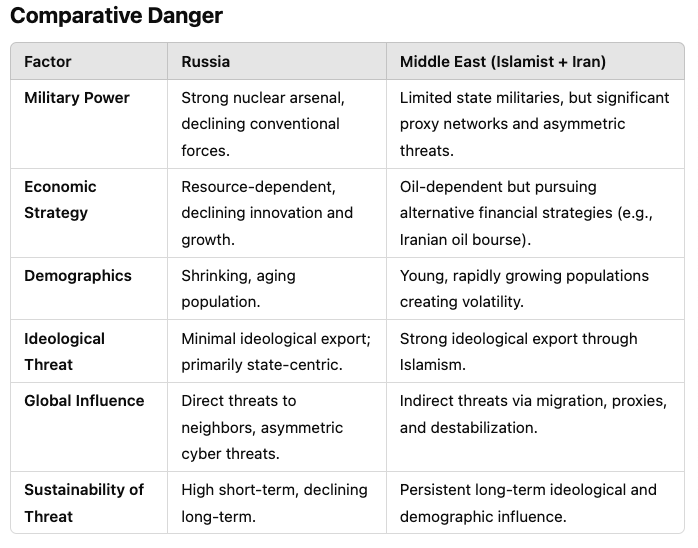
    Comparative Danger
    (See attached table)

    Part 3 – Conclusion

    Russia is a dangerous declining power, prone to aggressive military actions and destabilizing asymmetric tactics as its long-term prospects weaken. Its immediate threat lies in military confrontation and geopolitical destabilization.

    The Middle East, particularly through Iran’s state ambitions and Islamist strategies, poses a persistent ideological, demographic, and geopolitical challenge. It operates on a longer timeline, leveraging cultural and economic undermining to reshape global dynamics.

    In essence:
    Russia is a reactive threat: dangerous in the short term due to its military capabilities and willingness to destabilize to preserve its relevance.

    The Middle East is a proactive threat: dangerous in the long term due to ideological persistence, demographic pressures, and ambitions to reorder economic and geopolitical systems.

    Cheers
    CD


    PROMPT: “How dangerous is Russia ( resource economy, population collapsing, heavy corruption, low-trust ex-mongol authoritarian forced-into-land-expansion-because-geography) compared to the Middle East, and islam’s use of migrate, reproduce, and undermine from within, as well as Iran’s desire to create an empire, capture oil, create a bourse, and require oil bought in iranian currency, to finance further aggressive imperial expansion?”

    Source date (UTC): 2024-11-24 18:47:10 UTC

    Original post: https://twitter.com/i/web/status/1860757068539695104

  • ( And it was speculative. And they always fight the last war so to speak. But lo

    ( And it was speculative. And they always fight the last war so to speak. But look what’s happened since the use of drones in Ukraine… And FWIW they will be very reluctant to give up planes as reusable weapon delivery devices. And they will likely produce drones that protect…


    Source date (UTC): 2024-11-24 18:27:18 UTC

    Original post: https://twitter.com/i/web/status/1860752068216332730

    Replying to: https://twitter.com/i/web/status/1860723476333547904