Source: Twitter X

  • Edit “….formation – and only then the christian religion of the underclasses.”

    Edit “….formation – and only then the christian religion of the underclasses.”


    Source date (UTC): 2024-03-20 17:50:43 UTC

    Original post: https://twitter.com/i/web/status/1770508282853032237

    Reply addressees: @Saurabh_Shah1 @radiofreenw

    Replying to: https://twitter.com/i/web/status/1770507251809124831


    IN REPLY TO:

    Unknown author

    It’s not concrete and testable enough. And this form of construction is used only when trying to manipulate by use of conflation.

    The west consists of the natural religions, the germanic semi-formalization, the greco-roman formalization, and the greek philosophical formation, culminating in stoicism.

    The method for comparing civilizational differences consists of:
    1) Given the three means of coercion possible:
    … 1. Religion/Social by Seduction/Ostracization
    … 2. Economic by Trade/Boycott
    … 3. State by Defense/Violence
    2) Given the path dependence of institutional formation:
    … 1. Religion(Strong) > State(Weak) > Law(fail)
    … 2. Religion(Strong) > Law(Weak) > State(fail)
    … 3. State(Strong) > Religion(Weak) > Law (fail)
    … 4. State(Strong) > Law (Weak) > Religion (fail)
    … 5. Law(Strong) > Religion(Weak) > State (fail)
    … 6. Law(Strong) > State(weak) > Religion (fail)
    3) Given the Innovative ability of those institutions:
    … 1. Limited: Religion
    … 2. Only Under Stress: State
    … 3. Continuous: Law
    4) Given the adaptability of those institutions:
    … 1. Slow: Religion
    … 2. Medium: Law
    … 3. Fast: State
    5) Given the demographic composition of the polity (IQ):
    … Slow: Below Minimum (85) – no innovation or adaptation
    … Medium: Below Innovation (100) – adaptation
    … Fast: Above threshold (105) – innovation
    6) In addition:
    … Relationship between rulers and ruled (parasitic vs productive)
    … Homogeneity (good) vs Heterogeneity (bad)
    … Resources
    … Geography
    … Climate
    … Condition vs competing states.

    This determines the condition of the population.

    Cheers

    Original post: https://x.com/i/web/status/1770507251809124831

  • It’s not concrete and testable enough. And this form of construction is used onl

    It’s not concrete and testable enough. And this form of construction is used only when trying to manipulate by use of conflation.

    The west consists of the natural religions, the germanic semi-formalization, the greco-roman formalization, and the greek philosophical formation, culminating in stoicism.

    The method for comparing civilizational differences consists of:
    1) Given the three means of coercion possible:
    … 1. Religion/Social by Seduction/Ostracization
    … 2. Economic by Trade/Boycott
    … 3. State by Defense/Violence
    2) Given the path dependence of institutional formation:
    … 1. Religion(Strong) > State(Weak) > Law(fail)
    … 2. Religion(Strong) > Law(Weak) > State(fail)
    … 3. State(Strong) > Religion(Weak) > Law (fail)
    … 4. State(Strong) > Law (Weak) > Religion (fail)
    … 5. Law(Strong) > Religion(Weak) > State (fail)
    … 6. Law(Strong) > State(weak) > Religion (fail)
    3) Given the Innovative ability of those institutions:
    … 1. Limited: Religion
    … 2. Only Under Stress: State
    … 3. Continuous: Law
    4) Given the adaptability of those institutions:
    … 1. Slow: Religion
    … 2. Medium: Law
    … 3. Fast: State
    5) Given the demographic composition of the polity (IQ):
    … Slow: Below Minimum (85) – no innovation or adaptation
    … Medium: Below Innovation (100) – adaptation
    … Fast: Above threshold (105) – innovation
    6) In addition:
    … Relationship between rulers and ruled (parasitic vs productive)
    … Homogeneity (good) vs Heterogeneity (bad)
    … Resources
    … Geography
    … Climate
    … Condition vs competing states.

    This determines the condition of the population.

    Cheers

    Reply addressees: @Saurabh_Shah1 @radiofreenw


    Source date (UTC): 2024-03-20 17:46:37 UTC

    Original post: https://twitter.com/i/web/status/1770507251679174656

    Replying to: https://twitter.com/i/web/status/1770502259614310896

  • Working on it. πŸ˜‰

    Working on it. πŸ˜‰


    Source date (UTC): 2024-03-20 17:30:11 UTC

    Original post: https://twitter.com/i/web/status/1770503113641714037

    Reply addressees: @ancientnatsoc

    Replying to: https://twitter.com/i/web/status/1770502909630812291

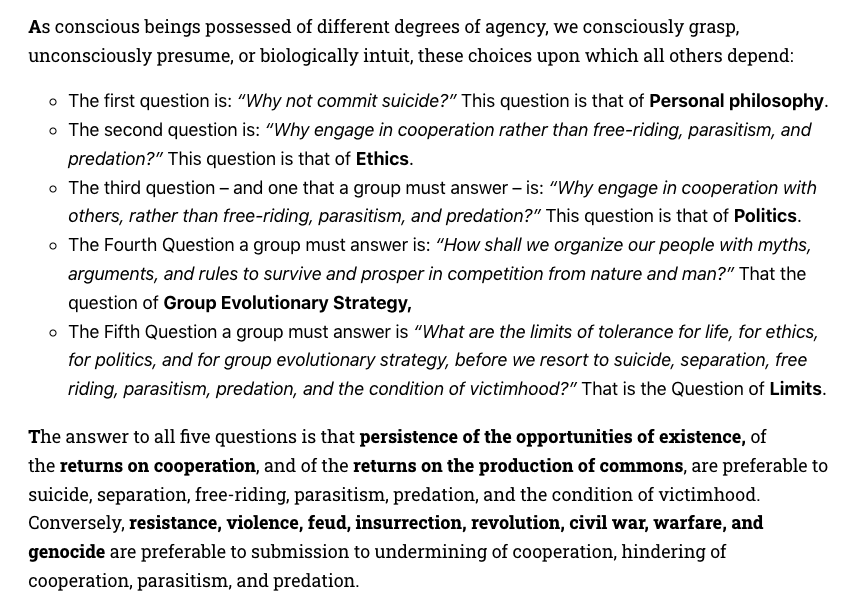
  • The First Principles of Philosophy In Five Questions

    The First Principles of Philosophy In Five Questions

    The First Principles of Philosophy In Five Questions. https://t.co/iqiYZaf9G1


    Source date (UTC): 2024-03-20 17:22:20 UTC

    Original post: https://twitter.com/i/web/status/1770501139076714577

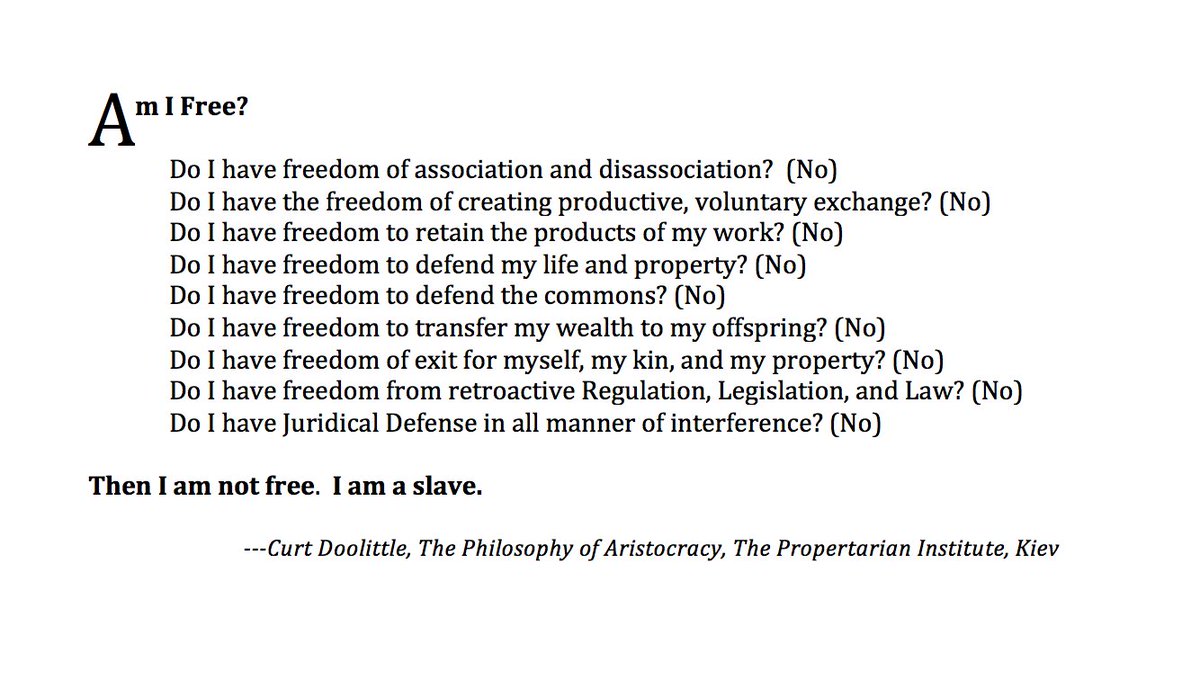
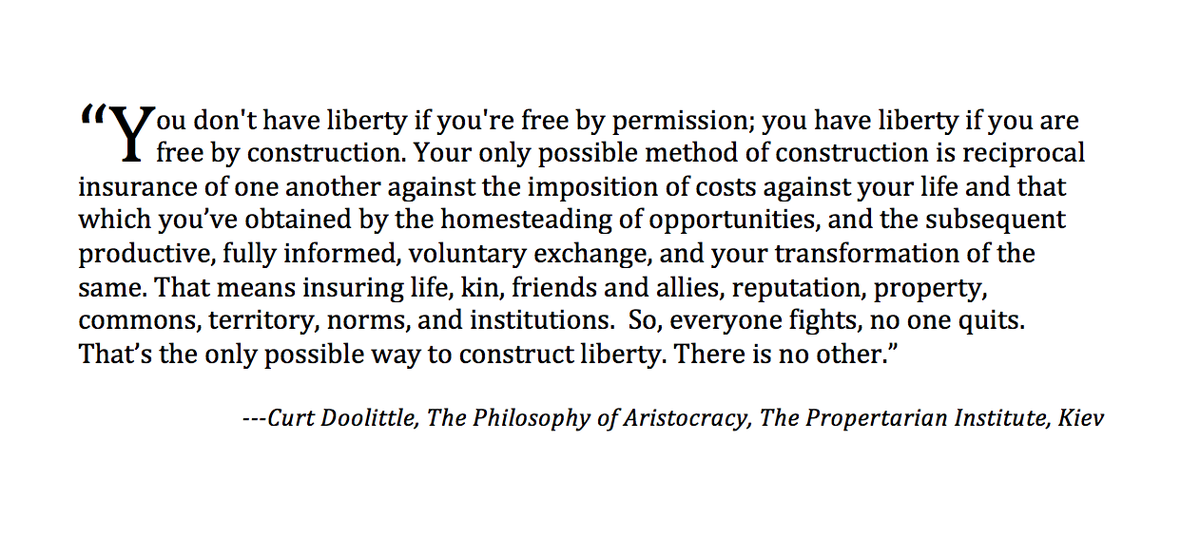
  • Worth Repeating

    Worth Repeating

    Worth Repeating: https://t.co/h8xlSp7Pu3


    Source date (UTC): 2024-03-20 17:21:45 UTC

    Original post: https://twitter.com/i/web/status/1770500993555267868

  • Worth Repeating

    Worth Repeating

    Worth Repeating: https://t.co/dRUIoekf92


    Source date (UTC): 2024-03-20 17:21:27 UTC

    Original post: https://twitter.com/i/web/status/1770500915004379187

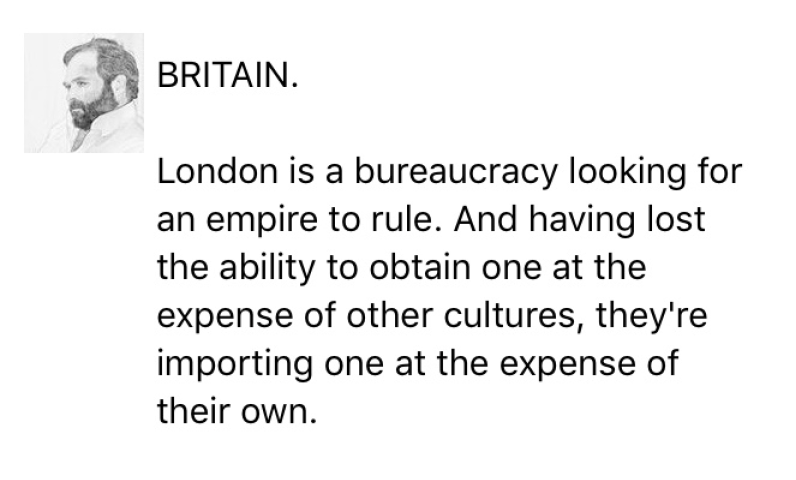
  • Reiterating my criticism of the UK’s suicide

    Reiterating my criticism of the UK’s suicide

    Reiterating my criticism of the UK’s suicide. https://t.co/OKJqtL6V3K


    Source date (UTC): 2024-03-20 17:20:59 UTC

    Original post: https://twitter.com/i/web/status/1770500799455531168

  • RT @curtdoolittle: @whatifalthist RE: Rudyard Lynch’s “Top 20 books which inform

    RT @curtdoolittle: @whatifalthist RE: Rudyard Lynch’s “Top 20 books which inform my worldview”
    https://twitter.com/whatifalthist/status/1769931765378863393

    I’m still thinking…

  • RE: Rudyard Lynch’s “Top 20 books which inform my worldview” I’m still thinking

    RE: Rudyard Lynch’s “Top 20 books which inform my worldview”
    https://twitter.com/whatifalthist/status/1769931765378863393

    I’m still thinking about this book list so I thought I’d make a few comments that might encourage others to read more of the list.

    Since I agree that most of them are necessary foundations I’ll…

  • RE: Rudyard Lynch’s “Top 20 books which inform my worldview” I’m still thinking

    RE: Rudyard Lynch’s “Top 20 books which inform my worldview”
    https://t.co/SrPwcXRZMo

    I’m still thinking about this book list so I thought I’d make a few comments that might encourage others to read more of the list.

    Since I agree that most of them are necessary foundations I’ll talk about the outliers:

    RE: #1. War in Human Civilization by Azar Gat: – I usually recommend other authors, including both Kagan and Van Creveld, because I’m trying to explain why europeans do not know how to conduct warfare against other civilizations (and why we fail, and why we can’t expand by other than replacement),. That said, Anzar Gat instead raises the bar by explaining war in evolutionary context – which is a more useful general understanding of war without the usual baggage.

    RE: Missing: The Evolution of Civilizations by Carroll Quigley – I might be more affected by this work because it is closer to the reduction to first principles, and resulting economic and evolutionary models I rely upon.
    The same goes for Gary Becker’s a) Economic approach to human behavior b) human capital, and c) treatise on the family, and d) economics of life.
    This is perhaps the best examples of the difference between Rudyard and I: his priestly-platonic-literary and compassionate view of history and my aristocratic-aristotelian-scientific and dispassionate view of history – despite that we pretty much agree on everything. (Rule 1: Rudyard is almost always right. Rule 2: If you think not, then see Rule 1. Meaning that disagreeing with valuation is not the same as disagreeing with causalities and patterns. ;).

    RE: #2. Sex and Power in History by Amaury de Riencourt – This is a novel insight that I encourage because the feminists are correct that history is written as if only men exist (or matter). In my work I try to expose the sex differences in instincts, cognition, behavior, lying, conflict, and warfare. This book makes my job easier by clearly illustrating the consequences of two sexes. πŸ˜‰ On the other hand, while I find I am overly criticized for my exposittion of destructive feminine behavior, and while it does bother me quite a bit to tear down the female pedestal, this book merely amplifies the fact that “while men are bad women are evil.”

    12. The Master and His Emissary by Ian McGhilchrist. I despise McGhilchrist for this book, just as I despise Sapolsky’s “Determined” arguing there is no free will. Both of these authors start with a grain of truth and bend it into a pseudoscience. That said, if you read either of tthose books you will learn something and Many people have done so. Ergo it’s better to learn something that’s half wrong, then to read nothing at all. ;). The hemispheric differences in brain structure are prey (right) and predator (left). The sex differences are generalization of prey vs specialization in predation. McGhilchrist’s attempt to evade that reality means all derivations from his premise are as biased as was Freud’s presumption we were all effeminate neurotic Ashkenazim.

    RE: # 16. The Invention of Yesterday by Tamim Ansary, “A history of the paradigms people have used over history” – This, again, is a novel lens through which to view history and human behavior. In my work I found it was a useful testing ground for the analysis of evolutionary expression of human justification for local adaptation. In other words, it’s an indirect insight into human psychology over time. Rudyard is, at least a bit, an apologist for Islam (or religion in general) and he is among the most devoted. This author is also an apologist (more than a bit). IMO just because a history exists and people justified it or survived it, tthat does not mean in the context of human history and evolution it’s not horrific. ;). I mean, I’m sure the Assyrians, Egyptians, Aztecs, Mongols, and Maori thought they were good people. Same for muslims. Despite their destruction and dysgenia that destroyed seven great civilizations of the ancient world and destroyed their fertile futures. πŸ˜‰

    Every other book in this list is rock solid. I love this list because of its breadth. πŸ˜‰

    So hopefully I was able to encourage you a bit. And also, please understand that I promote Rudyard because his is right. And we’re friends because he is right. I don’t promote him just because of our friendship. πŸ˜‰ I’m not that nice. πŸ˜‰

    Cheers
    Curt


    Source date (UTC): 2024-03-20 17:15:08 UTC

    Original post: https://twitter.com/i/web/status/1770499328672518144