Source: Original Site Post

  • Response To Posner On Guns

    (Note: I posted this as a comment on http://www.becker-posner-blog.com/ and am copying it here, as a I always do.) Guns are for more than hunting and self defense. They’re also a political symbol, and a political institution. Arms have uses. But the purpose of arms is to maintain the ability to overthrow an oppressive government, and to insure that members of a government take no actions that would sufficiently anger even a small percentage of the people, such that they might raise their arms and use them. Yes guns are cool. Yes they are a status symbol. Yes guns provide one with a sense of security. And yes, they are the material tools by which a people remain free. Even if remaining free is the sentiment of the minority of the population. One is not free if he must rely for his security upon the willingness of others. He is free because he chooses to preserve the existing social order, despite the fact that he has the physical power at his disposal to alter it if necessary.

    [callout]There are only three tools by which humans can coerce other human beings: violence, words and payment. Each social class has developed elites that master one of the three tools. And any attempt to deprive us of words, arms or property, is simply an attempt by the elites of one class to deprive members of another class of their political power, and to obtain additional power for their own at a discount. [/callout]

    Violence is a virtue: The more of it you have, the more free you are. The more free you make others by possessing it, but using it only to preserve that freedom. Restraint is the most powerful use of violence. If you no longer possess it, you cannot restrain it. It is most powerful if it is a potential. Actions which are not taken are often not measurable. Economists know this. It is the problem of the broken window fallacy, and the principle behind Opportunity Costs. As such, economists should be wary of applying infinite discounts to a property of human behavior, simply because of the difficulty of measuring the cost of that behavior. Property is an institution that is created by the threat of violence. The use of violence to create property, whether it be the several property of the individual or the shareholder property of the collective, is the most massive and constant application of violence that civilizations apply, from the very broadest group, down to each individual. Property is the highest cost institution. It is the hardest to develop. The Iron Law of Oligarchy and it’s manifestation in bureaucracies guarantees that all governments, of all forms, will be corrupt, and self serving. The only counter to the bureaucracy of the state is the promise of violence by it’s citizens. Under republican democracy and social democracy, the bureaucracy is demonstrably more self-serving than under other forms of government, and far less subject to democratic change. Tyrants can be killed. Bureaucracies cannot be. The vast efforts of the West for the past few centuries have been to create the institutions of property elsewhere. And our primary advances in human productivity and cooperation have been the result of the tools to account for, the legal systems to administer, the education to teach children how to use, and the new types of money and credit instruments, finance, banking, capital and markets to facilitate, the ordered use of property. And we have spread those instituions of property, almost always by the force of arms. This has occurred despite movement after movement by one class or another, from the base proletariat to the elitist public intellectual, to deprive us of that violence, so that they may use the violence of the state to remove from us our freedom, and to alter our definitions of property, and therefore appropriate the institutions, the property, or the results of our labors for the benefit of one group or another. Adherence to property definitions, and use of the tools and institutions to manipulate property, are the foundation of learning in every culture. The Justice that is used to resolve conflicts, and the government that is used to create and regulate markets, both sit upon the technology of violence. And governments, if they are over free men, are created and maintained by the fraternity of individuals who are wiling to forgo the institution of violence in order to preserve their definitions of property, their systems of justice, and their institutions of government. Guns, more than any type of arms in history, equalize our capacity for violence. They make us equal in age, health, strength and choice. Each of us possesses violence. It is a natural human potential. The more skilled we are, the more armed we are, the more we possess of it. The greater the store of it, the wealthier are our people. The more secure are our trade routes. The more respectful are our governors. The more free are our citizens. The more prosperous our people. The more choices for happiness are open to each of us. History does not favor the weak — whether as a nation, or as individuals. In the west, our social order, our history, derives from our unique development of cities, which was accomplished through the cooperation of a fraternity of warriors. We should understand that cities are synonymous with markets. Warriors built markets with the threat of violence, and it was done at high cost. Our trade system today is one of high cost. And common americans benefit from that high cost. Even if we are exporting debt and currency to pay for our military system, rather than simply taxing everyone else for our world trade routes. Our fraternity is what makes us unique among other civilizations. Its origin is in our weakness against the stronger, wealthier and more populous east. With smaller numbers, and better technology, our shareholders defended their markets against superior forces. And while in our lifetimes we have been majority for a brief flicker in time. We are a minority again. A minority who protects our markets, our trade, and our institutions and our freedom with a wealth of violence. By our actions-not-taken. Against the constant drum of talkers and scribblers who would take from us our violence and deprive us of our freedom. Today we use the word ‘shareholder’ instead of ‘citizen’ for our voluntary orders. We do so to obfuscate the cost of being a shareholder or a citizen. So that many people may become shareholders without first paying the cost of obtaining one’s share. By respecting the institutions of property, we gain admission to the market. To respect property is to refrain from violence and fraud. There are only three tools by which humans can coerce other human beings: violence, words and payment. Each social class has developed elites that master one of the three tools. And any attempt to deprive us of words, arms or property, is simply an attempt by the elites of one class to deprive members of another class of their political power, and to obtain additional power for their own at a discount. I hope that the meaning of that statement is not too subtle to be clear. Curt Doolittle
  • Teacher’s Unions: Unaccountable And Arrogant Entitlement Unable To Withstand Scrutiny

    A Perfect Quote: “Thirty years ago, the public saw teachers as underpaid and overworked professionals trying to prepare the next generation for leadership. These days, the teachers unions are doing their best to present an image of arrogant entitlement combined with an inability to withstand scrutiny and accountability. ” – ED MORRISSEY, of Hot Air Teacher’s unions need to be broken and banned. As Do All Government Employee Unions.

  • Military Violence Creates The Institution Of Property, and Private Government

    Whence comes Property? The answer is a strong army and navy, a strong diplomatic corps, a strong currency free of debasement Trade rests on trade routes. Trade routes rest on the military. THe purpose of militarily established order is to create teh institution of property, and the market for trading it. It’s purpose iis to deny corruption of the market to others. The purpose of government is to determine which form of corruption wins. the puprpose of an ancient repubic, which means, property holders, is to disallow corrutpion of trade and trade routes. a republic of shareholders was the first and remains the only means of preserving trade. It is a private government.

  • The Luddism Of Marxism And Anarcho Capitalism

    All human beings seek to game the market. The market system depends upon it. Without the desire to game the market and prices, we would have no innovation, no production increases, and no price decreases. In our market, innovation is the only ‘fair’ means by which we tolerate winning. Because winning in this market, means consumers reap the rewards of competition. Credit innovation is perhaps the most powerful advantage that the west has possessed. But all human beings seek to game the market. The market is a construct of man. As a construct it needs to be maintained. Not just from external forces, not jjust from governemnts, not just from cooperative organizations, but from individuals as well. Marxism is an effort to game the market. Anarchic libertarianism is an effort to game the market. Both seek to obtain the rewards of market activity at a discount. Both are luddite strategies. Both seek trade rather than market. Both are regressive strategies. The market, it’s incentives, it’s rules, and it’s communication system of prices are a construct of man. And like any other machine, it needs maintenance. It does not need direction – no human can provide the knowlege to guide it. Instead, It needs to protect against rust: the human propensity for corruption. The very propensity for curruption that guarantes that ihumans innovate to drive the market itself. And silly philosophies whether they be the marxist suppostion that people will not ‘cheat’ or the libertarian suppostiion that people will not act with corruption, are both no more than wishing that gravity did not exist, or that iron did not oxidize. Or, that there is a divine god who gives us scritpture and determines the course of our lives.

  • Cause And Effect In AGW Debate

    Over on Climate Etc, Judith Curry writes Blame on Heartland, Cato, Marshall, etc.

    The fossil fuel industries have been funding dedicated minions at the Heartland, Cato, and George C. Marshal Institutes (among others) to generate misinformation about global warming and global climate change. They have attempted to attack the climate science message (such attacks actually part and parcel of the scientific process), but without much success, since the foundations of climate science are more than strong enough to withstand such challenges. Having failed in discrediting the climate science message itself, they have resorted instead to attacking the climate science messengers with character assassination, political innuendo, stolen e-mails, etc.

    To which I replied:

    There is another answer: 1) Libertarians and libertarian theory are economic disciplines with economic history that they rely upon for judgement. Economics is a chaotic and mathematically rigorous discipline. It also consists of a long and deep history of narratives and logic within the history ideas. 2) Libertarians have, and continue, to represent the branch of logic that advocates that economic models are not predictive. Not only that they are not predictive, but that they CANNOT be predictive. Not only that they cannot be predictive but that statistical analysis is only relevant to closed systems – and economies, due to innovation, the plasticity of utility of resources, and changing human wants, renders categorical forecasting impossible. This logical framework is supported by the fact that economic models are in fact, not predictive. And this is one of the issues with current political methods: that we rely upon economic models for policy purposes despite the fact that they are decidedly not predictive. 3) External entities with economic interests fund libertarian institutions because they are disposed to view government solutions as detrimental to the economy, and because libertarians are naturally hostile to models which purport to be predictive. They are highly agitated because of the rapid increase in external competitive forces run by non-market governments, and their advantage is being weakened by both external competition and an increasingly academically unprepared and uncompetitive work force. 4) Libertarians do not generally take the position that AGW is true or false. Their position is that (a) the AGW models are highly questionable, (b) there are alternative explanations that seem more probable, and certainly that previous climate movements to date have been false, and (c) even if AGW is true, that the solution is to create a green social movement rather than a system of increased taxation. The current green movement is working. It has become a generationally dominant social value. People will not pay for the long term, whether it is saving, retirement, health care. They will not pay for what they suspect. The AGW movement will do far better and make better progress if it does not seek legislation and in fact, actively does NOT seek legislation, but eschews legislation. This will make it more acceptable. Otherwise all libertarians and conservatives hear is that it is an excuse to fund abusive government. It is hard for liberals to understand that they are the minority of 20%, and that libertarians are the thought leadership of the conservative party, and while they, like convicted marxists, are a minority, they provide the thought leadership of the majority and are more likely to, and have consistently created, more conservative policies – ie: policies that do not empower government to make economic decisions. We are in a period of economic and cultural and even political uncertainty. Until we exit this period (which according to economic history, may or may not ever happen) people will have nearer term priorities. They will not be charitable to future generations in the face of current circumstances of decline and uncertainty.

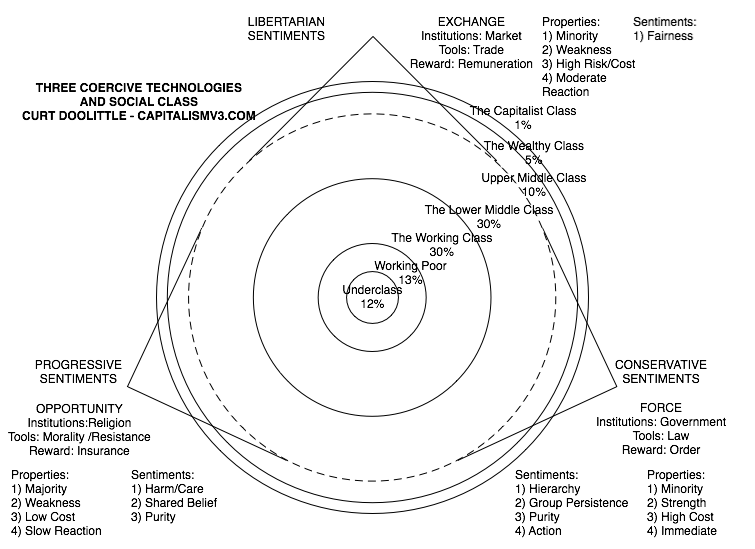
  • Rock, Paper, Scissors: Three Coercive Technologies, and Three Social Classes

    Rock, Paper, Scissors: Three Coercive Technologies, and Three Social Classes

    theecoercivetechnologies

    There are three means of coercing groups of people with institutions 1) Force, or the threat of force A person has a VIOLENCE INCENTIVE to behave in a particular way when it has been made known to him that failure to do so will result in some form of physical aggression being directed at him by other members of the collectivity in the form of inflicting pain or physical harm on him or his loved ones, depriving him of his freedom of movement, or perhaps confiscating or destroying his treasured possessions. 2) Remuneration or payment A person has a REMUNERATIVE INCENTIVE to behave in a particular way if it has been made known to him that doing so will result in some form of material reward he will not otherwise receive. If he behaves as desired, he will receive some specified amount of a valuable good or service (or money with which he can purchase whatever he wishes) in exchange. 3) Moral claims (collective goods) A person has a MORAL INCENTIVE to behave in a particular way when he has been taught to believe that it is the “right” or “proper” or “admirable” thing to do. If he behaves as others expect him to, he may expect the approval or even the admiration of the other members of the collectivity and enjoy an enhanced sense of acceptance or self-esteem. If he behaves improperly, he may expect verbal expressions of condemnation, scorn, ridicule or even ostracism from the collectivity, and he may experience unpleasant feelings of guilt, shame or self-condemnation. And a persuasive argument can consist of one or more of these strategies, often in great complexity. People give priority one or more different weighted combinations, or perhaps ‘chordic’ representations of these strategies. They do so out of habit, and class inclination, just as they follow religious and class sentiments due to their upbringing. People who belong to institutions have different capacities for adopting these strategies. Force requires discipline and long Time Bias. Remuneration requires cunning and invention. Moral claims require loyalty to consensus, and absorption of, and therefore payment of, opportunity costs. Different social classes have different time biases and consist of people with different time preferences, requiring different types of discipline under different social and economic conditions. ie: it is easier to have a long time preference if one is genetically disposed to better impulse control, and lives in greater security. It is easier to have a short time preference if one is more persuaded by impulses, less disciplined, and in an environment of scarcity. The social classes are organized by intelligence. Intelligence is the ability to absorb content in real time, to learn abstractions in time, and to permute those abstractions in application to problems in real time. Intelligence regresses toward the mean over generations. THerefore class membership is an indicator of the likelihood of class mobility, and upper class position is difficult to maintain. While we use the word ‘middle class’, and most people in the west live middle class lifestyles, the middle class means possessing disposable income and participating in the market. Therefore the majority of citizens are in the upper proletariat and lower middle classes, which we call the working, white collar working and craftsman classes. There are different costs to these institutions: Force is extremely expensive. Creating non-corruption, and order (some network of property definitions and their means of transfer). Property is a term for a scarce good that must used, consumed or transformed in the process of production, even if that process is human sustenance. Remunerative institutions require the complex task of concentrating capital then maintaining it in a constantly changing kaleidic and competitive environment. Moral claims require constant advocacy, verbal skill, maintenance of numerous relationships, and constant payment of opportunity costs. The Social classes have different access to each of these forms of coercion. Those in the institutional class, or upper class, have access to force in the form of policy and law. Those in the capitalist class, or middle, have access to capital : money, and market institutions. In each strategy people form elites, and organizations for utilizing those strategies. The elites create philosophical frameworks. Each of these frameworks consists of moral claims, and institutional means of perpetuating those claims, and the social benefits of adopting those claims. Each of these institutions is open to corruption, which is the privatization of opportunity and reward, for personal consumption at group expense. Corruption is fraud. Each of these strategies, their organizations, institutionas and elites compete against other strategies, organizations and elites, and each attempts to use it’s organization for discounts against other organizations. This competition is analogous to the game of Rock, Paper, Scissors, if more complicated: each group can sucessfully compete against one another under most circumstances, but can defeat and be defeated by some other combination of forces. The human mind is comfortable with identity and causality. It can with practice, understand a one dimensional causal spectrum. It can, with effort, understand two dimensions of cuasality. It can with more effort understand three dimensions of a causal spectrum. Human emotions for example, consist of probably no more than three stimuli: dominance, pleasure and activiation. And that all human emotions, in their seemingly infinite varieity can be described as using these three axis of stimuli. Likewise, human social behavior consists of three different forms of coercion, in some combination, and this leads set of axis leads to seemingly infinite variety. But it only seems infinite. At it’s base, there are only three forms of social organization.These three forms can be combined, as they are in the majority of the population in some manner or another. Or they can be used as one of three specializtions, each of which attempts to play rock, paper, scissors, with the other two.

  • Answers To Questions On Libertarian Criticism

    I. Curt, what does “Exchange under trade is different from exchange under market.” mean?

      [callout:]All social philosophies, whether marxist or libertarian, which claim universal application of their philosophy to all social classes, are luddite, regressive, anti-market philosophies whose underlying premise is to obtain the benefits of the market economy at a discount by getting the other sects to subsidize their economic advantage.[/callout]

      As such, a market is administered, managed and “governed”. Trade is not, since portable several property does not require institutions other than self defense. ie: libertarianism (at least the jewish wing of libertarianism, not the christian wing of libertarianism) is a luddite philosophy – it is regressive. Protestant upper Middle Class Classical Liberalism which split into two sects, the ‘liberal secular humanist’ or liberal and collective vs the ‘libertarian’ or conservative and individual, does not make the error inserted by the lower class Catholics (social democracy and Jews (marxism and socialism). All social philosophies, whether marxist or libertarian, which claim universal application of their philosophy to all social classes, are luddite, regressive, anti-market philosophies whose underlying premise is to obtain the benefits of the market economy at a discount by getting the other sects to subsidize their economic advantage. I should note that economic democracy, is a class cooperative philosophy rather than a universalist philosophy — as long as national credit is only released by the consent of the house of commons (since all borrowing is at the expense of the citizenry as a whole). II. RE: >> I’ve understood that , rather than three coercive technologies, there are two: force (the tribal chief) & fraud (the witch doctor). I’ve yet to understand your three.

        III. RE: Politics market = city. city = polis. politics = the technology organizing people who are cooperating in markets.

      • Every philosophy is a little bit right and a whole lot wrong

        The left is wrong on it’s face, because of the problems of incentives and economic calculation. The left is wrong on it’s perceptions: the pie isn’t fixed and people are not even closely equal in ability. The left is wrong on it’s sentiments: they are universalist and familial rather than group and political. They are wrong in their anti-sentiments: Care and Fair are only possible if first there is Order, and Group Persistence. The left is wrong on it’s logic: value is subjective, value is marginal, value is not determined by labor in, but by value out – and factor prices are determined by market prices of the end good. THe left is wrong on very purpose of society: it is a market first, and a society second. A society is it’s market and it’s market principles – everything else is an artifact of that market. THe left is wrong on diversity: people are demonstrably more charitable in the absence of diversity. The left is wrong in everything but it’s ambition – individual happiness in the absence of stress for the purpose of a happy family, rather than individual success for the purpose of group competition. The left is right that people at the bottom most likely have a claim on some amount of the profits of the market in which they participate, and that declining prices and increasing standard of living, and public services, and freedom from consumption taxes are to some degree justifiable.

        [callout:More Right Than Wrong]Everyone is a little bit right.Everyone is a whole lot wrong. But libertarians are more right and less wrong than everyone else — assuming that is, that we seek prosperity, safety, health and choice for the maximum number of people at the minimum cost, at the lowest risk.[/callout]

        But the right is wrong on rhetorical debate – the republican model breaks at scale – instead we would need economic democracy. It is wrong on monetary policy. The right is right on all of those things that the left is wrong on. Most importantly it’s right on group persistence, obligatory group identity. They are right on military dominance of the seas and trade, and the trade system, and of the expansion of a monetary empire. They are right on intolerance of extra-market orders. They are right on meritocratic rotation of the elites through market or military acts. The libertarians (the middle) are wrong on many of their principles. They are wrong on immigration. Immigration of an underclass that speaks a different language, and observes a different cult is demonstrably detrimental to a civilization. THey are wrong on free trade. They are wrong on intellectual property. They are wrong on the origins of society and market. They are wrong on forgone opportunity costs. They are wrong on equality – libertarianism is as beneficial to the intelligent, and totalitarianism is to the strong, and communism is to the weak. They are wrong on redistribution – precisely because they are wrong on the origin of markets. THey are wrong on empire and military. They are wrong on private courts. THey are wrong on private police. But the libertarians are right on monetary policy, on economic calculation and incentives, on rule of law, on small government, on privatization, on economic democracy. Everyone is a little bit right. Everyone is a whole lot wrong. But libertarians are more right and less wrong than everyone else — assuming that is, that we seek prosperity, safety, health and choice for the maximum number of people at the minimum cost, at the lowest risk.

      • Irrational Criticism Of Mubarak’s Replacement

        In a nation with no institutions other than tribal alliances, only members of the existing hierarchy can replace a leader, because the only institution that the society relies upon is loyalty to individuals, and religion, not to principles. In fact, this is the entire problem with the primitive civilization we call Islam. There is loyalty to family and tribe, loyalty to religion, but no loyalty to principles of government. We forget in the west, how miraculous and uncommon is our transfer or power between regimes. The anglo world is unique in it’s stability. Western culture is unique, and it’s method of government is unique. It is, since antiquity, based upon the balance of powers. The rest of the world lives under precisely the opposite postion: the concentration of power. We cannot hold others up to our standards. We can only help them understand that if they wish our economic prosperity, them must adopt our forms of loyalty. Loyalty first, to principles.

      • If I Were Paine, I’d Be Happy History Blamed Jefferson

        Regarding the debate as to whether Jefferson or Paine wrote the original draft of the Declaration of Independence. I don’t care whether Paine or Jefferson authored the constitution one way or the other. I don’t think it’s material. I am fairly sure at this point that we would have been better off in the end if Washington had been made King, as Adams desired. Much better off. Democracy, especially since the Senate has been directly elected is simply the slow road to totalitarianism. A government consisting of a King for affairs of state and justice, plus a Senate for affairs of money and commerce, plus a House of Commons for affairs of redistribution and charity, mirrors the class structure of society. Democracy perpetuates the myth of equality – the classes are not equal in ability, skill, knowledge or wisdom. They are instead, forms of specialization. The American revolution simply encouraged the turnover of the great monarchies, and the destruction of western civilization that restulted from it. We had it right. The old english system was right. Adams was right, and Paine got it wrong. If I were Paine, I’d be happy that history has blamed it all on Jefferson.