I distinguish between freudianism, psychologism, therapy, incentives/biases/limits/logic, neurochemistry, and cognitive science. When a person says “psychology” I usually have to deduce which of those they’re referring to. In my understanding psychology is used to refer to each of those. However, the first two are pseudosciences, therapy/self/help is something else, and the rest are sciences. Usually I am criticizing the use of the first two or the conflation of the first two with others. May 25, 2018 5:03pm
Source: Original Site Post
-
The Test of Demarcation Between Science and Pseudoscience in Psychology
All, Almost all papers in psychology and sociology fail the test of repeatability. Almost all papers in psychology and sociology depend on self reporting. Almost all papers in psychology and sociology include susceptibility to suggestion. Almost all papers in psychology and sociology make use of small populations of students or patients. Almost all papers in psychology and sociology include value judgements. Almost all papers in psychology and sociology assume a normative ideal. (this is what I object to) If instead our findings are repeatable; If instead we are measuring by context-free measurements; If instead our tests eliminate all chances of suggestion. If instead our population consists of more than 1000, and preferably 10k people; if Instead our categories of measurement contain no assertions of value to a trait (other than evolutionary or physical necessity – such as ‘neural economy’); if instead our categories of measurement contain *evolutionary specializations rather than uniform ideal*(authoritarianism); Then there is a fair chance we are conducting science, rather than projection. So if your paper passes these tests it’s got a chance of not being false. || Sample size > Reporting > Motivations / Value judgements > Specialization > Repeatability. Psychoanalysis and that argumentative technique making use of the categories of psychoanalysis (a uniform standard or ideal) that we call psychologism are pseudoscience. The problem for psychology is that the categories and terminology are pseudoscientific. That does not mean they are not meaningful. It means they are fictions. *As a general rule, the specification of an organism is determined by its limits not it’s median.* May 26, 2018 6:25am
-
The Test of Demarcation Between Science and Pseudoscience in Psychology
All, Almost all papers in psychology and sociology fail the test of repeatability. Almost all papers in psychology and sociology depend on self reporting. Almost all papers in psychology and sociology include susceptibility to suggestion. Almost all papers in psychology and sociology make use of small populations of students or patients. Almost all papers in psychology and sociology include value judgements. Almost all papers in psychology and sociology assume a normative ideal. (this is what I object to) If instead our findings are repeatable; If instead we are measuring by context-free measurements; If instead our tests eliminate all chances of suggestion. If instead our population consists of more than 1000, and preferably 10k people; if Instead our categories of measurement contain no assertions of value to a trait (other than evolutionary or physical necessity – such as ‘neural economy’); if instead our categories of measurement contain *evolutionary specializations rather than uniform ideal*(authoritarianism); Then there is a fair chance we are conducting science, rather than projection. So if your paper passes these tests it’s got a chance of not being false. || Sample size > Reporting > Motivations / Value judgements > Specialization > Repeatability. Psychoanalysis and that argumentative technique making use of the categories of psychoanalysis (a uniform standard or ideal) that we call psychologism are pseudoscience. The problem for psychology is that the categories and terminology are pseudoscientific. That does not mean they are not meaningful. It means they are fictions. *As a general rule, the specification of an organism is determined by its limits not it’s median.* May 26, 2018 6:25am
-
The Hierarchy of Revolutionary Arguments
Think of revolutionary arguments as a pyramid: – The theory (strategy) – The Incentives (science) of that strategy – The law (constitution) reflecting those incentives – The generational institutions (“government”) utilizing those incentives – The Intergenerational institutions (“education, religion”) retaining the strategy, incentives, law, and institutions). – The benefits for members (“rewards”) produced by those incentives, law, and institutions. – The motivations (“agitations”) that they produce by those what would obtain those benefits. – The Plan (“revolution”) that provides the opportunity for those whose motivations are sufficient to act – to do so. ||> Intellectuals > operators > citizens > agitators, revolutionaries: Arguments(solutions) for each. And let the weight of self interest drive the revolution – just like the enlightenment did and the eastern conquest of the western empire by levantine christianity did. I start at the top and work down. Most people start at the bottom and never make it past motivations. I expect others to take the ideas and communicate the benefits, inspire the motivations, and to organize the revolution according to plans that are fairly tactical. And I expect to pay a pretty high price for doing all of this work, and I”m ok with it. May 26, 2018 10:31am
-
The Hierarchy of Revolutionary Arguments
Think of revolutionary arguments as a pyramid: – The theory (strategy) – The Incentives (science) of that strategy – The law (constitution) reflecting those incentives – The generational institutions (“government”) utilizing those incentives – The Intergenerational institutions (“education, religion”) retaining the strategy, incentives, law, and institutions). – The benefits for members (“rewards”) produced by those incentives, law, and institutions. – The motivations (“agitations”) that they produce by those what would obtain those benefits. – The Plan (“revolution”) that provides the opportunity for those whose motivations are sufficient to act – to do so. ||> Intellectuals > operators > citizens > agitators, revolutionaries: Arguments(solutions) for each. And let the weight of self interest drive the revolution – just like the enlightenment did and the eastern conquest of the western empire by levantine christianity did. I start at the top and work down. Most people start at the bottom and never make it past motivations. I expect others to take the ideas and communicate the benefits, inspire the motivations, and to organize the revolution according to plans that are fairly tactical. And I expect to pay a pretty high price for doing all of this work, and I”m ok with it. May 26, 2018 10:31am
-
True Enough
TRUE ENOUGH FOR ACTION —“At what point do you know you have enough data and experience to act?”— Jeff Urizen When you (a) must act, (b) can pay for the full consequences of failure of your actions (c) can warranty your actions. In other words… when your knowledge is ‘true enough for the consequences’: TRUE ENOUGH A hierarchy of Truths: – True enough to imagine a conceptual relationship – True enough for me to feel good about myself. – True enough for me to take actions that produce positive results. – True enough for me to not cause others to react negatively to me. – True enough to resolve a conflict without subjective opinion among my fellow people with similar values. – True enough to resolve a conflict without subjective opinion across different peoples with different values. – True regardless of all opinions or perspectives. – Tautologically true: in that the two things are equal TRUE ENOUGH FOR THE CONSEQUENCES OF ERRORMay 26, 2018 12:51pm -
True Enough
TRUE ENOUGH FOR ACTION —“At what point do you know you have enough data and experience to act?”— Jeff Urizen When you (a) must act, (b) can pay for the full consequences of failure of your actions (c) can warranty your actions. In other words… when your knowledge is ‘true enough for the consequences’: TRUE ENOUGH A hierarchy of Truths: – True enough to imagine a conceptual relationship – True enough for me to feel good about myself. – True enough for me to take actions that produce positive results. – True enough for me to not cause others to react negatively to me. – True enough to resolve a conflict without subjective opinion among my fellow people with similar values. – True enough to resolve a conflict without subjective opinion across different peoples with different values. – True regardless of all opinions or perspectives. – Tautologically true: in that the two things are equal TRUE ENOUGH FOR THE CONSEQUENCES OF ERRORMay 26, 2018 12:51pm -
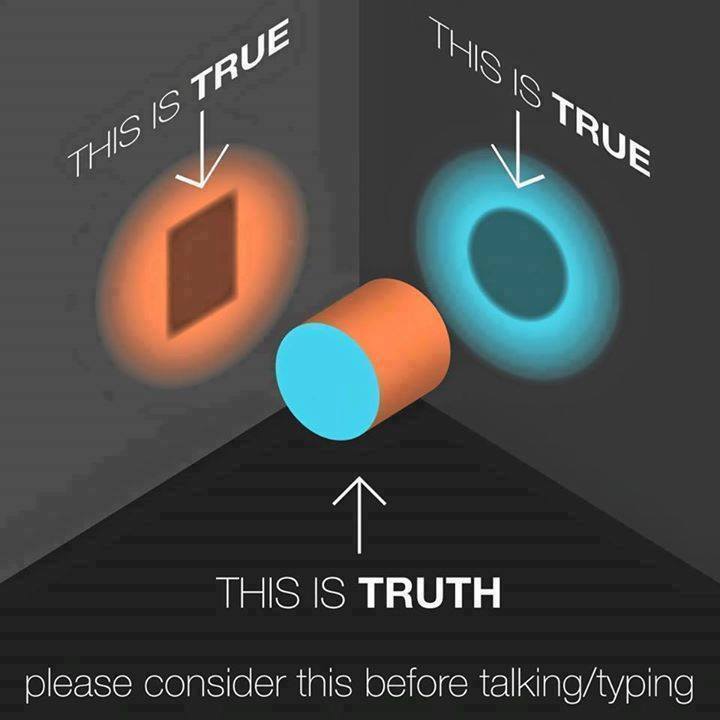
Um. No. Truthful vs True. Shadow or Object?
THIS ILLUSTRATION IS IMPRECISE (a) a “square” describes the shadow truthfully. (b) a “circle” describes the shadow truthfully. The question is whether one is testifying to the shadow or to the three dimensional object that casts it. One CANNOT testify to the shape of the three dimensional object that casts the shadow, one can only testify to the shape of the shadow. THAT IS THE WHOLE POINT OF TESTIMONY (Truth). “DO NOT MAKE SHIT UP by INFERENCE.”
-
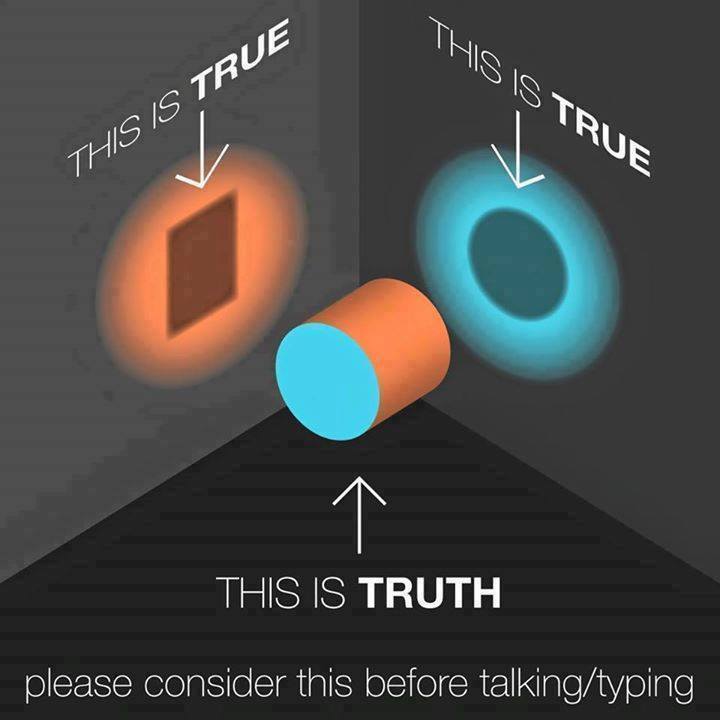
Um. No. Truthful vs True. Shadow or Object?
THIS ILLUSTRATION IS IMPRECISE (a) a “square” describes the shadow truthfully. (b) a “circle” describes the shadow truthfully. The question is whether one is testifying to the shadow or to the three dimensional object that casts it. One CANNOT testify to the shape of the three dimensional object that casts the shadow, one can only testify to the shape of the shadow. THAT IS THE WHOLE POINT OF TESTIMONY (Truth). “DO NOT MAKE SHIT UP by INFERENCE.”
-
2005’s War of The Worlds as Non-Aryan Myth
By Eli Harman (Curt: “Ghetto Ethics, and Rat Heroism”) In the traditional hero’s journey of Aryan myth and legand, somebody relatable and unassuming faces great challenges and trials, sometimes setbacks and losses, before finally rising to the occasion and triumphing gloriously, and probably getting the girl. Then everyone lives happily ever after (until it’s time to do it again.) But the many possible variations on this simple theme are notably absent from most contemporary media. A good example of the this would be the 2005 version of “War of the Worlds.” There is no glorious triumph. It’s just run, hide, escape, run hide, escape; plus morally ambiguous connundra resolved by choosing self-preservation at all costs. Finally, the protagonists eventually survive just by outlasting the invaders, who are brought down by the filth, disease, and corruption, that Earthlings live amidst, rather than any heroics or agency on their part. It’s not the hero’s journey, so much as the rat’s, because it was not written or directed by Aryans…