Source: Original Site Post
-
The Evolution of Movements
Every movement starts as fringe, and edgy, attracting novelty junkies, dysfunctionals, rebels, and malcontents. And if it has any meat to it, increasingly upgrades from edge cases to some position in the hierarchy of argumentative structures that we call ideologies, philosophies, and institutional models. What we should expect to see, as we move up this hierarchy, is the exit of early entrants, and expansion of late entrants increasingly closer to the mainstream. The edge does the research but stays the edge. Utility is obtained, and as a consequence power is either obtained or not.
-
The Evolution of Movements
Every movement starts as fringe, and edgy, attracting novelty junkies, dysfunctionals, rebels, and malcontents. And if it has any meat to it, increasingly upgrades from edge cases to some position in the hierarchy of argumentative structures that we call ideologies, philosophies, and institutional models. What we should expect to see, as we move up this hierarchy, is the exit of early entrants, and expansion of late entrants increasingly closer to the mainstream. The edge does the research but stays the edge. Utility is obtained, and as a consequence power is either obtained or not.
-
The Conflict of Civilization isn’t with Islam it’s with All of Abrahamism
See, you thought the Conflict of Civilizations was with Islam. It’s not. It’s with Abrahamism in all its forms. The problem is not only genes but content. And grammars convey the content. And Abrahamic grammar is nothing more than drug dealing for the human mind.
-
The Conflict of Civilization isn’t with Islam it’s with All of Abrahamism
See, you thought the Conflict of Civilizations was with Islam. It’s not. It’s with Abrahamism in all its forms. The problem is not only genes but content. And grammars convey the content. And Abrahamic grammar is nothing more than drug dealing for the human mind.
-
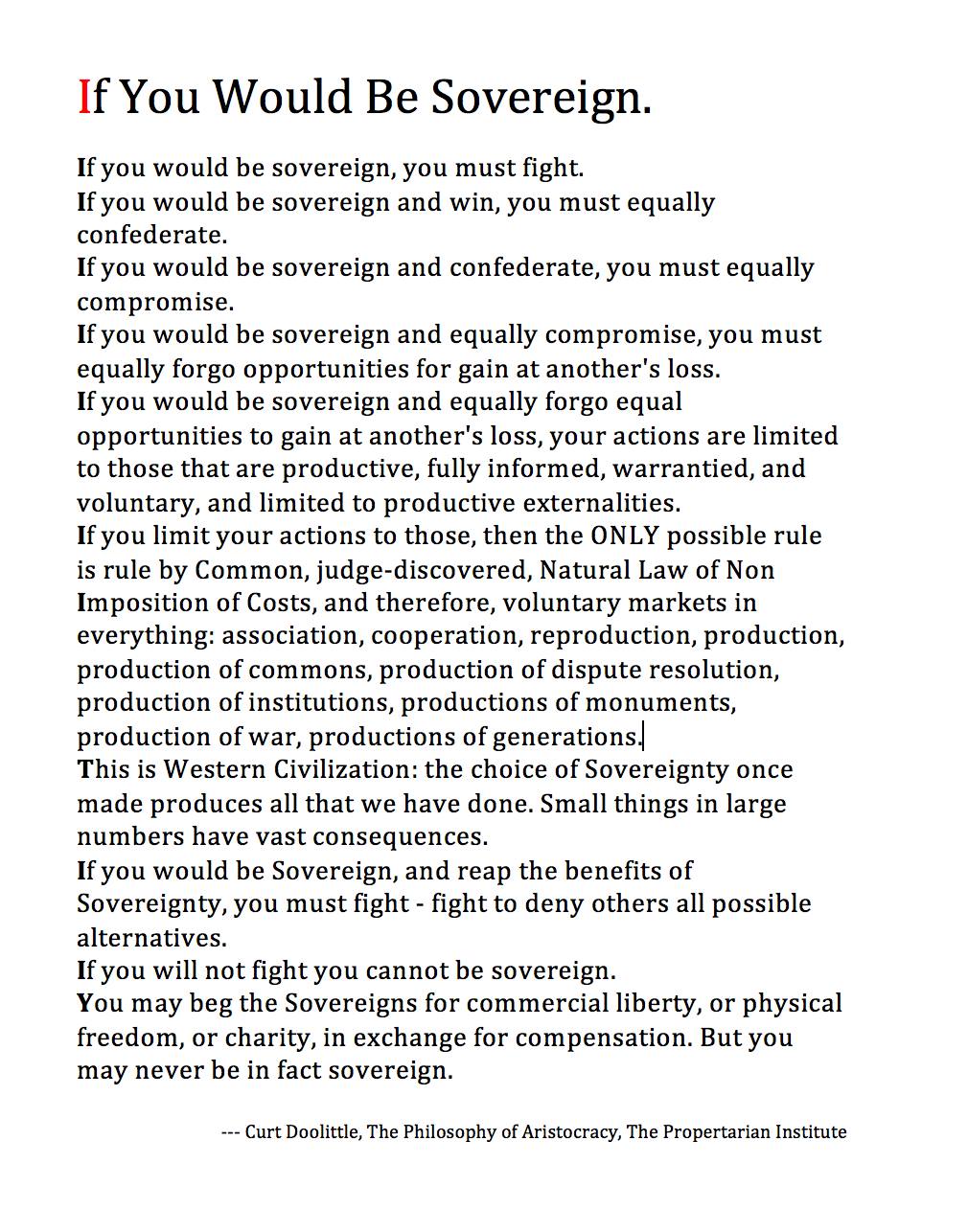
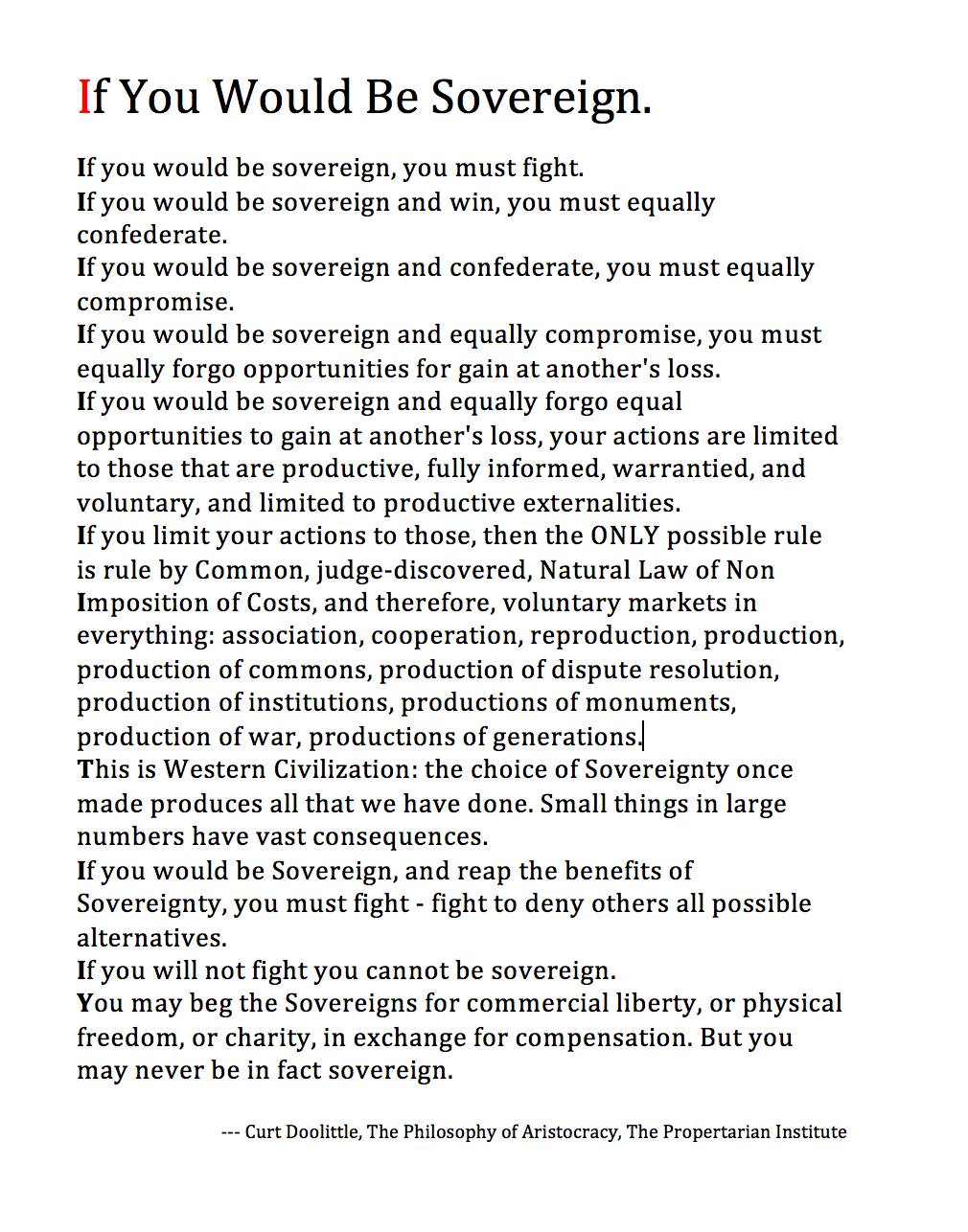
Sovereignty is something you practice.
—“Sovereignty is not something you give away to others, it’s something you practice. If peers practice equivalent sovereignty, institutions emerge between you so that in practice, you respect the sovereignty of others. But nobody rides for free.”—Simon Ström
-
Sovereignty is something you practice.
—“Sovereignty is not something you give away to others, it’s something you practice. If peers practice equivalent sovereignty, institutions emerge between you so that in practice, you respect the sovereignty of others. But nobody rides for free.”—Simon Ström
-
Women Rule only When Men Can No Longer Reach Consensus – It Is a Death Knell
From: The Fate of Empires by Arthur John Hubbard (via Noah J Revoy) “An increase of women in public life has often been associated with national decline. The later Romans complained that, although Rome ruled the world, women ruled Rome. In the tenth century, a similar tendency was observable in the Arab Empire, the women demanding admission to the Professions hitherto monopolized by men. ‘What,’ wrote the contemporary historian, lbn Bessam, ‘have the professions of clerk, tax-collector or preacher to do with women? These occupations have always been limited to men alone.’ Many women practised law, while others obtained posts as university professors. There was an agitation for the appointment of female judges, which, however, does not appear to have succeeded. Soon after this period, government and public order collapsed, and foreign invaders overran the country. The resulting increase in confusion and violence made it unsafe for women to move unescorted in the streets, with the result that this feminist movement collapsed.”
-
Women Rule only When Men Can No Longer Reach Consensus – It Is a Death Knell
From: The Fate of Empires by Arthur John Hubbard (via Noah J Revoy) “An increase of women in public life has often been associated with national decline. The later Romans complained that, although Rome ruled the world, women ruled Rome. In the tenth century, a similar tendency was observable in the Arab Empire, the women demanding admission to the Professions hitherto monopolized by men. ‘What,’ wrote the contemporary historian, lbn Bessam, ‘have the professions of clerk, tax-collector or preacher to do with women? These occupations have always been limited to men alone.’ Many women practised law, while others obtained posts as university professors. There was an agitation for the appointment of female judges, which, however, does not appear to have succeeded. Soon after this period, government and public order collapsed, and foreign invaders overran the country. The resulting increase in confusion and violence made it unsafe for women to move unescorted in the streets, with the result that this feminist movement collapsed.”