Source: Original Site Post

  • The Best Governors Are the Middle Class

    The government you end up with is determined by what point on this scale your polity equilibrates. —Justin Allred  x-axis: high trust<->low trust y-axis: distributed political agency<->concentrated political agency Monarchy – Tyranny Aristocracy – Oligarchy Polity – Democracy


    —“Does Aristotle deem monarchy to be the best form of government?”— by Andy Mansfield, DPhil, former academic, teacher and author. Aristotle discussed the six forms of government, the correct form and its deviant counterpart: Monarchy – Tyranny Aristocracy – Oligarchy Polity – Democracy However, monarchy was not the best form. F. Miller provides the answer to your question in ‘Aristotle’s Political Theory’ taken from The Stanford Encyclopedia of Philosophy (2011): ‘Although his own political views were influenced by his teacher Plato, Aristotle is highly critical of the ideal constitution set forth in Plato’s Republic on the grounds that it overvalues political unity, it embraces a system of communism that is impractical and inimical to human nature, and it neglects the happiness of the individual citizens (Politics II.1–5). In contrast, in Aristotle’s “best constitution,” each and every citizen will possess moral virtue and the equipment to carry it out in practice, and thereby attain a life of excellence and complete happiness (see VII.13.1332a32–8). All of the citizens will hold political office and possess private property because “one should call the city-state happy not by looking at a part of it but at all the citizens.” (VII.9.1329a22–3). Moreover, there will be a common system of education for all the citizens, because they share the same end (Pol. VIII.1). If (as is the case with most existing city-states) the population lacks the capacities and resources for complete happiness, however, the lawgiver must be content with fashioning a suitable constitution (Politics IV.11). The second-best system typically takes the form of a polity (in which citizens possess an inferior, more common grade of virtue) or mixed constitution (combining features of democracy, oligarchy, and, where possible, aristocracy, so that no group of citizens is in a position to abuse its rights). Aristotle argues that for city-states that fall short of the ideal, the best constitution is one controlled by a numerous middle class which stands between the rich and the poor. For those who possess the goods of fortune in moderation find it “easiest to obey the rule of reason” (Politics IV.11.1295b4–6). They are accordingly less apt than the rich or poor to act unjustly toward their fellow citizens. A constitution based on the middle class is the mean between the extremes of oligarchy (rule by the rich) and democracy (rule by the poor). “That the middle [constitution] is best is evident, for it is the freest from faction: where the middle class is numerous, there least occur factions and divisions among citizens” (IV.11.1296a7–9). The middle constitution is therefore both more stable and more just than oligarchy and democracy.’ SUMMARY Matt Stewart, B.A. Literature, History, and Philosophy No- the best government was the one best suited to the people and culture that are to be governed and which allows its citizens to flourish. Aristotle understood that different nations with different values function differently; whatever system of government allows a particular nation to function correctly and flourish is the best form of government for that particular nation. The Persians flourished under a monarchy, and the Athenians flourished as a democracy. The two states had very different forms of government, yet each flourished in its own way. A properly functioning government is one which incorporates and reflects the values and interests of its people. That is the long and short of Aristotle’s view on government.
  • The Best Governors Are the Middle Class

    The government you end up with is determined by what point on this scale your polity equilibrates. —Justin Allred  x-axis: high trust<->low trust y-axis: distributed political agency<->concentrated political agency Monarchy – Tyranny Aristocracy – Oligarchy Polity – Democracy


    —“Does Aristotle deem monarchy to be the best form of government?”— by Andy Mansfield, DPhil, former academic, teacher and author. Aristotle discussed the six forms of government, the correct form and its deviant counterpart: Monarchy – Tyranny Aristocracy – Oligarchy Polity – Democracy However, monarchy was not the best form. F. Miller provides the answer to your question in ‘Aristotle’s Political Theory’ taken from The Stanford Encyclopedia of Philosophy (2011): ‘Although his own political views were influenced by his teacher Plato, Aristotle is highly critical of the ideal constitution set forth in Plato’s Republic on the grounds that it overvalues political unity, it embraces a system of communism that is impractical and inimical to human nature, and it neglects the happiness of the individual citizens (Politics II.1–5). In contrast, in Aristotle’s “best constitution,” each and every citizen will possess moral virtue and the equipment to carry it out in practice, and thereby attain a life of excellence and complete happiness (see VII.13.1332a32–8). All of the citizens will hold political office and possess private property because “one should call the city-state happy not by looking at a part of it but at all the citizens.” (VII.9.1329a22–3). Moreover, there will be a common system of education for all the citizens, because they share the same end (Pol. VIII.1). If (as is the case with most existing city-states) the population lacks the capacities and resources for complete happiness, however, the lawgiver must be content with fashioning a suitable constitution (Politics IV.11). The second-best system typically takes the form of a polity (in which citizens possess an inferior, more common grade of virtue) or mixed constitution (combining features of democracy, oligarchy, and, where possible, aristocracy, so that no group of citizens is in a position to abuse its rights). Aristotle argues that for city-states that fall short of the ideal, the best constitution is one controlled by a numerous middle class which stands between the rich and the poor. For those who possess the goods of fortune in moderation find it “easiest to obey the rule of reason” (Politics IV.11.1295b4–6). They are accordingly less apt than the rich or poor to act unjustly toward their fellow citizens. A constitution based on the middle class is the mean between the extremes of oligarchy (rule by the rich) and democracy (rule by the poor). “That the middle [constitution] is best is evident, for it is the freest from faction: where the middle class is numerous, there least occur factions and divisions among citizens” (IV.11.1296a7–9). The middle constitution is therefore both more stable and more just than oligarchy and democracy.’ SUMMARY Matt Stewart, B.A. Literature, History, and Philosophy No- the best government was the one best suited to the people and culture that are to be governed and which allows its citizens to flourish. Aristotle understood that different nations with different values function differently; whatever system of government allows a particular nation to function correctly and flourish is the best form of government for that particular nation. The Persians flourished under a monarchy, and the Athenians flourished as a democracy. The two states had very different forms of government, yet each flourished in its own way. A properly functioning government is one which incorporates and reflects the values and interests of its people. That is the long and short of Aristotle’s view on government.

  • Break up The Monopolies

    —“These companies have to be broken up just like Teddy Roosevelt broke up the trusts. These [companies] are run by sociopaths,” he said. “These people are complete narcissists. These people ought to be controlled, they ought to be regulated.” “These people are evil. There is no doubt about that.”— Steve Bannon

  • Break up The Monopolies

    —“These companies have to be broken up just like Teddy Roosevelt broke up the trusts. These [companies] are run by sociopaths,” he said. “These people are complete narcissists. These people ought to be controlled, they ought to be regulated.” “These people are evil. There is no doubt about that.”— Steve Bannon

  • Hayek Wasn’t Quite Right

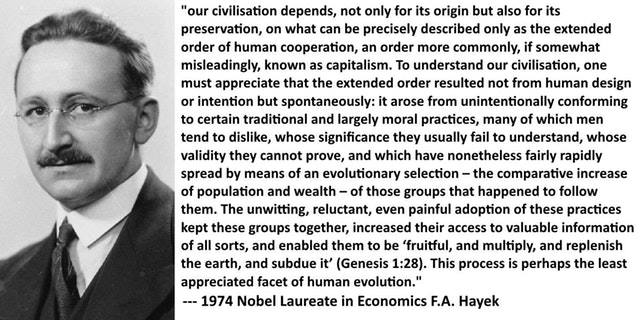
    Hayek wasn’t quite right. Our civilization depends upon the rule of law by tort (natural law), the result of which CAN ONLY be ‘markets in everything’ – which he refers to as “Capitalism” by adopting the marxist criticism of financial cooperation at scale – but that I would call ‘Market-ism”: or the suppression of all involuntary parasitism and predation and forcing all peoples into the market in the service of others to survive. This zero-tolerance of non-market behavior is the result of the institutionalization of sovereignty and with sovereignty, of necessity, tort, and with tort and sovereignty we construct natural law and markets. So while, in the end, he did understand that it was Law that was the foundation of western civilization, he did not make the connection that it was law that LIMITED US to anything other than market cooperation. I call this use of tort law (natural law) “incremental suppression of free riding, parasitism, and predation”.

    40684683_289741528289411_6976909244020817920_n.jpg
  • Hayek Wasn’t Quite Right

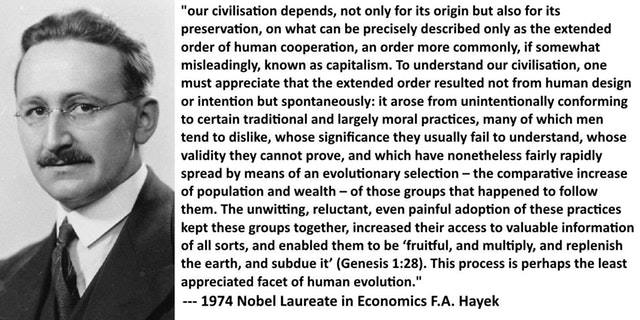
    Hayek wasn’t quite right. Our civilization depends upon the rule of law by tort (natural law), the result of which CAN ONLY be ‘markets in everything’ – which he refers to as “Capitalism” by adopting the marxist criticism of financial cooperation at scale – but that I would call ‘Market-ism”: or the suppression of all involuntary parasitism and predation and forcing all peoples into the market in the service of others to survive. This zero-tolerance of non-market behavior is the result of the institutionalization of sovereignty and with sovereignty, of necessity, tort, and with tort and sovereignty we construct natural law and markets. So while, in the end, he did understand that it was Law that was the foundation of western civilization, he did not make the connection that it was law that LIMITED US to anything other than market cooperation. I call this use of tort law (natural law) “incremental suppression of free riding, parasitism, and predation”.

    40684683_289741528289411_6976909244020817920_n.jpg
  • A Thing is Demonstrated not Claimed. Ergo, yes false.

    —Christianity is Not ‘false’, just figurative. Not literal. John Warner Mathisen has shown that the stories of the worlds religions are figurative stories(myths) describing the constellations of the night sky. This understanding is called Astro-Theology.”— A Friend Correct in their origin, but two problems with that presumption: 1) A statement is figurative if used figuratively (meaning) and false if used argumentatively (truth). How are the jewish, christian, and islamic statements used? Figuratively (analogically) or argumentatively (persuasively)? In other words, how something is used determines its constitution. There is very little evidence it was used figuratively. Especially given the doubling down by fundamentalists after the empirical, scientific, and technological revolutions. 2) The content of those statements is true if the means produce the promised or even beneficial ends. The statements are false if the means do not produce promised or beneficial ends. Judaism contributed nothing to humanity despite the most educated population in caucasia. Christianity destroyed the aristocracy of the roman world just as it was designed to do. Islam destroyed the great civilizations of the ancient world. And together these three religions ushered in 1B deaths, and a thousand year dark age we have spent the last five hundred years trying to escape – with christianity dying off, but judaism and islam still working diligently to destroy western civilization, with only the chinese, japanese, and koreans holding out. So The statements were and are not acted upon as figurative (analogies, myths) but wisdom, law, and civilizational objective. The outcome is not paradise in the afterlife, or under the pseudoscientific version of judaism (Marxism), christianity (libertarianism), Islam (neo-conservatism), prosperity and peace in this world. These three religions – all variations on abrahamism whether ancient semitic judaism, christianity, and islam, or modern marxism, feminism, and postmodernism – designed by intent to destroy “critique” the great civilizations by weaponizing the female competitive strategy of undermining and reputation destruction by disapproval, shaming, ridicule, gossip, and rallying, and doing so by taking advantage of the means of communication and immigration and publication created in the ancient world and the modern. The are not just false in statement, false in promise, but malicious in intent.

  • A Thing is Demonstrated not Claimed. Ergo, yes false.

    —Christianity is Not ‘false’, just figurative. Not literal. John Warner Mathisen has shown that the stories of the worlds religions are figurative stories(myths) describing the constellations of the night sky. This understanding is called Astro-Theology.”— A Friend Correct in their origin, but two problems with that presumption: 1) A statement is figurative if used figuratively (meaning) and false if used argumentatively (truth). How are the jewish, christian, and islamic statements used? Figuratively (analogically) or argumentatively (persuasively)? In other words, how something is used determines its constitution. There is very little evidence it was used figuratively. Especially given the doubling down by fundamentalists after the empirical, scientific, and technological revolutions. 2) The content of those statements is true if the means produce the promised or even beneficial ends. The statements are false if the means do not produce promised or beneficial ends. Judaism contributed nothing to humanity despite the most educated population in caucasia. Christianity destroyed the aristocracy of the roman world just as it was designed to do. Islam destroyed the great civilizations of the ancient world. And together these three religions ushered in 1B deaths, and a thousand year dark age we have spent the last five hundred years trying to escape – with christianity dying off, but judaism and islam still working diligently to destroy western civilization, with only the chinese, japanese, and koreans holding out. So The statements were and are not acted upon as figurative (analogies, myths) but wisdom, law, and civilizational objective. The outcome is not paradise in the afterlife, or under the pseudoscientific version of judaism (Marxism), christianity (libertarianism), Islam (neo-conservatism), prosperity and peace in this world. These three religions – all variations on abrahamism whether ancient semitic judaism, christianity, and islam, or modern marxism, feminism, and postmodernism – designed by intent to destroy “critique” the great civilizations by weaponizing the female competitive strategy of undermining and reputation destruction by disapproval, shaming, ridicule, gossip, and rallying, and doing so by taking advantage of the means of communication and immigration and publication created in the ancient world and the modern. The are not just false in statement, false in promise, but malicious in intent.

  • “Not an argument. I don’t issue opinions, I construct arguments. Arguments requi

    —“Not an argument. I don’t issue opinions, I construct arguments. Arguments require refutations. Schoolgirls engage in disapproval, rallying, shaming, gossip and reputation destruction: that is the socially dysfunctional female method of violence.”—

  • “Not an argument. I don’t issue opinions, I construct arguments. Arguments requi

    —“Not an argument. I don’t issue opinions, I construct arguments. Arguments require refutations. Schoolgirls engage in disapproval, rallying, shaming, gossip and reputation destruction: that is the socially dysfunctional female method of violence.”—