Source: Original Site Post

  • ‎Michelle German‎ to Curt Doolittle Hi Curt, I’ve been contemplating something t

    ‎Michelle German‎ to Curt Doolittle Hi Curt, I’ve been contemplating something that you spoke about not too long ago. That when we die, there is nothing else afterwards. And that legacy is through the bloodlines (meaning no spirit, no other side, etc). In my line of work as a death doula, one thing I’ve noticed across all belief systems (atheists included) is when the dying are in their eleventh hour, many speak about how they see (deceased) loved one(s). With the passing of my father recently, it’s quite challenging for me because it hurts like hell. When I contemplate that his spirit is with us, there seems to be comfort. But I’m not tried to delude myself. When the dying are talking about seeing their loved ones, is it the mind fabricating this? I don’t mean to state they’re delusional. I’m genuinely curious to know if the mind has some form of mechanism to shield itself, etc. Would love to hear your understanding of it. And pardon if I misunderstood anything about your previous post. ❤️

    pW]ell, as I understand it, and as I think I explained, our current understanding of the universe is that it consists of information, and that we, as part of that universe, consist of information too, and that we, as information, live on as information in the minds of all others who remember us, in display, word, deed, or consequence, either intentionally or not. Do the spirits (patterns of information) of our ancestors live on in us? Of course they do. Are they conscious in any meaningful way? Only in how they affect our thoughts and behaviors. Can we sense that information after they have passed? Of course we can. Are we, at the end (having been there myself) more concerned with those others whose ‘information they will now join in common condition”? Then yes. Furthermore I would not deny myself or others that joy. Some things are true enough, because they need only be true enough for our spirits and the spirits of others past present and future. This is one of them. There is no irreciprocity there. And if we make no truth claims, no falsehood.

    Michelle German Curt thank you.
  • ‎Michelle German‎ to Curt Doolittle Hi Curt, I’ve been contemplating something t

    ‎Michelle German‎ to Curt Doolittle Hi Curt, I’ve been contemplating something that you spoke about not too long ago. That when we die, there is nothing else afterwards. And that legacy is through the bloodlines (meaning no spirit, no other side, etc). In my line of work as a death doula, one thing I’ve noticed across all belief systems (atheists included) is when the dying are in their eleventh hour, many speak about how they see (deceased) loved one(s). With the passing of my father recently, it’s quite challenging for me because it hurts like hell. When I contemplate that his spirit is with us, there seems to be comfort. But I’m not tried to delude myself. When the dying are talking about seeing their loved ones, is it the mind fabricating this? I don’t mean to state they’re delusional. I’m genuinely curious to know if the mind has some form of mechanism to shield itself, etc. Would love to hear your understanding of it. And pardon if I misunderstood anything about your previous post. ❤️

    pW]ell, as I understand it, and as I think I explained, our current understanding of the universe is that it consists of information, and that we, as part of that universe, consist of information too, and that we, as information, live on as information in the minds of all others who remember us, in display, word, deed, or consequence, either intentionally or not. Do the spirits (patterns of information) of our ancestors live on in us? Of course they do. Are they conscious in any meaningful way? Only in how they affect our thoughts and behaviors. Can we sense that information after they have passed? Of course we can. Are we, at the end (having been there myself) more concerned with those others whose ‘information they will now join in common condition”? Then yes. Furthermore I would not deny myself or others that joy. Some things are true enough, because they need only be true enough for our spirits and the spirits of others past present and future. This is one of them. There is no irreciprocity there. And if we make no truth claims, no falsehood.

    Michelle German Curt thank you.
  • Upcoming Book on Human Intelligence

    Upcoming Book on Human Intelligence

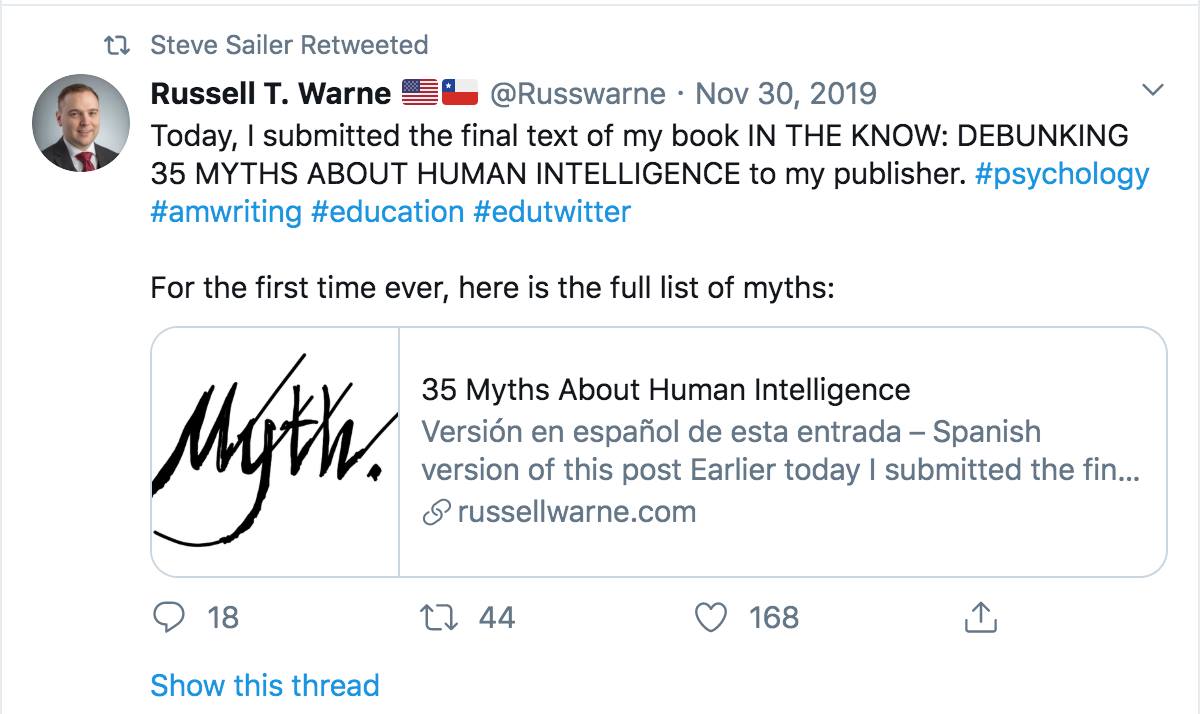
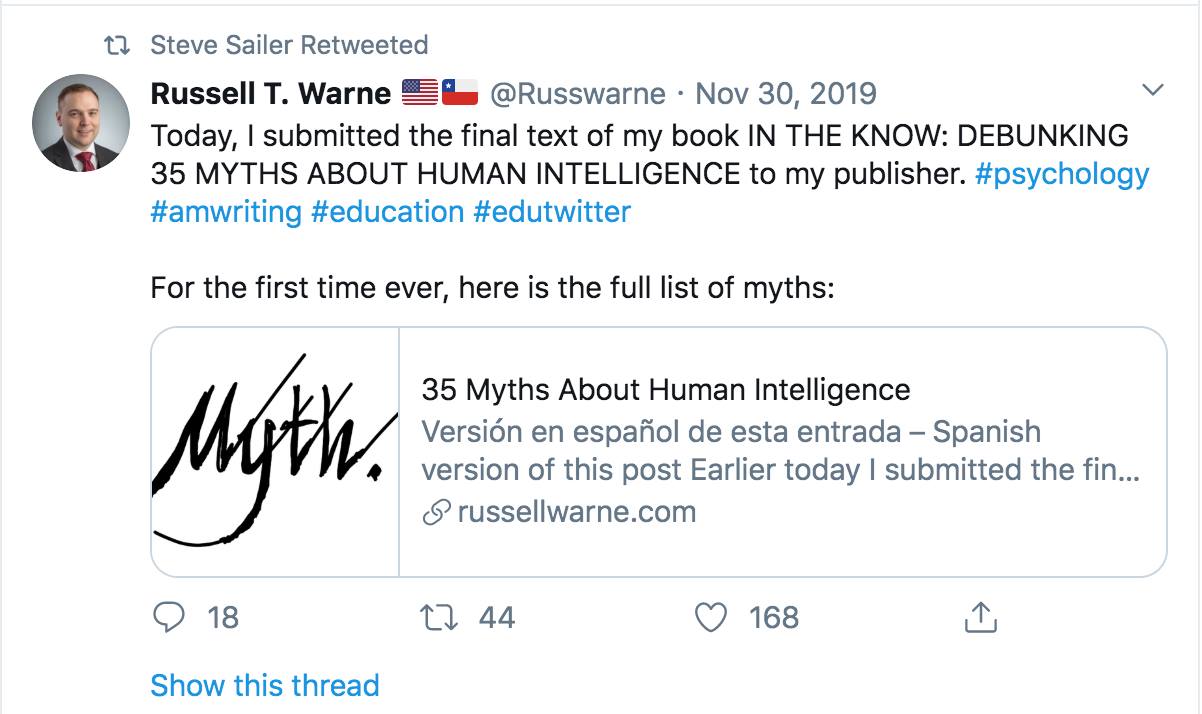
    Russell T. WarnePsychologist – Data Analyst – Educator(a book answering the science-denialists) [“E]arlier today I submitted the final text for my upcoming book In the Know: Debunking 35 Myths About Human Intelligence. It feels good to have it in the hands of my publisher. There is still some work to do, but most of it is work that my publisher has to do–not me. The book has 35 chapters (one per myth), plus an introduction and a conclusion. The chapters are each short enough that they can be read in one sitting, and the language is as non-technical as possible. My goal was to have the book serve as a convenient reference that people could use to combat common incorrect ideas about intelligence. The book will be published in fall 2020. In the meantime, here are the myths that the book addresses:

    Section 1: The Nature of Intelligence Intelligence is whatever collection of tasks a psychologist puts on a test. Intelligence is too complex to summarize with one number. IQ does not correspond to brain anatomy or functioning. Intelligence is a Western concept that does not apply to non-Western cultures. There are multiple intelligences in the human mind. Practical intelligence is a real ability, separate from general intelligence. Fact: there are aspects of brain anatomy and functioning that correlate with IQ scores. Section 2: Measuring Intelligence Measuring intelligence is difficult. Content on intelligence tests is trivial and cannot measure intelligence. Intelligence tests are imperfect and cannot be used or trusted. Intelligence tests are biased against diverse populations. Section 3: Influences on Intelligence IQ only reflects a person’s socioeconomic status. High heritability for intelligence means that raising IQ is impossible. Genes are not important for determining intelligence. Environmentally driven changes in IQ mean that intelligence is malleable. Social interventions can drastically raise IQ. Brain training programs can raise IQ. Improvability of IQ means intelligence can be equalized. The reality is that geneticists have identified hundreds of DNA segments that are associated with intelligence. In fact, in some samples, genes have a larger impact than environment on IQ. Section 4: Intelligence and Education Every child is gifted. Effective schools can make every child academically proficient. Non-cognitive variables have powerful effects on academic achievement. Admissions tests are a barrier to college for underrepresented students. Section 5: Life Consequences of Intelligence IQ scores only measure how good someone is at taking intelligence tests. Intelligence is not important in the workplace. Intelligence tests are designed to create or perpetuate a false meritocracy. Very high intelligence is not more beneficial than moderately high intelligence. Emotional intelligence is a real ability that is helpful in life. It is a myth that schools can equalize children in their knowledge, academic skills, or intelligence. Section 6: Demographic Group Differences Males and females have the same distribution of IQ scores. Racial/Ethnic group IQ differences are completely environmental in origin. Unique influences operate on one group’s intelligence test scores. Stereotype threat explains score gaps among demographic groups. Section 7: Societal and Ethical Issues Controversial or unpopular ideas should be held to a higher standard of evidence. Past controversies taint modern research on intelligence. Intelligence research leads to negative social policies. Intelligence research undermines the fight against inequality. Everyone is about as smart as I am.

    86790915_210269200371241_8064657175416406016_o.jpg
  • Upcoming Book on Human Intelligence

    Upcoming Book on Human Intelligence

    Russell T. WarnePsychologist – Data Analyst – Educator(a book answering the science-denialists) [“E]arlier today I submitted the final text for my upcoming book In the Know: Debunking 35 Myths About Human Intelligence. It feels good to have it in the hands of my publisher. There is still some work to do, but most of it is work that my publisher has to do–not me. The book has 35 chapters (one per myth), plus an introduction and a conclusion. The chapters are each short enough that they can be read in one sitting, and the language is as non-technical as possible. My goal was to have the book serve as a convenient reference that people could use to combat common incorrect ideas about intelligence. The book will be published in fall 2020. In the meantime, here are the myths that the book addresses:

    Section 1: The Nature of Intelligence Intelligence is whatever collection of tasks a psychologist puts on a test. Intelligence is too complex to summarize with one number. IQ does not correspond to brain anatomy or functioning. Intelligence is a Western concept that does not apply to non-Western cultures. There are multiple intelligences in the human mind. Practical intelligence is a real ability, separate from general intelligence. Fact: there are aspects of brain anatomy and functioning that correlate with IQ scores. Section 2: Measuring Intelligence Measuring intelligence is difficult. Content on intelligence tests is trivial and cannot measure intelligence. Intelligence tests are imperfect and cannot be used or trusted. Intelligence tests are biased against diverse populations. Section 3: Influences on Intelligence IQ only reflects a person’s socioeconomic status. High heritability for intelligence means that raising IQ is impossible. Genes are not important for determining intelligence. Environmentally driven changes in IQ mean that intelligence is malleable. Social interventions can drastically raise IQ. Brain training programs can raise IQ. Improvability of IQ means intelligence can be equalized. The reality is that geneticists have identified hundreds of DNA segments that are associated with intelligence. In fact, in some samples, genes have a larger impact than environment on IQ. Section 4: Intelligence and Education Every child is gifted. Effective schools can make every child academically proficient. Non-cognitive variables have powerful effects on academic achievement. Admissions tests are a barrier to college for underrepresented students. Section 5: Life Consequences of Intelligence IQ scores only measure how good someone is at taking intelligence tests. Intelligence is not important in the workplace. Intelligence tests are designed to create or perpetuate a false meritocracy. Very high intelligence is not more beneficial than moderately high intelligence. Emotional intelligence is a real ability that is helpful in life. It is a myth that schools can equalize children in their knowledge, academic skills, or intelligence. Section 6: Demographic Group Differences Males and females have the same distribution of IQ scores. Racial/Ethnic group IQ differences are completely environmental in origin. Unique influences operate on one group’s intelligence test scores. Stereotype threat explains score gaps among demographic groups. Section 7: Societal and Ethical Issues Controversial or unpopular ideas should be held to a higher standard of evidence. Past controversies taint modern research on intelligence. Intelligence research leads to negative social policies. Intelligence research undermines the fight against inequality. Everyone is about as smart as I am.

    86790915_210269200371241_8064657175416406016_o.jpg
  • [W]estern man always used markets. We had markets for leadership under trifuncti

    [W]estern man always used markets. We had markets for leadership under trifunctionalism, and under trifunctionalism, western man had two declared priesthoods: Juridical and Spiritual, and one undeclared: Science – which was metallurgy. When you hear our folktales of ‘spells’ it’s derived from metal smelting. Because our ancestors combined Horse, wheel, and bronze to conquer the known world. Philosophy was our ‘synthesis’ of the trifunctional, just as monotheism was the synthesis of the monopoly theology of the middle east. So, Yes, philosophy was and to some degree remains is the natural ‘theology’ of western man and heathen(nature, spirits, ancestors) and pagan(heroes, gods). Our philosophy was corrupted by the addition of monotheistic theology, resulting in the strange synthesis by Augustine. And it is this synthesis that failed repeatedly in the semitic dark ages, was replaced by literacy in the early modern period, with pure faith surviving in orthodox and american protestant forms, and catholicism and catholic dogma lost. So the question is whether we are returning to Law, Science, Philosophy and Faith, having finally left the failure of theology behind. And whether we will restore our ancestral religions of heathens and religion of the hearth (folktales, fairy tales, myths, legends), paganism (historical figures, aryanism), and maintain Christianity is yet to be discovered.

  • [W]estern man always used markets. We had markets for leadership under trifuncti

    [W]estern man always used markets. We had markets for leadership under trifunctionalism, and under trifunctionalism, western man had two declared priesthoods: Juridical and Spiritual, and one undeclared: Science – which was metallurgy. When you hear our folktales of ‘spells’ it’s derived from metal smelting. Because our ancestors combined Horse, wheel, and bronze to conquer the known world. Philosophy was our ‘synthesis’ of the trifunctional, just as monotheism was the synthesis of the monopoly theology of the middle east. So, Yes, philosophy was and to some degree remains is the natural ‘theology’ of western man and heathen(nature, spirits, ancestors) and pagan(heroes, gods). Our philosophy was corrupted by the addition of monotheistic theology, resulting in the strange synthesis by Augustine. And it is this synthesis that failed repeatedly in the semitic dark ages, was replaced by literacy in the early modern period, with pure faith surviving in orthodox and american protestant forms, and catholicism and catholic dogma lost. So the question is whether we are returning to Law, Science, Philosophy and Faith, having finally left the failure of theology behind. And whether we will restore our ancestral religions of heathens and religion of the hearth (folktales, fairy tales, myths, legends), paganism (historical figures, aryanism), and maintain Christianity is yet to be discovered.

  • Book. From Blog. “Whistleblower”

    [W]oman is on ride-sharing site with fellow employees. Guy propositions her. She rejects it. This is somehow ‘sexual harassment’ since according to women, only women should initiate seduction, because they are not adult enough to reject it. She reports it to HR. HR says ‘it’s his first offense, he’s a high performer (and you are not) so either stay on his team and deal with it, or move to another team’. This is the correct solution to the problem when dealing with a high performer and a low performer. You move the lower performer. Instead she plays victim, does not act in the company interest, and acts instead in her own interest, and rallies other women to HR with her. HR says it is his first offense because it’s the first offense we have record of. And we have more people complaining about YOU. Women feels she is self righteously due, so continues, writes blog, and undermines company’s competitive male culture of ‘stepping on toes to do what’s right’. This is why it is important to (a) have recruiting, benefits, payroll, and legal departments but NOT HR departments who are universally agents of undermining organizations by politicking – and force people to legal recourse outside the business. (b) this is why high performing companies should be very cautious about hiring women until the naturally destructive nature of women can be tolerated by scale. Sexual harassment is an obvious thing. Unwanted advancement is not sexual harassment. It’s just human. Why don’t we teach women how to reject men, and that men must respect it and not retaliate when rejected – rather than all these layers of deceit and destruction.

  • Book. From Blog. “Whistleblower”

    [W]oman is on ride-sharing site with fellow employees. Guy propositions her. She rejects it. This is somehow ‘sexual harassment’ since according to women, only women should initiate seduction, because they are not adult enough to reject it. She reports it to HR. HR says ‘it’s his first offense, he’s a high performer (and you are not) so either stay on his team and deal with it, or move to another team’. This is the correct solution to the problem when dealing with a high performer and a low performer. You move the lower performer. Instead she plays victim, does not act in the company interest, and acts instead in her own interest, and rallies other women to HR with her. HR says it is his first offense because it’s the first offense we have record of. And we have more people complaining about YOU. Women feels she is self righteously due, so continues, writes blog, and undermines company’s competitive male culture of ‘stepping on toes to do what’s right’. This is why it is important to (a) have recruiting, benefits, payroll, and legal departments but NOT HR departments who are universally agents of undermining organizations by politicking – and force people to legal recourse outside the business. (b) this is why high performing companies should be very cautious about hiring women until the naturally destructive nature of women can be tolerated by scale. Sexual harassment is an obvious thing. Unwanted advancement is not sexual harassment. It’s just human. Why don’t we teach women how to reject men, and that men must respect it and not retaliate when rejected – rather than all these layers of deceit and destruction.

  • Criticizing and Reforming “logos”

    [I] disagree with every use of Logos I’ve ever seen. As far as I know it’s original use meant ‘order identifiable and explicable through reason‘. Which doesn’t tell us anything, unless we have some claim on the truth or falsehood of it. Instead, civilizations evolve strategies (group competitive strategies), and persist them through metaphysical (unstated, presumed, unconscious) premises(laws of nature), and paradigms (plots), advanced by archetypes (characters) that anthropomorphize (mirror and amplify psychological or behavioral traits), which recursively reinforce the group strategy as if it is a law of nature. For this reason I argue that metaphysics as a discipline ‘doesn’t exist’ so to speak and that there is only one testifiable answer to existence (realism, naturalism, operationalism, empiricism, rational choice, reciprocity, transcendence) and that all else is fiction(parable, myth, literature) or fictionalism (theology, sophistry, pseudoscience) that either mirrors or does not mirror that most parsimonious testimony and strategy. Man must act. To act he must remember. With memory he must predict futures to choose from to act upon. To choose from those futures he must reason. To continuously improve his choices continuously reducing costs, he must improve his reason. To reason at any scale other than the trivial requires forms of categorizing, organizing, predicting, and calculating. Language allows us to calculate increasing complexity. Cooperation lets us produce disproportionate returns on our actions. Cooperation on increasingly complex production requires collective ends within which to discover cooperative means. Narratives allow us to calculate collective means of cooperation within complex social groups. Complex social groups using the same narratives make the majority of tie-breaking decisions in favor of the group strategy. It is the countless decisions we make in favor of the group strategy when it costs little or nothing to do so, or at least the not-prohibitive to do so, that produce our group strategy more than does any organized and intentional production of commons. So I don’t use “logos” because of it’s nonsense connotations. Instead I create an operational description of the world and therefore continue my war on nonsense terms from history that were invented to wow nonsensical ignorant people into the pretense that some presumed good was in fact true as well as presumed good. See what I did there? 😉 10John Ma

  • Criticizing and Reforming “logos”

    [I] disagree with every use of Logos I’ve ever seen. As far as I know it’s original use meant ‘order identifiable and explicable through reason‘. Which doesn’t tell us anything, unless we have some claim on the truth or falsehood of it. Instead, civilizations evolve strategies (group competitive strategies), and persist them through metaphysical (unstated, presumed, unconscious) premises(laws of nature), and paradigms (plots), advanced by archetypes (characters) that anthropomorphize (mirror and amplify psychological or behavioral traits), which recursively reinforce the group strategy as if it is a law of nature. For this reason I argue that metaphysics as a discipline ‘doesn’t exist’ so to speak and that there is only one testifiable answer to existence (realism, naturalism, operationalism, empiricism, rational choice, reciprocity, transcendence) and that all else is fiction(parable, myth, literature) or fictionalism (theology, sophistry, pseudoscience) that either mirrors or does not mirror that most parsimonious testimony and strategy. Man must act. To act he must remember. With memory he must predict futures to choose from to act upon. To choose from those futures he must reason. To continuously improve his choices continuously reducing costs, he must improve his reason. To reason at any scale other than the trivial requires forms of categorizing, organizing, predicting, and calculating. Language allows us to calculate increasing complexity. Cooperation lets us produce disproportionate returns on our actions. Cooperation on increasingly complex production requires collective ends within which to discover cooperative means. Narratives allow us to calculate collective means of cooperation within complex social groups. Complex social groups using the same narratives make the majority of tie-breaking decisions in favor of the group strategy. It is the countless decisions we make in favor of the group strategy when it costs little or nothing to do so, or at least the not-prohibitive to do so, that produce our group strategy more than does any organized and intentional production of commons. So I don’t use “logos” because of it’s nonsense connotations. Instead I create an operational description of the world and therefore continue my war on nonsense terms from history that were invented to wow nonsensical ignorant people into the pretense that some presumed good was in fact true as well as presumed good. See what I did there? 😉 10John Ma