Source: Original Site Post

  • Man – Cooperation – Tolerance Forbearance

    Investment: Forbearance

    The distinction between tolerance and forbearance.

    TOLERANCE: allowing costs to be assessed against non-consenting parties as ambiguity makes it unclear what additional party is specifically responsible for costs. – It is a passive state. – No agency.

    FORBEARANCE: intentionally taking responsibility for a cost to allow someone else not to. (example: my children, my disabled kin, my employee that has not matured fully yet). – It is an active state. – Allows agency.MORE ON THE FRAUD OF TOLERANCE AND THE PAYMENT OF FORBEARANCE

    —“The centre holds onto tolerance because tolerance is passive. Those lacking agency can participate in tolerance while ignoring limits, because they don’t have the agency to enforce limits, and by ignoring limits they can stay in denial of their lack of agency. Forbearance includes tolerance AND limits (until the cost one was willing carried has been exceeded), AND active participation – its a choice which one can boycott/defect based on the cost carried.” —- @[655376421:2048:Bill Joslin]

    FORBEARANCE

    —-“I use Tolerance to mean allowing costs to be assessed against non-consenting parties as ambiguity makes it unclear what additional party is specifically responsible for costs. It is a passive state. No agency. …. I use Forbearance to mean I intentionally take responsibility for the cost to allow someone else not to (ex. my children, my disabled kin, my employee that has not matured fully yet). It is an active state. Allows agency.”— @[1013719133:2048:Luke Weinhagen]

  • Man – Cooperation – Tolerance Forbearance

    Investment: Forbearance

    The distinction between tolerance and forbearance.

    TOLERANCE: allowing costs to be assessed against non-consenting parties as ambiguity makes it unclear what additional party is specifically responsible for costs. – It is a passive state. – No agency.

    FORBEARANCE: intentionally taking responsibility for a cost to allow someone else not to. (example: my children, my disabled kin, my employee that has not matured fully yet). – It is an active state. – Allows agency.MORE ON THE FRAUD OF TOLERANCE AND THE PAYMENT OF FORBEARANCE

    —“The centre holds onto tolerance because tolerance is passive. Those lacking agency can participate in tolerance while ignoring limits, because they don’t have the agency to enforce limits, and by ignoring limits they can stay in denial of their lack of agency. Forbearance includes tolerance AND limits (until the cost one was willing carried has been exceeded), AND active participation – its a choice which one can boycott/defect based on the cost carried.” —- @[655376421:2048:Bill Joslin]

    FORBEARANCE

    —-“I use Tolerance to mean allowing costs to be assessed against non-consenting parties as ambiguity makes it unclear what additional party is specifically responsible for costs. It is a passive state. No agency. …. I use Forbearance to mean I intentionally take responsibility for the cost to allow someone else not to (ex. my children, my disabled kin, my employee that has not matured fully yet). It is an active state. Allows agency.”— @[1013719133:2048:Luke Weinhagen]

  • Man – Organization – Elite Classes

    Horizontal Class – Elites

    Horizontal or Reproductive and Influence Class

    Reproductive class refers a rough division of humans into a distribution by their reproductive value. There is a competition between the classes, as there is a competition between all living organisms – and there must be for evolution continue and the species to persist. The competition between the classes is dysgenic at the bottom and eugenic at the top. In other words, classes are the result of evolution in action. And the question of whether an action is eugenic or dysgenic provides us with complete moral decidability in the broadest possible ethical and moral questions facing mankind. There are no moral dilemmas. There are no morally undecidable questions.    

    Horizontal Classes


    Definition of Horizontal Class: Reproductive StrategyThree Dominance Hierarchies What dominance hierarchies (classes) can man climb?

    1. Physical (force)
    2. Economic (exchange)
    3. Gossip (insurance, inclusion, exclusion)

    We can climb all three of them – and we do. If we can.  

    Three Elite Classes

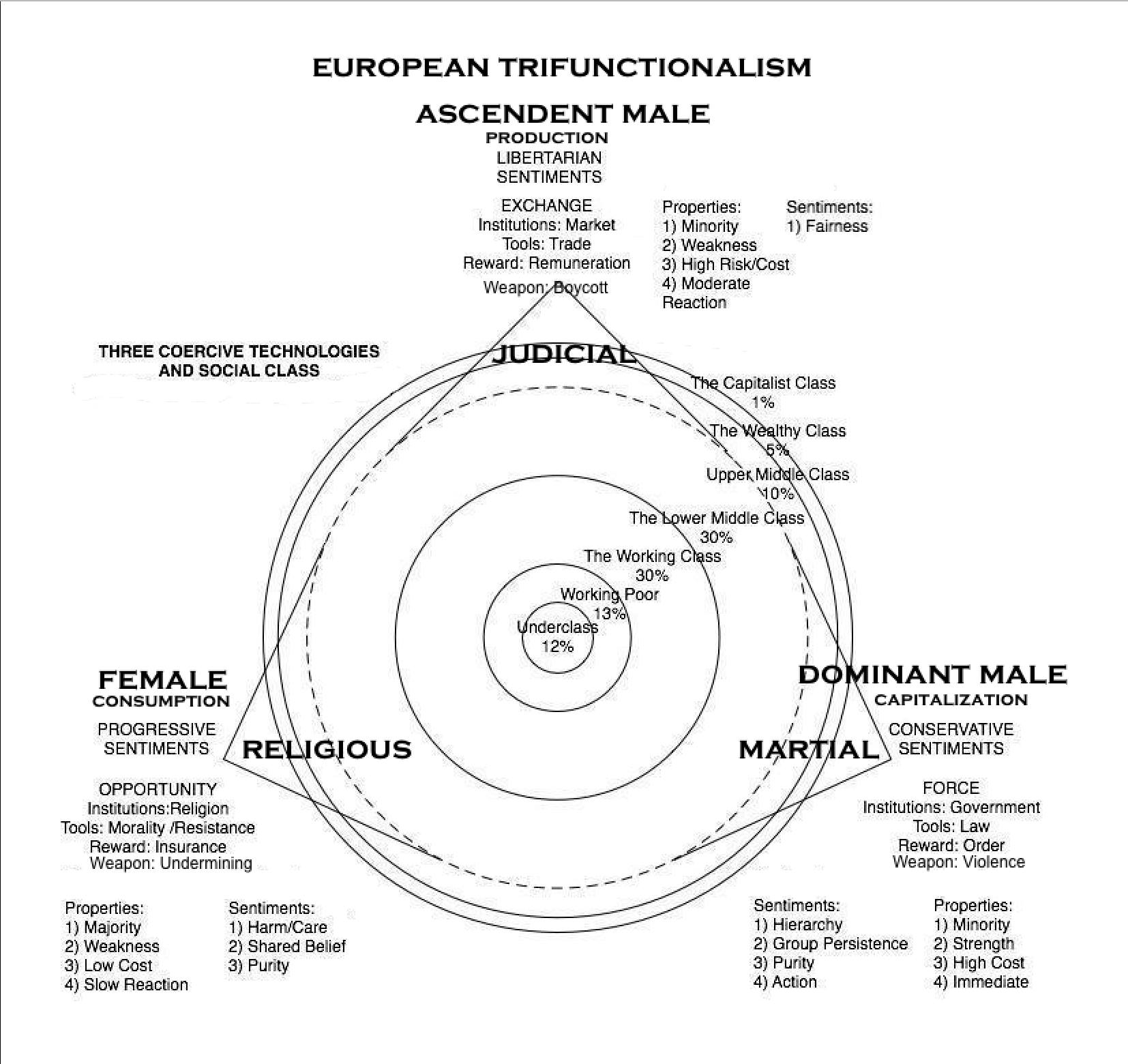
    ( … ) 1) The Military2) The Priesthood: talk/gossip/rallying/shaming, Academy, Politics. 3) The Judiciary: violence, order, law, war And 4) The Burghers: trade, enterpreneurship, finance, treasury. 5. Those who Work


    Combinations

    And a persuasive argument can consist of one or more of these strategies, often in great complexity.

    Force/Punishment/Limits < Exchange > Demand/Inclusion/Exclusion

    It is possible and often preferable to combine all three forms of power in order to coerce people most effectively. Conversely, it is possible and preferable to create an institutional framework in politics that restricts the ability to combine different forms of power in an effort to constrain power. All known societies employ all three sorts of incentives to at least some degree in order to evoke from its members the necessary degree of cooperation for the society to survive and flourish. However, different societies differ radically in the relative proportions of these different kinds of incentives used within their characteristic mix of incentives.   Or, more romantically:

    —“Human life can for convenience be divided into four major spheres, the pursuit of power (politics), the pursuit of wealth (economics), the pursuit of [mindfulness] salvation and meaning (religion), the pursuit of social and sexual warmth (kinship).”— McFarlane

    People give priority one or more different weighted combinations, or perhaps ‘chordic’ representations of these strategies. They do so out of habit, and class inclination, just as they follow religious and class sentiments due to their upbringing. People who belong to institutions have different capacities for adopting these strategies. Force requires discipline and long Time Bias. Remuneration requires cunning and invention. Moral claims require loyalty to consensus, and absorption of, and therefore payment of, opportunity costs. Different social classes have different time biases and consist of people with different time preferences, requiring different types of discipline under different social and economic conditions. ie: it is easier to have a long time preference if one is genetically disposed to better impulse control, and lives in greater security. It is easier to have a short time preference if one is more persuaded by impulses, less disciplined, and in an environment of scarcity. Under markets, the social classes are organized by intelligence (otherwise by violence, or corruption, or propaganda and deceit). Intelligence is the ability to absorb content in real-time, to learn abstractions in time, and to permute those abstractions in application to problems in real-time. Intelligence regresses toward the mean over generations. Therefore class membership is an indicator of the likelihood of class mobility, and upper-class position is difficult to maintain. While we use the word ‘middle class’, and most people in the west live middle-class lifestyles, the middle class means possessing disposable income and participating in the market. Therefore the majority of citizens are in the upper proletariat and lower-middle classes, which we call the working, white-collar working and craftsman classes. There are different costs to these institutions: Force is extremely expensive. Creating non-corruption, and order (some network of property definitions and their means of transfer). Property is a term for a scarce good that must be used, consumed or transformed in the process of production, even if that process is human sustenance. Remunerative institutions require the complex task of concentrating capital then maintaining it in a constantly changing kaleidic and competitive environment. Moral claims require constant advocacy, verbal skill, maintenance of numerous relationships, and constant payment of opportunity costs. Social classes have different access to each of these forms of coercion. Those in the institutional class, or upper class, have access to force in the form of policy and law. Those in the capitalist class, or middle, have access to capital: money, and market institutions. In each strategy, people form elites and organizations for utilizing those strategies. The elites create philosophical frameworks. Each of these frameworks consists of moral claims, and institutional means of perpetuating those claims, and the social benefits of adopting those claims. Each of these institutions is open to corruption, which is the privatization of opportunity and reward, for personal consumption at group expense. Corruption is a fraud. Each of these strategies, under the organizations, institutions, and elites, compete against other strategies, organizations, and elites, and each attempts to use its own organizations to obtain discounts against other organizations. This competition is analogous to the game of Rock, Paper, Scissors, if more complicated: each group can successfully compete against one another under most circumstances but can defeat and be defeated by some other combination of forces. The human mind is comfortable with identity and causality. It can with practice, understand a one-dimensional causal spectrum. It can, with effort, understand two dimensions of causality. It can with more effort to understand three dimensions of a causal spectrum. Human emotions for example, consist of probably no more than three stimuli: Dominance-Submission, Pleasure, and Activation. And that all human emotions, in their seemingly infinite variety can be described as using these three axes of stimuli. Likewise, human social behavior consists of three different forms of coercion, in some combination, and this set of axes leads to seemingly infinite variety. But it only seems infinite. At it’s base, there are only three forms of social organization. These three forms can be combined, as they are in the majority of the population in some manner or another. Or they can be used as one of three specializations, each of which attempts to play rock, paper, scissors, with the other two. All known societies employ all three sorts of incentives to at least some degree in order to evoke from its members the necessary degree of cooperation for the society to survive and flourish. However, different societies differ radically in the relative proportions of these different kinds of incentives used within their characteristic mix of incentives.      

       
  • Man – Action – Acquisition

    Acquisition

    “Man Acquires”

    “All behavior is reducible to the incentive to acquire interests. we can enumerate those categories of interests we seek to acquire. we remember those things we have invested in as costs, and defend those costs. (our complex interests some of which are our possessions” 1 – Time is limited and the only infinite scarcity 2 – Man is a costly form of life in an unpredictable universe. 3 – Man must acquire resources to live within this unpredictable universe. 4 – Man must act (move) to acquire and inventory resources, 5 – Man must remember to decrease the cost to acquire and inventory resources. 6 – Man must defend that which he has acquired and inventoried. (His possession is demonstrated by what he defends from loss, and what he retaliates for imposition of costs upon.) Demonstrated BehaviorMan acts to obtain the greatest return, in the shortest time, with the least effort, with the greatest certainty, at the lowest risk.Demonstrated Interests

    Three Means of Acquisition

    ( … Three Means of Acquisition )

  • Man – Action – Acquisition

    Acquisition

    “Man Acquires”

    “All behavior is reducible to the incentive to acquire interests. we can enumerate those categories of interests we seek to acquire. we remember those things we have invested in as costs, and defend those costs. (our complex interests some of which are our possessions” 1 – Time is limited and the only infinite scarcity 2 – Man is a costly form of life in an unpredictable universe. 3 – Man must acquire resources to live within this unpredictable universe. 4 – Man must act (move) to acquire and inventory resources, 5 – Man must remember to decrease the cost to acquire and inventory resources. 6 – Man must defend that which he has acquired and inventoried. (His possession is demonstrated by what he defends from loss, and what he retaliates for imposition of costs upon.) Demonstrated BehaviorMan acts to obtain the greatest return, in the shortest time, with the least effort, with the greatest certainty, at the lowest risk.Demonstrated Interests

    Three Means of Acquisition

    ( … Three Means of Acquisition )

  • Man – Action – Agency

    Agency

    Agency refers to the capacity for human beings to identify opportunities and make choices that are consistent, correspondent, existentially possible, and coherent with and within reality, and to act upon them, unimpeded by knowledge limitation (ignorance), intellectual limitation(intelligence), mindfulness limitation (impulse), physical limitations(body), instrumental limitations(technologies), resource limitations, the impediments of others and their organizations into norms, laws, institutions, polities, and armies. Perfect Agency would require omniscience, omniscience, and complete insulation from impulse. So, Agency, like Truth, or infinity, or perfection, or godhood, or moving half-way across Zeno’s line, describes an infinitely logarithmic curve: There is always more to be had. In social pseudoscience, one’s social, economic, and political agency is limited by ‘structure’ (institutions), and their (socialist) implication is that differences in income are an institutional choice not a necessity of human cooperation (natural law). In social pseudoscience then, we are considered to be equal in ability but unequal in institutional benefit. So we extended Agency by correcting the falsehood of equality and necessity. We are constrained both internally and externally. We have five sets of internal faculties:

    – Physical abilities (actions), one of which is speech. – Senses – the five senses – Intuitions – Reason – Technical Knowledge (actionable knowledge) Each of these faculties grants us abilities – some more, some less, because we are individually physically, intuitionistically, and rationally better or worse in our abilities. We are further constrained by externalities:

    – Geography – Resources, – Institutions of Cooperation – meaning norms, traditions and laws, and the economy. We can work to improve our physical abilities – with training

    – We can improve our senses with discipline and instruments. – We can improve our intuitions with training. – We can improve our reason with training. – We can improve our speech – with training – We can improve our knowledge – with training We can work with others.

    – We can work with others to improve our geography, resources, and formal and informal institutions. – We can work with others to improve our productivity in goods services and information. As we improve our internal and external ability to act, intuit, think, and speak, we improve our Agency. The Three Acknowledgments of Agency:

    1) I acknowledge that I can exercise some level of control over my thoughts, feelings, and actions.

    2) I acknowledge that I am responsible to control my thoughts, feelings, and actions to the best of my ability (within my natural limits).

    3) I acknowledge that I must work to develop the mental, emotional, and physical fortitude necessary to exercise my Agency.

    “We are just another self-domesticating animal. Some of us more successful at it than others. Nothing more complex is at work.”

    Biological Origins: How Much Agency Do We Have?

    Women and men demonstrably think very differently because of the difference between utility and truth, and between proportionality and reciprocity, and between dysgenia and eugenia. Why do we assume that this same cognitive bias is limited to gender rather than a balance between the genders and that different groups don’t just demonstrate the male cognitive bias or the female cognitive bias? Truth, Reciprocity, and Physical Violence that Ends when Ended, VERSUS Fraud, Proportionality, and Reputation Destruction that Never Ends until Destroyed. Violence and Threats VERSUS Shaming, Ridicule, Gossip, Straw Manning, Rallying, and Reputation Destruction. Those are the Male versus female competitive strategies. HERD <————–——> PACK Utility <———————> Truth Proportionality <—–—> Reciprocity Equality <——————> Meritocracy Dysgenia <—————–> Eugenia r <—————————–> K F<—————————–> M There is nothing in mankind that is complicated other than the lies we tell ourselves and others in order to achieve our desired ends. Male and female reproductive strategies are at odds. And we have little Agency in the choice of those strategies, at the individual, group, civilizational levels. Everything else is a consequence. So everywhere and everywhen, we discover compromises whether reciprocal or not in order to cooperate, or at least minimize conflict, between our different reproductive biases, interests, and strategies.

    There Is No Reason or Agency Among Animals.

    Speech provides the illusion that the rider controls the elephant, when in fact, there are very, very, few of us whose elephants correspond to reality, and as a consequence so do our riders. There is a reason that the animals do not argue rationally – because they lack agency, and because they lack agency, they are not in fact human. Just as children do not have the self-control of adults, many adults lack the self-control of others. While we may learn self-control of our bodies. We may learn self-control of our emotions. We may NOT learn self-control of our thoughts. We use the term ‘Agency’ to describe independence of our thoughts from physical and emotional impulses, from the bias of our intuitions, and from the bias of our thoughts. In this sense, some people are fully human (they have developed agency) or they are not fully human (they have not developed agency) and are still ‘animals’. Who Is and Isn’t Human? Is the line of demarcation between human and animal:

    1) Morphology? 2) Sentience? (Reaction to stimuli) 3) Awareness? (Sympathy-intent/Empathy-experience/Imitation-action) 4) Consciousness (time – space) 4) Speech? 5) Reason? (Agency) As far as I know, it is Reason and Agency that separate us from the animals.  That means very few of us are yet human. The rest are in different stages of domesticated animal. And I suspect that number (percentage) corresponds to the Pareto minimum. Our process of self-domestication is far from complete. It is merely sufficient for the west and to a lesser degree, east, to drag mankind out of ignorance, superstition, hard labor, filth, poverty, starvation, disease, plagues, suffering, child mortality, early death, continuous violence, and the vicissitudes of nature.

    |HUMAN| The gods we aspire to be < Trained Humans < untrained humans
     < trained animals < untrained animals < untrainable animals.

    We domesticated plants, those animals we could domesticate, and those humans we could domesticate. But we left the job unfinished.

    Reversal: Genetic Tolerance for Graceful Failure – Agency and Morality

    The evolutionary reason some of us have agency and most of us do not is that our reason is subject to temporal failure, and our information is subject to intertemporal failure, and instinct provides a very successful method of graceful failure in the face of limited information, limited time, and limited reason. Meanwhile, selection for success of those with Agency allows others to adopt new knowledge and understanding by imitation without abandoning their dependence upon intuition. This is the same reason we still have cheaters. While cooperation is most beneficial under ordinary circumstances, cheating (immorality), and predation (violence), are extremely valuable methods of graceful failure. The animal-majority is insurance in case we fail. But they are not to be taken seriously in what makes us succeed.

    SYSTEMS vs THE RIDER AND THE ELEPHANT

    System G (genes), System 0 (property), System 1 (intuition/search/continuous recursion), System 2 (steering, reason, calculation, computing) The ‘puppeteer’ (returns search results constantly) The mind handles exceptions (or disparate choices) Negotiation (morality) is an exception handler. I disagree with Chomsky, and I am fairly sure that Jeff Hawkins, and Kahnemann and his references, are correct: we just constantly search and re-search memory, and we pre-load any sequence of actions that have high value and then we become aware of the predicted outcome, and we choose to accept the proposition of our search, or we reject it, or we weigh it (research it, and reason with it). I like the “Systems” metaphors because they’re abstract. It is easier to understand the “Elephant and Rider” metaphor. And the ‘puppeteer’ metaphor is probably attributing too much agency to our intuition when it is just an acquisition machine. We act on behalf of our genes. The conscious mind (system 2: reasoning search) rides on the elephant of intuition (system 1: intuitionistic search), which is informed by our desire to acquire, inventory, and defend, which is biased by our reproductive strategy, which is biased by our genes.

    MAN IS A VICTIM OF HIS GENETIC BIASES

    We intuit that people – we and others – have agency. That the rider dominates the elephant. That is very hard to demonstrate when it appears the opposite. Developing Agency depends on the biological ability to do so, the market demand to do so, and the discipline to do so. So the elephant is a very simple machine, and the rider (consciousness) but a tool with which the elephant identifies opportunities, negotiates cooperation and executes conflict. In other words all we think and do as JUSTIFYING the commands of the elephant. And that very, very few of us are fully human and able to transcend the elephant. And that propertarianism is a means, like stoicism, like mathematics, of transcending the elephant – or rather COMPLETING THE TRANSCENDENCE OF MAN. All learning is continuous recursion. Epistemology and neurology are the same subject.

    THE CONSPIRACY OF THE ELEPHANTS

    There is no conspiracy among peoples with genetic and cultural homogeneity, any more than there is a conspiracy between women against men, or predators against prey, or competent against incompetent. We demonstrate differing degrees of neoteny, different moral intuitions, differing brain distributions, different endorphin distributions, and different morphology distributions for ancestral reasons. We all participate in the unconscious persistence of genetic, class, cultural, mythological, and institutional strategies. We can enumerate the properties of different group strategies, right down to the grammar of the speech and the methods of arguments, and the distributions of cognitive biases people and peoples use (which is one of the research programs what I work on). All of these properties and in group differences are both measurable at the individual and observable at the collective. One does not blame a dog for dragging it’s backside on the carpet. It’s a dog. One simply teaches the dog not to do so. One does not blame women for feminine cognitive biases and life preferences – they were an evolutionary necessity. One does not blame a competing group for pursuing its genetic interest at others expense – one simply creates norms, traditions, laws, institutions, and knowledge to prevent murder, violence, theft, fraud, fraud by omission, free riding, socialization of losses, privatization of commons, conspiracy, rent-seeking, producing pseudoscience, pseudo-rationalism, propaganda, systemic lying, advocating or practicing moral and ethical irreciprocity, attempts at conversion, at institutional erosion, asymmetric reproduction, invasion, conquest, war, and genocide in either short term or long term means. Either a group can defend itself against destructive, parasitic, and predatory competitors or it can’t. Groups compete. They compete by the means available to them. And groups learn to exploit every possible niche, from the most high trust, innovative, and productive, to the most low trust, parasitic, and destructive. But we cannot blame others for their immorality (free riding, parasitism and predation). We can only seek to defend ourselves against the immoral. There are no conspiracies. All our talk is just smoke and negotiation and deception on behalf of our genes. We are under the illusion that the rider drives the elephant, but the rider (our consciousness) is just a passenger on the elephant of our genes. Genes don’t conspire. They can’t.

    THE ILLUSION OF CONTROL

    Speech provides the illusion that the rider controls the elephant, when in fact, there are very, very, few of us whose elephants correspond to reality, and as a consequence so do our riders. There is a reason that the animals do not argue rationally – because they lack agency, and because they lack agency, they are not in fact humans
  • Man – Action – Agency

    Agency

    Agency refers to the capacity for human beings to identify opportunities and make choices that are consistent, correspondent, existentially possible, and coherent with and within reality, and to act upon them, unimpeded by knowledge limitation (ignorance), intellectual limitation(intelligence), mindfulness limitation (impulse), physical limitations(body), instrumental limitations(technologies), resource limitations, the impediments of others and their organizations into norms, laws, institutions, polities, and armies. Perfect Agency would require omniscience, omniscience, and complete insulation from impulse. So, Agency, like Truth, or infinity, or perfection, or godhood, or moving half-way across Zeno’s line, describes an infinitely logarithmic curve: There is always more to be had. In social pseudoscience, one’s social, economic, and political agency is limited by ‘structure’ (institutions), and their (socialist) implication is that differences in income are an institutional choice not a necessity of human cooperation (natural law). In social pseudoscience then, we are considered to be equal in ability but unequal in institutional benefit. So we extended Agency by correcting the falsehood of equality and necessity. We are constrained both internally and externally. We have five sets of internal faculties:

    – Physical abilities (actions), one of which is speech. – Senses – the five senses – Intuitions – Reason – Technical Knowledge (actionable knowledge) Each of these faculties grants us abilities – some more, some less, because we are individually physically, intuitionistically, and rationally better or worse in our abilities. We are further constrained by externalities:

    – Geography – Resources, – Institutions of Cooperation – meaning norms, traditions and laws, and the economy. We can work to improve our physical abilities – with training

    – We can improve our senses with discipline and instruments. – We can improve our intuitions with training. – We can improve our reason with training. – We can improve our speech – with training – We can improve our knowledge – with training We can work with others.

    – We can work with others to improve our geography, resources, and formal and informal institutions. – We can work with others to improve our productivity in goods services and information. As we improve our internal and external ability to act, intuit, think, and speak, we improve our Agency. The Three Acknowledgments of Agency:

    1) I acknowledge that I can exercise some level of control over my thoughts, feelings, and actions.

    2) I acknowledge that I am responsible to control my thoughts, feelings, and actions to the best of my ability (within my natural limits).

    3) I acknowledge that I must work to develop the mental, emotional, and physical fortitude necessary to exercise my Agency.

    “We are just another self-domesticating animal. Some of us more successful at it than others. Nothing more complex is at work.”

    Biological Origins: How Much Agency Do We Have?

    Women and men demonstrably think very differently because of the difference between utility and truth, and between proportionality and reciprocity, and between dysgenia and eugenia. Why do we assume that this same cognitive bias is limited to gender rather than a balance between the genders and that different groups don’t just demonstrate the male cognitive bias or the female cognitive bias? Truth, Reciprocity, and Physical Violence that Ends when Ended, VERSUS Fraud, Proportionality, and Reputation Destruction that Never Ends until Destroyed. Violence and Threats VERSUS Shaming, Ridicule, Gossip, Straw Manning, Rallying, and Reputation Destruction. Those are the Male versus female competitive strategies. HERD <————–——> PACK Utility <———————> Truth Proportionality <—–—> Reciprocity Equality <——————> Meritocracy Dysgenia <—————–> Eugenia r <—————————–> K F<—————————–> M There is nothing in mankind that is complicated other than the lies we tell ourselves and others in order to achieve our desired ends. Male and female reproductive strategies are at odds. And we have little Agency in the choice of those strategies, at the individual, group, civilizational levels. Everything else is a consequence. So everywhere and everywhen, we discover compromises whether reciprocal or not in order to cooperate, or at least minimize conflict, between our different reproductive biases, interests, and strategies.

    There Is No Reason or Agency Among Animals.

    Speech provides the illusion that the rider controls the elephant, when in fact, there are very, very, few of us whose elephants correspond to reality, and as a consequence so do our riders. There is a reason that the animals do not argue rationally – because they lack agency, and because they lack agency, they are not in fact human. Just as children do not have the self-control of adults, many adults lack the self-control of others. While we may learn self-control of our bodies. We may learn self-control of our emotions. We may NOT learn self-control of our thoughts. We use the term ‘Agency’ to describe independence of our thoughts from physical and emotional impulses, from the bias of our intuitions, and from the bias of our thoughts. In this sense, some people are fully human (they have developed agency) or they are not fully human (they have not developed agency) and are still ‘animals’. Who Is and Isn’t Human? Is the line of demarcation between human and animal:

    1) Morphology? 2) Sentience? (Reaction to stimuli) 3) Awareness? (Sympathy-intent/Empathy-experience/Imitation-action) 4) Consciousness (time – space) 4) Speech? 5) Reason? (Agency) As far as I know, it is Reason and Agency that separate us from the animals.  That means very few of us are yet human. The rest are in different stages of domesticated animal. And I suspect that number (percentage) corresponds to the Pareto minimum. Our process of self-domestication is far from complete. It is merely sufficient for the west and to a lesser degree, east, to drag mankind out of ignorance, superstition, hard labor, filth, poverty, starvation, disease, plagues, suffering, child mortality, early death, continuous violence, and the vicissitudes of nature.

    |HUMAN| The gods we aspire to be < Trained Humans < untrained humans
     < trained animals < untrained animals < untrainable animals.

    We domesticated plants, those animals we could domesticate, and those humans we could domesticate. But we left the job unfinished.

    Reversal: Genetic Tolerance for Graceful Failure – Agency and Morality

    The evolutionary reason some of us have agency and most of us do not is that our reason is subject to temporal failure, and our information is subject to intertemporal failure, and instinct provides a very successful method of graceful failure in the face of limited information, limited time, and limited reason. Meanwhile, selection for success of those with Agency allows others to adopt new knowledge and understanding by imitation without abandoning their dependence upon intuition. This is the same reason we still have cheaters. While cooperation is most beneficial under ordinary circumstances, cheating (immorality), and predation (violence), are extremely valuable methods of graceful failure. The animal-majority is insurance in case we fail. But they are not to be taken seriously in what makes us succeed.

    SYSTEMS vs THE RIDER AND THE ELEPHANT

    System G (genes), System 0 (property), System 1 (intuition/search/continuous recursion), System 2 (steering, reason, calculation, computing) The ‘puppeteer’ (returns search results constantly) The mind handles exceptions (or disparate choices) Negotiation (morality) is an exception handler. I disagree with Chomsky, and I am fairly sure that Jeff Hawkins, and Kahnemann and his references, are correct: we just constantly search and re-search memory, and we pre-load any sequence of actions that have high value and then we become aware of the predicted outcome, and we choose to accept the proposition of our search, or we reject it, or we weigh it (research it, and reason with it). I like the “Systems” metaphors because they’re abstract. It is easier to understand the “Elephant and Rider” metaphor. And the ‘puppeteer’ metaphor is probably attributing too much agency to our intuition when it is just an acquisition machine. We act on behalf of our genes. The conscious mind (system 2: reasoning search) rides on the elephant of intuition (system 1: intuitionistic search), which is informed by our desire to acquire, inventory, and defend, which is biased by our reproductive strategy, which is biased by our genes.

    MAN IS A VICTIM OF HIS GENETIC BIASES

    We intuit that people – we and others – have agency. That the rider dominates the elephant. That is very hard to demonstrate when it appears the opposite. Developing Agency depends on the biological ability to do so, the market demand to do so, and the discipline to do so. So the elephant is a very simple machine, and the rider (consciousness) but a tool with which the elephant identifies opportunities, negotiates cooperation and executes conflict. In other words all we think and do as JUSTIFYING the commands of the elephant. And that very, very few of us are fully human and able to transcend the elephant. And that propertarianism is a means, like stoicism, like mathematics, of transcending the elephant – or rather COMPLETING THE TRANSCENDENCE OF MAN. All learning is continuous recursion. Epistemology and neurology are the same subject.

    THE CONSPIRACY OF THE ELEPHANTS

    There is no conspiracy among peoples with genetic and cultural homogeneity, any more than there is a conspiracy between women against men, or predators against prey, or competent against incompetent. We demonstrate differing degrees of neoteny, different moral intuitions, differing brain distributions, different endorphin distributions, and different morphology distributions for ancestral reasons. We all participate in the unconscious persistence of genetic, class, cultural, mythological, and institutional strategies. We can enumerate the properties of different group strategies, right down to the grammar of the speech and the methods of arguments, and the distributions of cognitive biases people and peoples use (which is one of the research programs what I work on). All of these properties and in group differences are both measurable at the individual and observable at the collective. One does not blame a dog for dragging it’s backside on the carpet. It’s a dog. One simply teaches the dog not to do so. One does not blame women for feminine cognitive biases and life preferences – they were an evolutionary necessity. One does not blame a competing group for pursuing its genetic interest at others expense – one simply creates norms, traditions, laws, institutions, and knowledge to prevent murder, violence, theft, fraud, fraud by omission, free riding, socialization of losses, privatization of commons, conspiracy, rent-seeking, producing pseudoscience, pseudo-rationalism, propaganda, systemic lying, advocating or practicing moral and ethical irreciprocity, attempts at conversion, at institutional erosion, asymmetric reproduction, invasion, conquest, war, and genocide in either short term or long term means. Either a group can defend itself against destructive, parasitic, and predatory competitors or it can’t. Groups compete. They compete by the means available to them. And groups learn to exploit every possible niche, from the most high trust, innovative, and productive, to the most low trust, parasitic, and destructive. But we cannot blame others for their immorality (free riding, parasitism and predation). We can only seek to defend ourselves against the immoral. There are no conspiracies. All our talk is just smoke and negotiation and deception on behalf of our genes. We are under the illusion that the rider drives the elephant, but the rider (our consciousness) is just a passenger on the elephant of our genes. Genes don’t conspire. They can’t.

    THE ILLUSION OF CONTROL

    Speech provides the illusion that the rider controls the elephant, when in fact, there are very, very, few of us whose elephants correspond to reality, and as a consequence so do our riders. There is a reason that the animals do not argue rationally – because they lack agency, and because they lack agency, they are not in fact humans

  • Man – Classes

    Classes

    Reproductive Classes

    Ugly asymmetric, disproportionate, people, with low neoteny, low gender dimorphism, with low intelligence, and anti-social personality disorders, dysfunctional families, beliefs, habits, and traditions. -vs- Beautiful symmetrical and proportional people, with high neoteny, high gender dimorphism, with high intelligence, and pro-sociality, functional families, beliefs, habits, and traditions.   Elite – Extremely desirable Upper – Desirable throughout life. Middle – Desirable through fertility, Upper Lower – Desirable during peak fertility. Lower – Desirable only as ‘settling’ (last resort) Lowest – Undesirable Economic Classes  

  • Man – Classes

    Classes

    Reproductive Classes

    Ugly asymmetric, disproportionate, people, with low neoteny, low gender dimorphism, with low intelligence, and anti-social personality disorders, dysfunctional families, beliefs, habits, and traditions. -vs- Beautiful symmetrical and proportional people, with high neoteny, high gender dimorphism, with high intelligence, and pro-sociality, functional families, beliefs, habits, and traditions.   Elite – Extremely desirable Upper – Desirable throughout life. Middle – Desirable through fertility, Upper Lower – Desirable during peak fertility. Lower – Desirable only as ‘settling’ (last resort) Lowest – Undesirable Economic Classes  

  • Man – Species, Races, Subraces

    Species

    The Axes Of Human Variation 

    1 – Degree of Neoteny (asian white indian iranic semitic pacific african – testosterone levels, in that order) 2 – Rate and Depth of Maturity. (Same as above) 3 – Size of the Underclass through reproductive suppression and upward redistribution. (iq levels) 4 – Gender Distribution of Gender Traits (emphasis vs reversal) 5 – Group evolutionary Strategy using Gender Traits (Semitic maternal, asian paternal, western compromise).

    Biological Differences in Species of Human (Races)

    Neoteny Dimorphism Distribution

    Differences

    Races

    The Major races are species or we’re lying. We can either lie that human were not speciating and had not speciated as other animals and agadon the term race for species and sub-species lie every other life form, or we can preserve race as a synonym for species when regarding humans. Every alternative is lying. Racial Differences  Primary differences between races are due to degree of neoteny in climate, size of the underclass also because of climate, distribution of male and female biases (traits) between the genders in the group; and the norms, traditions, customs, formal and informal institutions that were necessary for those traits in that distribution in that region. As far as I know this is settled. Take any group’s IQ distribution and select 105. take the curve above 105 and find that percentage and standard deviation. Apply that standard deviation below 105 (mirror the curve). The new curve represents the people who are not a burden to mankind. Attached is the chart of world GDP per point of IQ, and it’s pretty obvious that the rate of decline is very fast after 95 – in fact it’s just a cliff. (the outlier is china with low gdp). Immigration has to be limited to something on the order of 125 and above, and young and old put to useful work for a polity to produce returns in the current world. There is no way to preserve our high trust society without insulation from those groups not yet having achieved sufficient eugenic evolution who will achieve here what it has elsewhere: regression.

    All Groups Can Transcend The Animal

    1) All groups can transcend the animal and evolve to fully human, and from fully human to our image of gods if they merely suppress the rates of reproduction of their lower classes. 2) Classes (distributions) matter far more than race. Among elites in all races, the primary differences across cultures appear to be verbal acuity – the ability to precisely articulate ideas. 3) As far as I can tell if people are fully integrated AND middle class or above (>105 IQ), and especially if they can obtain an empirical education (>110-115), they present no long term problem in small numbers because they try to obtain the benefits of membership in OUR society rather than attempt to obtain rents and political power on the behalf of their lower classes. 4) blaming others for our failings is simply an excuse not to act to change the status quo. the reason we are being invaded is the man in the mirror. States can only do what the warrior class (lower and middle-class men) allow them to do. On the other hand, if we build a worldwide alliance against corporatism and return to familialism, tribalism, and nationalism, it does not matter if we are different – it just provides us more opportunity to experiment, and more opportunity to win. And moreover, with many small nations, there is MORE ROOM AT THE TOP than there is in a ‘new world order’.