Mar 26, 2020, 12:57 PM There is nothing brilliant to be learned from the virus other than the fact that the government and bureaucracy failed again, by regulating during a stable market such that they created fragility (as always) during a panic market – thereby eliminating the european advantage (OODA LOOP) of dynamic adaptation to catastrophes crises, shocks, and changes. (see p on the european group strategy of markets in everything) We learned that the FDA and CDC followed the Department of Education into a failure of their core mission – because all bureaucracies expand work to fill available time, and expand rent seeking and privilege to the point of fragility. We will likely fail again to learn the lesson that regulation without clauses for crisis variation is less effective than threat of punishment. (see p on adaptive government) We learned that high corporate taxes, regulations, and unions drove production of strategic industries overseas so that they cannot be mobilized for non-market use in a crisis. (see p on full accounting by rule of law rather than free trade) We learned that once mobilized the private sector can adapt more rapidly than the public sector because it is NOT hierarchical. (see p on multiple economies rather than monolithic economy) We learned that the democratic party will do anything for power, just as the republican party will do anything to deny the left power – and we learned as we did in the impeachment that the democratic elites are underclass, jewish or female and the republican elites are middle class european or male. (see p on individual accountability of legislators) We learned that almost no one (other than the president business leaders, financial leadership) grasps that if the USA falls into depression that the whole world will collapse like a stone, and that we are fulfilling the cyclical predication that it will result in world scale warfare as states seize opportunities in duress that they could not seize in a period of stability and wealth creation. We learned that the press remains the enemy of the american people and that this crisis will possibly be their last gasp. (see p on accountability of the press in public speech) We learned that the Chinese as always practice face regardless of costs and we pay for it. (see p on foreign accountability for public speech in matters of the commons) We learned that globalization is over. (see p on universal nationalism) We learned that this disease will most likely be with us like the seasonal flu until there is a vaccine, but that unlike the seasonal flu, if we survive it, we are scarred by it. We learned that we will be in some sort of crisis through August just in time for the hate-meter to break the scales in the fall election cycle. And we learned that the Overton window is in a whirlpool that none of us can predict. (See p constitution for a western renaissance)
Source: Original Site Post
-
Lessons Learned from This Month’s Crisis
Mar 26, 2020, 12:57 PM There is nothing brilliant to be learned from the virus other than the fact that the government and bureaucracy failed again, by regulating during a stable market such that they created fragility (as always) during a panic market – thereby eliminating the european advantage (OODA LOOP) of dynamic adaptation to catastrophes crises, shocks, and changes. (see p on the european group strategy of markets in everything) We learned that the FDA and CDC followed the Department of Education into a failure of their core mission – because all bureaucracies expand work to fill available time, and expand rent seeking and privilege to the point of fragility. We will likely fail again to learn the lesson that regulation without clauses for crisis variation is less effective than threat of punishment. (see p on adaptive government) We learned that high corporate taxes, regulations, and unions drove production of strategic industries overseas so that they cannot be mobilized for non-market use in a crisis. (see p on full accounting by rule of law rather than free trade) We learned that once mobilized the private sector can adapt more rapidly than the public sector because it is NOT hierarchical. (see p on multiple economies rather than monolithic economy) We learned that the democratic party will do anything for power, just as the republican party will do anything to deny the left power – and we learned as we did in the impeachment that the democratic elites are underclass, jewish or female and the republican elites are middle class european or male. (see p on individual accountability of legislators) We learned that almost no one (other than the president business leaders, financial leadership) grasps that if the USA falls into depression that the whole world will collapse like a stone, and that we are fulfilling the cyclical predication that it will result in world scale warfare as states seize opportunities in duress that they could not seize in a period of stability and wealth creation. We learned that the press remains the enemy of the american people and that this crisis will possibly be their last gasp. (see p on accountability of the press in public speech) We learned that the Chinese as always practice face regardless of costs and we pay for it. (see p on foreign accountability for public speech in matters of the commons) We learned that globalization is over. (see p on universal nationalism) We learned that this disease will most likely be with us like the seasonal flu until there is a vaccine, but that unlike the seasonal flu, if we survive it, we are scarred by it. We learned that we will be in some sort of crisis through August just in time for the hate-meter to break the scales in the fall election cycle. And we learned that the Overton window is in a whirlpool that none of us can predict. (See p constitution for a western renaissance)
-
Money Flow
Mar 26, 2020, 1:35 PM
—“Dear Curt, I’ve watched several of your discussions with John Mark over the past year or so. Your ideas are very interesting. Tell me, have you tested your concepts, as outlined The Steps To American Restoration, by running a cost analysis and economic money flow? If the answer is yes, then would it be possible to view it? Yours sincerely,”— P de H.
There are a number of policies involved in our “Proposal”. The principle objectives are to (a) eliminate the possibility of financial rent seeking on consumers, (b) convert the banking system infrastructure (access to physical and digital cash) that disinter-mediates the citizenry from the treasury, (c) force investors into riskier returns on longer term capital investments – principally concentrating capital in tech, medicine, and automation that produce multipliers, (d) and redirect the savings to the production of investment impossible for the private sector – principally repatriation of medicine and tech, and further research and development, especially basic research (physics etc), (e) with the ambition of restoring the possibility of single income two parent households necessary for (non-dysgenic) intergenerational production of western high-investment human beings. Where western high investment parenting directs people to the production of commons and aggregate returns versus the asian and jewish production of familial goods. This will end the drastic cost to the working and middle class by the financialization of the economy necessary during the 20th to fight the world wars, the war against communism, and the conversion of the world to the anglo system of rule of law, finance, and trade, the continuation of our 1400 year war war to contain fundamentalist islam, and our present attempt to compensate for collapse of reproduction by immigrating consumers given our failure to produce increases in productivity without destroying gains by war, bureaucracy, inflation, and financial parasitism. For the audience: Circular Flow of the Economy
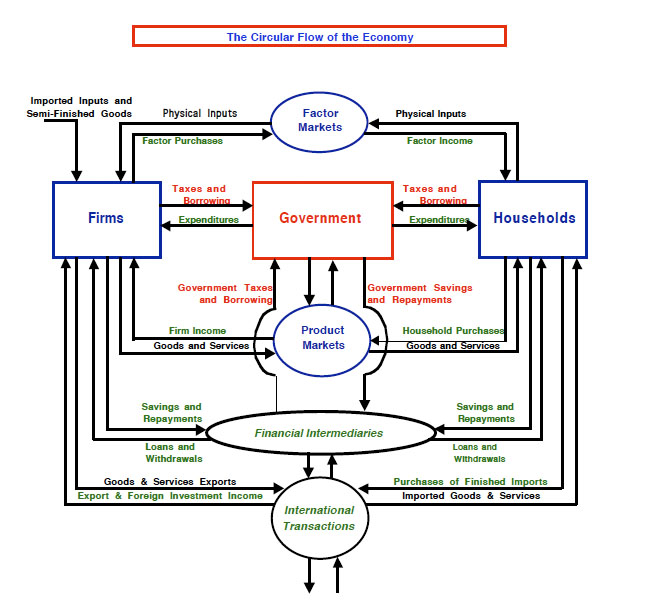
(see diagram attached) The economy can be thought of as two cycles moving in opposite directions. In one direction, we see goods and services flowing from individuals to businesses and back again. This represents the idea that, as laborers, we go to work to make things or provide services that people want. … In the opposite direction, we see money flowing from businesses to households and back again. This represents the income we generate from the work we do, which we use to pay for the things we want. … Both of these cycles are necessary to make the economy work. When we buy things, we pay money for them. When we go to work, we make things in exchange for money. … The circular flow model of the economy distills the idea outlined above and shows the flow of money and goods and services in a capitalist economy. What is Money Flow? Money flow is calculated by averaging the high, low and closing prices, and multiplying by the daily volume. Comparing that result with the number for the previous day tells traders whether money flow was positive or negative for the current day. Positive money flow indicates that prices are likely to move higher, while negative money flow suggests prices are about to fall. Economic Money Flow “Economic money flow” would refer to how money would flow through the economy under this model instead of the current model. Calculability: Proposal also includes right to repair. Consumer protection, creditor shall bear risk, elimination of hazard fees, prohibition on churning. all of which drive to higher quality lower volume more durable goods. Proposal restores intergenerational housing, zoning for it, limits on mortgage duration, suppression of housing prices, direction of savings to retirement savings, direction of retirement savings to long term investment. North et all did work as by product of MMT debate. MMT can’t work without continuous inflation. This strategy divorces the long term strategic economy (state-taxes), the innovative and adaptive economy (private sector), and the family consumer economy credit systems (treasury-debt). Modeling Produces: – increased search for stability if consumer credit rents are not available. – much more rapid restoration and adaption of the economy in response to socks, crises, business cycle shifts. – increased pressure on long term contracts to adapt to possible inflation – shifts in consumption – shift in rates of reproduction More later for those interested.’
-
Constitution Status
Mar 26, 2020, 6:37 PM The most important reformations in the constitution have to do with the law and rights. The rest of it decreases power distance as intended by the framers. Or the various political, economic, commercial, and educational reforms. If I keep at it for another few weeks I can get the constitution done enough for public debate. I just have to keep at it. And take a break just to do a course video. The topics are pretty much there. I find TINY holes still. But mostly I have to fill in topics and plug holes. Today I discovered a few holes: (a) didn’t handle the distinction between political disassociation for the production of commons, and political and territorial disassociation that would put the federation (empire) at risk. (b) that i didn’t define each of the markets in the ‘man’ (article 1) section. Now, the constitution is wrapped in a ‘book’. That book is a prosecution, judgement, and set of restitutions. The constitution is one of the restitutions. That will take longer. I should be able to get the constitution to edit-ready form during the crisis. The book is now ‘the big book’ because I have moved even the logics over into it. That has more holes. And unfortunately, I still can only work that hard a few hours a day without getting exhausted and having to work on something else.
-
Constitution Status
Mar 26, 2020, 6:37 PM The most important reformations in the constitution have to do with the law and rights. The rest of it decreases power distance as intended by the framers. Or the various political, economic, commercial, and educational reforms. If I keep at it for another few weeks I can get the constitution done enough for public debate. I just have to keep at it. And take a break just to do a course video. The topics are pretty much there. I find TINY holes still. But mostly I have to fill in topics and plug holes. Today I discovered a few holes: (a) didn’t handle the distinction between political disassociation for the production of commons, and political and territorial disassociation that would put the federation (empire) at risk. (b) that i didn’t define each of the markets in the ‘man’ (article 1) section. Now, the constitution is wrapped in a ‘book’. That book is a prosecution, judgement, and set of restitutions. The constitution is one of the restitutions. That will take longer. I should be able to get the constitution to edit-ready form during the crisis. The book is now ‘the big book’ because I have moved even the logics over into it. That has more holes. And unfortunately, I still can only work that hard a few hours a day without getting exhausted and having to work on something else.
-
Yes P Is a Formal Algorithmic, Operational, Science – It Is the Most Complete S Ci Ence: Law – by Which All Others Are Judged
Mar 27, 2020, 9:56 AM
—“You are not a scientist. You are a story teller. Arranging information, data, statistics, iqs into a self-deceptive, bias confirming narrative. As are the majority of scientists generally. Empirical science is inferior. Lacking holism and art. I renounce it.”—Learned Dr. Kantbot, PhD
SCIENCES:
1. Formal(Logics: logic, mathematics, algorithmic, operational). 2. Physical (the laws of nature). 3. Psychological (cognitive science), and; 4. Social (Social science: economics, law, politics, group strategy). P-law is a formal, operational, and algorithmic logic using a universally commensurable grammar (paradigm, vocabulary, logic grammar syntax), that tests (falsifies) every possible dimension of thought: coherent (consistent, correspondent, existentially and operationally possible). Now, you might arbitrarily define ‘science’, but by any present definition P-law is scientific. It is logical, empirical, operational, and under realism, naturalism, rational choice, and reciprocity. Human Faculties (physical process) > Epistemology > Grammar > Vocabulary > Speech > Due Diligence > including Ethics. Faculties:
1. Sense, Integration by prediction 2. Space-Time Modeling prediction, 3. Auto Association prediction (intuition), Auto Evaluation (emotion), 4. Attention-Recursion, 5. Reason, Planning, Calculation, Computation, 6. Action-Release > Repeat.Epistemology: Observation > Free Association > Hypothesis (reason tested) > Theory (operationally tested), > Surviving Theory (market tested) > Limitation > Falsification > Repeat. In P we use a ‘grammar’ to refer to the Paradigm and Vocabulary, grammar, logic, and syntax of a paradigm. And when we use the term “the Grammars’ we mean the spectrum of those grammars. A Grammar: refers to the Paradigm (permissible dimensions of perception, cognition, and action), the Names, Operations, and Rules of Continuous Recursive Disambiguation (morpheme, word, phrase, sentence, story organization) and the LOGIC (constant relations) that limit consistency, correspondence, coherence, and completeness. Vocabulary: Deflation and disambiguation by competition, operationalization, and serialization, ex: Moral: Evil < Bad < Immoral < Unethical < Amoral > Ethical > Moral > Good > Righteous. or Truth: Tautological < Analytic < Idea < Testifiable < Honest < Untested. Speech: Deflation (constraint upon) ordinary language grammar, limited to a single point of view, absent the verb to be, using complete promissory sentences, describing a series of operations (human actions), resulting in testable transactions (sentence),and sets of transactions. Due Diligence: realism, naturalism, sensory, identity (categorical), internal (logical), operational (actions in time), external (empirical), rational (bounded rationality), reciprocal (moral – reciprocal rationality), limited, fully accounted, warranteed, restitutable. Ethics (Morality): Productive, Fully informed, Voluntary Transfer of Demonstrated Interests, free of imposition of costs upon the demonstrated interests of others by externality, and warrantied, by due diligence against error bias and deceit, within the limits of restitution. No more sophistry. Philosophy is closed. Science has fully replaced it. P-law is complete. Including Metaphysics, Epistemology, Psychology, Ethics, Sociology, Economics, Politics, Law, Group Strategy, and Aesthetics.
-
Yes P Is a Formal Algorithmic, Operational, Science – It Is the Most Complete S Ci Ence: Law – by Which All Others Are Judged
Mar 27, 2020, 9:56 AM
—“You are not a scientist. You are a story teller. Arranging information, data, statistics, iqs into a self-deceptive, bias confirming narrative. As are the majority of scientists generally. Empirical science is inferior. Lacking holism and art. I renounce it.”—Learned Dr. Kantbot, PhD
SCIENCES:
1. Formal(Logics: logic, mathematics, algorithmic, operational). 2. Physical (the laws of nature). 3. Psychological (cognitive science), and; 4. Social (Social science: economics, law, politics, group strategy). P-law is a formal, operational, and algorithmic logic using a universally commensurable grammar (paradigm, vocabulary, logic grammar syntax), that tests (falsifies) every possible dimension of thought: coherent (consistent, correspondent, existentially and operationally possible). Now, you might arbitrarily define ‘science’, but by any present definition P-law is scientific. It is logical, empirical, operational, and under realism, naturalism, rational choice, and reciprocity. Human Faculties (physical process) > Epistemology > Grammar > Vocabulary > Speech > Due Diligence > including Ethics. Faculties:
1. Sense, Integration by prediction 2. Space-Time Modeling prediction, 3. Auto Association prediction (intuition), Auto Evaluation (emotion), 4. Attention-Recursion, 5. Reason, Planning, Calculation, Computation, 6. Action-Release > Repeat.Epistemology: Observation > Free Association > Hypothesis (reason tested) > Theory (operationally tested), > Surviving Theory (market tested) > Limitation > Falsification > Repeat. In P we use a ‘grammar’ to refer to the Paradigm and Vocabulary, grammar, logic, and syntax of a paradigm. And when we use the term “the Grammars’ we mean the spectrum of those grammars. A Grammar: refers to the Paradigm (permissible dimensions of perception, cognition, and action), the Names, Operations, and Rules of Continuous Recursive Disambiguation (morpheme, word, phrase, sentence, story organization) and the LOGIC (constant relations) that limit consistency, correspondence, coherence, and completeness. Vocabulary: Deflation and disambiguation by competition, operationalization, and serialization, ex: Moral: Evil < Bad < Immoral < Unethical < Amoral > Ethical > Moral > Good > Righteous. or Truth: Tautological < Analytic < Idea < Testifiable < Honest < Untested. Speech: Deflation (constraint upon) ordinary language grammar, limited to a single point of view, absent the verb to be, using complete promissory sentences, describing a series of operations (human actions), resulting in testable transactions (sentence),and sets of transactions. Due Diligence: realism, naturalism, sensory, identity (categorical), internal (logical), operational (actions in time), external (empirical), rational (bounded rationality), reciprocal (moral – reciprocal rationality), limited, fully accounted, warranteed, restitutable. Ethics (Morality): Productive, Fully informed, Voluntary Transfer of Demonstrated Interests, free of imposition of costs upon the demonstrated interests of others by externality, and warrantied, by due diligence against error bias and deceit, within the limits of restitution. No more sophistry. Philosophy is closed. Science has fully replaced it. P-law is complete. Including Metaphysics, Epistemology, Psychology, Ethics, Sociology, Economics, Politics, Law, Group Strategy, and Aesthetics.
-
Others Thoughts on Libertarians
Mar 27, 2020, 10:08 AM by Matt MacBradaigh I had a couple of thoughts about Libertarians. It might not be as intellectual as some, but I think not insignificant.
- Libertarian criticism of others on the Right, Republicans in particular, compares the actual failings of (some) Republicans vs the theoretical offering of Libertarianism.
I.e, “(a few) Republicans compromise on gun rights, they aren’t true defenders of liberty. Join real defenders of liberty in our ideologically pure (on paper), but wholly untested practice in the field.”
Theoretically, in this example, R’s are totally pro-gun rights. In practice, Reagan, H.W. Bush oversaw gun rights restrictions, and bump stock bans under Trump.
Theoretically, L’s are totally pro-gun rights, but have NEVER cast a vote, or passed a bill, to empirically prove it. When L’s want to lobby politicians for pro-gun rights (to keep the example consistent on this issue), they must lobby R’s to do their work for them. L’s didn’t cast a single vote to defend gun rights under Reagan, HW. Bush, Clinton (AWB), or under GW Bush for the sunset of AWB, or to defend gun rights post Sandy Hook, or post Parkland, FL, etc.
Given #2, it’s clear L’s aren’t even in the game. They’re watching, from the nosebleed cheap seats, and bitching about what the players actually did, armchair quarterbacking what they “should have” done.
I was reminded of this fact by Curt’s comment re: boys begging men to fight for them.
by Bill Smith Agreed. The ones I’ve met have been adult adolescents who unconsciously associate with their mothers as Jung described in Aion: The Syzygy: Anima and Animus They live spouting construct, never getting their hands dirty with interacting with their shadow… to continue with the jungian narrative.
- Libertarian criticism of others on the Right, Republicans in particular, compares the actual failings of (some) Republicans vs the theoretical offering of Libertarianism.
-
Others Thoughts on Libertarians
Mar 27, 2020, 10:08 AM by Matt MacBradaigh I had a couple of thoughts about Libertarians. It might not be as intellectual as some, but I think not insignificant.
- Libertarian criticism of others on the Right, Republicans in particular, compares the actual failings of (some) Republicans vs the theoretical offering of Libertarianism.
I.e, “(a few) Republicans compromise on gun rights, they aren’t true defenders of liberty. Join real defenders of liberty in our ideologically pure (on paper), but wholly untested practice in the field.”
Theoretically, in this example, R’s are totally pro-gun rights. In practice, Reagan, H.W. Bush oversaw gun rights restrictions, and bump stock bans under Trump.
Theoretically, L’s are totally pro-gun rights, but have NEVER cast a vote, or passed a bill, to empirically prove it. When L’s want to lobby politicians for pro-gun rights (to keep the example consistent on this issue), they must lobby R’s to do their work for them. L’s didn’t cast a single vote to defend gun rights under Reagan, HW. Bush, Clinton (AWB), or under GW Bush for the sunset of AWB, or to defend gun rights post Sandy Hook, or post Parkland, FL, etc.
Given #2, it’s clear L’s aren’t even in the game. They’re watching, from the nosebleed cheap seats, and bitching about what the players actually did, armchair quarterbacking what they “should have” done.
I was reminded of this fact by Curt’s comment re: boys begging men to fight for them.
by Bill Smith Agreed. The ones I’ve met have been adult adolescents who unconsciously associate with their mothers as Jung described in Aion: The Syzygy: Anima and Animus They live spouting construct, never getting their hands dirty with interacting with their shadow… to continue with the jungian narrative.
- Libertarian criticism of others on the Right, Republicans in particular, compares the actual failings of (some) Republicans vs the theoretical offering of Libertarianism.
-
Ivan Tries and Fails – Hot to Spot a Sophist
Mar 27, 2020, 10:42 AM (people not grasping closure) P-law is a formal, operational, and algorithmic logic using a universally commensurable grammar (paradigm, vocabulary, logic grammar syntax), that tests (falsifies) every possible dimension of coherent (consistent, correspondent, existentially and operationally possible) thought. … Now, you might arbitrarily define ‘science’, but by any definition P-law is scientific.
—“Let’s suppose all that is true, then how could you make a case for “P-law” in anything but P-law? The fact that you consistently engage in bog-standard rhetoric to “prove” P-law puts the lie to the whole thing.”—Ivan the Above Average @AboveIvan
How can you make a case for logic in anything other than logic? The fact that you counter signal closure when there is none w/o the full spectrum of falsifications (in P) puts a lie to the whole thing you call ‘rationalism’. You never seek to understand. That’s why you fail. You see, I understand your theological substitution. I always have. I just haven’t taken the time to fully entrap you in demonstrating it. The only way to falsify P is to run cases: tests. All you will discover is undecidability (testimony), where you find falsehood (inference). The fact that you’re still stuck in the early 20th c because philosophy was a dead end for truth, and limited to choice (or deceit) is simply that you’ve overinvested in a malinvestment. Reformation is extremely expensive. And humans protect investments (loss aversion). Either statements are testifiable or they are not. If they are not testifiable one cannot make a truth claim. For a statement to be testifiable requires it survive the tests of all dimensions, because the only closure available is falsification of all dimensions. Sorry. Just is.