Jan 30, 2020, 10:37 AM A life of solving this category of thought: civilizational crisis – requires we forgo most other forms of consumption into a stoic, epicurean, and spartan devotion of our lives exclusively to calculation by means of internal interpersonal and group argument: evolution by survival from competition. It is a costly means of obtaining immortality. But it is one of the only means of doing so. 😉 And once you transcend the animal it is one of the most rewarding.
Source: Original Site Post
-
A Costly Means of Obtaining Immortality
Jan 30, 2020, 10:37 AM A life of solving this category of thought: civilizational crisis – requires we forgo most other forms of consumption into a stoic, epicurean, and spartan devotion of our lives exclusively to calculation by means of internal interpersonal and group argument: evolution by survival from competition. It is a costly means of obtaining immortality. But it is one of the only means of doing so. 😉 And once you transcend the animal it is one of the most rewarding.
-
We Are Exceptional Not only For What We Do but For What We Do Not Do
Jan 30, 2020, 10:41 AM
—“WASPS haven’t declined so much as been artificially suppressed. Once we remove the monetary monopoly from the hands of our oppressors you will see how artificial their dominance of academia, entertainment, media, finance, and government administration in America really was.”—Scott De Warren
Why? Because we are exceptional not only for what we do BUT FOR WHAT WE DO NOT DO. And they are exceptional for what they do that we don’t: organized crime.
-
We Are Exceptional Not only For What We Do but For What We Do Not Do
Jan 30, 2020, 10:41 AM
—“WASPS haven’t declined so much as been artificially suppressed. Once we remove the monetary monopoly from the hands of our oppressors you will see how artificial their dominance of academia, entertainment, media, finance, and government administration in America really was.”—Scott De Warren
Why? Because we are exceptional not only for what we do BUT FOR WHAT WE DO NOT DO. And they are exceptional for what they do that we don’t: organized crime.
-
Has the Internet Made a Difference in Threat Perception?
Jan 30, 2020, 11:01 AM
—“Is anything different now — or has the internet just made us more AWARE of how the left rolls? For instance … if we were to apply our current knowledge of history to the standard history textbook of the 1980s, we would say “this is intolerable.” Or if we applied current understanding of inter-sexual dynamics to the dating marketplace of the 1990s (peak friendzone) we would say “this is intolerable.”—Michael Churchill
Great question. A three part answer (a) yes we are more aware (b) we cannot threaten, argue with, silence, or exit them – because our interpersonal physicality and genetic status is invisible and inaccessible on the web – so GSRRM is more effective than physicality (c) yes they are a greater threat demographically because they think they can win (caused by obama)
-
Has the Internet Made a Difference in Threat Perception?
Jan 30, 2020, 11:01 AM
—“Is anything different now — or has the internet just made us more AWARE of how the left rolls? For instance … if we were to apply our current knowledge of history to the standard history textbook of the 1980s, we would say “this is intolerable.” Or if we applied current understanding of inter-sexual dynamics to the dating marketplace of the 1990s (peak friendzone) we would say “this is intolerable.”—Michael Churchill
Great question. A three part answer (a) yes we are more aware (b) we cannot threaten, argue with, silence, or exit them – because our interpersonal physicality and genetic status is invisible and inaccessible on the web – so GSRRM is more effective than physicality (c) yes they are a greater threat demographically because they think they can win (caused by obama)
-
Tri-Partism and The Tri-Functional Hypothesis of Our Natural Gods, and Our Natural Religion
Jan 30, 2020, 11:36 AM (mandatory understanding on IE origins of Market Gods) (compare with the Monopoly of semitic underclass gods)The Trifunctional Hypothesis of prehistoric Proto-Indo-European society postulates a tripartite ideology (“idéologie tripartite”) reflected in the existence of three classes or castes—priests, warriors, and commoners (farmers or tradesmen)—corresponding to the three functions of the sacral, the martial and the economic, respectively. The trifunctional thesis is primarily associated with the French mythographer Georges Dumézil, who proposed it in 1929 in the book Flamen-Brahman, and later in Mitra-Varuna. According to Dumézil (1898–1986), Proto-Indo-European society comprised three main groups corresponding to three distinct functions:
- Sovereignty, which fell into two distinct and complementary sub-parts:
… 1.1 one formal, juridical and priestly but worldly;
… 1.2 the other powerful, unpredictable, and also priestly but rooted in the supernatural world. - Military, connected with force, the military and war.
- Productivity, herding, farming and crafts; ruled by the other two.
In the Proto-Indo-European mythology each social group had its own god or family of gods to represent it and the function of the god or gods matched the function of the group. Many such divisions occur in the history of Indo-European societies: Southern Russia: Bernard Sergent associates the Indo-European language family with certain archaeological cultures in Southern Russia and reconstructs an Indo-European religion based upon the tripartite functions. Early Germanic society: The supposed division between the king, nobility and regular freemen in early Germanic society. Norse mythology: Odin (sovereignty), Týr (law and justice), the Vanir (fertility). Odin is assigned one of the core functions in the Indo-European pantheon as a representative of the first function (sovereignty) corresponding to the Hindu Varuṇa (fury and magic) as opposed to Týr, who corresponds to the Hindu Mitrá (law and justice); while the Vanir represent the third function (fertility). Odin has been also been interpreted as a death-god (“Psychopomp”: transporting us to the afterlife) and connected to cremations, and has also been associated with ecstatic practices. Classic Greece: The three divisions of the ideal society as described by Socrates in Plato’s The Republic. Bernard Sergent examined the trifunctional hypothesis in Greek epic, lyric and dramatic poetry. India: The three Hindu castes, the Brahmins or priests; the Kshatriya, the warriors and military; and the Vaishya, the agriculturalists, cattle rearers and traders. The Shudra, a fourth Indian caste, is a peasant or serf. A 2001 study found that the genetic affinity of Indians to Europeans is proportionate to caste rank, the upper castes being most similar to Europeans whereas lower castes are more like Asians. The researchers believe that the Indo-European speakers entered India from the Northwest, mixing with or displacing proto-Dravidian speakers, and may have established a caste system with themselves primarily in higher castes. TRIPLE (TRIPARTITE) DIETIES A triple deity (sometimes referred to as threefold, tripled, triplicate, tripartite, triune or triadic, or as a trinity) is three deities that are worshipped as one. Such deities are common throughout world mythology; the number three has a long history of mythical associations. Carl Jung considered the arrangement of deities into triplets an archetype in the history of religion. In classical religious iconography or mythological art, three separate beings may represent either a triad who always appear as a group (Greek Moirai, Charites, Erinyes; Norse Norns; or the Irish Morrígan) or a single deity known from literary sources as having three aspects (Greek Hecate, Roman Diana). THE INDO EUROPEAN ORIGINS OF TRIPARTISM, TRIFUNCTIONALISM, TRIPLE GODS, AND TERNARY LOGIC Georges Dumézil’s trifunctional hypothesis proposed that ancient Indo-European society conceived itself as structured around three activities: worship, war, and toil. In later times, when slave labor became common, the three functions came to be seen as separate “classes”, represented each by its own god. Dumézil understood this mythology as reflecting and validating social structures in its content: such a tripartite class system is found in ancient Indian, Iranian, Greek and Celtic texts. In 1970, Dumézil proposed that some goddesses represented these three qualities as different aspects or epithets and identified examples in his interpretation of various deities including the Iranian Anāhitā, the Vedic Sarasvatī and the Roman Juno. Vesna Petreska posits that myths including trinities of female mythical beings from Central and Eastern European cultures may be evidence for an Indo-European belief in trimutive female “spinners” of destiny. But according to the linguist M. L. West, various female deities and mythological figures in Europe show the influence of pre-Indo-European goddess-worship, and triple female fate divinities, typically “spinners” of destiny, are attested all over Europe and in Bronze Age Anatolia. POST BRONZE AGE COLLAPSE CULTURES Ancient Celtic cultures The Matres or Matronae are usually represented as a group of three but sometimes with as many as 27 (3 × 3 × 3) inscriptions. They were associated with motherhood and fertility. Inscriptions to these deities have been found in Gaul, Spain, Italy, the Rhineland and Britain, as their worship was carried by Roman soldiery dating from the mid 1st century to the 3rd century AD.[24] Miranda Green observes that “triplism” reflects a way of “expressing the divine rather than presentation of specific god-types. Triads or triple beings are ubiquitous in the Welsh and Irish mythic imagery” (she gives examples including the Irish battle-furies, Macha, and Brigit). “The religious iconographic repertoire of Gaul and Britain during the Roman period includes a wide range of triple forms: the most common triadic depiction is that of the triple mother goddess” (she lists numerous examples).[25] In the case of the Irish Brigid it can be ambiguous whether she is a single goddess or three sisters, all named Brigid.[26] The Morrígan also appears sometimes as one being, and at other times as three sisters,[27][28][29][30] as do the three Irish goddesses of sovereignty, Ériu, Fódla and Banba.[31] Hinduism In Hinduism, the supreme divinity Para Brahman can take the form of the Trimurti, in which the cosmic functions of creation, preservation, and destruction of the universe are performed by the three deities of Brahma (the creator), Vishnu (the preserver), and Shiva (the destroyer), who are at the same time three forms of the one Para Brahman.[32] The divine being Dattatreya is a representation of all three of these deities incarnated as a single being.[33] Christianity (the trinity) Christians profess “one God in three divine persons” (God the Father, God the Son and God the Holy Ghost). This is not to be understood as a belief in (or worship of) three Gods, nor as a belief that there are three subjectively-perceived “aspects” in one God, both of which the Catholic Church condemns as heresy. The Catholic Church also rejects the notions that God is “composed” of its three persons and that “God” is a genus containing the three persons. The Gnostic text Trimorphic Protennoia presents a threefold discourse of the three forms of Divine Thought: the Father, the Son, and the Mother (Sophia). Many Christian saints, especially martyrs, are trios who share a feast day or other remembrance. (See Category:Saints trios.) Whether they are subject to actual veneration and prayed to for supernatural aid, or simply honored, varies by Christian denomination. ESTATES OF THE REALM A 13th-century French representation of the tripartite social order of the Middle Ages – Oratores (“those who pray”), Bellatores (“those who fight”), and Laboratores (“those who work”). The estates of the realm, or three estates, were the broad orders of social hierarchy used in Christendom (Christian Europe) from the medieval period to early modern Europe. Different systems for dividing society members into estates developed and evolved over time. The best known system is the French Ancien Régime (Old Regime), a three-estate system used until the French Revolution (1789–1799). Monarchy was for the king and the queen and this system was made up of clergy (the First Estate), nobles (the Second Estate), and peasants and bourgeoisie (the Third Estate). In some regions, notably Scandinavia and Russia, burghers (the urban merchant class) and rural commoners were split into separate estates, creating a four-estate system with rural commoners ranking the lowest as the Fourth Estate. Furthermore, the non-landowning poor could be left outside the estates, leaving them without political rights. In England, a two-estate system evolved that combined nobility and clergy into one lordly estate with “commons” as the second estate. This system produced the two houses of parliament, the House of Commons and the House of Lords. In southern Germany, a three-estate system of nobility (princes and high clergy), knights, and burghers was used. In Scotland, the Three Estates were the Clergy (First Estate), Nobility (Second Estate), and Shire Commissioners, or “burghers” (Third Estate), representing the bourgeois, middle class, and lower class. The Estates made up a Scottish Parliament. TRIPARTISM (COOPERATIONISM, MARKETS) IN PROPERTARIANISM In P we begin with the three means of coercion: Force-Defense, Remuneration-Deprivation, and Inclusion-Undermining (ostracization) in a market preserved by the judiciary. We argue that the three classes developed three ‘market competitions’ for elites; martial-judicial, priestly-educational, and productive-labor and trade. These three sets of elites we recognize as Conservative-Capitalizing (force), Progressive-consuming(Undermining), and Libertarian-Productive (Trade). In P we restore the “cooperation between the compatible but unequal classes”: The Monarchy as judge of last resort, The Judiciary as preservation of sovereignty, the Senate (nobility) as territorial (tribal) interests, the Upper House as the Commercial Interests, and the Lower House as Family and Labor Interests. Under this interpretation, christianity is migrating to its natural place as the feminine (forgiveness, love), while we are restoring our traditional gods as we try to restore our civlization after the abrahamic dark ages of death and decline. LEARN MORE This info is collected from wikipedia, but read Dumezil or at least the spartk notes version. 😉 If you undestand Dumizel’s description of, Campbell’s Monomyth, and the nordic myths you can begin to reconstruct our natural religions in both northern second generation and southern european first generation forms.
- Sovereignty, which fell into two distinct and complementary sub-parts:
-
Tri-Partism and The Tri-Functional Hypothesis of Our Natural Gods, and Our Natural Religion
Jan 30, 2020, 11:36 AM (mandatory understanding on IE origins of Market Gods) (compare with the Monopoly of semitic underclass gods)The Trifunctional Hypothesis of prehistoric Proto-Indo-European society postulates a tripartite ideology (“idéologie tripartite”) reflected in the existence of three classes or castes—priests, warriors, and commoners (farmers or tradesmen)—corresponding to the three functions of the sacral, the martial and the economic, respectively. The trifunctional thesis is primarily associated with the French mythographer Georges Dumézil, who proposed it in 1929 in the book Flamen-Brahman, and later in Mitra-Varuna. According to Dumézil (1898–1986), Proto-Indo-European society comprised three main groups corresponding to three distinct functions:
- Sovereignty, which fell into two distinct and complementary sub-parts:
… 1.1 one formal, juridical and priestly but worldly;
… 1.2 the other powerful, unpredictable, and also priestly but rooted in the supernatural world. - Military, connected with force, the military and war.
- Productivity, herding, farming and crafts; ruled by the other two.
In the Proto-Indo-European mythology each social group had its own god or family of gods to represent it and the function of the god or gods matched the function of the group. Many such divisions occur in the history of Indo-European societies: Southern Russia: Bernard Sergent associates the Indo-European language family with certain archaeological cultures in Southern Russia and reconstructs an Indo-European religion based upon the tripartite functions. Early Germanic society: The supposed division between the king, nobility and regular freemen in early Germanic society. Norse mythology: Odin (sovereignty), Týr (law and justice), the Vanir (fertility). Odin is assigned one of the core functions in the Indo-European pantheon as a representative of the first function (sovereignty) corresponding to the Hindu Varuṇa (fury and magic) as opposed to Týr, who corresponds to the Hindu Mitrá (law and justice); while the Vanir represent the third function (fertility). Odin has been also been interpreted as a death-god (“Psychopomp”: transporting us to the afterlife) and connected to cremations, and has also been associated with ecstatic practices. Classic Greece: The three divisions of the ideal society as described by Socrates in Plato’s The Republic. Bernard Sergent examined the trifunctional hypothesis in Greek epic, lyric and dramatic poetry. India: The three Hindu castes, the Brahmins or priests; the Kshatriya, the warriors and military; and the Vaishya, the agriculturalists, cattle rearers and traders. The Shudra, a fourth Indian caste, is a peasant or serf. A 2001 study found that the genetic affinity of Indians to Europeans is proportionate to caste rank, the upper castes being most similar to Europeans whereas lower castes are more like Asians. The researchers believe that the Indo-European speakers entered India from the Northwest, mixing with or displacing proto-Dravidian speakers, and may have established a caste system with themselves primarily in higher castes. TRIPLE (TRIPARTITE) DIETIES A triple deity (sometimes referred to as threefold, tripled, triplicate, tripartite, triune or triadic, or as a trinity) is three deities that are worshipped as one. Such deities are common throughout world mythology; the number three has a long history of mythical associations. Carl Jung considered the arrangement of deities into triplets an archetype in the history of religion. In classical religious iconography or mythological art, three separate beings may represent either a triad who always appear as a group (Greek Moirai, Charites, Erinyes; Norse Norns; or the Irish Morrígan) or a single deity known from literary sources as having three aspects (Greek Hecate, Roman Diana). THE INDO EUROPEAN ORIGINS OF TRIPARTISM, TRIFUNCTIONALISM, TRIPLE GODS, AND TERNARY LOGIC Georges Dumézil’s trifunctional hypothesis proposed that ancient Indo-European society conceived itself as structured around three activities: worship, war, and toil. In later times, when slave labor became common, the three functions came to be seen as separate “classes”, represented each by its own god. Dumézil understood this mythology as reflecting and validating social structures in its content: such a tripartite class system is found in ancient Indian, Iranian, Greek and Celtic texts. In 1970, Dumézil proposed that some goddesses represented these three qualities as different aspects or epithets and identified examples in his interpretation of various deities including the Iranian Anāhitā, the Vedic Sarasvatī and the Roman Juno. Vesna Petreska posits that myths including trinities of female mythical beings from Central and Eastern European cultures may be evidence for an Indo-European belief in trimutive female “spinners” of destiny. But according to the linguist M. L. West, various female deities and mythological figures in Europe show the influence of pre-Indo-European goddess-worship, and triple female fate divinities, typically “spinners” of destiny, are attested all over Europe and in Bronze Age Anatolia. POST BRONZE AGE COLLAPSE CULTURES Ancient Celtic cultures The Matres or Matronae are usually represented as a group of three but sometimes with as many as 27 (3 × 3 × 3) inscriptions. They were associated with motherhood and fertility. Inscriptions to these deities have been found in Gaul, Spain, Italy, the Rhineland and Britain, as their worship was carried by Roman soldiery dating from the mid 1st century to the 3rd century AD.[24] Miranda Green observes that “triplism” reflects a way of “expressing the divine rather than presentation of specific god-types. Triads or triple beings are ubiquitous in the Welsh and Irish mythic imagery” (she gives examples including the Irish battle-furies, Macha, and Brigit). “The religious iconographic repertoire of Gaul and Britain during the Roman period includes a wide range of triple forms: the most common triadic depiction is that of the triple mother goddess” (she lists numerous examples).[25] In the case of the Irish Brigid it can be ambiguous whether she is a single goddess or three sisters, all named Brigid.[26] The Morrígan also appears sometimes as one being, and at other times as three sisters,[27][28][29][30] as do the three Irish goddesses of sovereignty, Ériu, Fódla and Banba.[31] Hinduism In Hinduism, the supreme divinity Para Brahman can take the form of the Trimurti, in which the cosmic functions of creation, preservation, and destruction of the universe are performed by the three deities of Brahma (the creator), Vishnu (the preserver), and Shiva (the destroyer), who are at the same time three forms of the one Para Brahman.[32] The divine being Dattatreya is a representation of all three of these deities incarnated as a single being.[33] Christianity (the trinity) Christians profess “one God in three divine persons” (God the Father, God the Son and God the Holy Ghost). This is not to be understood as a belief in (or worship of) three Gods, nor as a belief that there are three subjectively-perceived “aspects” in one God, both of which the Catholic Church condemns as heresy. The Catholic Church also rejects the notions that God is “composed” of its three persons and that “God” is a genus containing the three persons. The Gnostic text Trimorphic Protennoia presents a threefold discourse of the three forms of Divine Thought: the Father, the Son, and the Mother (Sophia). Many Christian saints, especially martyrs, are trios who share a feast day or other remembrance. (See Category:Saints trios.) Whether they are subject to actual veneration and prayed to for supernatural aid, or simply honored, varies by Christian denomination. ESTATES OF THE REALM A 13th-century French representation of the tripartite social order of the Middle Ages – Oratores (“those who pray”), Bellatores (“those who fight”), and Laboratores (“those who work”). The estates of the realm, or three estates, were the broad orders of social hierarchy used in Christendom (Christian Europe) from the medieval period to early modern Europe. Different systems for dividing society members into estates developed and evolved over time. The best known system is the French Ancien Régime (Old Regime), a three-estate system used until the French Revolution (1789–1799). Monarchy was for the king and the queen and this system was made up of clergy (the First Estate), nobles (the Second Estate), and peasants and bourgeoisie (the Third Estate). In some regions, notably Scandinavia and Russia, burghers (the urban merchant class) and rural commoners were split into separate estates, creating a four-estate system with rural commoners ranking the lowest as the Fourth Estate. Furthermore, the non-landowning poor could be left outside the estates, leaving them without political rights. In England, a two-estate system evolved that combined nobility and clergy into one lordly estate with “commons” as the second estate. This system produced the two houses of parliament, the House of Commons and the House of Lords. In southern Germany, a three-estate system of nobility (princes and high clergy), knights, and burghers was used. In Scotland, the Three Estates were the Clergy (First Estate), Nobility (Second Estate), and Shire Commissioners, or “burghers” (Third Estate), representing the bourgeois, middle class, and lower class. The Estates made up a Scottish Parliament. TRIPARTISM (COOPERATIONISM, MARKETS) IN PROPERTARIANISM In P we begin with the three means of coercion: Force-Defense, Remuneration-Deprivation, and Inclusion-Undermining (ostracization) in a market preserved by the judiciary. We argue that the three classes developed three ‘market competitions’ for elites; martial-judicial, priestly-educational, and productive-labor and trade. These three sets of elites we recognize as Conservative-Capitalizing (force), Progressive-consuming(Undermining), and Libertarian-Productive (Trade). In P we restore the “cooperation between the compatible but unequal classes”: The Monarchy as judge of last resort, The Judiciary as preservation of sovereignty, the Senate (nobility) as territorial (tribal) interests, the Upper House as the Commercial Interests, and the Lower House as Family and Labor Interests. Under this interpretation, christianity is migrating to its natural place as the feminine (forgiveness, love), while we are restoring our traditional gods as we try to restore our civlization after the abrahamic dark ages of death and decline. LEARN MORE This info is collected from wikipedia, but read Dumezil or at least the spartk notes version. 😉 If you undestand Dumizel’s description of, Campbell’s Monomyth, and the nordic myths you can begin to reconstruct our natural religions in both northern second generation and southern european first generation forms.
- Sovereignty, which fell into two distinct and complementary sub-parts:
-
I love trash talking. Don’t pick fights you can’t win. 😉
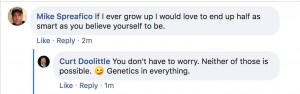
—“Is there anything better than Coffee and Doolittle in the morning?”— Sal Victus —“Yes, when he roasts someone! That’s gold right there”—Carlos Couto —“Here [a link to the american burn association]”— Terry Paisley
-
Genetics Are All That Matters: Murray, Plomin, Reich, Cochran, and Gobineu
by Tom Creo Prof Robert Plomin, best behavioral and population geneticist on the planet, summarises 40 years of behavioral and population genetics in his wonderful book “Blueprint” last year. Despite being a massive leftist he states that it is definitive that, in the West at least, it is genetics that makes us who we are and that the environmental contributions to each of us are random noise; unknowable, unpredictable, and uncontrollable in principle. There are essentially no systemic or institutional environmental effects on individual’s in the West. If there was this research would have found it by now – and as we all know leftist geneticists are highly ideologically incentivised to look for it. Genetics is indeed all that matters. THE FOUR MOST USEFUL BOOKS Charles Murray’s Human Diversity Blueprint: Robert Reich Who We Are And How We Got Here Greg Cochran’s 10000 Year Explosion Of Course The Book That Was Right All Along: THe causes of war: the inequality of the races.