Source: Facebook

  • photos_and_videos/TimelinePhotos_dJ9jhts2Ng/72688499_485728855357343_70954696429

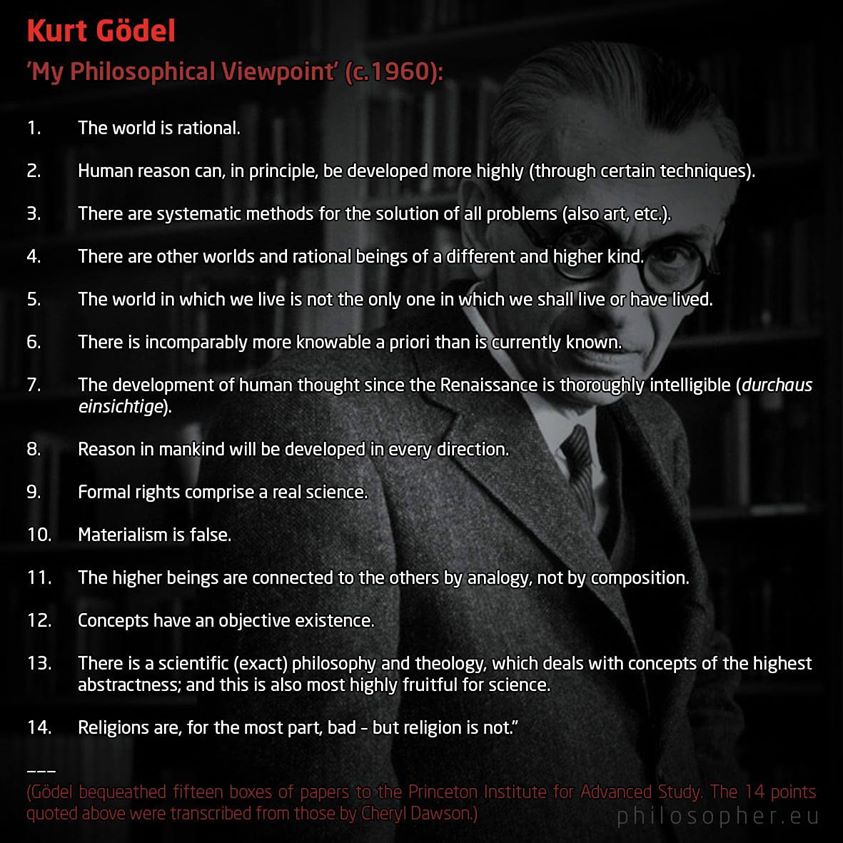
    photos_and_videos/TimelinePhotos_dJ9jhts2Ng/72688499_485728855357343_7095469642973446144_o_485728848690677.jpg CONTRAST GOEDEL WITH P – REQUEST FROM KASH V.

    (Godel is a Platonist, I’m an operationalist)

    1. Man acts rationally, and by rationally amorally. But given the disproportionate value of cooperation, and the disproportionate risk of retaliation, it’s just in his interest to act morally much more often than immorally.

    1a. We can incrementally reduce observations of the universe, using our senses, reason, and instrumentation to descriptions of invariant constant relations (paradigms)

    1b + 3. We can describe (explain) all of experience as constant relations (a single paradigm)

    2. While our ability to reason is constant, every increase convergence of our instruments and paradigms increases the explanatory power available to our reason.

    4. The capacity to reason is a deterministic product of entropy at convenient temperatures in convenient conditions, for sufficient periods of time. It is likely that given the vastness of the universe, other creatures have evolved reason, and that while the logic of constant relations will exist, and mathematics as a logic of constant positional relations will exist in some form, that the composition of experience that results from different body structures will result in different techniques for employing reason. (think octopi). And that the ability of these creatures may vastly outperform ours.

    5. Because we are able to use our powers of prediction using free association to construct a model of the world we exist in, and the worlds we might exist in, and the worlds we cannot exist in, we can experience, many candidate worlds.

    5b. The set of demands we evolved and express daily is largely invariant. The set of paradigms we use to imagine opportunities for fulfilling those demands evolves (and devolves) constantly. So while we largely increase the coherence of paradigms, and approach a single paradigm for describing the universe, we have experienced the world differently in the past than in the present, and will so again experience it differently in the future.

    6. If we can construct an operational grammar and paradigm for a given set of constant relations, we can produce an operational logic of that set of constant relations, and conduct experiments logically by trial and error as we do in mathematics. To do so we require convergence of paradigms to the point of marginal indifference of those logical constructions. But the Analytic program failed, and Godel and Frege et all were wrong – closure does not exist.

    7. Yes the development of thought since Aristotle expanded on Democritus, has been consistent and rational with the exception of the semitic abrahamic dark ages of supernatural ignorance.

    8. Reason is reason is reasoning and there is nothing to it. There are however endless permutations of reason especially as knowledge increases.

    9. The via-negativa of Natural Law can be restated in the via-positiva as Natural rights, and this logic and empirical combination produces a science of cooperation, and law the institutional enforcement of cooperation under that law, and economics the measure of it’s success, and economics the language of analysis and measurement within that science.

    10.The material(noun) and the Operational(verb) are true (exist, and are testifiable). The platonic (ideal) is false. All sets of constant relations are identified, retained, applied, reinforced, and revised by merging physical stimuli with physical organization of information in the brain, producing a hierarchy of changes in state over time we call ‘experience’. So while it is correct to say that the universe is deterministic (composed of constant relations), it is only correct to say that we can observe sets of constant relations, identify them (category), compare them, name them, and predict future states of of them, and in relation to them. These memories and predications like running consist of physical potential, that produce results in time. In other words, al of reality is constructed physically, from a hierarchy of changes in state over time we call experience.

    12. Concepts do not exist. the potential for Concepts exists. Running only exists when one is running. We have the potential to run. We have the potential to identify sets of constant relations (concepts), but experience of contexts only exist when we are acting to recall them in time.

    13. It appears we can know the most parsimonious paradigm, and host of parsimonious sub-paradigms of increasing complexity (permutations) allowing us to speak the truth using evidence – science; that we can know the same for choices using arguments – philosophy; and we can know the same for collective organization using stories – theology.

    14. Existing religions are bad to terrible to suicidal – but human psychological, social, political, and strategic demand for the products of ‘religion’ (order) are endless. So we need to educate one another in mindfulness, ethics(interpersonal), morality (extrapersonal), political, and strategic (competitive), by means gracefully increasing and decreasing in accessibility: parable, story, history, reason and general rules, science and outcomes.CONTRAST GOEDEL WITH P – REQUEST FROM KASH V.

    (Godel is a Platonist, I’m an operationalist)

    1. Man acts rationally, and by rationally amorally. But given the disproportionate value of cooperation, and the disproportionate risk of retaliation, it’s just in his interest to act morally much more often than immorally.

    1a. We can incrementally reduce observations of the universe, using our senses, reason, and instrumentation to descriptions of invariant constant relations (paradigms)

    1b + 3. We can describe (explain) all of experience as constant relations (a single paradigm)

    2. While our ability to reason is constant, every increase convergence of our instruments and paradigms increases the explanatory power available to our reason.

    4. The capacity to reason is a deterministic product of entropy at convenient temperatures in convenient conditions, for sufficient periods of time. It is likely that given the vastness of the universe, other creatures have evolved reason, and that while the logic of constant relations will exist, and mathematics as a logic of constant positional relations will exist in some form, that the composition of experience that results from different body structures will result in different techniques for employing reason. (think octopi). And that the ability of these creatures may vastly outperform ours.

    5. Because we are able to use our powers of prediction using free association to construct a model of the world we exist in, and the worlds we might exist in, and the worlds we cannot exist in, we can experience, many candidate worlds.

    5b. The set of demands we evolved and express daily is largely invariant. The set of paradigms we use to imagine opportunities for fulfilling those demands evolves (and devolves) constantly. So while we largely increase the coherence of paradigms, and approach a single paradigm for describing the universe, we have experienced the world differently in the past than in the present, and will so again experience it differently in the future.

    6. If we can construct an operational grammar and paradigm for a given set of constant relations, we can produce an operational logic of that set of constant relations, and conduct experiments logically by trial and error as we do in mathematics. To do so we require convergence of paradigms to the point of marginal indifference of those logical constructions. But the Analytic program failed, and Godel and Frege et all were wrong – closure does not exist.

    7. Yes the development of thought since Aristotle expanded on Democritus, has been consistent and rational with the exception of the semitic abrahamic dark ages of supernatural ignorance.

    8. Reason is reason is reasoning and there is nothing to it. There are however endless permutations of reason especially as knowledge increases.

    9. The via-negativa of Natural Law can be restated in the via-positiva as Natural rights, and this logic and empirical combination produces a science of cooperation, and law the institutional enforcement of cooperation under that law, and economics the measure of it’s success, and economics the language of analysis and measurement within that science.

    10.The material(noun) and the Operational(verb) are true (exist, and are testifiable). The platonic (ideal) is false. All sets of constant relations are identified, retained, applied, reinforced, and revised by merging physical stimuli with physical organization of information in the brain, producing a hierarchy of changes in state over time we call ‘experience’. So while it is correct to say that the universe is deterministic (composed of constant relations), it is only correct to say that we can observe sets of constant relations, identify them (category), compare them, name them, and predict future states of of them, and in relation to them. These memories and predications like running consist of physical potential, that produce results in time. In other words, al of reality is constructed physically, from a hierarchy of changes in state over time we call experience.

    12. Concepts do not exist. the potential for Concepts exists. Running only exists when one is running. We have the potential to run. We have the potential to identify sets of constant relations (concepts), but experience of contexts only exist when we are acting to recall them in time.

    13. It appears we can know the most parsimonious paradigm, and host of parsimonious sub-paradigms of increasing complexity (permutations) allowing us to speak the truth using evidence – science; that we can know the same for choices using arguments – philosophy; and we can know the same for collective organization using stories – theology.

    14. Existing religions are bad to terrible to suicidal – but human psychological, social, political, and strategic demand for the products of ‘religion’ (order) are endless. So we need to educate one another in mindfulness, ethics(interpersonal), morality (extrapersonal), political, and strategic (competitive), by means gracefully increasing and decreasing in accessibility: parable, story, history, reason and general rules, science and outcomes.

    Source date (UTC): 2019-10-16 10:51:00 UTC
  • photos_and_videos/TimelinePhotos_kg5QueHwVw/72355004_137347730996722_59143672043

    photos_and_videos/TimelinePhotos_kg5QueHwVw/72355004_137347730996722_5914367204375134208_o_137347727663389.jpg CONTRAST WITH P – REQUEST FROM KASH VIKAS

    (Godel is a Platonist and I’m an Operationalist. This contrast is rather helpful in illustrating the operational vs platonist vs empirical.)

    1. Man acts rationally, and by rationally amorally. But given the disproportionate value of cooperation, and the disproportionate risk of retaliation, it’s just in his interest to act morally much more often than immorally.

    1a. We can incrementally reduce observations of the universe, using our senses, reason, and instrumentation to descriptions of invariant constant relations (paradigms)

    1b + 3. We can describe (explain) all of experience as constant relations (a single paradigm)

    2. While our ability to reason is constant, every increase convergence of our instruments and paradigms increases the explanatory power available to our reason.

    4. The capacity to reason is a deterministic product of entropy at convenient temperatures in convenient conditions, for sufficient periods of time. It is likely that given the vastness of the universe, other creatures have evolved reason, and that while the logic of constant relations will exist, and mathematics as a logic of constant positional relations will exist in some form, that the composition of experience that results from different body structures will result in different techniques for employing reason. (think octopi). And that the ability of these creatures may vastly outperform ours.

    5. Because we are able to use our powers of prediction using free association to construct a model of the world we exist in, and the worlds we might exist in, and the worlds we cannot exist in, we can experience, many candidate worlds.

    5b. The set of demands we evolved and express daily is largely invariant. The set of paradigms we use to imagine opportunities for fulfilling those demands evolves (and devolves) constantly. So while we largely increase the coherence of paradigms, and approach a single paradigm for describing the universe, we have experienced the world differently in the past than in the present, and will so again experience it differently in the future.

    6. If we can construct an operational grammar and paradigm for a given set of constant relations, we can produce an operational logic of that set of constant relations, and conduct experiments logically by trial and error as we do in mathematics. To do so we require convergence of paradigms to the point of marginal indifference of those logical constructions. But the Analytic program failed, and Godel and Frege et all were wrong – closure does not exist.

    7. Yes the development of thought since Aristotle expanded on Democritus, has been consistent and rational with the exception of the semitic abrahamic dark ages of supernatural ignorance.

    8. Reason is reason is reasoning and there is nothing to it. There are however endless permutations of reason especially as knowledge increases.

    9. The via-negativa of Natural Law can be restated in the via-positiva as Natural rights, and this logic and empirical combination produces a science of cooperation, and law the institutional enforcement of cooperation under that law, and economics the measure of it’s success, and economics the language of analysis and measurement within that science.

    10.The material(noun) and the Operational(verb) are true (exist, and are testifiable). The platonic (ideal) is false. All sets of constant relations are identified, retained, applied, reinforced, and revised by merging physical stimuli with physical organization of information in the brain, producing a hierarchy of changes in state over time we call ‘experience’. So while it is correct to say that the universe is deterministic (composed of constant relations), it is only correct to say that we can observe sets of constant relations, identify them (category), compare them, name them, and predict future states of of them, and in relation to them. These memories and predications like running consist of physical potential, that produce results in time. In other words, al of reality is constructed physically, from a hierarchy of changes in state over time we call experience.

    12. Concepts do not exist. the potential for Concepts exists. Running only exists when one is running. We have the potential to run. We have the potential to identify sets of constant relations (concepts), but experience of contexts only exist when we are acting to recall them in time.

    13. It appears we can know the most parsimonious paradigm, and host of parsimonious sub-paradigms of increasing complexity (permutations) allowing us to speak the truth using evidence – science; that we can know the same for choices using arguments – philosophy; and we can know the same for collective organization using stories – theology.

    14. Existing religions are bad to terrible to suicidal – but human psychological, social, political, and strategic demand for the products of ‘religion’ (order) are endless. So we need to educate one another in mindfulness, ethics(interpersonal), morality (extrapersonal), political, and strategic (competitive), by means gracefully increasing and decreasing in accessibility: parable, story, history, reason and general rules, science and outcomes.CONTRAST WITH P – REQUEST FROM KASH VIKAS

    (Godel is a Platonist and I’m an Operationalist. This contrast is rather helpful in illustrating the operational vs platonist vs empirical.)

    1. Man acts rationally, and by rationally amorally. But given the disproportionate value of cooperation, and the disproportionate risk of retaliation, it’s just in his interest to act morally much more often than immorally.

    1a. We can incrementally reduce observations of the universe, using our senses, reason, and instrumentation to descriptions of invariant constant relations (paradigms)

    1b + 3. We can describe (explain) all of experience as constant relations (a single paradigm)

    2. While our ability to reason is constant, every increase convergence of our instruments and paradigms increases the explanatory power available to our reason.

    4. The capacity to reason is a deterministic product of entropy at convenient temperatures in convenient conditions, for sufficient periods of time. It is likely that given the vastness of the universe, other creatures have evolved reason, and that while the logic of constant relations will exist, and mathematics as a logic of constant positional relations will exist in some form, that the composition of experience that results from different body structures will result in different techniques for employing reason. (think octopi). And that the ability of these creatures may vastly outperform ours.

    5. Because we are able to use our powers of prediction using free association to construct a model of the world we exist in, and the worlds we might exist in, and the worlds we cannot exist in, we can experience, many candidate worlds.

    5b. The set of demands we evolved and express daily is largely invariant. The set of paradigms we use to imagine opportunities for fulfilling those demands evolves (and devolves) constantly. So while we largely increase the coherence of paradigms, and approach a single paradigm for describing the universe, we have experienced the world differently in the past than in the present, and will so again experience it differently in the future.

    6. If we can construct an operational grammar and paradigm for a given set of constant relations, we can produce an operational logic of that set of constant relations, and conduct experiments logically by trial and error as we do in mathematics. To do so we require convergence of paradigms to the point of marginal indifference of those logical constructions. But the Analytic program failed, and Godel and Frege et all were wrong – closure does not exist.

    7. Yes the development of thought since Aristotle expanded on Democritus, has been consistent and rational with the exception of the semitic abrahamic dark ages of supernatural ignorance.

    8. Reason is reason is reasoning and there is nothing to it. There are however endless permutations of reason especially as knowledge increases.

    9. The via-negativa of Natural Law can be restated in the via-positiva as Natural rights, and this logic and empirical combination produces a science of cooperation, and law the institutional enforcement of cooperation under that law, and economics the measure of it’s success, and economics the language of analysis and measurement within that science.

    10.The material(noun) and the Operational(verb) are true (exist, and are testifiable). The platonic (ideal) is false. All sets of constant relations are identified, retained, applied, reinforced, and revised by merging physical stimuli with physical organization of information in the brain, producing a hierarchy of changes in state over time we call ‘experience’. So while it is correct to say that the universe is deterministic (composed of constant relations), it is only correct to say that we can observe sets of constant relations, identify them (category), compare them, name them, and predict future states of of them, and in relation to them. These memories and predications like running consist of physical potential, that produce results in time. In other words, al of reality is constructed physically, from a hierarchy of changes in state over time we call experience.

    12. Concepts do not exist. the potential for Concepts exists. Running only exists when one is running. We have the potential to run. We have the potential to identify sets of constant relations (concepts), but experience of contexts only exist when we are acting to recall them in time.

    13. It appears we can know the most parsimonious paradigm, and host of parsimonious sub-paradigms of increasing complexity (permutations) allowing us to speak the truth using evidence – science; that we can know the same for choices using arguments – philosophy; and we can know the same for collective organization using stories – theology.

    14. Existing religions are bad to terrible to suicidal – but human psychological, social, political, and strategic demand for the products of ‘religion’ (order) are endless. So we need to educate one another in mindfulness, ethics(interpersonal), morality (extrapersonal), political, and strategic (competitive), by means gracefully increasing and decreasing in accessibility: parable, story, history, reason and general rules, science and outcomes.


    Source date (UTC): 2019-10-16 10:49:00 UTC

  • “The low trust population erodes the informal institutions which results in a de

    —“The low trust population erodes the informal institutions which results in a demand for formal institutions to fill the gap.”–Bill Joslin


    Source date (UTC): 2019-10-15 18:06:00 UTC

  • LOANS AGAINST TRUST by Luke Weinhagen Law and contract can be used to subsidize

    LOANS AGAINST TRUST

    by Luke Weinhagen

    Law and contract can be used to subsidize for the absence of specific trust, such as between strangers or untested business partners.

    Both are “loans” against the stored trust in a polity. Enforced and insured by the commons in the form of “WE as a common polity will impose a cost on any party that breaches law or contract”.

    Law and contract only provide incentives for adherence where you can expect positive reciprocity (trust producing – rule of law) or where you can rely on the enforcement mechanisms to compel adherence (trust consuming – rule by law).

    Trust consumption eventually gets us back to “Might makes Right” and brings us back to the question “Why don’t I kill you and take your stuff?” (we descend the foundational rule stack). If trust is not there in some form, no one follow the law or sticks to contracts.


    Source date (UTC): 2019-10-15 18:05:00 UTC

  • ON DOWN GIRL @[541432766350869:274:Kate Manne] Q: “When will women be human? Whe

    https://www.amazon.com/Down-Girl-Misogyny-Kate-Manne/dp/0190604980NOTES ON DOWN GIRL

    @[541432766350869:274:Kate Manne]

    https://www.amazon.com/Down-Girl-Misogyny-Kate-Manne/dp/0190604980

    Q: “When will women be human? When?” asked feminist legal theorist, Catharine A. MacKinnon, in a 1999 essay.

    A: When Truth, Productive and Accumulative, and Eugenic, take precedence over Approval, Consumption and Dysgenia.

    WHY MISOGYNY? Presumption: Why do women confuse rejection, disapproval, restraint from ir-reciprocity with emotional disapproval (hate)? Why do women not argue truth or falsehood, reciprocity vs reciprocity? Why do women engage in endless conflict by Undermining … vs Exchange?

    Why do women consider emotions a cost? Example: “These asymmetrical moral support relations may be instantiated in many different ways” …Asymmetrical accumulation of cellular damage may be instantiated in many different ways. That’s why men die earlier. How are they equivalent?

    “… serves to police and enforce these social roles…” Or serves to constrain female hyperconsumption,hypergamy, undermining, and involuntary transfer of resources from males through preservation of reciprocity (exchanges).

    Men = Material Economics,Physics, Constraint (Reals)

    Women = Emotional Economics, Manipulation, Consumption (feels).

    “M:Stress over failing to advance” versus “F:Fear of being left behind”.

    Kate: study physics, economics, cognitive science, and developmental biology emphasizing gender and class differences. Then study the differences in mental illness, anti-social behavior, and conflict between men and women instead of philosophy: the language of sophism and deceit.

    What does Moral mean? It can only mean reciprocity (voluntary exchange) within limits of proportionality (defection). Normative morals vary because reciprocal traditions vary. Personal moral bias is just a demonstration of Class, Gender, Gender Expression and Sexual Market Value.

    Envy, Revolt against Nature. Demand for greater gains for less contributions. Yes. But the west advanced beyond the rest by legal sovereignty, reciprocity, truth before face, judgement by jury, and resulting markets in all aspects of life – domesticating (Eugenics) the worst.

    Our success that made women’s ‘liberation’ from household chores, and productive enough to hire substitute mothers, was the product of 1500+years of eugenics, as much as it was our strange male obsession with truth reciprocity and institutions of continuous competition.

    —“It also emerges that the failure to recognize women as human”– No, just that women are unequal to men in the foundations of european successes: truth, reciprocity, duty, markets, and meritocracy, and so far have demanded concessions in every aspect of life to accommodate.

    I mean, this is another use of Female Gossiping, Shaming, Ridiculing, Moralizing, Psychologizing, Suggestion, Obscurantism, Sophism and Critique (straw manning) completely ignoring both truth vs falsehood and the necessity of cooperative exchange vs gender specific ideals.

    So in other words, this book demonstrates the second Abrahamic (sophomoric) attempt to undermine western civlization: Monotheism in the old world, then Marxism, Feminism, Postmodernism, and ‘Denialism’ now – more embarrassing by far than pretense of religious dogma.

    If you can’t make a moral argument in economic terms either you lack the intellectual ability or you are engaging in some for of fraud by deceit. This is yet another book doing the latter. And then feminists wonder why men are losing patience with the experiment of the franchise.

    I am aware that it’s an uneven contest but I’ll happily debate anyone intellectually honest: Women are excessively privileged, and failing to learn, just like all other peoples have failed to learn, from the lessons of european achievement in the ancient and modern world: Trade.Updated Oct 15, 2019, 6:04 PM


    Source date (UTC): 2019-10-15 18:04:00 UTC

  • LETTER FROM CURT TO THE CHRISTIANS” (so to speak) ~35min. Explaining Prop. Objec

    https://www.youtube.com/watch?v=M8hb5UpTiNo”A LETTER FROM CURT TO THE CHRISTIANS” (so to speak)

    ~35min. Explaining Prop. Objectives for Religion

    https://www.youtube.com/watch?v=M8hb5UpTiNoUpdated Oct 15, 2019, 4:48 PM


    Source date (UTC): 2019-10-15 16:48:00 UTC

  • VIDEO: “A LETTER TO CHRISTIANS” ~35 Minutes. Explaining Objectives. Oct 15, 2019

    https://www.youtube.com/watch?v=M8hb5UpTiNoNEW VIDEO: “A LETTER TO CHRISTIANS”

    ~35 Minutes. Explaining Objectives.

    https://www.youtube.com/watch?v=M8hb5UpTiNoUpdated Oct 15, 2019, 4:40 PM


    Source date (UTC): 2019-10-15 16:40:00 UTC

  • photos_and_videos/TimelinePhotos_kg5QueHwVw/72736611_136848037713358_80246044063

    photos_and_videos/TimelinePhotos_kg5QueHwVw/72736611_136848037713358_8024604406357950464_o_136848031046692.jpg This made my day. lolThis made my day. lol


    Source date (UTC): 2019-10-15 16:15:00 UTC

  • AND THE STORE OF TRUST by @[1013719133:2048:Luke Weinhagen] ( CD: I’m Sharing be

    https://standard.co.uk/lifestyle/books/jonathan-haidt-the-coddling-of-the-american-mind-a4261081.htmlSCALE AND THE STORE OF TRUST

    by @[1013719133:2048:Luke Weinhagen]

    ( CD: I’m Sharing because of this bit of genius:

    —“The system can not scale beyond its ability to generate and store trust and begins to fail immediately when the extraction of stored trust exceeds the production of trust. That store can act as a buffer during a period of backsliding (and can enable a lot of really destructive behavior in the guise of “tolerance”), but it will not save us.”— @[1013719133:2048:Luke Weinhagen]

    )

    === COMPLETE POST ===

    —-“We came out of a century that had some of the worst horrors in history but which made extraordinary progress on almost every conceivable front in the decades afterwards, and now we’re backsliding.” — Jon Haidt

    Putting this in the context I’ve been building over the last couple weeks, the “progress” Haidt is describing (from my perspective) are the mechanisms we developed to foster the development of trust that became possible through the shared exposure to those horrors.

    I agree with both Haidt and Doolittle in that the outcome of this backsliding in inevitable should it continue. The lesson will impose itself. Whether we learn from it, kindly or not, is another matter.

    Looking at Curt’s response in the same context I’ve been using –

    “…conspicuous consumption of compromises between genes, gender, class, and interests” = extraction of trust.

    “…cooperative necessity in social orders…” = mechanisms for the production of trust

    The system can not scale beyond its ability to generate and store trust and begins to fail immediately when the extraction of stored trust exceeds the production of trust. That store can act as a buffer during a period of backsliding (and can enable a lot of really destructive behavior in the guise of “tolerance”), but it will not save us.

    “Domestication” is the process of transcendence from each of the lower foundational rules of human interaction to the next higher form of interaction/expansion of the capacity to store trust.

    THE FOUNDATIONS

    1. Via Positiva: ……. The Golden Rule.

    2. Via Negativa: ….. The Silver Rule.

    3. Via Logica: ……….The Natural Law of Reciprocity.

    4. Via Existentia: …. Rule of Law,

    ………………………….. … The Jury, and

    ………………………….. … Markets in everything.

    5. Via Violentia: …. The Iron Rule. Might Makes Right.

    Both of these texts are worth a read when you get a chance. – Luke WeinhagenUpdated Oct 15, 2019, 2:22 PM


    Source date (UTC): 2019-10-15 14:22:00 UTC

  • “”I can believe in natural law in itself because I see evidence of it all around

    —“”I can believe in natural law in itself because I see evidence of it all around me. That’s what I attribute all the beauty of creation to.””—@[1655513331:2048:Martin Štěpán] via Alain DwightUpdated Oct 15, 2019, 2:15 PM


    Source date (UTC): 2019-10-15 14:15:00 UTC