Source: Facebook

  • EXAMPLE OF HOW LEGAL EDUCATION FAILS —“The Libertarian Case for Rejecting Meat

    EXAMPLE OF HOW LEGAL EDUCATION FAILS

    —“The Libertarian Case for Rejecting Meat Consumption”

    If George Orwell were alive today, he would troll vegetarians. In The Road to Wigan Pier (1937), Orwell described with exasperation how mere mention of the words “Socialism” or “Communism” seemed to…”—

    Yeah. File this under “stupid libertarian games by the application of stupid Pilpul games from Abrahamic theology”. You can’t have a contract with someone or something that can’t empathize and sympathize, cooperate, negotiate terms, or hold to a contract.

    —“As a matter of law, your last sentence is incorrect. Most contracts are made with fictitious entities (corps, LLCs, etc.) that don’t feel anything. Most contracts are form contracts that can’t be negotiated. And many contracts (e.g., terms of service) are offered by a computer.”– Well Meaning Fool

    —“But the LLC can agree, through it’s representatives, to a contract, and be held accountable for violating the same.”—

    That’s a sophistry Corwin. There is always and everywhere an owner of an entity. And a corporate entity exists solely as a means of limiting the liability of its members, in order to encourage investment, the result of which is taxes, for the gov’t as insurer of last resort.

    The fact that we create asset holding vehicles to insulate them from liability cascades, does not mean that in order to act, someone or some group doesn’t act on behalf of the members of that asset store.

    —-“That’s a bad response. First, you completely ignored everything other than the fictitious entity aspect of my post. Why? (Hint: I’m right and you know it.) Second, identifying humans *somewhere* doesn’t establish sympathy or anything close to it.”—

    1) I don’t make errors. Especially in jurisprudence. Even more so in operational construction – but you don’t know that.

    2) Please: how any such entity can come into existence without an human being able to enter into a contract.

    3) Contract requires consent. What can consent?

    4) What faculties are necessary for consent? (Sympathy: Thought, Empathy: feelings, and Cognitive

    —“That’s all horseshit. The entity isn’t merely a transmission of its human parts. Those parts may disagree, not pay attention, delegate decisions to automatic processes, and so on. Furthermore, it says a lot that you ignored my comment on standardized contracts.”—

    Someone eventually acts. Sorry. A horse, pony, cow, sheep, dog can’t act. They can’t enter into contract. They cant sympathize (mental) or empathize (emotional) or even comprehend contract. At best they can only learn to trust you and your behavior or not by repetitive experience. Chimps can pass the mirror test. Gorillas only sometimes, and dogs not at all.

    We cannot have a contract for cooperation with non-rational species (series: sentience > awareness > consciousness > reason > calculation > computation )

    —“Indeed, you (and fictitious entites) can accept contracts without ever reading them — or even looking at them — much less engaging in any thought process of any kind. It happens all the time with EULAs, TOSes, various click wraps, parking agreements, and so on.”—-

    So people acted, just as I said. And standardized contracts serve as standards of weights and measures. Their context conveys their content. If it doesn’t then the court doesn’t uphold it. Standardized contracts do nothing more than explain the existing law on the subject so that individuals know the limit of their rights. People are still accountable for their actions because they CAN have read, understood and agreed to thoughtless acceptance of rules.

    Papers and Titles can’t act, so can’t agree. Only people can act.

    Corporations are not superior to people, they are WARDS of people (children). People can act on behalf of wards, wards cannot act. All corporations regardless of tax and decision constraint are operated by people.

    Boards, Executives, Shareholders, Employees, have limited liability for the Ward (corporation). That’s the purpose of corporations.

    I am kind of surprised that Platonism, against which legal education should protect, is something you cannot seem to avoid – or even comprehend.

    I also find it somewhat humorous when people in the profession – the equivalent of craftsmen – debate me on matters of truth, constitution, and jurisprudence. Debate me on procedure and legislative and regulatory matters (local custom) sure. These are pragmatisms not truths.

    There are a not insignificant number of lifetime lawyers that have said “I never understood the logic of the law until you taught it.”

    I do natural law (law), testimony, evidence, jurisprudence, and decidability, under strict construction from reciprocity.

    Law is science not custom.

    Custom is falsified by the science.


    Source date (UTC): 2020-02-03 09:36:00 UTC
  • “Talking to the Left is a waste of time. Talking to grassroots civnats/normiecon

    —“Talking to the Left is a waste of time. Talking to grassroots civnats/normiecons often is worth it though.”— John Mark

    —“I honestly don’t think civnats are much better in most respects.”—Predmetsky Rosenborg 😉

    CD: Our goal is not to make the majority agree, it is to get enough of us of like mind to act if we need to, that the civnats and normiecons know what we’re trying to accomplish.

    Awareness reduces resistance.

    Large armies are hard to move and feed.

    Light, fast, infantry.


    Source date (UTC): 2020-02-03 09:11:00 UTC

  • P IS EASIER THAN THAT by John Mark It’s way faster/easier to learn to think talk

    P IS EASIER THAN THAT

    by John Mark

    It’s way faster/easier to learn to think talk in “operational language” (and force others to that standard, and to the standard of the 5-pt definition of recipricity) than to go thru a checklist of 2 dozen fallacies. (See my video “Don’t Talk Like a Leftist”.)


    Source date (UTC): 2020-02-03 09:09:00 UTC

  • There is a difference between european people (a race), european culture (a trad

    There is a difference between european people (a race), european culture (a tradition), european civilization (a strategy), and the institutional TECHNOLOGY in science, language, myth, literature, philosophy, law, institutions. Any people can copy them if they are able – it appears no one else is able. And this is the ONLY remaining european technological advantage: genetics and civilization. And this remaining advantage is what the enemy seeks to destroy as they did Greece, Rome, and the continent.


    Source date (UTC): 2020-02-03 08:52:00 UTC

  • photos_and_videos/TimelinePhotos_dJ9jhts2Ng/84391809_566699850593576_50368984279

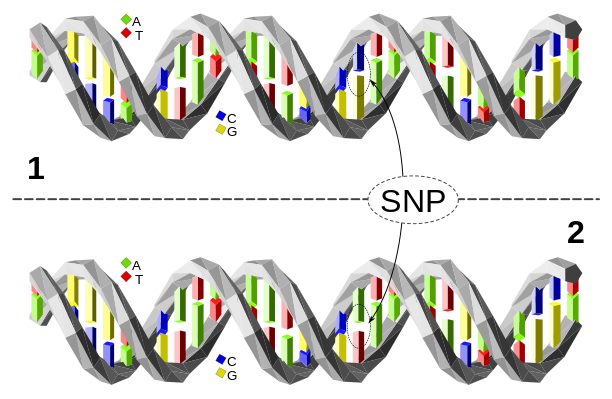
    photos_and_videos/TimelinePhotos_dJ9jhts2Ng/84391809_566699850593576_5036898427955314688_n_566699843926910.jpg SNP’S (SNIPS) THE ‘BITS’ OF THE GENOME

    (basic genetic terms)

    A single-nucleotide polymorphism (SNP, or ‘snip’) is a substitution of a single nucleotide that occurs at a specific position in the genome, where each variation is present at a level of more than 1% in the population

    More than 335 million SNPs have been found across humans from multiple populations. A typical genome differs from the reference human genome at 4 to 5 million sites, most of which (more than 99.9%) consist of SNPs and short indels

    Single-nucleotide polymorphisms may fall within coding sequences of genes, non-coding regions of genes, or in the intergenic regions (regions between genes). SNPs within a coding sequence do not necessarily change the amino acid sequence of the protein that is produced, due to degeneracy of the genetic code.

    The genomic distribution of SNPs is not homogenous; SNPs occur in non-coding regions more frequently than in coding regions or, in general, where natural selection is acting and “fixing” the allele (eliminating other variants) of the SNP that constitutes the most favorable genetic adaptation.

    A large part of DNA (more than 98% for humans) is non-coding, meaning that these sections do not serve as patterns for protein sequences.

    SNPs in the coding region are of two types: synonymous and nonsynonymous SNPs. Synonymous SNPs do not affect the protein sequence, while nonsynonymous SNPs change the amino acid sequence of protein.

    SNPs that are not in protein-coding regions may still affect gene splicing, transcription factor binding, messenger RNA degradation, or the sequence of noncoding RNA.SNP’S (SNIPS) THE ‘BITS’ OF THE GENOME

    (basic genetic terms)

    A single-nucleotide polymorphism (SNP, or ‘snip’) is a substitution of a single nucleotide that occurs at a specific position in the genome, where each variation is present at a level of more than 1% in the population

    More than 335 million SNPs have been found across humans from multiple populations. A typical genome differs from the reference human genome at 4 to 5 million sites, most of which (more than 99.9%) consist of SNPs and short indels

    Single-nucleotide polymorphisms may fall within coding sequences of genes, non-coding regions of genes, or in the intergenic regions (regions between genes). SNPs within a coding sequence do not necessarily change the amino acid sequence of the protein that is produced, due to degeneracy of the genetic code.

    The genomic distribution of SNPs is not homogenous; SNPs occur in non-coding regions more frequently than in coding regions or, in general, where natural selection is acting and “fixing” the allele (eliminating other variants) of the SNP that constitutes the most favorable genetic adaptation.

    A large part of DNA (more than 98% for humans) is non-coding, meaning that these sections do not serve as patterns for protein sequences.

    SNPs in the coding region are of two types: synonymous and nonsynonymous SNPs. Synonymous SNPs do not affect the protein sequence, while nonsynonymous SNPs change the amino acid sequence of protein.

    SNPs that are not in protein-coding regions may still affect gene splicing, transcription factor binding, messenger RNA degradation, or the sequence of noncoding RNA.


    Source date (UTC): 2020-02-03 08:10:00 UTC

  • UNREGULATED (WITHOUT LIMITS) WOMEN by Eliza Thentor I realised this is my confli

    UNREGULATED (WITHOUT LIMITS) WOMEN

    by Eliza Thentor

    I realised this is my conflict with my daughter. ” Unregulated women ” . She is surrounded by girls who are much much less regulated than she is, and many are spoiled. One particular, who I thought, after a few conversations with mother, that mother was very shallow and something was not right. I learned last week, the woman has been years on anti-anxiety tablets and could not stay at home and therefore “had” to go to work because of muh anxiety and depression. This mother showers the girl with lots lots of money, out of guilt. So I try to regulate my daughter (as I come from a military father who regulated us) and she causes a big confusion at home, because her friends probably nag her or give her “advice” about me on the phone.Updated Feb 3, 2020, 7:07 AM


    Source date (UTC): 2020-02-03 07:07:00 UTC

  • TESTIMONY: UNITE THE FIELDS —“I had a similar realization when I first started

    TESTIMONY: UNITE THE FIELDS

    —“I had a similar realization when I first started getting into P. I had always thought to myself “You know, the people who talk about creating a ‘Theory of Everything’ always want to unify Quantum Mechanics and General Relativity. But what about unifying both of those with economics, law, and human behavior/morals too? Aren’t they all linked somehow?” And course, they are.”— Ron Roky

    Yep. 😉


    Source date (UTC): 2020-02-03 07:02:00 UTC

  • WHY DO YOU REDUCE SO MUCH TO MALE VS FEMALE? To explain causality. There are onl

    WHY DO YOU REDUCE SO MUCH TO MALE VS FEMALE?

    To explain causality.

    There are only so many dimensions of variation in human development with the most influential being the male-female, and the consequences of male-female developmental differences in cognitive emotional physical outcomes and the expression of sexual strategy in all three.

    1. Cognitive Spectrum: Female Psychotic Solipsistic Sensitive Agreeable < Balanced > Disagreeable, Insensitive, Analytic, Autistic Male

    2. Conflict: Female: Social Predation: Undermine Until Destroyed. Male: Political Predation: Fight For Position then Settle.

    This pair of differences explain the Left(Female Social Temporal Consumptive Strategy) vs Right (Male Political Intertemporal Capitalizing Strategy) and (a) our political differences are not a choice (b) they are no longer compatible and we need to separate and *speciate*.

    Conservative (european) market order is the compromise between the gender strategies, at the cost of limiting the reproduction of the unproductive. All other strategies are MORE male, and the left wants MORE female.

    Ok. Have it. Separate Specialize.

    And you will have slums.


    Source date (UTC): 2020-02-03 06:37:00 UTC

  • CURT WHY DO YOU USE “NORTH SEA PEOPLE” Above the Hajnal line. Where rule of law

    CURT WHY DO YOU USE “NORTH SEA PEOPLE”

    Above the Hajnal line. Where rule of law matured. And in parallel, I tend to separate eras into water areas: the mediterranean, north sea, and Atlantic instead of land areas.


    Source date (UTC): 2020-02-02 23:07:00 UTC

  • SOME BIASES TO CONSIDER 😉 False uniqueness bias …The tendency of people to se

    SOME BIASES TO CONSIDER 😉

    False uniqueness bias

    …The tendency of people to see their projects and themselves as more singular than they actually are.

    False consensus effect

    … The tendency for people to overestimate the degree to which others agree with them

    Bandwagon effect

    … The tendency to do (or believe) things because many other people do (or believe) the same. Related to groupthink and herd behavior

    Empathy gap

    … The tendency to underestimate the influence or strength of feelings, in either oneself or others

    Groupthink

    … Where the desire for harmony or conformity in the group results in an irrational or dysfunctional decision-making outcome.

    Shared information bias

    … The tendency for group members to spend more time and energy discussing information that all members are already familiar with (i.e., shared information), and less time and energy discussing information that only some members are aware of (i.e., unshared information).

    Illusion of asymmetric insight

    …People perceive their knowledge of their peers to surpass their peers’ knowledge of them

    Illusion of transparency

    … People overestimate others’ ability to know themselves, and they also overestimate their ability to know others.

    Dunning–Kruger effect

    … The tendency for unskilled individuals to overestimate their own ability and the tendency for experts to underestimate their own ability

    Curse of knowledge

    … When better-informed people find it extremely difficult to think about problems from the perspective of lesser-informed people

    Illusory superiority

    … Overestimating one’s desirable qualities, and underestimating undesirable qualities, relative to other people. (Also known as “better-than-average effect”, or “superiority bias”.)

    Naïve realism

    … The belief that we see reality objectively and without bias; that the facts are plain for all to see; that rational people will agree with us; and that those who don’t are either uninformed, lazy, irrational, or biased.

    Just-world hypothesis

    … The tendency for people to want to believe that the world is fundamentally just, causing them to rationalize an otherwise inexplicable injustice as deserved by the victim(s).

    Ambiguity effect

    … The tendency to avoid options for which the probability of a favorable outcome is unknown

    Anchoring

    …. The tendency to rely too heavily, or “anchor”, on one trait or piece of information when making decisions (usually the first piece of information acquired on that subject)

    Doubling Down

    … Or Backfire effect. The reaction to disconfirming evidence by strengthening one’s previous beliefs.


    Source date (UTC): 2020-02-02 23:05:00 UTC