Source: Facebook

  • Mar 18, 2018, 7:33 PM

    https://www.quora.com/How-do-current-British-history-textbooks-portray-the-American-revolutionaries-Are-they-considered-to-be-rebels-and-traitors-to-the-empire-or-as-enlightened-men-who-fought-for-a-just-cause-against-an-unfair-and/answer/Curt-Doolittle?share=c8fab953&srid=u4QvUpdated Mar 18, 2018, 7:33 PM


    Source date (UTC): 2018-03-18 19:33:00 UTC

  • is not so much a philosophy as the results of science that I can no longer deny,

    https://www.quora.com/What-is-your-personal-philosophy-as-it-relates-to-ethics-and-metaphysics-Why/answer/Curt-Doolittle?share=127d3364&srid=u4QvThis is not so much a philosophy as the results of science that I can no longer deny, and so I live according to the science – in large part because it is advantageous.

    1. We are an expensive life form. Particularly our brains.

    2. We must acquire, and we acquire at cost to ourselves.

    3. All our emotions are nothing but reflections in state of that which we plan to, are in the process of, or have acquired an interest.

    4. Cooperation is logarithmically more productive than any action an individual can take, and therefore we must cooperate to survive. (Possibly as much as ten thousand times as productive.)

    5. People are purely rational, not moral or immoral but amoral: they cheat and try to acquire disproportionately from cooperation, they free ride, steal from, and prey upon others. This is why we demonstrate altruistic punishment of cheaters in all walks of life, even at high personal cost: to prevent defectors from cheating.

    6. The optimum algorithm (really) for developing cooperation is to exhaust every opportunity for cooperation even from cheaters. They almost always come around, because it is always an advantage to come around. This was the entire message of christianity which was lost in the dogma. But it’s just science.

    7. All our speech is merely a dance of negotiation so that we may create opportunities to acquire, do acquire, or preserve what we acquire. All of it is just signaling.

    8. We are entirely incognizant of these behaviors because it is evolutionarily disadvantageous for us to be intuitively honest, honest with ourselves, and honest with others. This is the same reason we have many cognitive, social, and probabilistic biases in our genes. To keep us going when evidence would overwhelm us.

    9. Most of the joy in life is playing this set of word games, cooperative games, and acquisition games with others so that we all acquire what we want as best we can without making others avoid us so that we can’t acquire what we want and need. This is why people commit suicide when they are lonely, and do not commit suicide when they are not.

    10. Therefor the only rule of cooperation, of morality, and of law, is reciprocity: productive, fully informed, warrantied, voluntary cooperation with each other, and the only immoral actions are those that violate that moral rule by free riding, parasitism, theft, or predation. And that is why reciprocity is the basis of all traditional laws (and why it is not the basis of legislation).

    This little list is the answer to nearly all of metaphysics, epistemology, psychology, sociology, ethics, and politics.Updated Mar 18, 2018, 7:16 PM


    Source date (UTC): 2018-03-18 19:16:00 UTC

  • EMMA, THERE IS NEVER A REASON TO TRUST YOUR OWN THOUGHTS —“If you have an IQ l

    https://www.quora.com/If-you-have-an-IQ-lower-than-130-can-you-trust-your-own-thoughts/answer/Curt-Doolittle?share=097f7732&srid=u4QvSORRY EMMA, THERE IS NEVER A REASON TO TRUST YOUR OWN THOUGHTS

    —“If you have an IQ lower than 130, can you trust your own thoughts?”– Emma

    Hmmm…. Interesting question. Can you trust your own thoughts? Does intelligence mean you can trust your own thoughts?

    I have an answer for you that you’ll find insightful.

    Intelligence generally translates to time required to learn – although below somewhere in the 80’s learning even the most trivial of sequences appears nearly impossible. And below the mid 90’s begins to become prohibitively costly upon those that teach. 10% of people are impossible to teach, and nearly half of people are costly to teach. Hence the future problem of employment.

    Intelligence above 105 is largely reducible to a learning curve. at 105 or so you can learn from instructions, repair machines, and express yourself logically. About every 7–10 points or so higher, it’s easier to learn from increasingly abstract (less obviously related) bits of information. Around 115 learn on your own. Around 125 invent new machines. Around 135 understand complex relations and synthesize them for others. Around 145 invent and reorganize existing ideas.

    Above that I have not seen anything meaningful other than the ability to construct longer denser sentences (I cannot speak in long narrations like Chomsky, and I cannot grasp and translate ideas as fast as Terence Tau. And I have also seen the opposite, which is a tendency to place too much value on intuitions (some people who shall remain nameless), and given that I specialize in identifying pseudoscience, there are a vast number of theorists in many fields who do not know about that which they speak.

    Those higher than you are not so much smarter as we they had more ‘time’ to create vast networks of relations (associations) – so the time required to identify a new pattern is shorter. The only way I know to improve your “demonstrated” intelligence in every day life is to be well read (possess more general knowledge) in multiple fields, and be lucky to have high conscientiousness as a personality trait. (All fields develop systemic falsehoods, so cross field knowledge is necessary).

    Those that are nearly frightening (children), and born with extraordinary abilities are very rare but I think we are beginning to understand what makes them possible (in utero). And their abilities do not necessarily continue past maturity.

    People in the 130’s tend to specialize in synthesizing and communicating difficult ideas to those in the standard deviations below them, and you would find that most CEO’s are in the 130’s, just like a lot of professors are in the 140’s. This is why the ability to articulate your ideas and make use of vocabulary is such an extraordinary proxy for intelligence.

    So here is my suggestion no matter where you are on the spectrum: Assume you’re wrong until you can’t possible find an alternative. Because that’s actually what demonstrated intelligence means.

    So I want to reframe your question for you: there is NEVER A REASON to trust your thoughts, feelings, or intuitions for anything other than “ouch, that hurts”. Knowledge like evolution is the result of survival, not justification. No matter how good you think your reasoning, the only test of truth is survival against all odds.

    That’s what being smart means. Which was Socrates’ whole point.Updated Mar 18, 2018, 6:55 PM


    Source date (UTC): 2018-03-18 18:55:00 UTC

  • photos_and_videos/your_posts/29340387_199796673950564_2775568036618694907_n_1997

    photos_and_videos/your_posts/29340387_199796673950564_2775568036618694907_n_1997

    photos_and_videos/your_posts/29340387_199796673950564_2775568036618694907_n_199796673950564.jpg photos_and_videos/your_posts/29386726_199796690617229_130955727216358836_n_199796690617229.jpg (Can someone explain to me the fascination with building or buying Hollywood guns? Is it analogous to customizing your motorcycle? An excuse to spend more time with your hobby? I mean, I like simple guns, naked bikes, Porsches. but … I guess I don’t get the whole ‘hindu bus decoration’ aesthetic on my tools. It seems … strange. But you know, I”m not exactly normal, so I don’t get it.)

    SAME DIFFERENCE


    Source date (UTC): 2018-03-18 18:28:00 UTC

  • photos_and_videos/TimelinePhotos_dJ9jhts2Ng/29365988_199789277284637_10276789047

    photos_and_videos/TimelinePhotos_dJ9jhts2Ng/29365988_199789277284637_10276789047

    photos_and_videos/TimelinePhotos_dJ9jhts2Ng/29365988_199789277284637_1027678904791628085_n_199789277284637.jpg


    Source date (UTC): 2018-03-18 17:49:00 UTC

  • “If it weren’t for (((Those))) Lawyers we wouldn’t have had the civil rights mov

    —“If it weren’t for (((Those))) Lawyers we wouldn’t have had the civil rights movement”—

    Yes and I am educating you about the meaning of rule of law by the test of reciprocity that prevents rule by discretion. Yet these very people destroyed rule of law by intentionally selecting cases to fund and prosecute in order to undermine it. (really).

    The correct answer to the civil rights movement was to provide internal funding to the underdeveloped community, so that they could establish a middle class using cheap postwar credit. Instead, well intentioned people without any history of self government destroyed rule of law.

    The west differs from the rest for one reason and one reason only: we pay the price of truth telling and reciprocity even at the cost of self image, status, and influence on the dominance hierarchy. That leaves only rule of law possible. You have your choices because of that rule.

    We dragged humanity kicking and screaming out of ignorance, superstition, poverty, starvation, hard labor, child mortality, early death, disease, and the vicissitudes of nature by that one rule. And they destroyed it. Never assume you understand the big things. They did.


    Source date (UTC): 2018-03-18 17:41:00 UTC

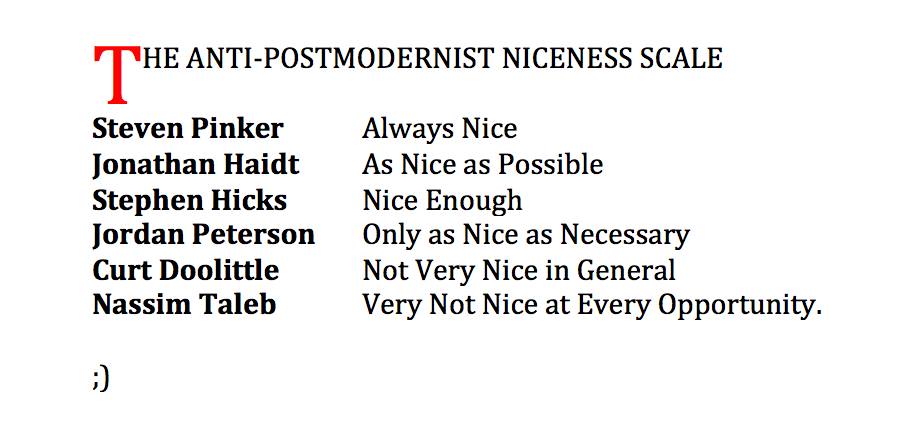
  • THE ANTI-FICTIONALIST NICENESS SCALE Pinker – Always Nice Haidt – As Nice as Pos

    THE ANTI-FICTIONALIST NICENESS SCALE

    Pinker – Always Nice

    Haidt – As Nice as Possible

    Peterson – Only as nice as necessary

    Doolittle – Not Very Nice at all

    Taleb – Very Not Nice at every opportunity.

    (OMG Thats awesome William ….)


    Source date (UTC): 2018-03-18 17:17:00 UTC

  • (my family gets upset when I say I miss Ukraine, but I miss Ukraine every day so

    (my family gets upset when I say I miss Ukraine, but I miss Ukraine every day so much that it’s like a trauma.)


    Source date (UTC): 2018-03-18 17:08:00 UTC

  • (God of love cooking. Anglo comfort food. Today, Sunday, it’s hearty chicken ste

    (God of love cooking. Anglo comfort food. Today, Sunday, it’s hearty chicken stew with parsley dumplings. Yesterday relatives made corned beef for the holiday, cooked in Guiness. Living in Ukraine was godsend. I can’t even eat anything bad any longer. lol )


    Source date (UTC): 2018-03-18 17:08:00 UTC

  • HOW DO WE TEACH MORALITY IF WE DISAGREE WHAT IS MORAL? Because if we disagree, t

    HOW DO WE TEACH MORALITY IF WE DISAGREE WHAT IS MORAL?

    Because if we disagree, then one, the other, or both, are wrong.

    There is (both logically and empirically) only one moral law, and it is the basis for all law from the common law to international law : reciprocity.

    The only question is, given the demographics, economy, norms, and institutions, and traditions, whether the current order provides reciprocity, free riding, parasitism, predation, or all of the above.

    The only reason we can ask this question today is because we have gained sufficient wealth that we desire to specialize in self fulfillment rather than cooperative survival, and with our specialization, form many more smaller more specialized groups. But this is impossible under large diverse governments.

    The optimum solution is to divide into groups with shared moral biases (and pay the price and gain the reward for doing so).

    It is trivial to teach morality. The silver rule: do not unto others as you would not want done unto you, and do unto others ONLY what they wish done to them. The golden rule merely amplifies the silver rule: do unto others as you would have done unto you – but do not expect reciprocity. You are merely trying to encourage them to prefer cooperating with you rather than someone else more rewarding. The value of the golden rule is that exhaustion of attempts at cooperation tends to (in all cases) produce more cooperation than any other strategy.

    That’s it.That’s all there is. The rest is just techicalities of achieving some form of voluntary cooperation in any set of circumstances.


    Source date (UTC): 2018-03-18 16:25:00 UTC