https://twitter.com/DegenRolf/status/1027446881545318400https://twitter.com/DegenRolf/status/1027446881545318400NOPE. JAPANESE ARE NOT MORE COLLECTIVIST
Source date (UTC): 2018-08-11 12:59:00 UTC
https://twitter.com/DegenRolf/status/1027446881545318400https://twitter.com/DegenRolf/status/1027446881545318400NOPE. JAPANESE ARE NOT MORE COLLECTIVIST
Source date (UTC): 2018-08-11 12:59:00 UTC
Eric Danelaw wrote on a timeline.
Source date (UTC): 2018-08-11 12:47:00 UTC
Eric Danelaw wrote on a timeline.
Source date (UTC): 2018-08-11 12:46:00 UTC
photos_and_videos/TimelinePhotos_dJ9jhts2Ng/38955227_274344449829119_1755636747745624064_n_274344446495786.jpg
Source date (UTC): 2018-08-11 12:43:00 UTC
photos_and_videos/TimelinePhotos_dJ9jhts2Ng/39014977_274344039829160_8727437510419939328_o_274344033162494.jpg
Source date (UTC): 2018-08-11 12:42:00 UTC
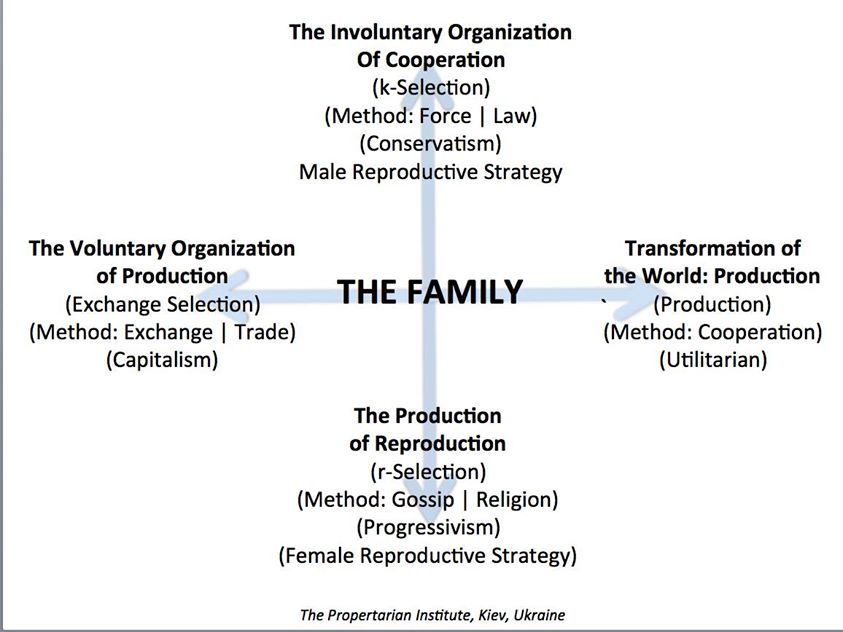
photos_and_videos/TimelinePhotos_dJ9jhts2Ng/38935277_274341759829388_6768957660671770624_o_274341736496057.jpg IT’S REALLY ALL THAT SIMPLE. REALLY.
Three means of coercing man, and one of coercing nature.
We specialize in creating families that specialize in some combination of them.IT’S REALLY ALL THAT SIMPLE. REALLY.
Three means of coercing man, and one of coercing nature.
We specialize in creating families that specialize in some combination of them.
Source date (UTC): 2018-08-11 12:41:00 UTC
MONARCHY vs. CONSTITUTIONAL MONARCHY vs. DEMOCRACY
Assuming rule of law exists (european customary law of sovereignty and tort):
In a constitutional monarchy either the monarchy asks for approval from the people directly or from their representatives, or the people ask approval of the monarchy.
However, without approval one direction or the other you have Democracy (population) or Prussianism (monarchy) – not any form of monarchy no matter what pretenses you make.
So, a monarchy may include democratic and republican participation, but a democracy cannot contain a monarchy.
The principle reason being where the decision of last resort rests: with the house or with the monarch.
As I undrestand it, in order to retain rule of law, where the monarchy is the judge of last resort, the monarchy must retain right of veto (dissent).
If a monarchy is successful in manufacturing rule of law it should be possible for the people to produce houses of governance.
This is simply a utilitarian solution, since there is little if any evidence that democracy does anything other than consume accumulated capital at the expense of those who created it, and those who would have inherited it, and the goods that come from its preservation.
Source date (UTC): 2018-08-11 12:33:00 UTC
SHIFT IS TOO SUBTLE A WORD FOR THE MOVEMENT OF THE OVERTON WINDOW
Researching old posts looking for something in particular, and being struck (hard) by the rather obvious: the Overton window has moved so far already that it was unimaginable in 2012. To the point where I had to berate people for thinking revolution was impossible, and today the mainstream acknowledges that we are very close to it, with only a single event required to light it off.
I’ve gone from a libertarian of conviction defending western civilization’s rule of law to a market-fascist advocating the most intolerant demand for truthful speech ever envisioned as defense of not only the goods of my civilization, but of the civilization itself, and of the kin group that constructed it.
Source date (UTC): 2018-08-11 11:39:00 UTC
PRIORITIES IN POLITICAL ORDERS
by Brendan Hegarty
Racism(Falangelism): …….kin, cult, corporation.
Facism(Prussianism): …….kin, corporation, cult.
Integralism: ………………….cult, kin, corporation
Classical Liberalism: ……..corporation, kin, cult.
Amerikwa: ……………………cult, corporation, kin.
Liberalism: …………………..corporation, cult, kin.
Various permutations of 3 orders: Kin, Cult, Corporation
Source date (UTC): 2018-08-11 10:33:00 UTC
REGARDING PHILOSOPHY
I dunno.
As far as I know, one can practice a limited spectrum of methods of producing paradigms (networks) of decidability: occult < theology < literature < philosophy <- common law -> science > mathematics > logic.
We do possess three faculties: intuition-emotion, reason, and physical sensation. And we depend more or less on each of those faculties in each, with law depending upon all, and others depending upon less so.
It’s not unreasonable that some would seek to rely more on intuition, more on reason, or more on physical sense and perception, if for no other reason than intuition is cheap, reason is more difficult and therefore costly, and physical operations are the most difficult and costly of all. But conversely, intuition > reason, and > physical demonstration are decreasingly prone to error, bias, wishful thinking, suggestion, and deceit.
I consider this a scientific, logical, and legal statement, because it has no room for, or tolerance for untestifiable fictionalisms (irreciprocity, pseudoscience, pseudo-rationalism, fiction, and the combination of those in mythology, theology and the occult.) And conversely it demands testifiability, reciprocity, existential possibility, rationality (cost), consistency, correspondence, and coherence.
Common (traditional) Law, reasoning, and observation within that law existed before all other disciplines and exists even where there are no other disciplines, and as far as I know of all other disciplines are derivatives of the rules of resolution of conflict that we call law.
The origin of western philosophy was largely in the circumvention of traditional law, in an effort to reform it to match the rates of innovation and changes in the scale of cooperation – in particular the learnings of mathematics.
It’s certainly true that there has been a conflict between law, and martial authority, and law and religious authority, and even in the modern world, between law and commercial authority, or law and popular authority.
And this is because coercion by various fictionalisms (pseudo-rational, pseudoscientific, supernatural) seek to deceive or coerce others such that they can violate the law that requires the rational, reciprocal, logical, scientific, and existential that can be testified to.
So because philosophy is not as strong (decidable) as law, science, mathematics, because it’s scope is smaller, but does accommodate preference and good rather than decidability(truth).
So I consider philosophy a discipline for violating law (reciprocity, volition, rational choice, costs), science, logic, and mathematics, – all of which that evolved because it was cheaper than experimentation (science).
Or stated more simply, between Saul, Augustine, Plato, And Aristotle, Aristotle’s science won:
Saul(Supernatural) < Augustine(Theological) < Plato(Ideal) < Aristotle(Real Empirical)
And science won because it is more demanding of decidability – but was delayed because it’s more expensive. Philosophy was a cheap substitute prior to the development of science. And all disciplines are now subsets of science not philosophy.
I work in the science of natural law (testimony and decidability). I only use the term ‘philosopher’ to directly compete with the discipline – which I consider, like theology, dead, and or fraud.
(Hopefully that will stimulate a conversation). 😉
Source date (UTC): 2018-08-11 09:46:00 UTC