–“Self ownership cannot exist because ownership requires reciprocity.”— by Bill Joslin: What about possession? Context: In fact : Possession – what you can defend is yours Agreement : Property– what others agree is yours is yours Legal : 3rd party insurance of ownership agreement In fact : (de facto) soverienty – hold monopoly of violence over a domain Agreement (De jur): recognition of soverienty by other soveriegns (example Israel) Legal – (and currently non-existent) 3rd party ensurance of agreement of soverienty (no world power to enforce) The notion of possessing the volition of another can not exist ‘in fact’ only in agreement. (a slave agrees to be a slave when given this choice: “be a slave or die”) In other words ownership of a human can not be demonstrated ‘in fact’, only in agreement and in law. The simple act of raising one’s arm or scratching one’s ass demonstrates possession of volition which, in fact, can only be the person doing the scratching. The only type of human ownership which remains coherent across all three domains (physical – in fact, social-agreement, legal-3rd party ensurance) is self ownership were by we agree to self ownership (ownership coheres to possession) and the law ensures it. Any other form of human ownership can only cohere to 2 of the 3 (agreement and law) To clarify further. Human volition remains bound by biology and thus can not be transferred, in fact, to another. One human’s volition bent to the will of another can only occur via agreement between the slave and master. The slave always retains possession and control. So the quote follows the same structure as libertarian arguments which rally for liberty while ignoring the physical necessity of soverienty for liberty’s existence. Liberty can only exist in agreement with the soveriegn and law by the soveriegn. Human ownership can only exist in agreement with the slave bolstered by the law of the masters. Just as libertarians seek liberty while avoiding the costs of soverienty, this argument seeks slavery without the requirement of reciprocity (slave’s agreement). I can only think of one reason to promote the idea – the wish to justify coercion.”—
Form: Reply
-
Animal Language?
—“What do believe is the qualitative difference between human and animal language?”—Bob Robertson As far as I know animals do not possess language, it only exists within humans. All other creatures merely manage to communicate. Charles Hockett (1967) introduced a generally accepted check list for language, a set of features that all human languages possess. His seven key properties are: 1 – productivity (the ability to create and understand new utterances): system which makes it possible to construct an unlimited number of sentences from a limited set of rules. 2 – arbitrariness (when signs/words do not resemble the things they represent), 3 – displacement (the ability to refer to the past and to things not present), and 4 – duality of pattern (the combination of a phonological system and a grammatical system), 5 – interchangeability (the ability to transmit and to receive messages by exchanging roles), 6 – specialization (when the only function of speech is communication and the speaker does not act out his message), 7 – cultural transmission (the ability to teach/learn from other individuals, e.g. by imitation). As far as I know the reason humans can speak is simply brain size and complexity (long chains). But I won’t go into all of it here. But the ability to imagine futures, imagine stories, ‘self-observe’ and describe those stories in a series of symbols, using a series of rules’ takes a great deal of processing power. While we can see elements of these patterns in parrots, corvids, dolphins, and the apes, we must teach them, and they say very simple things – because they only think very simple things. Assuming we selected and trained enough chimpanzees to use sign language to build a self sustaining community of them, and assuming we could leave them on an island for a few centuries, it’s possible that sign language would persist. I suspect the problem is that it’s hard to produce a community of chimps with the intelligence necessary for perpetuation.
-
Animal Language?
—“What do believe is the qualitative difference between human and animal language?”—Bob Robertson As far as I know animals do not possess language, it only exists within humans. All other creatures merely manage to communicate. Charles Hockett (1967) introduced a generally accepted check list for language, a set of features that all human languages possess. His seven key properties are: 1 – productivity (the ability to create and understand new utterances): system which makes it possible to construct an unlimited number of sentences from a limited set of rules. 2 – arbitrariness (when signs/words do not resemble the things they represent), 3 – displacement (the ability to refer to the past and to things not present), and 4 – duality of pattern (the combination of a phonological system and a grammatical system), 5 – interchangeability (the ability to transmit and to receive messages by exchanging roles), 6 – specialization (when the only function of speech is communication and the speaker does not act out his message), 7 – cultural transmission (the ability to teach/learn from other individuals, e.g. by imitation). As far as I know the reason humans can speak is simply brain size and complexity (long chains). But I won’t go into all of it here. But the ability to imagine futures, imagine stories, ‘self-observe’ and describe those stories in a series of symbols, using a series of rules’ takes a great deal of processing power. While we can see elements of these patterns in parrots, corvids, dolphins, and the apes, we must teach them, and they say very simple things – because they only think very simple things. Assuming we selected and trained enough chimpanzees to use sign language to build a self sustaining community of them, and assuming we could leave them on an island for a few centuries, it’s possible that sign language would persist. I suspect the problem is that it’s hard to produce a community of chimps with the intelligence necessary for perpetuation.
-
love you man. relax a bit. 😉
love you man. relax a bit. 😉
Source date (UTC): 2017-10-31 16:41:43 UTC
Original post: https://twitter.com/i/web/status/925402413519040513
Reply addressees: @eruditenights
Replying to: https://twitter.com/i/web/status/925191443089461248
IN REPLY TO:
@eruditenights
@curtdoolittle You’re the key to the future anyways, gotta win over your favor; a pass from you could just do it; forget the writing…
Original post: https://twitter.com/i/web/status/925191443089461248
-
lol. i dont think that means what you think it means, but i appreciate the inten
lol. i dont think that means what you think it means, but i appreciate the intended
humor anyway. 😉
Source date (UTC): 2017-10-28 04:12:04 UTC
Original post: https://twitter.com/i/web/status/924126595568283649
Reply addressees: @AnimeRenaissanc
Replying to: https://twitter.com/i/web/status/924112467122204673
IN REPLY TO:
Original post on X
Original tweet unavailable — we could not load the text of the post this reply is addressing on X. That usually means the tweet was deleted, the account is protected, or X does not expose it to the account used for archiving. The Original post link below may still open if you view it in X while signed in.
Original post: https://twitter.com/i/web/status/924112467122204673
-
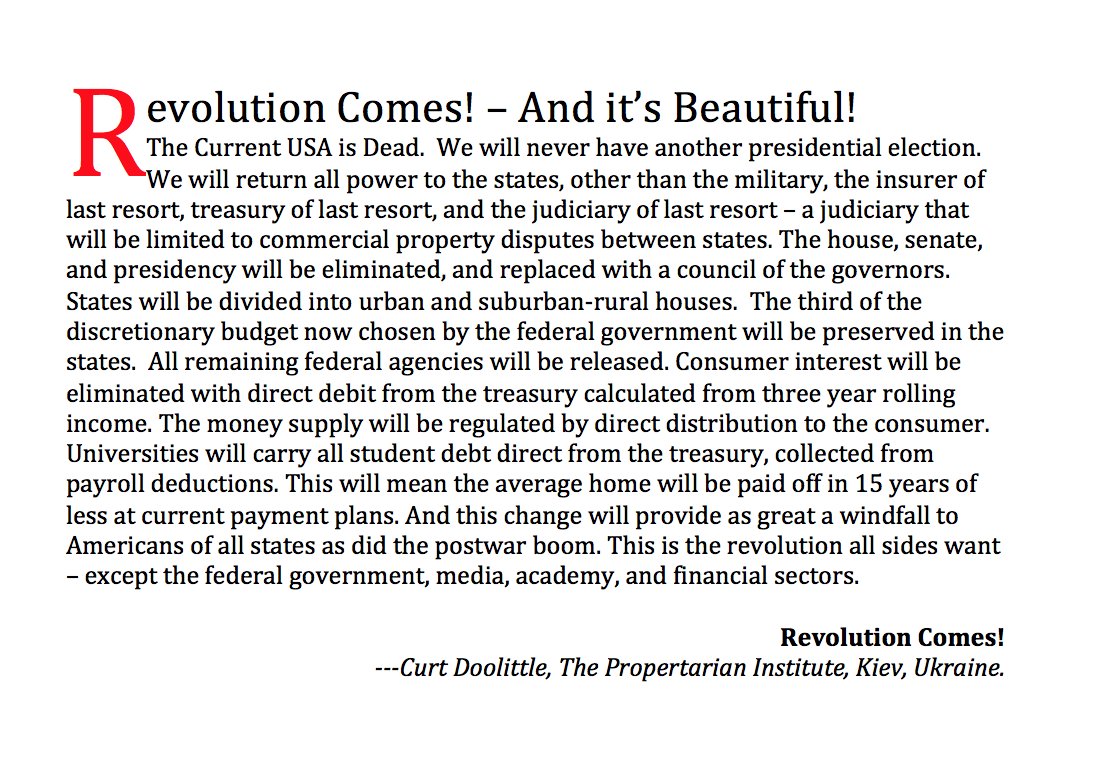
RT @curtdoolittle: THIS IS THE REVOLUTION WE ALL WANT – ON BOTH SIDES – AND IT’S
RT @curtdoolittle: THIS IS THE REVOLUTION WE ALL WANT – ON BOTH SIDES – AND IT’S BEAUTIFUL!
#Trump #Potus https://t.co/d248Lj058C
Source date (UTC): 2017-10-27 11:45:26 UTC
Original post: https://twitter.com/i/web/status/923878300761640960
-
“Did Heinlein have an influence on you? I have been listening to Starship Troope
—“Did Heinlein have an influence on you? I have been listening to Starship Troopers and I swear I hear you and Eli, mostly you.”— Anne Summers Great Question. (a) I had only read Time Enough for Love (which I read upon release). I was heavily influenced by it and think I still am subconsciously.. I was more influenced by Harlan Ellison and I see him in my thoughts. Maybe Ben Bova as well. I was influenced by Arthur c Clarke, particularly Rendezvous with Rama and Childhood’s end. But I was equally if not more so influenced by William Gibson and Neal Stephenson. Im really a child of the 70’s and 80’s – when these books were published. But I was more influenced by reading weapons and warfare and in particular samuel colt, and then reading encyclopedias. I read a lot of encyclopedias. (b) I think that there is an aristocratic ethic in the literature of exploration and colonization, and science fiction of the postwar period replaced the *actual* aristocracy of exploration and colonization that had existed prior to the war. So just as James Bond is really a lament to lost british power, science fiction of the period was a lament to lost european power. It was an effort to direct our exploration and colonization (and militarism) to the stars. (c) I think that christianity was a vehicle for aryanism (heroism, aristocracy, exploration, expansion, colonization, domestication of nature, beast, and man) and I think the period of expansion in the ancient world, and in the modern, was just another vehicle for Aryanism. (d) what you hear in Eli and I is that same Aryanism (heroism, aristocracy, expansion, colonization, domestication of nature, beast, and man). What you Hear in Ellison, Clarke, (or jules Verne, or Edgar burroughs, Or Robert Howard, or HG Wells, or Tolkien, or Stephenson and Gibson, is that Aryanism via military, scientific, traditional, and technological classes. This is the Aryanism of the military, scientific, traditional, and technological classes, just as capitalism is an expression of Aryanism in the merchant classes. (e) Heinlein reformed Aryanism in the early-mid 20th century like Sir Walter Scott reframed it in the early 19th century with Ivanhoe. (or George Lucas refrormed it with the original star wars.). And I think Eli and I and many others are formed by that same experience. And I do think that Heinlein captured that reformation in language that all of us can understand today. And that it has endured through the postmodern rise and fall of the late 20th and early 21st century. (f) So I think that the answer is that we have both been heavily influneced by the Aryan tradition. And that we certainly share the mid-century technological vision of Aryanism consisting of the combination of military and technology as a DEFENSE, rather than military and religion of the post-ancient period, or military and moral justification of the colonial period. And that among the technological, military, scientific, classes, Heinlein created the least apologetic vision. And that we share that least apologetic, and therefore most Aryan ethic. (g) The only difference is that Eli is more interested in space, and I am more interested in upping our game and taking over this planet over the objections of those who need domestication. In other words, he is kinder than I. Hence why you hear a bit more Aurthur Clarke in Eli and a bit more Heinlein in me: I am ‘resigned’ to the military option as the only viable (affordable) one. 😉 -
photos_and_videos/TimelinePhotos_dJ9jhts2Ng/22550286_157994568130775_28600758830
photos_and_videos/TimelinePhotos_dJ9jhts2Ng/22550286_157994568130775_2860075883038094257_o_157994568130775.jpg —“Did Heinlein have an influence on you? I have been listening to Starship Troopers and I swear I hear you and Eli, mostly you.”— Anne Summers
Great Question.
(a) I had only read Time Enough for Love (which I read upon release). I was heavily influenced by it and think I still am subconsciously.. I was more influenced by Harlan Ellison and I see him in my thoughts. Maybe Ben Bova as well. I was influenced by Arthur c Clarke, particularly Rendezvous with Rama and Childhood’s end. But I was equally if not more so influenced by William Gibson and Neal Stephenson. Im really a child of the 70’s and 80’s – when these books were published. But I was more influenced by reading weapons and warfare and in particular samuel colt, and then reading encyclopedias. I read a lot of encyclopedias.
(b) I think that there is an aristocratic ethic in the literature of exploration and colonization, and science fiction of the postwar period replaced the *actual* aristocracy of exploration and colonization that had existed prior to the war. So just as James Bond is really a lament to lost british power, science fiction of the period was a lament to lost european power. It was an effort to direct our exploration and colonization (and militarism) to the stars.
(c) I think that christianity was a vehicle for aryanism (heroism, aristocracy, exploration, expansion, colonization, domestication of nature, beast, and man) and I think the period of expansion in the ancient world, and in the modern, was just another vehicle for Aryanism.
(d) what you hear in Eli and I is that same Aryanism (heroism, aristocracy, expansion, colonization, domestication of nature, beast, and man). What you Hear in Ellison, Clarke, (or jules Verne, or Edgar burroughs, Or Robert Howard, or HG Wells, or Tolkien, or Stephenson and Gibson, is that Aryanism via military, scientific, traditional, and technological classes. This is the Aryanism of the military, scientific, traditional, and technological classes, just as capitalism is an expression of Aryanism in the merchant classes.
(e) Heinlein reformed Aryanism in the early-mid 20th century like Sir Walter Scott reframed it in the early 19th century with Ivanhoe. (or George Lucas refrormed it with the original star wars.). And I think Eli and I and many others are formed by that same experience. And I do think that Heinlein captured that reformation in language that all of us can understand today. And that it has endured through the postmodern rise and fall of the late 20th and early 21st century.
(f) So I think that the answer is that we have both been heavily influneced by the Aryan tradition. And that we certainly share the mid-century technological vision of Aryanism consisting of the combination of military and technology as a DEFENSE, rather than military and religion of the post-ancient period, or military and moral justification of the colonial period. And that among the technological, military, scientific, classes, Heinlein created the least apologetic vision. And that we share that least apologetic, and therefore most Aryan ethic.
(g) The only difference is that Eli is more interested in space, and I am more interested in upping our game and taking over this planet over the objections of those who need domestication. In other words, he is kinder than I. Hence why you hear a bit more Aurthur Clarke in Eli and a bit more Heinlein in me: I am ‘resigned’ to the military option as the only viable (affordable) one. ;)—“Did Heinlein have an influence on you? I have been listening to Starship Troopers and I swear I hear you and Eli, mostly you.”— Anne Summers
Great Question.
(a) I had only read Time Enough for Love (which I read upon release). I was heavily influenced by it and think I still am subconsciously.. I was more influenced by Harlan Ellison and I see him in my thoughts. Maybe Ben Bova as well. I was influenced by Arthur c Clarke, particularly Rendezvous with Rama and Childhood’s end. But I was equally if not more so influenced by William Gibson and Neal Stephenson. Im really a child of the 70’s and 80’s – when these books were published. But I was more influenced by reading weapons and warfare and in particular samuel colt, and then reading encyclopedias. I read a lot of encyclopedias.
(b) I think that there is an aristocratic ethic in the literature of exploration and colonization, and science fiction of the postwar period replaced the *actual* aristocracy of exploration and colonization that had existed prior to the war. So just as James Bond is really a lament to lost british power, science fiction of the period was a lament to lost european power. It was an effort to direct our exploration and colonization (and militarism) to the stars.
(c) I think that christianity was a vehicle for aryanism (heroism, aristocracy, exploration, expansion, colonization, domestication of nature, beast, and man) and I think the period of expansion in the ancient world, and in the modern, was just another vehicle for Aryanism.
(d) what you hear in Eli and I is that same Aryanism (heroism, aristocracy, expansion, colonization, domestication of nature, beast, and man). What you Hear in Ellison, Clarke, (or jules Verne, or Edgar burroughs, Or Robert Howard, or HG Wells, or Tolkien, or Stephenson and Gibson, is that Aryanism via military, scientific, traditional, and technological classes. This is the Aryanism of the military, scientific, traditional, and technological classes, just as capitalism is an expression of Aryanism in the merchant classes.
(e) Heinlein reformed Aryanism in the early-mid 20th century like Sir Walter Scott reframed it in the early 19th century with Ivanhoe. (or George Lucas refrormed it with the original star wars.). And I think Eli and I and many others are formed by that same experience. And I do think that Heinlein captured that reformation in language that all of us can understand today. And that it has endured through the postmodern rise and fall of the late 20th and early 21st century.
(f) So I think that the answer is that we have both been heavily influneced by the Aryan tradition. And that we certainly share the mid-century technological vision of Aryanism consisting of the combination of military and technology as a DEFENSE, rather than military and religion of the post-ancient period, or military and moral justification of the colonial period. And that among the technological, military, scientific, classes, Heinlein created the least apologetic vision. And that we share that least apologetic, and therefore most Aryan ethic.
(g) The only difference is that Eli is more interested in space, and I am more interested in upping our game and taking over this planet over the objections of those who need domestication. In other words, he is kinder than I. Hence why you hear a bit more Aurthur Clarke in Eli and a bit more Heinlein in me: I am ‘resigned’ to the military option as the only viable (affordable) one. 😉
Source date (UTC): 2017-10-22 22:56:00 UTC
-
“Did Heinlein have an influence on you? I have been listening to Starship Troope
—“Did Heinlein have an influence on you? I have been listening to Starship Troopers and I swear I hear you and Eli, mostly you.”— Anne Summers Great Question. (a) I had only read Time Enough for Love (which I read upon release). I was heavily influenced by it and think I still am subconsciously.. I was more influenced by Harlan Ellison and I see him in my thoughts. Maybe Ben Bova as well. I was influenced by Arthur c Clarke, particularly Rendezvous with Rama and Childhood’s end. But I was equally if not more so influenced by William Gibson and Neal Stephenson. Im really a child of the 70’s and 80’s – when these books were published. But I was more influenced by reading weapons and warfare and in particular samuel colt, and then reading encyclopedias. I read a lot of encyclopedias. (b) I think that there is an aristocratic ethic in the literature of exploration and colonization, and science fiction of the postwar period replaced the *actual* aristocracy of exploration and colonization that had existed prior to the war. So just as James Bond is really a lament to lost british power, science fiction of the period was a lament to lost european power. It was an effort to direct our exploration and colonization (and militarism) to the stars. (c) I think that christianity was a vehicle for aryanism (heroism, aristocracy, exploration, expansion, colonization, domestication of nature, beast, and man) and I think the period of expansion in the ancient world, and in the modern, was just another vehicle for Aryanism. (d) what you hear in Eli and I is that same Aryanism (heroism, aristocracy, expansion, colonization, domestication of nature, beast, and man). What you Hear in Ellison, Clarke, (or jules Verne, or Edgar burroughs, Or Robert Howard, or HG Wells, or Tolkien, or Stephenson and Gibson, is that Aryanism via military, scientific, traditional, and technological classes. This is the Aryanism of the military, scientific, traditional, and technological classes, just as capitalism is an expression of Aryanism in the merchant classes. (e) Heinlein reformed Aryanism in the early-mid 20th century like Sir Walter Scott reframed it in the early 19th century with Ivanhoe. (or George Lucas refrormed it with the original star wars.). And I think Eli and I and many others are formed by that same experience. And I do think that Heinlein captured that reformation in language that all of us can understand today. And that it has endured through the postmodern rise and fall of the late 20th and early 21st century. (f) So I think that the answer is that we have both been heavily influneced by the Aryan tradition. And that we certainly share the mid-century technological vision of Aryanism consisting of the combination of military and technology as a DEFENSE, rather than military and religion of the post-ancient period, or military and moral justification of the colonial period. And that among the technological, military, scientific, classes, Heinlein created the least apologetic vision. And that we share that least apologetic, and therefore most Aryan ethic. (g) The only difference is that Eli is more interested in space, and I am more interested in upping our game and taking over this planet over the objections of those who need domestication. In other words, he is kinder than I. Hence why you hear a bit more Aurthur Clarke in Eli and a bit more Heinlein in me: I am ‘resigned’ to the military option as the only viable (affordable) one. 😉 -
“Q&A: CURT: WHAT DO YOU THINK OF THE FUTURE OF RIPPLE?” (THE CRYPTOCURRENCY) —
“Q&A: CURT: WHAT DO YOU THINK OF THE FUTURE OF RIPPLE?” (THE CRYPTOCURRENCY) —“In my opinion, Ripple is currently the long term win beacsue institutions will buy into it, the public can make use of it, and they are friendly to govt regulation. My concern with BTC, having been a small investor in an experimental BTC company, is that it has too many negatives: near impossibility of use, poor transaction rates, problem of scale, record of corruption(thefts), high ‘fringe’ (criminal) factor involved. I have a hard time seeing BTC survive (long term) as other than the exchange of choice for drug dealers, money launderers, and gamblers. But that will not stop the low volume-high price of btc. So I separate the investment opportunity and the timing of exit before collapse, from the long term viability of the technology. BTC price gain is due to, speculation on price gains not on the future of the technology. This same opportunity may not be present for Ripple which is a traditional business model.”— Curt Doolittle