Form: Quote Commentary

  • photos_and_videos/TimelinePhotos_SxeO6JU-xg/53380628_10157038608452264_525238834

    photos_and_videos/TimelinePhotos_SxeO6JU-xg/53380628_10157038608452264_5252388340333805568_o_10157038608447264.jpg Iranic

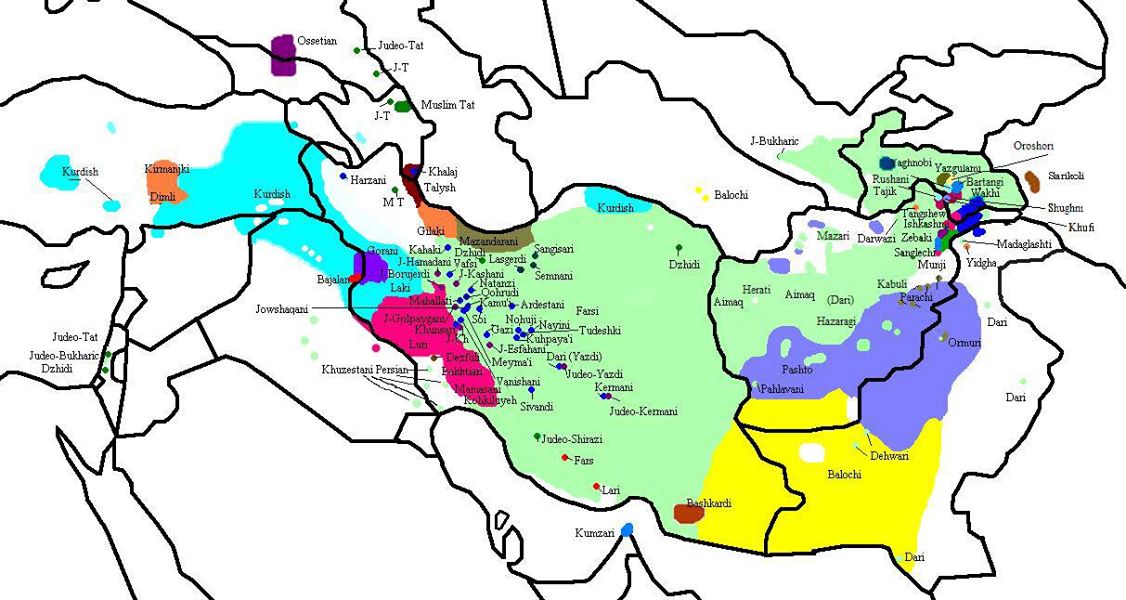
    The Iranian or Iranic languages[2][3] are a branch of the Indo-Iranian languages in the Indo-European language family that are spoken natively by the Iranian peoples.

    The Iranian languages are grouped in three stages: Old Iranian (until 400 BC), Middle Iranian (400 BC – 900 AD), and New Iranian (since 900 AD). The two directly attested Old Iranian languages are Old Persian (from the Achaemenid Empire) and Old Avestan (the language of the Avesta). Of the Middle Iranian languages, the better understood and recorded ones are Middle Persian (from the Sasanian Empire), Parthian (from the Parthian Empire), and Bactrian (from the Kushan and Hephthalite empires).

    As of 2008, there were an estimated 150–200 million native speakers of the Iranian languages.[4] Ethnologue estimates that there are 86 Iranian languages,[5][6] the largest among them being Persian, Pashto, and the Kurdish dialect continuum.[7]

    The term Iranian is applied to any language which descends from the ancestral Proto-Iranian language.[8]

    This use of the term for the Iranian language family was introduced in 1836 by Christian Lassen.[9] Robert Needham Cust used the term Irano-Aryan in 1878,[10] and Orientalists such as George Abraham Grierson and Max Müller contrasted Irano-Aryan (Iranian) and Indo-Aryan (Indic). Some recent scholarship, primarily in German, has revived this convention.[11][12][13][14]

    The Iranian languages are divided into the following branches:

    The Western Iranian languages subdivided into:

    Southwestern, of which Persian is the dominant member;

    Northwestern, of which the Kurdish languages are the dominant members.

    The Eastern Iranian languages subdivided into:

    Southeastern, of which Pashto is the dominant member;

    Northeastern, by far the smallest branch, of which Ossetian is the dominant member.

    Proto-Iranian

    Historical distribution in 100 BC: shown are Sarmatia, Scythia, Bactria (Eastern Iranian, in orange); and the Parthian Empire (Western Iranian, in red)

    The Iranian languages all descend from a common ancestor: the so-called Proto-Iranian which itself evolved from Proto-Indo-Iranian. This ancestor language is speculated to have origins in Central Asia, and the Andronovo Culture is suggested as a candidate for the common Indo-Iranian culture around 2000 BC.

    It was situated precisely in the western part of Central Asia that borders present-day Russia (and present-day Kazakhstan). It was in relative proximity to the other satem ethno-linguistic groups of the Indo-European family, like Thracian, Balto-Slavic and others, and to common Indo-European’s original homeland (more precisely, the steppes of southern Russia to the north of the Caucasus), according to the reconstructed linguistic relationships of common Indo-European.

    Proto-Iranian thus dates to some time after Proto-Indo-Iranian break-up, or the early second millennium BCE, as the Old Iranian languages began to break off and evolve separately as the various Iranian tribes migrated and settled in vast areas of southeastern Europe, the Iranian plateau, and Central Asia.

    Proto-Iranian innovations compared to Proto-Indo-Iranian include:[15] the turning of sibilant fricative *s into non-sibilant fricative glottal *h; the voiced aspirated plosives *bʰ, *dʰ, *gʰ yielding to the voiced unaspirated plosives *b, *d, *g resp.; the voiceless unaspirated stops *p, *t, *k before another consonant changing into fricatives *f, *θ, *x resp.; voiceless aspirated stops *pʰ, *tʰ, *kʰ turning into fricatives *f, *θ, *x, resp.Iranic

    The Iranian or Iranic languages[2][3] are a branch of the Indo-Iranian languages in the Indo-European language family that are spoken natively by the Iranian peoples.

    The Iranian languages are grouped in three stages: Old Iranian (until 400 BC), Middle Iranian (400 BC – 900 AD), and New Iranian (since 900 AD). The two directly attested Old Iranian languages are Old Persian (from the Achaemenid Empire) and Old Avestan (the language of the Avesta). Of the Middle Iranian languages, the better understood and recorded ones are Middle Persian (from the Sasanian Empire), Parthian (from the Parthian Empire), and Bactrian (from the Kushan and Hephthalite empires).

    As of 2008, there were an estimated 150–200 million native speakers of the Iranian languages.[4] Ethnologue estimates that there are 86 Iranian languages,[5][6] the largest among them being Persian, Pashto, and the Kurdish dialect continuum.[7]

    The term Iranian is applied to any language which descends from the ancestral Proto-Iranian language.[8]

    This use of the term for the Iranian language family was introduced in 1836 by Christian Lassen.[9] Robert Needham Cust used the term Irano-Aryan in 1878,[10] and Orientalists such as George Abraham Grierson and Max Müller contrasted Irano-Aryan (Iranian) and Indo-Aryan (Indic). Some recent scholarship, primarily in German, has revived this convention.[11][12][13][14]

    The Iranian languages are divided into the following branches:

    The Western Iranian languages subdivided into:

    Southwestern, of which Persian is the dominant member;

    Northwestern, of which the Kurdish languages are the dominant members.

    The Eastern Iranian languages subdivided into:

    Southeastern, of which Pashto is the dominant member;

    Northeastern, by far the smallest branch, of which Ossetian is the dominant member.

    Proto-Iranian

    Historical distribution in 100 BC: shown are Sarmatia, Scythia, Bactria (Eastern Iranian, in orange); and the Parthian Empire (Western Iranian, in red)

    The Iranian languages all descend from a common ancestor: the so-called Proto-Iranian which itself evolved from Proto-Indo-Iranian. This ancestor language is speculated to have origins in Central Asia, and the Andronovo Culture is suggested as a candidate for the common Indo-Iranian culture around 2000 BC.

    It was situated precisely in the western part of Central Asia that borders present-day Russia (and present-day Kazakhstan). It was in relative proximity to the other satem ethno-linguistic groups of the Indo-European family, like Thracian, Balto-Slavic and others, and to common Indo-European’s original homeland (more precisely, the steppes of southern Russia to the north of the Caucasus), according to the reconstructed linguistic relationships of common Indo-European.

    Proto-Iranian thus dates to some time after Proto-Indo-Iranian break-up, or the early second millennium BCE, as the Old Iranian languages began to break off and evolve separately as the various Iranian tribes migrated and settled in vast areas of southeastern Europe, the Iranian plateau, and Central Asia.

    Proto-Iranian innovations compared to Proto-Indo-Iranian include:[15] the turning of sibilant fricative *s into non-sibilant fricative glottal *h; the voiced aspirated plosives *bʰ, *dʰ, *gʰ yielding to the voiced unaspirated plosives *b, *d, *g resp.; the voiceless unaspirated stops *p, *t, *k before another consonant changing into fricatives *f, *θ, *x resp.; voiceless aspirated stops *pʰ, *tʰ, *kʰ turning into fricatives *f, *θ, *x, resp.

    Source date (UTC): 2019-03-09 14:34:00 UTC
  • photos_and_videos/TimelinePhotos_SxeO6JU-xg/53902797_10157038587157264_195185184

    photos_and_videos/TimelinePhotos_SxeO6JU-xg/53902797_10157038587157264_1951851843332079616_n_10157038587147264.jpg Indic languages

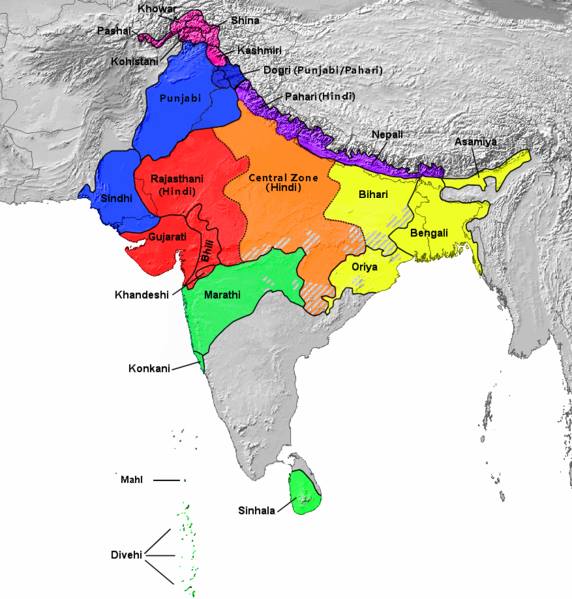
    Indic languages are a major language family of the Indian subcontinent. They constitute a branch of the Indo-Iranian languages, itself a branch of the Indo-European language family. In the early 21st century, Indo-Aryan languages were spoken by more than 800 million people, primarily in India, Bangladesh, Nepal, Pakistan, and Sri Lanka.[2] Moreover, there are large immigrant and/or expatriate Indo-Aryan speaking communities in northwestern Europe, Western Asia, North America and Australia. There are about 219 known Indo-Aryan languages. [3]

    The largest in terms of speakers are Hindustani (Hindi-Urdu, about 329 million),[4] Bengali (242 million),[5] Punjabi (about 100 million),[6] and other languages, with a 2005 estimate placing the total number of native speakers at nearly 900 million.[7]Waqas AhmadOur iranic branch is smaller as compared to Germanic and Indic [Indo-Aryan] Langs.Mar 9, 2019, 2:26 PMMarcus IngwazI’m curious what your position is on the Aryan invasion “theory”.

    It’s somewhat described in the rig veda, it’s a logical conclusion.

    I mean whites have made a history of conquering other people. Seems out of place to do any different.

    I speak with Hindus all the time who go against the rig veda, favoring some “new science” which disputes the invasion, stating it was peaceful.Mar 9, 2019, 3:01 PMCurt Doolittledata is data is data. 70% -> 30% genetic cline from NW to SE india. Religion and language. Hard to know if Hrappans had already fallen or were felled, but the result is the invasion happened, and this angers the hell out of some indians for some reason.

    I mean. my people were atlantics and the IE”s invaded my people too….Mar 9, 2019, 3:43 PMDouglas Scott LawsCurt Doolittle IE had a racial caste system through Zoroastrianism. The caste systems original racial meaning was lost and the people bred out.Mar 9, 2019, 5:18 PMIndic languages

    Indic languages are a major language family of the Indian subcontinent. They constitute a branch of the Indo-Iranian languages, itself a branch of the Indo-European language family. In the early 21st century, Indo-Aryan languages were spoken by more than 800 million people, primarily in India, Bangladesh, Nepal, Pakistan, and Sri Lanka.[2] Moreover, there are large immigrant and/or expatriate Indo-Aryan speaking communities in northwestern Europe, Western Asia, North America and Australia. There are about 219 known Indo-Aryan languages. [3]

    The largest in terms of speakers are Hindustani (Hindi-Urdu, about 329 million),[4] Bengali (242 million),[5] Punjabi (about 100 million),[6] and other languages, with a 2005 estimate placing the total number of native speakers at nearly 900 million.[7]


    Source date (UTC): 2019-03-09 14:23:00 UTC

  • photos_and_videos/TimelinePhotos_SxeO6JU-xg/54114900_10157038583577264_511348667

    photos_and_videos/TimelinePhotos_SxeO6JU-xg/54114900_10157038583577264_5113486675619610624_n_10157038583572264.jpg photos_and_videos/TimelinePhotos_SxeO6JU-xg/54435725_10157038583617264_6883440151385604096_o_10157038583607264.jpg Uralic languages

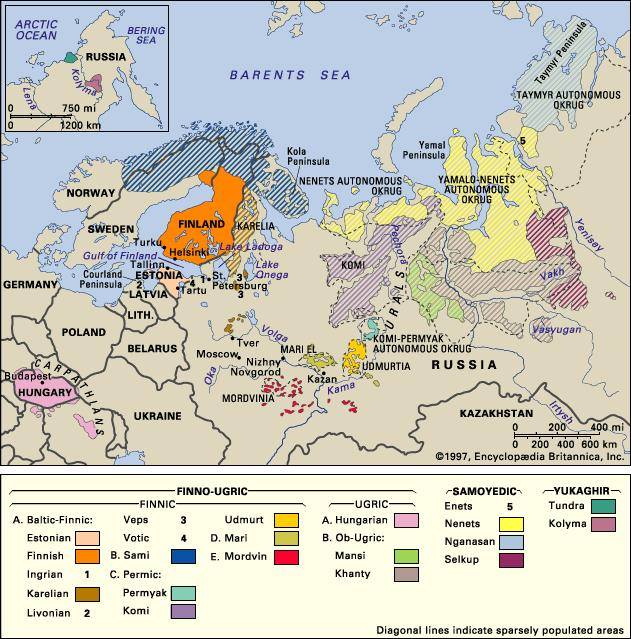
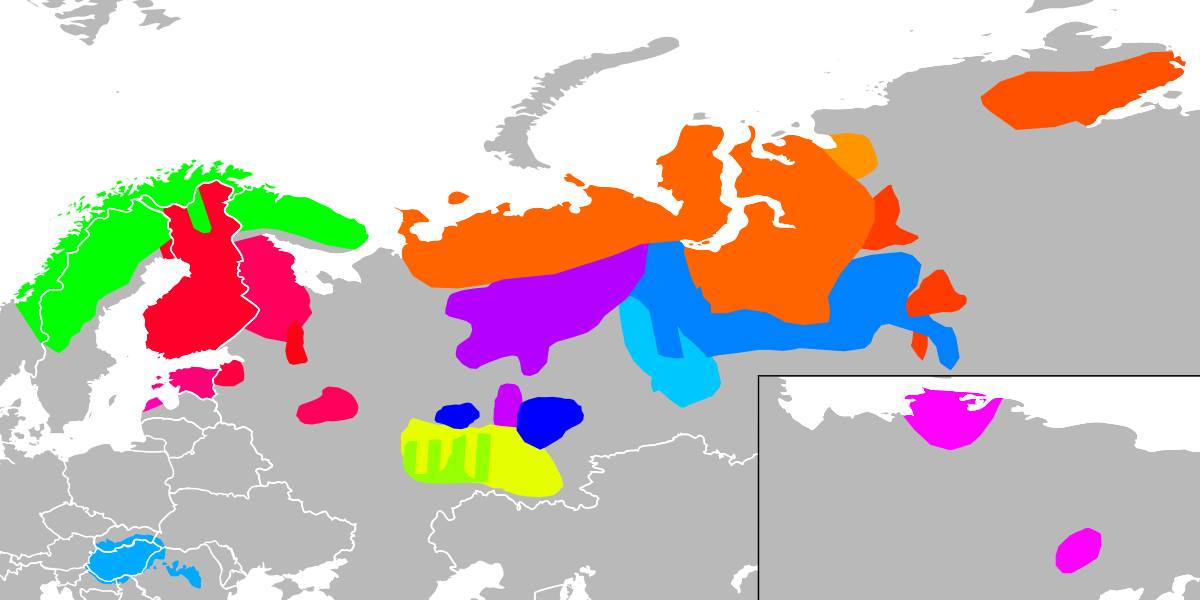
    Uralic languages, family of more than 20 related languages, all descended from a Proto-Uralic language that existed 7,000 to 10,000 years ago. At its earliest stages, Uralic most probably included the ancestors of the Yukaghir language. The Uralic languages are spoken by more than 25 million people scattered throughout northeastern Europe, northern Asia, and (through immigration) North America. The most demographically important Uralic language is Hungarian, the official language of Hungary. Two other Uralic languages, Estonian (the official language of Estonia) and Finnish (one of two national languages of Finland—the other is Swedish, a Germanic language), are also spoken by millions.

    Attempts to trace the genealogy of the Uralic languages to periods earlier than Proto-Uralic have been hampered by the great changes in the attested languages, which preserve relatively few features and therefore provide little evidence upon which scholars may base meaningful claims for a more distant relationship. Most commonly mentioned in this respect is a putative connection with the Altaic language family (including Turkic and Mongolian). This hypothetical language group, called Ural-Altaic, is not considered by most scholars to be soundly based. Although the Uralic and Indo-European languages are not generally thought to be related, more speculative studies have suggested a connection between them. Relationship with the Eskimo languages, Dravidian (e.g., Telugu), Japanese, Korean, and various American Indian groups has also been proposed. The most radical of these claims is the massive Dené-Finnish grouping of Morris Swadesh, which encompasses, among others, Sino-Tibetan (e.g., Chinese) and Athabaskan (e.g., Navajo).

    The Uralic language family in its current status consists of two related groups of languages, the Finno-Ugric and the Samoyedic, both of which developed from a common ancestor, called Proto-Uralic, that was spoken 7,000 to 10,000 years ago in the general area of the north-central Ural Mountains. At its very earliest stages Uralic most probably included the ancestors of the Yukaghir languages (formerly listed as a Paleo-Siberian stock with no known relatives).

    Over the millennia, both Finno-Ugric and Samoyedic branches of Uralic have given rise to more or less divergent subgroups of languages, which nonetheless have retained certain traits from their common source. For example, the degree of similarity between two of the least closely related members of the Finno-Ugric group, Hungarian and Finnish, is comparable to that between English and Russian (which belong to the Indo-European family of languages). The difference between any Finno-Ugric language and any Samoyedic tongue would be even greater. On the other hand, more closely related members of Finno-Ugric, such as Finnish and Estonian, differ in much the same manner as greatly diverse dialects of the same language.


    Source date (UTC): 2019-03-09 14:21:00 UTC

  • By: Pat Ryan America expended its goodwill as the great equality experiment via

    By: Pat Ryan

    America expended its goodwill as the great equality experiment via democratic tradition during the two World Wars, ensuring the mythology was monopolized by grass-is-greener communism. …. America traded mythological hope for material justice. Guess when discontent institutionalized?


    Source date (UTC): 2019-03-09 11:06:00 UTC

  • photos_and_videos/TimelinePhotos_SxeO6JU-xg/53294677_10157034246837264_531658659

    photos_and_videos/TimelinePhotos_SxeO6JU-xg/53294677_10157034246837264_5316586590896652288_n_10157034246827264.jpg Connor WhittlawProtectionism of productive people. Wew that’s a good oneMar 7, 2019, 3:15 PMStephen ThomasHa!

    Brilliant!

    Propertarianism= Protecting the productive!

    Absolutely love this. With a small amount of explanation and elaboration, this could very well be the “gospel” of P. Everyone can understand this.Mar 7, 2019, 3:34 PMShannon Constantine Loganthis made me smileMar 7, 2019, 4:19 PMGünther Shroomachershit, you did it in 3 words, lolMar 7, 2019, 9:32 PMStephen ThomasI was gonna do it in 2. lol

    But it makes less sense that way.Mar 7, 2019, 9:36 PM


    Source date (UTC): 2019-03-07 15:02:00 UTC

  • JOSEPH POSTMA DRILLS DOWN TO THE NET OF IT —“They are incredibly good at decei

    JOSEPH POSTMA DRILLS DOWN TO THE NET OF IT

    —“They are incredibly good at deceit. Very good. However, we’re very good at identifying it, and the ONLY reason they’ve gotten away with it this far is because they own the media, and the ability to lie to the commons. That ends with Propertarianism. The thing is, it only takes a single one of us to identify their deceit and to make it known to others, while for them it takes a trillion-dollar media global enterprise to maintain it.”—Joseph E. Postma

    Under law, it takes only one of us.


    Source date (UTC): 2019-03-07 13:25:00 UTC

  • “When the next fascist movement rises again we need to ensure that sophists are

    —“When the next fascist movement rises again we need to ensure that sophists are dealt with accordingly. Never again can we allow this to happen again because of these sophists and bullshitters The coming generation of europeans will either perish or reach the stars. Lets hope they reach the stars.”—Phill Knyspel


    Source date (UTC): 2019-03-07 12:35:00 UTC

  • “TESTIMONIALISM ROCKS!!!” —“Curt: The moment she said “…the thing in itself”

    “TESTIMONIALISM ROCKS!!!”

    —“Curt: The moment she said “…the thing in itself”, my mind directly answered “can u testify for that thing in itself of yours”.

    And the answers surely would be no.

    And if she tried to then she will be bringing, or applying a monopoly demand for consent of the rationalization she will be making, ie, deceit.

    Testimonialism ROCKS.”— Deus Ex


    Source date (UTC): 2019-03-07 12:18:00 UTC

  • “Rule by Judges? Sounds a lot more like Rule by Truth and the Rule of Law. Sure,

    —“Rule by Judges? Sounds a lot more like Rule by Truth and the Rule of Law. Sure, in the beginning there will be more activity in the courts as people adjust to an honest society. However, once the adjustment to a more “clean” Commons is made. The Courts will calm down as the cost of lying will be far too high to pay.”—Stephen Thomas


    Source date (UTC): 2019-03-07 09:41:00 UTC

  • very interesting article about 4th generation warfare and scenarios for Europe a

    https://ammo.com/articles/asymmetrical-warfare-4gw-americas-domestic-viet-cong?fbclid=IwAR2Zjn2HrkIWcyansYY-dv1qTeM2E9uW66Oy4AzGuGq6m6eV8RU3aVg8s5g—“A very interesting article about 4th generation warfare and scenarios for Europe and the US. Worth a read.”—Liberty Machine News

    https://ammo.com/articles/asymmetrical-warfare-4gw-americas-domestic-viet-cong


    Source date (UTC): 2019-03-07 09:22:00 UTC